
 Reviewed by: Takahiro Sugiyama (CEO, meguri Inc.)
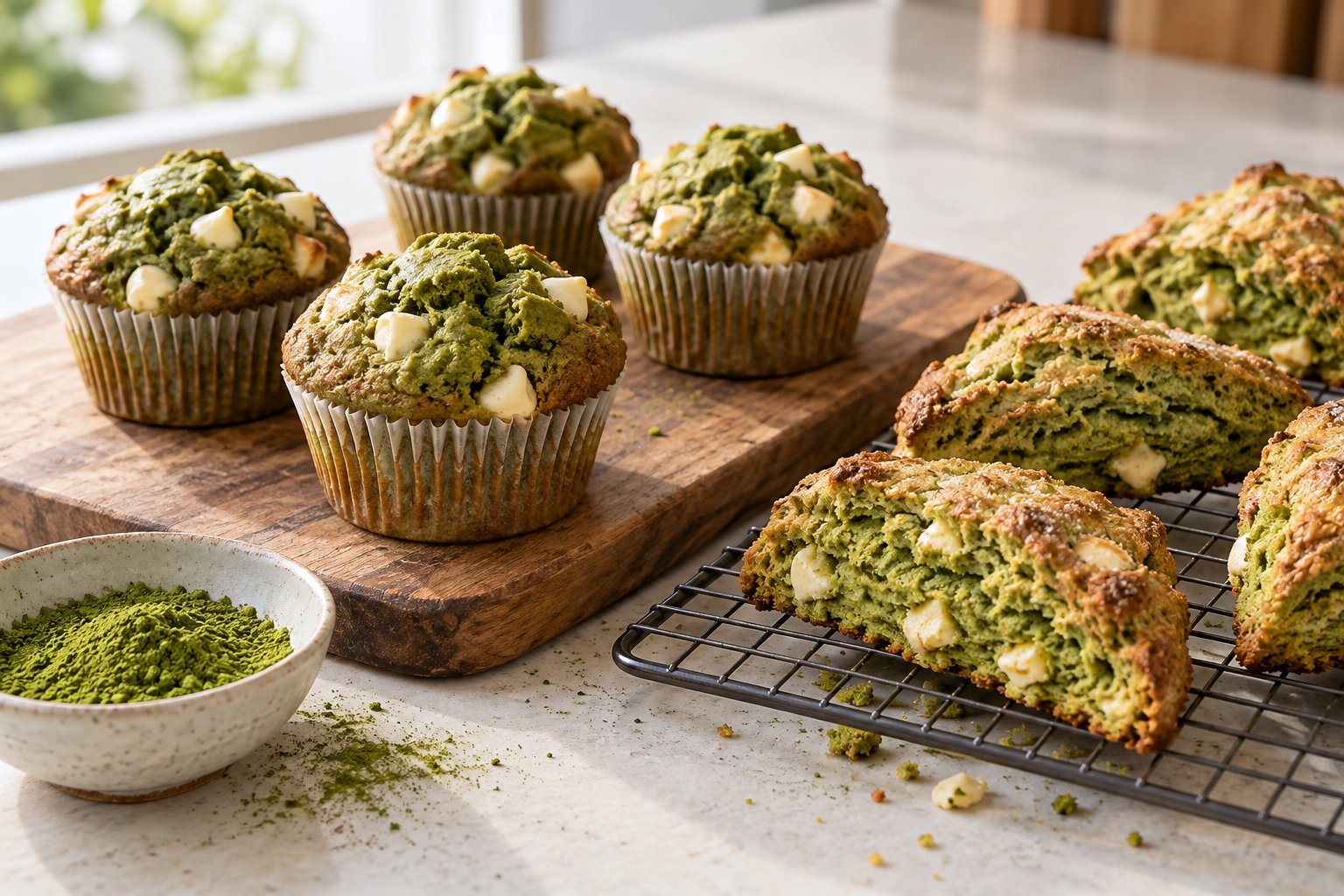
Matcha muffins and matcha scones are easy baked goods for a café that serves matcha lattes to put in its breakfast or takeaway case. Both are simple to portion with a pan or a knife, and shaped scone dough can be frozen ahead, which suits a shop. On the other hand, matcha as a share of flour differs more than twofold between recipes, and baking at high heat turns the green brownish. We compare official recipes from a baking supplier, flour companies and tea companies to look at the matcha amount, dough types, mixing, oven temperature, make-ahead and frozen dough, storage, and matcha per piece.
Types of matcha muffins and scones
Muffins differ by their mix-ins, and scones by whether they are British or American style, and that changes the dough and how the matcha shows. Decide which style you will serve before you choose a recipe.
Muffins: sweet beans, chestnut, chocolate, berries
All four official matcha muffin recipes we compared from Tomizawa Shoten, a Japanese baking supply company, contain amanatto (sweet simmered beans, here dainagon adzuki or white tebo beans), and some add candied chestnuts or walnuts. The tea company Ito En publishes a muffin with roasted chestnuts and matcha. Jade Leaf, a US matcha seller, makes matcha muffins with chocolate chips.
We found no official recipe for a matcha muffin with berries. King Arthur Baking, a US flour company, says that tossing berries with the dry ingredients keeps them from sinking in its basic muffin. Frozen berries tend to streak the batter with color, and the company also writes that rinsing frozen blueberries in cold water several times keeps the batter from turning blue-green. Berry color mixed into green matcha batter tends to look dark, so rinse the berries and fold them in lightly at the end (our view).
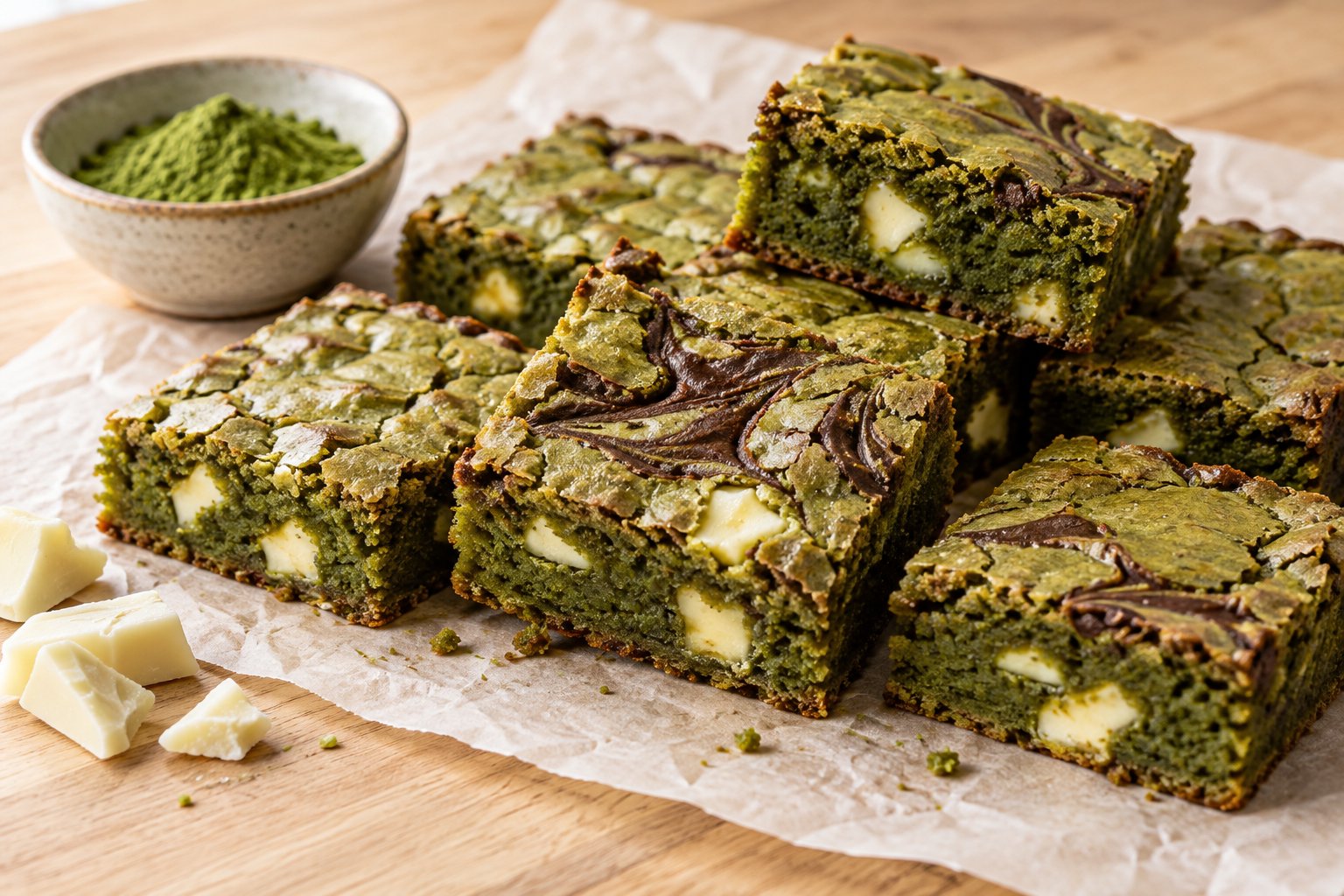
White chocolate is in 3 of the 6 official matcha scone recipes we compared (Showa Sangyo, Tomizawa Shoten’s cream scones and AIYA America). For handling white chocolate, see Matcha chocolate.
Scones: British and American
King Arthur Baking divides British and American scones as follows.
| British | American | |
|---|---|---|
| Sweetness and mix-ins | Barely sweet. At most currants or raisins | Sweeter. Many mix-ins such as fruit, nuts and chocolate |
| Shape | Often cut into rounds (sometimes triangles) | Usually triangles |
| Dough | Butter or cream worked into flour until crumbly, baked finely crumbed and tender | More liquid and mixed more to take the mix-ins |
| Serving | Spread with salted butter, jam or clotted cream | Sometimes finished with a glaze |
Tomizawa Shoten’s “Matcha scones” are cut with a round cutter and eaten filled with clotted cream or simmered adzuki beans, close to the British style. Its “Matcha and white chocolate cream scones” are described as scones made with cream and no butter, a method popular in the US. AIYA America in the US adds cranberries and white chocolate and cuts its scones into wedges.
Matcha amounts in official recipes
In official recipes that give matcha in grams, matcha was about 4.2–10% of the flour in muffins and 5–7.5% in scones. We calculated each share by dividing the matcha weight by the flour weight (or the pancake mix weight).
Muffins
| Source | Mix-ins | Matcha | Flour | Matcha to flour | Mixing | Baking | Yield |
|---|---|---|---|---|---|---|---|
| Tomizawa Shoten, basic muffin (matcha version) | Dainagon beans | 5g | Cake flour 120g | about 4.2% | Cream butter and sugar | 170°C for 25 min | 6 |
| Tomizawa Shoten, matcha muffin | Sweet beans, chestnuts | 10g | Cake flour 200g | 5% | Cream butter and sugar | 180°C for 20–25 min | 6 (about 90g each) |
| Tomizawa Shoten, matcha muffin with tebo beans and walnuts | Sweet tebo beans, walnuts | 1 tbsp (8g) | Cake flour 92g | about 8.7% | Cream butter and sugar | 180°C for about 25 min | 5 |
| Tomizawa Shoten, matcha muffin with dainagon beans | Dainagon beans | 20g | Cake flour 200g (plus 25g almond flour) | 10% | Melted butter | 180°C for about 23 min | about 8 |
| Ito En, chestnut and tea muffin | Roasted chestnuts | 1/2 tsp | Cake flour 40g, almond flour 80g | not in grams | Cream butter and sugar | 180°C for 15 min, then 160°C for 10 min | 4 |
| Jade Leaf (US matcha seller) | Chocolate chips | 3–4 tsp | All-purpose flour 2 cups | by volume | Mix wet and dry separately, then combine | 375°F (about 191°C) for 22–25 min | 12–18 |
Source: Tomizawa Shoten, “抹茶マフィン” (Matcha muffins, in Japanese) https://tomiz.com/recipe/pro/detail/4108d01
Scones
| Source | Style | Matcha | Flour | Matcha to flour | Baking | Yield |
|---|---|---|---|---|---|---|
| Showa Sangyo, white chocolate matcha scones | With white chocolate | 10g | Pancake mix 200g | 5% | 170°C for 20 min | cut into 6 |
| Tomizawa Shoten, matcha yogurt scones | No egg, yogurt and honey | 10g | Cake flour 140g | about 7.1% | 200°C for about 15 min | 9 |
| Tomizawa Shoten, matcha scones | Round, close to British style | 15g | Cake flour 200g | 7.5% | 180°C for about 15 min | 6 |
| Tomizawa Shoten, matcha and white chocolate cream scones | American style, no butter | 1 tbsp | Semi-strong flour 190g | not in grams | 180°C for 10 min, then 170°C for about 18 min | 6 |
| Nakamura Tokichi Honten (tea company in Uji, Kyoto) | Cold butter | 10g of its own matcha product “Matcha Starter” | Cake flour 200g | not calculated | 180°C for 15–20 min | 8 |
| AIYA America | Cranberries and white chocolate | 2 tbsp culinary matcha | Flour 2 cups | by volume | 400°F (about 204°C) for 12–15 min | not clearly stated |
We did not calculate a share for Nakamura Tokichi Honten’s “Matcha Starter” because we could not confirm its ingredients from an official source.
Why the shares differ, and how they compare with other bakes
With the same 200g cake flour, Tomizawa Shoten’s “Matcha muffin” uses 10g matcha and its “Matcha muffin with dainagon beans” uses 20g, twice as much. To bring matcha forward, start at 10% of the flour; to balance it with sweet beans or chestnuts, start around 5% (our suggestion).
Compared the same way in official recipes, bread uses about 1–3% of flour (Matcha bread and croissants), cookies about 2.7–12.5% (Matcha cookies), and most pancakes 4–5% of the mix (Matcha pancakes). Muffins and scones fall within the cookie range. A tablespoon of matcha weighs differently depending on whether it was sifted, so record matcha in grams in your shop recipe.
Mixing and matcha lumps
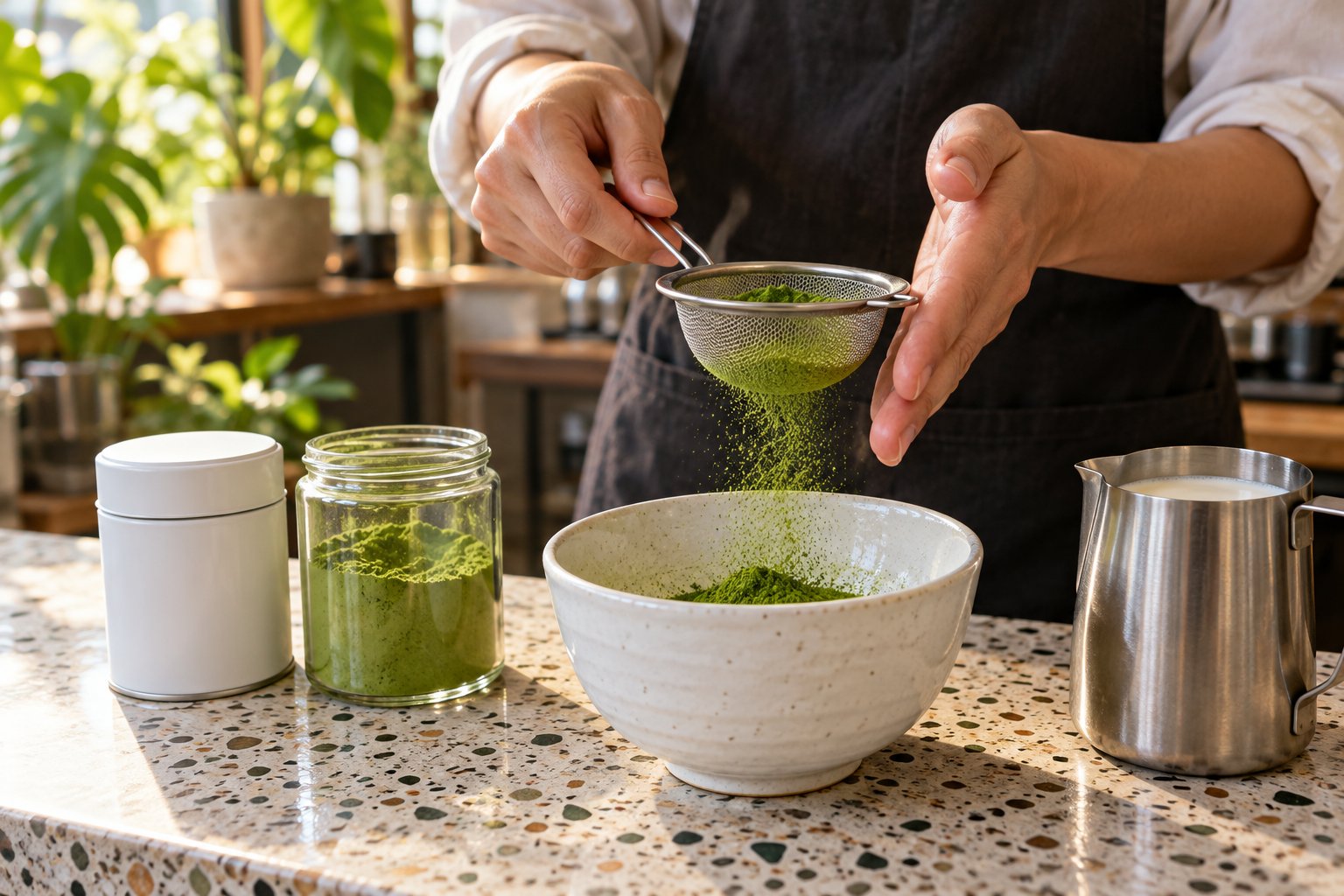
Sift matcha together with the flour before adding it. All four Tomizawa Shoten muffins either sift matcha with the cake flour and baking powder or sift it into the dry ingredients. Why lumps form is explained in Choosing matcha for baking. How long to mix after adding flour differs between muffin recipes, and scones made with butter use cold butter.
Muffins: two mixing methods
The muffins we compared use one of two methods.
- Cream butter and sugar until pale, then add egg, then flour and milk (Tomizawa Shoten’s matcha muffin, basic muffin and tebo bean muffin, and Ito En)
- Mix the dry ingredients and the liquids such as egg and milk separately, then combine, using melted butter or oil (Tomizawa Shoten’s muffin with dainagon beans, and Jade Leaf)
How much to mix after adding flour differs between recipes. Tomizawa Shoten’s matcha muffin adds milk while some flour is still visible and mixes without kneading. King Arthur Baking also says that mixing just until the batter comes together is the trick to light, lofty muffins. On the other hand, Tomizawa Shoten’s basic muffin mixes thoroughly after each addition of flour and milk, and its tebo bean muffin says that mixing until the batter is smooth and glossy gives an even crumb. Bake the same recipe with different amounts of mixing, and write the amount you choose into your shop recipe (our suggestion).
Scones: cold butter, and dough that is not kneaded
Official scone recipes that use butter rub or cut the butter into the flour before adding liquid. Showa Sangyo, Nakamura Tokichi Honten and Tomizawa Shoten’s matcha scones cut the butter into 1cm cubes and chill it. Nakamura Tokichi Honten says that using butter while cold makes the scones crisp, and that gathering the dough without kneading creates layers that crumble tenderly. Showa Sangyo writes that it helps to chill all the ingredients in the refrigerator. King Arthur Baking also says that over-handling makes tough scones. On a warm work surface in a hot shop, butter softens quickly, so chill the flour and matcha too (our suggestion).
Oven temperature and keeping the green
The Japanese official recipes we compared bake at 160–200°C, mostly around 180°C. Basic American muffins and scones bake hotter, but heat turns matcha’s green yellowish, so for matcha bakes start in the Japanese temperature range.
Temperatures in official recipes
| Temperature | Recipe |
|---|---|
| 180°C, lowered to 160°C | Ito En (muffin) |
| 170°C | Tomizawa Shoten basic muffin, Showa Sangyo (scones) |
| 180°C, lowered to 170°C | Tomizawa Shoten cream scones |
| 180°C | Tomizawa Shoten matcha muffin, dainagon and tebo bean muffins, matcha scones, Nakamura Tokichi Honten (scones) |
| 200°C | Tomizawa Shoten matcha yogurt scones |
| 375°F (about 191°C) | Jade Leaf (muffins) |
| 400°F (about 204°C) | AIYA America (scones) |
In recipes without matcha, King Arthur Baking bakes its basic muffins at 425°F (about 218°C), and its classic scones in an oven preheated to 500°F (260°C) and lowered to 450°F (about 232°C). The company says a muffin’s high dome comes from the high oven heat and the baking powder.
Aiming for both a dome and green color
Chlorophyll, the pigment behind matcha’s green, turns olive with heat, and stronger heating adds browning reactions. The mechanism is explained with research papers in Choosing matcha for baking. Tomizawa Shoten’s cream scone recipe says white chocolate burns easily, so adjust the temperature to your oven.
The following are our suggestions.
- Start at 180°C, and check the color and a skewer once at the shorter time in the recipe
- When the tops begin to brown, cover with foil to finish baking
- In recipes with strongly acidic ingredients such as lemon juice, the green fades more easily, so check the color in a test bake
For judging matcha color, see Matcha color.
Make-ahead batter and frozen dough
Scones can be shaped, frozen and baked from frozen. Muffin batter rises differently depending on the leavening and how long it sits. Plan which steps to do the day before to match your morning bake.
Freeze scones after shaping
King Arthur Baking freezes shaped scones on a baking sheet, then once solid wraps them, bags them, dates the bag and keeps them frozen. To bake, it places them on a sheet while the oven preheats and adds a couple of minutes to the recipe time. Scones frozen for three weeks showed no difference in rise or taste, but those frozen for five weeks lost rise and moisture, so it suggests no longer than a month.
Source: King Arthur Baking, “How to freeze scones and bake them later” https://www.kingarthurbaking.com/blog/2016/05/30/how-to-freeze-scones
The company’s article on storing scones says that if you will bake within three days, shape the dough into a disk about 2cm (3/4”) thick, refrigerate it and cut just before baking. For later than that, shape and freeze the scones, then bake from frozen, adding 5 to 10 minutes.
Chill after shaping, even when baking right away
King Arthur Baking says that even when baking right away, putting shaped scones in the freezer for about 30 minutes hardens the fat and relaxes the gluten (the stretchy network formed by wheat proteins), giving a higher rise. Showa Sangyo’s matcha scones are also shaped into a disk and left in the freezer for about 30 minutes before cutting and baking. Tomizawa Shoten’s matcha yogurt scones rest in the refrigerator for 15 minutes.
Muffin batter depends on the leavening
King Arthur Baking says that batter for its basic muffin made with double-acting baking powder (which reacts once when wet and again when heated) can be refrigerated for up to a week before baking. In the company’s test of resting cake batter, rests of up to 3 hours made no difference, while 10 hours in the refrigerator gave cakes about 15–25% shorter. A batter leavened with baking soda alone rose about 14% less after just 1 hour at room temperature, and refrigerating it prevented this.
On the other hand, the Japanese pancake mix makers Morinaga and Showa Sangyo do not recommend storing batter before cooking (Matcha pancakes). For batter made with a mix, or any recipe you have not tested, bake overnight batter side by side with fresh batter before deciding to make it ahead (our suggestion). We found no official source on how the color of matcha batter changes as it rests.
Storage and shelf life after baking
The US flour company says to wrap muffins and scones and keep them at room temperature for a few days, and to freeze them for longer. In a shop in a hot climate, store your own recipe in your own packaging to set the date.
Storage guidance from the maker
| Source | Item | Storage |
|---|---|---|
| King Arthur Baking | Basic muffins (home baking) | Bag and freeze for up to 3 months. Warm in a 350°F (about 177°C) oven for a few minutes |
| King Arthur Baking | Blueberry muffins (home baking) | Airtight at room temperature for a couple of days, or frozen for up to 1 month |
| King Arthur Baking | Scones (home baking) | Best the day they are baked. Cool completely, wrap, and keep at room temperature for several days. Reheat at 350°F for 5 to 10 minutes, tented with foil so they do not brown too much |
Wrapping while warm traps steam and softens the outside, so cool completely before wrapping. None of the official matcha muffin or scone recipes we compared gave a shelf life in days.
Shops in hot climates
In the 1991–2020 normals, Singapore’s monthly mean temperature is 26.8–28.6°C and Bangkok’s is 27.3–30.7°C. King Arthur Baking’s days are for a US home, so they cannot be applied as they are. In a shop in a hot climate, keep the bakes in an air-conditioned area, and set the date only after storing them and checking taste, texture and color. Keep anything topped with buttercream or cream cheese in a refrigerated case, and do not leave bakes under display lights for long (both our suggestions). Matcha fades in light even after baking (Choosing matcha for baking). For storing matcha powder, see Matcha shelf life, and for labels and allergens on individually wrapped bakes, see Matcha cookies.
Matcha per piece and matcha cost
The matcha cost per piece is “buying price per kg ÷ 1,000 × grams of matcha per piece”. To get grams per piece, divide the matcha in one batch by the number of pieces it makes.
Matcha in one piece
| Recipe | Matcha per batch | Pieces | Matcha per piece |
|---|---|---|---|
| Tomizawa Shoten basic muffin (matcha version) | 5g | 6 | about 0.83g |
| Tomizawa Shoten matcha yogurt scones | 10g | 9 | about 1.1g |
| Tomizawa Shoten matcha muffin with tebo beans and walnuts | 8g | 5 | 1.6g |
| Tomizawa Shoten matcha muffin | 10g (plus 1–2g in the icing) | 6 | about 1.7g (about 1.8–2.0g with icing) |
| Showa Sangyo white chocolate matcha scones | 10g | 6 (6 servings, cut into 6) | about 1.7g |
| Tomizawa Shoten matcha muffin with dainagon beans | 20g | about 8 (as stated in the recipe) | about 2.5g |
| Tomizawa Shoten matcha scones | 15g | 6 | 2.5g |
Per-piece figures are our calculations, dividing by the number of pieces stated in each recipe. Depending on the recipe, matcha per piece ranges from about 0.83g to 2.5g, a threefold difference. One matcha latte uses 3g of matcha in Ippodo Tea’s recipe (How to make a hot matcha latte).
What goes into the cost
Besides matcha, include flour, butter, eggs, dairy, mix-ins, cups and individual bags, and an allowance for failed bakes and unsold pieces in the cost per piece. Weigh matcha used in icing or dusted on top and add it too. How the price of matcha per kg is set is explained in What determines matcha prices.
Choose matcha by test baking your recipe
Decide whether to use the same matcha as your lattes or a separate one for baking by test baking your shop’s recipe. Use 100% matcha powder, not a latte mix blended with sugar or milk powder. Bake each candidate with the same amount, temperature and time, photograph the outside and the cut face under the same light right after baking, the next day and on day 2, and taste for the balance of bitterness and mix-in sweetness (our suggestion). For grade names, see Matcha grades, and for choosing matcha for baking overall, see Choosing matcha for baking.
Omakase Matcha supplies matcha from Uji, Yame, Shizuoka, Kagoshima and Miyazaki, with orders from 1kg and up to 3 samples. Request matcha for test baking from Samples, and see how regions differ in Origins.
Sources
- Tomizawa Shoten, “抹茶マフィン” (Matcha muffins, in Japanese) https://tomiz.com/recipe/pro/detail/4108d01
- Tomizawa Shoten, “アレンジ自由自在!基本のマフィン” (Basic muffins with variations, in Japanese) https://tomiz.com/recipe/pro/detail/20250917095713
- Tomizawa Shoten, “大納言入り抹茶マフィン” (Matcha muffins with dainagon beans, in Japanese) https://tomiz.com/recipe/pro/detail/20250818162833
- Tomizawa Shoten, “大手亡かのこ豆とクルミの抹茶マフィン” (Matcha muffins with tebo beans and walnuts, in Japanese) https://tomiz.com/recipe/pro/detail/20170804102800
- Tomizawa Shoten, “抹茶のスコーン” (Matcha scones, in Japanese) https://tomiz.com/recipe/pro/detail/20241224162242
- Tomizawa Shoten, “抹茶とホワイトチョコの生クリームスコーン” (Matcha and white chocolate cream scones, in Japanese) https://tomiz.com/recipe/pro/detail/20230801235153
- Tomizawa Shoten, “抹茶ヨーグルトスコーン” (Matcha yogurt scones, in Japanese) https://tomiz.com/recipe/pro/detail/20200616194432
- Showa Sangyo, “ホワイトチョコの抹茶スコーン” (White chocolate matcha scones, in Japanese) https://www.showa-sangyo.co.jp/recipe/list/article.html?pdid2=546
- Ito En, “栗とお茶のマフィン” (Chestnut and tea muffins, in Japanese) https://www.itoen.jp/recipe/39886/
- Nakamura Tokichi Honten, “抹茶の香りで楽しむ、秋の朝のスコーンレシピ” (Matcha scones for an autumn morning, in Japanese) https://tokichi.jp/blogs/life-with-cha/recipe-matcha-scone
- AIYA America, “Matcha Cranberry Scones” https://aiya-america.com/matcha-cranberry-scones/
- Jade Leaf, “Matcha Chocolate Chip Muffins” https://www.jadeleafmatcha.com/blogs/matcha-recipes/matcha-chocolate-chip-muffins
- King Arthur Baking, “The best basic muffin recipe” https://www.kingarthurbaking.com/blog/2016/04/25/best-basic-muffin-recipe
- King Arthur Baking, “Blueberry Muffins” https://www.kingarthurbaking.com/recipes/blueberry-muffins-recipe
- King Arthur Baking, “The secret to baking with frozen blueberries” https://www.kingarthurbaking.com/blog/2013/09/08/too-blue-the-secret-to-baking-with-frozen-blueberries
- King Arthur Baking, “Baking trials: How long can I wait to bake my cake batter?” https://www.kingarthurbaking.com/blog/2025/11/20/rest-cake-batter
- King Arthur Baking, “What is a scone? And how exactly does it differ from a biscuit?” https://www.kingarthurbaking.com/blog/2024/06/10/what-is-a-scone
- King Arthur Baking, “How to freeze scones and bake them later” https://www.kingarthurbaking.com/blog/2016/05/30/how-to-freeze-scones
- King Arthur Baking, “How to store scones” https://www.kingarthurbaking.com/blog/2024/02/20/how-to-store-scones
- King Arthur Baking, “Scone Baking” https://www.kingarthurbaking.com/learn/guides/scone
- King Arthur Baking, “Classic Scones” https://www.kingarthurbaking.com/recipes/classic-scones-recipe
- Meteorological Service Singapore, “Climate of Singapore” https://www.weather.gov.sg/climate-climate-of-singapore/
- Thai Meteorological Department, “Climatological Data for the Period 1991-2020” https://ubonmet.tmd.go.th/files/MetInfo/climate_normal.pdf