
 Reviewed by: Takahiro Sugiyama (CEO, meguri Inc.)
Matcha chocolate is an easy item for a café that already serves matcha lattes to add to its pastry shelf or seasonal gifts. But chocolate is mostly fat, matcha is a very fine powder, and cream is mostly water, so mixing them the wrong way leads to lumps or split ganache. In a hot country, storing the finished chocolate is also harder. Using official recipes from chocolate makers and tea companies, this article compares how much matcha they use, then looks at mixing, tempering (controlling the temperature of chocolate), color, storage and the amount of matcha per piece.
Types of matcha chocolate
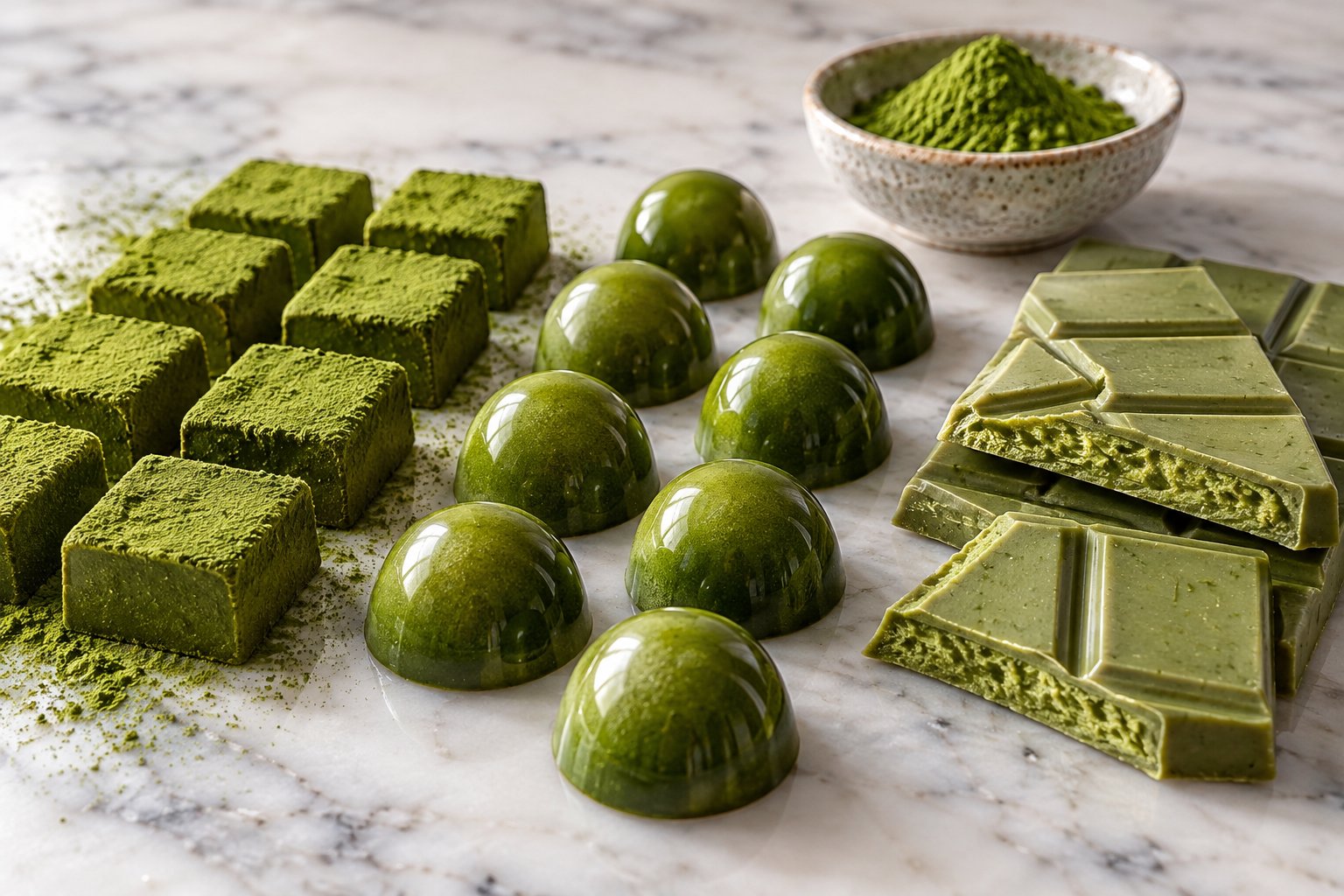
Green matcha chocolate is mostly made by mixing matcha into white chocolate. Nama chocolate, truffles and bonbons are all typical sweets that use ganache (chocolate mixed with warm cream).
Mixed into white chocolate, it turns green
Meiji, a Japanese chocolate maker, explains that matcha chocolate is made by adding matcha to chocolate (or similar) base, and that the yellow-green to green kinds are mostly based on white chocolate. Meiji also notes that some products pair matcha with milk or dark chocolate to combine the aromas of cacao and matcha.
Nama chocolate, truffles, bonbons and bars
| Type | How it is made | Tempering (our own summary) |
|---|---|---|
| Nama chocolate | Ganache poured into a tray, chilled until set, cut and dusted with powder | Not needed |
| Truffle | Ganache rolled into balls, then dusted with powder or covered in chocolate | Needed if the covering chocolate is to form a glossy shell |
| Bonbon | The general name for bite-sized chocolates. A filling (such as ganache) covered with a chocolate shell | Needed for the shell |
| Bar or coating | Matcha mixed into melted chocolate, poured into molds or used to coat other sweets | Needed |
The way nama chocolate, truffles and bonbons are divided follows Meiji’s explanation of ganache. The tempering column is our own summary based on Meiji’s explanation of tempering (it is needed when melted chocolate is set). Meiji says covering ganache with chocolate makes it keep better.
Japan’s standard for “nama chocolate”
Japan has a voluntary industry rule, the Fair Competition Code on the Labelling of Chocolates. Under the code, the words “nama chocolate” (“fresh chocolate”) may appear in a product name only when chocolate base kneaded with water-containing ingredients that include cream makes up 60% or more of the total weight, cream 10% or more, and water 10% or more. For pieces dusted with a powder such as matcha, this nama chocolate must be 60% or more of the total weight, and chocolate base 40% or more. This is a rule for selling in Japan, not a rule abroad. If you name a product “nama chocolate” overseas, do so knowing that in Japan the name refers to this kind of recipe (our own view).
Comparing matcha amounts in official recipes
In five official recipes that give matcha in grams, matcha was about 0.8–8.5% of the white chocolate and about 0.6–4.1% of the total. We calculated the percentages by dividing the weight of matcha by the weight of the white chocolate and by the total weight of the ingredients (taking 1ml as 1g).
Matcha as a share of the chocolate
| Source | Sweet | White chocolate | Cream | Matcha | Matcha to chocolate | Matcha to total |
|---|---|---|---|---|---|---|
| Fukujuen (Kyoto tea company) | Matcha truffles | 600g | 170g (butter 5g, starch syrup 5g) | 5g | About 0.8% | About 0.6% |
| Meiji (Japanese chocolate maker) | Matcha nama chocolate (8×11cm tray) | 140g | 50g | 1.5–2g | About 1.1–1.4% | About 0.8–1.0% |
| Yamamotoyama (Tokyo tea and nori company) | Matcha nama chocolate (about 200g) | 125g | 50ml (butter 15g, honey 5g) | 6g | About 4.8% | About 3.0% |
| Kyoritsu Foods (Japanese baking ingredients company) | Matcha truffles (6 pieces) | About 50g | About 15cc (plus 1 tablespoon of milk to mix the matcha) | 3g | 6% | About 3.6% |
| Nakamura Tokichi Honten (tea company in Uji, Kyoto) | Matcha ganache (a sauce for dipping fruit) | 200g | 200g | 17g | 8.5% | About 4.1% |
| AIYA America (website of a US matcha seller) | Matcha truffles | 1 cup | 1/2 cup (coconut oil 1 tablespoon) | 2 teaspoons | Given by volume | Given by volume |
Kyoritsu Foods’ recipe makes ganache from 100g of white chocolate and 30cc of cream, then turns half into matcha truffles and half into white truffles. The table shows the amounts for the matcha half. Some recipes, such as Meiji’s “two-color truffles,” do not put matcha inside at all and only dust it on the outside.
Source: Meiji Hello, Chocolate, “抹茶チョコレートはどう作られる?おすすめの抹茶チョコレートも紹介” (How is matcha chocolate made? In Japanese) https://www.meiji.co.jp/hello-chocolate/column/121/. The recipe uses an 8×11cm tray, about 20g of matcha for dusting, melts the white chocolate over water at about 50℃, and sifts the matcha in through a tea strainer.
Cream from one third of the chocolate to the same weight
Meiji gives the basic ganache ratio as chocolate to cream = 3:1 to 1:1, and for milk or white chocolate, which set less easily with a lot of cream, suggests 2:1 to 3:1. King Arthur Baking, a US flour company, also recommends 1 part cream to 3 parts chocolate (by weight) for white chocolate and similar chips.
In the table, the nama chocolates and truffles used about 2.5–3.5 times as much chocolate as cream. Nakamura Tokichi Honten’s ganache is 1:1; it is not set but kept warm over hot water and used as a sauce for dipping fruit. For nama chocolate or truffles to cut and sell, start testing at 2:1 to 3:1; for a sauce, start at 1:1.
The range reflects different uses
In the table, Fukujuen, Meiji, Yamamotoyama and Kyoritsu Foods all finish with a dusting of matcha. Fukujuen and Meiji, with around 1% matcha inside, can be read as recipes where much of the bitterness and color comes from the dusting (our own reading). Preferences for bitterness and sweetness differ from shop to shop, so make two or three batches with amounts from the table’s range and compare.
Mixing without lumps or splitting
Matcha lumps are powder that stays clumped, and split ganache is fat and water that have not combined properly. The official recipes add matcha in three ways.
Why ganache splits
Chocolate is mostly fat (cocoa butter), and cream is mostly water. Meiji calls the state in which fine droplets of chocolate fat are spread through the water in the cream “emulsion,” and says ganache splits when this emulsion has not formed properly. The causes and fixes are as follows.
| Cause (Meiji) | Fix (Meiji) |
|---|---|
| The chocolate has not fully melted (cold cream, or mixing too quickly) | Warm the whole bowl a little to melt it |
| Not mixed enough | Mix with a stick blender or food processor |
| Not enough cream (water) | Add warm cream a little at a time. Cold cream makes the fat set |
In the table, Yamamotoyama (more matcha) adds butter and Kyoritsu Foods adds milk, separately from the cream. When testing with more matcha, have a little warm cream ready as well (our suggestion).
Three ways to add matcha
| Method | Examples in official recipes |
|---|---|
| Sift it in | Meiji: sift matcha through a tea strainer into the melted white chocolate. Yamamotoyama: melt the chocolate in warm cream, then sift in the matcha. Fukujuen: use sifted matcha |
| Make a paste with a little warm liquid | Kyoritsu Foods: mix matcha passed through a tea strainer with warm milk into a paste, then add it |
| Make a paste with melted chocolate | Nakamura Tokichi Honten: take a little of the melted chocolate, mix it with the matcha until smooth, then return it |
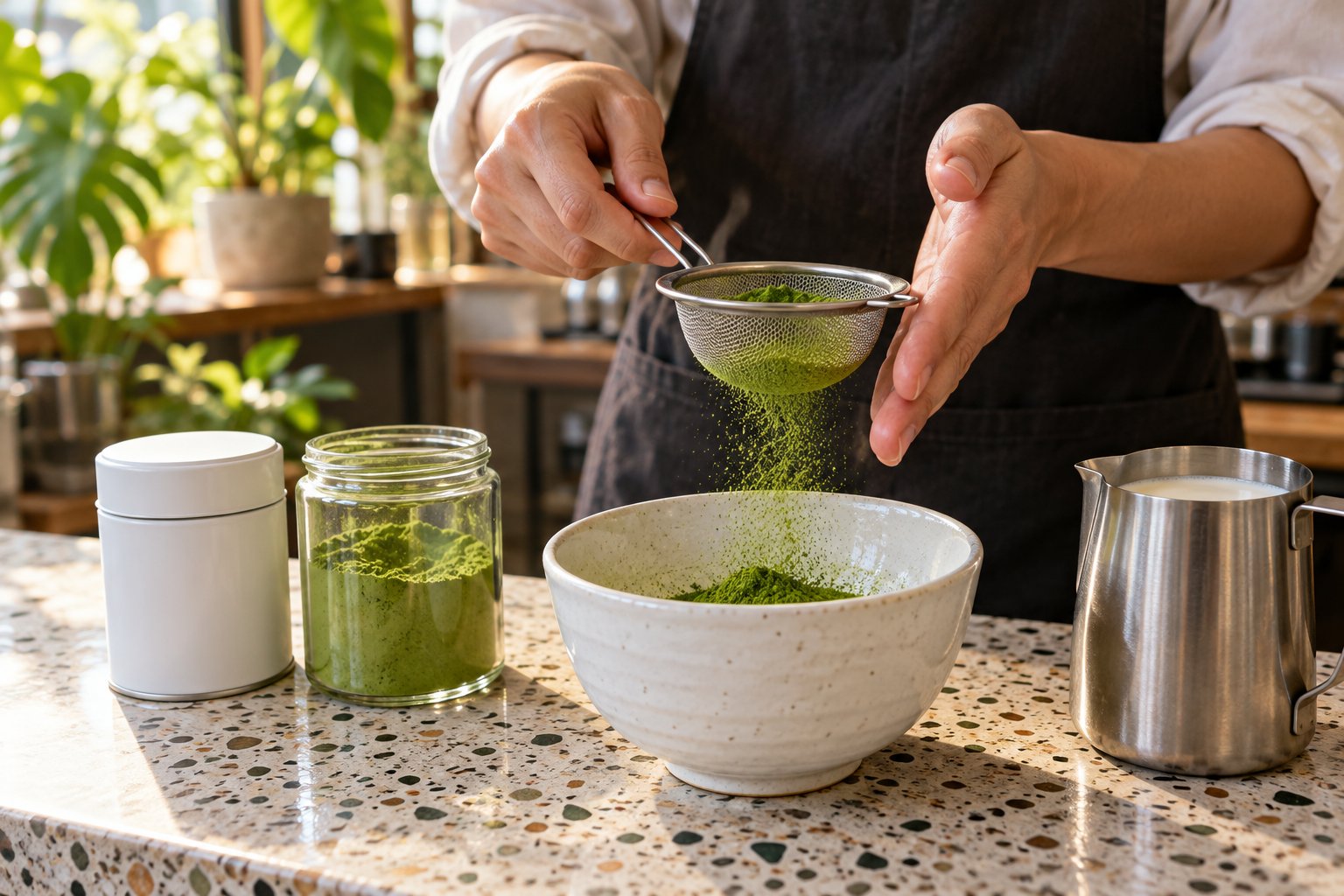
Yamamasa Koyamaen, a matcha maker in Uji, explains that matcha is a fine powder of about 10 microns that easily forms lumps through static electricity and its own weight during storage, and may be hard to mix with confectionery ingredients, so it recommends sifting it just before use. Kyoritsu Foods says that matcha mixed into a paste with warm milk or hot water gives a stronger flavor and color than matcha added as powder. Meiji says that because mixing matcha in tends to form lumps, a matcha-flavored couverture (chocolate for confectionery) is also convenient. Why matcha itself forms lumps is covered under “How to prevent lumps” in How to Make Matcha.
No water in bars and coatings
Unlike ganache, bar and coating chocolate contain almost no water. Meiji says that water getting into chocolate makes it thick so tempering fails, and can also make it split, and it warns about steam from the hot water bath. For bars and coatings, do not mix the matcha with milk or water; sift it in as powder, or make a paste with melted chocolate (our suggestion).
Tempering and matcha chocolate
Tempering means raising and lowering the temperature of melted chocolate so the cocoa butter forms stable crystals. Following Meiji’s explanation, matcha chocolate needs it for bars, and for the outside of truffles and bonbons when it is to form a glossy shell.
Where tempering is needed, and where it is not
Meiji says tempering gives chocolate its gloss and smooth melt, and that too few crystals make chocolate slow to set and lead to fat bloom, where the surface turns whitish. Callebaut, a Belgian chocolate maker, also says chocolate that is simply melted and cooled will not be glossy.
The ganache inside nama chocolate and truffles is made by mixing chocolate with cream and chilling it, and the official recipes have no tempering step. In Meiji’s “two-color truffles,” the rolled ganache is coated by hand with chocolate melted over hot water, then rolled in matcha or cocoa. The recipe has no tempering step, and the outside is covered in powder.
White chocolate temperatures given by manufacturers
| Source | Melt | Cool to | Working temperature |
|---|---|---|---|
| Meiji (water-cooling method, home chocolate recipes) | 40–45℃ | 24–25℃ | 27–28℃. Start again if it reaches 29℃ or above |
| Meiji (tempering to fix bloom) | 50–55℃ | 27–29℃ | From 31–32℃, 1–2℃ lower for milk and white |
| Callebaut (seeding with Callets) | 45℃ | Lower to ±29℃ and add 5% Callets (chocolate drops) at room temperature | ±29℃ |
The working temperature for white chocolate ranges from about 27 to 31℃ across the three sources. Meiji says to keep the room at 25℃ if possible. Temperatures differ by chocolate brand, so follow the temperatures on your chocolate’s packaging or in the maker’s documents.
When to add matcha (our suggestion)
As far as we checked, we found no manufacturer’s document on how matcha affects tempering. In the shop, temper chocolate with and without matcha at the same temperatures, pour both into molds, and compare how they set and how glossy they are before deciding. Add the matcha at the melting stage, mix well, and check that there are no lumps before cooling.
Why the color fades, and handling on display
Matcha’s green turns brownish with heat and fades with light. Matcha chocolate is not baked, so the main concerns are light and time since it was made.
Heat and light take the green away
Matcha’s green comes from chlorophyll. How heat and light change it is explained under “Why matcha changes color in baked goods and desserts” in Matcha for Baking. Yamamasa Koyamaen says matcha fades in light, and the same happens when it is used in confectionery, giving the example of keeping a matcha cake under display case lighting for a long time.
What you can do on display (our suggestion)
- Dust matcha just before serving, or only on the pieces you will sell that day
- Do not leave pieces for long on shelves where display lights or window light fall directly
- When you change lot or grade, compare photos of the color when freshly made and the next day
Storage, shelf life and bloom in hot climates
Nama chocolate in the refrigerator, pure chocolate at 12–18℃, and humidity of 70% or below where it is kept: these are the storage guidelines given by manufacturers. Singapore’s temperature is above these guidelines all year round.
Manufacturers’ storage guidelines
| Source | Item | Storage guideline |
|---|---|---|
| Meiji | Nama chocolate | Refrigerator (10℃ or below). It picks up odors easily, so put it in a bag |
| Meiji | Bonbons | 16℃ or below, or 10℃ or below, depending on the product. Ganache contains a lot of water and keeps less well |
| Meiji | Bars | Recommended storage temperature 15–18℃ (retail packs say 28℃ or below) |
| Callebaut | Pure chocolate / chocolate products | The ideal storage temperature for pure chocolate is 12–18℃. Chocolate products at a relative humidity of 70% or below, away from light and strong odors |
| Callebaut | Refrigeration | Generally not recommended for confections, because they absorb moisture inside the refrigerator |
Source: Callebaut, “Confectionery Shelf Life: Good Storage Practices” https://www.callebaut.com/en/confectionery-shelf-life-good-storage-practices. The page also says that at higher temperatures chocolate softens and loses its gloss, that condensation when chilled products return to room temperature can cause sugar bloom, and that packaged products should return to room temperature before the packaging is opened.
Meiji recommends refrigerating nama chocolate, while Callebaut does not generally recommend refrigerating confections. Thinking of it as nama chocolate (rich in cream) in the refrigerator, bars in a cool place at 12–18℃, and bonbons at 16℃ or below or 10℃ or below depending on the recipe fits both explanations (our own summary).
Shelf life guidelines
Meiji says that nama chocolate is sold with a best-before period as short as a few days, and that many shops use about 14–21 days on average. The best-before for Meiji’s “two-color truffles” is about 3–4 days in the refrigerator. Callebaut says whether a ganache lasts only a few days or keeps for months depends partly on water activity (Aw: the share of water in a food that is free to move), which is a better measure of spoilage risk than the water content itself. Decide your selling period after storing your own recipe in your own packaging and checking taste, melt and appearance.
Singapore’s climate and bloom
According to the Meteorological Service Singapore’s 1991–2020 averages, the monthly mean temperature is 26.8–28.6℃ and the mean annual relative humidity is about 82%. Meiji explains that when chocolate starts to melt at around 25℃ and then cools again, the cocoa butter crystals grow coarse and the surface turns white (fat bloom). When chilled chocolate is taken from the refrigerator to a warm place, moisture condenses on the surface, sugar dissolves and sets white (sugar bloom).
| Fat bloom | Sugar bloom | |
|---|---|---|
| Cause (Meiji) | Storage temperature too high, not enough tempering | Condensation when chilled chocolate is moved to a warm place |
| How to tell (Meiji) | Disappears when the surface is warmed | Stays when warmed, and feels rough |
| Can it be fixed? (Meiji) | For bars, melt and temper again | Cannot be reversed |
In the shop, keep both display and stock in air-conditioned rooms or chilled cases, and let chilled pieces return to room temperature in their packaging before opening. Meiji says chocolate taken out of the refrigerator should be brought to room temperature over 15–30 minutes. Storing matcha powder itself in hot climates is covered in Does Matcha Go Bad?.
Selling it packaged
White chocolate, cream and butter all contain milk. Labelling and allergen rules for selling in bags or boxes in Singapore, Thailand and Indonesia are covered in Matcha Cookies for Cafés. In Fukujuen’s and Yamamotoyama’s matcha recipes and the matcha version of Meiji’s “two-color truffles,” the liqueur or brandy is optional. If you are considering halal certification, see also Is Matcha Halal?.
Matcha per piece and matcha cost
By our calculation, assuming a 10g piece, the matcha mixed inside comes to 0.06–0.4g per piece; Kyoritsu Foods’ truffles use 0.5g each. The 10g piece is our own assumption to compare the recipes on the same basis, not a size given in the recipes. Matcha for dusting the outside may be prepared in larger amounts than the matcha mixed inside.
Matcha inside one piece
| Source | Matcha mixed inside | Per piece (our calculation, assuming a 10g piece) |
|---|---|---|
| Fukujuen truffles | 5g in about 785g total | About 0.06g per 10g |
| Meiji nama chocolate | 1.5–2g in about 192g total | About 0.08–0.1g per 10g |
| Yamamotoyama nama chocolate | 6g in about 201g total | About 0.3g per 10g |
| Nakamura Tokichi Honten ganache | 17g in about 417g total | About 0.4g per 10g |
| Kyoritsu Foods truffles | 3g for 6 pieces | 0.5g per piece |
Meiji’s nama chocolate uses 1.5–2g of matcha inside and prepares about 20g of matcha for dusting. Some of the dusting matcha stays in the tray, so weigh the matcha before and after dusting, and divide the amount used in one batch by the number of pieces to find the dusting matcha per piece.
Working out the matcha cost
The matcha cost per piece is “buying price per 1kg ÷ 1,000 × grams used per piece (inside plus dusting).” How the price per 1kg is set is explained in Why Is Matcha So Expensive?. Besides matcha, include chocolate, cream, cups or boxes and spoiled pieces in the cost of each piece.
Choosing matcha for matcha chocolate
Check that the matcha is 100% matcha, then decide by making test batches with your own recipe and comparing color and bitterness. Whether to use the same matcha as for lattes or a different one is also decided by those tests.
What to check
- Whether the only ingredient is matcha. A latte mix with sugar or milk powder will not give enough matcha at the recipe amount, and changes the sweetness (Pure Matcha)
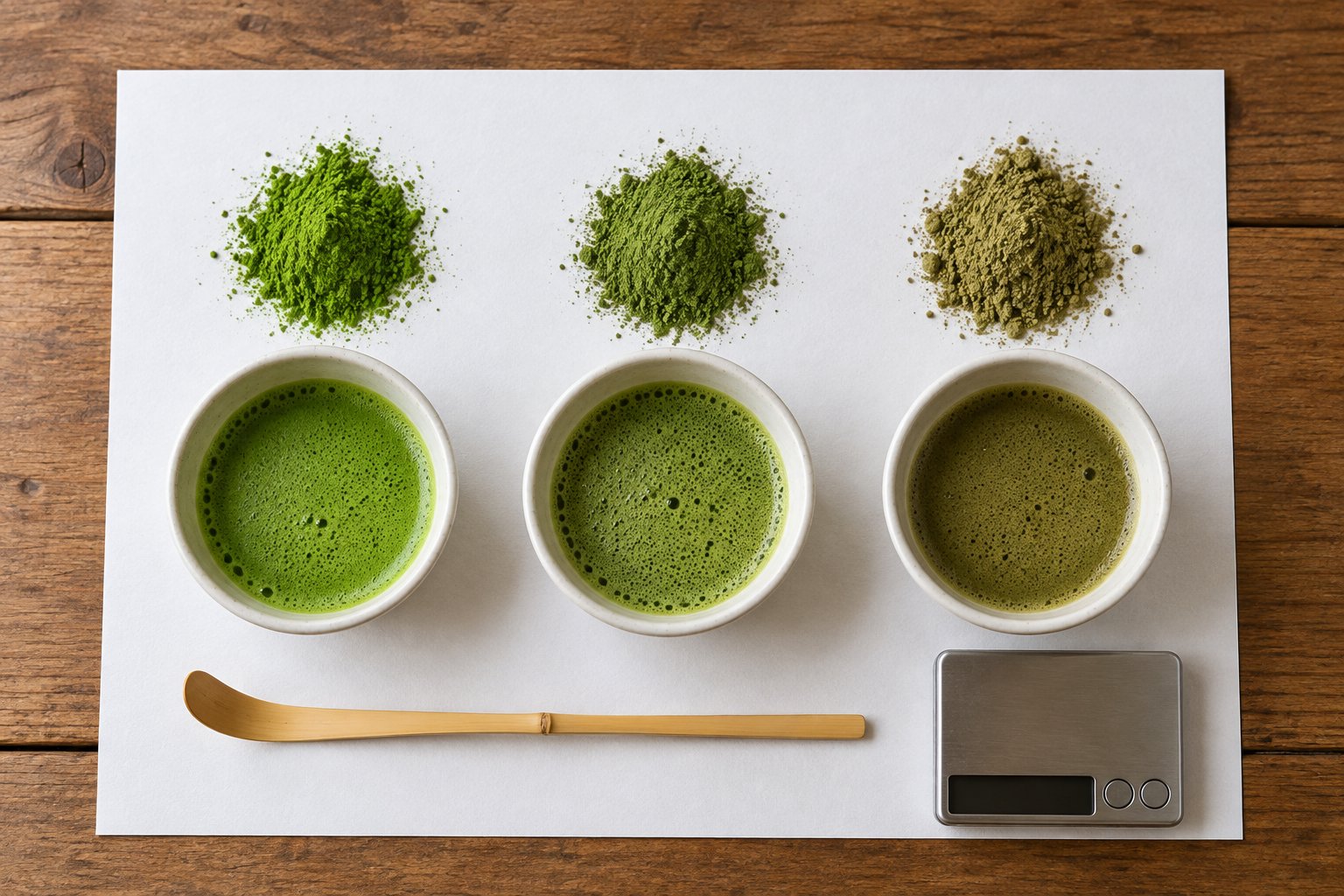
- Harvest and grade. You can also try different grades for the matcha inside and the matcha for dusting (Matcha grades)
- Whether you can keep buying the same specification. When the lot changes, check the color mixed into white chocolate with a test batch
How to run test batches
- Make a batch with each candidate matcha, using the same white chocolate and cream recipe and the same amount of matcha
- Photograph the color under the same light when freshly made, on the next day in the refrigerator, and on day three
- Taste for the balance of bitterness and sweetness, then decide together with the matcha cost per piece and the selling price
Recipes for other matcha desserts are covered in Matcha Parfait for Cafés and Matcha Pudding for Cafés. Omakase Matcha supplies matcha from Uji, Yame, Shizuoka, Kagoshima and Miyazaki, with orders from 1kg and up to 3 samples. Request matcha for test batches from Samples, and see how regions differ in Origins.
Sources
- Meiji Hello, Chocolate, “抹茶チョコレートはどう作られる?おすすめの抹茶チョコレートも紹介” (How is matcha chocolate made? Recommended matcha chocolates, in Japanese) https://www.meiji.co.jp/hello-chocolate/column/121/
- Meiji Hello, Chocolate, “生チョコレートとは?賞味期間や保存方法、レシピも紹介” (What is nama chocolate? Best-before, storage and a recipe, in Japanese) https://www.meiji.co.jp/hello-chocolate/basic/11.html
- Japan Fair Trade Council of Chocolate Industry, “チョコレート類の表示に関する公正競争規約及び施行規則” (Fair Competition Code on the Labelling of Chocolates and its Enforcement Rules, Article 4, Paragraph 1, Item 3, in Japanese) https://www.chocokoutori.org/cont3/13.html
- Meiji Hello, Chocolate, “ガナッシュとは?生チョコ・トリュフとの違い、作り方や分離の対処方法を解説” (What is ganache? How it differs from nama chocolate and truffles, and how to fix splitting, in Japanese) https://www.meiji.co.jp/hello-chocolate/column/69/
- Meiji Hello, Chocolate, “テンパリングとは?” (What is tempering? In Japanese) https://www.meiji.co.jp/hello-chocolate/basic/06.html
- Meiji Hello, Chocolate, “チョコレートが白くなる?ブルーム現象の原因や防ぐ方法” (Why chocolate turns white: causes of bloom and how to prevent it, in Japanese) https://www.meiji.co.jp/hello-chocolate/column/106/
- Meiji Hello, Chocolate, “チョコレートの正しい保存方法は?冷蔵庫保管する際のポイントを解説” (How to store chocolate, and refrigerator tips, in Japanese) https://www.meiji.co.jp/hello-chocolate/column/34/
- Meiji home chocolate recipes, “テンパリング” (Tempering, in Japanese) https://www.choco-recipe.jp/milk/smartphone/basic/basic_06.html
- Meiji home chocolate recipes, “2色のトリュフ” (Two-color truffles, in Japanese) https://www.choco-recipe.jp/milk/recipe/077.html
- Callebaut, “Tempering chocolate with Callets” https://www.callebaut.com/callebaut-chocolate-academy/tutorials/tempering/tempering-chocolate-with-callets
- Callebaut, “Confectionery Shelf Life: Good Storage Practices” https://www.callebaut.com/en/confectionery-shelf-life-good-storage-practices
- Callebaut, “Shelf Life: Introduction to Water Activity” https://www.callebaut.com/en/shelf-life-introduction-water-activity
- Kyoritsu Foods, “コク深い中まで抹茶のトリュフ” (Rich matcha truffles, in Japanese) https://www.kyoritsu-foods.co.jp/recipe/563/
- Kyoritsu Foods, “抹茶パウダー” (Matcha powder, in Japanese) https://www.kyoritsu-foods.co.jp/product/1505/
- Fukujuen, “抹茶を使ったアレンジレシピ” (Recipes using matcha, in Japanese) https://www.fukujuen.com/shop/pg/1matcha-recipe/
- Yamamotoyama, “How to make matcha chocolate” https://ec.yamamotoyama.co.jp/en/blogs/column/reading274
- Nakamura Tokichi Honten, “Indulge in the Depth of Matcha Ganache” https://global.tokichi.jp/blogs/life-with-tea/indulge-in-the-depth-of-matcha-ganache
- AIYA America, “Matcha White Chocolate Truffles” https://aiya-america.com/matcha-white-chocolate-truffles-recipe/
- King Arthur Baking, “How to make ganache” https://www.kingarthurbaking.com/blog/2019/02/13/how-to-make-ganache
- Yamamasa Koyamaen, “抹茶の取扱い” (Handling matcha, in Japanese) https://www.yamamasa-koyamaen.co.jp/matcha/basic/handling.html
- Meteorological Service Singapore, “Climate of Singapore” https://www.weather.gov.sg/climate-climate-of-singapore/