
 Reviewed by: Takahiro Sugiyama (CEO, meguri Inc.)
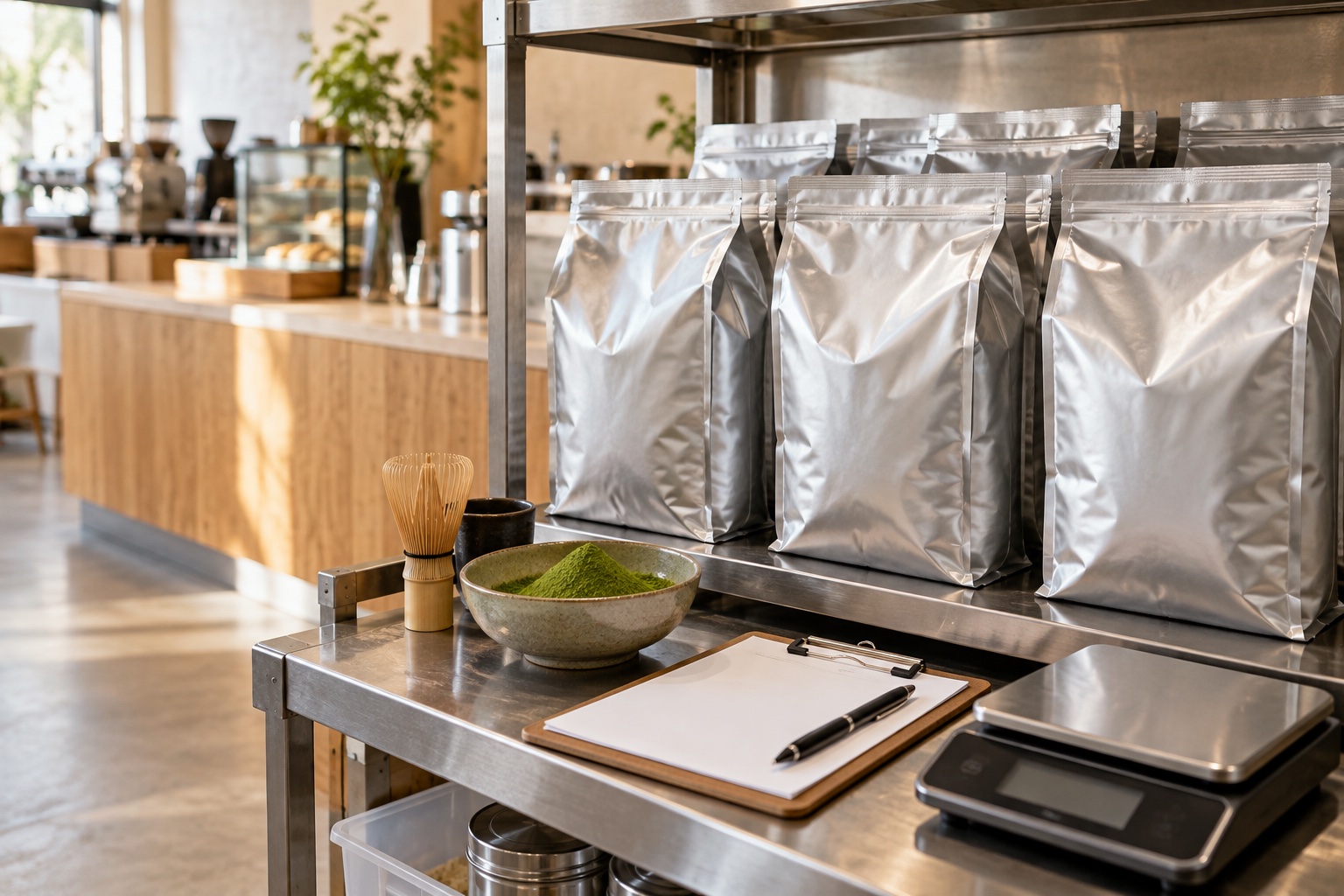
Once matcha lattes are on the menu, the first practical question is how much to buy. Order too little and you run out before the next shipment arrives from Japan; order too much and opened bags lose their aroma. This guide works out monthly use from the grams in each drink, adds the days it takes to arrive from Japan, and shows how to calculate when and how much to order.
The four numbers that set your matcha order
How much matcha to order depends on four numbers: grams per drink, drinks per day, days until delivery, and days to finish an opened bag. The first two set how much you use; the last two set how much stock you hold.
Numbers that set how much you use
Monthly use is:
Monthly use = grams per drink × drinks per day × trading days
Grams per drink come from your recipe, and drinks per day from your sales. If several menu items use matcha, calculate each one and add them up.
Numbers that set how much stock you hold
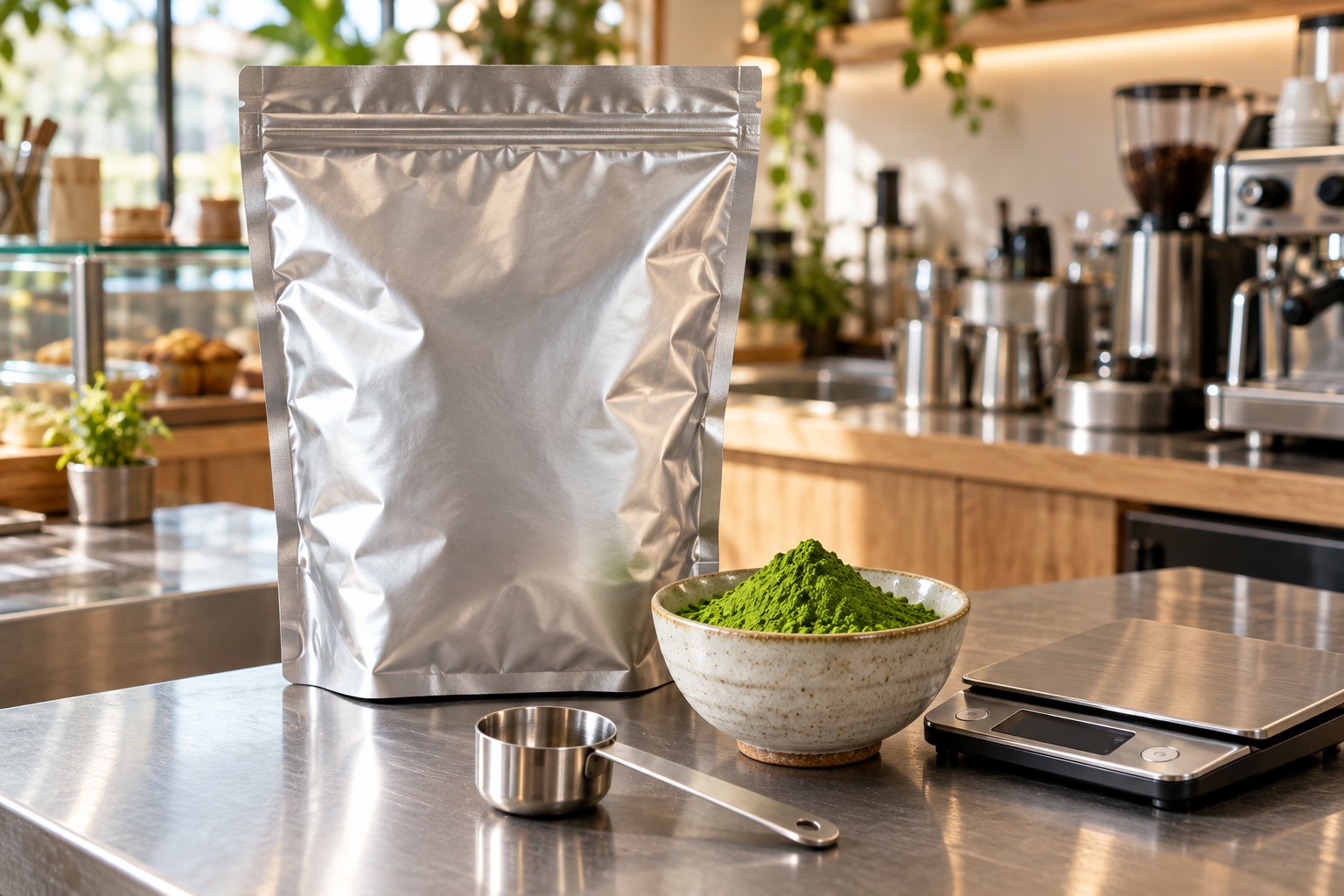
When you buy from Japan, it takes some days from ordering to having the matcha in your café. If you do not keep enough on hand for those days, you run out before the next shipment arrives. On the other hand, matcha starts losing aroma and colour once opened, so the number of days you need to finish an opened bag sets the upper limit on bag size. How long opened matcha keeps and how to store it are covered in Does matcha expire?, and handling 1kg bags in Choosing matcha for food service.
How much matcha goes into one drink
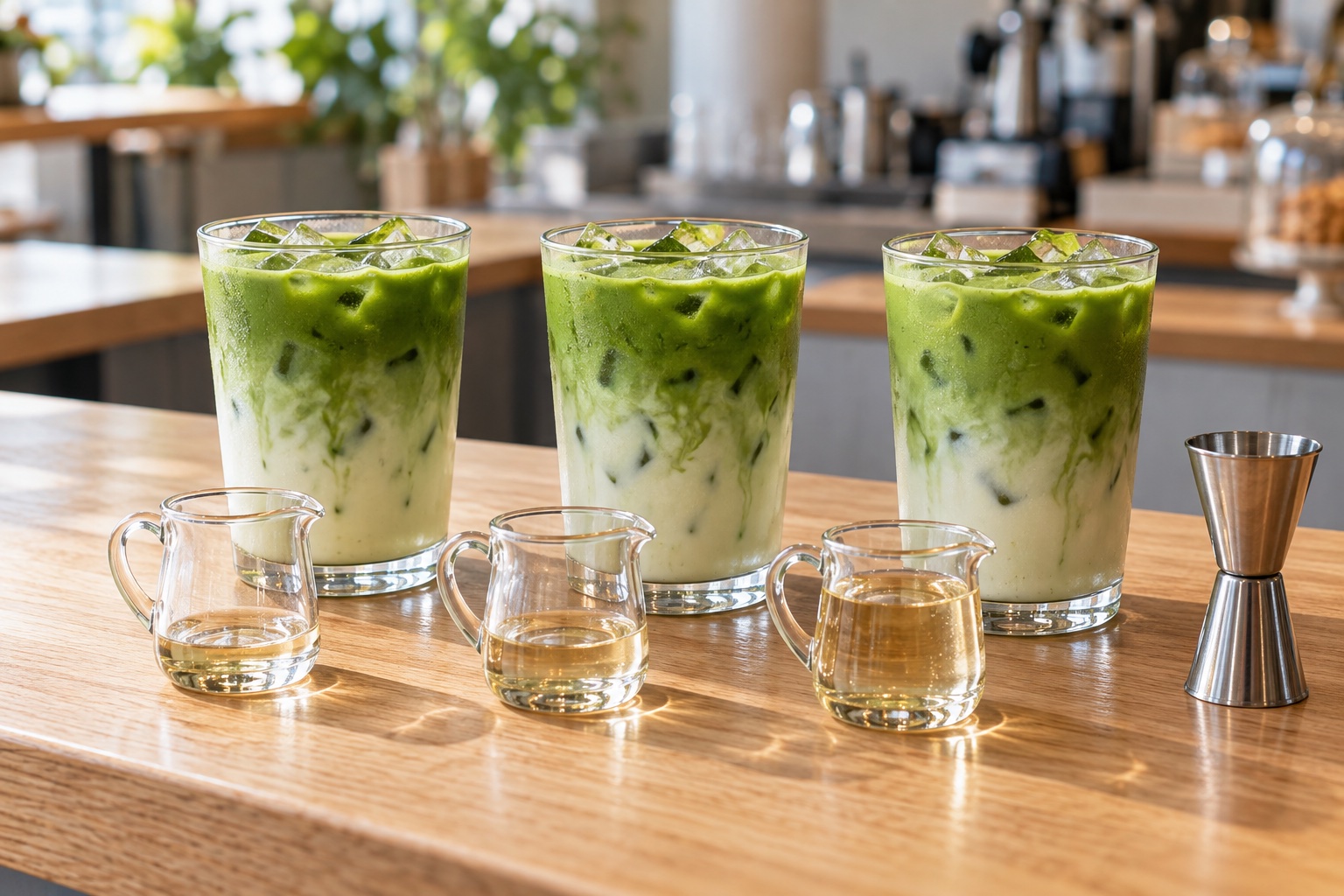
Official matcha latte recipes use 2 to 4g of matcha per drink. At 3g per drink, 1kg makes about 333 drinks.
Grams per drink in official recipes
Recipes from tea companies and others that give matcha in grams:
| Recipe | Matcha per drink | Other ingredients |
|---|---|---|
| Kurasu Kyoto (a coffee shop in Kyoto) matcha latte | 2.5g | 30–40ml hot water, 150g milk |
| Ippodo Tea matcha latte | 3g | 100mL water at 80°C, 100mL milk |
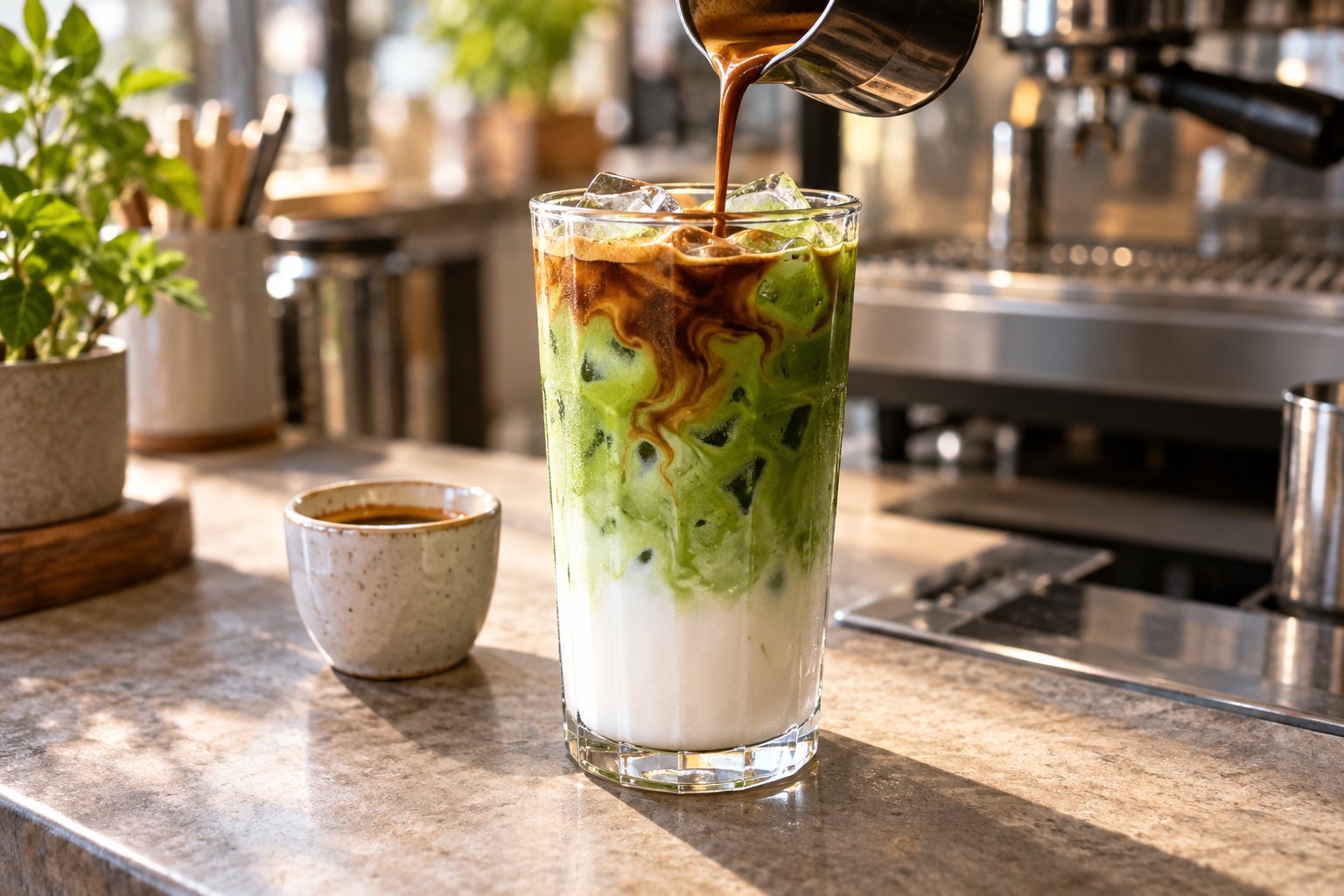
| Ippodo Tea iced matcha latte | 3g | 100mL water at 80°C, 100mL cold milk, ice |
| Ito En cold matcha latte | 3g | 30ml hot water, 130g milk, ice |
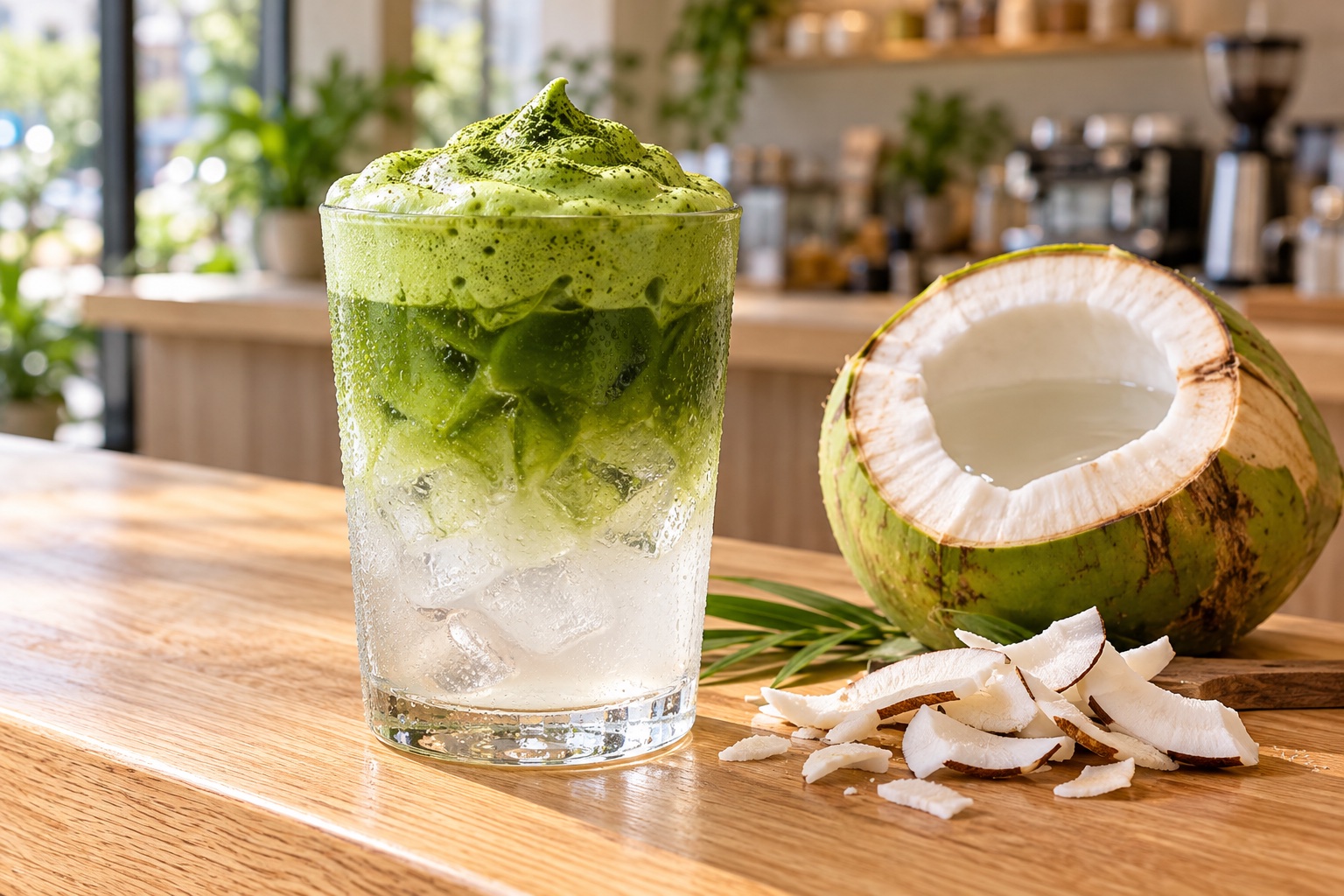
| Matchaful (a US matcha company) coconut water matcha | 4g | 5 fl oz (about 150ml) coconut water |
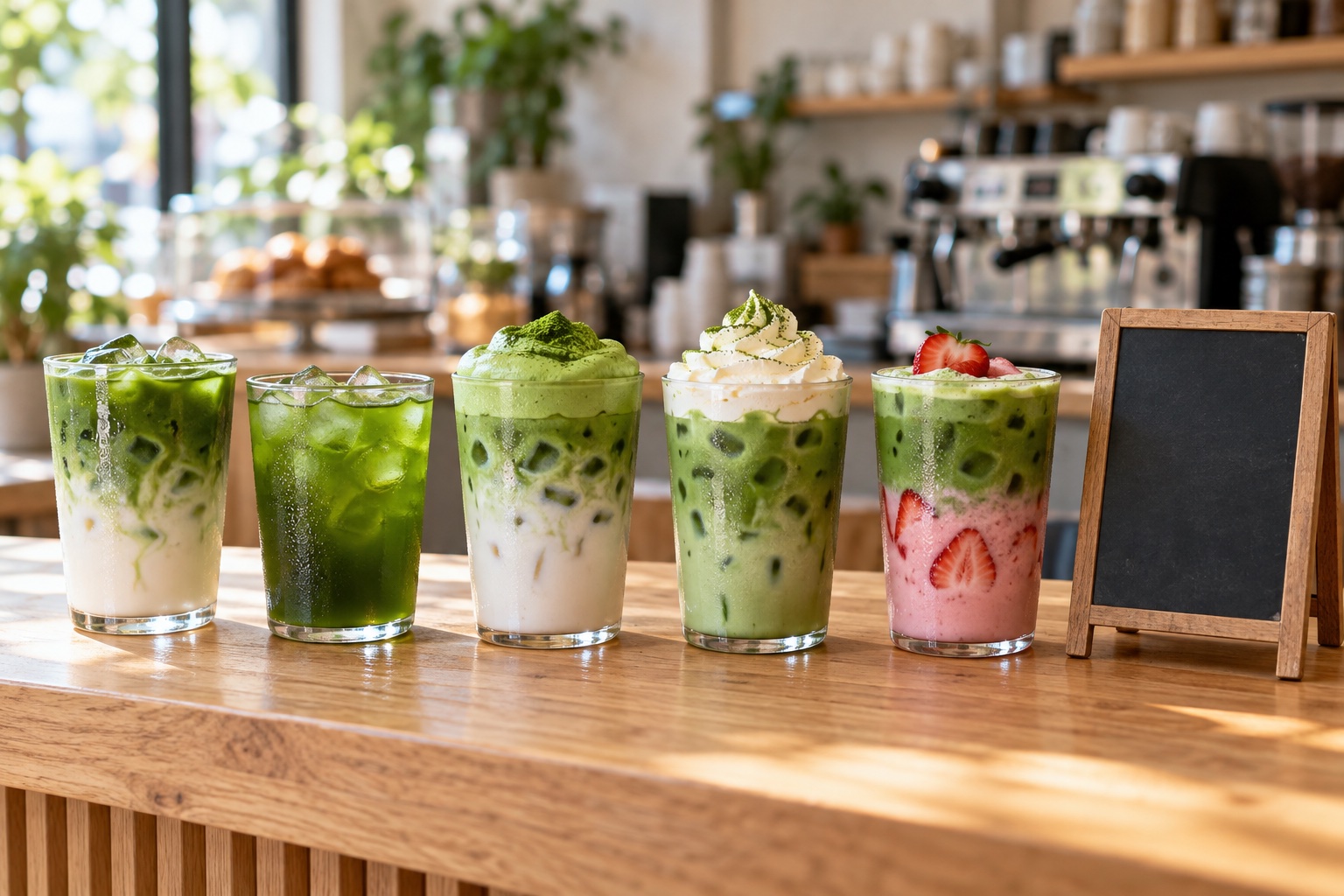
The matcha amounts for other drinks are listed on our matcha drinks page. Ratios and methods are compared in How to make a hot matcha latte and How to make an iced matcha latte.
Recipes measured in teaspoons
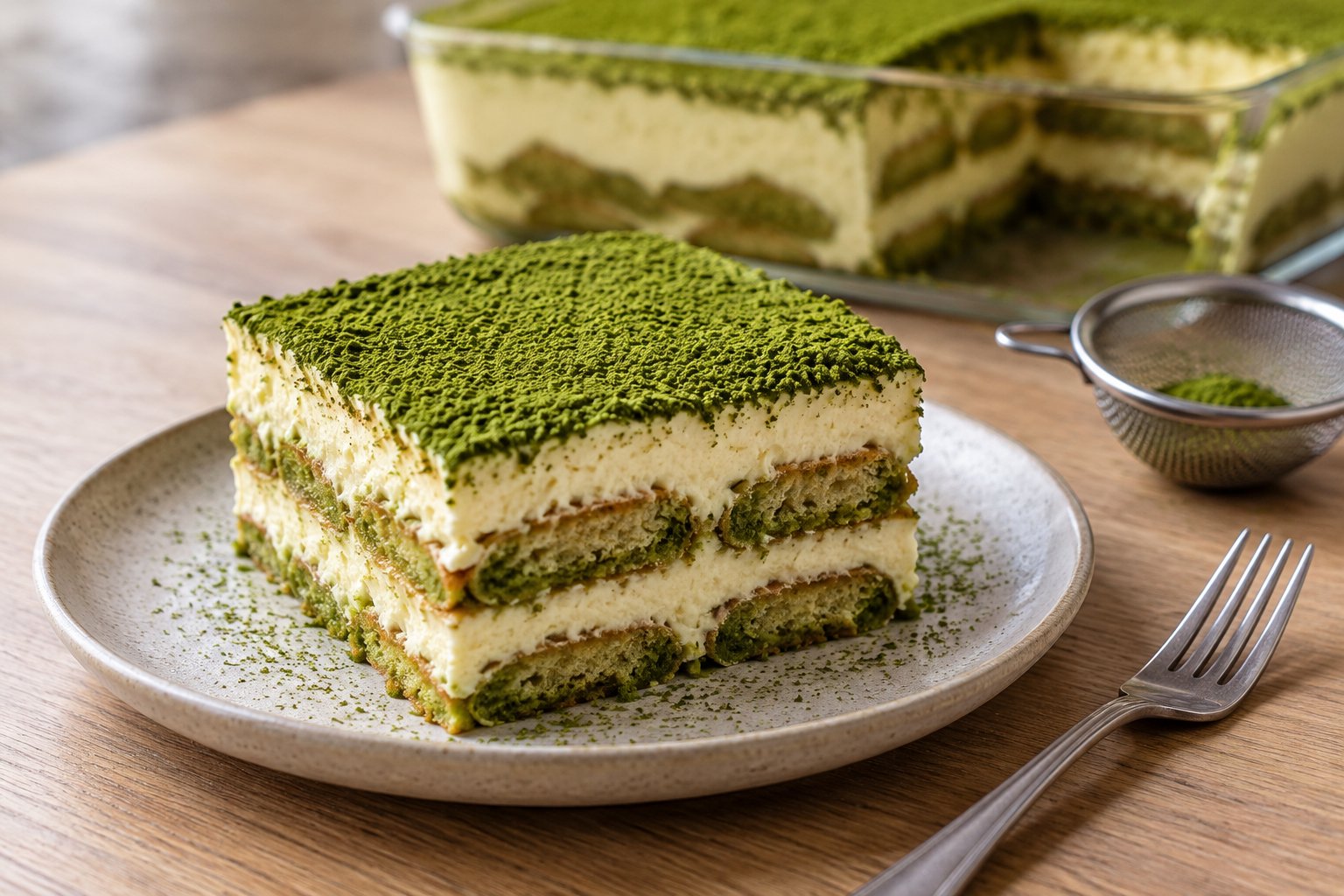
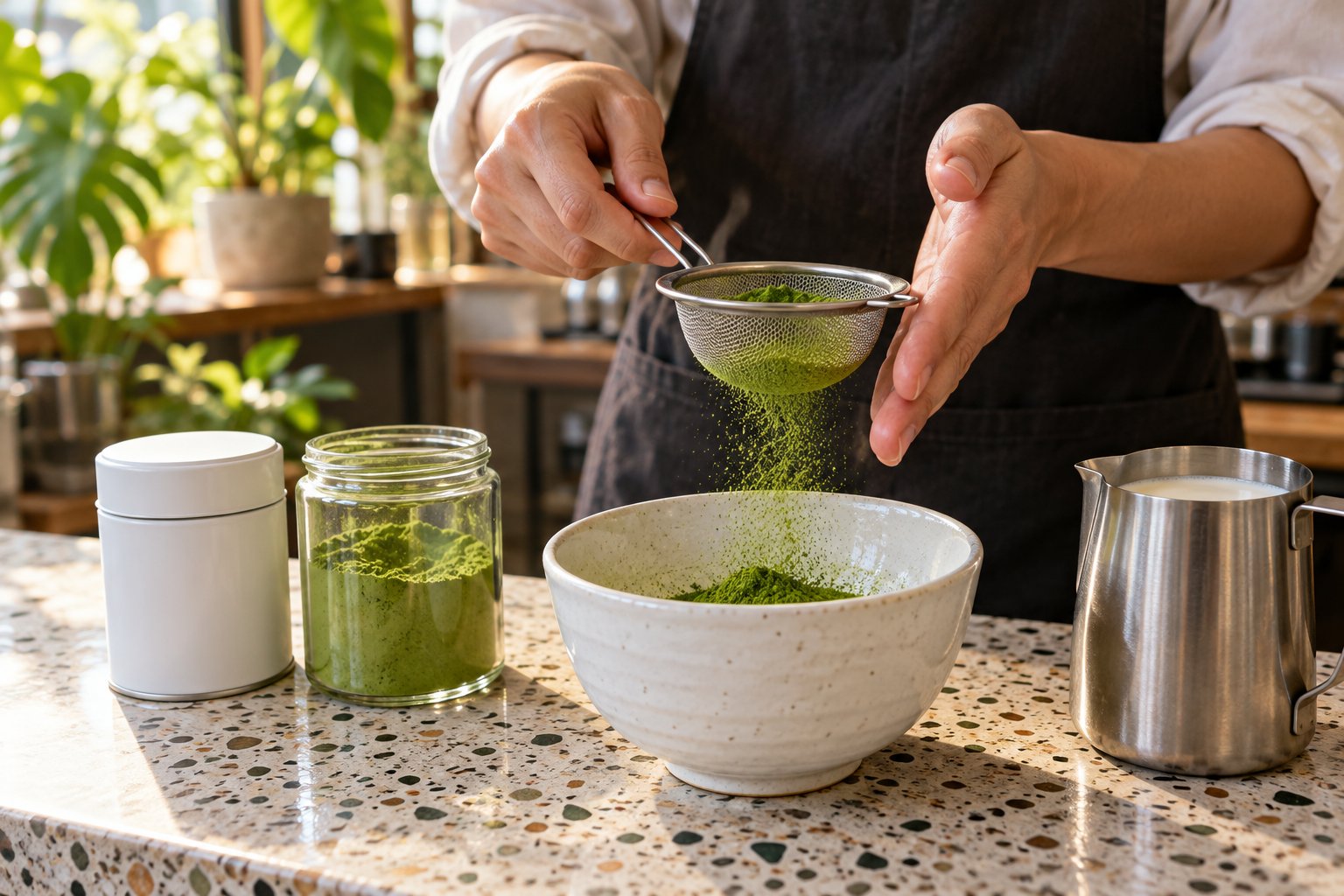
Some recipes give matcha as “1 teaspoon”, such as the recipe in the magazine of Japan’s Ministry of Agriculture, Forestry and Fisheries (MAFF). Ippodo Tea treats 2g of matcha for usucha (matcha whisked in a bowl at normal strength) as one level teaspoon. If your café sets its standard in grams on a scale rather than in teaspoons, your monthly calculation and the actual use stay closer together.
How many drinks 1kg makes
| Matcha per drink | Drinks per 1kg |
|---|---|
| 2g | 500 |
| 2.5g | 400 |
| 3g | about 333 |
| 4g | 250 |
Changing the amount by 1g per drink changes the drinks per 1kg by roughly 80 to 170. Grams per drink affect not only taste but also how much you order and your cost per drink.
From drinks per day to monthly use
A café selling 30 drinks a day at 3g per drink uses 2.7kg of matcha a month over 30 trading days. If several menu items use matcha, work out each one, add them up, and then correct the total with how fast your bags actually go down.
Monthly use by drinks per day and grams per drink
Monthly use for 30 trading days (our calculation):
| Drinks per day | 2g per drink | 3g per drink | 4g per drink |
|---|---|---|---|
| 10 | 0.6kg | 0.9kg | 1.2kg |
| 20 | 1.2kg | 1.8kg | 2.4kg |
| 30 | 1.8kg | 2.7kg | 3.6kg |
| 50 | 3.0kg | 4.5kg | 6.0kg |
| 80 | 4.8kg | 7.2kg | 9.6kg |
| 100 | 6.0kg | 9.0kg | 12.0kg |
If you trade 26 days a month, multiply the figures by 26/30. Planning before opening is covered in How to start a matcha business.
Example: a café with several matcha drinks
Take a café serving these three drinks at the official recipe amounts above:
| Drink | Drinks per day | Matcha per drink | Matcha per day |
|---|---|---|---|
| Hot matcha latte (Kurasu Kyoto amount) | 15 | 2.5g | 37.5g |
| Iced matcha latte (Ippodo Tea and Ito En amount) | 25 | 3g | 75g |
| Coconut water matcha (Matchaful amount) | 5 | 4g | 20g |
| Total | 45 | 132.5g |
This café uses 132.5g a day, or about 4.0kg over 30 days. If you also use matcha in baking, add the number of cakes or batches per day × grams per cake to the same table.
Correct the figure with actual use
The calculated amount and the amount you actually use differ because of test drinks, spills and how staff measure. From here on is our suggestion. At the start and end of each week, weigh the opened bag and your unopened stock, and record the difference as the actual use for that week. If it is far from the amount worked out from drinks sold, check how each drink is measured, or add the difference to your daily use when you calculate.
How many days a 1kg bag lasts
Divide 1,000g by your daily use to get the number of days a 1kg bag lasts. A café using 90g a day finishes it in about 11 days.
Days per bag by daily use
| Daily use (drinks at 3g) | 1kg bag | 500g bag |
|---|---|---|
| 30g (10 drinks) | about 33 days | about 17 days |
| 60g (20 drinks) | about 17 days | about 8 days |
| 90g (30 drinks) | about 11 days | about 6 days |
| 150g (50 drinks) | about 7 days | about 3 days |
| 240g (80 drinks) | about 4 days | about 2 days |
| 300g (100 drinks) | about 3 days | about 2 days |
For the café with several drinks above (132.5g a day), a 1kg bag lasts about 7.5 days.
Choosing a bag size
Ippodo Tea recommends drinking matcha within a month of opening for the best taste. In the table, a 1kg bag lasts more than a month only at around 30g a day. Cafés with low daily use should not open 1kg at once: buy smaller bags, or open one bag at a time. Storage and splitting bags are covered in Does matcha expire? and Choosing matcha for food service.
How long it takes to arrive from Japan
Japan Post’s standard EMS (Express Mail Service) days are 2 to 3 days to Singapore, 3 to 4 days to Thailand and 8 to 9 days to Indonesia. These are the days from posting to delivery; the time from placing an order to having the matcha in your café is longer.
EMS standard days
Japan Post publishes an EMS delivery-days table for each region of posting. Standard days to the three countries from regions where the main matcha origins are:
| Posted from | Singapore | Thailand | Indonesia |
|---|---|---|---|
| Tokyo | 2 days | 3 days | 8 days |
| Tokai (Shizuoka, Aichi, Gifu, Mie) | 2 days | 3 days | 8 days |
| Kinki (Kyoto, Osaka, Nara and others) | 2 days | 3 days | 8 days |
| Kyushu (Fukuoka, Miyazaki, Kagoshima and others) | 3 days | 4 days | 9 days |
Source: Japan Post, “お届け日数表(EMS:九州)” (EMS delivery days from Kyushu, in Japanese) https://www.post.japanpost.jp/send/oversea/date/ems/kyushu.html
Japan Post states that the days in the table do not include the day of posting. It also states that items needing special time for customs can take a different number of days, and weekends, holidays and flight delays add more days. The days in the table are not guaranteed.
Days to add on top of the standard days
Between ordering and having the matcha in your café, these days come on top of the EMS days:
- Days your supplier needs from receiving the order to shipping (including confirming payment, if you pay in advance)
- Days for import procedures. In Singapore, a Cargo Clearance Permit (CCP) may be needed for every consignment; in Indonesia, an import permit (SKI) from BPOM (the Indonesian Food and Drug Authority) is obtained for each import
- Days from arrival to checking the goods and putting them on your shelf or in the fridge
Days to shipping differ by supplier, so ask when you request a quote. Import procedures are covered in How to import matcha into Singapore, How to import matcha into Thailand and How to import matcha into Indonesia.
Air cargo and sea freight
Days by air cargo or sea freight depend on the flight or sailing and on waiting time at ports and airports, and we did not find published standard days like Japan Post’s EMS table. Ask your freight company to quote the days from shipping to delivery to your café. The differences between shipping methods, and temperature and humidity in transit, are covered in Shipping matcha from Japan to Singapore, Thailand and Indonesia.
When to reorder: the reorder point
Place the next order when your stock falls to the “reorder point”. The reorder point is the amount you use until delivery, plus an allowance for delays and swings in sales.
The reorder point formula in inventory management
In inventory management, ordering a set amount whenever stock falls to a set level (the reorder point) is called the reorder point method (fixed-quantity ordering). Lecture slides from the Kurokawa Hisayuki laboratory at Tokyo University of Marine Science and Technology show the reorder point as the average demand during the lead time (the time from ordering to delivery) plus safety stock:
Reorder point s = LT × μ + k × √LT × σ
Here LT is the lead time, μ is average demand, k is the safety factor and σ is the standard deviation of demand. The first part is the average demand during the lead time; the second part is safety stock.
Source: Kurokawa Hisayuki (Tokyo University of Marine Science and Technology), inventory management lecture slides “発注方式①” (Ordering methods 1, in Japanese) https://www2.kaiyodai.ac.jp/~kurokawa/lecture/im/m/im09.pdf
The safety stock in the second part grows larger the more sales vary (the standard deviation) and the longer the lead time.
A simpler formula for cafés
Calculating the day-to-day variation in drinks sold takes effort, so we suggest replacing safety stock with “buffer days”:
Reorder point = daily use × the sum of days until delivery and buffer days
Days until delivery are the days to shipping, the days in transit, and the days for import procedures and checking the goods. Set buffer days to cover weekends and holidays in between and delays at customs. If your sales swing a lot, use daily use in your busiest week rather than the monthly average.
Example by country
For a café using 90g a day (30 drinks at 3g), we assumed 2 days to shipping, 1 day from receipt to having the matcha in the café, and 4 buffer days. Transit days are the EMS standard days (our calculation).
| Destination | Posted from | Days until delivery (assumed) | Including buffer | Reorder point |
|---|---|---|---|---|
| Singapore | Tokyo, Tokai, Kinki | 2+2+1 = 5 days | 9 days | 810g |
| Singapore | Kyushu | 2+3+1 = 6 days | 10 days | 900g |
| Thailand | Tokyo, Tokai, Kinki | 2+3+1 = 6 days | 10 days | 900g |
| Thailand | Kyushu | 2+4+1 = 7 days | 11 days | 990g |
| Indonesia | Tokyo, Tokai, Kinki | 2+8+1 = 11 days | 15 days | 1,350g |
| Indonesia | Kyushu | 2+9+1 = 12 days | 16 days | 1,440g |
For the same café using 90g a day, in Indonesia the calculation says to reorder while around 1.4kg is still in stock. Replace the days to shipping and buffer days with your supplier’s answer and your own records.
How much to order each time, and how often
Order more than you will use before the next order, and less than you can hold while keeping opened and unopened matcha in good condition. Once the amount is set, the interval between orders is “amount per order ÷ daily use”.
Lower limit: enough not to run out
If each order is too small, stock falls below the reorder point soon after it arrives and you keep ordering. A café using 90g a day that orders 1kg at a time orders about every 11 days, or about 3 times a month. Where procedures are repeated for every shipment, such as Singapore’s permit for each consignment or Indonesia’s SKI for each import, more orders mean more work.
Upper limit: what you can hold in good condition
The upper limit is set by how many days you need to finish an opened bag and by where you can keep unopened stock. In a storage test on matcha for processing, matcha kept its product characteristics for 24 weeks at 25°C or below, while at 37°C its quality became fairly bad in 3 to 4 weeks. In hot countries such as Singapore, Thailand and Indonesia, the amount that fits in a fridge or an air-conditioned room is a guide to the upper limit for unopened stock. How to decide by storage place is covered in the “How much to buy” section of Does matcha expire?.
Worked example
A café in Singapore using 90g a day (reorder point 810g, 5 days until delivery) orders 2kg (two 1kg bags) each time (our calculation):
- Interval between orders: 2,000g ÷ 90g = about 22 days
- Used in the 5 days from ordering to delivery: 90g × 5 days = 450g
- Left when the order arrives: 810g − 450g = 360g (the 4 buffer days)
- Stock just after delivery: 360g + 2,000g = about 2.4kg
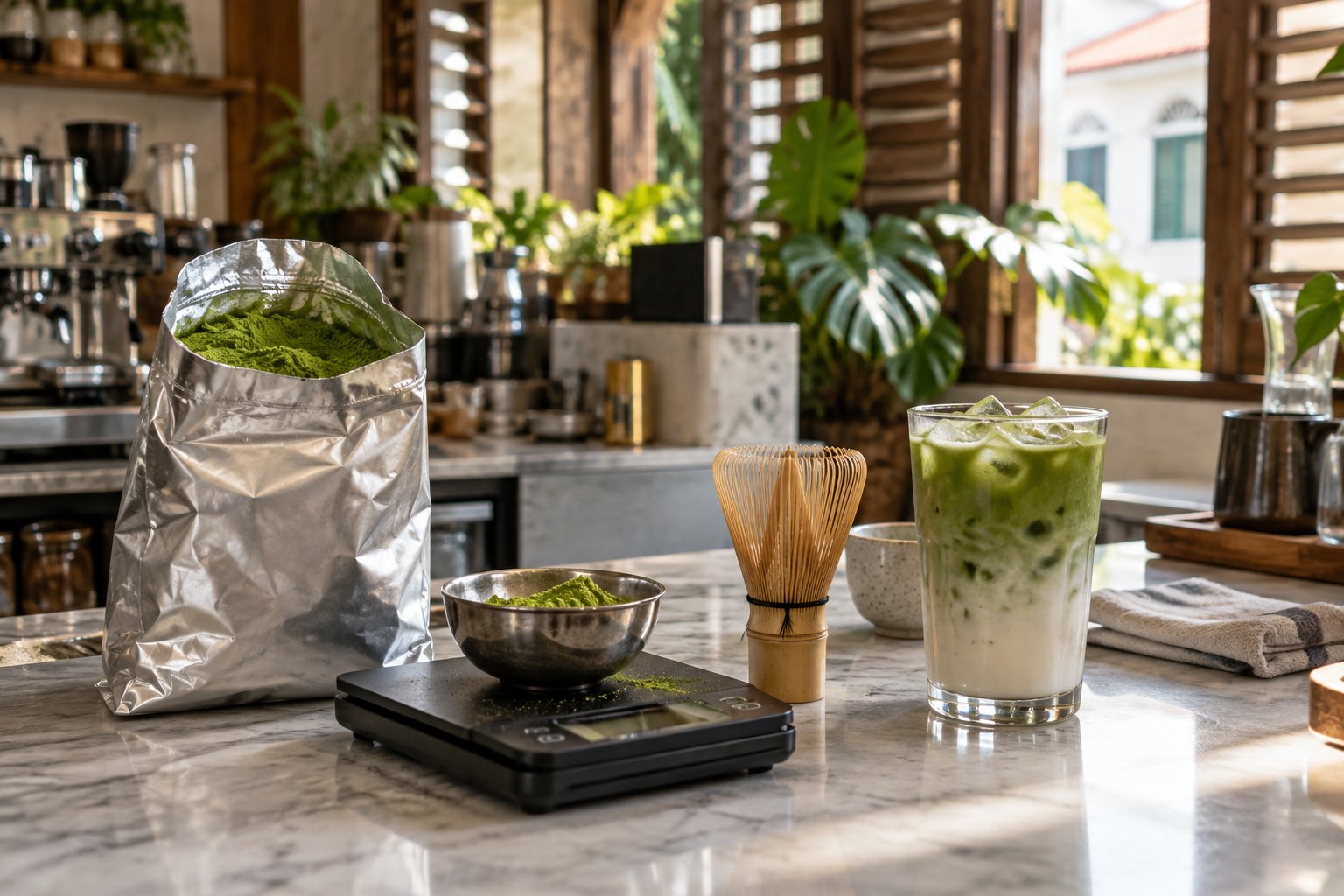
This café finishes an opened 1kg bag in about 11 days and keeps one unopened 1kg bag plus the remainder in the fridge. If a supplier’s minimum order quantity (minimum lot) is more than you use in a month, see Buying matcha wholesale.
When to review your order quantity
When your daily use changes, recalculate the reorder point and the amount per order. The lecture slides also state that for products whose demand changes with the season, order quantity and reorder point need to be recalculated.
Seasons and new menu items
If iced drinks sell more in hot months or you add a new matcha drink, recalculate from daily use. In the month you launch a new drink, add the matcha used for test drinks.
Changing grams per drink or grade
Going from 3g to 2.5g per drink cuts monthly use for a café selling 30 drinks a day from 2.7kg to 2.25kg. When you change grade, allow for test drinks to check the taste of the new matcha. Grade differences are explained in Matcha grades, and choosing to fit your selling price in Choosing matcha for café lattes.
Tell your supplier your yearly volume early
The average first-flush trading price of tencha (the tea leaves used to make matcha) at the JA Zen-Noh Kyoto tea market rose from 5,402 yen per kg in 2024 to 17,797 yen in 2026 (as of 19 June), according to Ippodo Tea. Telling your supplier early how much you expect to use in a year makes it easier to discuss volume and price. The background is in Is there still a matcha shortage?
Omakase Matcha takes orders from 1kg per product, and you can request up to 3 kinds of samples. Terms for each country are on the wholesale page.
Sources
Checked on 22 October 2026.
- Ippodo Tea, “Matcha Latte” https://ippodotea.com/blogs/recipes-to-brew-japanese-tea/matcha-latte-recipe
- Ippodo Tea, “Iced Matcha Latte” https://ippodotea.com/blogs/recipes-to-brew-japanese-tea/iced-matcha-latte
- Ippodo Tea, “Usucha (Classic Matcha)” https://ippodotea.com/blogs/recipes-to-brew-japanese-tea/usucha-thin-matcha
- Ippodo Tea, “How to Keep Your Matcha Fresh” https://ippodotea.com/blogs/ippodo-tea-blog/how-to-keep-your-matcha-fresh
- Ito En, “茶リスタ 小山和裕氏監修!本格抹茶ラテ” (Authentic matcha latte supervised by tea barista Kazuhiro Koyama, in Japanese) https://www.itoen.jp/recipe/45614/
- Kurasu Kyoto, “Kurasu Blend / SUI 美味しい『抹茶ラテ』のレシピ” (Matcha latte recipe, in Japanese) https://jp.kurasu.kyoto/blogs/kurasu-journal/okumidori-no-sugar-recipe
- Matchaful, “Recipe: Coconut Water Matcha” https://www.matchaful.com/blogs/the-matchaful-blog/coconut-water-matcha
- MAFF, aff April 2017, “特集2 抹茶(2)” (Feature: matcha, part 2, in Japanese) https://www.maff.go.jp/j/pr/aff/1704/spe2_02.html
- Japan Post, “お届け日数表(EMS)” (EMS delivery days, in Japanese) https://www.post.japanpost.jp/send/oversea/date/ems/index.html
- Japan Post, “お届け日数表(EMS:東京)” (EMS delivery days from Tokyo, in Japanese) https://www.post.japanpost.jp/send/oversea/date/ems/tokyo.html
- Japan Post, “お届け日数表(EMS:東海)” (EMS delivery days from Tokai, in Japanese) https://www.post.japanpost.jp/send/oversea/date/ems/tokai.html
- Japan Post, “お届け日数表(EMS:近畿)” (EMS delivery days from Kinki, in Japanese) https://www.post.japanpost.jp/send/oversea/date/ems/kinki.html
- Japan Post, “お届け日数表(EMS:九州)” (EMS delivery days from Kyushu, in Japanese) https://www.post.japanpost.jp/send/oversea/date/ems/kyushu.html
- Kurokawa Hisayuki (Tokyo University of Marine Science and Technology), inventory management lecture slides “発注方式①” (Ordering methods 1, in Japanese) https://www2.kaiyodai.ac.jp/~kurokawa/lecture/im/m/im09.pdf
- Singapore Food Agency, “Application Process & Fees for Licence / Permit / Registration for Import / Export” https://www.sfa.gov.sg/food-import-export/licence-permit-registration/application-process-fees-for-licence-permit-registration-for-import-export
- BPOM Regulation No. 27 of 2022, amended by No. 28 of 2023 (supervision of drug and food imports, in Indonesian) https://pasal.id/peraturan/perban/peraturan-bpom-no-28-tahun-2023
- Ippodo Tea, “2026年10月・11月 商品仕様の見直しと価格改定について” (Product specification changes and price revisions for October and November 2026, 1 September 2026, in Japanese) https://www.ippodo-tea.co.jp/blogs/news/20260901
- Haraguchi Yasuhiro et al., “原料抹茶の保存条件が品質に与える影響” (Effect of storage conditions on the quality of raw matcha), Tea Research Journal No. 93 (2002, in Japanese) https://www.jstage.jst.go.jp/article/cha1953/2002/93/2002_93_1/_pdf