
 Reviewed by: Takahiro Sugiyama (CEO, meguri Inc.)
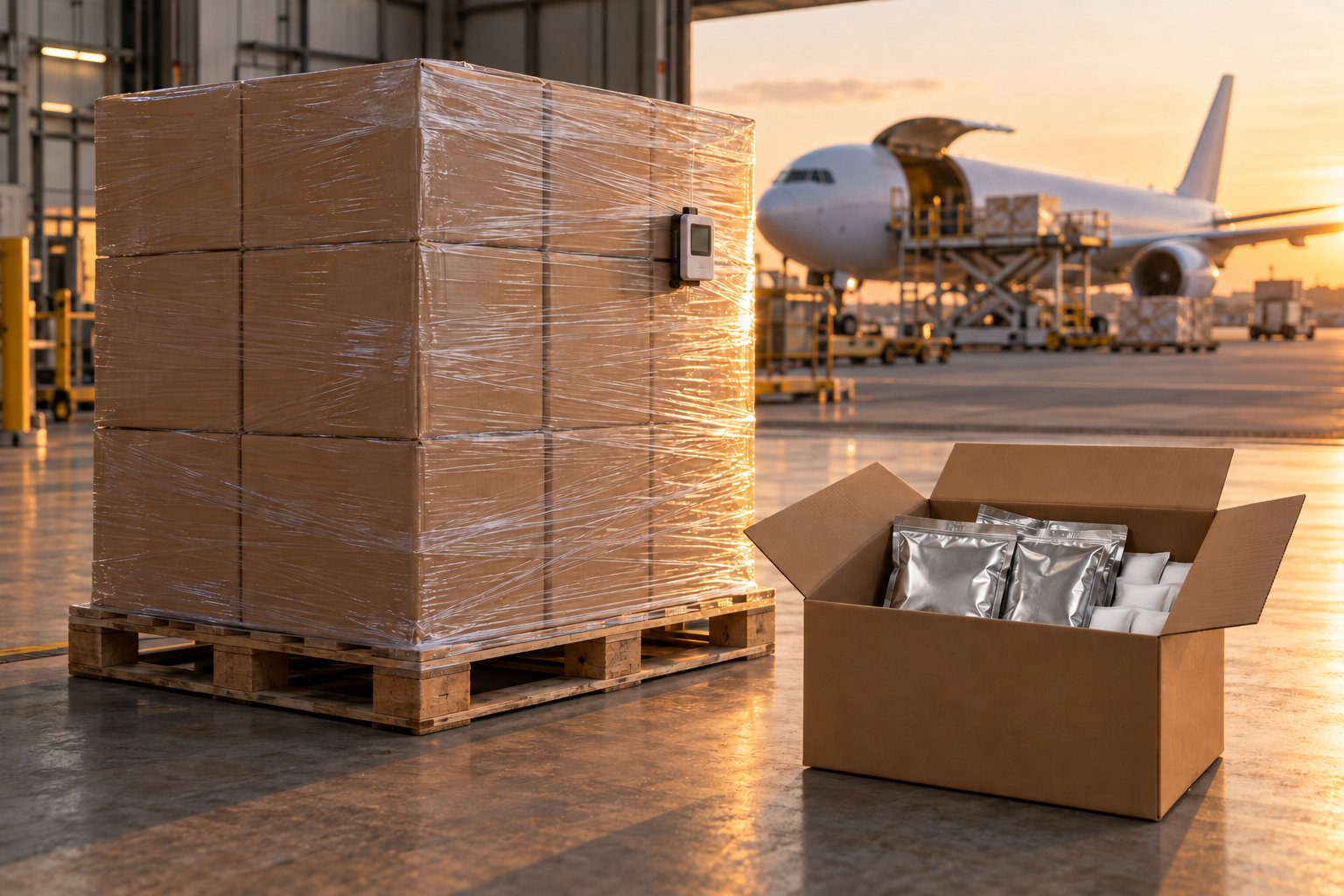
When you order matcha from Japan, a quote usually lists EMS, international couriers such as FedEx or DHL, air freight and sea freight. If you choose by freight cost alone, the goods can be held at customs or left in a hot warehouse, and the matcha may arrive with less colour and aroma. This article sets out, for each method, who handles customs, what happens to temperature and humidity in transit, and what to check on arrival, based on materials from Japan Post, Japan Customs, JETRO and MAFF.
Four ways to ship matcha from Japan
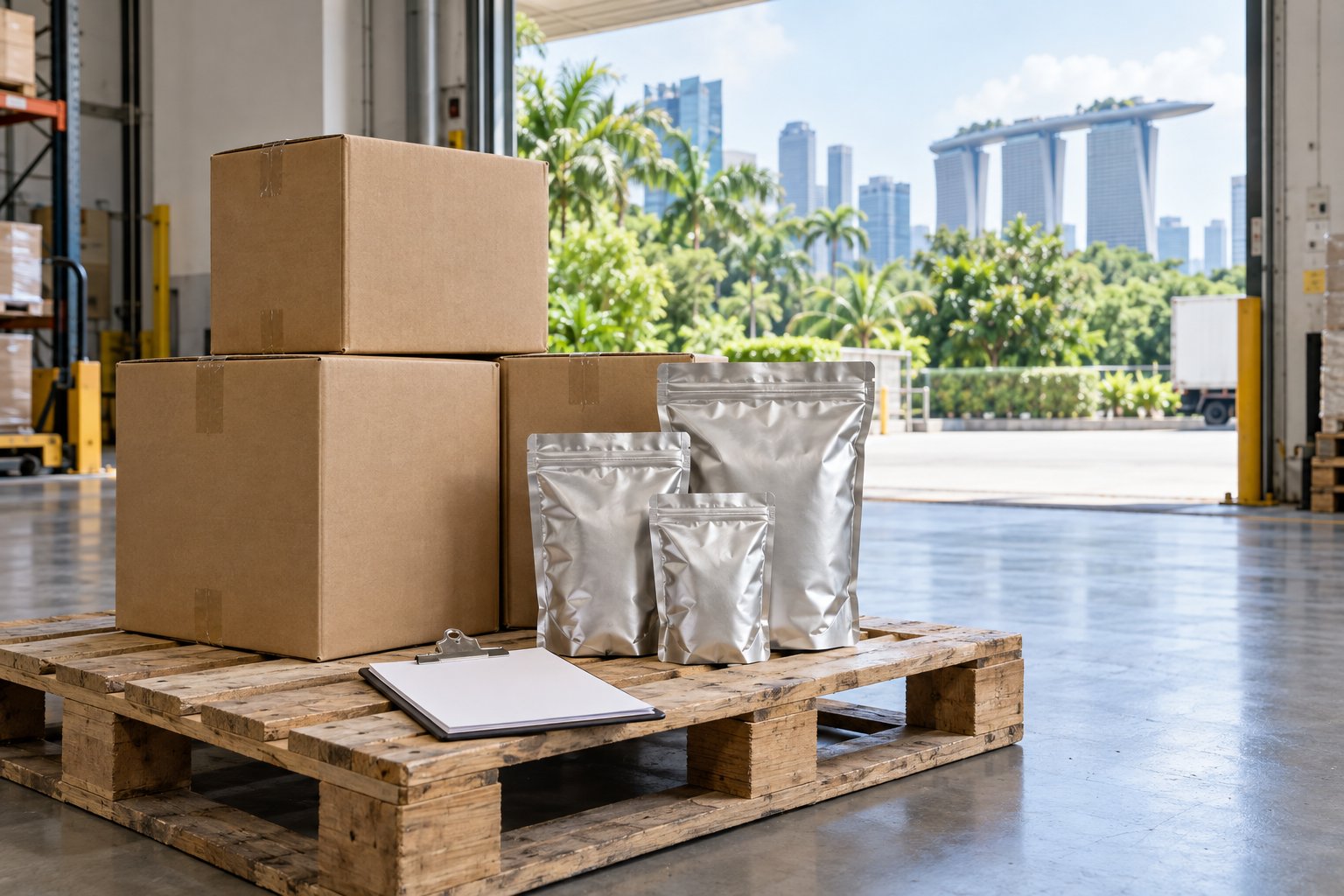
There are four ways to ship matcha from Japan: post (EMS), international courier, air freight and sea freight. Choose by quantity and by who handles customs procedures.
| Method | Suited quantity | Export procedure in Japan | Carrier |
|---|---|---|---|
| EMS (Japan Post’s international express mail) | Samples up to 30kg | Export declaration if contents total over 200,000 yen | Japan Post and the post office of the destination country |
| International courier (FedEx, DHL, etc.) | Samples to small lots | How much the company handles depends on the company and service | The courier company |
| Air freight | Larger lots | Export declaration by the exporter or a customs broker acting for them | The airline, booked by a freight forwarder |
| Sea freight | Even larger lots | Same as above | The shipping line. FCL (renting a whole container) or LCL (sharing a container) |
Export declaration in Japan, and import procedures at the destination
According to Japan Customs, the export declaration is made by the exporter or by a customs broker acting for the exporter. Whichever method you use, import procedures after arrival in Singapore, Thailand or Indonesia (the importer’s registration and permits, and payment of duties and taxes) are needed separately.
Choose by quantity and use
Our editors suggest thinking about it this way:
- Samples to compare regions or grades: EMS or an international courier. Each shipment is small and can be tracked
- First orders or monthly restocking: EMS or an international courier, then air freight as quantities grow. Having the matcha delivered in amounts that fit your shop’s fridge shortens how long it sits in the shop
- A year’s supply in one shipment: consider sea freight. The time from arrival until the matcha is used up gets longer, so secure cool storage first
With every method, the freight cost depends on weight, size and season. Get quotes for several methods for the same quantity and the same destination, and compare them side by side.
Conditions for sending by EMS
EMS is Japan Post’s fastest international mail service, carrying items up to 30kg to more than 120 countries and regions. It suits samples and small amounts of matcha, but there are conditions for each country and different procedures depending on value.
Contents over 200,000 yen need an export declaration
According to Japan Post, international mail, including EMS, whose contents total more than 200,000 yen needs an export declaration to customs and an export permit. You can ask Japan Post to make the declaration for you, for a fee of 2,800 yen per declaration. You prepare an invoice in English and a customs power of attorney. When two or more items are sent to the same recipient at the same time, the contents of all the boxes are added together to see whether they exceed 200,000 yen.
Singapore: watch the “processed food, 5kg, 100 Singapore dollars” rule
In Japan Post’s international mail conditions table, tea is not on the list of prohibited items for Singapore. However, the table says processed food with a gross weight over 5kg and a value over 100 Singapore dollars needs prior permission from the relevant authority.
| Item | Details | Condition | Mail types |
|---|---|---|---|
| Processed food | Processed food with a gross weight over 5kg and a value over 100 Singapore dollars requires prior permission from the relevant authority (Agri-Food and Veterinary Authority) | Conditionally permitted | Letter post, parcels, EMS |
Source: Japan Post, “国際郵便条件表(国・地域別情報)シンガポール 禁制品” (International mail conditions table, Singapore, prohibited items, in Japanese) https://www.post.japanpost.jp/cgi-kokusai/nonmailable_articles.php?cid=179
The authority named in the table is a former name. Food imports are now handled by the Singapore Food Agency (SFA). If you import matcha to sell in a shop, you need the importing company’s registration and an import permit for each shipment, even below this amount. Details are in How to Import Matcha into Singapore.
Japan Post’s conditions table also says that EMS to Singapore is delivered Monday to Saturday, and that taxed items may have to be collected at customs.
Thailand: shipments can be held if the contents are not fully declared
Prohibited items for Thailand include meat products and matches. Tea is not on the list. However, Japan Post’s conditions table says that if the recipient’s address and the number, net weight and value of the items are not entered, customs may not allow the import. Importing matcha to sell in a shop also needs a Thai FDA licence and a food registration number (How to Import Matcha into Thailand).
Indonesia: a standard 8 days from Tokyo
In Japan Post’s table of EMS delivery days, the standard time from Tokyo to Indonesia is 8 days. Importing matcha to sell in a shop needs a local importer holding a distribution permit (ML number) from the Indonesian Food and Drug Authority (BPOM). Halal certification for imported food and beverages was due to become mandatory on 18 October 2026, but in October 2026 the government announced it will start on 18 October 2028; the regulation amendment is still to come (Bulk Matcha: How to Buy Matcha Wholesale).
Cool EMS: suspended for Thailand
Cool EMS, which carries goods chilled (0 to 10°C), delivers in as little as two days after the day of posting. It can be used for Singapore, but as of 20 October 2026, Japan Post is not accepting Cool EMS for Thailand. Indonesia is not a Cool EMS destination.
| Cool EMS destination | Status |
|---|---|
| Taiwan | Available |
| Hong Kong | Acceptance suspended |
| Vietnam | Available |
| Thailand | Acceptance suspended |
| Malaysia | Available |
| Singapore | Available |
Source: Japan Post, “クールEMS” (Cool EMS, in Japanese) https://www.post.japanpost.jp/service/send/oversea/list/delivery/ems/cool/index.html
Cool EMS to Singapore has these conditions: chilled items must be pre-cooled at 10°C or below for at least 6 hours before posting, items whose contents total over 200,000 yen are not accepted, chilled items are limited to 15kg, and a booking must be made by noon on the Wednesday of the week before posting. Japan Post also says that, as of 20 October 2026, post offices in western Japan (excluding Kyushu) have suspended Cool EMS.
Air freight and international couriers: who handles customs
As quantities grow, use air freight or an international courier. Both go by plane, but who handles the procedures is different.
International couriers: check how much customs work is included
International couriers such as FedEx and DHL are convenient when you need a small amount quickly. How much export and import customs work is included differs by company and service, so check this in the quote. As with mail, import permits are needed (registration and permits in Singapore, a Thai FDA licence in Thailand, a BPOM distribution permit in Indonesia), so have the importer’s details ready before the goods are sent.
Air freight: ask a forwarder to arrange it
For air freight, in many cases a freight forwarder (a company that arranges transport) books space with an airline, and a customs broker acting for the exporter makes the export declaration. At the destination, the importer, or a customs broker hired by the importer, handles import procedures. In the quote, check whether delivery from the airport to your shop is included.
Sea freight: LCL, FCL and reefer containers
Sea freight is either FCL, where you rent a whole container, or LCL (consolidated cargo), where you share one with other shippers. For goods such as matcha that are sensitive to heat and humidity, also decide whether to use a temperature-controlled container.
FCL and LCL
According to JETRO, with FCL (Full Container Load), the exporter loads the container at its own warehouse and hands it to the shipping line at the container yard (CY) at the port. With LCL (Less than Container Load), the cargo is handed over at a consolidation facility at the port (CFS, container freight station), and the shipping line packs it into a container with other shippers’ cargo. LCL cargo is also delivered at a CFS at the destination port.
Whether to use a reefer container
A reefer container is a refrigerated container that keeps a steady temperature with a built-in cooling unit (MAFF handbook). We could not find any official standard for reefer temperatures for matcha. If you ship a large quantity by sea, our editors suggest getting quotes for both a standard container and a reefer, and comparing storage at the port and the number of days as well.
Temperature and humidity in transit
The higher the temperature and the more moisture it absorbs, the faster matcha deteriorates. Temperatures in Singapore and Thailand are higher than the temperature at which quality held in a storage test, so pay attention to temperatures in transit and while waiting at ports and airports.
25°C and 37°C make a large difference
In a storage test of raw matcha for processing, published in the Tea Research Journal (Japan), matcha stored at 25°C or below kept its product characteristics for 24 weeks, while at 37°C it was rated unusable within 3 to 4 weeks. Temperatures in Singapore and Bangkok and storage in the shop are covered in Does Matcha Go Bad?.
Moisture has a large effect
When Kyoto Prefecture’s tea research institute tested green tea, it found that, of temperature, oxygen and moisture, moisture had a large effect, and tea that had absorbed moisture turned reddish and astringent after a month. Do not use matcha from a bag that is torn or has a pinhole (a tiny hole), even if the outer box looks normal.
Goods can travel at ambient temperature even by air
MAFF’s handbook on exporting fresh fruit and vegetables says, using peaches as an example, that air transport is at ambient temperature during transit too. This is about fresh produce, not matcha. Even when the flight is short, goods wait at airports for loading and customs. If you want the goods kept chilled, ask your forwarder whether temperature control can be arranged, including storage at airports.
What to check in the packing
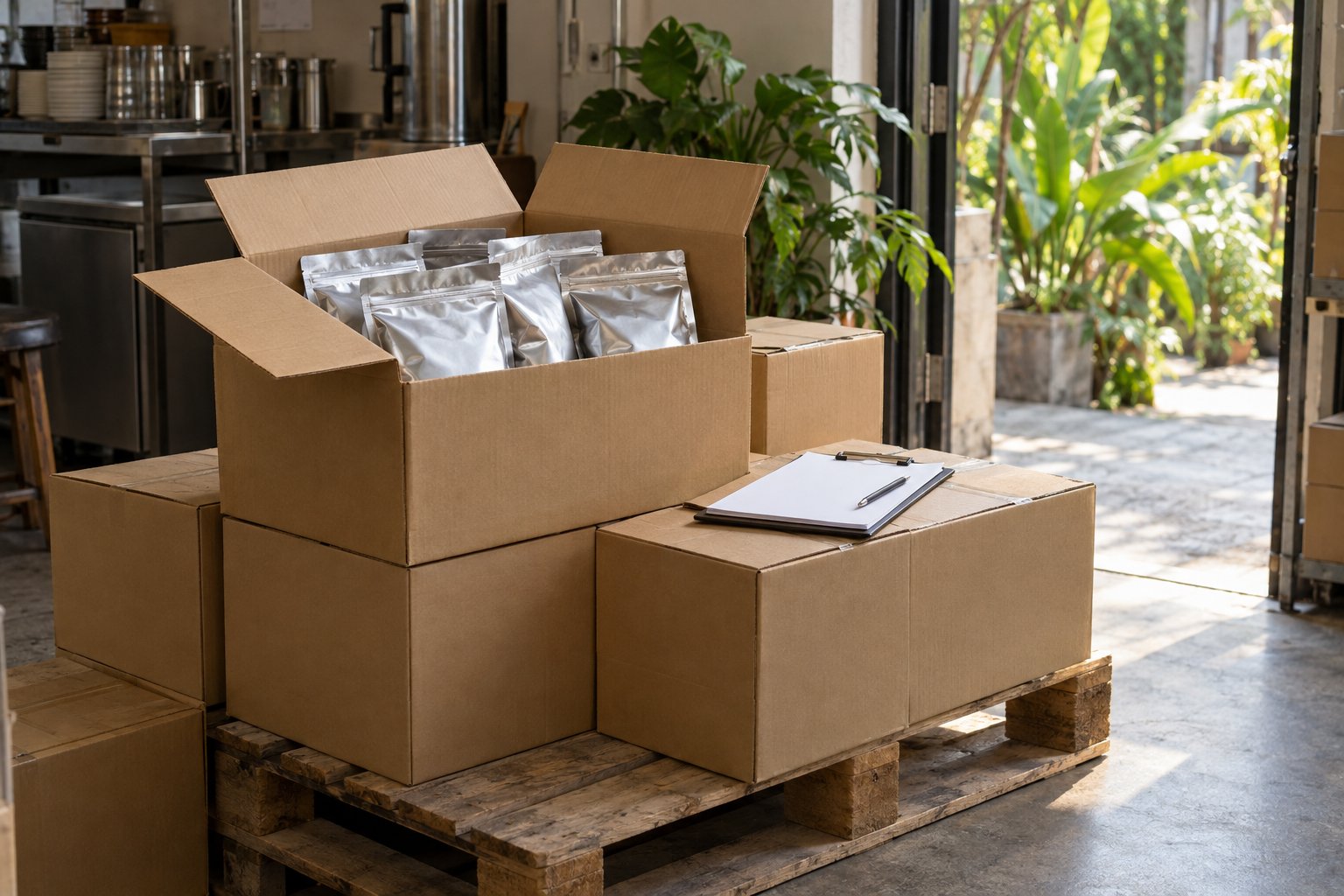
Before shipment, confirm with your supplier that the matcha bags keep out moisture and oxygen, and that the outer boxes will not collapse from humidity. Insurance does not cover damage caused by insufficient packing, so packing also matters for any claim after arrival.
Bags: sealing and oxygen absorbers
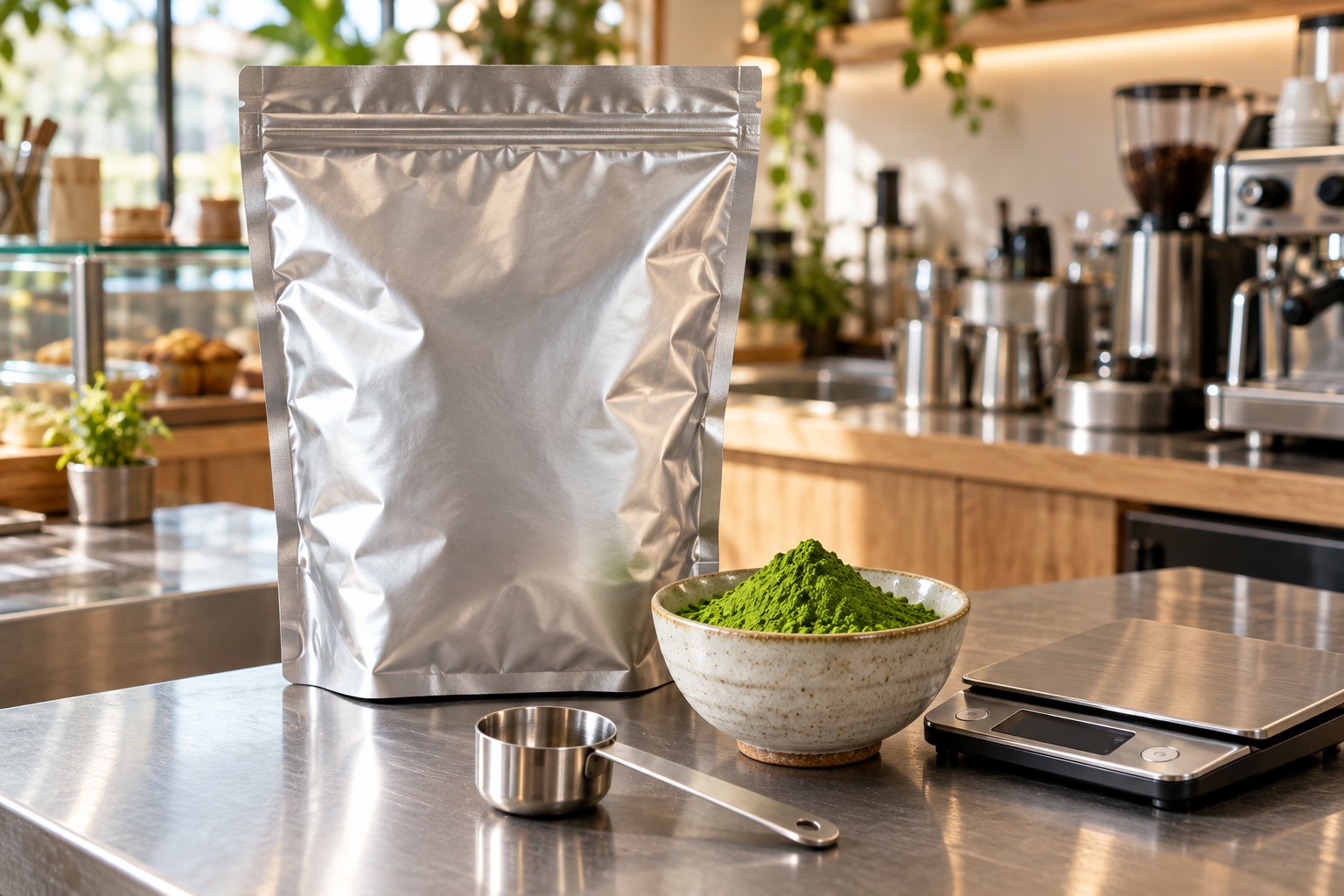
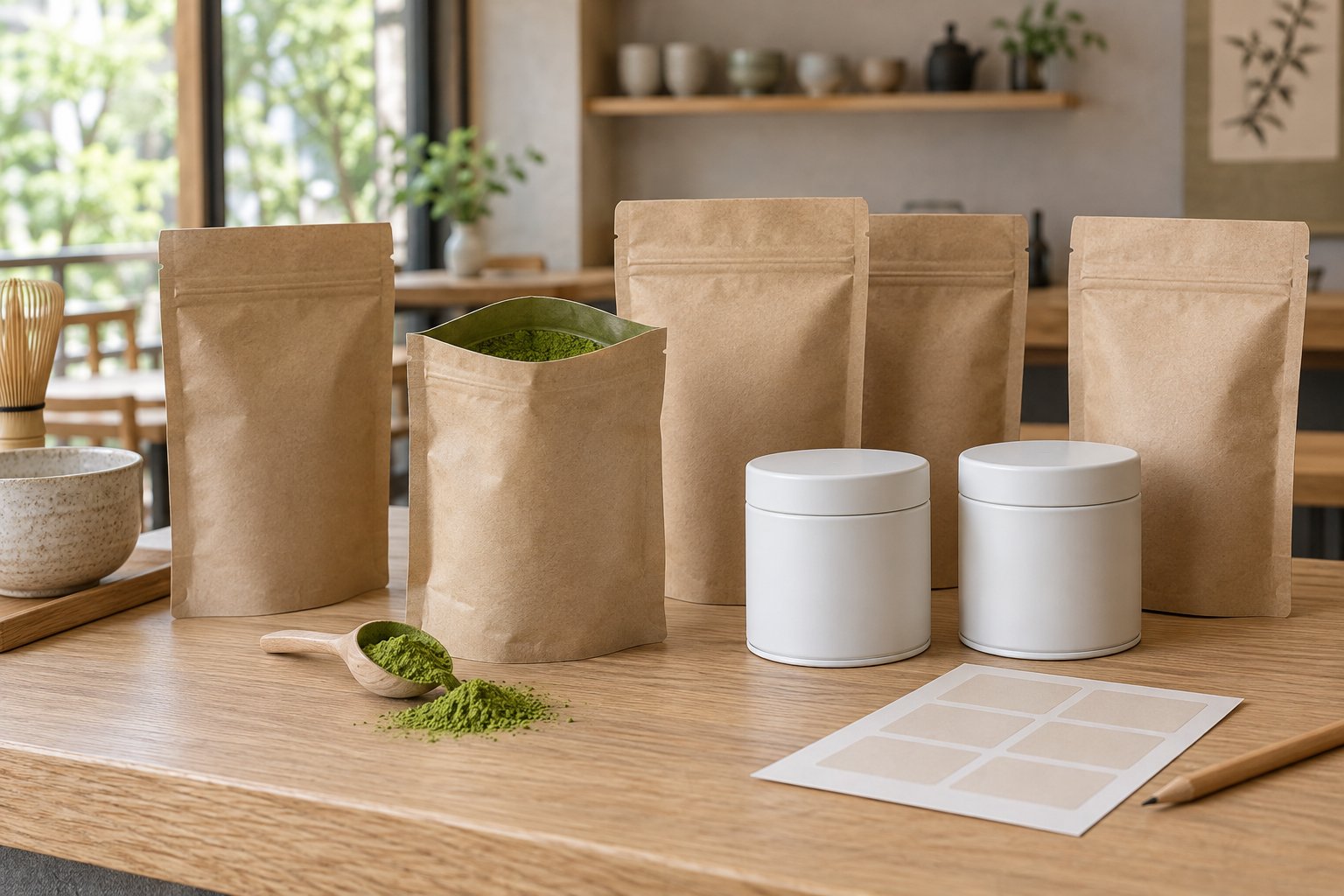
Yamamasa Koyamaen, a tea merchant in Kyoto, seals its matcha bags with an oxygen absorber (a small sachet that absorbs oxygen in the bag) and guarantees a best-before period of 8 months if unopened and kept away from high temperatures. Ask your supplier about the bag material, whether oxygen absorbers or desiccants are included, and the weight of each bag. Bags small enough to use up after opening also reduce deterioration in the shop.
Outer boxes: humidity weakens cardboard
MAFF’s handbook on exporting fresh fruit and vegetables says that when outside humidity is high, for example during sea transport, cardboard absorbs moisture and loses strength, and loads can collapse. For sea freight, also check the strength of the outer boxes and how they are secured to the pallet (the platform the cargo sits on).
Cargo insurance, and what it does not cover
Cargo insurance covers damage from accidents in transit, but a loss of matcha quality is often not covered under standard conditions. Decide first, under your trade terms, who insures the goods and how far the cover goes.
Who takes out insurance
According to JETRO, marine cargo insurance also covers air cargo, and the insured amount is usually capped at the CIF value (the price of the goods plus freight and insurance) plus 10%. Cover normally runs from when the goods leave the warehouse at the shipping end until they enter the warehouse at the destination. Even before the goods reach the destination warehouse, cover ends 60 days after they are unloaded from the ship (30 days after unloading from the aircraft for air cargo). Under DAP or DDP, the seller arranges insurance until the goods are handed over at the destination. Under terms such as FOB, where the buyer bears the risk, the buyer takes out insurance. The differences between trade terms are covered in Bulk Matcha: How to Buy Matcha Wholesale.
Losses that insurance does not cover
According to JETRO, even ICC (A) (the A clauses of the Institute Cargo Clauses), which has the widest cover, does not cover losses caused by insufficient packing, by the nature of the goods themselves, or by delay. MAFF’s handbook on exporting fresh fruit and vegetables (compiled by insurance companies and others under a MAFF-commissioned project) also says that standard marine cargo insurance does not cover rot, quality deterioration or temperature changes. The same handbook says some insurers offer products that cover rot and quality deterioration of fresh produce. This is written for fresh produce, so ask your insurer whether matcha can be covered and on what conditions.
EMS compensation
If an EMS item arrives broken or with contents missing, Japan Post compensates the actual loss, up to a maximum of 2 million yen. If the contents are worth more than 20,000 yen, the sender declares a compensation amount based on the value of the contents when posting. Up to 20,000 yen is free, and each further 20,000 yen costs 50 yen.
Checks on arrival, and who to contact
When the goods arrive, check the outer packing and the quantity on the spot, and have any problem noted on the delivery documents before accepting them. Damage found later is harder to prove happened in transit.
What to check on receipt
- Dents, wet patches or tears on the outer boxes, and whether the sealing tape has been opened
- Whether the number of boxes matches the quantity and weight on the packing list
- Whether the lot number on the bags (the number that shows when it was made) and the best-before date match the invoice and the certificate of analysis
- Whether bags have holes or are swollen, and whether the powder has clumped
- If a temperature data logger was packed, the highest temperature in transit
Let matcha that travelled chilled come back to room temperature with the bag still closed before opening it. Yamamasa Koyamaen says that opening it while cold causes condensation from the temperature difference, and the quality drops quickly.
Who to tell if you find damage
According to Japan Post’s guidance, when EMS sent from Japan arrives damaged, the recipient tells the sender in Japan, and the sender asks for an investigation at the post office where the item was posted. For EMS, a damage claim can only be made from the Japanese side, so send photos to the sender (your supplier) straight away.
According to JETRO, with FCL, if the container shows no damage from the outside, the shipping line issues the bill of lading with a note that the shipper packed it. This note means the shipping line is not responsible for the condition of the contents. With FCL, it is important to have any dents or holes on the outside of the container written on the documents when you receive it.
For sea freight, according to JETRO, obtain the equipment interchange receipt or cargo delivery receipt with the damage noted, and under the bill of lading terms, notify the shipping line within 3 days of delivery. Japan’s International Carriage of Goods by Sea Act (Article 7) also says the receiver must give the carrier written notice of the general nature of the damage when receiving the goods, or within 3 days of receipt if the damage cannot be found immediately. Without notice, the goods are presumed to have been delivered undamaged. According to JETRO, the deadline for a formal claim in Japan and the United States is 1 year from delivery. If the goods are insured, contact the insurer at the same time.
Import procedures, and leaving shipping to your supplier
Before choosing how to ship, decide who the importer is, what registration and permits they hold, and who pays duties and taxes. If this is not settled, the goods will be held at customs at the destination whichever method you use.
Singapore requires the importing company’s registration with the Singapore Food Agency (SFA) and an import permit for each shipment. Thailand requires a Thai FDA import licence and a food registration number. Indonesia requires a local importer holding a BPOM distribution permit (ML number); mandatory halal certification for imports is set to be pushed back to 18 October 2028. The steps are in How to Import Matcha into Singapore and How to Import Matcha into Thailand.
What to agree with your supplier before shipment
- Who the importer is (your shop or an import company), and their registration or permit numbers
- The trade term and place of delivery (for example, “DAP Bangkok”)
- The shipping method, and whether to specify a temperature
- Who takes out insurance, and on what conditions
- Documents: whichever of the invoice, packing list, certificate of origin and composition or analysis certificates the importing country and the customs broker require
- Who to contact, and where to send photos, if the goods arrive damaged
Once you know who the importer is, the shipping method and documents mostly follow.
Buying from Omakase Matcha
Omakase Matcha delivers to shops in Singapore on DDP terms, with duties and taxes paid by us, and to shops in Thailand and Indonesia on DAP terms, with duties and taxes paid by the shop on receipt. Payment is in advance by Wise or PayPal. You can request samples and see the terms for each country on the Wholesale page.
Sources
Checked on 20 October 2026. JETRO’s website has been suspended since 17 October 2026, so the three JETRO Q&A pages were checked on archived copies in the Internet Archive (web.archive.org).
- Japan Post, “EMS(国際スピード郵便)” (EMS, in Japanese) https://www.post.japanpost.jp/service/send/oversea/list/delivery/ems/
- Japan Post, “クールEMS” (Cool EMS, in Japanese) https://www.post.japanpost.jp/service/send/oversea/list/delivery/ems/cool/index.html
- Japan Post, “クールEMS シンガポール” (Cool EMS to Singapore, in Japanese) https://www.post.japanpost.jp/service/send/oversea/list/delivery/ems/cool/shipping_singapore.html
- Japan Post, “国際郵便条件表 シンガポール(禁制品)” (International mail conditions table, Singapore, prohibited items, in Japanese) https://www.post.japanpost.jp/cgi-kokusai/nonmailable_articles.php?cid=179
- Japan Post, “国際郵便条件表 タイ(禁制品)” (International mail conditions table, Thailand, prohibited items, in Japanese) https://www.post.japanpost.jp/cgi-kokusai/nonmailable_articles_print.php?cid=194
- Japan Post, “国際郵便条件表 タイ(送達条件)” (International mail conditions table, Thailand, delivery conditions, in Japanese) https://www.post.japanpost.jp/cgi-kokusai/country_hikaku.php?cid=194
- Japan Post, “内容品の合計価格が20万円を超える郵便物を海外へ発送されるお客さまへ” (Sending mail with contents over 200,000 yen, in Japanese) https://www.post.japanpost.jp/service/send/oversea/attention/sendover20/
- Japan Post, “EMSの損害賠償制度” (EMS compensation, in Japanese) https://www.post.japanpost.jp/service/send/oversea/list/delivery/ems/damage.html
- Japan Post, “もしものトラブル(日本から海外へ送った場合)” (If something goes wrong: items sent from Japan, in Japanese) https://www.post.japanpost.jp/service/send/oversea/use/howto/students/helpful/trouble.html
- Japan Customs, “輸出通関手続の概要(カスタムスアンサー5001)” (Outline of export customs procedures, Customs Answer 5001, in Japanese) https://www.customs.go.jp/tetsuzuki/c-answer/extsukan/5001_jr.htm
- JETRO, “荷主としての貨物への保険の種類と留意点:日本” (Types of cargo insurance for shippers, Japan, in Japanese) https://www.jetro.go.jp/world/qa/04A-010151.html (checked on the archived copy of 10 February 2026)
- JETRO, “貨物海上保険で填補できない免責事由と危険回避の対処:日本” (Exclusions in marine cargo insurance, Japan, in Japanese) https://www.jetro.go.jp/world/qa/04A-000A46.html (checked on the archived copy of 23 January 2026)
- JETRO, “貨物保険をかけ忘れた場合の船会社への損害賠償請求” (Claims against a shipping line when cargo was not insured, in Japanese) https://www.jetro.go.jp/world/qa/04A-A11049.html (checked on the archived copy of 21 May 2026)
- e-Gov Law Search, “国際海上物品運送法” (International Carriage of Goods by Sea Act, in Japanese) https://laws.e-gov.go.jp/law/332AC0000000172
- MAFF, “青果物の輸出における腐敗・品質劣化防止の手引き” (Handbook on preventing rot and quality deterioration in exports of fresh fruit and vegetables, March 2025, in Japanese) https://www.maff.go.jp/j/shokusan/export/e_enkatu/attach/pdf/index-12.pdf
- Haraguchi Y. et al., “原料抹茶の保存条件が品質に与える影響” (Effect of storage conditions on the quality of raw matcha), Tea Research Journal No. 93 (2002, in Japanese) https://www.jstage.jst.go.jp/article/cha1953/2002/93/2002_93_1/_pdf
- Kyoto Prefectural Agriculture, Forestry and Fisheries Technology Center, Tea Research Institute, “試験研究業務月報” (Monthly research report, February 2022, in Japanese) https://www.pref.kyoto.jp/nosoken/monthlyreport/documents/040203.pdf
- Yamamasa Koyamaen, “抹茶の取扱い” (Handling matcha, in Japanese) https://www.yamamasa-koyamaen.co.jp/matcha/basic/handling.html
- Japan Post, “お届け日数表(EMS:東京)” (EMS delivery days from Tokyo, in Japanese) https://www.post.japanpost.jp/send/oversea/date/ems/tokyo.html
- BPOM Regulation No. 28 of 2023 (supervision of drug and food imports, in Indonesian) https://pasal.id/peraturan/perban/peraturan-bpom-no-28-tahun-2023
- ANTARA, “Pemerintah memperpanjang penahapan sertifikasi halal hingga 2028” (17 October 2026, in Indonesian) https://www.antaranews.com/berita/5793025/pemerintah-memperpanjang-penahapan-sertifikasi-halal-hingga-2028
- ANTARA, “RI extends halal certification mandate for select sectors to Oct. 2028” (17 October 2026) https://en.antaranews.com/amp/news/436173/ri-extends-halal-certification-mandate-for-select-sectors-to-oct-2028