
 Reviewed by: Takahiro Sugiyama (CEO, meguri Inc.)
Some of the matcha sold to cafés in Thailand and Singapore is labelled “Nishio matcha.” Nishio is a matcha region in Aichi Prefecture, and in Japan the use of the name “Nishio no matcha” (Nishio matcha) is set by a trademark registered with the Japan Patent Office. Knowing where the leaves must be grown, where they must be made into matcha, and how much the region produces makes it easier to check what your supplier tells you.
What is Nishio matcha?
Nishio matcha is matcha made from tea leaves grown in Nishio city, Anjo city and the former Kira town in Aichi Prefecture, made into tencha in the same area and ground with a stone mill. It is registered with the Japan Patent Office as a regional collective trademark (a trademark that combines the name of a region with the name of a product). The holder is the Nishio Tea Cooperative Association, made up of tea growers and tea merchants.
The conditions registered with the Japan Patent Office
The regional collective trademark “Nishio no matcha” (registration number 5204296) covers matcha that meets the following conditions:
- It uses tea leaves grown in Nishio city, Anjo city or Kira town in Hazu district, Aichi Prefecture
- The leaves are processed into tencha (the tea leaves used as the raw material for matcha) and finished in the same area
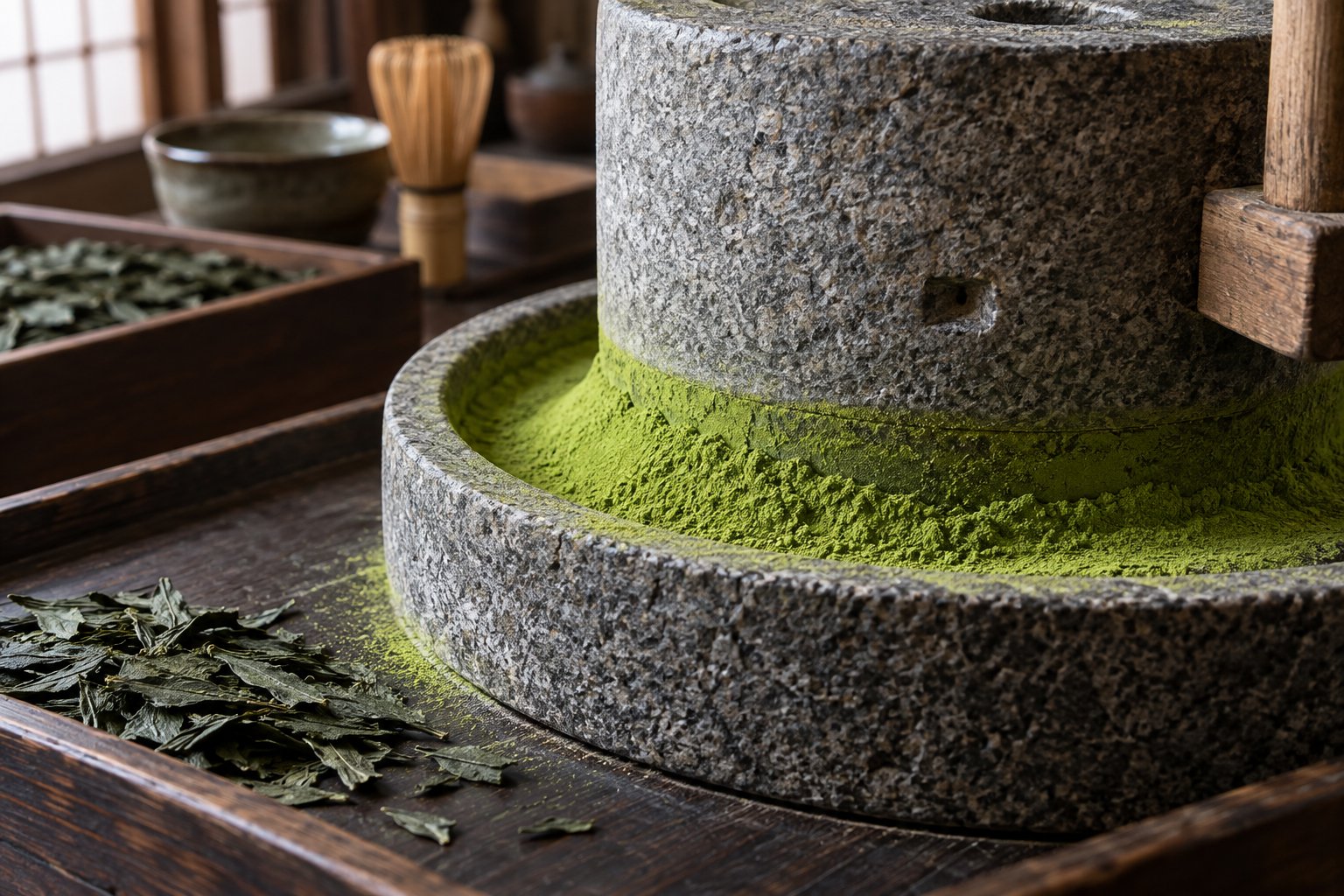
- The tencha is ground into matcha with a stone mill (chausu)
Kira town merged into Nishio city on 1 April 2011, together with Isshiki town and Hazu town. Both the place where the leaves are grown and the place where they are made into tencha and ground are limited to the area. This is the defining feature of the trademark.
| Item | Registered content (translated) |
|---|---|
| Trademark | 西尾の抹茶 (Nishio no matcha), registration number 5204296 |
| Holder | Nishio Tea Cooperative Association (Nishio city, Aichi Prefecture) |
| Designated goods | Matcha made from tea leaves grown in Nishio city, Anjo city and Kira town in Hazu district, Aichi Prefecture, processed into tencha and finished in the same area, and ground with a stone mill |
Source: Japan Patent Office, “商標登録第5204296号 西尾の抹茶” (Trademark registration No. 5204296, Nishio no matcha) https://www.jpo.go.jp/system/trademark/gaiyo/chidan/shoukai/ichiran/5204296.html
The Nishio Tea Cooperative Association
The Nishio Tea Cooperative Association was formed in 2007. It is made up of five organisations, including the Nishio Tea Wholesalers’ Association, the Nishio City Tea Growers’ Association and the Kira Tea Growers’ Association, and has 48 member companies.
The trademark and the geographical indication (GI)
In 2009, Nishio matcha became the first regional collective trademark in Japan limited to matcha. However, it is no longer a national geographical indication (GI, a system in which the government protects the link between a product’s origin and its quality); it was removed in 2020.
The first trademark limited to matcha
According to Nishio city’s “Nishio no Matcha Omotenashi Ordinance” and the Nishio Tea Cooperative Association, Nishio matcha was recognised by the Japan Patent Office as a regional collective trademark in 2009, the first in Japan limited to matcha. In the same year, the association created a brand mark (a design of a tea bowl and a tea whisk in matcha green), which is now shown on more than 400 products.
The Japan Patent Office’s list has five regional collective trademarks with “matcha” in the name: Kawagoe matcha, Kakegawa matcha, Nishio no matcha, Uji matcha and Yame matcha.
The GI registration was cancelled in 2020
Nishio matcha was registered as GI No. 27 with MAFF. According to MAFF’s public notice, the registered producer group, the Nishio Tea Cooperative Association, notified MAFF that the registration had lapsed. The registration lapsed on 3 February 2020 and was removed on 14 February 2020. What protects the name Nishio matcha today is the Japan Patent Office trademark, not a GI. The tea GIs currently registered are “Yame Dento Hon Gyokuro,” “Fukamushi Kikugawa Cha” and “Nihoncha” (Japanese tea), registered in July 2026.
History of Nishio matcha
Tea growing in Nishio goes back to the Kamakura period, and tencha became the main product from the late Taisho period. Nishio city’s ordinance describes Nishio as a city with “750 years of matcha history.”
According to the ordinance, the history runs as follows:
| Period | Event |
|---|---|
| Kamakura period | Shoichi Kokushi, founder of Jissoji temple, built in 1271 (Bun’ei 8), sowed the first tea seeds in the temple grounds |
| Meiji period | Tea production got fully under way |
| Late Taisho period | Growing and making tencha became the main activity, and remains so today |
A document from the Aichi Agricultural Research Center says that tencha growing in Aichi Prefecture began in Nishio city in 1906 and spread quickly in the lower Yahagi River area. Nishio city’s ordinance describes Nishio as blessed with a warm climate, and with rich soil and river fog brought by the Yahagi River.
Tencha production in Aichi Prefecture
Aichi Prefecture, which includes Nishio city, produced 463 tonnes of tencha in 2025, about 7% of Japan’s total, ranking fourth. We found no public statistics showing tencha volume by municipality, so the figures here are for the whole prefecture.
Tencha by prefecture (2025 harvest)
According to the National Federation of Tea Producers’ Associations, Japan produced 6,278 tonnes of tencha in 2025.
| Prefecture | Tencha | Share of Japan |
|---|---|---|
| Kagoshima | 2,670 tonnes | About 43% |
| Kyoto (including Uji) | 989 tonnes | About 16% |
| Shizuoka | 875 tonnes | About 14% |
| Aichi (including Nishio and Toyota) | 463 tonnes | About 7% |
| Mie | 398 tonnes | About 6% |
| Miyazaki | 304 tonnes | About 5% |
| Fukuoka (including Yame) | 280 tonnes | About 4% |
Shares are calculated from the national total.
The same Aichi Prefecture document says that tencha is grown mainly in Nishio city and Toyota city, that Aichi ranks fourth in Japan for tencha, and that a high share of Aichi’s tencha is ichibancha (the first tea picked each year).
Source: Aichi Prefecture, “2025年産茶の生産状況” (Tea production in 2025, National Federation of Tea Producers’ Associations survey) https://www.pref.aichi.jp/uploaded/attachment/622005.pdf
From second to fourth
In 2015, Aichi produced 505 tonnes of tencha and ranked second in Japan. In 2024 it produced 428 tonnes and ranked fourth, and in 2025 it produced 463 tonnes, still fourth. Over this period Japan’s total tencha output grew sharply: according to MAFF, the 2025 harvest was about 3.2 times that of 2014. Kyoto Prefecture says that Kagoshima Prefecture rapidly switched from sencha to tencha. From 2024 to 2025, Japan’s total rose by about 18% and Aichi’s by about 8%.
Some overseas articles and shop pages say that “Nishio produces 20 to 25% of Japan’s matcha,” but they either give no source or use old figures. By current volume, Aichi Prefecture, which includes Nishio, is the fourth-largest tencha region in Japan.
A region built around tencha
About 80% of the tea made in Aichi Prefecture is tencha. This sets it apart from Kagoshima and Shizuoka, where sencha is the main type.
Tencha as a share of aracha
Aracha is unfinished tea: picked leaves that have been steamed and dried but not yet finished. Using the 2025 figures from the National Federation of Tea Producers’ Associations, we calculated what share of each prefecture’s aracha is tencha.
| Prefecture | Aracha | Of which tencha | Tencha share |
|---|---|---|---|
| Aichi | 561 tonnes | 463 tonnes | About 83% |
| Kyoto | 2,121 tonnes | 989 tonnes | About 47% |
| Kagoshima | 30,000 tonnes | 2,670 tonnes | About 9% |
| Shizuoka | 24,100 tonnes | 875 tonnes | About 4% |
| Japan | 73,372 tonnes | 6,278 tonnes | About 9% |
On its website, Aichi Prefecture explains that “production of tencha, the raw material for matcha, is active” in the prefecture. The main tencha areas are Nishio city, Toyota city and Shinshiro city. The Toyota City Tea Growers’ Association has 21 growers and about 40 ha of tea fields, producing about 42 tonnes of aracha a year (2024 harvest), and more than 90% of it is tencha.
Share of ichibancha and cultivars
Aichi Prefecture says that a high share of the prefecture’s tencha is ichibancha. In a document by MAFF’s Tokai Regional Agricultural Administration Office summarising MAFF’s crop statistics, ichibancha made up 61% of Aichi’s aracha in 2020. In the same document, Mie Prefecture, which makes more second-flush and later tea, was at 41%.
Cultivars also differ. By tea field area in 2024, Yabukita accounts for 64.0% nationally, but in Aichi it is 53.9%, with Samidori, a cultivar suited to tencha, at 19.7% and Okumidori at 15.5%.
How Nishio tencha is grown and processed
Aichi Prefecture names three features of its tencha: tanagake (shading on a shelf frame built over the tea field), brick tencha furnaces and stone-mill grinding.
Shading and picking
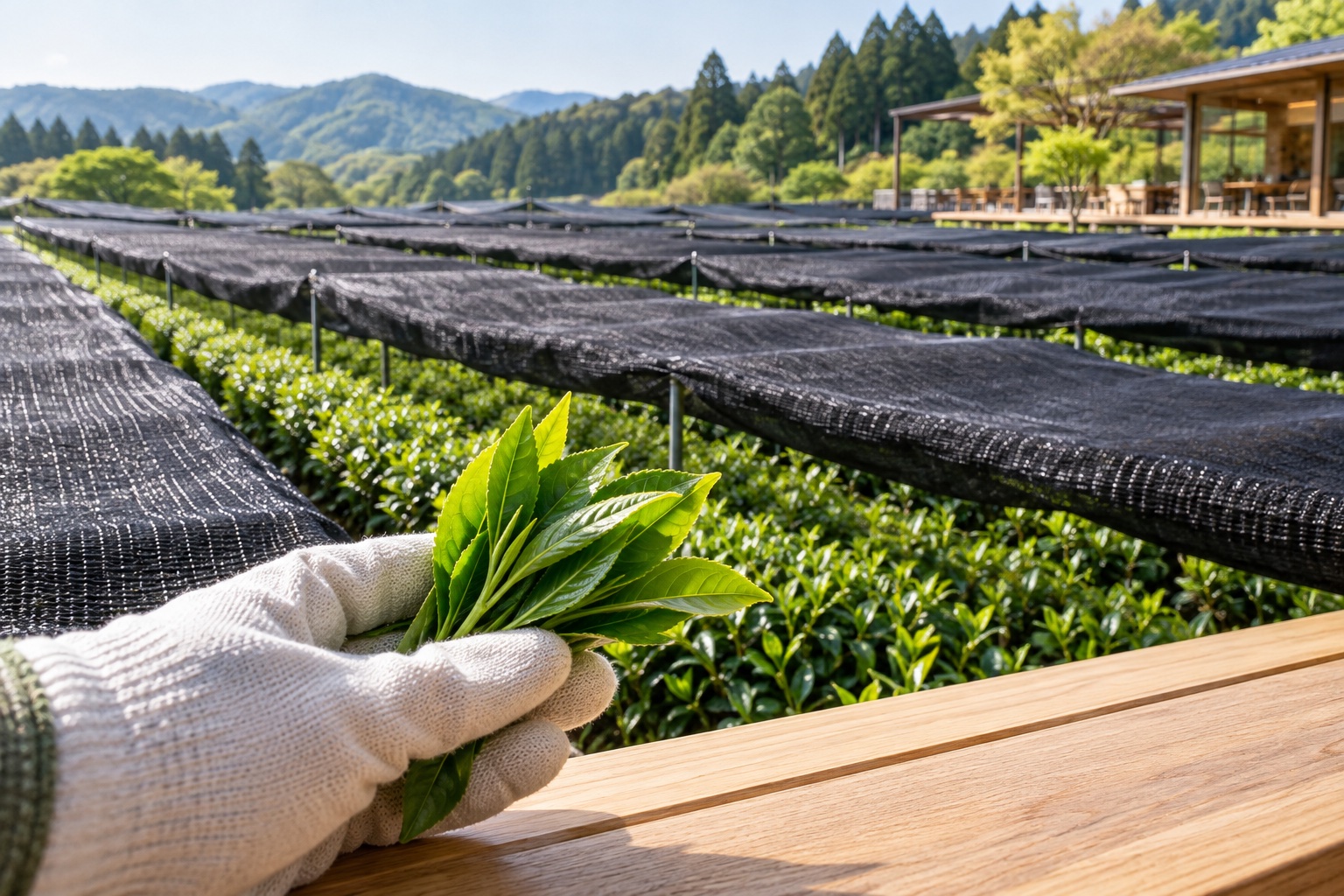
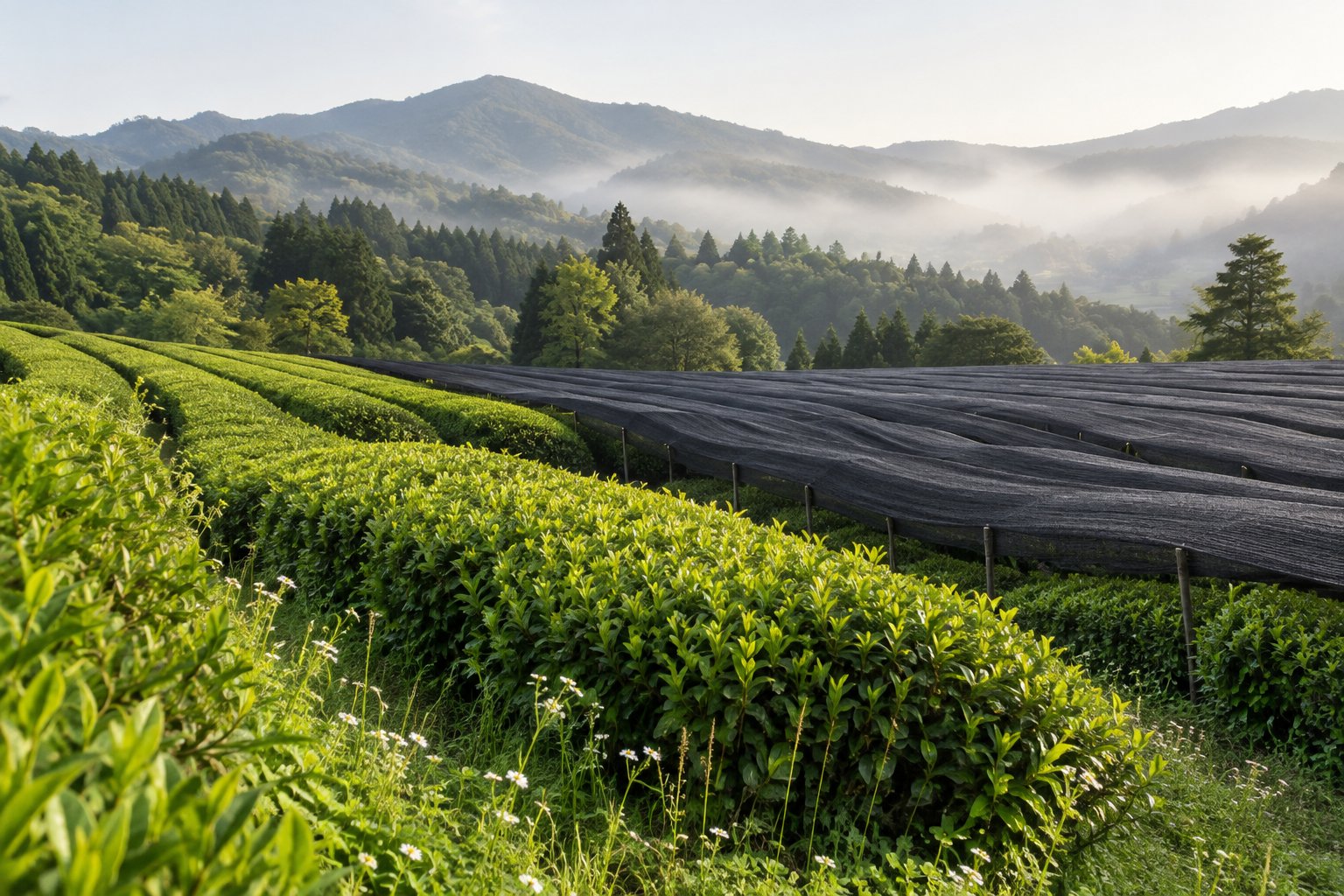
Tencha is grown by covering the new shoots before picking to block sunlight. According to Aichi Prefecture, most of the prefecture’s tencha is shaded indirectly: rather than laying the cover directly on the tea bushes, the cover is spread over a shelf frame. The Nishio Tea Cooperative Association also says it maintains shelf-style shade growing in Nishio city and Anjo city.
The materials used for shading have changed over time. According to the Aichi Agricultural Research Center, in the 1960s growers tried switching from hon-zu (reed screens topped with rice straw) to synthetic fibre covers. The research center developed growing methods that keep quality and yield with synthetic covers and machine picking. Even when a product carries the Nishio name, whether the tea was hand-picked or machine-picked differs from farm to farm.
Tencha furnaces and stone mills
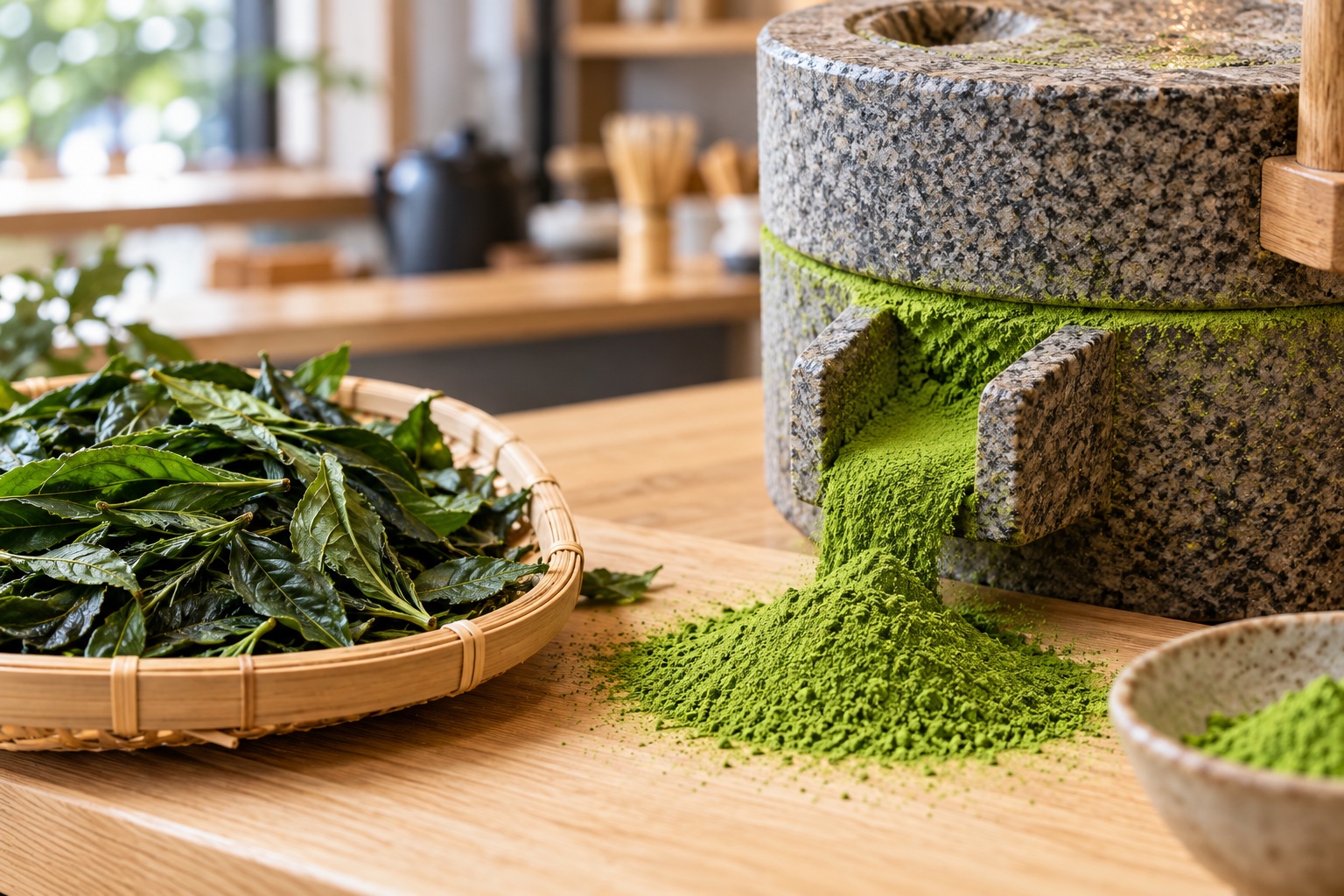
The picked leaves are steamed, then dried without rolling to make tencha. According to the Nishio Tea Cooperative Association, in Nishio the leaves are dried in a “Mikawa-style tencha drying furnace,” a brick furnace with five layers of mesh, and the finished tencha is ground in granite stone mills. “Ground with a stone mill” is also one of the trademark conditions.
How Nishio compares with Uji and Kagoshima
Uji, Nishio and Kagoshima differ in trademark scope, tencha volume and how much of their tea is tencha. We have not found any public data that compares taste by region.
| Item | Nishio (Aichi) | Uji (Kyoto) | Kagoshima |
|---|---|---|---|
| Regional collective trademark for matcha | Nishio no matcha | Uji matcha | None |
| Where the raw material must come from | Nishio city, Anjo city, former Kira town | Four prefectures: Kyoto, Nara, Shiga, Mie | — |
| Where it must be finished | Made into tencha and stone-ground in the same area | Finished inside Kyoto Prefecture by a Kyoto-based company | — |
| Tencha (2025 harvest) | 463 tonnes (Aichi) | 989 tonnes (Kyoto) | 2,670 tonnes |
| Tencha share of aracha | About 83% | About 47% | About 9% |
Because Uji matcha can use tea from four prefectures, its raw material can come from a much wider area than Nishio matcha. The definition of Uji matcha and where it is grown in Kyoto are covered in What Is Uji Matcha?, and Yame matcha from Fukuoka Prefecture in Yame Matcha. Kagoshima produces about 5.8 times as much tencha as Aichi, but has no regional collective trademark with “matcha” in the name.
Ranked by tencha volume, the order is Kagoshima, Kyoto, Shizuoka, then Aichi. Volume rank and suitability for lattes are separate questions.
What to check when buying “Nishio matcha” overseas
Even when a product carries the Nishio name, you need to check product by product whether it meets the trademark conditions. The Nishio Tea Cooperative Association has registered “NISHIO MATCHA” or its brand mark as a trademark in 10 countries and regions, and has held promotions in Singapore and, in 2020, in Bangkok.
What to confirm with your supplier
When buying matcha as Nishio matcha, confirm the following with your supplier in writing:
- Where the leaves were grown: which of Nishio city, Anjo city or the former Kira town
- Where they were made into tencha and where they were ground with a stone mill: whether both were inside the same area
- Brand mark: whether the product shows the Nishio Tea Cooperative Association’s mark
- Picking season: whether it is ichibancha, or includes second-flush and later tea
- Lot and test documents: whether origin, production date and test results such as pesticide residues are all available
Matcha made from Nishio-grown leaves but ground in another region does not meet the conditions of this trademark. Under the “Green Tea Labelling Standard” of the Japan Tea Central Public Interest Incorporated Association (a voluntary industry standard), a region name may be shown on the label only if at least 50% of the raw material comes from that region, and if it is less than 100%, the label must make clear that it is a blend.
Price, and choosing for lattes
According to Aichi Prefecture, tea prices in the prefecture for the 2025 harvest were about 20% higher than the year before, due to factors such as rising overseas demand for matcha. Why prices are rising and how this affects café buying is covered in Is There a Matcha Shortage?
When choosing for your café, deciding in this order makes it easier:
- Decide whether you need it for lattes or for drinking straight (Matcha grades)
- Work out the buying price you can afford from the cost per cup (How to Choose Matcha for Café Lattes)
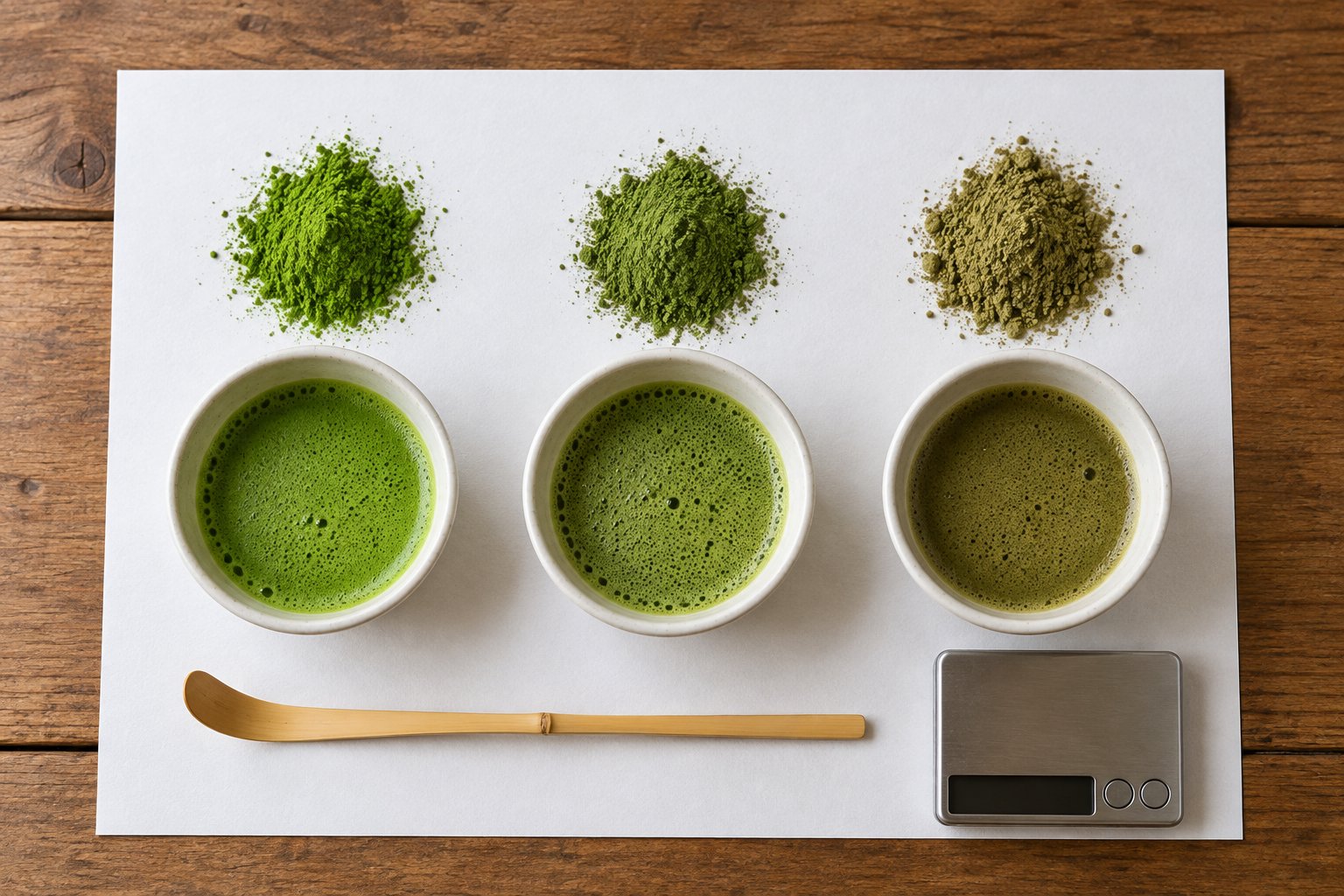
- Taste Nishio matcha side by side with matcha from other regions such as Uji and Kagoshima, using the same amount and the same milk
- Collect the origin, lot and test documents for the matcha you choose
The regions Omakase Matcha works with are listed on Origins.
Sources
- Japan Patent Office, “商標登録第5204296号 西尾の抹茶” (Trademark registration No. 5204296, Nishio no matcha, in Japanese) https://www.jpo.go.jp/system/trademark/gaiyo/chidan/shoukai/ichiran/5204296.html
- Japan Patent Office, “地域団体商標登録案件一覧” (List of registered regional collective trademarks, in Japanese) https://www.jpo.go.jp/system/trademark/gaiyo/chidan/shoukai/ichiran/index.html
- MAFF, “登録の消除の公示(登録番号第27号)” (Public notice of removal of registration No. 27, in Japanese) https://www.maff.go.jp/j/shokusan/gi_act/register/0027_elimination/index.html
- MAFF, “地理的表示(GI)保護制度 登録産品一覧” (List of registered GI products, in Japanese) https://www.maff.go.jp/j/shokusan/gi_act/register/index.html
- MAFF, “茶をめぐる情勢(令和8年10月)” (The situation of tea, October 2026, in Japanese) https://www.maff.go.jp/j/seisan/tokusan/cha/attach/pdf/ocha-201.pdf
- Kyoto Prefecture, “京都府茶業振興計画” (Kyoto Prefecture Tea Industry Promotion Plan, March 2025, in Japanese) https://www.pref.kyoto.jp/nosan/documents/2025kyoto_chagyousinkoukeikakui.pdf
- Ministry of Internal Affairs and Communications, “市町村合併資料集(愛知県)” (Municipal mergers: Aichi Prefecture, in Japanese) https://www.soumu.go.jp/gapei/hensen_aichi.html
- Aichi Prefecture, “2025年産茶の生産状況” (Tea production in 2025, National Federation of Tea Producers’ Associations survey, in Japanese) https://www.pref.aichi.jp/uploaded/attachment/622005.pdf
- Aichi Prefecture, “茶の栽培面積及び生産量(2024年産)” (Tea field area and production, 2024 harvest, in Japanese) https://www.pref.aichi.jp/uploaded/attachment/586547.pdf
- Aichi Prefecture, “あいちの茶” (Tea in Aichi, in Japanese) https://www.pref.aichi.jp/soshiki/engei/aichinocha.html
- Aichi Agricultural Research Center, “省力的にてん茶の品質向上” (Improving tencha quality with less labour, in Japanese) https://www.pref.aichi.jp/uploaded/attachment/233816.pdf
- Tokai Regional Agricultural Administration Office, “東海地域における茶の生産動向” (Tea production trends in the Tokai region, in Japanese) https://www.maff.go.jp/tokai/seisan/engei/tea/attach/pdf/index-3.pdf
- Nishio city, “西尾の抹茶おもてなし条例” (Nishio no Matcha Omotenashi Ordinance, in Japanese) https://www.city.nishio.aichi.jp/_res/projects/default_project/_page_/001/005/678/omotenasi.pdf
- Nishio Tea Cooperative Association, “西尾の抹茶について” (About Nishio no matcha, in Japanese) https://nishiomatcha.jp/about.html
- Nishio Tea Cooperative Association, “西尾茶協同組合について” (About the Nishio Tea Cooperative Association, in Japanese) https://nishiomatcha.jp/union.html
- Japan Tea Central Public Interest Incorporated Association, “緑茶の表示基準” (Green Tea Labelling Standard, in Japanese) https://www.nihon-cha.or.jp/pdf/hyoujikijyun.pdf