
 Reviewed by: Takahiro Sugiyama (CEO, meguri Inc.)
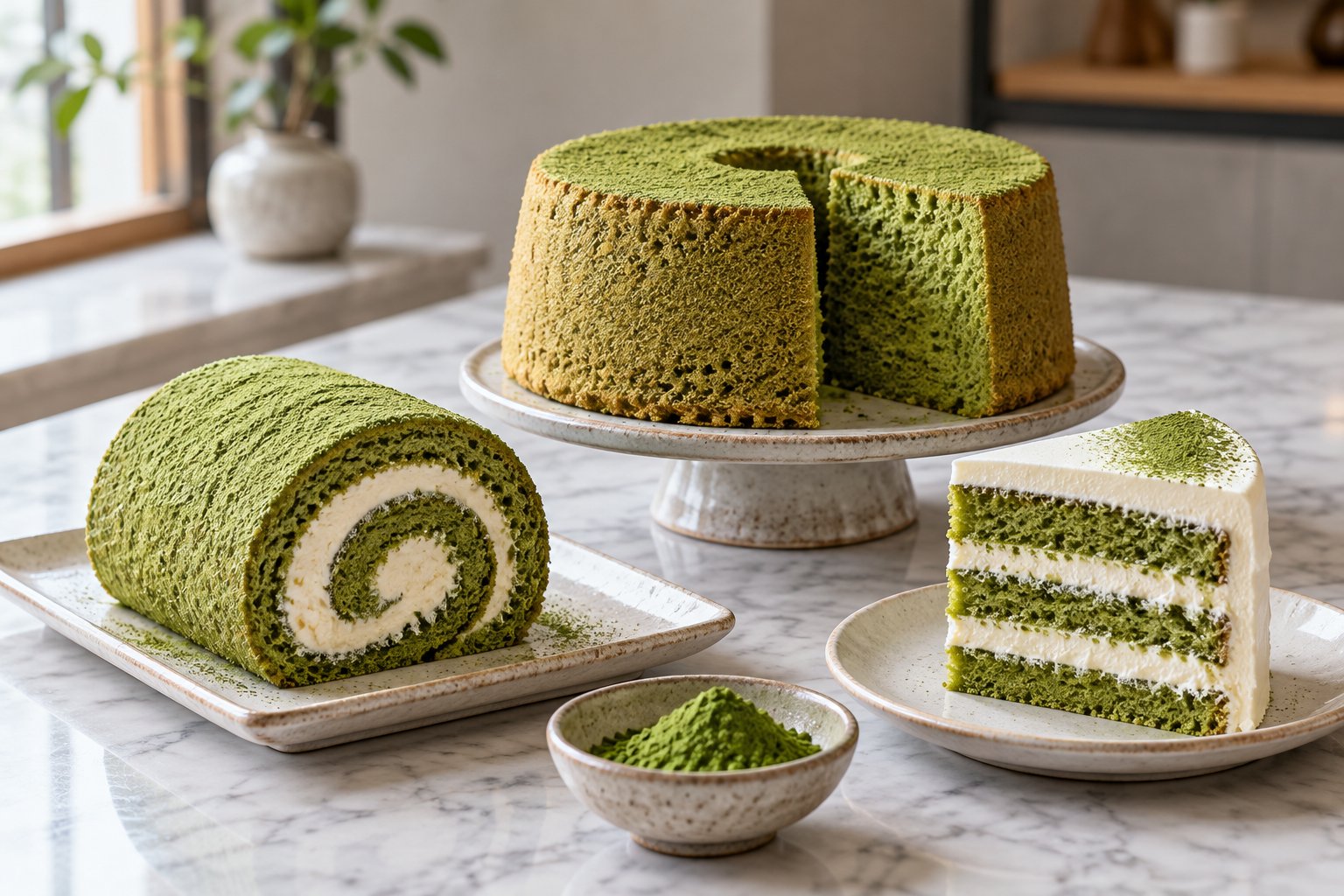
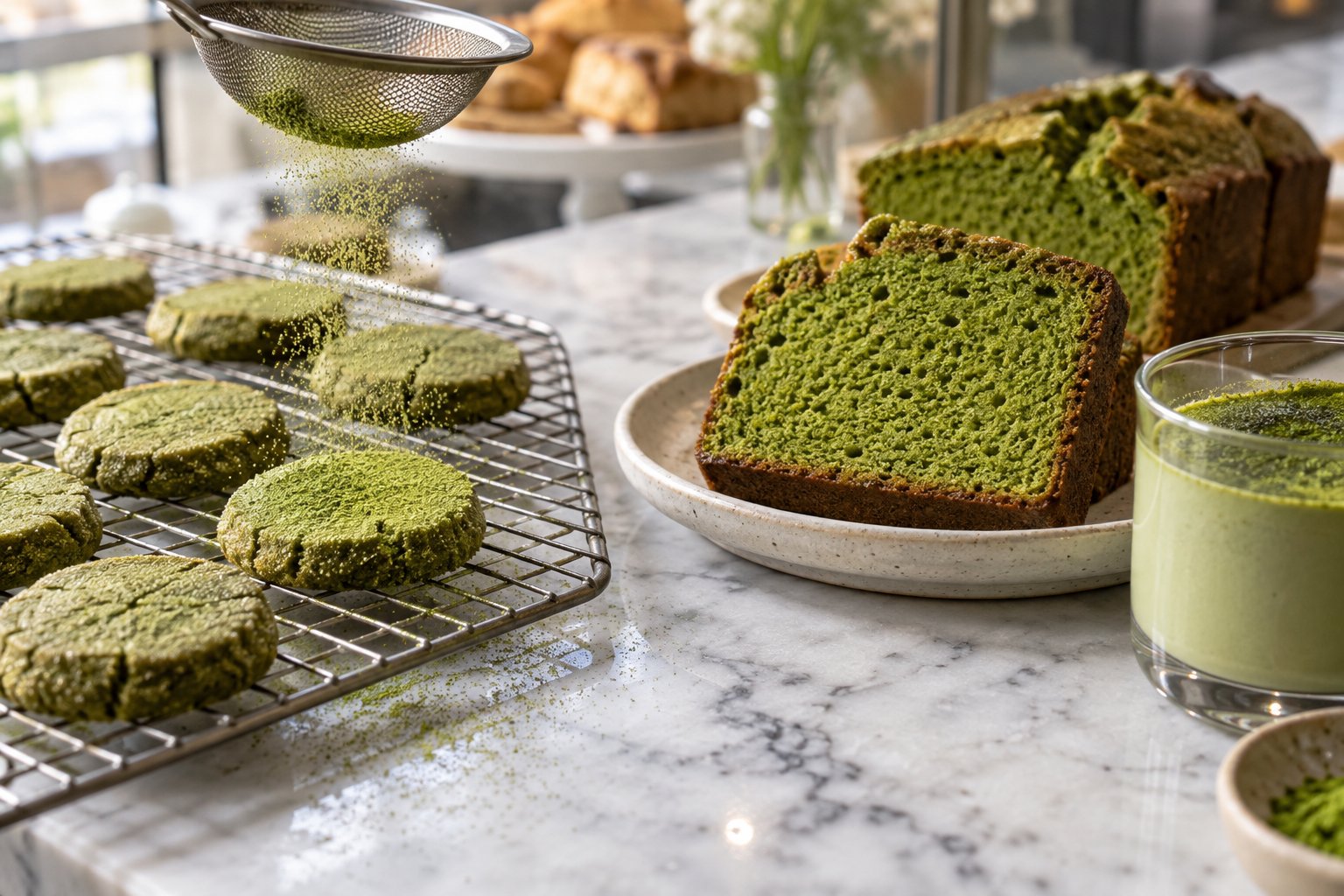
Matcha roll cakes and shortcakes catch the eye with their green sponge against white cream. But sponge cakes rise on the air beaten into eggs, so the way you add matcha can make the batter collapse, and baking and display can fade the green. We compared recipes published by Japanese dairy companies, a baking supplies shop and a government office, and checked colour, storage and cost step by step.
3 types of matcha cake: roll, chiffon and shortcake
Matcha sponge cakes served in cafés fall into 3 types: roll cake, baked thin and rolled; chiffon cake, baked tall in a tube pan; and shortcake (decorated cake), made of sponge layers covered in cream. Matcha can go into 3 places: the sponge, a syrup and the cream.
How the batter is whipped
There are 2 ways to whip a sponge batter: whole eggs whipped together (the “together” method, tomodate in Japanese), or yolks and whites whipped separately, with the whites made into meringue (the “separate” method, betsudate). Nisshin Seifun Group’s basic shortcake uses the whole-egg method because it gives a fluffier, softer cake, and says the separate method is easier to whip.
| Type | Batter | Official recipe examples |
|---|---|---|
| Roll cake | Spread thin on a sheet pan. Both methods are used | Morinaga Milk (separate-egg chiffon sponge), Megmilk Snow Brand (whole egg) |
| Chiffon cake | Meringue folded into an oil and yolk batter, baked in a tube pan and cooled upside down | Tomizawa Shoten, MAFF Hokuriku Regional Agricultural Administration Office (rice flour) |
| Shortcake | A whole-egg génoise (French sponge) is baked, cut into 3 layers and filled with cream | 2 recipes from Tomizawa Shoten |
Where the matcha goes
All 3 types put matcha in the sponge. Among the shortcakes, Tomizawa Shoten’s “Japanese-style square matcha shortcake” brushes matcha syrup onto the sponge and uses matcha cream only on the outside. The roll cakes from Morinaga Milk and Megmilk Snow Brand put no matcha in the cream. Keeping the cream white makes the green of the sponge stand out in the cross-section.
Matcha in official recipes: about 3 to 20% of the flour
In 6 official recipes that give both matcha and flour in grams, matcha was about 3 to 20% of the flour. Morinaga Milk, with 4 eggs to 50 g of cake flour, is the highest, and Megmilk Snow Brand, with 3 eggs to 100 g of cake flour, is the lowest.
7 recipes compared
| Source | Cake | Eggs | Flour | Matcha | Matcha to flour | Baking |
|---|---|---|---|---|---|---|
| Morinaga Milk | Roll cake (one 30 cm square sheet pan, separate-egg) | 4 | Cake flour 50 g | 10 g | 20% | 180°C, about 13 min |
| Tomizawa Shoten (baking supplies shop) | Decorated cake (size 5 = 15 cm across, whole-egg) | 2 | Cake flour 60 g | 10 g | About 16.7% | 170 or 180°C, about 25 min |
| Tomizawa Shoten | Chiffon cake (17 cm pan) | 4 | Cake flour 70 g | 8 g | About 11.4% | 170°C, 25 min or more |
| MAFF Hokuriku Regional Agricultural Administration Office | Rice flour chiffon cake (18 cm pan) | 4 | Rice flour 60 g | 5 g | About 8.3% | 180°C, 30 min |
| Tomizawa Shoten | Square shortcake (15 cm square, whole-egg) | Whole egg 200 g | Cake flour 120 g | 9 g | 7.5% | 160°C, 30 to 35 min |
| Megmilk Snow Brand | Roll cake (one 25 cm square sheet pan, whole-egg) | 3 | Cake flour 100 g | 3 g | 3% | 170°C, about 15 min |
| Ito En | Roll cake (egg-white-only batter) | 3 whites | Rice flour 60 g | 1/2 tablespoon | Not in grams | 160°C, 20 min |
The percentages are our own calculation: matcha weight divided by flour weight. The MAFF Hokuriku recipe is a “matcha” variation of a plain recipe with 65 g rice flour: 5 g less rice flour and 5 g matcha added. Megmilk Snow Brand’s page would not load on 22 October, so we checked the same page saved in the Internet Archive.
Source: Morinaga Milk, “ふわふわ抹茶のロールケーキ” (Fluffy matcha roll cake, in Japanese) https://www.morinagamilk.co.jp/recipe/detail/recipe.php?id=94071Y
Where the difference comes from
Morinaga Milk’s roll cake has only 50 g of cake flour for 4 eggs. Megmilk Snow Brand’s roll cake has 100 g of cake flour for 3 eggs, so with more flour the percentage drops. The amount of matcha itself also differs more than threefold, 10 g against 3 g, and Megmilk Snow Brand describes its recipe as having a grown-up taste of slightly bitter matcha. We compare matcha ratios across other sweets (Taiwanese castella, cookies and more) in choosing matcha for baking; the Fukujuen Group roll cake covered there uses 8 g matcha to 50 g flour (16%).
More matcha, less rise
A study published in a Korean academic journal in 2024 added green tea powder to sponge cake at 3 to 12% and compared the results. The more green tea powder, the lower the specific volume (volume per weight, a measure of rise), and lightness and yellowness also fell. Including the tasters’ ratings, 3% was judged the most suitable. The study used green tea powder, so the same numbers may not apply to matcha. When setting your own amount, bake versions with different amounts and compare sponge height and the colour of the cross-section (our suggestion).
Matcha in the cream, and whipping without weeping or splitting
In 4 official recipes for cream with matcha in it, matcha was about 1 to 6% of the cream. To avoid lumps, mix the matcha with sugar and dissolve it in a little cream first; to avoid splitting, keep the cream cold and do not overwhip.
Matcha cream recipes
| Source | Used for | Cream | Matcha | Matcha to cream | Whipping |
|---|---|---|---|---|---|
| Nakazawa Milk (cream maker) | Basic matcha cream | 100 ml | 1 g | About 1% | Over ice water |
| Tomizawa Shoten (square shortcake) | Outside only | 120 g (60 g each of 36% and 45% milk fat) | 5 g | About 4.2% | Soft peaks (70%) |
| Fukujuen Group (Kyoto tea company) | Roll cake cream | 200 cc | 10 g | 5% | Not stated |
| Tomizawa Shoten (decorated cake) | All filling and coating | 250 g (36% milk fat) | 15 g | 6% | Medium-stiff peaks (80%) |
| Ito En | Roll cake cream | 200 to 300 cc | 1 teaspoon | Not in grams | Whip, add matcha, whip again |
The percentages are our own calculation, counting 1 ml as 1 g. Nakazawa Milk’s page could not be reached on 22 October, so we checked the same page saved in the Internet Archive. Tomizawa Shoten’s square shortcake puts no matcha in the 280 g of cream used for the filling. For matcha cream ratios used in parfaits, see matcha parfait.
Dissolve the matcha before adding the cream
Nakazawa Milk mixes matcha and sugar well, adds 10 ml of cream, dissolves it completely over hot water, then adds the remaining 90 ml. If the matcha is not fully dissolved at this stage, the cream ends up with lumps. Tomizawa Shoten also rubs matcha and sugar together, then adds the cream a little at a time. Mixing matcha well with sugar before it meets the cream is common to Nakazawa Milk and both Tomizawa Shoten recipes. Ito En makes a paste of matcha and water, then mixes it into whipped cream.
Why cream splits and weeps
Takanashi Milk Products explains that keeping the cream over ice water while whipping makes failures such as splitting less likely, and that overwhipped, split cream will not go back to being smooth. Nisshin Seifun Group’s shortcake stops whipping while the cream is still a little soft, chills it, and lightly rewhips only the amount needed.
On weeping, where water seeps out of cream over time, a 2000 study from Rakuno Gakuen University reported that whipped dairy cream weeps more than whipped vegetable-fat cream, and that weeping decreased as more vegetable cream was blended in. King Arthur Baking suggests adding a stabiliser such as confectioners’ sugar if you use whipped cream in a roll cake. For cakes coated in 100% dairy cream, keep the time between finishing and serving short (our suggestion).
Adding matcha without knocking the air out of the eggs
There are 3 ways to add matcha: sifted with the flour, dissolved in liquid, or mixed into the yolk batter first. Whichever you use, how well the cake rises depends on not overmixing once the flour and fat go in, so the air stays in.
3 ways to add matcha
| Method | Official recipes |
|---|---|
| Sifted with the flour | Morinaga Milk, all 3 Tomizawa Shoten recipes (twice for the decorated and square cakes, “twice or more if possible” for the chiffon) |
| Dissolved in liquid | Megmilk Snow Brand (dissolved by adding warm milk little by little), Ito En (made into a paste with water) |
| Mixed into the yolk batter first | MAFF Hokuriku (after the oil and water, matcha alone goes in before the rice flour), Fukujuen Group (whipped with the yolks and sugar) |
Tomizawa Shoten’s chiffon recipe sifts the matcha because it clumps easily. We explain why matcha forms lumps in how to make matcha.
Lighten the yolk batter before adding the meringue
Tomizawa Shoten’s chiffon recipe notes that the yolk batter and the meringue have different densities (weight per volume) and do not mix easily, so it first lightens the yolk batter with some of the meringue, rewhips the rest of the meringue once, then combines them. Morinaga Milk also mixes in half the meringue thoroughly, then folds in the rest lightly. Nisshin Seifun Group warns that mixing too much after the flour goes in breaks the air bubbles.
Mix butter or oil with some batter first
Both Tomizawa Shoten shortcakes put some of the batter into a bowl of warm butter (or rice bran oil) and milk, mix well, then return it to the main batter. The fat does not go straight into the big bowl. It is first blended into a little batter, then returned.
Keeping the cake from sinking after baking
Nisshin Seifun Group drops the cake from a height of about 20 cm straight out of the oven to release the hot air inside and keep the top from sinking. Tomizawa Shoten’s chiffon recipe cools the cake upside down in its pan so it does not collapse, and preheats the sheet pan with the oven so heat reaches the bottom well. Weak heat from below causes the bottom of the cake to lift and leave a hollow.
Baking colour, the green, and display lighting
Matcha’s green changes when baked, and fades under lights after baking. Trim off browned surfaces, dust matcha just before serving, and keep display time in the case short.
Baking temperature and colour
The official recipes bake at 160 to 180°C: 13 to 20 minutes for thin roll sponges, 25 to 35 minutes for thicker sponges and chiffon cakes. How heat turns matcha from green to olive is explained in choosing matcha for baking. According to Yamamasa Koyamaen, matcha can turn reddish when heated.
Nisshin Seifun Group says that if the top of the baked cake is burnt or uneven, you can slice a thin layer off the top to level it. With a shortcake, where the sponge is cut into layers, you can remove the browned surfaces and show only green cross-sections.
Colour fades under LED lights too
Yamamasa Koyamaen explains that matcha’s green fades in light, also when used as a baking ingredient, and that matcha cake left under display case lights for a long time fades. In a 2013 report by the Mie Prefecture Industrial Research Institute, matcha powder vacuum-packed in film bags was exposed to fluorescent and LED light at about 5,000 lux for 3 to 8 hours, and the degree of colour deterioration was the same under both. The report attributes the lack of difference to the back of the LED fixture reaching 70 to 80°C and warming the matcha. At least in this test, switching to LED lighting alone did not prevent fading.
What a shop can do (our suggestions)
- Put in the display case only what you will sell that day, and keep the rest in a dark refrigerator
- For roll cakes shown by their cross-section, keep the time between slicing and display short
- Do not place cakes directly under lights or where the heat from lights builds up
For how light affects matcha powder itself and how to store it, see matcha shelf life.
Rolling a roll cake without cracking
Roll cakes crack when the sponge is dry, or overbaked and brittle. Roll it before it dries out, and make only the first turn tight.
Why it cracks
King Arthur Baking explains that overbeating the batter or baking the cake too long can make it dense and dry, and more likely to crack. It recommends chiffon-style cakes for roll cakes because they contain more oil, are moister and less likely to crack when rolled. Morinaga Milk’s roll cake is also a chiffon sponge with 40 g of vegetable oil.
How the official recipes roll
| Source | After baking | Rolling |
|---|---|---|
| Morinaga Milk | Remove from the pan and let cool slightly. If you cannot roll it straight away, put the sponge in a plastic bag to stop it drying | Browned side up, spread cream all over, roll from the near edge |
| Megmilk Snow Brand | Let cool slightly | Browned side up, cut the last 1 to 2 cm diagonally. Spread cream leaving about 3 cm free at the far edge |
| Ito En | Turn out onto a damp, well-wrung cloth to cool | Roll tightly from the near edge |
| King Arthur Baking | Roll once while warm, without filling, then cool | First turn tight, then loose. Press mix-ins into the filling |
King Arthur Baking says mix-ins that pop up while rolling cause cracking, and that the filling should be slightly thinner than the cake. Megmilk Snow Brand’s step of cutting the end diagonally and leaving cream off the far edge likely serves to stop cream squeezing out at the end of the roll (our interpretation).
Chill before slicing
Morinaga Milk and Ito En chill the roll for at least 1 hour, and Megmilk Snow Brand for about 1 hour, before slicing. King Arthur Baking also says chilling in the fridge before serving helps the cake set.
Refrigeration, freezing and shelf life
A matcha sponge cake, which is coated with cream by hand and cut with a knife after baking, should be handled as a sweet with “manual work after heating”, with set refrigeration temperatures and use-by dates that you record. If you freeze anything, freeze only the sponge and finish it with cream after thawing.
How Japan’s hygiene guide classifies it
Japan’s “Guide to Creating Hygiene Management Plans for Confectionery Manufacturing Based on HACCP”, made by Japanese confectionery industry bodies and confirmed by the Ministry of Health, Labour and Welfare, divides sweets into 5 categories by how they are made. Sponge cakes are in Category 3, sweets with manual work after heating. The guide notes that even the same castella cake falls into Category 2 if it is cut by machine after baking, and Category 3 if a person cuts it with a knife.
| Category | Process | Main examples |
|---|---|---|
| Category 2: heated after the batter is made | Heating, then cooling, finishing, packaging | Steamed sweets, oven-baked sweets, butter cakes |
| Category 3: manual work after heating | Heating and cooling, then manual work, where unheated ingredients are also added | Mochi sweets, sponge cakes, pies, choux pastries, rice crackers |
Source: All Nippon Kashi Association and others, “HACCPの考え方を取り入れた菓子製造業における衛生管理計画作成の手引書” (Guide to hygiene management plans for confectionery manufacturing based on HACCP, confirmed by the Ministry of Health, Labour and Welfare, revised 4 June 2024, in Japanese) https://www.mhlw.go.jp/content/11130500/000478404.pdf
The guide says to check the temperature of refrigerators and refrigerated display cases at the start and end of every working day, to find and fix the cause if a refrigerator reads 10°C or higher, and, when selling chilled products, to ask how long the customer will take to get home and add ice packs. It says use-by and best-before dates should be set on a reasonable basis, such as testing. Its table of past food poisoning cases includes roll cakes and strawberry shortcake.
How many days in the fridge
The US FDA Food Code 2026 (a model hygiene code for food businesses) says ready-to-eat, refrigerated foods made in a shop and held for more than 24 hours must be date-marked and kept at 5°C (41°F) or below for up to 7 days, counting the day of preparation as day 1. As a guide for home bakers, King Arthur Baking says cakes with whipped cream should not be stored at room temperature, and keep for 3 to 5 days in the fridge. Set your shop’s number of days shorter than these, also checking the date on the cream you used, and record it (our suggestion). For refrigeration standards and date marking for cold desserts with eggs and cream, see matcha cheesecake and matcha tiramisu.
Resting and freezing the sponge
Nisshin Seifun Group says that once the sponge has cooled completely, keeping it in a plastic bag for half a day to a day makes it moister. Tomizawa Shoten’s square shortcake also rests the sponge wrapped in plastic wrap in the fridge overnight before assembling.
On freezing, King Arthur Baking says to cool unfrosted cake completely, wrap it in two layers of plastic wrap and freeze it, that it is best within 3 to 4 months, and to thaw it overnight in the fridge. For cream, Nakazawa Milk explains that freezing liquid cream breaks the membranes around the fat globules with ice crystals, so it cannot be whipped after thawing, and Takanashi Milk Products also advises against freezing liquid cream. Takanashi Milk Products says whipped cream can be frozen in portions, but cannot be used for decorating. Freeze no further than the sponge, and whip the cream and finish the cake on the day you serve it (our suggestion).
Matcha per slice, its cost, and which grade
Working from the official recipes, a slice contains about 0.4 to 1 g of matcha for roll and chiffon cakes, and about 2 to 4.2 g for shortcakes with matcha in the cream too (our calculation; some slice counts are our assumption). Matcha cost per slice = price per kg ÷ 1,000 × grams per slice.
Matcha per slice
| Recipe | Matcha per cake | Slices | Matcha per slice |
|---|---|---|---|
| Morinaga Milk roll cake | 10 g (sponge only) | 10 (as in the recipe’s nutrition information) | 1 g |
| Megmilk Snow Brand roll cake | 3 g (sponge only) | 8 (our assumption) | About 0.4 g |
| Tomizawa Shoten chiffon cake (17 cm) | 8 g | 8 (our assumption) | 1 g |
| MAFF Hokuriku rice flour chiffon cake (18 cm) | 5 g | 8 (our assumption) | About 0.6 g |
| Tomizawa Shoten square shortcake (15 cm square) | 18 g (sponge 9 g, syrup 4 g, outer cream 5 g) | 9 (our assumption) | 2 g |
| Tomizawa Shoten decorated cake (15 cm across) | 25 g (sponge 10 g, cream 15 g) | 6 (our assumption) | About 4.2 g |
Matcha dusted on top is listed as “as needed”, so it is not in the table. Weigh what you dust in your shop and add it. Ito En’s roll cake is cut into 5 or 6 pieces, but its matcha is given in spoons, so we have not worked out grams per slice.
A matcha latte uses about 2 to 3 g of matcha (how to make a hot matcha latte). Roll and chiffon cakes with matcha only in the sponge have about 1 g per slice, less than half a latte. A decorated cake with matcha in the cream too can have more than one latte’s worth per slice. Besides matcha, include eggs, cream, sugar, flour and packaging in the cost, as well as anything thrown away unsold within your shelf life. How the price per kg is set is covered in what decides the price of matcha.
Grade, and what to compare in trials
Yamamasa Koyamaen recommends processing grades up to its No. 1 for baked doughs such as sponge, and drinking grades for cream (more in choosing matcha for baking; grade differences in matcha grades). Whether to use different grades for the sponge and the cream can be decided by trial baking in this order (our suggestion):
- Bake each candidate matcha in the same sponge recipe, and compare the cross-section colour on the day and the next day, and the sponge height
- Make matcha cream and compare its colour freshly made and after a few hours under the display case lights
- Work out grams of matcha and matcha cost per slice, and decide together with your selling price
Omakase Matcha supplies matcha from Uji, Yame, Shizuoka, Kagoshima and Miyazaki, takes orders from 1 kg, and offers up to 3 samples. To compare colour and bitterness in sponge and cream, request samples. Differences between regions are covered in matcha origins.
Sources
- Morinaga Milk, “ふわふわ抹茶のロールケーキ” (Fluffy matcha roll cake, in Japanese) https://www.morinagamilk.co.jp/recipe/detail/recipe.php?id=94071Y
- Megmilk Snow Brand, “大人の和風ロールケーキ” (Japanese-style roll cake for adults, in Japanese; checked on 22 October 2026 via the Internet Archive copy of 25 April 2026) https://www.meg-snow.com/recipe/detail/2881.html
- Tomizawa Shoten, “【抹茶の基本スイーツ】抹茶のデコレーションケーキ” (Basic matcha sweets: matcha decorated cake, in Japanese) https://tomiz.com/recipe/pro/detail/20220216104120
- Tomizawa Shoten, “抹茶の和風スクエアショートケーキ” (Japanese-style square matcha shortcake, in Japanese) https://tomiz.com/recipe/pro/detail/20231205163417
- Tomizawa Shoten, “基本のふわふわ抹茶シフォンケーキ” (Basic fluffy matcha chiffon cake, in Japanese) https://tomiz.com/recipe/pro/detail/20241217213500
- MAFF Hokuriku Regional Agricultural Administration Office, “米粉のシフォンケーキ(プレーン)” (Rice flour chiffon cake, plain, in Japanese) https://www.maff.go.jp/hokuriku/seisan/komeko/recipe100.html
- Ito En, “抹茶ロールケーキ” (Matcha roll cake, in Japanese) https://www.itoen.jp/recipe/40034/
- Ujinotsuyu Seicha, “抹茶ロールケーキ” (Matcha roll cake, in Japanese) https://www.ujinotsuyu.co.jp/recipe/matcha/2024-09-30-04-31-32
- Nisshin Seifun Group, “ショートケーキ” (Shortcake, Komugiko Club, in Japanese) https://www.nisshin.com/entertainment/komugiko_club/shortcake/
- Nakazawa Milk, “色物クリーム” (Flavoured creams, in Japanese; checked via the Internet Archive copy of 11 May 2026) https://www.nakazawa.co.jp/chiebukuro/?mode=chiebukuro03
- Nakazawa Milk, “クリームは冷凍できますか?” (Can cream be frozen?, in Japanese; checked via the Internet Archive copy of 11 February 2026) https://www.nakazawa.co.jp/contact/faq/detail/1027
- Takanashi Milk Products, “なぜホイップ時に氷水をあてるのでしょうか?” (Why use ice water when whipping?, in Japanese) https://www.takanashi-milk.co.jp/qa/detail/343
- Takanashi Milk Products, “泡立てすぎて分離してしまったら、どうしたらよいですか?” (What to do if cream splits from overwhipping, in Japanese) https://www.takanashi-milk.co.jp/qa/detail/332
- Takanashi Milk Products, “クリームは冷凍できますか?” (Can cream be frozen?, in Japanese) https://www.takanashi-milk.co.jp/qa/detail/334
- Yamaguchi K., Ishishita M., Samejima K., “ホイップクリームの性状に関する研究 第2報” (Studies on the properties of whipped cream, part 2), Milk Science 49(3) (2000, in Japanese) https://www.jstage.jst.go.jp/article/milk/49/3/49_139/_article/-char/ja/
- Shin, “Quality Characteristics of Sponge Cake with Green Tea Powder”, Culinary Science & Hospitality Research 30(1) (2024, in Korean with English abstract) https://doi.org/10.20878/cshr.2024.30.1.008
- Sago T., Inoue K., “LED技術を利用した抹茶の光劣化軽減に関する調査” (Investigation on reduction of photodeterioration of powdered green tea by LED light), Mie Prefecture Industrial Research Institute Report No. 37 (2013, in Japanese) https://www.pref.mie.lg.jp/common/content/000172115.pdf
- Yamamasa Koyamaen, “抹茶の取扱い” (Handling matcha, in Japanese; checked via the Internet Archive copy of 22 January 2026) https://www.yamamasa-koyamaen.co.jp/matcha/basic/handling.html
- Yamamasa Koyamaen, “加工用抹茶・他パウダー(業務用・製菓用)” (Matcha and other powders for food processing, in Japanese; checked via the Internet Archive copy of 9 December 2025) https://www.yamamasa-koyamaen.co.jp/product/for-processing.html
- King Arthur Baking, “My quest to make a perfect Bûche de Noël” (10 December 2021) https://www.kingarthurbaking.com/blog/2021/12/10/how-to-make-buche-de-noel
- King Arthur Baking, “How long does cake last in the fridge?” (19 August 2024) https://www.kingarthurbaking.com/blog/2024/08/19/how-long-does-cake-last-in-the-fridge
- All Nippon Kashi Association and others, “HACCPの考え方を取り入れた菓子製造業における衛生管理計画作成の手引書” (Guide to hygiene management plans for confectionery manufacturing based on HACCP, confirmed by the Ministry of Health, Labour and Welfare, revised 4 June 2024, in Japanese) https://www.mhlw.go.jp/content/11130500/000478404.pdf
- U.S. Food and Drug Administration, “Food Code 2026” §3-501.17 https://www.fda.gov/food/fda-food-code/food-code-2026