
 Reviewed by: Takahiro Sugiyama (CEO, meguri Inc.)
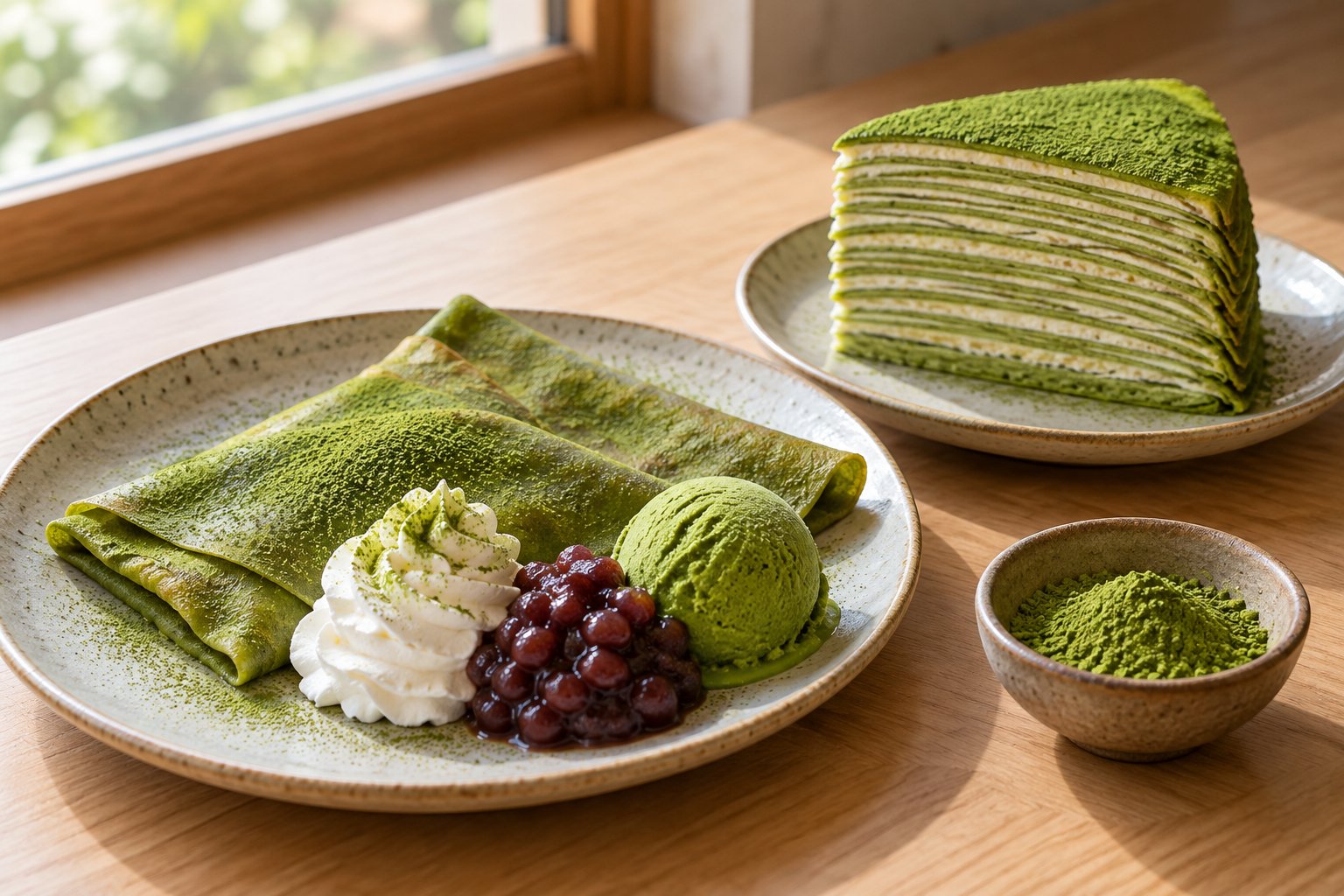
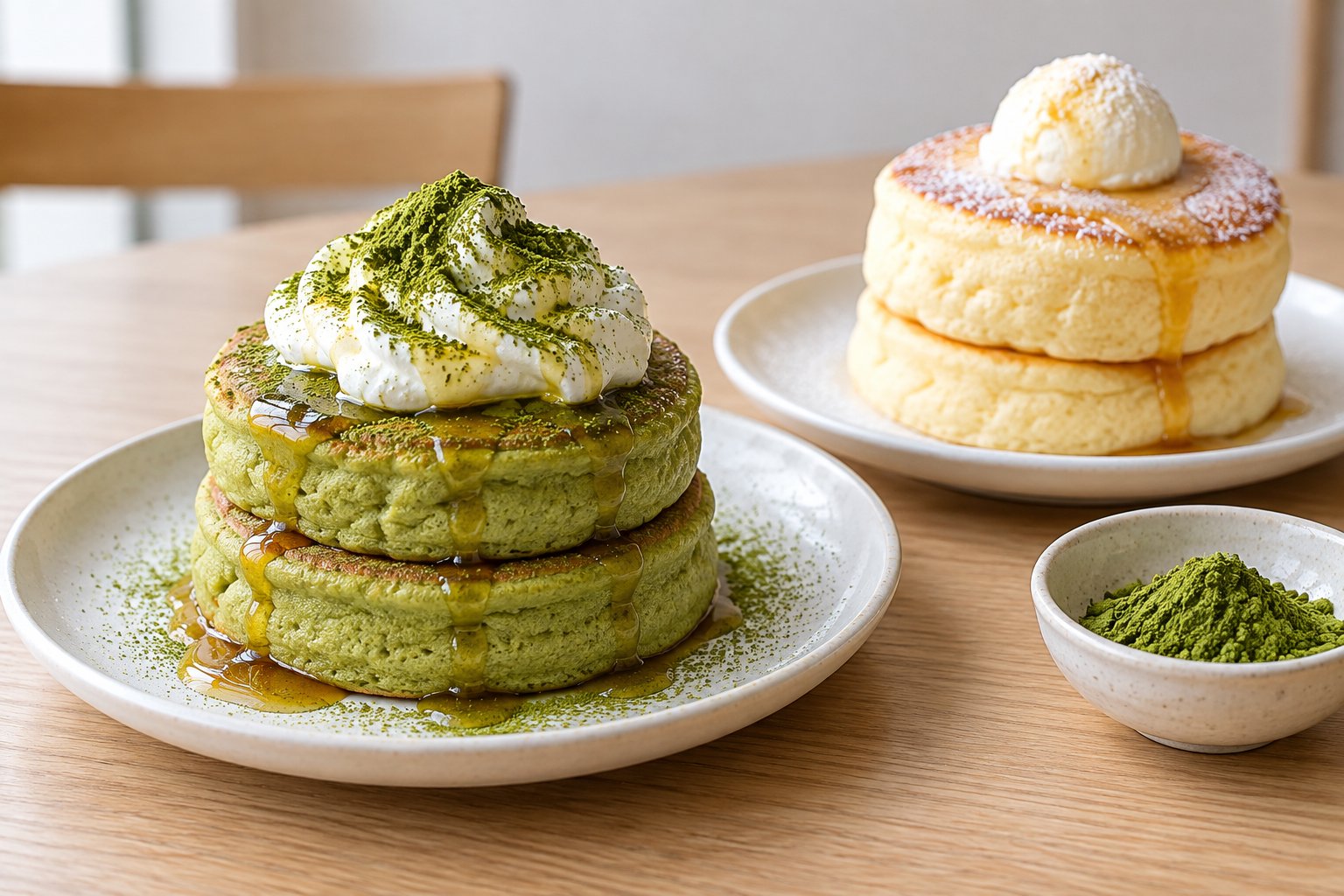
A matcha crepe is a thin pancake with matcha in the batter, or one wrapped around matcha cream or anko (sweet red bean paste). Stack many crepes with matcha cream between them and you have a matcha crepe cake, called a “mille crepe” in Japan. We put official recipes from tea companies, a baking supply store and food makers side by side, and look in turn at the matcha in the batter and the cream, resting and cooking the batter, layers, how a hygiene guide treats crepes, and matcha per crepe and per slice.
Two ways to serve matcha crepes: wrapped crepes and crepe cake
Matcha crepes come in two forms: a crepe wrapped around a filling and eaten by hand, and a crepe cake of stacked crepes sliced and served on a plate. The batter is made almost the same way. What differs is how the filling is put together and how long it takes from cooking to serving.
How the two forms differ
| Wrapped crepe (handheld) | Matcha crepe cake (on a plate) | |
|---|---|---|
| Crepe size | About 18–20cm (Meiji and Tomizawa Shoten 20cm, Morinaga about 18cm) | 15–20cm, stacked |
| Crepes per serving | 1 | About 10–20 per cake |
| Where the matcha goes | Batter, cream, sauce, ice cream | Batter and cream, dusted on top |
| When it is assembled | After the order | Stacked ahead, chilled, then sliced |
| Refrigeration | Crepes and fillings chilled separately | Each whole cake chilled |
King Arthur Baking, a US flour company, says crepes can be folded in quarters to eat on a plate, or rolled burrito-style to eat while walking.
Where to show the matcha
Matcha in the batter makes the outside and the cut surface of a wrapped crepe green. To show matcha through the filling instead, wrap matcha cream or matcha ice cream in a plain crepe and dust matcha on top for color. The toppings in a tea company’s official recipe are chunky anko, white chocolate sauce, powdered sugar and matcha.
Comparing the amount of matcha in official recipes
In official recipes, matcha in the batter was 4% to about 14% of the flour. We calculated the ratio by dividing the weight of matcha by the weight of flour.
Batter recipes (matcha as a percentage of flour)
| Source | Recipe | Flour | Matcha | Matcha ratio | Size and number | Resting |
|---|---|---|---|---|---|---|
| Nakamura Tokichi Honten | Matcha mille crepe | 100g cake flour | 2 teaspoons (about 4g) | about 4% | 18–20cm, about 15 | 30 minutes in the refrigerator |
| Tomizawa Shoten | Rice flour matcha mille crepe | 75g rice flour | 4g | about 5.3% | about 18cm, about 50cc each | Not stated |
| Tomizawa Shoten | Matcha and white chocolate mille crepe | 70g cake flour + 30g bread flour | 6g | 6% | 16cm, about 14 | 1 hour at room temperature |
| Tomizawa Shoten | Matcha and sakura mille crepe | 92g bread flour | 8g | about 8.7% | 15cm, 18–19 | 1 hour in the refrigerator |
| Tomizawa Shoten | Rich matcha mille crepe | 70g cake flour | 10g | about 14.3% | 15cm, 10–15 | 1 hour or more |
| Tomizawa Shoten | Orange mille crepe with matcha cream | 140g cake flour | None (matcha in the cream) | 0% | 20cm | Half a day in the refrigerator |
The amounts of milk and eggs relative to flour differ between recipes. If you move only the matcha ratio into your own recipe, test cook to check how the batter spreads.
Nakamura Tokichi Honten’s recipe (one 18–20cm cake): batter of 100g cake flour, 2 teaspoons (about 4g) matcha, 30g sugar, 2 eggs, 300ml milk and 30g melted butter, rested covered in the refrigerator for about 30 minutes and cooked over medium-low heat into about 15 crepes, then stacked to cool. Matcha cream of 200ml cream, 20g sugar and 1 teaspoon matcha, whipped over ice water to soft-firm peaks. The stacked cake is chilled in the refrigerator for 2 hours or more.
Source: Nakamura Tokichi Honten, “抹茶ミルクレープの作り方” (How to make matcha mille crepe, in Japanese) https://tokichi.jp/blogs/life-with-cha/matcha-mille-crepe-recipe
The range reflects where the matcha flavor comes from
The “Rich matcha mille crepe” at about 14% also puts a lot of matcha in the cream and dusts matcha on top. The 4–6% recipes keep the cream’s matcha low too, at about 1–2%, and pair it with sweet fillings such as chunky anko, white chocolate or amanatto (candied beans). If you want the batter to carry the matcha flavor, start at 8% or more. If the batter is mainly for color with matcha cream, start at 4–6% (our view).
Compared with other sweets
Compared the same way using official recipes, most pancake mix recipes were 4–5% (Matcha pancakes for cafés), and cake batters such as roll cakes were about 3–20% of flour (Matcha cake for cafés). Crepe batter sits at the same level as pancakes or slightly higher.
Making, resting and cooking the batter
Mix the flour and matcha first, thin with eggs and milk, then rest the batter before cooking. The batter contains eggs, so in a shop rest it in the refrigerator, and cook over low heat for only light browning.
Avoid matcha lumps
The official recipes either sift the flour and matcha together (Tomizawa Shoten) or mix the flour, matcha and sugar in a bowl first (Nakamura Tokichi Honten). Nakamura Tokichi Honten says matcha lumps easily, so always sift it. Tomizawa Shoten’s “Matcha and sakura” strains the mixed batter before resting. Add eggs and milk a little at a time for a smooth, thin batter with no lumps.
Why and where to rest it
Nakamura Tokichi Honten explains that resting lets the gluten (the elastic network formed by wheat proteins) settle, so the crepes tear less. King Arthur Baking also says that resting at room temperature for about an hour changes the batter and makes for a much better crepe. King Arthur Baking adds that even with gluten-free flour, resting lets the starches absorb water and reduces grittiness.
The official recipes differ on where to rest the batter.
| Source | Where and how long |
|---|---|
| Nakamura Tokichi Honten | About 30 minutes in the refrigerator |
| Morinaga (layer cake) | 30 minutes or more in the refrigerator |
| Tomizawa Shoten (matcha and sakura) | About 1 hour in the refrigerator |
| Tomizawa Shoten (orange) | Half a day in the refrigerator. Back to room temperature before adding melted butter |
| Tomizawa Shoten (matcha and white chocolate) | About 1 hour at room temperature |
| King Arthur Baking | About 1 hour at room temperature |
In a shop, rest batter that contains eggs in the refrigerator. The reason is explained with the hygiene guide in the prep and storage section.
Browning and green
For heat, the official recipes use medium-low (Nakamura Tokichi Honten), low heat on both sides (Tomizawa Shoten’s “Matcha and sakura”), very low (“Orange”), and low heat for about 1 minute 30 seconds, then about 30 seconds after flipping (Showa Sangyo’s pancake mix crepe). Tomizawa Shoten’s “Rich matcha mille crepe” flips when the edge is lightly colored and cooks the other side for about 30 seconds.
Strong browning hides the green of the batter. Chlorophyll, the source of matcha’s green, changes color with heat, and browning also comes from the sugar and dairy in the batter (explained in Matcha color and Matcha pancakes). On the other hand, Morinaga’s “Layer cake” says that browning the crepes well makes the layers show more clearly. Decide how much to brown based on whether you want to show the layers or the green of the batter in a crepe cake’s cut surface.
Matcha in the filling: matcha cream, anko, shiratama and ice cream
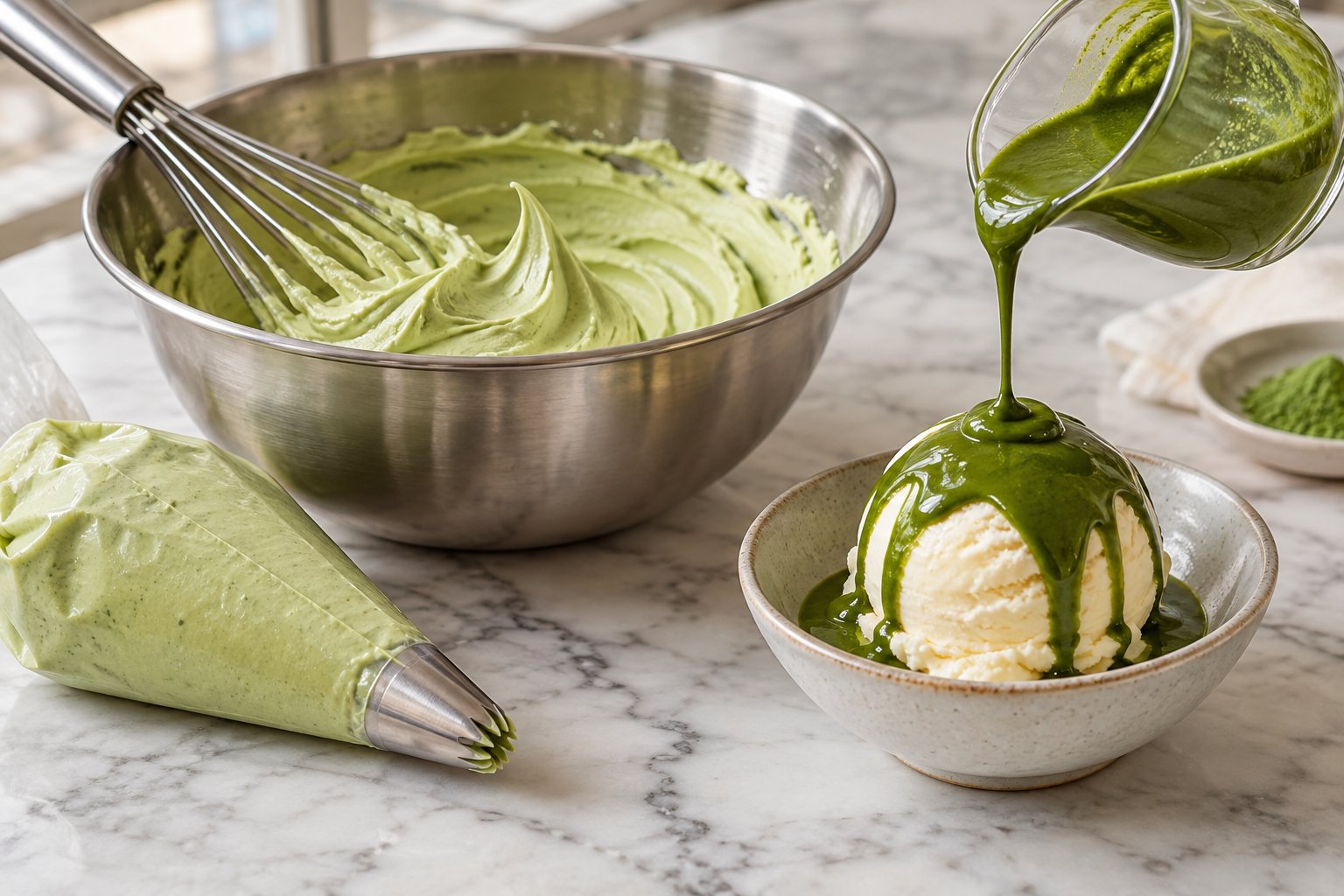
In official recipes, matcha cream used about 1–8% matcha to cream. For wrapped crepes, matcha cream is combined with anko, shiratama (small rice flour dumplings), matcha ice cream and so on.
Matcha cream recipes
| Source | Cream | Matcha | Sugar | Matcha ratio (our calculation) |
|---|---|---|---|---|
| Nakamura Tokichi Honten | 200ml | 1 teaspoon (about 2g) | 20g | about 1% (counting 200ml as 200g) |
| Tomizawa Shoten (matcha and white chocolate) | 200g at 36% fat | 2g | 20g (plus 50g white chocolate) | 1% |
| Tomizawa Shoten (rice flour) | 250g at 45% fat (plus 25g milk) | 5g | 24g | 2% |
| Tomizawa Shoten (orange) | 200g at 36% fat | 5g | 25g (mixed with 150g custard) | 2.5% |
| Tomizawa Shoten (rich) | 150g at 42% fat | 12g | 12g | 8% |
We counted Nakamura Tokichi Honten’s 1 teaspoon as about 2g, because the same recipe gives 2 teaspoons as about 4g. Tomizawa Shoten’s “Rich” recipe mixes the matcha and sugar, adds the cream a little at a time to make a paste first, then whips. How to dissolve matcha into cream, prevent separation and compare other recipes is in Matcha cream and matcha sauce.
Pairing with anko, shiratama and ice cream
The official recipes combine the following:
- Nakamura Tokichi Honten: powdered sugar, matcha, white chocolate sauce and chunky anko on the side
- Tomizawa Shoten: layers with custard (rich), amanatto (rice flour), orange (orange) and sakura anko (matcha and sakura)
- Meiji: an example of matcha ice cream and anko wrapped in a crepe
Shiratama hardens when cold. If you wrap it with refrigerated cream, make the shiratama on the day of serving and check its texture before use (why, and how to serve it, in Matcha mochi, daifuku and warabi mochi). Ice cream melts if the crepe is still warm. Showa Sangyo and Morinaga cool the cooked crepes before adding toppings. Matcha ice cream recipes are in Matcha ice cream and soft serve.
Matcha crepe cake: layers, cream and slicing
A matcha crepe cake usually stacks 10–20 crepes of 15–20cm and is chilled in the refrigerator for 30 minutes to 2 hours or more before slicing. According to King Arthur Baking, while the cake chills the crepes absorb some moisture from the filling, and the filling firms up so the cake slices more easily.
Number of layers and filling
| Source | Size | Crepes | Filling |
|---|---|---|---|
| Morinaga (strawberry mille crepe) | 18–20cm | 6–7 | Cream cheese, strawberries |
| Tomizawa Shoten (rich) | 15cm | 10–15 | Matcha cream (150g cream) |
| Tomizawa Shoten (matcha and white chocolate) | 16cm | About 14 | Matcha white chocolate cream (200g cream) |
| Nakamura Tokichi Honten | 18–20cm | About 15 | Matcha cream (200ml cream) |
| Tomizawa Shoten (matcha and sakura) | 15cm cut to 12cm (4-go size) | About 15 | Sakura cream, sakura anko every 2–3 crepes |
| King Arthur Baking | 8 inches (about 20cm) | 18–20 | A scant 3 cups of filling |
King Arthur Baking says that starting with three crepes with no filling between them gives a solid base that holds up when sliced. Now and then, stack two or three crepes together, and finish with three crepes on top. Spread about 2 tablespoons of filling on each crepe, leaving about 1/2 inch (about 1.3cm) bare around the edge. Tomizawa Shoten’s “Matcha and sakura” keeps one well-cooked crepe for the top and uses crepes with holes inside.
Chill before slicing
| Source | Chilling time |
|---|---|
| Tomizawa Shoten (rich) | 30 minutes or more. The cream firms up and slices more easily |
| Tomizawa Shoten (orange) | About 1 hour, until the cream settles |
| King Arthur Baking | At least 1 hour, up to overnight |
| Nakamura Tokichi Honten | 2 hours or more |
Nakamura Tokichi Honten says that chilling well lets the layers settle together and gives a clean cut surface. Tomizawa Shoten writes that cooling the crepes well before spreading the cream, and chilling well after stacking, makes the cake easier to cut.
Number of slices
Official recipes rarely say how many slices to cut. In this article we assume 8 slices per cake to calculate matcha per slice (our assumption). Recalculate for how you sell it, for example 6 slices for a small 15cm cake.
Serving wrapped crepes in a shop
For wrapped crepes, cook and cool the crepes ahead, and wrap the fillings after the order. Chilling crepes and fillings separately shortens the time from wrapping to serving.
Crepes cooked ahead
King Arthur Baking says crepes can be cooled completely, then stacked, wrapped well and refrigerated or frozen. Unfilled crepes, not folded and well wrapped, keep in the refrigerator for several days, and should be frozen for longer storage. Set and record your shop’s number of refrigerated days in line with the official standards in the later section (our suggestion).
Steps after the order (our suggestion)
- Take one crepe from the refrigerator and rewrap the rest so they do not dry out
- Pipe the matcha cream, then add anko, shiratama or fruit
- Add ice cream last and wrap straight away
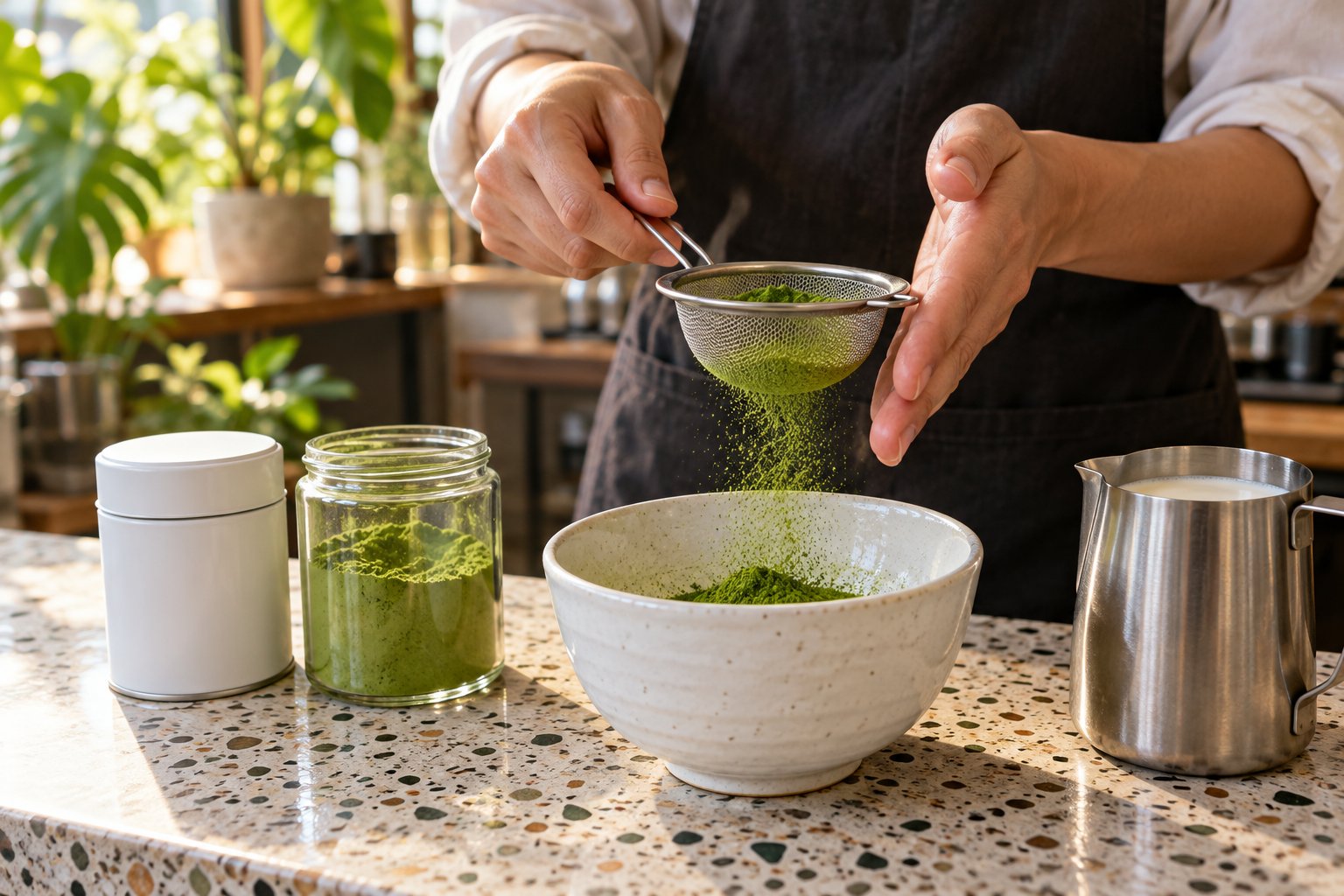
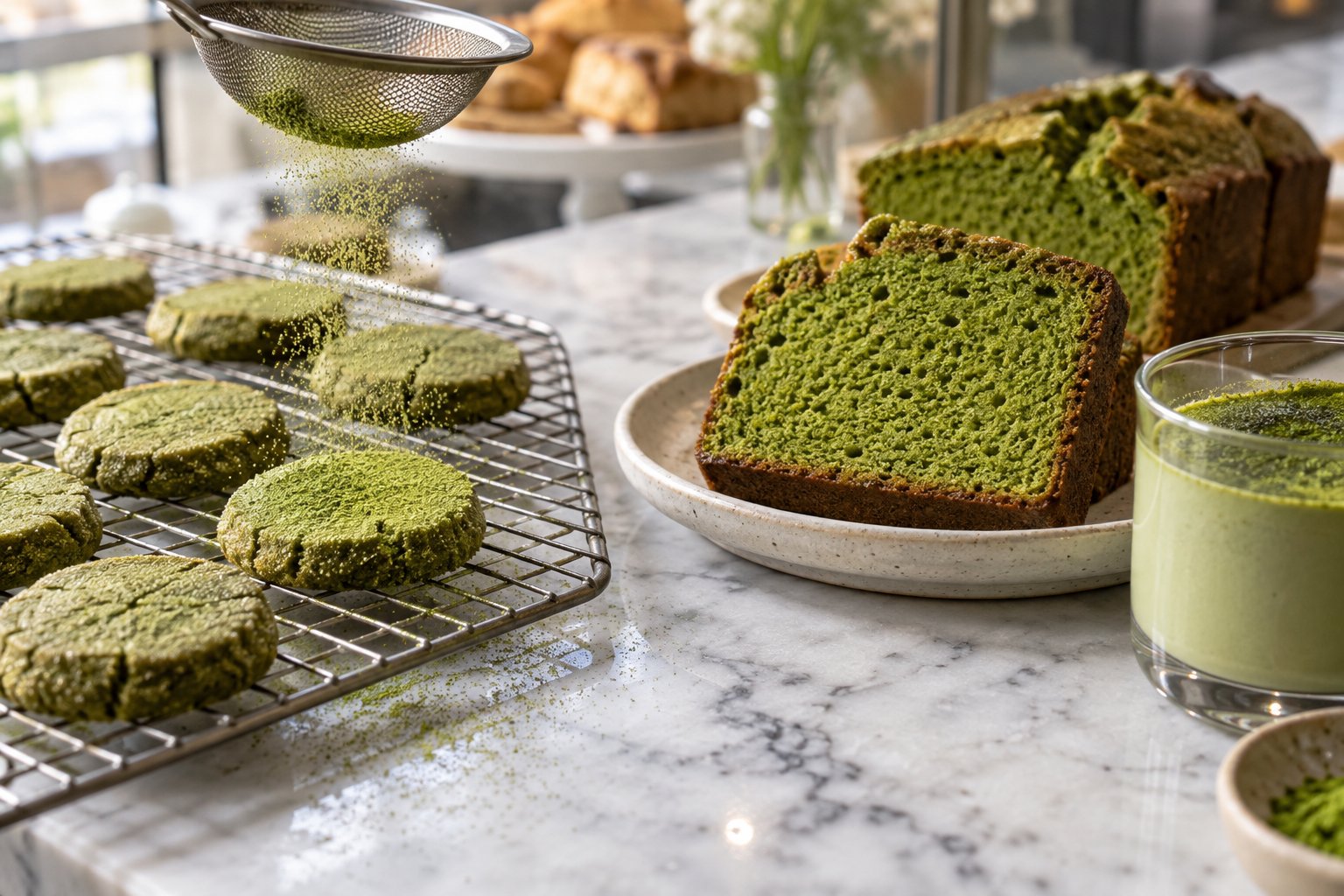
- Dust the finishing matcha through a tea strainer after wrapping. Matcha powder loses color with light and humidity, so keep only the amount for dusting in a small container
Handheld crepes may be taken away still wrapped. The confectionery hygiene guide says that when selling items that need refrigeration, staff should ask how long the customer will take to get home and add ice packs.
Prep and storage: the hygiene guide and official standards
In the confectionery hygiene guide checked by Japan’s Ministry of Health, Labour and Welfare, crepes appear in food poisoning cases as a sweet that is finished by hand after “low heat” cooking. The basics are handling eggs at 10°C or below and keeping the hand steps of wrapping and stacking clean after cooking.
How the hygiene guide treats crepes
The “Guide to creating hygiene management plans for confectionery manufacturing based on HACCP principles,” written by Japanese confectionery industry bodies and checked by the Ministry of Health, Labour and Welfare, divides sweets into five categories by how they are made. Category 5 covers sweets that are not heated, or are heated at a low level that does not reach the equivalent of 75°C for 1 minute. The guide says that of 81 confectionery food poisoning cases from 2000 to 2017, the 6 in category 5 were sakura mochi, dorayaki and crepes, all of which involve hand work after low heat cooking.
The guide’s table of cases by hazard: norovirus 33, Salmonella 27, Staphylococcus 17, Bacillus cereus 3 and enterohemorrhagic E. coli 1, for a total of 81 (category 2: 3, category 3: 69, category 5: 6, unknown: 3).
Source: All Nippon Kashi Association and others, “HACCPの考え方を取り入れた菓子製造業における衛生管理計画作成の手引書” (Guide to hygiene management plans for confectionery manufacturing, checked by the Ministry of Health, Labour and Welfare, revised 4 June 2024, in Japanese), page 17 https://www.mhlw.go.jp/content/11130500/000478404.pdf
The guide’s table of cases lists a buckwheat crepe in Kyoto city in 2002 (Salmonella, 13 patients) and a crepe in Himeji city in 2004 (Salmonella, 9 patients). The guide says that because category 5 sweets have no heating step, the hygiene procedures need even more effort, and suitable packaging and use-by or best-before dates are essential.
Handling eggs and batter
The guide says that one of the main hazards for confectionery food poisoning is Salmonella carried by eggs. It asks that shell eggs be stored at 10°C or below and liquid egg at 8°C or below, and that unpasteurized shell eggs not be left at room temperature. Crepe batter is a mix of eggs and milk, so rest it in the refrigerator. Some recipes rest it at room temperature, but in a shop follow the recipes that rest it in the refrigerator (Nakamura Tokichi Honten, Morinaga, Tomizawa Shoten’s “Matcha and sakura”) (our suggestion). Melted butter sets when added to cold batter, so Tomizawa Shoten’s “Orange” brings the refrigerated batter back to room temperature before adding the butter.
Official standards and a prep schedule
| Source | What it says |
|---|---|
| Ministry of Health, Labour and Welfare, “Hygiene management manual for large-scale cooking facilities” | Store cream as a raw material at 10°C or below. Cooked food should ideally be eaten within 2 hours |
| Confectionery hygiene guide | Check the temperature of refrigerators and refrigerated display cases every day at the start and end of work. Set dates on a reasoned basis such as testing |
| US FDA “Food Code 2026” | Refrigerated food made in the shop and held for more than 24 hours: 5°C or below for a maximum of 7 days. Count the day of preparation as day 1 and mark the date |
| Part | When to make it (our suggestion) |
|---|---|
| Batter | Mix the day before or that morning, rest in the refrigerator, and cook the same day |
| Cooked crepes | Cool, stack, wrap and refrigerate. Write the date and time made |
| Matcha cream | Whip one day’s worth |
| Crepe cake | Stack and chill. After slicing, wrap so it does not dry out. Set the number of days shorter than the dates on the cream and eggs |
Freezing whipped cream and chilling custard are covered in Matcha cake and Matcha cream and matcha sauce. Storing matcha powder itself is covered in Matcha shelf life and storage.
Matcha per crepe and per slice, and matcha cost
The matcha cost of one crepe or slice is “buying price per kg ÷ 1,000 × grams of matcha used”. Divide the matcha in the batter by the number of crepes, then add the matcha in the cream and the dusting.
Matcha in one crepe
| Source | Matcha in the batter | Crepes | Per crepe (our calculation) |
|---|---|---|---|
| Nakamura Tokichi Honten | about 4g | about 15 | about 0.27g |
| Tomizawa Shoten (matcha and sakura) | 8g | 18–19 | about 0.42–0.44g |
| Tomizawa Shoten (matcha and white chocolate) | 6g | about 14 | about 0.43g |
| Tomizawa Shoten (rich) | 10g | 10–15 | about 0.67–1g |
For a wrapped crepe, add the matcha in the matcha cream. For example, 50g of 2% matcha cream per crepe holds 1g of matcha (the cream amount is our assumption).
Matcha per crepe cake and per slice
| Source | Matcha in the batter | Matcha in the cream | Total per cake | Per slice (8 slices is our assumption) |
|---|---|---|---|---|
| Tomizawa Shoten (orange) | None | 5g | 5g | about 0.63g |
| Nakamura Tokichi Honten | about 4g | about 2g | about 6g | about 0.75g |
| Tomizawa Shoten (matcha and white chocolate) | 6g | 2g | 8g | 1g |
| Tomizawa Shoten (rice flour) | 4g | 5g | 9g | about 1.1g |
| Tomizawa Shoten (rich) | 10g | 12g | 22g (finishing matcha not included) | about 2.75g |
Cutting a cake into 8 slices is our assumption, and the figures leave out the finishing dusting and failed crepes. In the rich recipe, one slice out of 8 holds about 2.75g of matcha, close to the 3g in one matcha latte from Ippodo Tea, a long-established Kyoto tea shop. If you use the same matcha as your lattes, the matcha cost of one slice can come close to that of one latte. How the price per kg is set is covered in How matcha prices are set.
Choosing and testing matcha for crepes
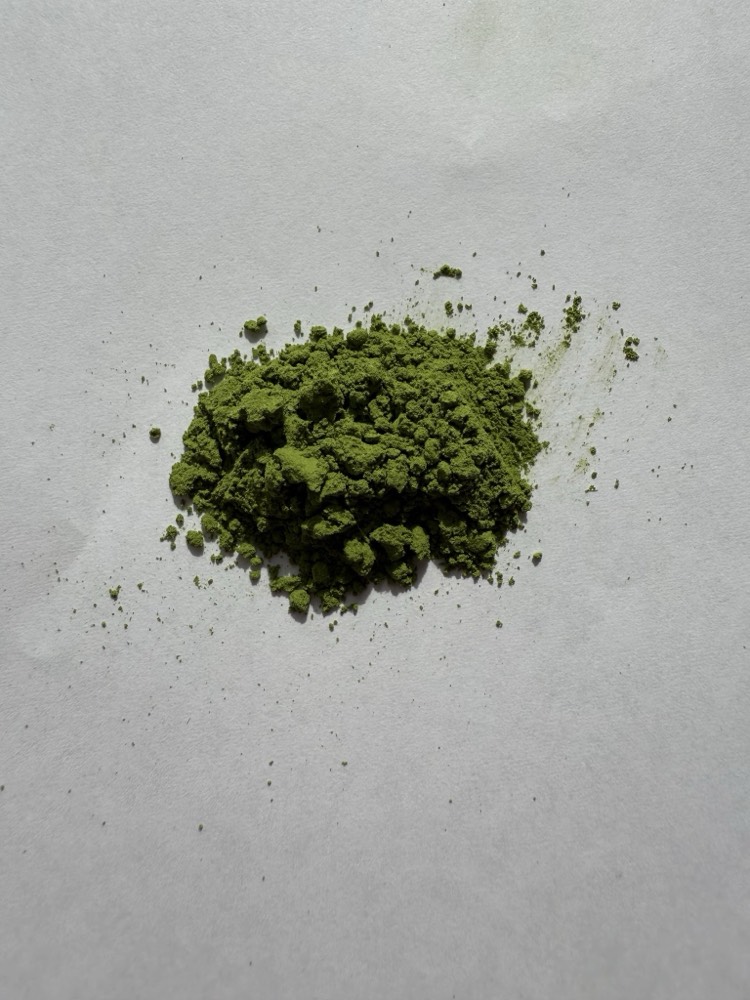
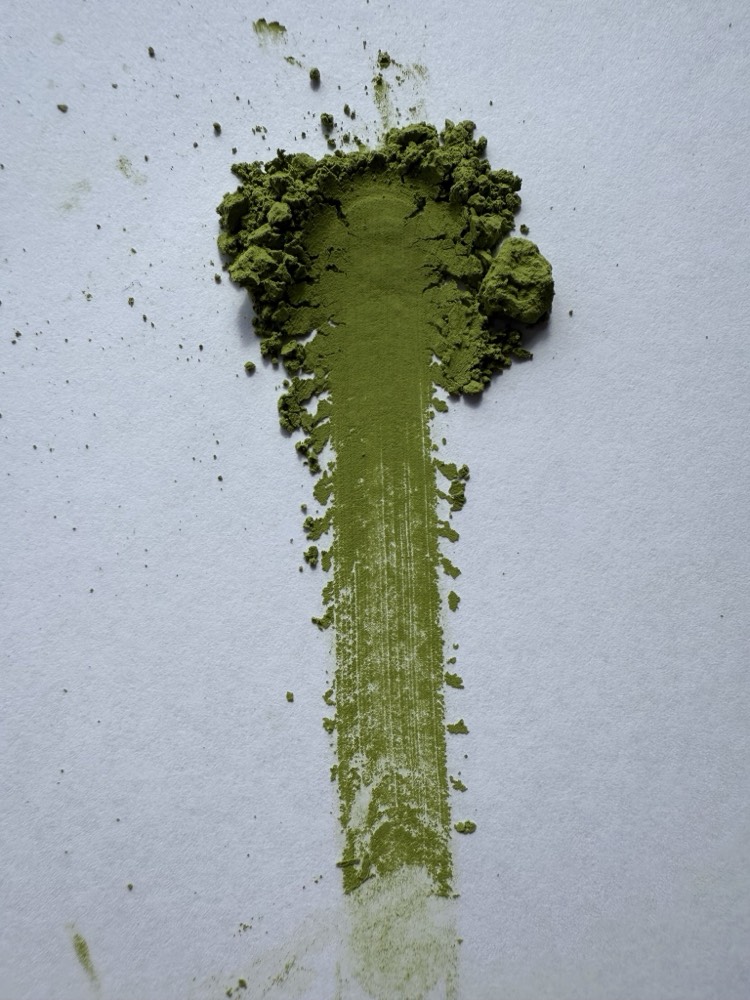
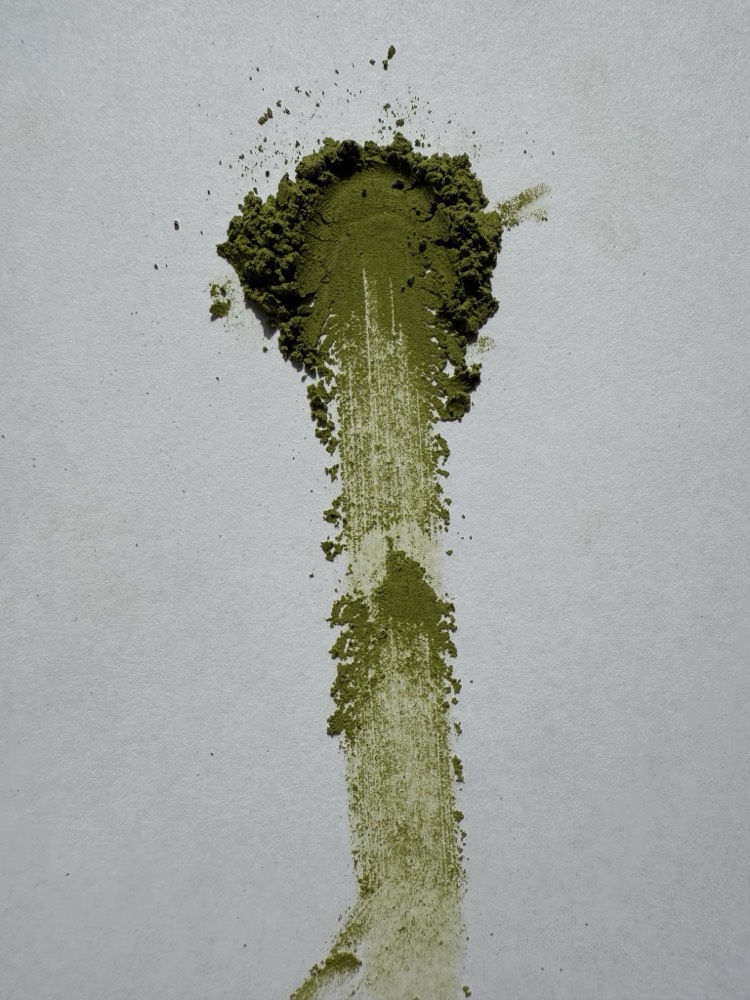
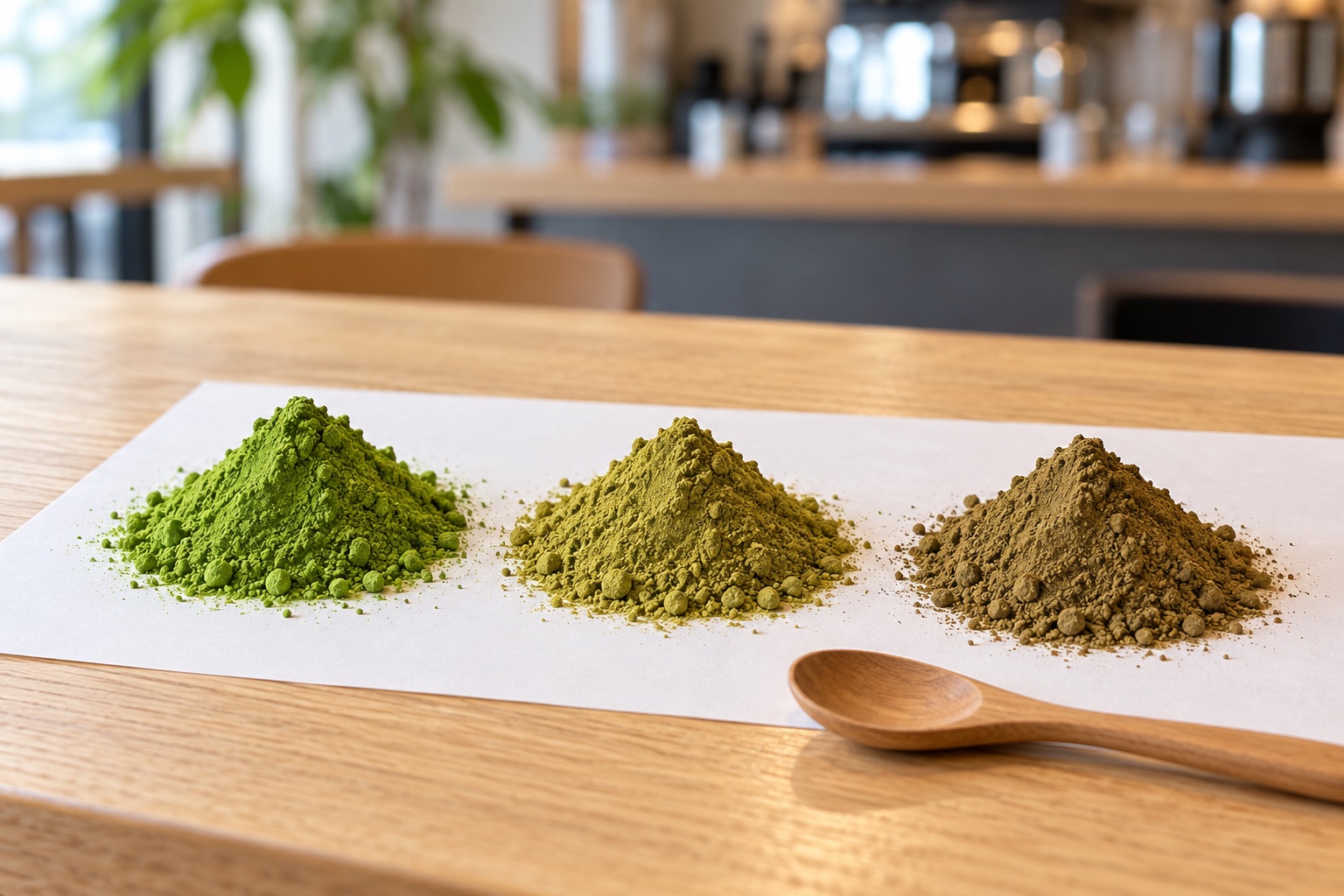
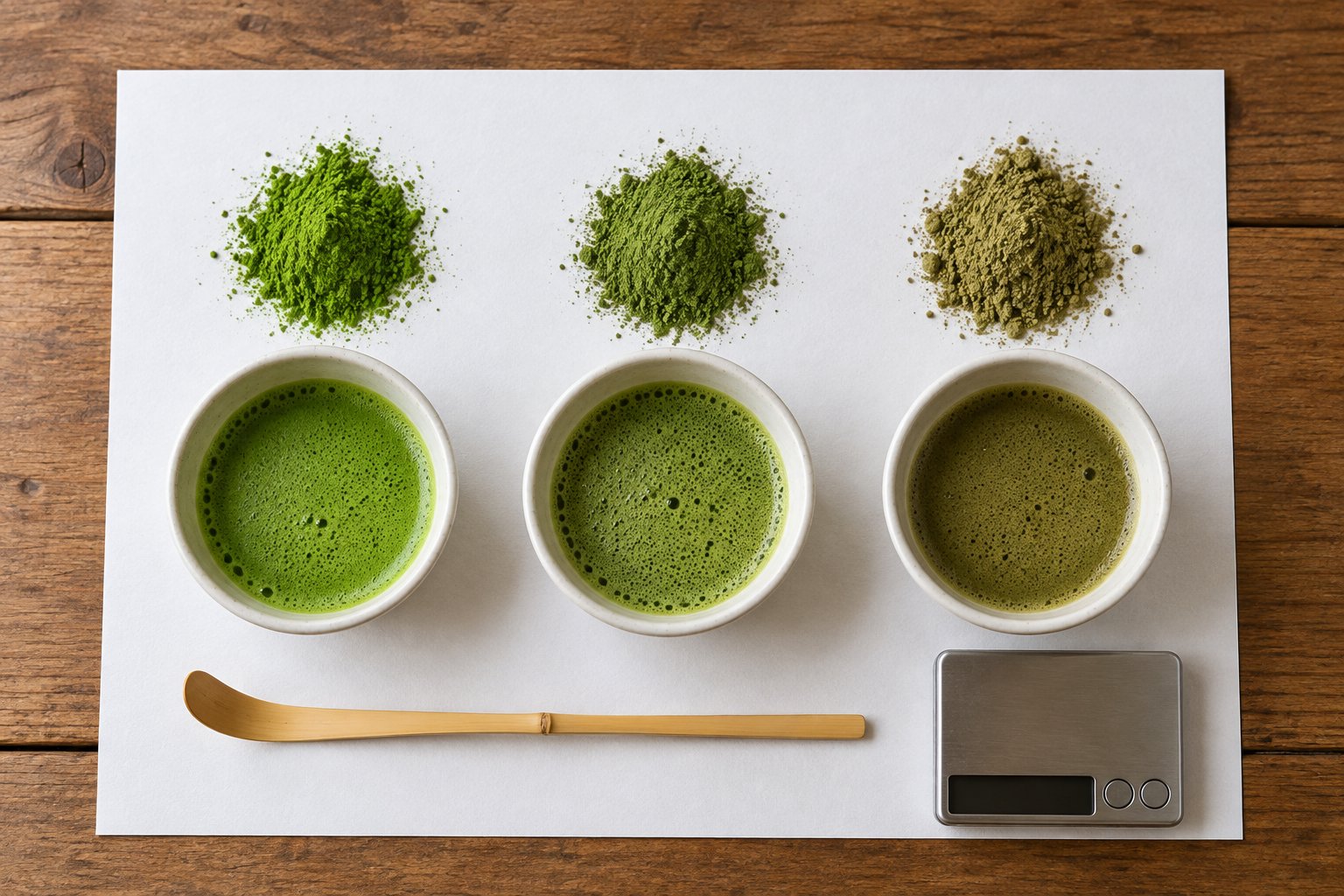
Decide by test cooking whether to use the same matcha for the batter and for the cream and dusting, or two different ones. The batter is cooked, so its color changes, while the cream and the dusting are not heated, so their color and aroma show as they are.
What to check
- Whether it is 100% matcha. A matcha mix with sugar or milk powder will not give enough matcha at the recipe amount (how to tell: What is pure matcha?)
- How much goes into the batter and the cream. In a rich recipe, the grade changes the cost per slice a lot (grade names: Matcha grades, grades for sweets: Choosing matcha for baking)
- Whether you can keep buying the same spec. A new lot can change the color of the batter and the cream
Test cooking steps
- Cook crepes with each candidate matcha in your recipe, using the same amount of matcha and the same heat
- Photograph both sides of the crepe, the cut surface of the crepe cake and the cream right after making and after a night in the refrigerator, under the same light
- Taste for the balance of bitterness against the sweetness of the cream and anko, and decide together with the matcha cost per crepe or slice and the menu price
Omakase Matcha supplies matcha from Uji, Yame, Shizuoka, Kagoshima and Miyazaki, with orders from 1kg and up to 3 samples. Request matcha for test cooking on Samples, and see the differences between regions on Origins.
Sources
- Nakamura Tokichi Honten, “抹茶ミルクレープの作り方” (How to make matcha mille crepe, in Japanese) https://tokichi.jp/blogs/life-with-cha/matcha-mille-crepe-recipe
- Tomizawa Shoten, “濃厚!抹茶のミルクレープ” (Rich matcha mille crepe, in Japanese) https://tomiz.com/recipe/pro/detail/20220115123224
- Tomizawa Shoten, “米粉の抹茶ミルクレープ” (Rice flour matcha mille crepe, in Japanese) https://tomiz.com/recipe/pro/detail/20240411154444
- Tomizawa Shoten, “抹茶とホワイトチョコのミルクレープ” (Matcha and white chocolate mille crepe, in Japanese) https://tomiz.com/recipe/pro/detail/20210126151603
- Tomizawa Shoten, “抹茶と桜のミルクレープ” (Matcha and sakura mille crepe, in Japanese) https://tomiz.com/recipe/pro/detail/20240311135509
- Tomizawa Shoten, “抹茶クリームのオレンジミルクレープ” (Orange mille crepe with matcha cream, in Japanese) https://tomiz.com/recipe/pro/detail/20170608180158
- Morinaga, “もちもちクレープ” (Chewy crepes, in Japanese) https://www.morinaga.co.jp/recipe/detail/1050
- Morinaga, “レイヤーケーキ” (Layer cake, in Japanese) https://www.morinaga.co.jp/recipe/detail/1340
- Morinaga, “苺のミルクレープ” (Strawberry mille crepe, in Japanese) https://www.morinaga.co.jp/recipe/detail/179
- Showa Sangyo, “クレープ” (Crepes, in Japanese) https://www.showa-sangyo.co.jp/recipe/list/article.html?pdid2=448
- Meiji, “おうちクレープ屋さん” (Crepe shop at home, in Japanese) https://www.meiji.co.jp/sweets/icecream/essel/recipe/104/
- King Arthur Baking, “Parisian Street Vendor Crêpes” https://www.kingarthurbaking.com/recipes/parisian-street-vendor-crepes-recipe
- King Arthur Baking, “Cheese Blintzes” https://www.kingarthurbaking.com/recipes/cheese-blintzes-recipe
- King Arthur Baking, “Buttermilk Pancake Crêpes” https://www.kingarthurbaking.com/recipes/buttermilk-pancake-crepes-recipe
- King Arthur Baking, “How to make a sky-high cake without the oven” (2021) https://www.kingarthurbaking.com/blog/2021/07/07/crepe-cake
- All Nippon Kashi Association and others, “HACCPの考え方を取り入れた菓子製造業における衛生管理計画作成の手引書” (Guide to hygiene management plans for confectionery manufacturing, checked by the Ministry of Health, Labour and Welfare, revised 4 June 2024, in Japanese) https://www.mhlw.go.jp/content/11130500/000478404.pdf
- Ministry of Health, Labour and Welfare, “大量調理施設衛生管理マニュアル” (Hygiene management manual for large-scale cooking facilities, last revised 16 June 2017, in Japanese) https://www.mhlw.go.jp/file/06-Seisakujouhou-11130500-Shokuhinanzenbu/0000168026.pdf
- US Food and Drug Administration, “FDA Food Code 2026” §3-501.17 https://www.fda.gov/food/fda-food-code/food-code-2026
- Ippodo Tea, “抹茶ラテ” (Matcha latte, in Japanese) https://www.ippodo-tea.co.jp/blogs/tea-recipe/19%E6%8A%B9%E8%8C%B6%E3%83%A9%E3%83%86