
 Reviewed by: Takahiro Sugiyama (CEO, meguri Inc.)
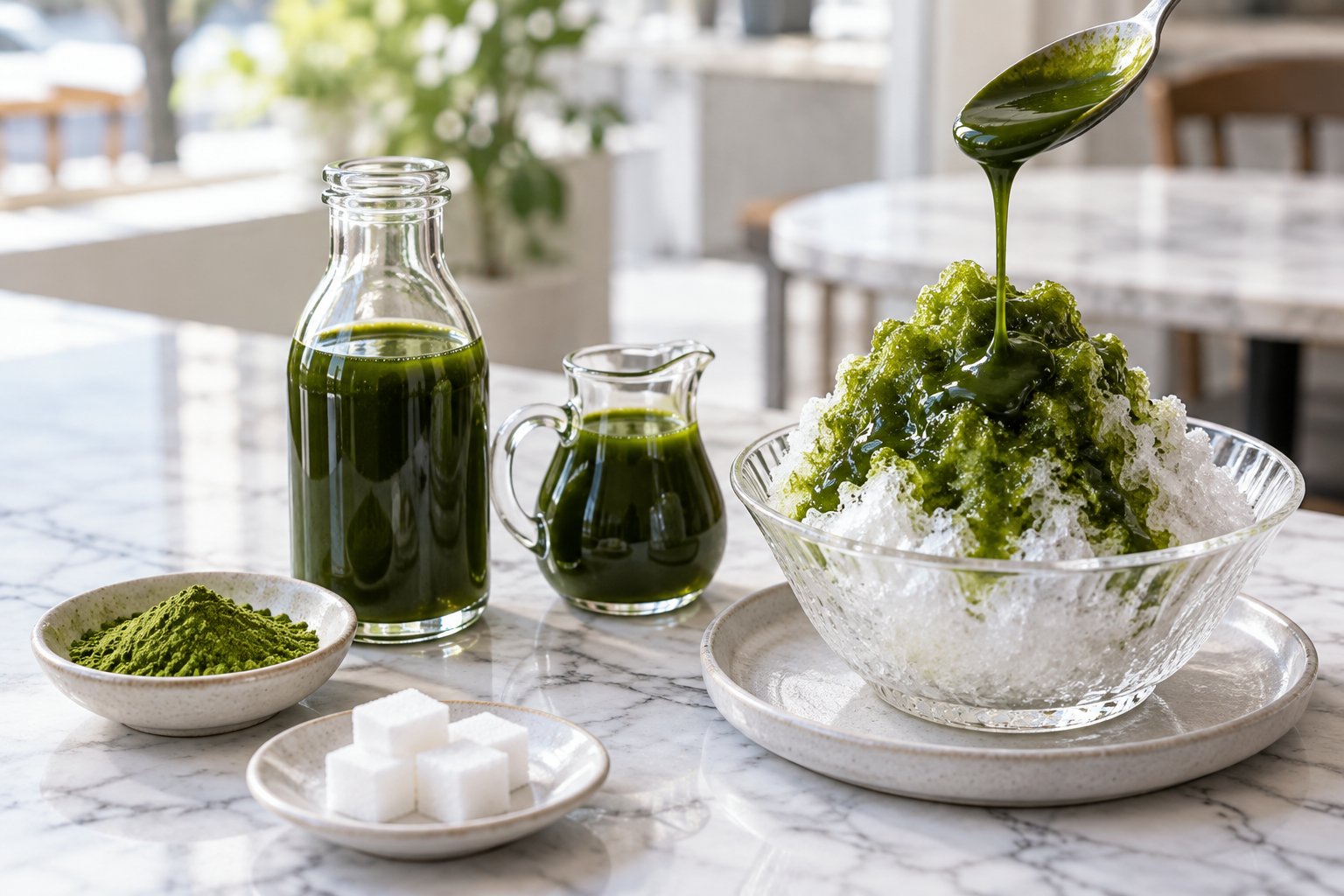
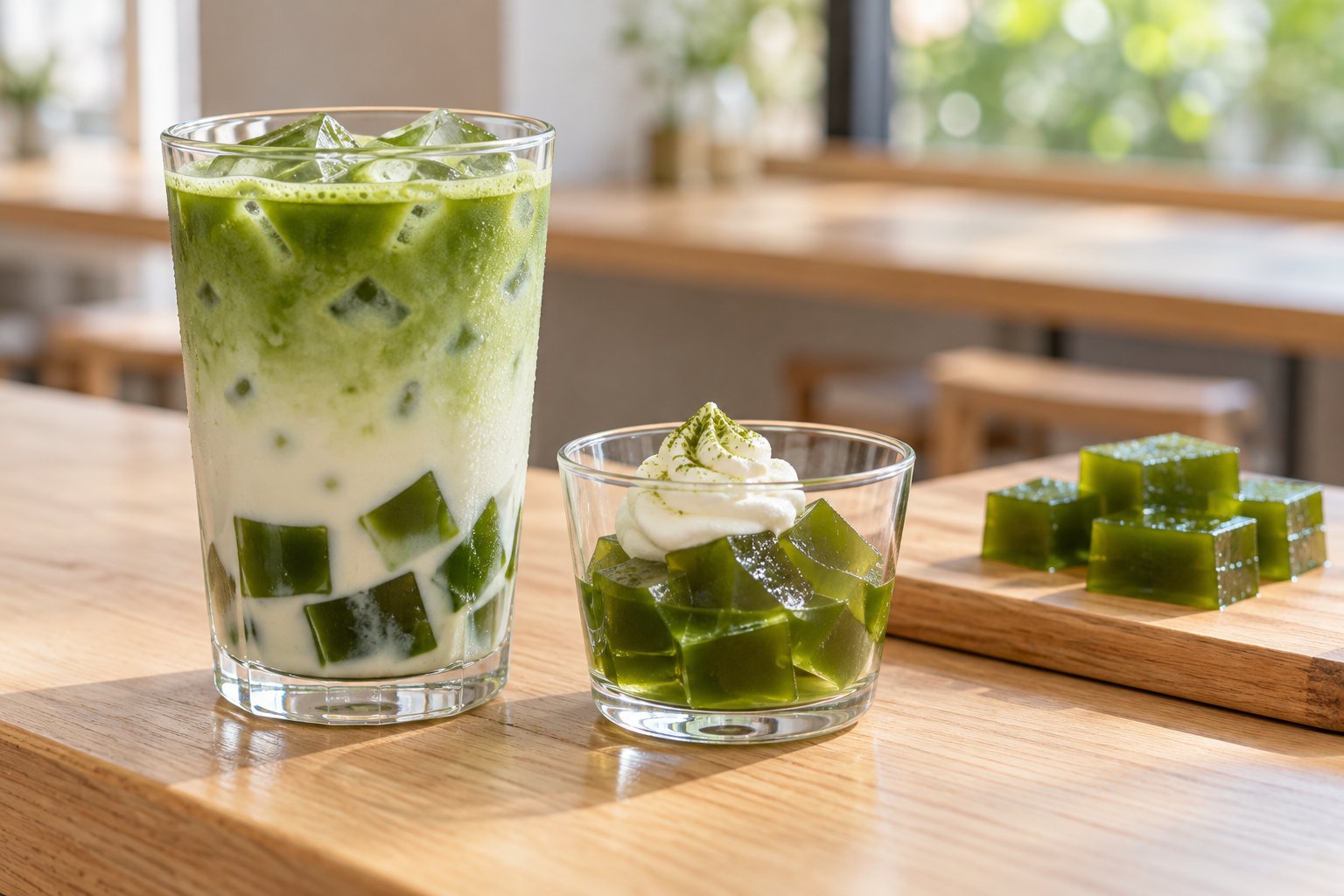
With matcha syrup, you can make lattes, sodas and shaved ice without whisking matcha for every order. But two products that are both called “matcha syrup” can contain very different amounts of matcha. This guide compares the recipes published by tea companies, food companies and Japan’s Ministry of Agriculture, Forestry and Fisheries, then covers how to dissolve the matcha, storage, the amount per drink, how to read commercial labels, and cost.
What is matcha syrup?
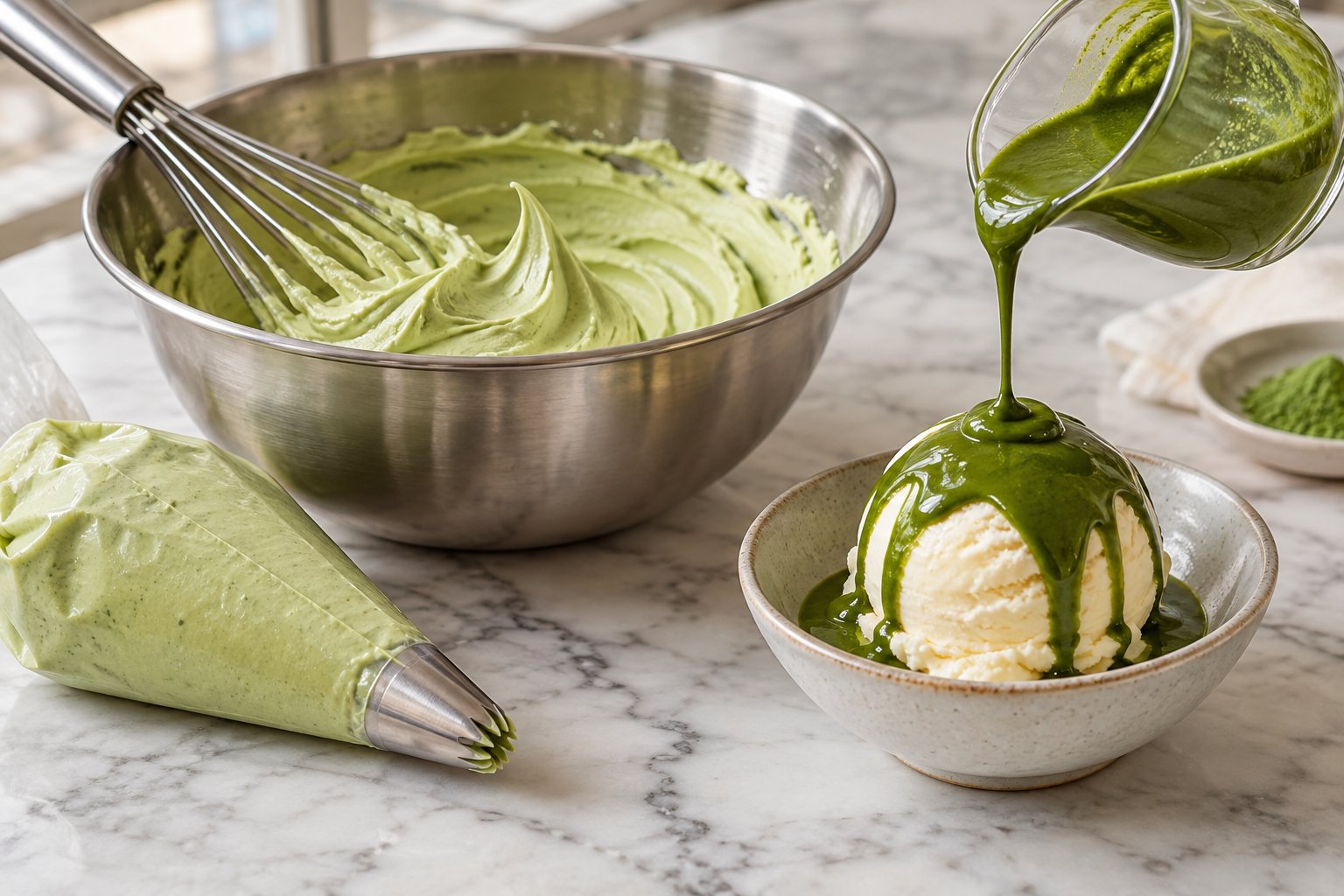
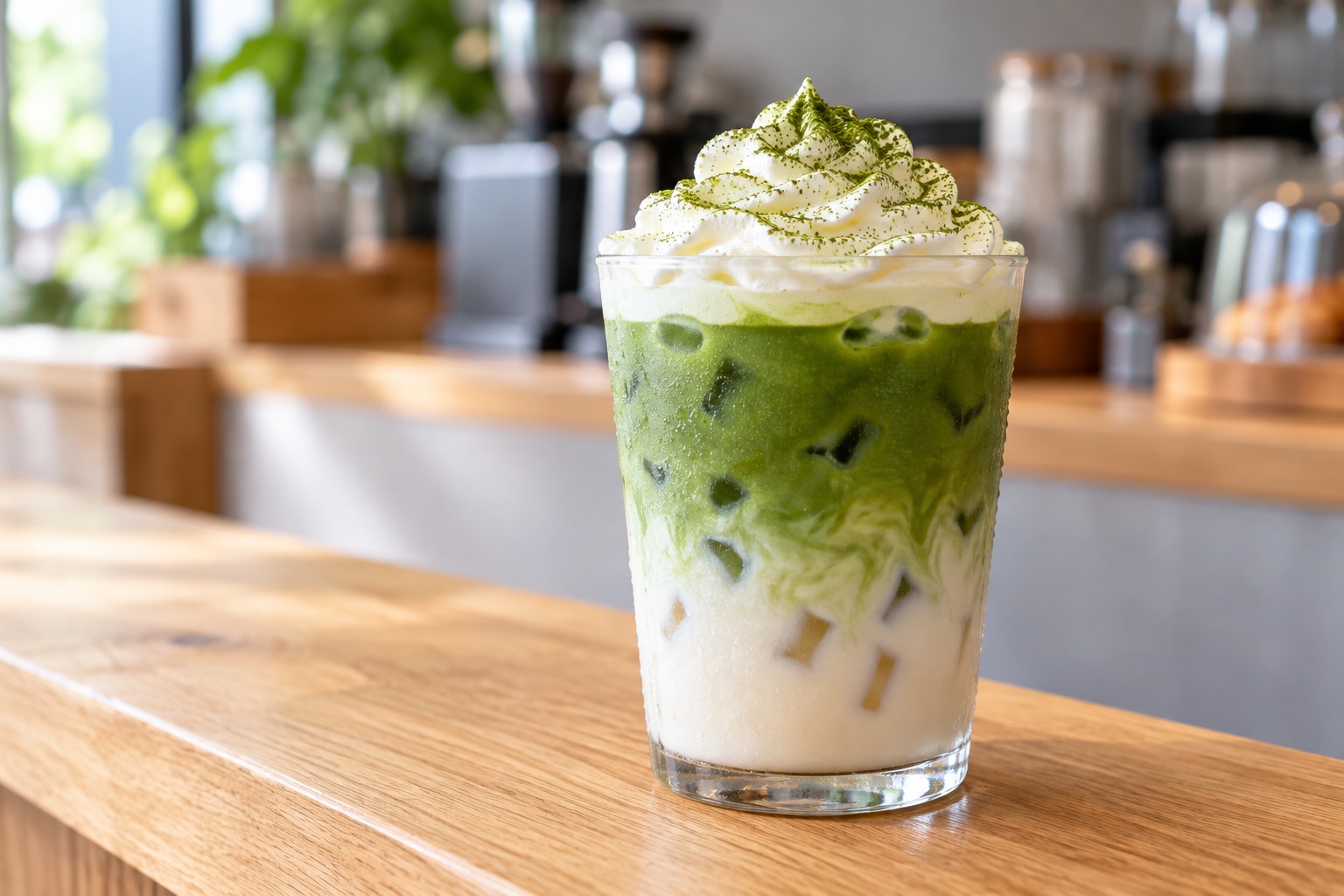
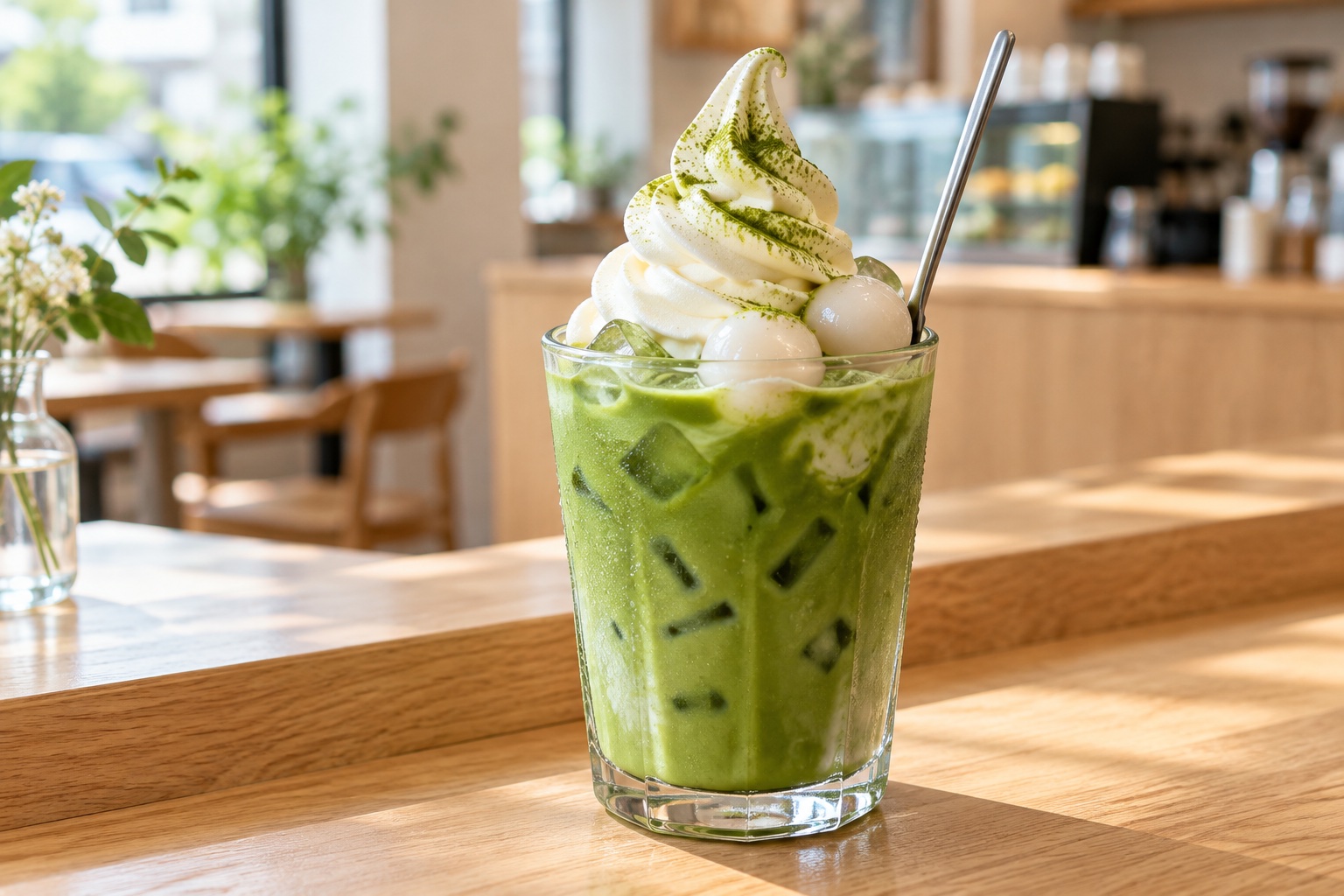
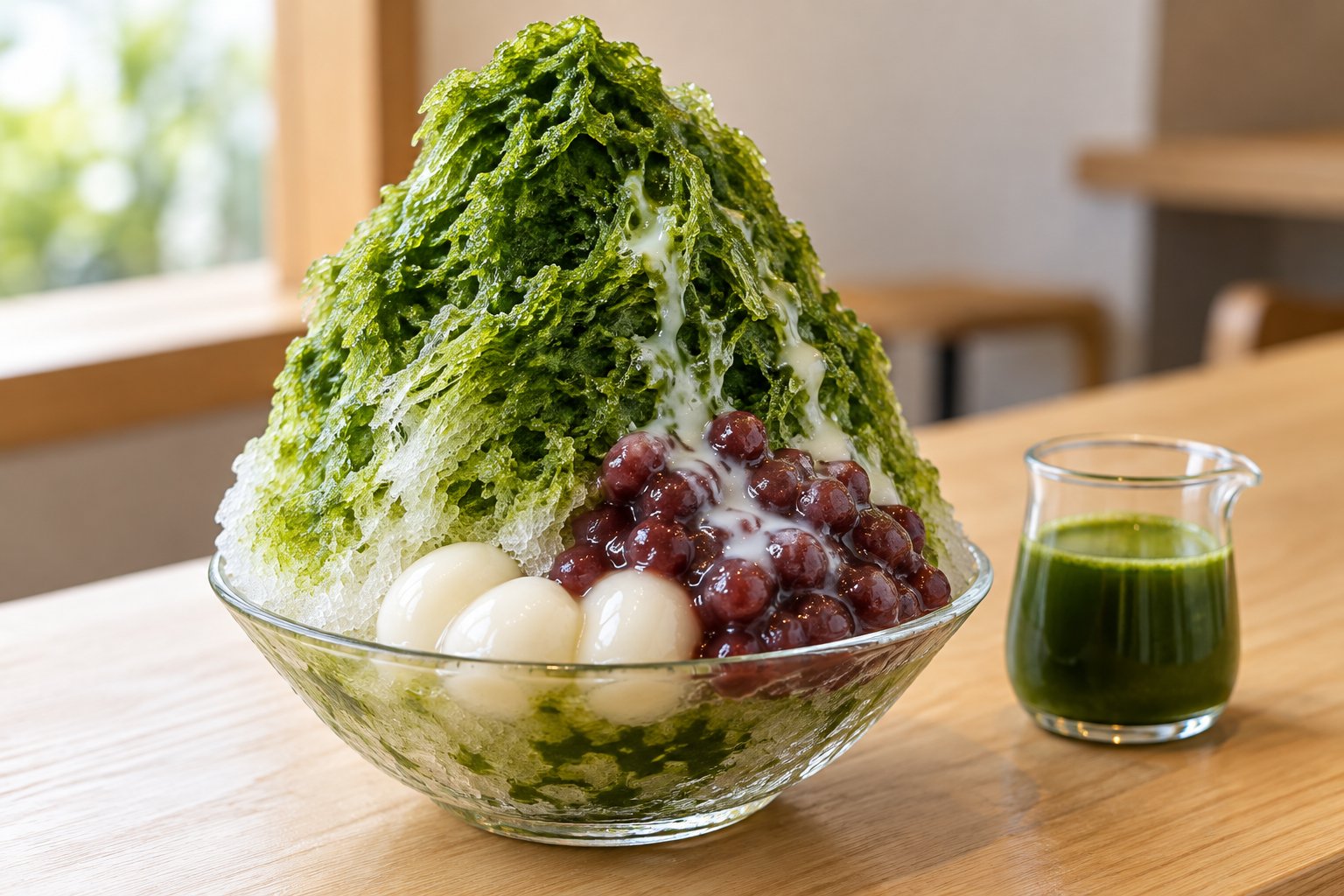
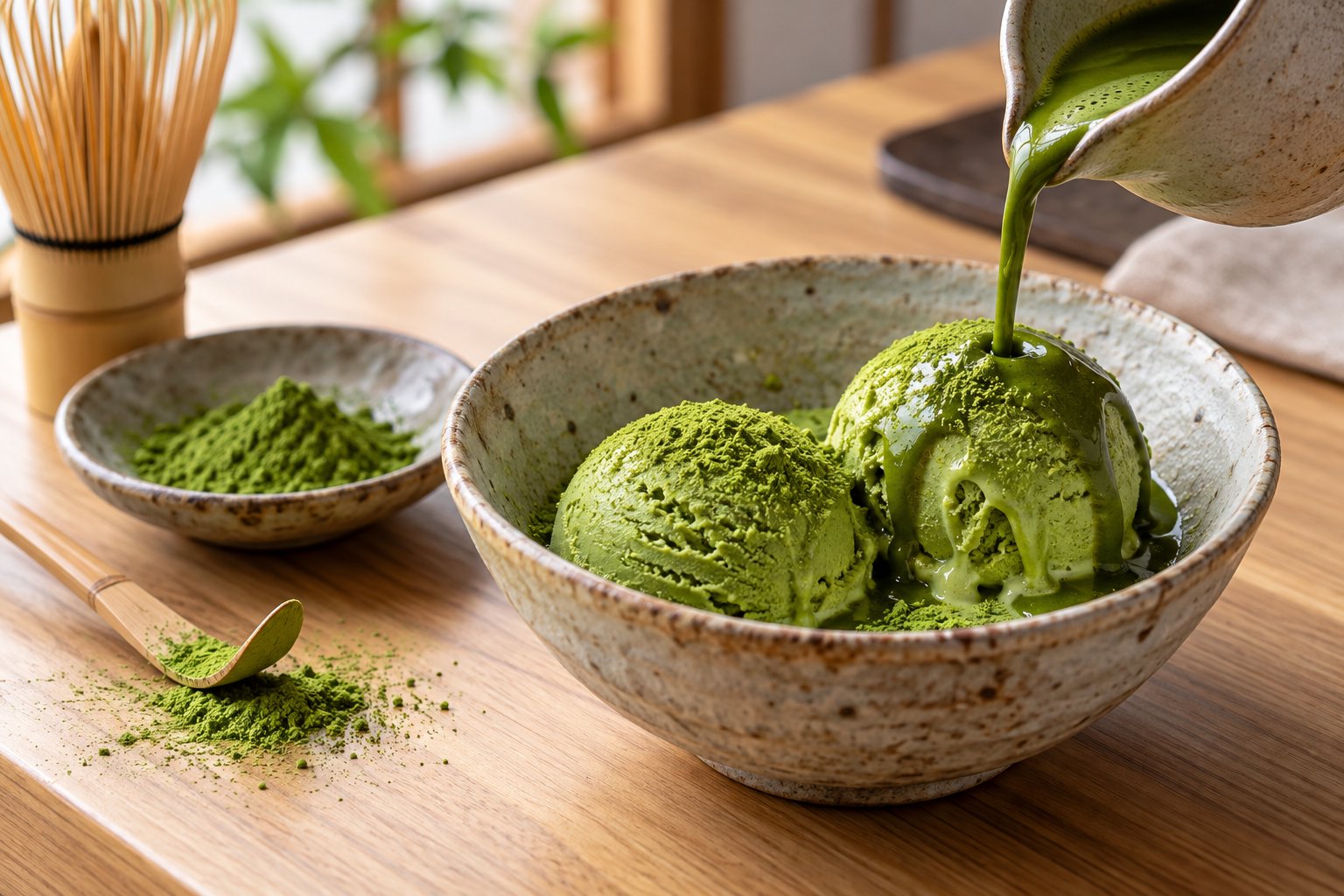
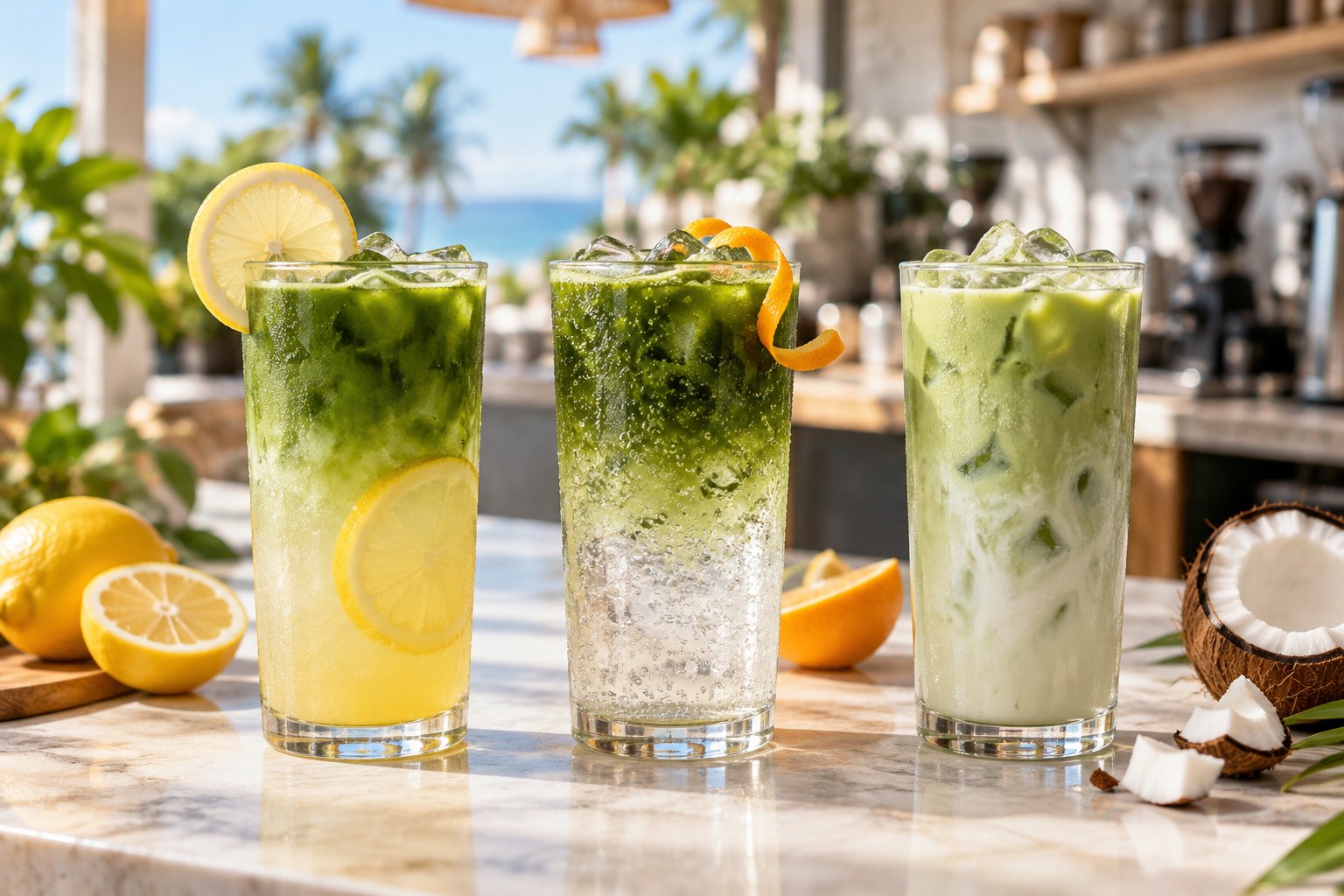
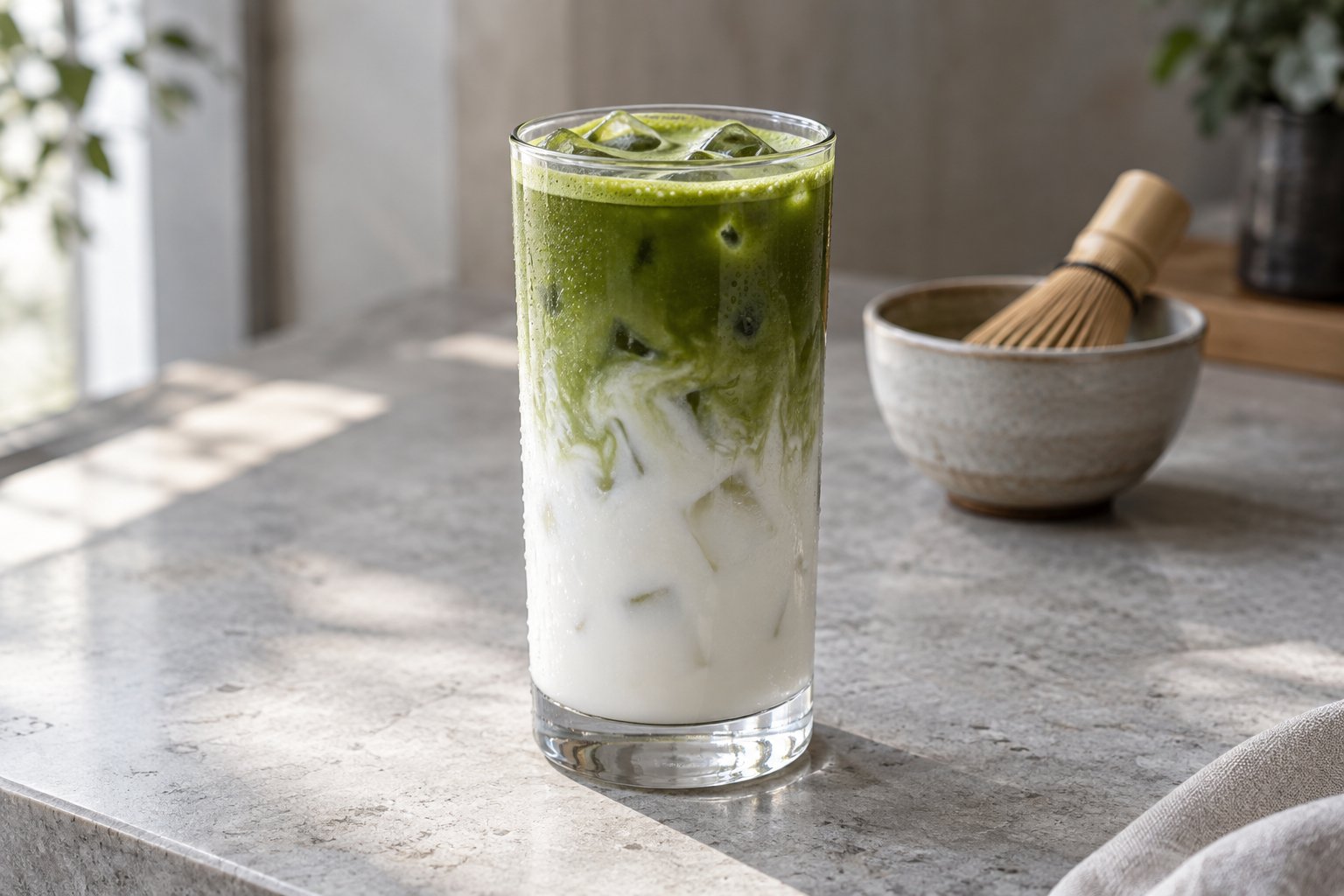
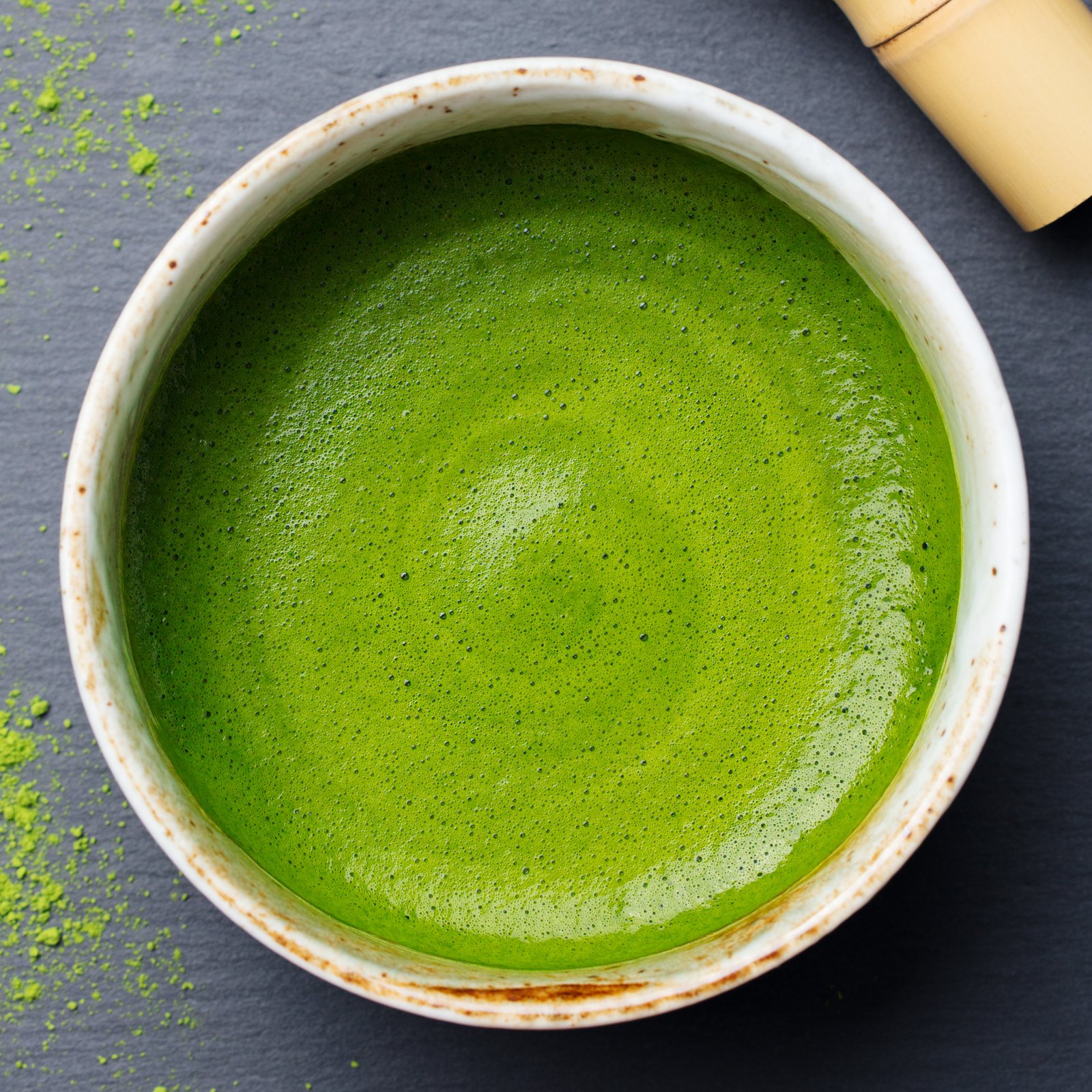
Matcha syrup is a sweet syrup made by dissolving matcha in sugar and water (hot water). It is poured over shaved ice or ice cream, or mixed with milk or soda water to make drinks.
Homemade and commercial
There is homemade syrup, made in the shop from matcha and sugar, and commercial syrup made by syrup companies. Some commercial products contain flavorings, coloring ingredients or acidity regulators as well as matcha.
“Matcha syrup” has two meanings in English
In English, “matcha syrup” can also mean a syrup of just sugar and water (simple syrup) used to sweeten a matcha latte. This guide is about syrup with matcha dissolved in it. For how to decide the amount of sweetener, see “How to add sweetener (syrup)” in our iced matcha latte recipe.
Official recipes compared
Across 8 published recipes, matcha makes up between about 2% and about 9% of the syrup, a difference of more than four times. The ratio of sugar to water also ranges from 0.25:1 to 1.2:1.
The 8 recipes
| Source | Matcha | Sugar | Water | Sugar : water | Matcha share |
|---|---|---|---|---|---|
| Morihan (Kyoto tea company), standard, 2 servings | 3–4g | 60g | 50ml boiling water | 1.2:1 | about 2.6–3.5% |
| Morihan, authentic, 2 servings | 5g | 30g | 60ml boiling water | 0.5:1 | about 5.3% |
| MAIKO Cha Boutique (Uji tea café) | 8g | 200g | 200cc hot water | 1:1 | about 2.0% |
| Isodaen (tea company), recipe replacing 50g of sweetened green tea powder | 4g | 50g | 50g hot water | 1:1 | about 3.8% |
| cotta (online confectionery supplier), recipe site, about 2 cups | 10g | 50g white sugar | 70ml water | about 0.7:1 | about 7.7% |
| Kurasu (Kyoto coffee and tea shop) | 2.5g | 5g | 20g hot water | 0.25:1 | about 9.1% |
| Yagomatcha (Swiss matcha seller) | 2g | 125ml | 125ml + 2 tsp lukewarm water | 1:1 by volume | not calculated (sugar given by volume) |
| MAFF magazine aff (April 2017), matcha shaved ice | a suitable amount, dissolved strong in hot water | beet sugar 75g, granulated sugar 85g, wasanbon sugar 15g, a little brown sugar | 200ml water | about 0.9:1 | matcha and syrup poured separately |
The matcha share is the weight of matcha divided by the total of matcha, sugar and water (taking 1ml as 1g), calculated by our editors. Water lost in heating is not taken into account.
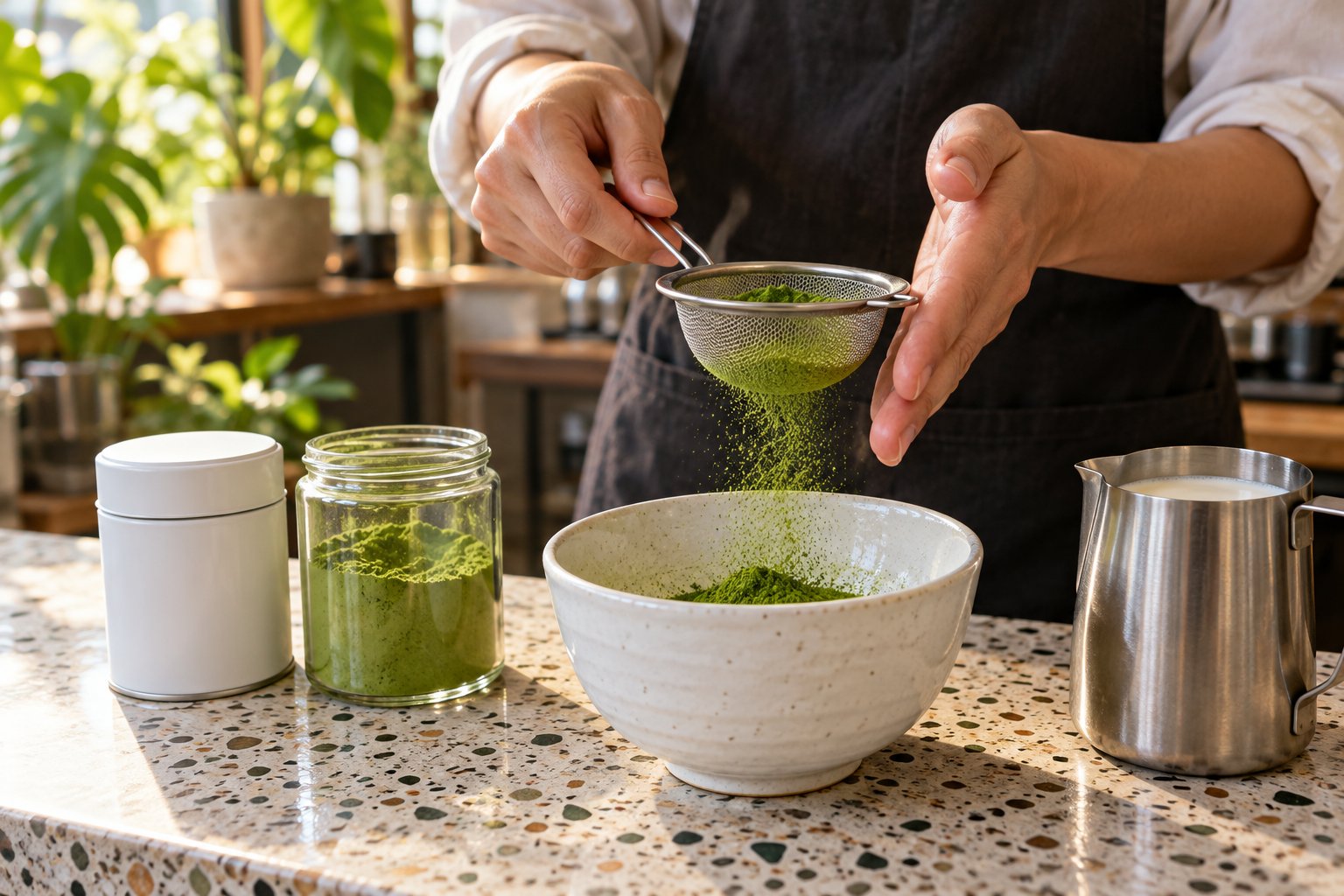
Morihan’s method: bring the water to a boil, add the sugar and heat for about 40 seconds over medium heat, let the syrup cool slightly, then add it little by little to the sifted matcha. Morihan notes that matcha lumps more easily when there is too little water.
Source: Morihan official blog, “夏は抹茶のかき氷! 抹茶シロップの作り方教えます!” (Matcha shaved ice for summer: how to make matcha syrup, in Japanese) https://www.tea-and-coffee.shop/blog/2023/08/25/kakigori/
Syrups for shaved ice are sweeter, the latte syrup has more matcha
The 5 recipes from Morihan, MAIKO Cha Boutique, Isodaen and cotta are all for pouring over shaved ice. Their sugar is 0.5 to 1.2 times the water, and matcha is about 2–8%. Kurasu’s recipe, by contrast, is for a matcha latte made with milk: sugar is only a quarter of the water and matcha is about 9%, a strong mix. Morihan also recommends its standard recipe to people who like café-chain lattes, and the authentic recipe with less sugar to people who like lattes at Japanese tea cafés.
If you make a latte with a sweet shaved-ice syrup, it becomes too sweet before there is enough matcha. For example, to get 2.5g of matcha from Morihan’s standard syrup (calculated with 3.5g matcha), you need about 81g of syrup, which contains about 43g of sugar. With Kurasu’s syrup, 27.5g gives 2.5g of matcha and 5g of sugar. This calculation is our editors’ own.
Our editors recommend making two syrups for two uses: one with plenty of matcha for lattes, like Kurasu’s, and one with roughly equal sugar and water for shaved ice. This makes it easier to keep the amount of matcha per drink consistent.
How to make it without lumps
Mix the matcha well with the sugar first, or sift it, work it into a paste with a little liquid, then add the rest of the liquid little by little. The official recipes fall into two methods.
Mix the sugar and matcha first
MAIKO Cha Boutique mixes the sugar and matcha well in a bowl, then adds them to boiled water to dissolve. It says that mixing with the sugar first stops lumps forming when the matcha goes into the hot water. Isodaen recommends the same method.
Make the sugar water first, then add it to the matcha little by little
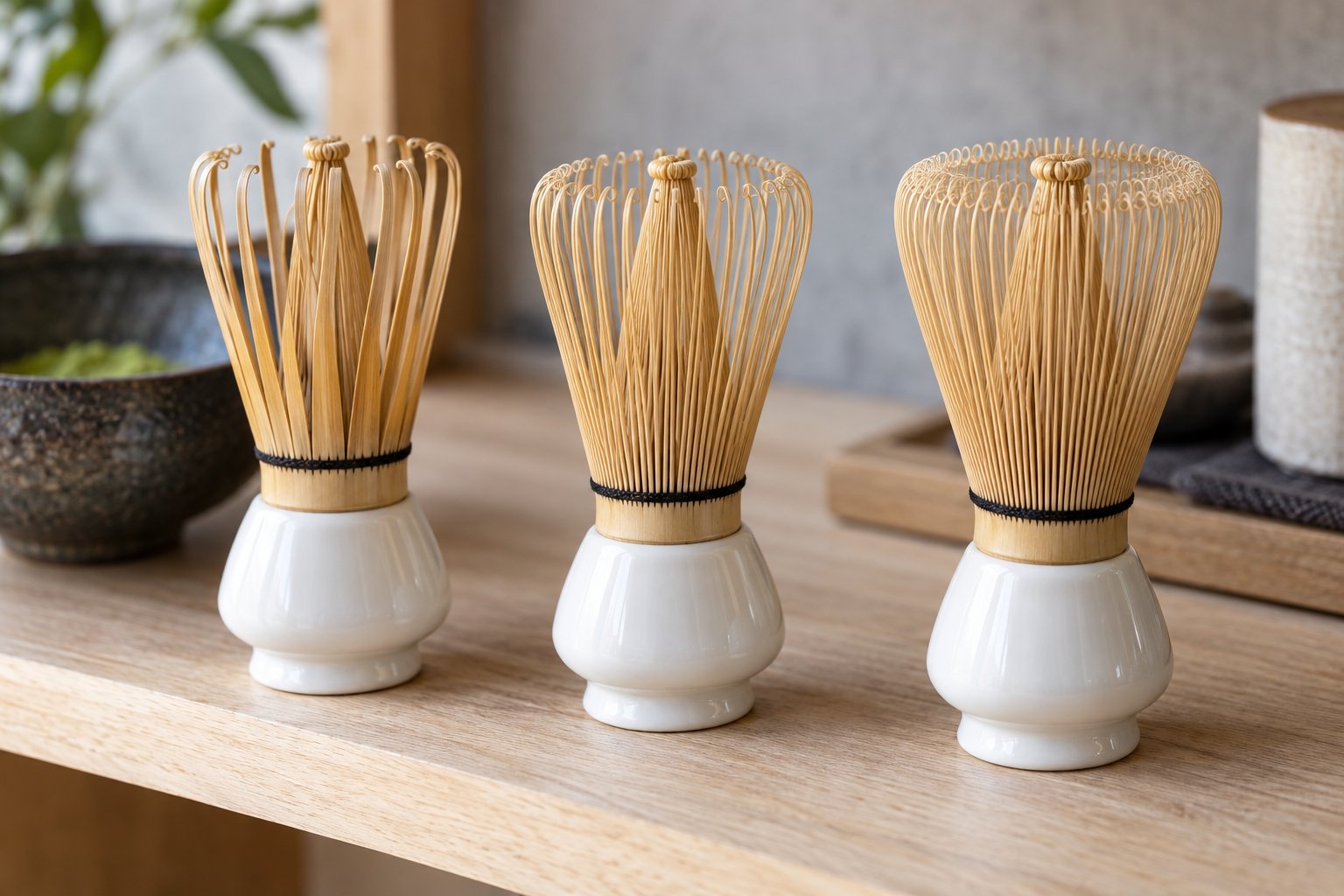
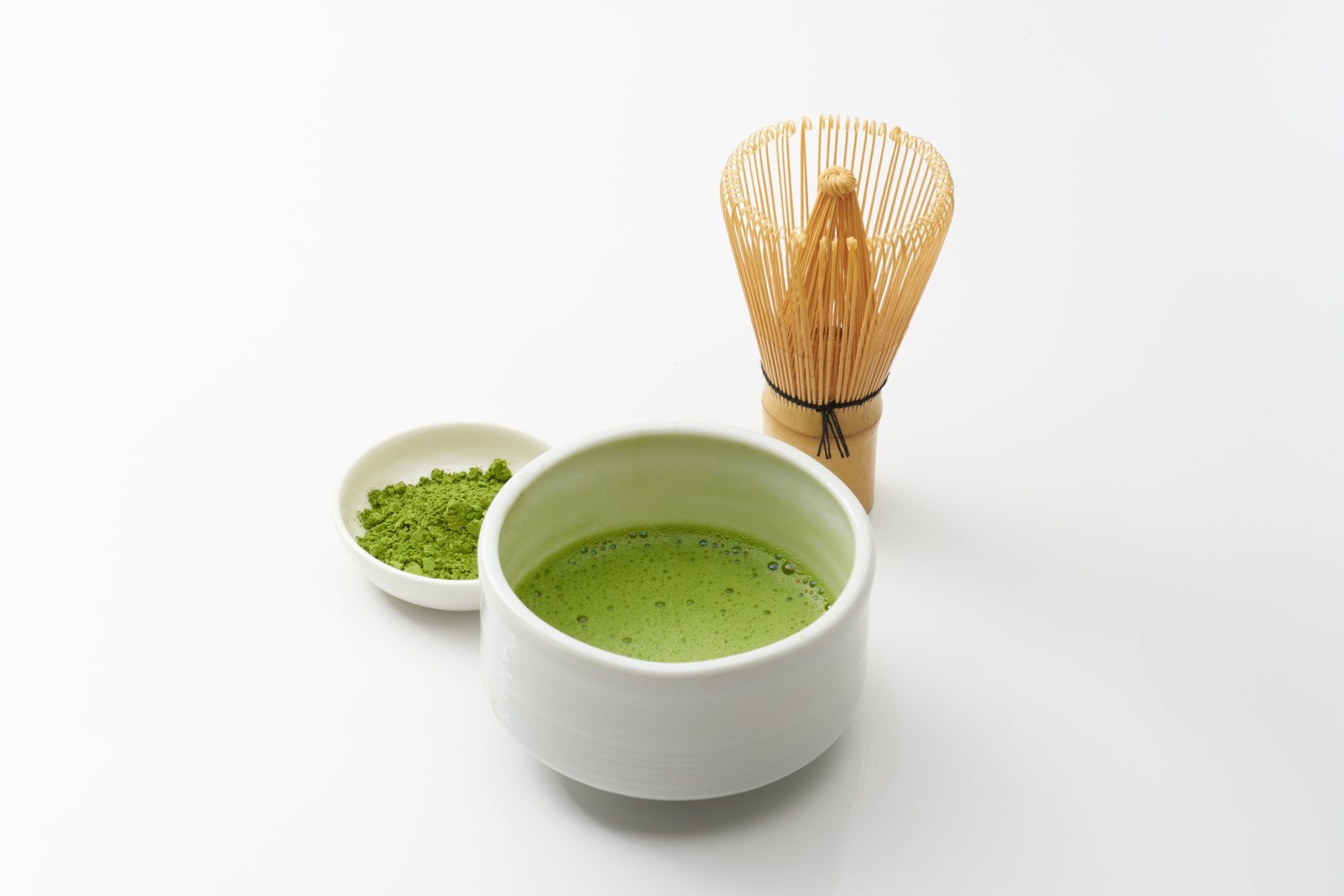
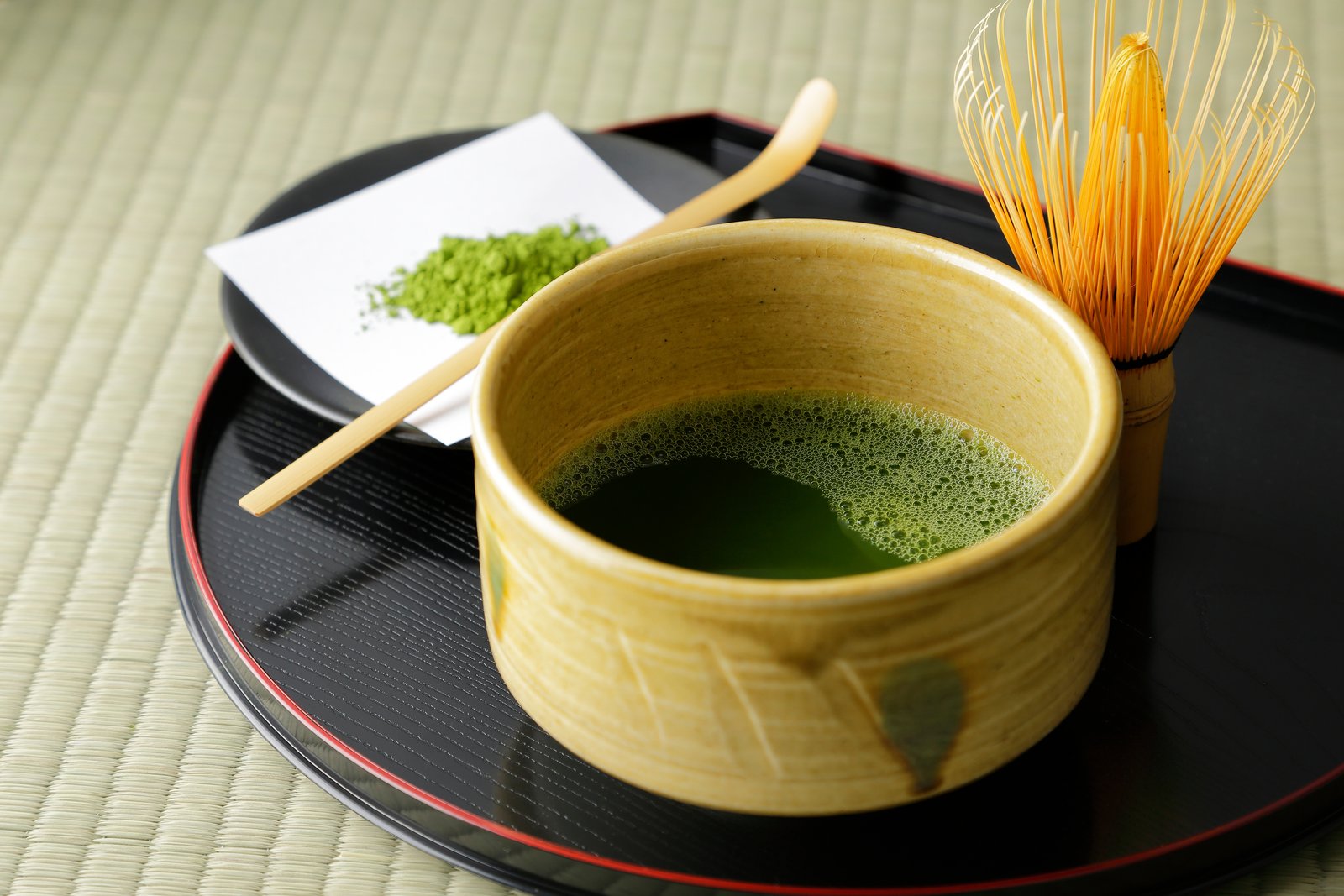
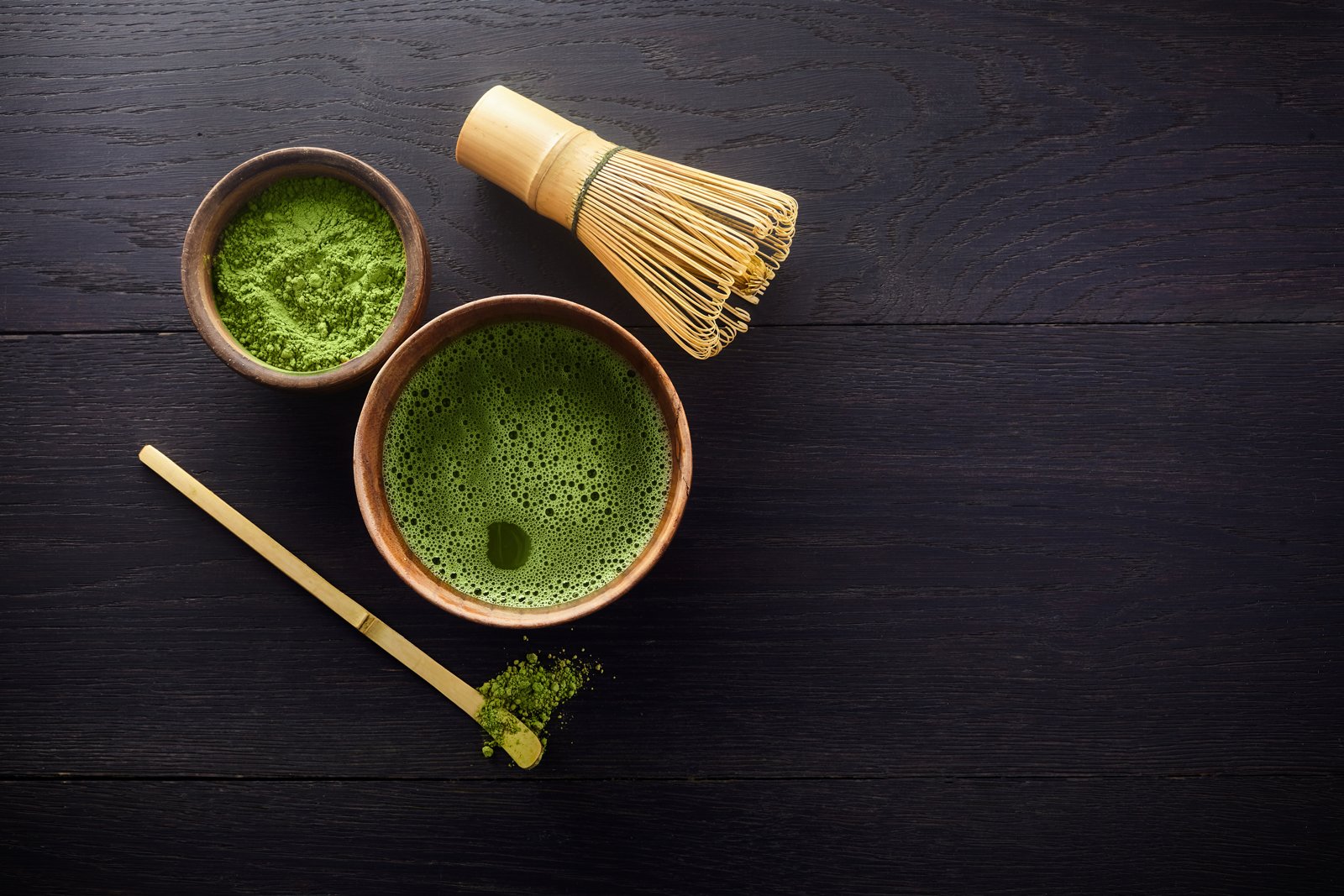
Morihan adds the sugar to boiling water, heats it for about 40 seconds over medium heat, and adds the slightly cooled sugar water (white syrup) little by little to matcha sifted through a tea strainer. Because its authentic recipe uses more matcha and lumps easily, it recommends using a chasen (bamboo whisk) or a whisk.
Don’t boil it too long
MAIKO Cha Boutique says that boiling hard makes the matcha’s color worse, so heat it only briefly if you want to keep a good color. Morihan and cotta heat only the sugar water and add the matcha after it has cooled. When making it in the shop, avoid long cooking after the matcha goes in. For why lumps form and how to sift and make a paste, see “How to prevent lumps” in how to make matcha.
Storage that keeps the color and aroma
We did not find any public guideline on how many days homemade matcha syrup keeps. The information available is guidance from established tea shops and sellers, and labels from commercial makers.
Storage guides for homemade and commercial syrup
| Source | Type | Storage guide |
|---|---|---|
| Yagomatcha | Homemade recipe | About 2 weeks in the fridge. To keep the color, wrap it completely in aluminum foil if possible and refrigerate |
| MAIKO Cha Boutique | Homemade recipe | Contains no preservatives, so use it up soon |
| Monin (French syrup maker), matcha concentrate | Commercial | No refrigeration needed. Store at room temperature away from heat and direct sunlight |
| The Syrup Project (syrup company), matcha syrup | Commercial | Once opened, 90–180 days capped in a cool, dry place below 25°C. 30–60 days with a pump fitted |
The number of days for commercial products depends on each product’s recipe and manufacturing method, and does not apply directly to homemade syrup.
Syrup with less sugar spoils more easily
The Hiroshima Prefecture Food Technology Research Center explains that when a food contains a lot of sugar or salt, much of its water is used to dissolve them, leaving less water that microorganisms can use. As a guide, ordinary bacteria grow at a water activity (a value showing how much water microorganisms can use) of 0.90 or above, yeasts at 0.88 or above, and molds at 0.80 or above. A latte syrup with less sugar leaves more water that microorganisms can use than a sweet shaved-ice syrup. This is a reason to refrigerate it and make it in small batches.
For official guidelines on cold-holding temperatures and how long prepared drinks can be kept, see “Can you make it ahead?” in our iced matcha latte recipe.
Light and heat dull the green
The green of matcha comes from chlorophyll. A presentation at the 2024 annual meeting of the Japanese Society for Food Science and Technology found that a green tea solution made with matcha changed color under light, and inferred that the cause was the breakdown of chlorophyll and a reaction between chlorophyll and catechins (the astringent compounds in tea). In a 2022 study that heated green tea powder with microwaves, the stronger the heating, the more green was lost, mainly because chlorophyll lost its magnesium or broke down.
Yamamasa Koyamaen, an established tea company in Kyoto, also explains that matcha’s green fades with light, and that the same is true of foods made with matcha. Keep it in a container that blocks light, and don’t heat it for long after the matcha goes in. For storing matcha powder, see matcha shelf life.
Storage in the shop (our editors’ view)
Refrigerate it in a bottle that blocks light and write the date and time it was made. To decide how many days it can be kept, mix freshly made syrup and syrup kept for a few days with the same milk, and compare color, aroma and taste side by side in the shop.
How to use it and how much per drink
In the official recipes, the syrup for one latte is 27.5g at Kurasu and 22.5–30mL at Monin. Monin’s lemonade uses 15mL. For soda and shaved ice, set the amount to suit the size of the glass or bowl.
Amount per drink
| Use | Source | Amount of syrup | Combined with |
|---|---|---|---|
| Hot latte | Kurasu | 27.5g (2.5g matcha) | 150g warmed milk |
| Iced latte | Kurasu | 27.5g (2.5g matcha) | about 100g ice, 155g cold milk |
| Hot latte (480mL mug) | Monin “Coconut Hot Matcha Tea” | 30mL concentrate | 2 pumps of coconut concentrated flavor, steamed coconut milk |
| Latte with espresso (360mL) | Monin “Caramel Apple Dirty Matcha” | 22.5mL concentrate | 15mL caramel apple syrup, 120mL steamed milk, espresso |
| Matcha lemonade (480mL glass with ice) | Monin “Big Apple Matcha Lemonade” | 15mL concentrate | 15mL apple syrup, 210mL lemonade |
| Shaved ice | Morihan, standard | about 113g for 2 servings (about 57g per serving, our editors’ calculation) | shaved ice |
Lattes
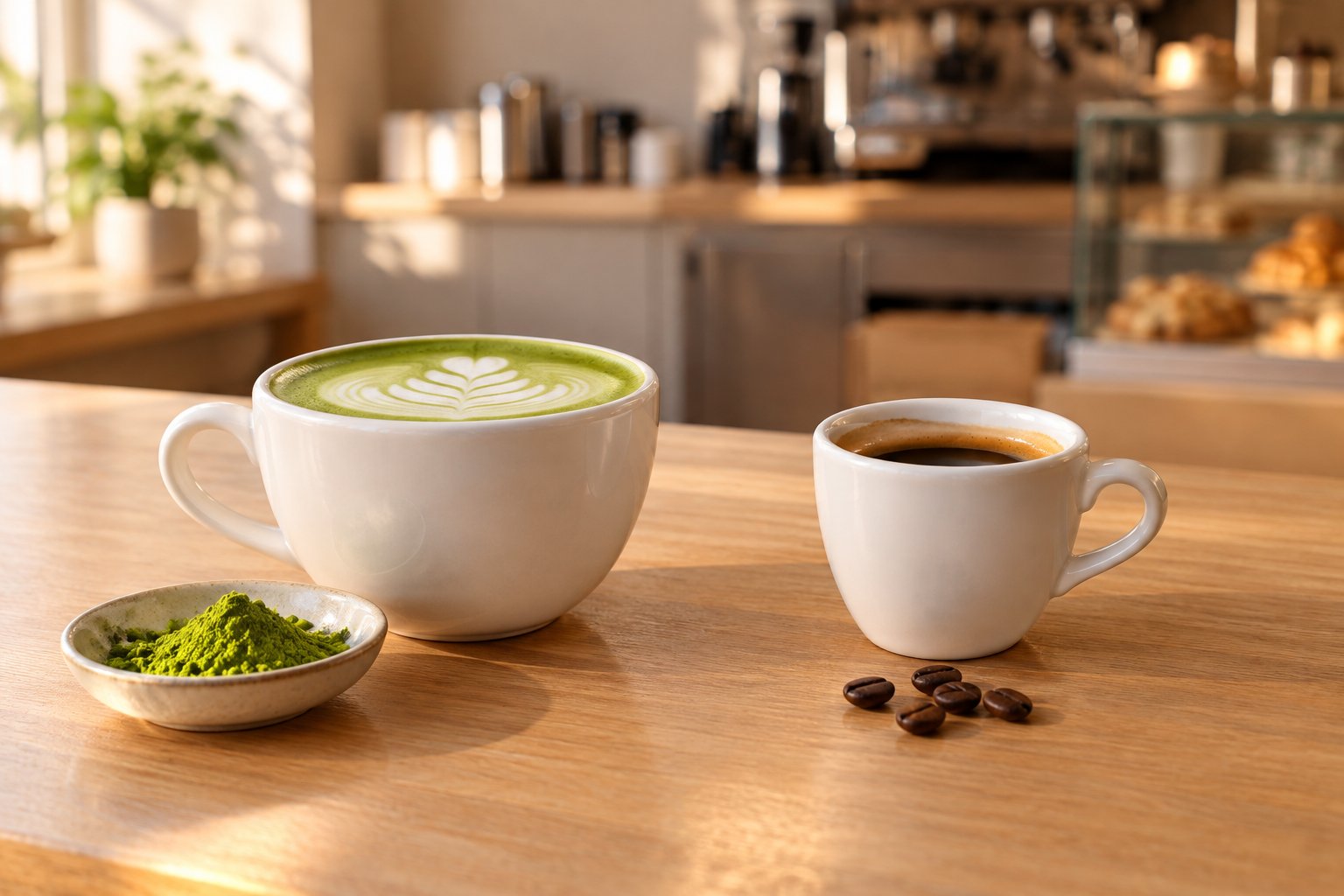
The official matcha latte recipe from Ippodo, an established Kyoto tea company, uses 3g of matcha. Kurasu’s 27.5g of syrup contains 2.5g of matcha, so to match that strength, use a little more syrup or a higher share of matcha. For recipes using matcha powder, see how to choose matcha for café lattes. Because the matcha is already dissolved, the syrup mixes straight into cold milk, saving the work of dissolving matcha for iced drinks.
Soda and lemonade
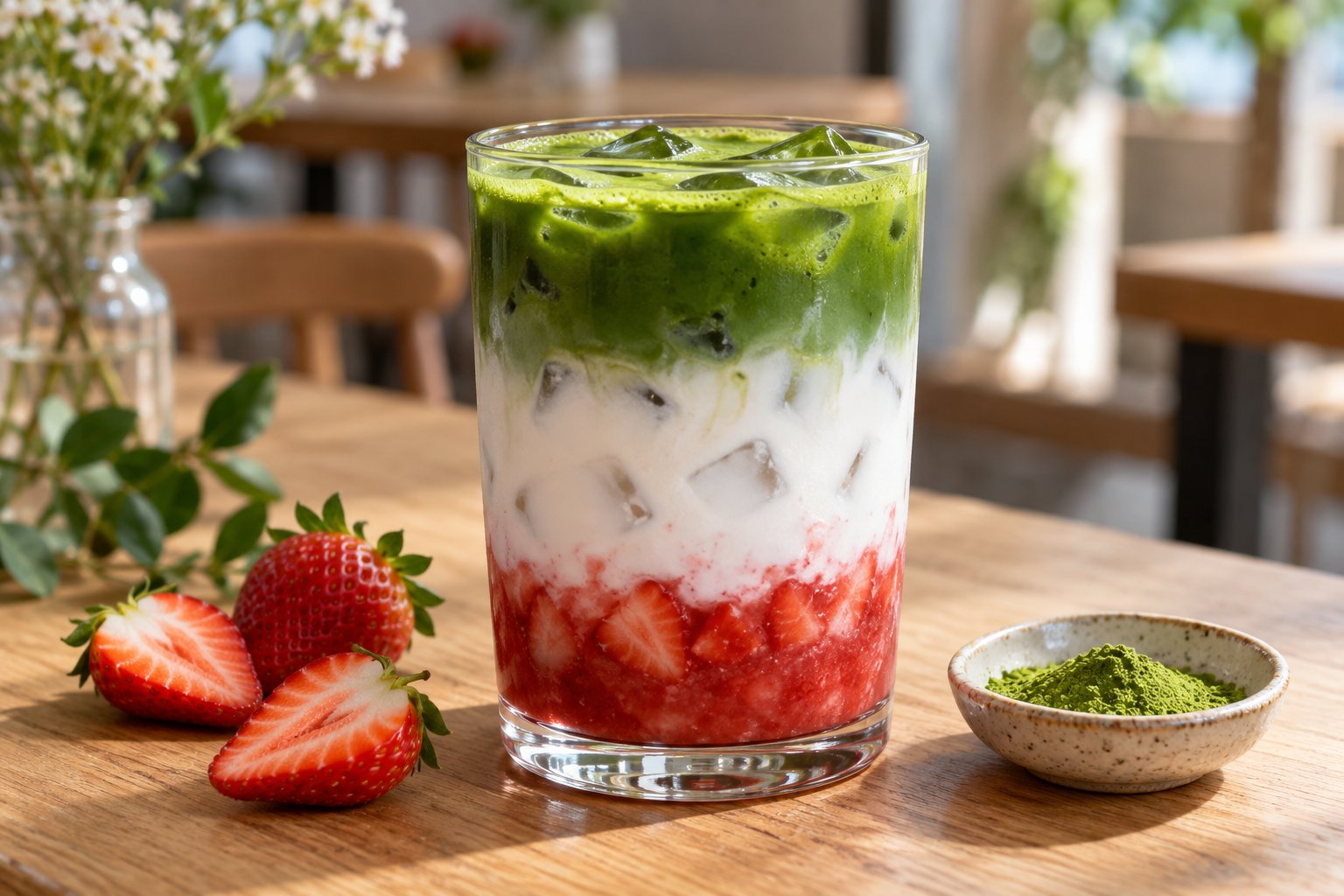
For Monin’s lemonade, the ingredients are poured into a glass with ice, transferred to another container to mix, and poured back. For layered drinks with strawberry, see our strawberry matcha latte.
Shaved ice and desserts
Morihan’s standard recipe works out at about 57g of syrup per serving, containing about 1.5–2g of matcha (our editors’ calculation). The recipe in the Ministry of Agriculture’s magazine makes a sugar syrup and matcha dissolved strong in hot water separately, then pours them over shaved ice one after the other. Because the matcha is not mixed into the sugar water, sweetness and matcha strength can be adjusted separately.
For leftover syrup, Morihan suggests lattes and ice cream, and MAIKO Cha Boutique suggests mixing it with iced water or milk to make a sweet green tea drink.
How to read the ingredient list on commercial matcha syrup
In Japan, Singapore and the US, ingredients are listed in descending order of weight. Where matcha appears in the list, and what is used for color and flavor, shows how products differ.
Ingredients are listed from most to least
Japan’s Food Labeling Standards require ingredients to be listed in descending order of their share of the ingredients by weight. The Singapore Food Agency (SFA) labelling guide also says that, unless the quantity or proportion of each ingredient is stated, ingredients and additives are listed in descending order of their weight at the time of manufacture. US federal regulations also require ingredients to be listed by their common name in descending order of weight.
For example, the ingredients of Monin’s matcha concentrate are, in order: water, pure cane sugar, natural flavors, organic matcha powder, spirulina (color), green tea extract, citric acid, turmeric (color) and natural caffeine. Matcha comes after water, sugar and flavors. The Syrup Project’s matcha syrup lists organic cane sugar, filtered water, organic matcha powder, organic spirulina and citric acid, in that order. Neither states what percentage of matcha it contains.
The share of matcha is often not stated
Under Japanese rules, a product that just says “matcha” does not need to state the percentage of matcha. The Consumer Affairs Agency’s Q&A on the Food Labeling Standards gives matcha as an example of a general name.
On the other hand, emphasizing an origin or brand, such as “made with Uji tea,” counts as a distinctive ingredient. The Consumer Affairs Agency explains that consumers reading such a claim assume 100% is used, so unless it is 100%, the percentage must be stated alongside, as in “made with 10% domestic ××.” The percentage is given either as a share of the whole product or as a share of the same type of ingredient (in this case, matcha).
| Category of distinctive ingredient | Examples given by the Consumer Affairs Agency |
|---|---|
| Specific place of origin | domestic soybean silken tofu, Turkish hazelnuts, Tokachi azuki beans |
| Organic produce, livestock and processed foods | organic wheat flour, organic beef |
| Non-GMO, etc. | (labelled under the GMO rules) |
| Specific place of manufacture | butter made in Hokkaido |
| Produce grown by special methods | carrots grown without pesticides during cultivation |
| Variety names, etc. | Tochiotome strawberries, Koshihikari rice |
| Brand, label or product names | made with Uji tea, Matsusaka beef, Echizen crab |
The Q&A defines a distinctive ingredient as one where a “made with ○○” claim would mislead consumers into thinking the product is better than it is if ○○ is less than 100% of that type of ingredient.
Source: Consumer Affairs Agency, “食品表示基準Q&A” (Q&A on the Food Labeling Standards), Chapter 2 Processed foods, Q 202 (in Japanese) https://www.caa.go.jp/policies/policy/food_labeling/food_labeling_act/assets/food_labeling_cms201_261001_12.pdf
Check how color and flavor are added
Under Japan’s Food Labeling Standards, a coloring is labelled with its purpose and substance name together, as in “coloring (gardenia).” If the name contains the character for “color” (as in gardenia color), the word “coloring” can be omitted. In Singapore, additives can be declared by name, INS number (the international numbering system for additives), E number and so on, and stating their purpose is not required. Whether an ingredient adds color is judged from the substance name.
When comparing commercial products, look at where matcha appears, the coloring ingredients (such as spirulina, turmeric or gardenia), whether green tea extract or flavorings are added, and the sugar content. Monin’s concentrate contains 12g of total sugars per 30mL. For Singapore’s nutrition label for sweetened drinks (Nutri-Grade), see our strawberry matcha latte.
Cost per drink
As with a matcha latte, the matcha cost per drink is calculated as “price per kg ÷ 1,000 × grams used per drink.” For syrup, divide the ingredient cost of one batch by the amount of syrup it makes to get the cost per gram.
Homemade
Say you make 10 times Kurasu’s recipe, with 25g matcha, 50g sugar and 200g hot water. If the batch makes 275g of syrup, the 27.5g for one latte contains 2.5g of matcha and 5g of sugar. The cost per gram of syrup is the total cost of the matcha and sugar in the batch ÷ grams of syrup made.
Turning matcha into syrup does not change the matcha cost; the amount of matcha per drink sets the cost. A latte made with 27.5g of syrup has 2.5g of matcha, 0.5g less than a latte made with 3g of matcha powder. How the price per kg is set is covered in what decides the price of matcha.
Heating reduces the water, so always weigh the finished syrup. Include any syrup thrown away unused in the cost, then add milk, ice, cups and so on to get the ingredient cost per drink.
Commercial
For commercial syrup, calculate bottle price ÷ volume × amount used per drink. For example, on Monin’s US official online store, a 750mL bottle of matcha concentrate costs $16.50 (checked 14 October 2026), about $0.022 per mL. Using 30mL in a latte costs about $0.66, and 15mL in a lemonade about $0.33. Prices vary by country and retailer, so recalculate with your shop’s purchase price.
Homemade or commercial?
Homemade suits shops that want to decide the amount and origin of the matcha themselves; commercial syrup suits shops that want less prep and storage work. Whichever you choose, recording the amount of matcha and the cost per drink lets you compare.
Shops that suit homemade
Shops that feature the strength or origin of the matcha in their lattes on the menu suit homemade syrup. The ingredients can be just matcha, sugar and water, but it needs refrigerated storage and frequent prep.
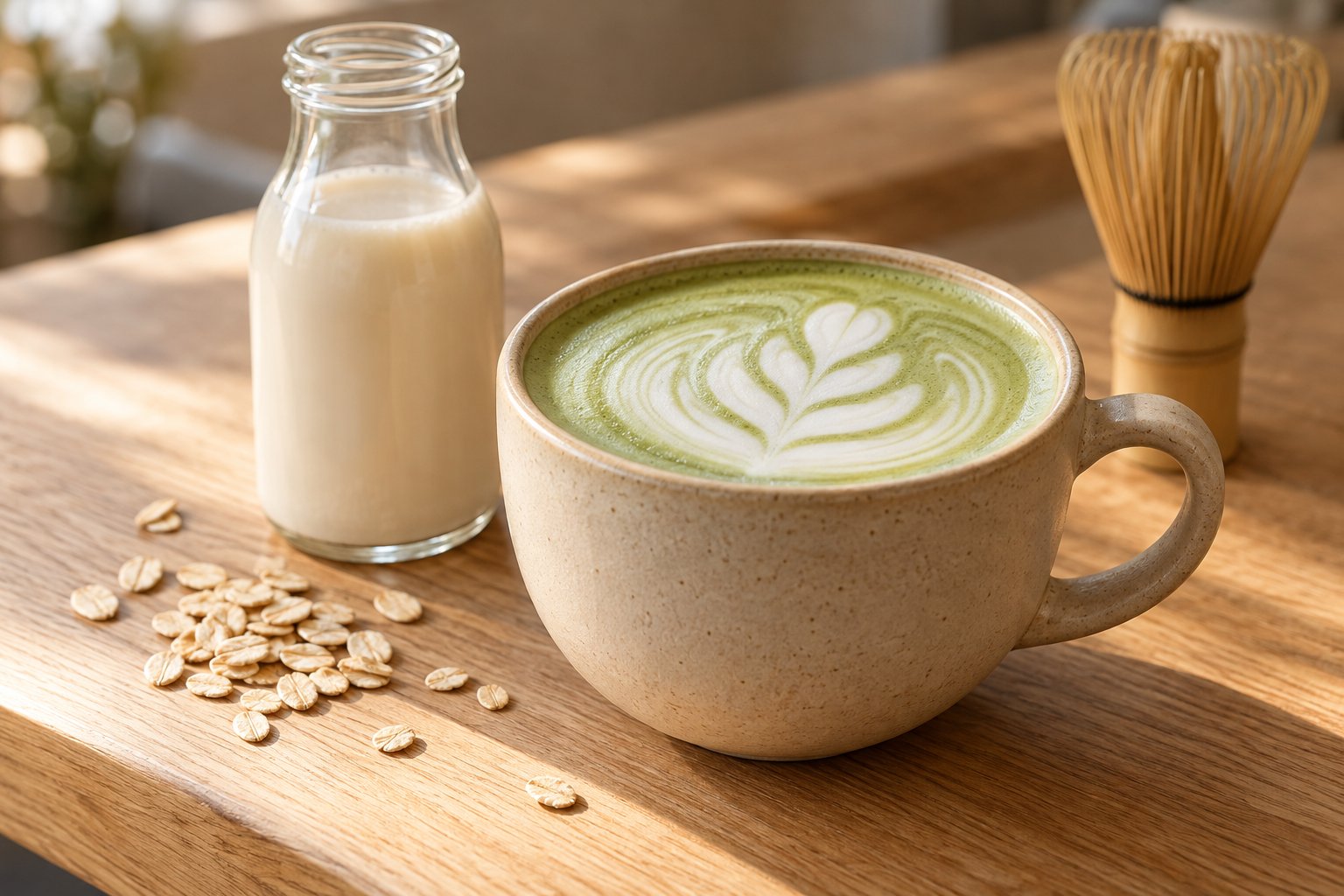
For grades of matcha used in lattes, see matcha grades, and for differences between regions, see matcha origins. If you mix it with oat milk, see also how to choose matcha for oat milk lattes.
Shops that suit commercial syrup
Shops with few matcha drinks, or that use a little at a time in lemonades, suit commercial syrup that can be stored at room temperature. Check where matcha appears on the label and what the coloring ingredients are, then mix it with your own milk and compare it with homemade before deciding.
Sources
- Morihan official blog, “夏は抹茶のかき氷! 抹茶シロップの作り方教えます!” (Matcha shaved ice for summer: how to make matcha syrup, 25 August 2023, in Japanese) https://www.tea-and-coffee.shop/blog/2023/08/25/kakigori/
- MAIKO Cha Boutique, “抹茶のカキ氷シロップの作り方教えちゃいます!” (How to make matcha syrup for shaved ice, 6 August 2016, in Japanese) https://maiko.ne.jp/boutique/?p=583
- Isodaen, “抹茶かき氷シロップの作り方” (How to make matcha shaved ice syrup, 1 August 2024, in Japanese) https://www.isodaen.co.jp/2024/08/01/%e6%8a%b9%e8%8c%b6%e3%81%8b%e3%81%8d%e6%b0%b7%e3%82%b7%e3%83%ad%e3%83%83%e3%83%97%e3%81%ae%e4%bd%9c%e3%82%8a%e6%96%b9/
- cotta, “抹茶シロップ(かき氷用)” (Matcha syrup for shaved ice, in Japanese) https://www.cotta.jp/recipe/recipe.php?recipeid=00008454
- Kurasu, “Matcha Recipe” (6 March 2023) https://kurasu.kyoto/blogs/recipe/matcha-recipe
- Yagomatcha, “Matcha Sirup” https://yagomatcha.ch/en/blogs/rezepte/matcha-sirup
- MAFF, aff April 2017, “抹茶を使ったおいしいレシピ” (Tasty recipes using matcha, in Japanese) https://www.maff.go.jp/j/pr/aff/1704/spe2_02.html
- Monin US, “Matcha Green Tea Concentrate” https://monin.us/products/matcha-green-tea-concentrate
- Monin US, “About” https://monin.us/pages/about
- Monin US, “Coconut Hot Matcha Tea” https://monin.us/products/coconut-hot-matcha-tea
- Monin US, “Caramel Apple Dirty Matcha” https://monin.us/products/caramel-apple-dirty-matcha
- Monin US, “Big Apple Matcha Lemonade” https://monin.us/products/big-apple-matcha-lemonade
- The Syrup Project, “Organic Matcha Syrup 750mL” https://thesyrupproject.com/products/750ml-handcrafted-organic-matcha-syrup
- Ippodo Tea, “Matcha Latte Recipe” https://ippodotea.com/blogs/recipes-to-brew-japanese-tea/matcha-latte-recipe
- Yamamasa Koyamaen, “抹茶の取扱い” (Handling matcha, in Japanese) https://www.yamamasa-koyamaen.co.jp/matcha/basic/handling.html
- Hiroshima Prefecture Food Technology Research Center, “企業のためになるQ&A” (Q&A for businesses: water activity, in Japanese) https://www.pref.hiroshima.lg.jp/soshiki/26/foodfaq6-5.html
- Yasuda et al., “光照射による緑茶の色と成分の変化” (Changes in the color and components of green tea under light), abstract, 71st annual meeting of the Japanese Society for Food Science and Technology (2024, in Japanese) https://www.jstage.jst.go.jp/article/aamjsfst/71/0/71_45/_article/-char/ja
- Wang et al., “The Effect of Microwave Radiation on the Green Color Loss of Green Tea Powder,” Foods (2022) https://pmc.ncbi.nlm.nih.gov/articles/PMC9407078/
- Consumer Affairs Agency, “食品表示基準” (Food Labeling Standards, in Japanese) https://www.caa.go.jp/policies/policy/food_labeling/food_labeling_act/assets/food_labeling_cms201_261001_01.pdf
- Consumer Affairs Agency, “食品表示基準Q&A” (Q&A on the Food Labeling Standards), Chapter 2 Processed foods (in Japanese) https://www.caa.go.jp/policies/policy/food_labeling/food_labeling_act/assets/food_labeling_cms201_261001_12.pdf
- Consumer Affairs Agency, “食品表示基準Q&A” (Q&A on the Food Labeling Standards), Annex: food additives (in Japanese) https://www.caa.go.jp/policies/policy/food_labeling/food_labeling_act/assets/food_labeling_cms201_260401_09.pdf
- Singapore Food Agency, “A Guide to Food Labelling and Advertisements” https://www.sfa.gov.sg/docs/default-source/food-information/labelling-and-packaging-information/a-guide-to-food-labelling-and-advertisements.pdf
- eCFR, “21 CFR 101.4 Food; designation of ingredients” https://www.ecfr.gov/current/title-21/chapter-I/subchapter-B/part-101/subpart-A/section-101.4