
 Reviewed by: Takahiro Sugiyama (CEO, meguri Inc.)
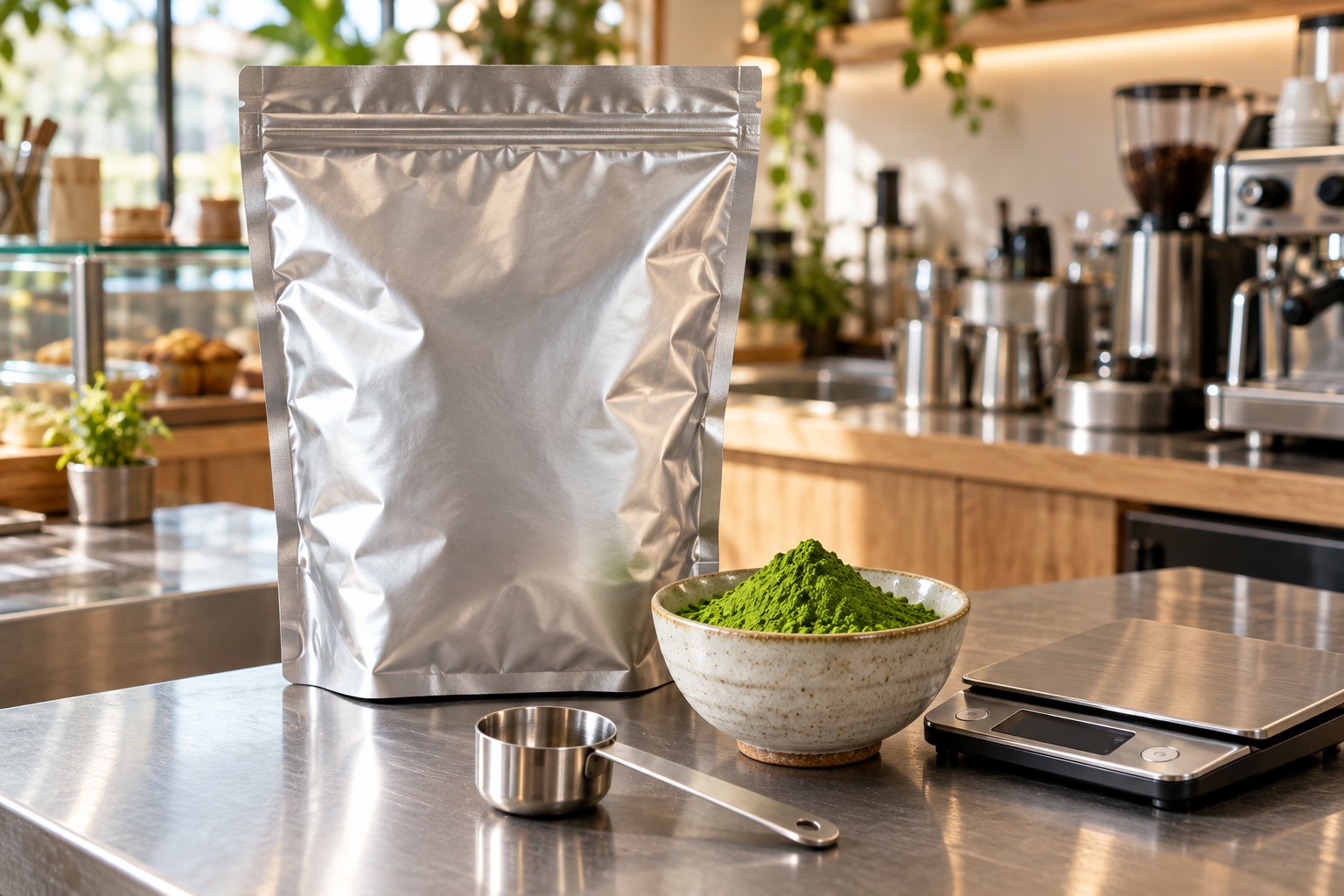
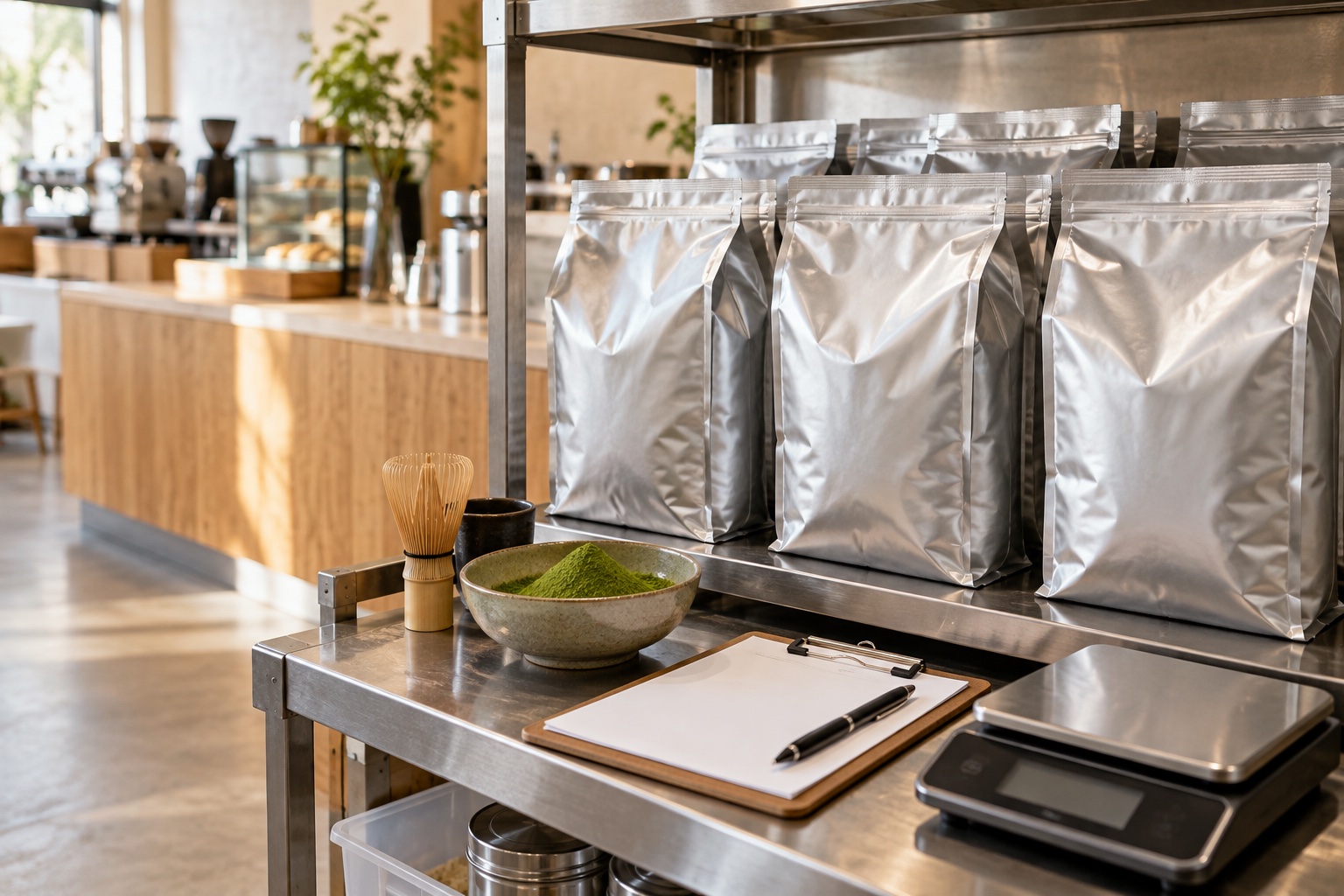
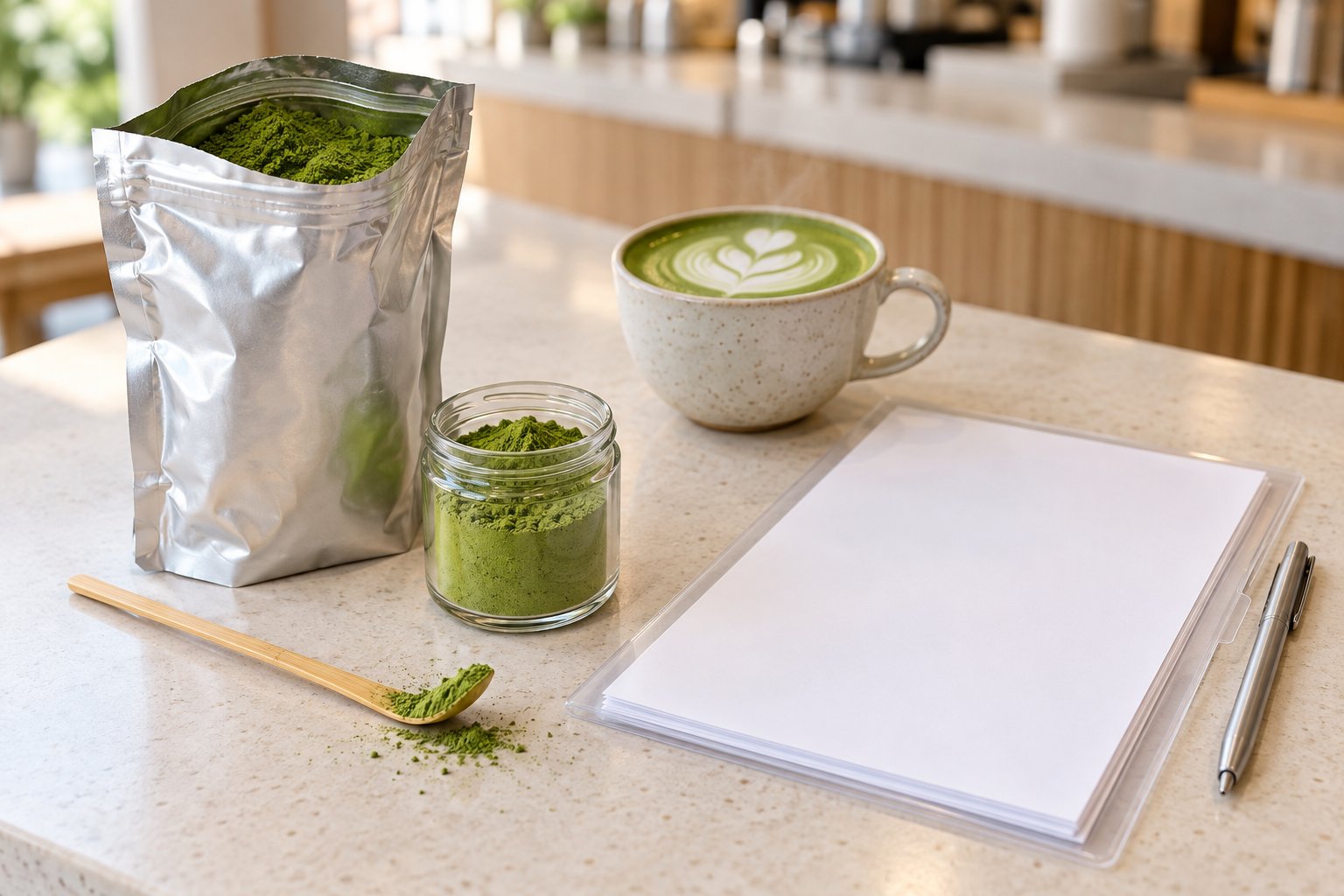
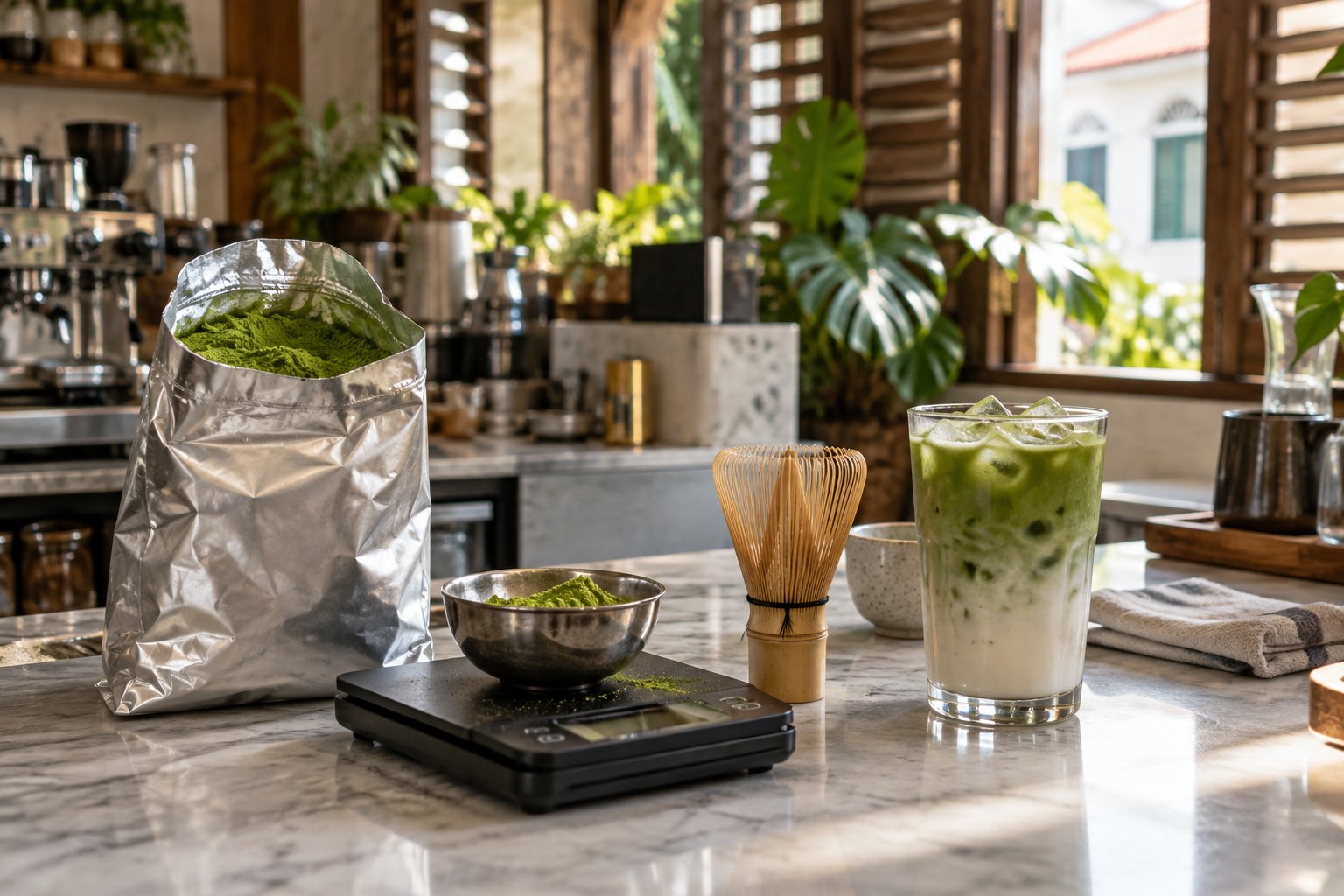
For a café that serves matcha lattes every day, buying matcha in bulk in commercial bags makes the cost per cup easier to control than topping up with retail tins. When you buy from Japan, though, you need to decide more than taste and price: documents, delivery terms, payment and the import procedures of your country. This article covers what to check from choosing a supplier until the matcha arrives, based on public information from JETRO (the Japan External Trade Organization), MAFF and Singapore government agencies.
What buying matcha wholesale means
Buying matcha wholesale means buying a larger amount in commercial bags, at a price set by a quote. Unlike retail tins, the price changes with quantity and delivery terms, and you need documents both for importing and for checking quality.
The main differences from retail are:
| Retail (tins, small bags) | Wholesale (commercial) | |
|---|---|---|
| Packaging | Small tins or bags | Commercial bags such as 500g or 1kg |
| Price | The listed price in shops or online | A quote for each quantity, grade and delivery term |
| Import procedures | Already done by the seller | Done by your shop or an importer |
Grade names such as “ceremonial,” “latte” and “culinary,” used for matcha sold overseas, are not defined in Japan’s green tea labelling standard. Compare what is in the bag, not the name. Grades are explained in Matcha grades, and how to choose matcha for lattes in How to Choose Matcha for Café Lattes.
Types of matcha supplier and how to choose
Matcha suppliers fall into four types: Japanese tea merchants and manufacturers, Japanese export companies, importers and wholesalers in your own country, and buying directly from producing regions. Which to choose depends on who takes on the import procedures.
| Supplier | Import procedures | What to check |
|---|---|---|
| Japanese tea merchant or manufacturer | Done by your shop or a separate importer | Whether they ship overseas and can issue export documents |
| Japanese export company | Depends on the delivery term (the seller under DDP) | Which region and factory the matcha comes from, and whether the lot can be traced |
| Importer or wholesaler in your country | Already done by the importer | Whether they can show origin, harvest and lot in documents |
| Directly from a factory in a producing region | Done by your shop or an importer | Whether they accept small quantities and can prepare the documents |
Buying from an importer in your own country means you do not have to handle registration or customs clearance. On the other hand, it can be harder to see where the matcha was made. If you buy directly from a Japanese company, first decide whether your shop holds an import registration, or whether you can use an importer that does.
If you want tins or bags sold under your shop’s name, also ask whether the supplier accepts private label orders (having the product made under your own brand).
Minimum order and how much to order
The minimum order quantity (the smallest amount you can order at one time) differs by supplier. Decide how much to order from how much you use in a month and how much you can finish after opening a bag.
Work out your monthly use
You can calculate how much matcha you use in a month with this formula:
Monthly use = grams per cup × cups per day × trading days
For example, if you use 3g per cup, sell 40 cups a day and open 26 days a month, that is 3 × 40 × 26 = 3,120g, or about 3kg. With 1kg bags, you would use about 3 bags a month.
Buy only what you can finish
Yamamasa Koyamaen, a tea merchant in Kyoto, explains that buying a 1kg bag when you use only a little means the opened bag is kept for longer, which lowers its quality. It recommends buying smaller bags that match your use, such as two 500g bags instead of one 1kg bag. How to store matcha in hot countries is covered in How to Make Matcha.
Even if a larger order lowers the unit price, matcha that goes stale before you finish it affects the quality of your menu. Start with an amount you can use within a month, check the quality and delivery time, and then increase the quantity.
Tell your supplier your yearly volume early
Yamamasa Koyamaen explains that the trading price of tencha (the tea leaves that are ground into matcha) during the spring new-tea season sets the basis of matcha production costs for the following year. Yamamasa Koyamaen has revised its matcha prices two years in a row, in 2025 and 2026, so telling your supplier how much you will use in a year, before spring, makes it easier to discuss quantity and price. The background to the price rises is in Is There a Matcha Shortage?.
What to check in a quote
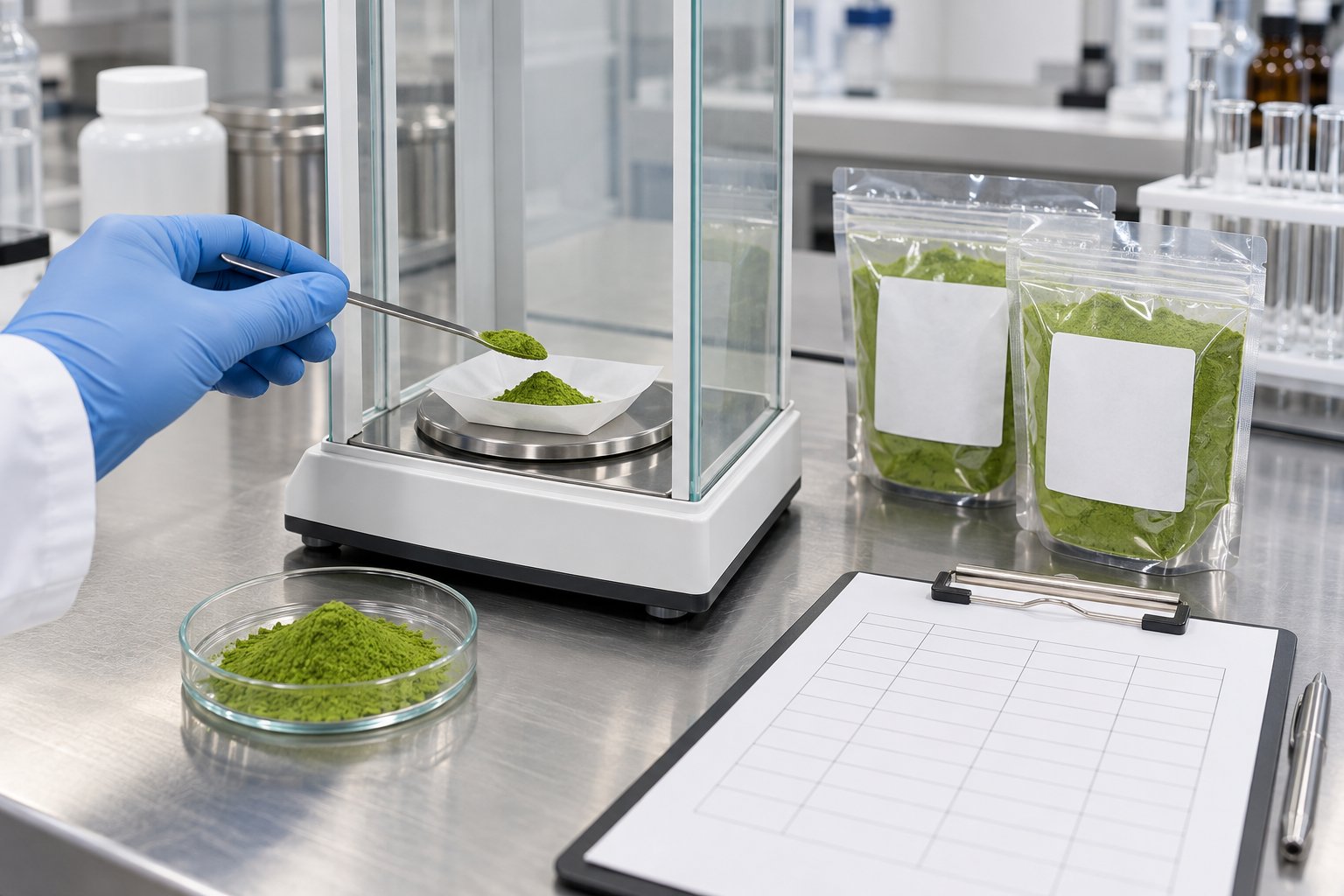
In a quote, check not only the unit price but also the grade, origin, harvest, lot, COA, pesticide residues and the costs included in the unit price. Two quotes for the same “price per kg” cannot be compared if the documents or delivery terms differ.
Contents and documents
| Item | What to check |
|---|---|
| Grade | Whether it is first flush only or blended with second flush and later; whether it was ground with a stone mill or by machine |
| Origin | The prefecture, and the breakdown if several regions are blended |
| Harvest | First flush (the first picking of the year) or second flush and later |
| Lot number | A number that shows when it was made; whether the number on the delivered bag matches the documents |
| Certificate of analysis (COA) | A document with the test results for each lot; also check what was tested |
| Pesticide residue test results | Whether they meet the limits of the country you import into |
| Best-before date and storage | The grinding date, and how long it can be used after delivery |
Differences between regions are covered in Origins.
Judge pesticide residues by the limits of the importing country
Residue limits differ by country, so matcha that meets Japan’s limits does not necessarily meet those of the country you import into. MAFF explains that tea which meets Japan’s limits may fail to meet the destination’s limits and cannot be exported, and it publishes tables comparing the limits for tea in countries and regions including Singapore and Thailand.
| Item | What MAFF’s page says (translated) |
|---|---|
| Why the information is published | The residue limits for pesticides that can be used on rice, fruit and vegetables, and tea differ between Japan and export destinations, so products that meet Japan’s limits may fail to meet the destination’s limits and cannot be exported |
| What it contains | The limits set in major export destinations, compiled so they can be compared with Japan’s limits |
Source: MAFF, “諸外国における残留農薬基準値に関する情報” (Information on pesticide residue limits in other countries, in Japanese) https://www.maff.go.jp/j/shokusan/export/zannou_kisei.html
In Thailand, residue limits for tea are set by notifications of the Ministry of Public Health. For pesticides with no Thai limit, values such as those of the Codex Alimentarius Commission (the body that sets international food standards, run jointly by the UN Food and Agriculture Organization and the World Health Organization) apply. When you receive test results, check which country’s limits they were judged against.
What is included in the unit price
What the unit price includes depends on the delivery term. Ask for each line of the quote to show separately whether it covers only the goods, or also shipping, duties and taxes. With costs separated, you can compare suppliers on the same basis.
How to get and compare samples
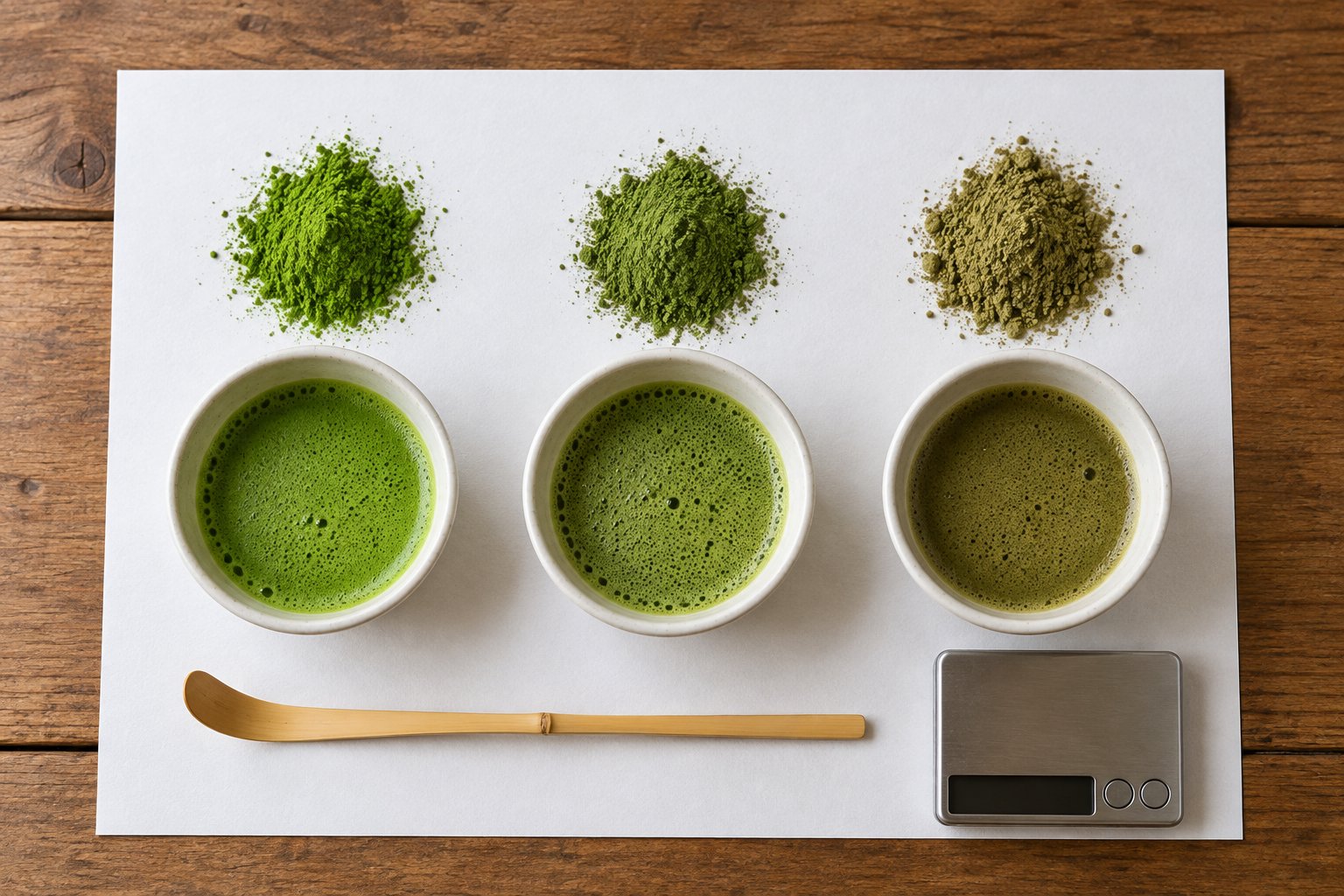
Order 2 to 3 samples and compare them on the same day, under the same conditions, with the milk and amounts your shop uses. Even samples can require import procedures in some countries.
How to compare
- Decide the use (hot latte, iced latte, straight, baking and so on)
- Order 2 to 3 samples that differ in grade or origin
- Whisk them at the same water temperature and amount, then add your shop’s milk
- Record colour, aroma, bitterness, mouthfeel and taste with sweetener
- Compare the colour when freshly made and after 10 minutes
Mixing ratios and points to compare are covered in detail in How to Choose Matcha for Café Lattes.
Some countries require procedures even for samples
The Singapore Food Agency treats receiving and selling food samples, including samples that arrive by parcel post, as importing food for commercial sale. Shops without a registration receive samples through a registered importer. For Thailand, we could not find a clear statement in public sources on how samples are handled. Before a sample is sent, check with your importer or supplier how to receive it.
Delivery terms: the difference between FOB, DAP and DDP
FOB, DAP and DDP are terms that set how far the seller and buyer each pay freight, duties and taxes, and where the risk passes. They are part of the Incoterms international rules set by the International Chamber of Commerce (ICC), and the latest version is Incoterms 2020, in force from 1 January 2020.
The 11 Incoterms 2020 rules are divided into two groups:
| Group | Rules |
|---|---|
| Rules for any mode or modes of transport | EXW, FCA, CPT, CIP, DAP, DPU, DDP |
| Rules for sea and inland waterway transport | FAS, FOB, CFR, CIF |
Source: JETRO, “インコタームズ2020” (Incoterms 2020, in Japanese) https://www.jetro.go.jp/world/qa/04C-070304.html
How the three terms differ
Based on JETRO’s explanations, the points that matter to a café compare as follows.
| Term | Seller bears | Buyer bears |
|---|---|---|
| FOB (Free on Board) | Costs and risk until the goods are loaded on the ship at the Japanese port | Sea freight and insurance, import clearance, duties and taxes |
| DAP (Delivered at Place) | Export clearance, and freight and risk to the destination | Import clearance costs, duties and taxes, and costs and risk after delivery |
| DDP (Delivered Duty Paid) | Delivery to the destination, export and import clearance, and payment of duties and import taxes | Receiving the goods at the destination |
Under FOB, the risk passes to the buyer when the goods are placed on board the ship. Under DAP, the seller has delivered when the goods are placed at the buyer’s disposal on the arriving means of transport (such as a truck) at the destination, ready for unloading.
For air freight, use FCA rather than FOB
FOB is a term for sea and inland waterway transport. JETRO notes that for container transport, FCA (Free Carrier: the risk passes when the goods are handed to the carrier named by the buyer) and similar terms are recommended instead of FOB, and that air cargo is handled in the same way as containers. If a quote for air freight says “FOB,” ask whether it matches how the goods will actually be shipped.
What to agree on
Incoterms are neither a law nor a treaty, so when you use them, write the term and place in the contract or purchase order, for example “DAP Bangkok.” Incoterms do not set the price or the payment method, so agree payment terms separately.
Under DAP, the receiving side pays duties and taxes. In a country such as Thailand, where duty varies widely, assume a DAP quote does not include duties and taxes, and add the import costs yourself when you compare.
Payment terms
Payment methods include payment in advance, payment after delivery and letters of credit, and they differ in whether the seller or the buyer carries the risk. For a first order, starting with a small quantity is the safer choice.
JETRO explains that with payment in advance, the buyer carries the risk of not receiving the goods, and with payment after delivery, the seller carries the risk of not being paid. A letter of credit (L/C: a document in which the buyer’s bank promises payment) avoids the risk for both sides, but the bank charges a fee to open it.
When paying in advance, check the following:
- That the company exists, and that its address and contact details match official information
- That the quote and invoice state quantity, unit price, delivery term and delivery date
- Which side pays the bank transfer fees
- Which currency is used (exchange rate movements change the amount you pay)
JETRO also suggests splitting the payment into several transfers, or starting with small imports and building up the relationship, when a seller asks for payment in advance.
Import procedures for Singapore, Thailand and Indonesia
In Singapore, Thailand and Indonesia alike, importing matcha for sale requires a registration for the importing company and procedures for each shipment. If your shop does not hold the registration, import through an importer that does.
Singapore
| Item | Details |
|---|---|
| Registration of the importing company | Registration with the Singapore Food Agency (SFA), required regardless of the nature and mode of your business |
| Procedure for each shipment | An import permit through the customs electronic system (TradeNet) for every consignment |
| Duty | None (duty applies only to four categories: liquor, tobacco, motor vehicles and petroleum products) |
| Tax | Goods and Services Tax (GST) of 9%, charged on the total of the CIF value (goods, insurance and freight), duties, and commission and other charges |
Thailand
According to JETRO’s research (as of October 2024), importing tea into Thailand requires the following:
| Item | Details |
|---|---|
| Food import licence (Orr.7) | When importing for sale, the importer obtains it from the Thai Food and Drug Administration (Thai FDA) of the Ministry of Public Health. Application fee of 5,000 baht and licence fee of 15,000 baht; takes 5 business days |
| Food registration number | Tea needs a registration number for each product. Registration requires a certificate that the manufacturing factory meets manufacturing standards (GMP certificate) |
| Plant quarantine | A Japanese phytosanitary certificate is required (not needed for tea processed beyond a certain level) |
| Tariff quota | Tea is a tariff quota item, and both within and outside the quota an advance application to the Department of Foreign Trade of the Ministry of Commerce is required |
| Duty | 30% within the quota and 90% outside it; within the quota it is exempt under the Japan-Thailand Economic Partnership Agreement (JTEPA) |
| Value added tax (VAT) | 7%. JETRO states that additive-free tea that has only gone through preservation processes such as drying is not subject to VAT |
| Labelling | Packaged food must show the food name, registration number and other information in Thai |
In Thailand, duty ranges from 0% to 90% depending on whether a shipment falls within the quota. To use the JTEPA exemption, you need a certificate of origin issued by the Japan Chamber of Commerce and Industry and a certificate from the Department of Foreign Trade. Quota applications are accepted three times a year, and only companies can apply. When buying on DAP terms, your shop or importer pays this duty and tax, so check with your importer before comparing quotes.
Indonesia
| Item | Details |
|---|---|
| Permit for the importing company | To sell packaged processed food, you need a distribution permit (ML number) from the Indonesian Food and Drug Authority (BPOM). The local importer applies for it |
| Procedures for each shipment | An import approval (SKI) from BPOM for each import |
| Halal certification | Halal certification for imported food and beverages was due to become mandatory on 18 October 2026, but in October 2026 the government announced it will start on 18 October 2028 (the regulation amendment is still to come) |
| Duty | The tariff regulation was revised in September 2026, so check the current rate before you trade |
In Indonesia, you first need a local importer holding a BPOM distribution permit. The halal requirement has been pushed back, but buyers may still ask for a halal certificate, so check whether the matcha you buy has one. If you don’t have an importer yet, start with samples for tasting and look for a company to handle the import. By Japan Post EMS, the standard delivery time from Tokyo is 8 days.
From order to delivery
A first purchase goes in this order: samples, quote, order, payment, shipping, import clearance and delivery. The table shows what to check at each step.
| Step | What to do | What to check |
|---|---|---|
| 1 | Decide the use and monthly volume | Grams per cup, cups, the amount you can finish |
| 2 | Decide who imports | Whether your shop has the registration or licence, and which importer you can use |
| 3 | Order and compare samples | How samples are treated on import, taste with your shop’s milk |
| 4 | Get quotes | Grade, origin, harvest, lot, COA, pesticide residues, delivery term, breakdown of the unit price |
| 5 | Order and pay | An invoice stating quantity, delivery date and delivery term; payment method and currency |
| 6 | Shipping and import clearance | Invoice, packing list, certificates required in the importing country |
| 7 | Delivery and inspection | Lot numbers on the bags against the documents, storage after opening |
Omakase Matcha’s terms
Omakase Matcha supplies matcha sourced directly from the producing regions of Uji, Yame, Kagoshima, Shizuoka and Miyazaki, from 1kg. You can request up to 3 samples through Samples, and we also adjust blends to suit your menu. We also visit shops in Singapore and Thailand.
For delivery, Singapore is DDP, with duties and taxes paid by us, and Thailand and Indonesia are DAP, with duties and taxes paid by your shop on delivery. Payment is in advance by Wise or PayPal. Terms for each country are on Wholesale, Singapore, Thailand and Indonesia.
Sources
- JETRO, “インコタームズ2020” (Incoterms 2020, in Japanese) https://www.jetro.go.jp/world/qa/04C-070304.html
- JETRO, “DAP(仕向地持込渡)の詳細を教えてください” (Details of DAP, in Japanese) https://www.jetro.go.jp/world/qa/04A-011212.html
- JETRO, “VAT登録の要否:EUへ輸出する場合” (VAT registration when exporting to the EU, explaining DDP, in Japanese) https://www.jetro.go.jp/world/qa/04O-110801.html
- JETRO, “船積までのリスクをカバーする輸出FOB保険:日本” (Export FOB insurance covering risk until loading, in Japanese) https://www.jetro.go.jp/world/qa/04A-010732.html
- JETRO, “コンテナ輸送の貿易取引条件” (Trade terms for container transport, in Japanese) https://www.jetro.go.jp/world/qa/04A-011002.html
- JETRO, “輸入代金前払決済のリスク回避策:日本” (Avoiding risk when paying for imports in advance, in Japanese) https://www.jetro.go.jp/world/qa/04J-010201.html
- JETRO, “輸入における価格および取引条件の決定方法:日本” (Setting prices and terms when importing, in Japanese) https://www.jetro.go.jp/world/qa/04A-011203.html
- JETRO, “茶の輸入規制、輸入手続き(タイ)” (Import regulations and procedures for tea, Thailand, in Japanese) https://www.jetro.go.jp/world/asia/th/foods/exportguide/greentea.html
- MAFF, “諸外国における残留農薬基準値に関する情報” (Information on pesticide residue limits in other countries, in Japanese) https://www.maff.go.jp/j/shokusan/export/zannou_kisei.html
- Yamamasa Koyamaen, “抹茶の取扱い” (Handling matcha, in Japanese) https://www.yamamasa-koyamaen.co.jp/matcha/basic/handling.html
- Yamamasa Koyamaen, “価格改定のお知らせ” (Notice of price revision, 1 July 2026, in Japanese) https://www.yamamasa-koyamaen.co.jp/info/2026/post-10/
- Japan Tea Central Public Interest Incorporated Association, “緑茶の表示基準” (Green Tea Labelling Standard, in Japanese) https://www.nihon-cha.or.jp/pdf/hyoujikijyun.pdf
- SFA, “What You Need to Know for Import of Food for Commercial Sale” https://www.sfa.gov.sg/food-import-export/commercial-imports/what-you-need-to-know-for-import-of-food
- Singapore Customs, “Duties and Dutiable Goods Overview” https://www.customs.gov.sg/doing-business/valuation-duties-and-fees/duties-and-dutiable-goods/duties-and-dutiable-goods-overview/
- IRAS, “Importing of Goods” https://www.iras.gov.sg/taxes/goods-services-tax-(gst)/claiming-gst-(input-tax)/importing-of-goods
- IRAS, “Current GST Rates” https://www.iras.gov.sg/taxes/goods-services-tax-(gst)/basics-of-gst/current-gst-rates
- BPOM Regulation No. 28 of 2023 (supervision of drug and food imports; sets the SKI import approval for processed food) https://pasal.id/peraturan/perban/peraturan-bpom-no-28-tahun-2023
- ANTARA, “Pemerintah memperpanjang penahapan sertifikasi halal hingga 2028” (17 October 2026, in Indonesian) https://www.antaranews.com/berita/5793025/pemerintah-memperpanjang-penahapan-sertifikasi-halal-hingga-2028
- ANTARA, “RI extends halal certification mandate for select sectors to Oct. 2028” (17 October 2026) https://en.antaranews.com/amp/news/436173/ri-extends-halal-certification-mandate-for-select-sectors-to-oct-2028
- Japan Post, “お届け日数表(EMS:東京)” (EMS delivery days from Tokyo, in Japanese) https://www.post.japanpost.jp/send/oversea/date/ems/tokyo.html