
 Reviewed by: Takahiro Sugiyama (CEO, meguri Inc.)
Alongside “Uji matcha,” cafés and online shops overseas also sell matcha labelled “Shizuoka matcha.” Shizuoka has more tea fields than any other prefecture in Japan, but about 60% of its aracha is sencha, and Kagoshima and Kyoto both make more of the raw material for matcha. Checking public sources for how much Shizuoka matcha is made, where and how, makes it easier to compare what suppliers tell you.
What is Shizuoka matcha?
Shizuoka matcha is a name for matcha ground from tencha made in Shizuoka Prefecture. There is no fixed definition of “Shizuoka matcha.” The Japan Patent Office’s regional collective trademarks (trademarks that combine the name of a region with the name of a product) include “Shizuoka tea” for green tea from Shizuoka Prefecture and “Kakegawa matcha” for matcha from Kakegawa city.
Shizuoka is a sencha region
According to Japan’s Ministry of Agriculture, Forestry and Fisheries (MAFF), Shizuoka has 11,600 hectares of tea fields, the largest in Japan. MAFF describes its production as centred on sencha (steamed and rolled green tea), especially fukamushi sencha (sencha steamed for longer). In 2024 and 2025, Kagoshima ranked first for aracha production and Shizuoka second. Aracha is tea before final processing: picked leaves that have been steamed and dried at a factory in the growing area.
Tencha and matcha
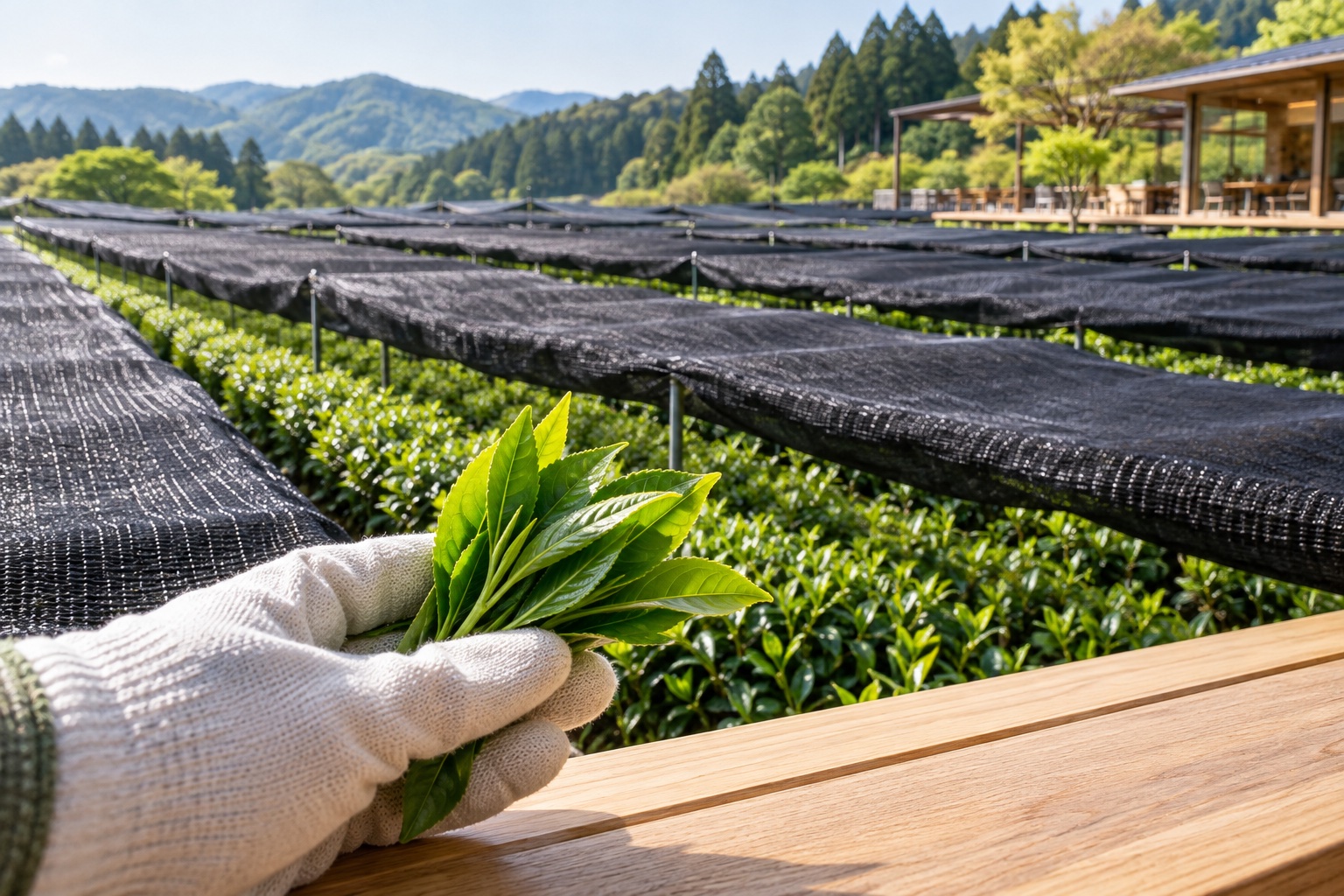
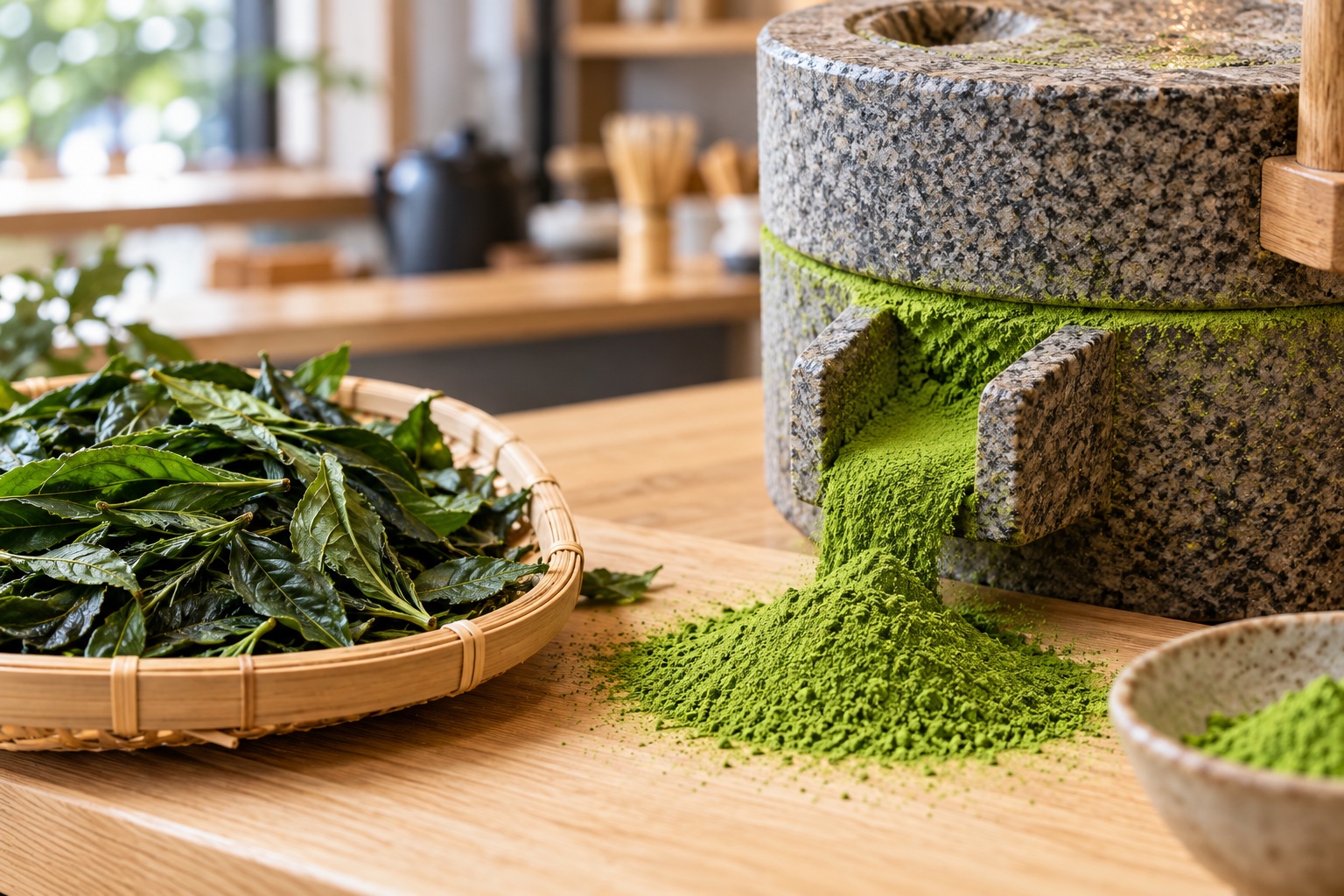
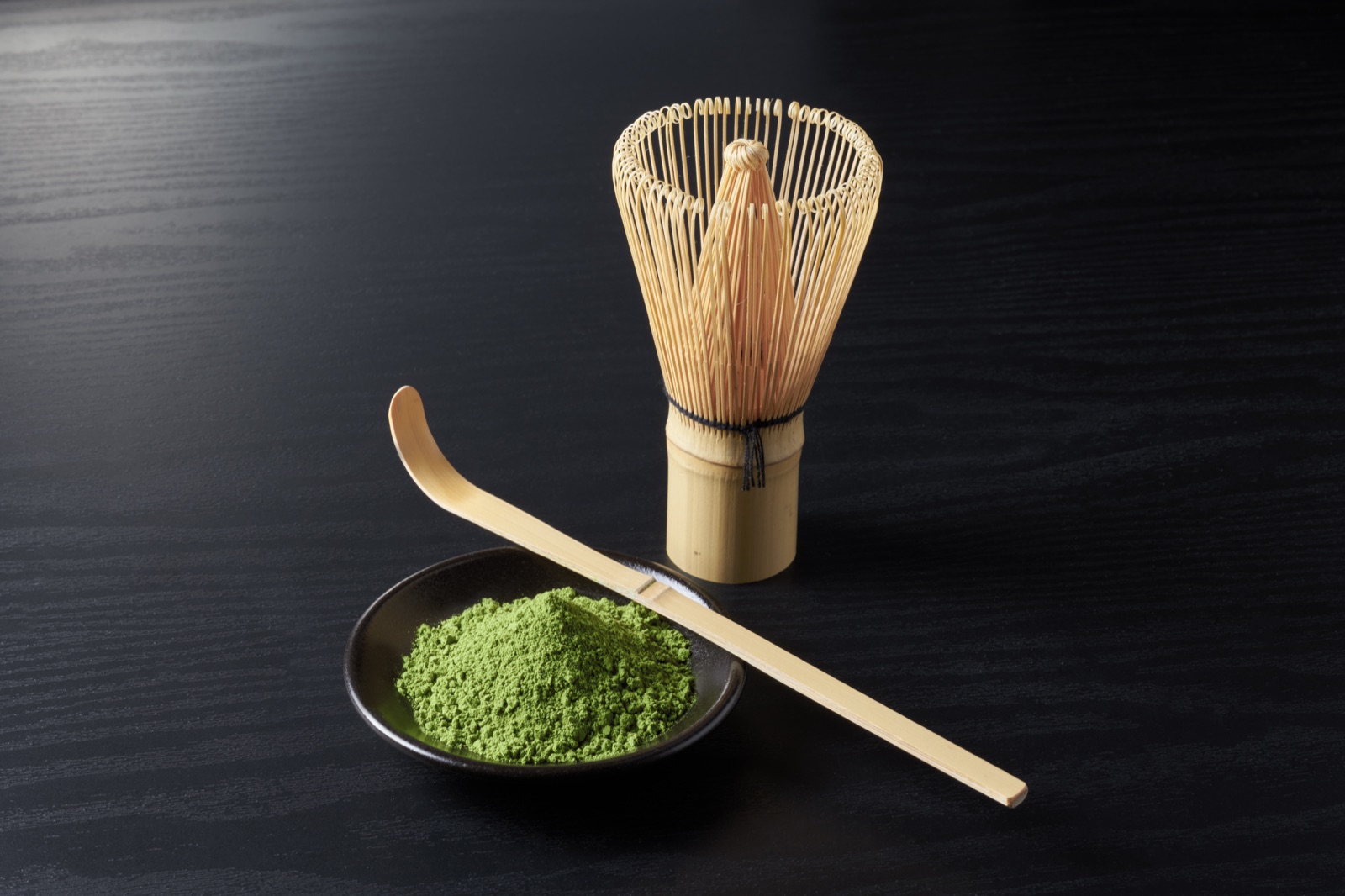
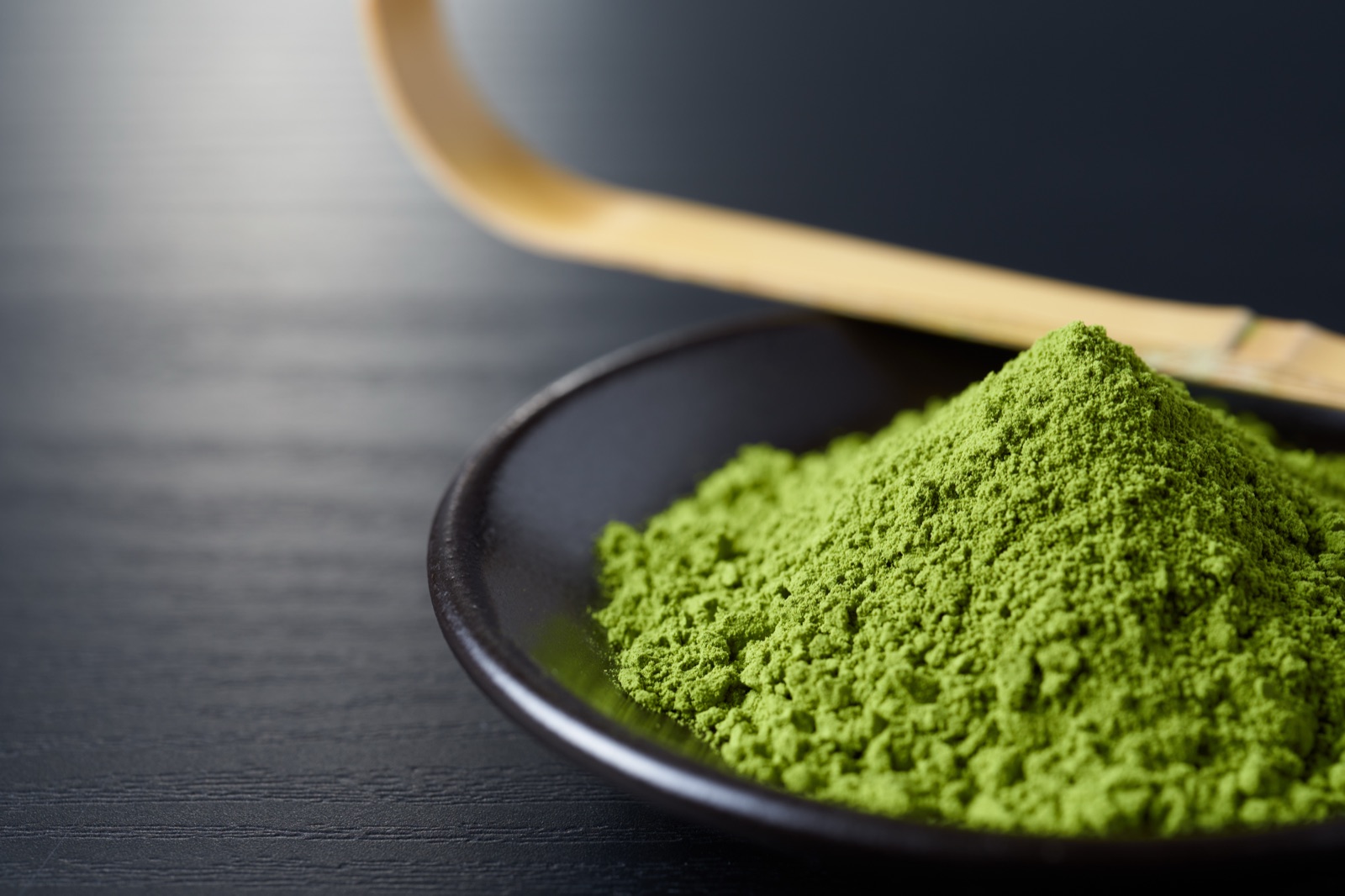
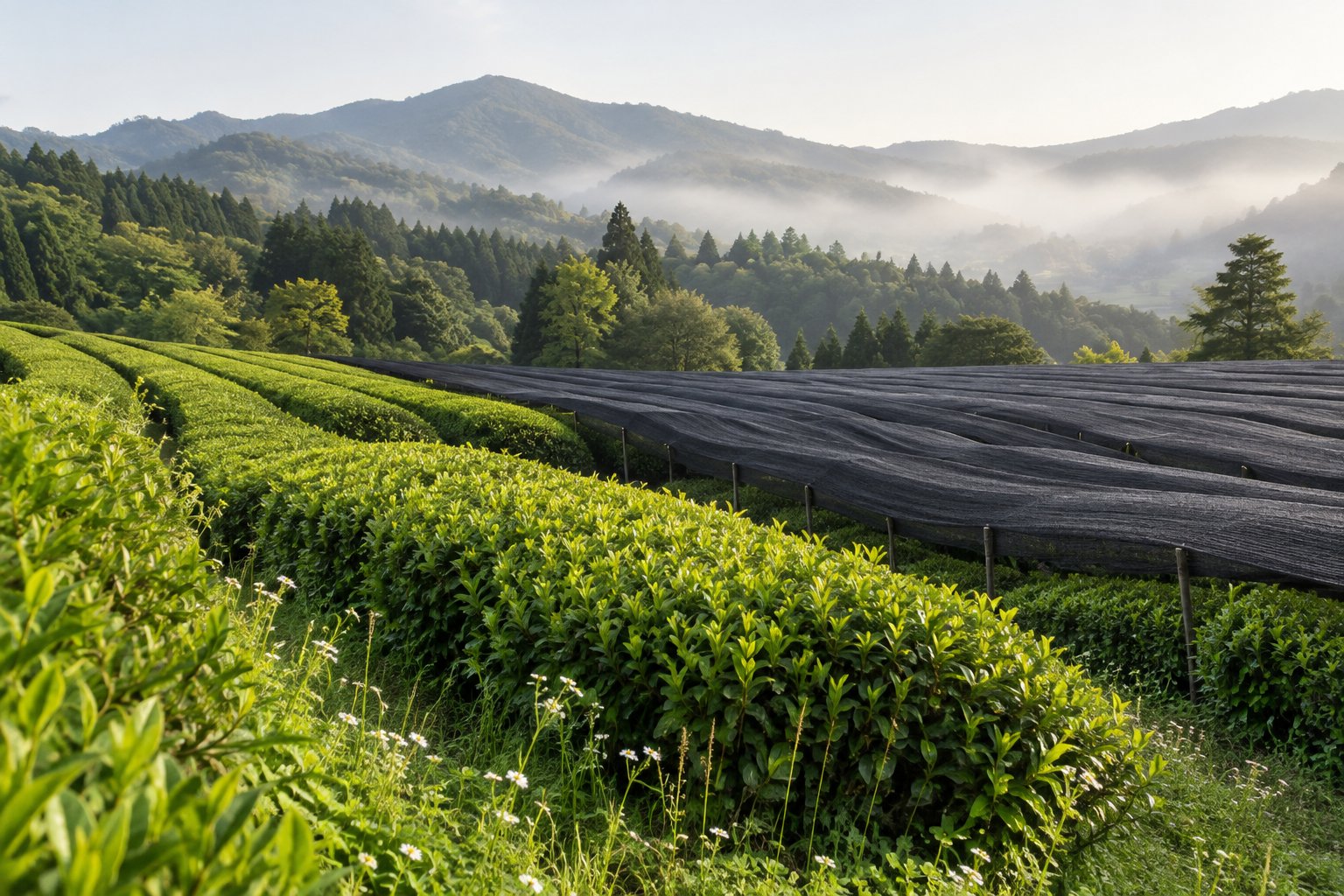
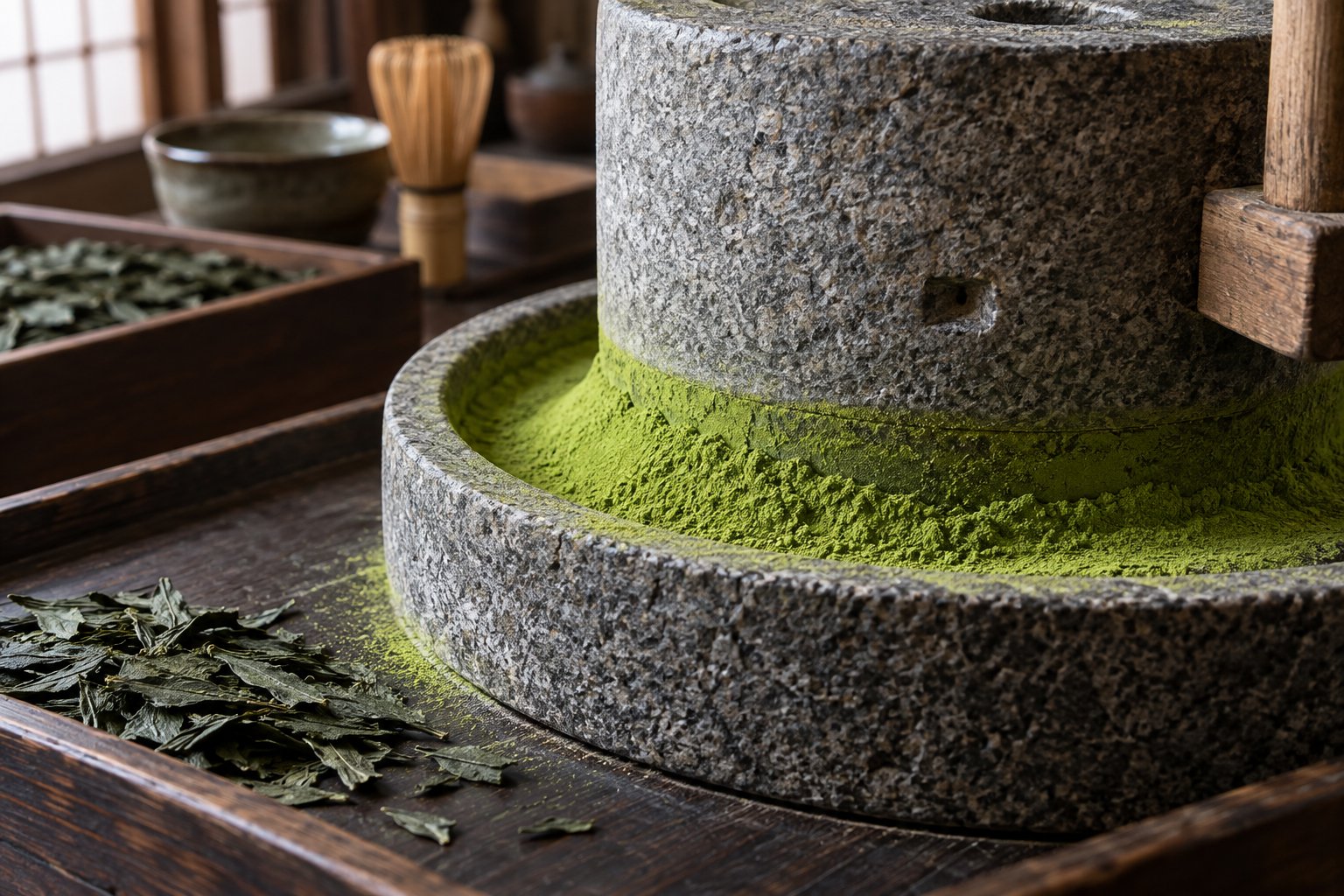
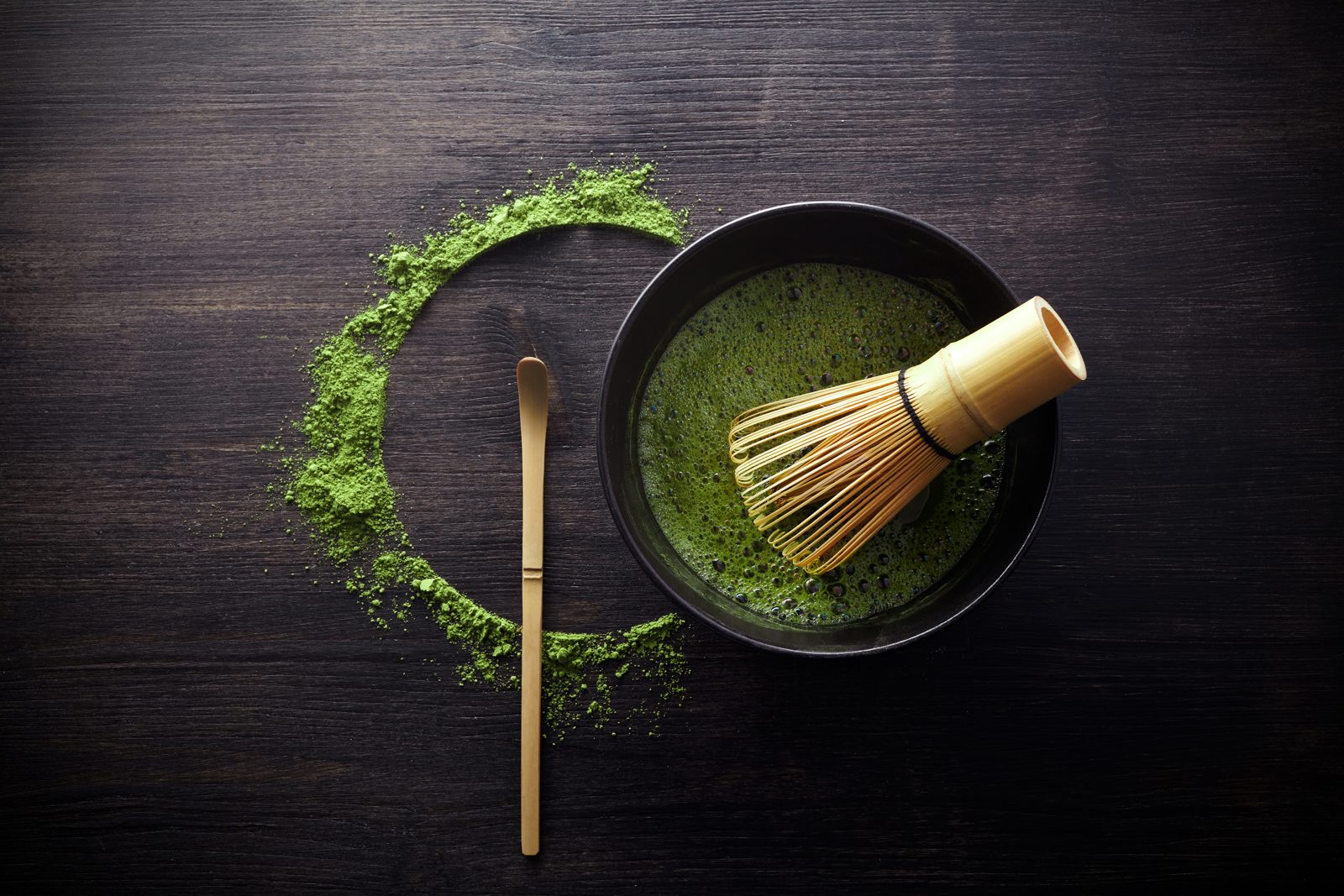
Tencha is the tea leaf that matcha is made from. According to MAFF, tea fields are covered with reed screens, straw mats, kanreisha (shade cloth) or similar materials for about 2 to 3 weeks before picking. The picked leaves are steamed and then dried without rolling. Grinding tencha into a fine powder, for example with a stone mill, makes matcha.
How much tencha Shizuoka produces
Shizuoka produced 875 tonnes of tencha in 2025, third in Japan after Kagoshima and Kyoto. Tencha was about 4% of the prefecture’s 24,100 tonnes of aracha, while sencha made up about 60%.
Tencha by prefecture (2025)
According to the National Federation of Tea Producers’ Associations, Japan produced 6,278 tonnes of tencha in 2025.
| Prefecture | Tencha | Share of Japan | All aracha | Tencha share of aracha |
|---|---|---|---|---|
| Kagoshima | 2,670 t | about 43% | 30,000 t | about 9% |
| Kyoto | 989 t | about 16% | 2,121 t | about 47% |
| Shizuoka | 875 t | about 14% | 24,100 t | about 4% |
| Aichi | 463 t | about 7% | 561 t | about 83% |
| Mie | 398 t | about 6% | 4,805 t | about 8% |
Shares are calculated from the National Federation of Tea Producers’ Associations figures. Shizuoka produced 14,310 tonnes of sencha.
Shizuoka’s tencha in volume terms
Shizuoka’s tencha output is about one third of Kagoshima’s. On the other hand, Shizuoka’s aracha output is more than 10 times Kyoto’s. A change of 1 percentage point in the share of aracha that goes to tencha would move about 240 tonnes.
Shizuoka’s tea promotion plan estimates the prefecture’s 2025 output of “matcha and powdered tea” at 4,400 tonnes. This is the prefecture’s estimate by end use, not a figure for tencha alone.
The shift from sencha to tencha
As demand for sencha falls, Shizuoka Prefecture plans to shift its tea production towards more tencha and organic tea. The Shizuoka Prefecture Tea Industry Promotion Plan, published in March 2026, sets a target of raising matcha and powdered tea to about one third of all aracha by 2040.
Figures in the prefecture’s plan
According to the plan, aracha prices in Shizuoka had stayed low for a long time, but in 2025 the annual average rose by about 80% from the previous year, partly because of the matcha boom. At the same time, the prefecture’s aracha fell to 24,100 tonnes in 2025, 1,700 tonnes less than the year before, and its tea fields shrank by 1,200 hectares. The plan’s main figures are below.
| Item | Current | Target |
|---|---|---|
| Matcha and powdered tea production | 3,200 t (2024) | 6,700 t (2030), 8,600 t (2040) |
| Tea fields converted to export-oriented production | 0 ha (2024) | 320 ha cumulative (2028) |
| Tea exports by businesses in the prefecture | 10.6 billion yen (2024) | 15.4 billion yen (2028) |
The plan’s chart of target production by tea type says matcha and powdered tea will be expanded to about one third of all aracha to meet export demand, with these figures:
| Year | Matcha and powdered tea |
|---|---|
| 2024 | 3,200 t |
| 2025 | 4,400 t |
| 2030 | 6,700 t |
| 2035 | 7,400 t |
| 2040 | 8,600 t |
Source: Shizuoka Prefecture, “静岡県茶業振興計画(2025〜2028年)” (Shizuoka Prefecture Tea Industry Promotion Plan, 2025 to 2028) https://www.pref.shizuoka.jp/_res/projects/default_project/_page_/001/027/277/keikaku.pdf
The plan says the prefecture will steadily move fields to cultivars suited to tencha and introduce shade growing. Under the prefecture’s subsidy programme for fiscal 2026, tea growers at prefecture-selected “export production bases” can receive support for switching to shade growing for tencha, with a reference amount of 100,000 yen per 10 ares.
Research at the Tea Research Center
Shizuoka’s Tea Research Center has studied how to make tencha from the sencha cultivars already planted in the prefecture, without waiting for replanting. Its fiscal 2019 research results note that tencha production in the prefecture was rising but tencha cultivars were hardly used, and that switching cultivars takes time and money.
The results published that year found the following:
- Most tencha in the prefecture is made with jikagake (direct covering), where black shade netting is laid directly on the tea bushes
- With direct covering by netting that blocks 85% of sunlight, Sayamakaori, Sawamizuka and Koshun gave first-flush yields at least 20% higher than Yabukita
- For total tencha quality scores, Tsuyuhikari and Koshun scored high. For appearance and colour, Tsuyuhikari, Koshun and Okumidori scored high; for aroma and taste, Saemidori scored high
- Direct covering for 20 days gave 949 kg per 10 ares, more than the 630 kg from 15 days. Longer covering raised yield, but lowered total nitrogen, one of the quality indicators
These research materials show that as of fiscal 2019, tencha in Shizuoka was mainly made from sencha cultivars shaded by direct covering.
Main tencha-producing areas in Shizuoka
The areas named as tencha producers in prefectural and national public documents are the Shida-Haibara area, Kakegawa city and Tenryu ward of Hamamatsu city. We could not find tencha statistics by city or town in Shizuoka’s public documents, unlike in Kyoto.
Shida-Haibara area
According to a Shizuoka extension case study published by MAFF, in the area covered by the Shida-Haibara agriculture and forestry office, which includes Shimada city, tencha production rose from 463 tonnes in fiscal 2021 to 793 tonnes in fiscal 2024. Organic tencha rose from 214 tonnes to 295 tonnes. The number of tencha factories went from 13 in fiscal 2021 to 17 in fiscal 2025, and 11 of them handle organic tencha.
The same document says that in Japan, tencha trades at more than twice the aracha price of sencha, and that demand for organic tencha is especially high. These figures differ in year and source from the prefecture-wide 875 tonnes (2025), so they cannot be compared directly.
Kakegawa and Tenryu ward, Hamamatsu
According to Shizuoka Prefecture, the following tencha processing facilities were built under a national subsidy programme (the Production Base Power-Up Programme) in fiscal 2024.
| Location | What was built |
|---|---|
| Kurami, Kakegawa city | Tencha processing facility including a brick tencha furnace (a furnace that dries tencha), with a capacity of 300 kg per hour |
| Tenryu ward, Hamamatsu city | A full tencha processing line for export (including one brick tencha furnace) and a product storage facility |
The Shizuoka Tea Chamber of Commerce and Industry divides the prefecture’s tea-growing areas into eight: Seien, Chuen, Makinohara, Kawane, Shida, Honyama, Shimizu and Fuji-Numazu. These are areas for tea as a whole, including sencha, not tencha-producing areas.
The Shizuoka Tea Market and tencha trading
The Shizuoka Tea Market is a market where aracha is traded between sellers and buyers, and tencha is also sold there by tender. Seven lots of tencha were offered at the tender sale on 30 July 2026.
About the Shizuoka Tea Market
Shizuoka Tea Market Co., Ltd. was established in 1956, is based in Aoi ward, Shizuoka city, and is 16.7% owned by Shizuoka Prefecture. Its business is spot trading of tea and consignment sales. According to the market, about 40% of its total trading volume is tea from outside the prefecture. According to Shizuoka Prefecture, the market has been trialling tenders, where prices are set by competitive bidding, since the first flush of 2025.
The July 2026 tencha tender
The lot list for the “10th Tencha, Organic Tea and Fermented Tea Tender Sale” published by the Shizuoka Tea Market shows 51 lots in total, 7 of them tencha.
| Item | Details |
|---|---|
| Tencha lots and volume | 7 lots, 2,352.8 kg in total |
| Minimum winning price (no bid below this price can win) | 3,000 to 4,500 yen (figures in the lot list; lot quantities are given in kg) |
| Cultivar | Yabukita 5 lots, blend 2 lots |
| Flush | First flush 2 lots, second flush 5 lots |
| Growing method | All 7 lots conventional (not organic) |
Source: Shizuoka Tea Market, “第10回 碾茶・有機茶・発酵茶 入札販売会出品一覧” (Lot list, 10th Tencha, Organic Tea and Fermented Tea Tender Sale) https://chaichiba.co.jp/news/17654/
We could not find the actual winning prices in public documents.
Names such as “Shizuoka tea” and “Kakegawa matcha”
The rules for tea carrying the Shizuoka name come from the Japan Patent Office’s regional collective trademarks and the labelling standard of the Japan Tea Central Public Interest Incorporated Association. There is no “Shizuoka matcha” trademark, and no national geographical indication (GI: a system in which the Japanese government protects the link between a region and the quality of its product) protects matcha under the Shizuoka name.
Regional collective trademarks for tea in Shizuoka
In the Japan Patent Office’s list of regional collective trademarks (checked on 13 October 2026), the tea trademarks in Shizuoka Prefecture are as follows.
| Trademark | Registration number | Covers |
|---|---|---|
| 静岡茶 (Shizuoka tea) | 5062720 | Green tea from Shizuoka Prefecture |
| 掛川抹茶 (Kakegawa matcha) | 6538181 | Matcha from Kakegawa city, Shizuoka Prefecture |
| 掛川茶 (Kakegawa tea) | 5082404 | Green tea from Kakegawa city, Shizuoka Prefecture |
| 掛川茶 (Kakegawa tea) | 6813218 | Tea made only from aracha produced in Kakegawa city and surrounding former towns and other nearby areas, with at least 75% of it from aracha factories in Kakegawa city |
| 川根茶 (Kawane tea) | 5053823 | Green tea produced in Kawane town and Kawanehon town |
| 東山茶 (Higashiyama tea) | 5517008 | Tea from Higashiyama, Kakegawa city |
Source: Japan Patent Office, “商標登録第6538181号 掛川抹茶” (Trademark registration No. 6538181, Kakegawa matcha). The holders are the Kakegawa Tea Merchants Cooperative, JA Kakegawa and JA Enshu Yumesaki https://www.jpo.go.jp/system/trademark/gaiyo/chidan/shoukai/ichiran/6538181.html
Across Japan, there are five regional collective trademarks with “matcha” in the name: Kawagoe matcha, Kakegawa matcha, Nishio no matcha, Uji matcha and Yame matcha (the rules for Yame matcha are covered in Yame matcha). No trademark protects matcha under the prefecture’s name, and Kakegawa is the only place in Shizuoka with a matcha trademark.
GIs in Shizuoka
Shizuoka has the GI “Fukamushi Kikugawa-cha” (deep-steamed Kikugawa tea), registered in 2023. The registration covers deep-steamed tea and does not mention matcha. The other tea GIs are “Yame Dento Hon Gyokuro” and “Japanese Tea,” registered on 10 July 2026. “Japanese Tea” does not cover a specific region; it covers all green tea grown and processed in Japan (including sencha, gyokuro and matcha).
Labelling rules
Under the “Green Tea Labelling Standard” of the Japan Tea Central Public Interest Incorporated Association (a voluntary industry standard), a region name may be shown only if the tea is Japanese and at least 50% of the raw material comes from that region. At 100%, the tea can be called “[region] tea.” From 50% to under 100%, the label must make clear that it is a blend. If the tea was finished somewhere other than where the aracha was made, the place of finishing must be shown.
How Shizuoka compares with Uji and Kagoshima
Volume, cultivars and growing practices can be compared with public figures, but there is no public data showing that one region’s matcha tastes better. Some overseas shop articles describe the taste of Shizuoka matcha, but they do not show data behind it.
What public data lets you compare
| Item | Shizuoka | Kyoto (Uji) | Kagoshima |
|---|---|---|---|
| Tencha (2025) | 875 t | 989 t | 2,670 t |
| Tencha share of aracha | about 4% | about 47% | about 9% |
| Features in MAFF data | Mainly fukamushi sencha. Third in Japan for tencha and kabusecha (lightly shaded tea) | Second in Japan for gyokuro and tencha | First in Japan for tencha. Diverse mix of cultivars |
| Share of tea fields planted with Yabukita (fiscal 2025) | 86% | 49% | 28% |
| Share using ride-on tea harvesters (fiscal 2025) | 96.9% | 22.9% | 99.0% |
| Share of tea fields in hilly and mountainous areas (fiscal 2020) | 29.2% | 85.1% | 45.6% |
| Trademark with “matcha” in the name | Kakegawa matcha (from Kakegawa city) | Uji matcha (tea from four prefectures finished in Kyoto) | None |
Tencha figures are from the National Federation of Tea Producers’ Associations; cultivar, harvester and hilly-area figures are from MAFF’s “Situation of Tea” report. The cultivar, harvester and hilly-area figures cover all tea, not tencha alone.
What the figures show
Shizuoka has a high share of Yabukita in its tea fields, at 86%, and many flat fields that can be harvested with ride-on machines. In Kagoshima, early cultivars (Yutakamidori and Saemidori) cover about 40% of tea fields, and in Kyoto more than 80% of tea fields are in hilly and mountainous areas. The definition of Uji matcha and where it is grown in Kyoto are covered in What is Uji matcha?.
What to check when buying “Shizuoka matcha” overseas
Even when a product says “Shizuoka,” where the tencha was made, the share of Shizuoka raw material and the cultivar differ from product to product. About 40% of the tea traded at the Shizuoka Tea Market comes from outside the prefecture, so not all tea traded in Shizuoka is from Shizuoka.
What to check with your supplier
When buying matcha as Shizuoka matcha, check the following in writing:
- Where the tencha was made: which city or town in Shizuoka
- Share of Shizuoka raw material: 100%, or a blend with other regions
- Cultivar and flush: Yabukita or another cultivar such as Tsuyuhikari; first or second flush
- Shading method and length: direct covering or overhead shelf, and for how many days
- If it says “Kakegawa matcha”: whether it is matcha from Kakegawa city
- If it says “Organic”: whether the raw material and factory are certified under organic JAS (Japan’s organic standard)
How cafés can choose
The right grade depends on whether you use it for lattes or serve it whisked on its own. Decide the use first (matcha grades), work out the purchase price you can afford from the cost per cup (choosing matcha for café lattes), then taste matcha from Shizuoka against matcha from other regions such as Uji and Kagoshima, with the same amount and the same milk. Why prices are rising is covered in Is matcha still in short supply?, and the regions Omakase Matcha sources from are on matcha origins.
Sources
- Aichi Prefecture, “2025年産茶の生産状況” (Tea production in 2025, survey by the National Federation of Tea Producers’ Associations, in Japanese) https://www.pref.aichi.jp/uploaded/attachment/622005.pdf
- MAFF, “茶をめぐる情勢(令和8年10月)” (Situation of Tea, October 2026, in Japanese) https://www.maff.go.jp/j/seisan/tokusan/cha/attach/pdf/ocha-201.pdf
- Shizuoka Prefecture, “静岡県茶業振興計画(2025〜2028年)” (Tea Industry Promotion Plan, 2025 to 2028, March 2026, in Japanese) https://www.pref.shizuoka.jp/_res/projects/default_project/_page_/001/027/277/keikaku.pdf
- Shizuoka Prefecture Tea Promotion Division, “令和8年度 輸出拡大生産体制強化支援事業 公募要領【生産者向け】” (Fiscal 2026 export production support programme, call for applications for growers, in Japanese) https://www.pref.shizuoka.jp/_res/projects/default_project/_page_/001/085/137/boshuyouryose.pdf
- Shizuoka Prefectural Research Institute of Agriculture and Forestry, Tea Research Center, “静岡県茶奨励品種等におけるてん茶適性” (Tencha suitability of recommended cultivars, fiscal 2019, in Japanese) https://www.pref.shizuoka.jp/_res/projects/default_project/_page_/001/044/307/r1-d.pdf
- Shizuoka Prefectural Research Institute of Agriculture and Forestry, Tea Research Center, “てん茶の良質多収を目指した被覆技術” (Covering techniques for high-quality, high-yield tencha, fiscal 2019, in Japanese) https://www.pref.shizuoka.jp/_res/projects/default_project/_page_/001/044/307/r1-a.pdf
- MAFF, extension case study “海外輸出需要に対応したてん茶栽培加工経営体の育成” (Developing tencha growers and processors for export demand, Shizuoka, in Japanese) https://www.maff.go.jp/j/seisan/gizyutu/hukyu/h_zirei/r7/attach/pdf/r7-155.pdf
- Shizuoka Prefecture, “令和6年度実施地区の概要(産地生産基盤パワーアップ事業)” (Fiscal 2024 projects, Production Base Power-Up Programme, in Japanese) https://www.pref.shizuoka.jp/_res/projects/default_project/_page_/001/026/990/r6_sanpajissitiku.pdf
- Shizuoka Tea Chamber of Commerce and Industry, “静岡県の茶業 有名茶産地” (Tea-growing areas of Shizuoka, in Japanese) https://shizuoka-cha.com/index.php/ocha/sanchi/
- Shizuoka Prefecture, “点検評価表(株式会社静岡茶市場)” (Review sheet, Shizuoka Tea Market Co., Ltd., in Japanese) https://www.pref.shizuoka.jp/_res/projects/default_project/_page_/001/077/363/tenken/r7_47_shizuokacha.pdf
- Shizuoka Tea Market, “特徴・歴史” (Features and history, in Japanese) https://chaichiba.co.jp/chaitiba/history/
- Shizuoka Tea Market, “第10回 碾茶・有機茶・発酵茶入札販売会開催のご案内” (Notice of the 10th tender sale, in Japanese) https://chaichiba.co.jp/news/17525/
- Shizuoka Tea Market, “第10回 碾茶・有機茶・発酵茶 入札販売会出品一覧” (Lot list, 10th tender sale, in Japanese) https://chaichiba.co.jp/news/17654/
- Japan Patent Office, “商標登録第5062720号 静岡茶” (Trademark registration No. 5062720, Shizuoka tea, in Japanese) https://www.jpo.go.jp/system/trademark/gaiyo/chidan/shoukai/ichiran/5062720.html
- Japan Patent Office, “商標登録第6538181号 掛川抹茶” (Trademark registration No. 6538181, Kakegawa matcha, in Japanese) https://www.jpo.go.jp/system/trademark/gaiyo/chidan/shoukai/ichiran/6538181.html
- Japan Patent Office, “商標登録第5082404号 掛川茶” (Trademark registration No. 5082404, Kakegawa tea, in Japanese) https://www.jpo.go.jp/system/trademark/gaiyo/chidan/shoukai/ichiran/5082404.html
- Japan Patent Office, “商標登録第6813218号 掛川茶” (Trademark registration No. 6813218, Kakegawa tea, in Japanese) https://www.jpo.go.jp/system/trademark/gaiyo/chidan/shoukai/ichiran/6813218.html
- Japan Patent Office, “商標登録第5053823号 川根茶” (Trademark registration No. 5053823, Kawane tea, in Japanese) https://www.jpo.go.jp/system/trademark/gaiyo/chidan/shoukai/ichiran/5053823.html
- Japan Patent Office, “商標登録第5517008号 東山茶” (Trademark registration No. 5517008, Higashiyama tea, in Japanese) https://www.jpo.go.jp/system/trademark/gaiyo/chidan/shoukai/ichiran/5517008.html
- Japan Patent Office, “地域団体商標登録案件一覧” (List of registered regional collective trademarks, in Japanese) https://www.jpo.go.jp/system/trademark/gaiyo/chidan/shoukai/ichiran/index.html
- MAFF, “第130号:深蒸し菊川茶” (GI No. 130, Fukamushi Kikugawa-cha, in Japanese) https://www.maff.go.jp/j/shokusan/gi_act/register/0130/index.html
- Japan Tea Central Public Interest Incorporated Association, “緑茶の表示基準” (Green Tea Labelling Standard, in Japanese) https://www.nihon-cha.or.jp/pdf/hyoujikijyun.pdf