
 Reviewed by: Takahiro Sugiyama (CEO, meguri Inc.)
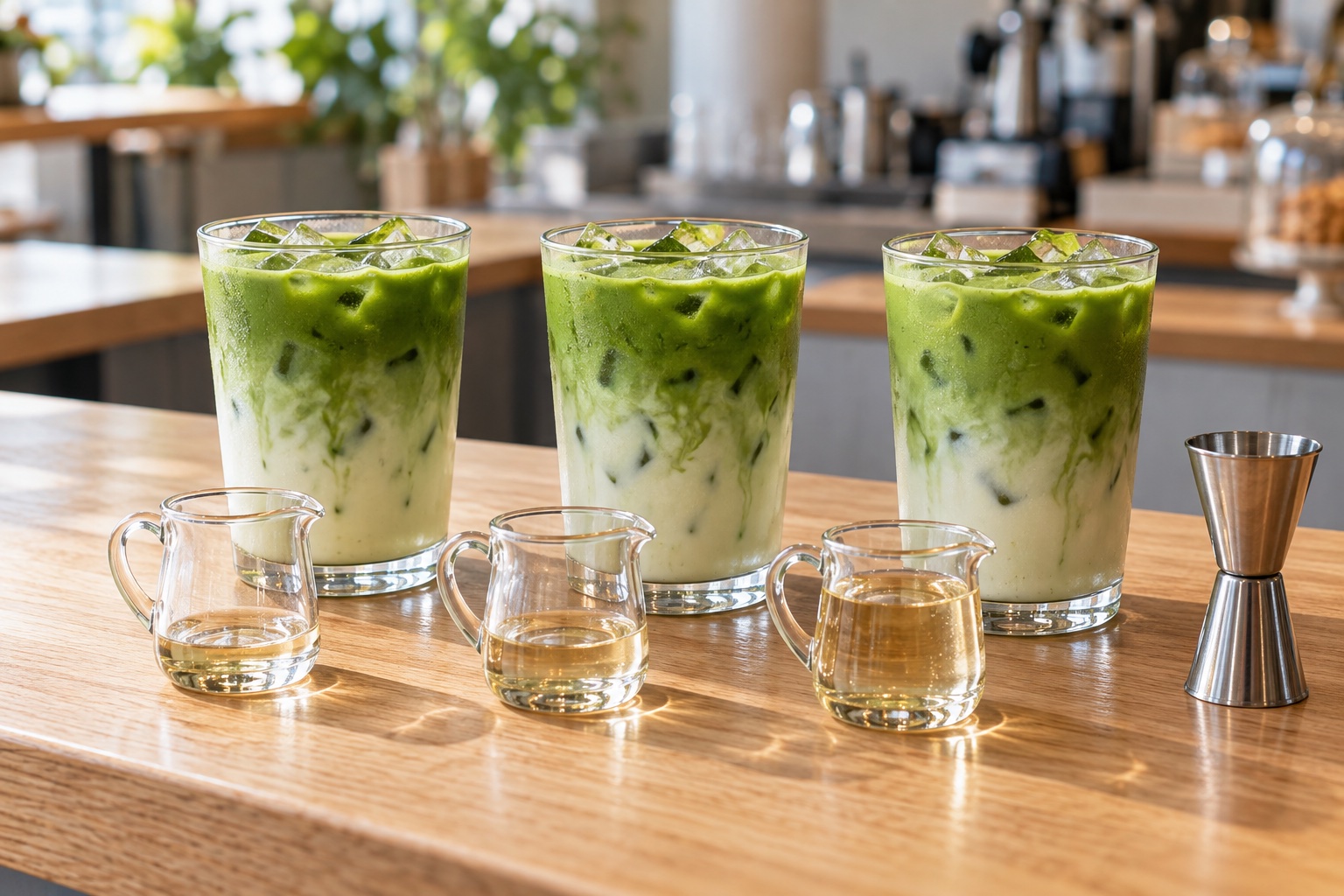
Cafés in Singapore, Thailand and Indonesia offer menus where you can choose how sweet your matcha latte is. But how many grams of sugar “50% sweet” means differs from shop to shop. Using official information from public bodies and companies, this page covers how to set each sweetness level in grams of sugar and ml of syrup, how sweetness changes the way matcha bitterness is perceived, and the sugar rules in the three countries.
What are matcha drinks with selectable sugar levels?
Sugar levels are shown as percentages such as 0, 25, 50 and 100%, but the amount of sugar behind “100%” is set by each shop and is not a common unit. That is why a shop needs to fix each level in grams of sugar or ml of syrup.
How sweetness is chosen in the three countries
Starbucks Singapore lists “Low-fat Matcha Latte (Less Sweet),” made with low-fat milk and less sweetness, alongside its “Matcha Latte.” In Thailand, the Department of Health under the Ministry of Public Health started an initiative on 11 February 2026 to halve the “normal sweetness” of freshly made drinks, joined by 9 brands from 7 companies including Inthanin, Café Amazon and All Café. Indonesia’s Ministry of Health named boba, teh tarik (black tea mixed with milk and frothed), coffee with milk and palm sugar, and juice as examples of sweetened drinks, and in April 2026 set up a system for showing a sugar grade on menus.
“100%” is not the same everywhere
Figures in general articles do not match either. An article reporting a Malaysian hospital’s dietitians gives 100% as 20 teaspoons of sugar, while Thailand’s Department of Health gives 100% for a 16 oz milk tea as 6.6 teaspoons. The “50%” the customer sees may be the same, but the sugar differs between shops. Set your levels from your own recipe.
The full range of matcha drinks and their guides is on the matcha drinks page.
Official figures: how much sugar is one level?
By Thailand’s Department of Health figures, a 16 oz iced tea or milk tea has about 26.4 g of sugar at 100%, 13.2 g at 50% and 6.8 g at 25%. Japanese matcha latte recipes that state the sugar (Ministry of Agriculture, Forestry and Fisheries and Kurasu) use 3 to 5 g a cup, the same as or less than Thailand’s 25%.
Thailand’s sugar figures for 16 oz
The Bureau of Dental Health of Thailand’s Department of Health gives the sugar in freshly made drinks as teaspoons per 16 oz (about 470 ml) cup. The same page treats 4 g of sugar as one teaspoon and advises not to exceed 6 teaspoons (24 g) of sugar a day.
| 16 oz cup | 100% | 50% | 25% |
|---|---|---|---|
| Coffee (กาแฟสด) | 7.3 tsp (about 29.2 g) | 3.7 tsp (about 14.8 g) | 1.9 tsp (about 7.6 g) |
| Iced tea, milk tea (ชาเย็น/ชานม) | 6.6 tsp (about 26.4 g) | 3.3 tsp (about 13.2 g) | 1.7 tsp (about 6.8 g) |
| Fruit smoothie | 30 tsp (about 120 g) | 15 tsp (about 60 g) | 7.5 tsp (about 30 g) |
Source: Thailand Department of Health, Bureau of Dental Health, “ภารกิจสำรวจเครื่องดื่มหวานน้อยในร้านค้าชุมชน” (in Thai) https://dental.anamai.moph.go.th/th/hl4/
We calculated the grams using the same page’s “4 g of sugar = 1 teaspoon.”
Sweetener in Japanese official recipes
| Source | Matcha and liquid | Sweetener |
|---|---|---|
| Ministry of Agriculture, Forestry and Fisheries, aff magazine (April 2017) | 1 teaspoon matcha, about 20 ml hot water, 100 ml milk | 3 g sugar (adjust to taste) |
| Kurasu (a coffee and tea shop in Kyoto) | 2.5 g matcha, 20 g hot water, 150 g milk | 5 g sugar (dissolved into a syrup) |
| Ito En | 3 g matcha, 30 ml hot water, 130 g milk | 5 to 10 g syrup (to taste) |
| Ippodo Tea | 1.5 teaspoons matcha, 100 mL hot water, 100 mL milk | Not stated |
What the comparison shows
The Japanese official recipes are smaller cups with about 100 to 150 ml of milk, and those that state the sugar use 3 to 5 g. That is about the same as, or less than, Thailand’s 25% (about 6.8 g in 16 oz). The recipes compared either keep sweetener low or add it to taste. When to add the sweetener is covered in how to make a matcha latte, and for iced drinks in how to make an iced matcha latte.
How to set your shop’s sugar levels in grams
First fix the grams of sugar for “100%” for each cup size, then work out each level as a share of it. Finally, turn each amount into pumps of syrup or spoons that staff can measure easily. This section is our own approach, based on the official figures above.
Step 1: Decide 100%
For each latte cup size (12 oz, 16 oz and so on), decide the grams of sugar for 100%. A shop in Thailand can compare its current 100% with the Department of Health’s figure of about 26 g for 16 oz. To follow Thailand’s new standard, make half of your current 100% the new “normal.”
Step 2: Put the levels in a table
| Level | 16 oz, 100% = 26.4 g | 12 oz, 100% = 20 g |
|---|---|---|
| 0% | 0 g | 0 g |
| 25% | 6.6 g | 5 g |
| 50% | 13.2 g | 10 g |
| 75% | 19.8 g | 15 g |
| 100% | 26.4 g | 20 g |
The 20 g for 12 oz is an example for the calculation. Replace it with your own 100%.
Step 3: Decide how to measure
Turn the grams for each level into pumps of syrup or measuring spoons, and write them on the recipe card. Add the sweetener separately from the matcha, measured for each order. If you make a sweetened matcha base in advance, you can no longer offer levels. Test the hot and iced versions of the same drink separately.
Converting syrup ml into grams of sugar
For a commercial syrup, work out the grams of sugar per ml from the label’s serving size and total sugars. On Monin’s US website, Pure Cane Syrup (ingredients: cane sugar and water) has 6 g of total sugars per 7.5 mL, or about 0.8 g per mL.
Conversion table for Pure Cane Syrup
Monin says one press of its syrup pump dispenses 1/4 oz (about 7.5 mL).
| Pumps | Syrup | Sugar |
|---|---|---|
| 1 | 7.5 mL | 6 g |
| 2 | 15 mL | 12 g |
| 3 | 22.5 mL | 18 g |
| 4 | 30 mL | 24 g |
Applied to the Department of Health’s 16 oz milk tea, 100% (about 26.4 g) is about 4.4 pumps, 50% (about 13.2 g) about 2.2 pumps and 25% (about 6.8 g) about 1.1 pumps. This is our calculation, and the figures on the label are rounded to whole numbers. If you get fractions, round the pumps to whole numbers and reset your 100%.
Syrup made in the shop
If you weigh the sugar and water for your own syrup, the calculation is simple.
| Sugar : water (by weight) | Share of sugar in the syrup | Syrup needed for 13.2 g of sugar |
|---|---|---|
| 1:1 | One half | 26.4 g |
| 2:1 | Two thirds | 19.8 g |
Heating reduces the water, so weigh the finished syrup and recalculate the share of sugar. If you put it in a pump, weigh 10 presses to check the grams per press. How to make, store and keep the color of matcha syrup is in how to make matcha syrup.
How does lower sweetness change matcha bitterness?
The sweetness of sugar makes bitterness feel weaker, so lowering the sweetness tends to bring matcha’s bitterness forward. However, a study found that strongly suppressing bitterness took a high concentration of sugar, so sweetness alone is a hard way to hide bitterness.
What research shows
In a US study (Green et al., 2010) that mixed sweet, salty, sour and bitter solutions and compared taste intensity, the sweetness of sugar tended to be the least suppressed and the strongest suppressor of the other tastes. A review of taste interactions (Wilkie and Capaldi Phillips, 2014) also describes sweeteners suppressing bitterness as a relatively consistent result across substances and methods.
On tea compounds, a Korean study (Oh and Kim, 2021) reported that adding more sugar to water raised the concentration at which caffeine and tea catechins (such as EGCG, compounds behind tea’s astringency and bitterness) are first detected. On the other hand, a Japanese study (Nakamura et al., 2002) needed a high sugar concentration of 800 mM to suppress about 80% of the bitterness of quinine, a bitter substance.
Where matcha’s bitterness comes from
In a study at a tea research institute in China (Xu et al., 2018), the bitterness of green tea was strongly correlated with the concentrations of the catechins EGCG and ECG. The less sweet the drink, the more the matcha’s own bitterness and astringency come through.
Using this on the menu (our approach)
This is our own approach. If you offer 0% and 25%, choose a matcha that tastes good at those levels, and taste each level side by side with the same milk. Keeping the amount of matcha the same when you lower the sweetness keeps the matcha flavor consistent across levels. How to choose matcha for lattes is in choosing matcha for café lattes, and the grades are explained in matcha grades.
Thailand: “หวานปกติ = หวาน 50%”
Thailand’s “หวานปกติ = หวาน 50%” (normal sweetness = 50% sweetness) is a Department of Health initiative that halves the current “normal sweetness” of freshly made drinks. It is not a compulsory measure; participating shops change their own recipes.
The Department of Health announcement
According to the Department of Health’s announcement of 11 February 2026, the department has promoted “หวานน้อยสั่งได้” (you can order less sweet) since 2020. In 2026 it declared the start of the new standard “หวานปกติ = หวาน 50%,” which halves the baseline sweetness, and the Thai Coffee Association and 9 brands from 7 companies, including Inthanin, Café Amazon, All Café and Black Canyon, stated their intention to adjust recipes to the new standard nationwide.
Three months later
In its announcement of 4 June 2026, the department said participation had grown to 14 brands and more than 30,000 outlets. It described the approach as a “Default Choice” (making the healthier option the starting point) rather than a compulsory measure, and said more customers are also choosing 25% sweetness and 0% with no added sugar.
What to align in the shop (our approach)
This is our own approach. To follow the new standard, halve the grams of your current 100% and call that “normal,” and reset 0% and 25% in the same table. Check that what the menu and POS show matches the grams on the recipe card. What counts as a “beverage” for Thailand’s excise tax is covered in matcha frappe. The sugar in recipes using condensed milk is in Thai green tea vs matcha latte.
Singapore: Nutri-Grade
Singapore’s Nutri-Grade sorts drinks into A to D by sugar and saturated fat per 100 ml, and C and D must be labelled on the menu. For freshly made drinks with selectable sweetness, the menu must state which preparation the grade is based on.
The grade thresholds
According to the Health Promotion Board (HPB) Nutri-Grade guide (version 2.1, June 2023), the grades are as follows, and a drink takes the poorer of its sugar and saturated fat grades. Grade A drinks cannot contain non-sugar sweeteners.
| Grade | Sugar (per 100 ml) | Saturated fat (per 100 ml) |
|---|---|---|
| A | 1 g or less | 0.7 g or less |
| B | Over 1 g, up to 5 g | Over 0.7 g, up to 1.2 g |
| C | Over 5 g, up to 10 g | Over 1.2 g, up to 2.8 g |
| D | Over 10 g | Over 2.8 g |
Sugar here means total sugars minus lactose and galactose. The lactose in milk is not counted, so the sugar or syrup you add changes the grade. According to the HPB, freshly prepared drinks have been covered since 30 December 2023, and businesses with revenue of no more than S$1 million selling at fewer than 10 premises are, for now, exempt from labelling freshly prepared drinks. Toppings such as pearls must show their sugar content on the menu.
The reference for customisable drinks
The HPB guide requires freshly prepared drinks that customers can customise to carry a statement of the basis of the grade (for example, “Nutri-Grade mark is based on preparation at 120% sugar (before addition of ice)”) at least once on menus and similar materials. The reference preparation is the default, meaning what is served if the customer asks for nothing, or, for drinks with no default where the customer must choose a sugar level, the highest sugar level.
The Starbucks example, and grades by sweetness
Starbucks Singapore gives its Matcha Latte as 6.5 g total sugar, 3.7 g lactose and 2.4 g saturated fat per 100 mL, with a C mark. The Less Sweet version has 5.2 g total sugar, 3.7 g lactose and 0.9 g saturated fat, with a B mark. Both state that the grade is based on the default preparation (before addition of ice). After subtracting lactose, the Matcha Latte’s sugar is 2.8 g, within B; the C comes from saturated fat.
The table below is our calculation of the sugar grade alone when the Department of Health’s sugar levels are added to a matcha latte of 350 ml before ice. Sugar from the matcha itself is not included.
| Sugar added | Per 100 ml | Sugar grade |
|---|---|---|
| 0 g | 0 g | A (if no sweetener is used) |
| 6.8 g (25%) | about 1.9 g | B |
| 13.2 g (50%) | about 3.8 g | B |
| 26.4 g (100%) | about 7.5 g | C |
At 350 ml, the sugar grade becomes C once added sugar goes over 17.5 g. The actual grade also depends on saturated fat, so it changes with the milk you use. An example with a high saturated fat milk such as coconut milk is in coconut matcha latte.
Indonesia: Nutri-Level and the tax on sweetened drinks
In 2026 Indonesia set up a sugar, salt and fat grade called “Nutri-Level” both for freshly made drinks (Ministry of Health) and for packaged food (BPOM). Labelling for freshly made drinks starts with large businesses.
The Ministry of Health decree (KMK 301/2026)
The Ministry of Health decree (KMK HK.01.07/MENKES/301/2026, 14 April 2026) provides that Nutri-Level can be shown for freshly made drinks on menus, commercial apps, leaflets and similar media, starting with large businesses. The business declares the grade itself, based on analysis by a government laboratory or another accredited laboratory. Labelling becomes mandatory two years after maximum limits for sugar, salt and fat are set. The ministry says micro, small and medium food businesses are not targeted in the first stage.
| Nutrient (per 100 mL) | A | B | C | D |
|---|---|---|---|---|
| Sugar (g) | 1 or less, no added sweetener | Over 1, up to 5 | Over 5, up to 10 | Over 10 |
| Salt (mg) | 5 or less | Over 5, up to 120 | Over 120, up to 500 | Over 500 |
| Saturated fat (g) | 0.7 or less | Over 0.7, up to 1.2 | Over 1.2, up to 2.8 | Over 2.8 |
Source: Ministry of Health of Indonesia, “Keputusan Menteri Kesehatan Nomor HK.01.07/MENKES/301/2026” (in Indonesian) https://jdih.kemkes.go.id/storage/documents/pdfs/2026kepmenkes301.pdf
The decree also states that grade A cannot use sweeteners and grade B can use only natural sweeteners. The sugar bands are the same as Singapore’s, and lactose is not counted as sugar. Whether a drink goes over the 5 g boundary between B and C is a useful guide when setting sweetness levels. Unlike Singapore, salt (sodium) is also part of the grade.
Nutri-Level on packaged food (BPOM)
Indonesia’s Food and Drug Authority (BPOM) introduced Nutri-Level for packaged food through a regulation (PerBPOM 10/2026) enacted on 17 June 2026. According to BPOM’s announcement, it covers ready-to-drink beverages, powdered drinks, and liquid and solid concentrates, with a 24-month period for businesses to adjust. When you buy sweetened matcha mix powder or packaged syrup, the Nutri-Level on the pack becomes something to check. Import procedures are in importing matcha into Indonesia.
The excise on sweetened drinks
According to the state news agency ANTARA, the Director General of Customs and Excise said in October 2026 that the government aims to start the excise on packaged sweetened drinks (MBDK) in the second half of 2027. The rate and the sugar level at which it applies have not been decided. It covers packaged drinks, not drinks made in the shop.
Sugar and cost per cup, and what to check when buying
The sugar in a cup is the grams of sweetener added plus the sugar in toppings and bases. The cost of the sweetener is the amount of syrup used multiplied by its price per ml or per g.
Working out the sugar per cup
- Syrup: mL used × total sugars per mL (from the label)
- Syrup made in the shop: g used × share of sugar in the syrup
- Condensed milk, sweetened powder, toppings: calculate from each label’s sugars
With a sweetened matcha mix, the sugar in the powder goes in even when the customer chooses 0%. To offer 0%, use a powder that is matcha only. The sugar in toppings such as tapioca is covered in matcha boba.
The cost of sweetener
The cost of sweetener is the price of one bottle ÷ volume × the amount used per cup. Once each level’s amount is set, the same formula gives the cost difference between 0%, 25%, 50% and 100%. The cost of matcha is “price per kg ÷ 1,000 × grams per cup” and does not change with the sweetness level. How the price per kg is set is in what determines the price of matcha.
What to check when buying syrup and powder
- Serving size and total sugars: work out grams of sugar per mL
- Type of sweetener: in Singapore and Indonesia, grade A drinks cannot use sweeteners, and Indonesia’s grade B allows only natural sweeteners
- Volume per pump: check the maker’s figure and weigh 10 presses in the shop
- Ingredients of the matcha powder: matcha only, or with sugar or creamer added
Managing the sweetness levels, the recipe cards in grams and the grade calculations together means that when you change a recipe, you can update the menu labels at the same time.
Sources
- Thailand Department of Health, Bureau of Dental Health, “ภารกิจสำรวจเครื่องดื่มหวานน้อยในร้านค้าชุมชน” (in Thai) https://dental.anamai.moph.go.th/th/hl4/
- Thailand Department of Health, “สธ.จับมือ 9 แบรนด์ ร่วมนโยบาย “หวานปกติ = หวาน 50%”” (11 February 2026, in Thai) https://multimedia.anamai.moph.go.th/news/1102692/
- Thailand Department of Health, “สธ. เปิดชื่อ 14 แบรนด์ดัง ร่วมแคมเปญ ‘หวานปกติ = หวาน50%’” (4 June 2026, in Thai) https://multimedia.anamai.moph.go.th/news/040669/
- Health Promotion Board (HPB), “Nutri-Grade Mark for Nutri-Grade Beverages Usage guide for graphic applications,” version 2.1 (June 2023) https://isomer-user-content.by.gov.sg/484/18d52de5-00e1-4425-aa70-b63d9dd21005/simplified-nutri-grade-ci-guide.pdf
- Health Promotion Board (HPB), “Measures for Nutri-Grade” https://hpb.gov.sg/healthy-living/food-beverage/nutri-grade
- Ministry of Health Singapore, HealthHub, “Nutri-Grade Mark” https://www.healthhub.sg/programmes/nutrition-hub/nutri-grade-mark
- Starbucks Singapore, “Matcha Latte” https://www.starbucks.com.sg/menu/beverages/teavana-tea/matcha-latte
- Starbucks Singapore, “Low-fat Matcha Latte (Less Sweet)” https://www.starbucks.com.sg/low-fat-matcha-latte-less-sweet
- Ministry of Health of Indonesia, “Keputusan Menteri Kesehatan Nomor HK.01.07/MENKES/301/2026” (in Indonesian) https://jdih.kemkes.go.id/storage/documents/pdfs/2026kepmenkes301.pdf
- Ministry of Health of Indonesia, “Kemenkes Terbitkan Aturan Untuk Cegah Konsumsi Gula Berlebih” (14 April 2026, in Indonesian) https://kemkes.go.id/id/kemenkes-terbitkan-aturan-untuk-cegah-konsumsi-gula-berlebih
- BPOM, “Nutri Level Hadir di Indonesia, Permudah Konsumen Pilih Pangan Lebih Sehat” (30 July 2026, in Indonesian) https://www.pom.go.id/siaran-pers/nutri-level-hadir-di-indonesia-permudah-konsumen-pilih-pangan-lebih-sehat
- ANTARA, “Kemenkeu targetkan cukai MBDK berlaku mulai semester II 2027” (9 October 2026, in Indonesian) https://www.antaranews.com/berita/5778309/kemenkeu-targetkan-cukai-mbdk-berlaku-mulai-semester-ii-2027
- Monin US, “Pure Cane Syrup” https://monin.us/products/pure-cane-syrup
- Monin US, “Pump Care 101: How to Use a Monin Syrup Pump” https://monin.us/blogs/blog/how-to-use-monin-syrup-pumps-pump-care-101
- MAFF, aff magazine April 2017, “抹茶を使ったおいしいレシピ” (Recipes using matcha, in Japanese) https://www.maff.go.jp/j/pr/aff/1704/spe2_02.html
- Ito En, “茶リスタ 小山和裕氏監修!本格抹茶ラテ” (Authentic matcha latte, in Japanese) https://www.itoen.jp/recipe/45614/
- Kurasu, “Matcha Recipe” https://kurasu.kyoto/blogs/recipe/matcha-recipe
- Ippodo Tea, “Matcha Latte Recipe” https://ippodotea.com/blogs/recipes-to-brew-japanese-tea/matcha-latte-recipe
- SAYS, “PJ Hospital Shares Dietitians’ Tips On How You Should Order Bubble Tea” (23 July 2019) https://says.com/my/lifestyle/thomson-hospital-kota-damansara-shares-tips-for-ordering-bubble-tea-the-healthy-way
- Green BG et al., “Taste mixture interactions: suppression, additivity, and the predominance of sweetness,” Physiology & Behavior (2010) https://pubmed.ncbi.nlm.nih.gov/20800076/
- Wilkie LM, Capaldi Phillips ED, “Heterogeneous binary interactions of taste primaries,” Neuroscience & Biobehavioral Reviews (2014) https://pubmed.ncbi.nlm.nih.gov/25069085/
- Oh H, Kim MK, “The roles of sucrose on the retronasal thresholds of tea catechins and polyphenols in water-based system,” Journal of Sensory Studies (2021) https://doi.org/10.1111/joss.12653
- Nakamura T et al., “The effect of various substances on the suppression of the bitterness of quinine,” Chemical & Pharmaceutical Bulletin (2002) https://pubmed.ncbi.nlm.nih.gov/12499596/
- Xu YQ et al., “Quantitative analyses of the bitterness and astringency of catechins from green tea,” Food Chemistry (2018) https://pubmed.ncbi.nlm.nih.gov/29655718/