Reviewed by: Takahiro Sugiyama (CEO, meguri Inc.)

To buy Japanese matcha and sell it in Indonesia, you need a distribution permit obtained by a local importer and an import permit for each import. Mandatory halal certification for imported food and drinks has been announced to be postponed to 18 October 2028. Duty is 0% if you use the economic partnership agreement with Japan. We checked this against regulations and announcements of Indonesia’s Food and Drug Authority (BPOM) and the Halal Product Assurance Agency (BPJPH), tariff schedules of the Indonesian Ministry of Finance, and documents from Japan’s Ministry of Finance, Ministry of Agriculture, Forestry and Fisheries (MAFF) and Japan Post. Where we could not confirm something, we say so.
The overall picture of importing matcha into Indonesia
Every permit needed to sell matcha in Indonesia is obtained by the local importer. The Japanese supplier prepares and hands over the documents those permits need. What you have to do changes greatly depending on whether a café or wholesaler imports itself or goes through an importer that holds the permits.
The product code for matcha (HS code)
Duty and regulations are decided by product code. In Japan’s export statistics schedule, matcha is green tea “in powder form” and falls under 0902.10-100 (in immediate packings of 3kg or less) and 0902.20-100 (other packings). In Indonesia’s 8-digit codes, it corresponds to 0902.10.90 and 0902.20.90, “Other (Lain-lain)”, rather than the leaf (Daun) codes.
According to Japan’s Ministry of Finance trade statistics, powdered green tea exported from Japan to Indonesia in 2025 totalled 216,625kg and 715.4 million yen across the 2 codes. For 2026, the cumulative total from January to August was 106,940kg and 584.09 million yen. How matcha is used in Indonesian shops is covered in Matcha Powder in Indonesia.
Who can be the importing company
Under Minister of Trade Regulations No. 16 and No. 37 of 2025, the NIB (business identification number) doubles as the importer identification number (API). A company importing goods to resell them holds a general importer number (API-U). Whether you have an importer identification number also changes the rate of income tax at import, covered in a later section.
Order of procedures
| Step | What to do | Who you deal with |
|---|---|---|
| 1 | Obtain an NIB (which doubles as the importer identification number) | Importing company |
| 2 | Sign an appointment agreement with the Japanese supplier and receive documents | Supplier |
| 3 | Obtain a distribution permit (ML number) for each matcha product | BPOM |
| 4 | Register the Japanese certification body’s halal certificate in SIHALAL (requirement scheduled from 18 October 2028) | BPJPH |
| 5 | Prepare the phytosanitary inspection, pesticide residue test and certificate of origin in Japan | Supplier, exporter |
| 6 | File the import declaration and pay duty, VAT and income tax | Directorate General of Customs and Excise |
| 7 | Obtain an import permit (SKI) for each import | BPOM |
| 8 | Sell products bearing Indonesian-language labels | Importing company |
Indonesia’s Directorate General of Customs and Excise states that regulated goods are released once the requirements of the relevant ministries are met. For matcha, BPOM’s procedures are these requirements, and BPJPH’s procedures will be added once the halal requirement starts.
The importer obtains a BPOM distribution permit (ML number) for each matcha product
Processed food imported and sold in retail packaging needs a BPOM distribution permit (izin edar). Numbers for imports start with “ML”, distinguishing them from “MD” for food made in Indonesia. According to a BPOM explainer, the simple notification for home industries (SPP-IRT) cannot be used for imports.
Only an appointed importer can apply
The basis is BPOM Regulation No. 23 of 2023. Article 3(1) requires a permit for imported food in retail packaging, and Article 3(2) states that products for market testing also need a permit. Under Article 9, only an importer appointed by the Japanese company can apply. The importer must meet these 3 conditions.
- It holds a licence to import food
- It has an appointment agreement with the Japanese company (stating the right to register and the period, and stating if it is exclusive; certification by a Japanese notary, chamber of commerce or similar is required)
- It meets BPOM’s quality management for distribution (SMKPO)
Because the Japanese company cannot apply itself, the first decision is who to sign the appointment agreement with.
Application steps and time
You register a company account and apply for each product. The system assigns a risk category (Articles 20 and 21), and once you pay within 10 days of the payment instruction, the review for that category begins. Days are counted in business days.
| Risk category | Time to issue (BPOM Regulation No. 23 of 2023) |
|---|---|
| Medium-low risk | Within 1 day of payment confirmation (Article 23) |
| Medium-high risk | Within 5 days (Article 24) |
| High risk | Review within 30 days. 15 days if, for example, a product of the same type is already registered (Article 27) |
If additional documents are requested and not submitted within 5 days, the application is rejected (Article 25). We could not confirm which category matcha is assigned to. The permit is valid for 5 years (Article 53(1)). The fee is a state fee (Article 50), and under Government Regulation No. 32 of 2017, which sets the fees, a new registration for beverages (excluding dairy products and alcohol) is 300,000 rupiah per product. We could not confirm whether this regulation is still in use or whether tea is treated under this category.
Documents to receive from the Japanese supplier
The documents listed in Annex IV of the same regulation are as follows.
| Document | Prepared by |
|---|---|
| Information on ingredients, manufacturing process, best-before date and lot number | Supplier |
| Draft label and photos of the label | Importer, supplier |
| Translation by a sworn translator of labels not in English (Japanese, etc.) | Importer |
| Health certificate or certificate of free sale issued by Japanese authorities | Supplier |
| Appointment agreement | Both |
| Nutrition analysis results (if a nutrition facts table is shown) | Supplier |
| Halal certificate (if a halal label is shown) | Supplier |
Depending on the category, analysis results for additives and contaminants may also be required. BPOM’s registration guide (2023) lists powdered tea and tea bags as foods exempt from mandatory nutrition labelling. This means powdered tea is treated as processed food registered with BPOM, and while it does not need a nutrition facts table, the other label items are still required.
When no permit is needed
Article 4(1) also lists foods that do not need a permit. These include food used as an ingredient for other food and not sold directly to consumers, food in bulk bags not sold directly to consumers, samples for testing (Article 4(1)(g)), and food for research or personal use. The quantity exempt as samples is decided by a recommendation on an application through BPOM’s special route (Article 4(3)). If a café only uses large food-service bags as an ingredient for drinks, it may be exempt, but we found no document reaching that conclusion. Check with BPOM through your importer whether your use applies.
The SKI (import permit) obtained for each import
Even after obtaining the distribution permit, processed food needs a BPOM import permit (SKI, Surat Keterangan Impor) for every single import. The distribution permit is per product, and the SKI is per shipment.
SKI rules
The basis is BPOM Regulation No. 27 of 2022 (amended by No. 28 of 2023). For processed food, it is enough to hold the SKI within 7 days of release approval, and you can also apply before customs clearance (Article 3(5) and (6) as amended). Imports for research, product development or exhibitions are treated separately. Imports for market testing do not fall under this separate treatment.
The importer checks the application screens and processing time in the current system.
Shipment size and the permit
Because the SKI is obtained for each import, sending small amounts many times means more procedures. If an importer holding the distribution permit imports in bulk and wholesales to shops, the shops do not need to obtain an SKI. Ways to ship from Japan and how the transit times differ are in Shipping from Japan to Singapore, Thailand and Indonesia.
Mandatory halal for imported food and drinks is set to be postponed to 18 October 2028
Mandatory halal certification for imported food and drinks was scheduled to start on 18 October 2026, but the government has announced it will be postponed to 18 October 2028. The announcement was made on 16 to 17 October 2026, when Susiwijono Moegiarso, Secretary of the Coordinating Ministry for Economic Affairs, explained that the deadline for imported food, drinks and slaughtered products would be extended. The reason is to put mutual recognition with each country’s certification bodies in place. As of 9 October, BPJPH had said there would be no postponement.
The postponement is to be made by amending Government Regulation No. 42 of 2024, and the amending regulation had not been promulgated as of 20 October 2026. The image below is a 2024 article in which BPJPH explained the original schedule before the postponement.
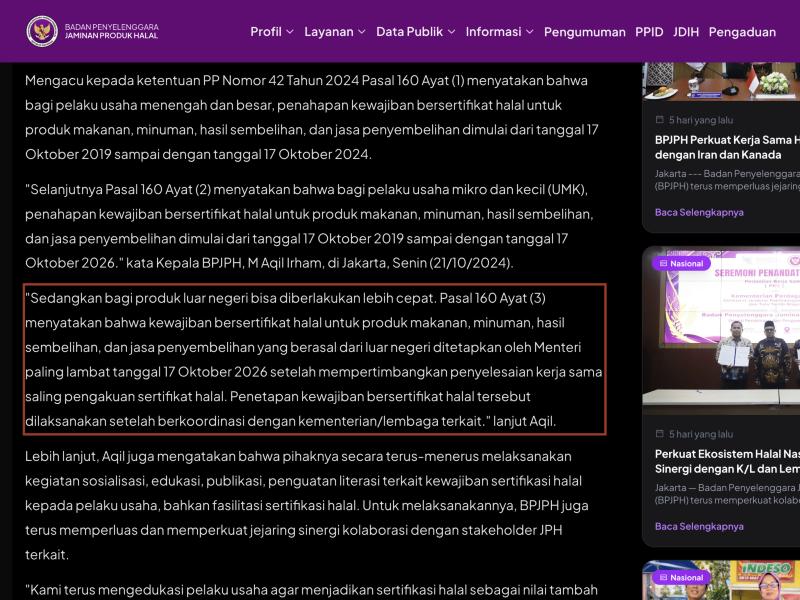 Source: BPJPH, “17 Oktober 2026 Produk Makanan-Minuman UMK Harus Sudah Bersertifikat Halal, Bagaimana dengan Produk Luar Negeri?” https://bpjph.halal.go.id/read/bpjph-17-oktober-2026-produk-makanan-minuman-umk-harus-sudah-bersertifikat-halal-bagaimana-dengan-produk-luar-negeri
Even before the requirement starts, Indonesian business customers may ask for a halal certificate. If you obtain one from a Japanese certification body with mutual recognition with BPJPH, it can also be used once the requirement starts.
Matcha is not on the list of materials that need no certification
Minister of Religious Affairs Decree No. 1360 of 2021 lists materials that do not need halal certification. 33 items are listed as plant-derived, unprocessed or only physically processed, with no other ingredients added (numbered up to 34, with number 25 missing). They include fresh fruit, dried vegetables, grains, dried seaweed, cocoa powder, menthol and peppermint oil. The list does not mention tea, green tea or the tea plant (Camellia sinensis).
The decree also includes a criterion of “physical processing only”. However, we found no document in which BPJPH decided that steaming, drying and grinding fall under this. We also could not confirm whether tea has been added to the list since 2021.
Japanese certification bodies and certificate registration
To use a halal certificate issued by a Japanese body, that body must have mutual recognition with BPJPH. According to a BPJPH article, the bodies with mutual recognition are Japan Islamic Trust (JIT) and Japan Muslim Association (JMA), and Muslim Professional Japan Association (MPJA) and Japan Halal Association are in process. This article is dated 27 September 2024, and we could not confirm the list as of 2026.
The importer registers foreign certificates in BPJPH’s system (SIHALAL) (SHLN registration). The Japanese organisations recognised by bodies in Singapore, Malaysia and Thailand are compared in Is Matcha Halal?
The pre-shipment halal check is set to be abolished
In August 2026, BPJPH Regulation No. 4 of 2026 was issued, requiring a pre-shipment check for imports. It required a check by an inspection body at a warehouse on the Japanese side and a report (LPPH) for each shipment (Article 2(3), Article 6 and Article 12(2)). Test samples and personal parcels were excluded (Article 2(4)). Plans to abolish this regulation were announced together with the postponement to 2028.
Documents prepared in Japan: phytosanitary inspection, pesticide residues and certificate of origin
The Japanese supplier and exporter prepare 3 things: the phytosanitary inspection, a pesticide residue test against Indonesian standards, and the certificate of origin. The health certificate or certificate of free sale needed for the distribution permit is also obtained on the Japanese side.
Phytosanitary inspection
According to documents from Japan’s Plant Protection Station, “green tea (processed tea)” sent to Indonesia by post requires an export inspection in Japan. This also applies when sending samples by EMS.
Pesticide residue test
Decree No. 2314 of 2025 of the Head of the Indonesian Quarantine Agency requires “green tea and black tea” imported from Japan to be tested lot by lot at a Japanese laboratory registered with Indonesia, with a certificate of analysis attached. The decree was enacted on 30 June 2025, and the registered laboratories are valid for 3 years from 1 July 2025.
The decree’s annex only says “green tea, black tea”, with no product codes and no distinction between leaf and powder. MAFF’s page also makes no mention of matcha or powder. Nor does anything say powder is excluded, so the safe course is to prepare for matcha to be covered by this test. The limits are as follows.
| Substance | Limit (mg/kg) |
|---|---|
| Bifenthrin | 30 |
| Chlorpyrifos | 2 |
| Clothianidin | 0.7 |
| Cypermethrin | 15 |
| Deltamethrin | 5 |
| Etoxazole | 15 |
| Fenpropathrin | 2 |
| Hexythiazox | 15 |
| Paraquat | 0.2 |
| Permethrin | 20 |
| Propargite | 5 |
| Thiamethoxam | 20 |
| Cadmium | 0.03 |
| Lead | 2 |
Test results judged against Japanese standards alone are not enough, so ask your supplier for a certificate of analysis from a registered laboratory. How lead limits compare by country is covered in Matcha Lead.
Certificate of origin
To use the 0% rate under the Indonesia-Japan Economic Partnership Agreement (IJEPA), attach a Japanese Certificate of Origin. In Japan, the Japan Chamber of Commerce and Industry issues certificates for the Japan-Indonesia agreement. Indonesia’s Minister of Finance Regulation No. 60 of 2026 sets the tariff rates and leaves the certificate of origin procedures to a separate regulation (Article 4(1)).
Duty and taxes: 0% under IJEPA, 5% without an agreement, VAT effectively 11%
Duty on matcha is 0% under IJEPA and 5% without an agreement. On top of this, VAT (value added tax, called PPN in Indonesia) and income tax at import (PPh22) apply. We checked all of these against Indonesian Ministry of Finance regulations.
Duty rates
| Category | 0902.10.90 (powder in immediate packings of 3kg or less) | 0902.20.90 (other powder) | Basis |
|---|---|---|---|
| IJEPA (with a Japanese certificate of origin) | 0% | 0% | Minister of Finance Regulation No. 60 of 2026, Annex A |
| RCEP (April 2026 to March 2027) | 2.0% | 3.0% | Minister of Finance Regulation No. 225 of 2022 |
| General rate (no agreement) | 5% | 5% | Minister of Finance Regulation No. 26 of 2022 |
The IJEPA tariff schedule was updated by Minister of Finance Regulation No. 60 of 2026, enacted on 31 July 2026 and in force from 1 August. The 4 codes under 0902.10 and 0902.20 are 0% in every year from 2026 to 2031 and beyond. Minister of Finance Regulation No. 69 of 2026 in September 2026 only rewrote Annexes B and C, and Annex A, which contains tea, did not change.
RCEP rates fall on 1 April each year, reaching 0% from April 2030 for 0902.10.90 and from April 2035 for 0902.20.90. The general rate of 5% was not changed by No. 50 of 2026 either.
VAT and income tax at import
| Tax | Rate | Basis |
|---|---|---|
| VAT (PPN) | Rate of 12% with the tax base set at 11/12, so effectively 11% | Minister of Finance Regulation No. 131 of 2024 |
| Income tax at import (PPh22) | 2.5% of the import value with an importer identification number (API), 7.5% without | Minister of Finance Regulation No. 51 of 2025 |
The treatment that sets the VAT base at 11/12 applies to goods other than luxury goods. For income tax at import, green tea (0902.10 and 0902.20) is not on the lists of items taxed at 10% or 7.5%, so the rate for “other items” applies. The only tea on the 7.5% list is black tea (0902.30 and 0902.40). The Directorate General of Customs and Excise states that importers self-assess and pay duty, and that the customs value is the CIF value (goods, insurance and freight).
Indonesian-language labels must be on at the point of entry
Bags and tins sold in shops must have the required items printed in Indonesian, attached by the time they enter Indonesia. The basis is BPOM Regulation No. 31 of 2018 (amended by No. 20 of 2021).
Required items
The items set by Article 5(1) are as follows.
- Product name
- Ingredients
- Net quantity
- Name and address of the manufacturer or importer
- Halal label (where required)
- Production date and lot
- Best-before date
- Distribution permit number
- Origin of certain ingredients
These are written and printed in Indonesian (Article 7(1)), and adding foreign languages is allowed (Article 7(2)).
The point of entry, and matching the registered label
Imports must have the label attached at the time they enter Indonesia (Article 2(2)). The label must be the same as the label approved when the distribution permit was obtained (Article 3(1)), so the draft label submitted with the distribution permit application becomes the label printed on the bag.
The importer and supplier decide whether to apply Indonesian labels in Japan before shipping or to make their own bags. What to decide when making bags under your own brand is in Private Label Matcha.
Sending samples and parcels
Tasting samples can be sent by Japan Post EMS. However, what is exempt from the BPOM distribution permit is samples for testing (BPOM Regulation No. 23 of 2023, Article 4(1)(g)), and the quantity is decided by a recommendation on an application through BPOM’s special route (Article 4(3)). Being for tasting alone does not mean no permit is needed, so check through an importer before receiving them. If you receive them as goods to sell in your shop, you need the permits covered in the sections above.
EMS conditions
| Japan Post notice (translated) | Content |
|---|---|
| Indonesia, parcels | Changed so that requests for return or change of address are not accepted |
| Indonesia, all mail items | Added that if the recipient does not have a 16-digit number from the Indonesian tax authority, an identification number such as a passport number must be provided |
Source: Japan Post, “国際郵便条件表の変更について” (Changes to the international mail conditions table, 24 March 2026, in Japanese) https://www.post.japanpost.jp/service/send/oversea/information/2026/0324_01.html
| Item | Details |
|---|---|
| Can it be sent? | Yes (all SAL service is suspended) |
| Transit time | Standard 8 days when posted from Tokyo |
| Recipient’s number | From 1 April 2026, if the recipient does not have a 16-digit Indonesian tax number, write a passport number or similar |
Tax on parcels
Under Minister of Finance Regulation No. 96 of 2023 (amended by No. 4 of 2025), parcels of 3 dollars or less are exempt. Parcels over 3 dollars and up to 1,500 dollars are charged 7.5% duty plus VAT.
Samples and permits
The SKI regulation does not put imports for market testing under the separate treatment, and the distribution permit rules also require a permit for products for market testing (BPOM Regulation No. 23 of 2023, Article 3(2)). A small amount for tasting and products sold on a trial basis are treated differently, so check with an importer before serving it in your shop.
How a shop without a permit can buy matcha
A shop that does not obtain its own distribution permit or halal registration buys through an importer that holds a BPOM distribution permit (ML number) and halal registration with BPJPH. The importer imports under its own permit and takes care of the SKI, customs clearance and paying duty and taxes.
What to check with the importer
- Whether it has obtained, or will obtain, a distribution permit (ML number) for the matcha it handles
- Whether the Japanese body that issued the halal certificate has mutual recognition with BPJPH
- Whether it can arrange a certificate of analysis for pesticide residues
- Whether it uses the IJEPA certificate of origin to bring duty to 0%
- Whether the matcha arrives with Indonesian-language labels attached
If you buy directly from Japan on DAP terms (delivered at place, where the buyer pays duties and taxes), add duty, VAT and income tax to the quote when comparing. How the procedures differ from Singapore and Thailand is in How to Import Matcha into Singapore and How to Import Matcha into Thailand, and grades suited to lattes in Matcha grades.
Buying from Omakase Matcha
Omakase Matcha supplies matcha wholesale from 1kg. To Indonesia, we deliver by EMS in about 8 days on DAP terms, with duties and taxes paid by your shop on receipt. Payment is in advance by Wise or PayPal.
Some products are halal certified. Whether a certificate is accepted in Indonesia depends on whether the certification body is recognised by BPJPH, so we check and let you know for each product. If you want to taste before ordering, you can request up to 3 samples. Terms are on the Indonesia wholesale and Wholesale pages.
Sources
Checked on 20 October 2026.
- BPOM Regulation No. 23 of 2023 (registration of processed food) (in Indonesian) https://jdih.pom.go.id/download/rule/1518/23/2023/Peraturan%20Badan%20Pengawas%20Obat%20dan%20Makanan%20Nomor%2023%20Tahun%202023%20tentang%20Registrasi%20Pangan%20Olahan
- BPOM, “Pedoman Registrasi Pangan Olahan 2023” (Processed food registration guide) (in Indonesian) https://registrasipangan.pom.go.id/storage/medialain/Registrasi-Pangan-file1713848654.pdf
- BPOM, “Mengenal Izin Edar Pangan” (how SPP-IRT differs from MD and ML) (in Indonesian) https://intelijen.pom.go.id/hot-issue/mengenal-izin-edar-pangan-apa-bedanya-spp-irt-dan-bpom-ri-md-ml
- BPOM Regulation No. 27 of 2022 (import control) (in Indonesian) https://pasal.id/peraturan/perban/peraturan-bpom-no-27-tahun-2022
- BPOM Regulation No. 28 of 2023 (amending No. 27 of 2022) (in Indonesian) https://pasal.id/peraturan/perban/peraturan-bpom-no-28-tahun-2023
- BPOM Regulation No. 31 of 2018 (processed food labels) (in Indonesian) https://pasal.id/peraturan/perban/peraturan-bpom-no-31-tahun-2018
- Government Regulation No. 32 of 2017 (BPOM fees) (in Indonesian) https://jdih.kemenkeu.go.id/fullText/2017/32TAHUN2017PP.pdf
- BPJPH, mandatory halal for imported products (in Indonesian) https://bpjph.halal.go.id/read/bpjph-17-oktober-2026-produk-makanan-minuman-umk-harus-sudah-bersertifikat-halal-bagaimana-dengan-produk-luar-negeri
- ANTARA, “Pemerintah memperpanjang penahapan sertifikasi halal hingga 2028” (17 October 2026) (in Indonesian) https://www.antaranews.com/berita/5793025/pemerintah-memperpanjang-penahapan-sertifikasi-halal-hingga-2028
- Coordinating Ministry for Economic Affairs, “Pemerintah Sesuaikan Masa Penahapan Kewajiban Bersertifikat Halal dengan Memperhatikan Kesiapan Ekosistem dan Pemangku Kepentingan” (16 October 2026, in Indonesian) https://www.ekon.go.id/publikasi/detail/7161/pemerintah-sesuaikan-masa-penahapan-kewajiban-bersertifikat-halal-dengan-memperhatikan-kesiapan-ekosistem-dan-pemangku-kepentingan
- BPJPH Regulation No. 4 of 2026 (pre-shipment check for imports) (in Indonesian) https://peraturan.go.id/id/peraturan-bpjph-no-4-tahun-2026
- BPJPH Regulation No. 4 of 2026 (pasal.id) (in Indonesian) https://pasal.id/peraturan/perban/peraturan-bpjph-4-2026
- BPJPH, “Indonesia and Japan discuss cooperation on halal product assurance” (27 September 2024) (in Indonesian) https://bpjph.halal.go.id/read/indonesia-jepang-bahas-penguatan-kerja-sama-jaminan-produk-halal
- BPJPH, “Materials exempt from mandatory halal certification” (in Indonesian) https://bpjph.halal.go.id/read/penting-diketahui-ini-bahan-yang-dikecualikan-dari-kewajiban-bersertifikat-halal
- Minister of Religious Affairs Decree No. 1360 of 2021 (materials exempt from certification), copy (in Indonesian) https://lph.uin-alauddin.ac.id/assets/download/KMA_1360_Tahun_2021_tentang_Bahan_yang_Dikecualikan_dari_Kewajiban_Bersertifikat_Halal(rev).pdf
- Tilleke & Gibbins, “Foreign Halal Certificate Registration in Indonesia” https://www.tilleke.com/insights/foreign-halal-certificate-registration-in-indonesia/4/
- Baker McKenzie, “Indonesia: New Import Framework Brings Greater Clarity for Importers” https://www.bakermckenzie.com/en/insight/publications/alerts/2025/11/indonesia-new-import-framework-brings-greater-clarity-for-importers
- Indonesian Minister of Finance Regulation No. 60 of 2026 (IJEPA tariff rates) (in Indonesian) https://jdih.kemenkeu.go.id/api/download/7908de01-c644-403d-8cc1-362998327b55/2026pmkeuangan060.pdf
- Indonesian Minister of Finance Regulation No. 69 of 2026 (in Indonesian) https://jdih.kemenkeu.go.id/api/download/7d4613bc-ba8e-4826-b468-6b3a13644ec8/2026pmkeuangan069.pdf
- Indonesian Minister of Finance Regulation No. 225 of 2022 (RCEP tariff rates, Japan) (in Indonesian) https://jdih.kemenkeu.go.id/api/download/e71e2ec0-dd4d-4d98-b101-6c2eab675da7/225~PMK.010~2022Per.pdf
- Indonesian Minister of Finance Regulation No. 26 of 2022 (tariff classification and rates) (in Indonesian) https://jdih.kemenkeu.go.id/api/download/04d90736-33d5-4b72-92a3-0d2b7c6bb8bd/26~PMK.010~2022Per.pdf
- Indonesian Minister of Finance Regulation No. 50 of 2026 (in Indonesian) https://jdih.kemenkeu.go.id/api/download/11a0ec3c-7cde-4dac-a02a-9f06d7e650f0/2026pmkeuangan050.pdf
- Indonesian Minister of Finance Regulation No. 51 of 2025 (income tax at import) (in Indonesian) https://jdih.kemenkeu.go.id/api/download/2b4a88f1-0b7e-430c-aba7-b44dd401765d/2025pmkeuangan051.pdf
- Directorate General of Taxes, Indonesia (Minister of Finance Regulation No. 131 of 2024, VAT) https://www.pajak.go.id/en/node/113453
- DDTC News (Minister of Finance Regulations No. 96 of 2023 and No. 4 of 2025, tax on parcels) (in Indonesian) https://news.ddtc.co.id/berita/nasional/1808928/barang-kosmetik-hingga-tas-impor-bisa-kena-pph-5-persen-cek-aturannya
- Directorate General of Customs and Excise, Indonesia, “Impor untuk Dipakai” (in Indonesian) https://www.beacukai.go.id/impor-untuk-dipakai
- Japan Chamber of Commerce and Industry, “EPAに基づく特定原産地証明書発給事業” (Issuing Certificates of Origin under EPAs, in Japanese) https://www.jcci.or.jp/international/certificates-of-origin/
- Japan Ministry of Finance, export statistics schedule, Chapter 9 (in Japanese) https://www.customs.go.jp/yusyutu/2026_01_01/data/j_09.htm
- Japan Ministry of Finance trade statistics, exports by commodity and country (2025, Indonesia) (in Japanese) https://www.customs.go.jp/toukei/srch/index.htm?M=01&P=1,1,,,,,,,,4,1,2025,0,0,0,2,090210,090220,,,,,,,,,6,118,,,,,,,,,,,,,,,,,,,,,20
- Japan Ministry of Finance trade statistics, exports by commodity and country (2026 cumulative to August, Indonesia) (in Japanese) https://www.customs.go.jp/toukei/srch/index.htm?M=01&P=1,1,,,,,,,,1,0,2026,0,8,0,2,090210,090220,,,,,,,,,6,118,,,,,,,,,,,,,,,,,,,,,20
- MAFF, “インドネシア向け輸出茶の残留農薬検査” (Pesticide residue testing for tea exported to Indonesia, in Japanese) https://www.maff.go.jp/j/shokusan/export/id_lab.html
- Decree No. 2314 of 2025 of the Head of the Indonesian Quarantine Agency (posted by MAFF) https://www.maff.go.jp/j/shokusan/export/attach/pdf/id_lab-26.pdf
- Decree No. 2314 of 2025 of the Head of the Indonesian Quarantine Agency (posted by MAFF, second PDF) https://www.maff.go.jp/j/shokusan/export/attach/pdf/id_lab-27.pdf
- Plant Protection Station, “郵便物で送る植物の輸出検査(アジア)” (Export inspection of plants sent by post, Asia, in Japanese) https://www.maff.go.jp/pps/j/search/ekuni/as/yubin2.html
- Japan Post, “国・地域別情報(インドネシア)” (Country information, Indonesia, in Japanese) https://www.post.japanpost.jp/cgi-kokusai/nonmailable_articles.php?cid=102
- Japan Post, “国際郵便条件表の変更について” (Changes to the international mail conditions table, in Japanese) https://www.post.japanpost.jp/service/send/oversea/information/2026/0324_01.html
- Japan Post, “EMSお届け日数表(東京)” (EMS delivery times from Tokyo, in Japanese) https://www.post.japanpost.jp/send/oversea/date/ems/tokyo.html