
 Reviewed by: Takahiro Sugiyama (CEO, meguri Inc.)
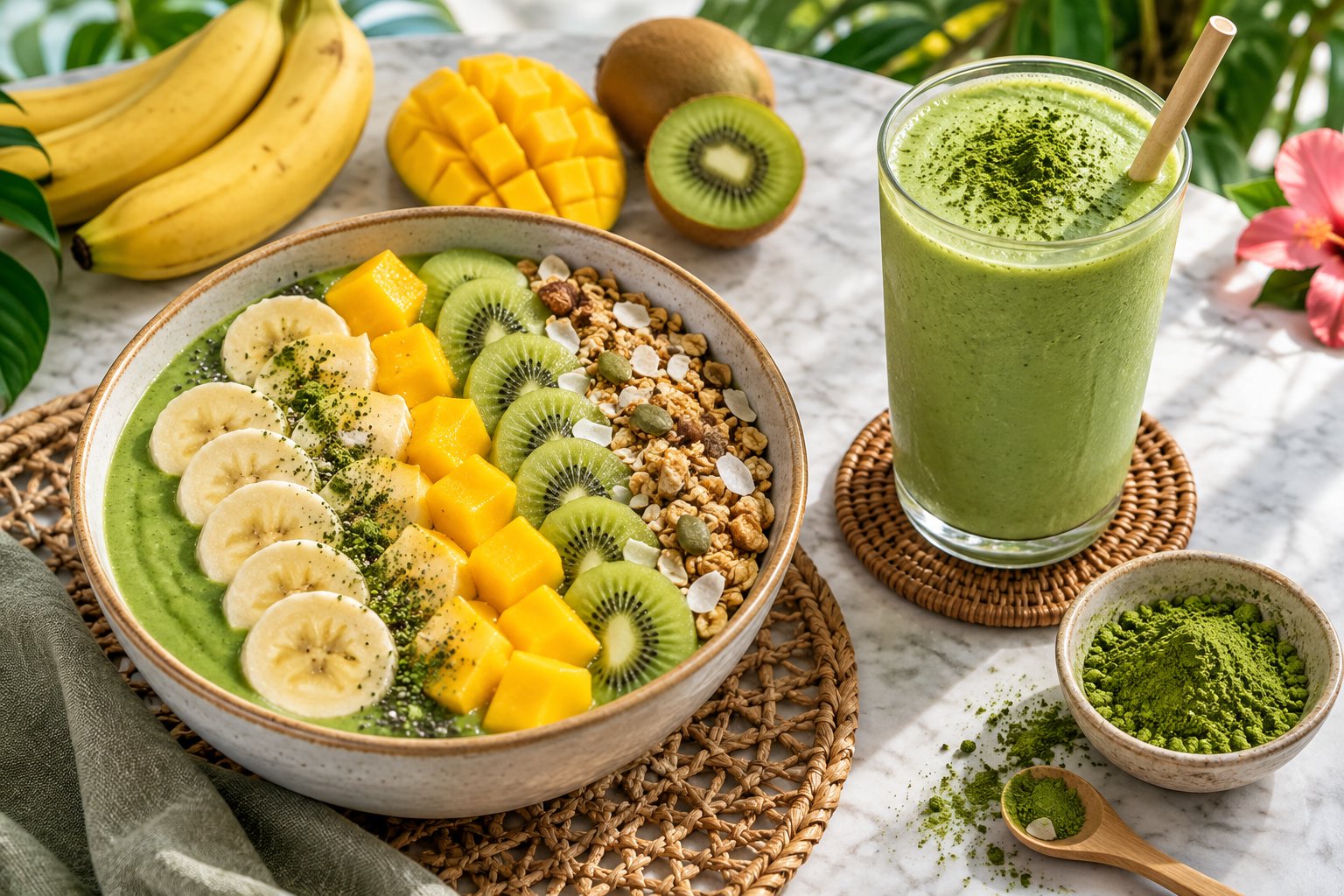
A matcha smoothie is a cold drink made by blending matcha with fruit and milk or juice. Put it in a bowl and top it with fruit or nuts, and it becomes a smoothie bowl. This article sets out official recipes from a Japanese government food site, a tea company, a blender maker and a food company, and looks at the ratio, fruit, chilling, protein, hygiene, sugar labelling and cost per cup that a café has to decide.
What is a matcha smoothie?
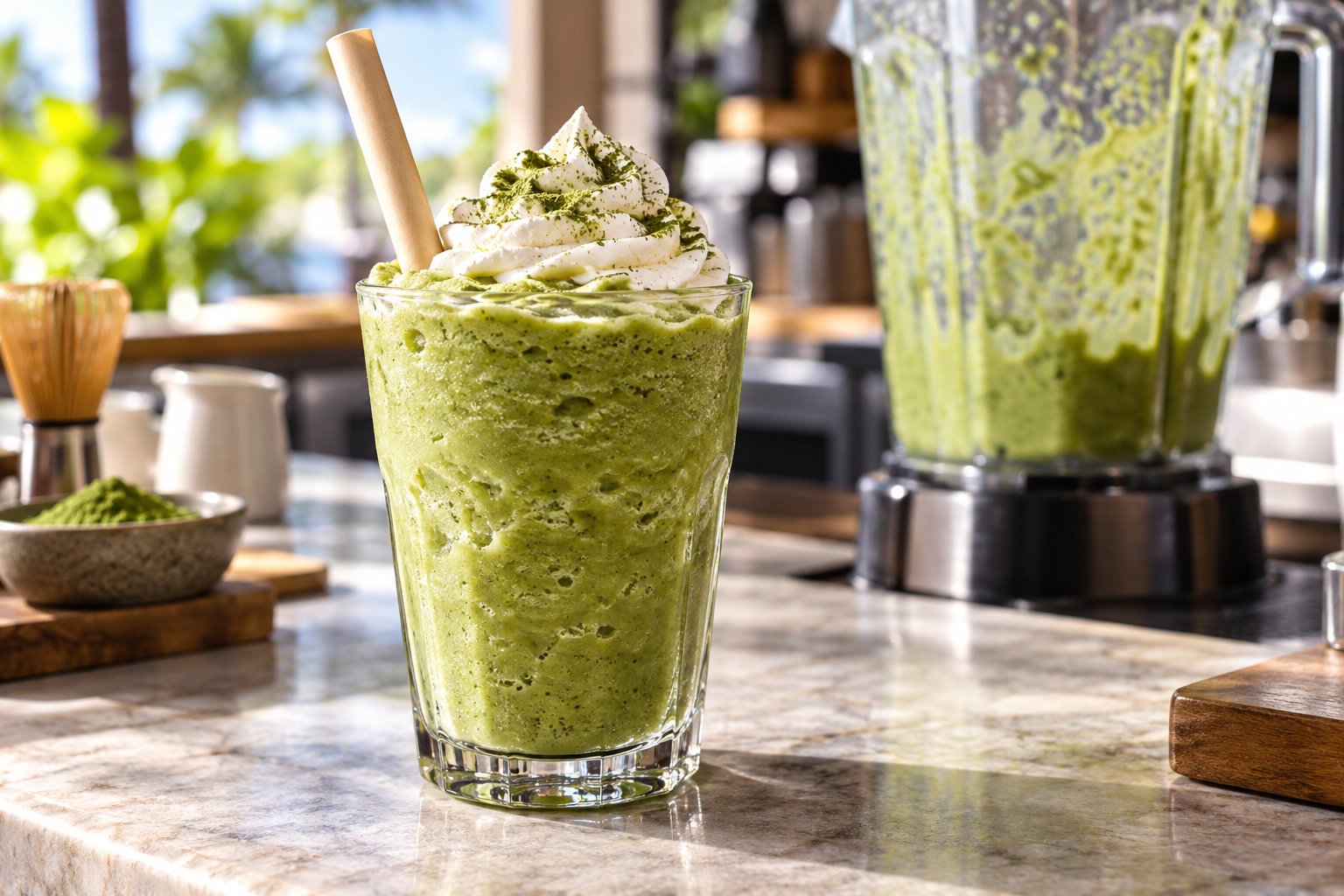
A matcha smoothie is a drink built mainly on fruit, blended with matcha and a liquid until thick. A matcha frappe, built mainly on ice and milk, is chilled and thickened in a different way.
How it differs from a frappe
The Cambridge Dictionary defines a smoothie as “a thick, cold drink made from fruit and often yogurt or ice cream, mixed together until smooth,” and a frappe as a partly frozen drink, or a drink made with a lot of ice, containing milk, fruit juice or alcohol. All the official matcha smoothie recipes below use frozen fruit. Frappe ratios and ice amounts are covered in how to make a matcha frappe.
Smoothie bowls
MAFF’s Taste of Japan pours a smoothie of frozen banana and matcha into a bowl, chills it in the fridge, and tops it with blueberries, chia seeds and nuts. Served in a bowl with toppings and eaten with a spoon like this, it is what is called a smoothie bowl.
Menu names
In English you can write “Matcha Smoothie” or “Matcha Banana Smoothie,” and in Thai “สมูทตี้มัทฉะ” or “มัทฉะสมูทตี้.” Call the bowl “Matcha Smoothie Bowl” and list the fruit on top, which helps avoid mixed-up orders.
Official recipe ratios compared
Every official recipe uses banana, and matcha ranges from about 1/2 teaspoon to 3g per serving. The liquid varies: milk, plant-based milk or coconut water.
Five official recipes compared
| Source | Matcha | Fruit | Liquid and other | Servings |
|---|---|---|---|---|
| MAFF Taste of Japan “Matcha smoothie” | 12g | 600g frozen banana | 175ml almond milk, 4 dates | 4 (bowl) |
| ITO EN (US) Tropical Matcha Smoothie | 1 tsp (Culinary Matcha) | 1 banana, 1 cup frozen mango, 1 cup frozen pineapple | 1 1/2 cups coconut water | 2 glasses |
| ITO EN (US) Berry Matcha Smoothie | 1 tsp (Culinary Matcha) | 1 banana, 1 cup frozen blueberries, 1 cup frozen strawberries | 1 1/4 cups milk, 1/2 cup Greek yogurt | 2 glasses |
| Vitamix “Creamy Matcha Oat Smoothie” | 1 Tbsp | 3 frozen bananas | 2 cups soy milk, 1 cup rolled oats, 4 dates | Not stated |
| Bob’s Red Mill “Matcha Mango Smoothie” | 1/2 tsp | 1 1/4 cups frozen mango, 1/2 banana, 2 Tbsp goji berries | 1 1/4 cups coconut milk, 1/3 cup almond protein powder, 1/2 cup ice | 1 (about 2 1/2 cups) |
What the table shows
Per serving, MAFF’s recipe is 3g of matcha, 150g of frozen banana and about 44ml of almond milk. Very little liquid goes in relative to the fruit, and it is served in a bowl to eat with a spoon. ITO EN uses 1 teaspoon of matcha for 2 glasses, so each glass gets 1/2 teaspoon.
Four of the five chill the drink with frozen fruit and use no ice. Only Bob’s Red Mill adds a sweetener such as sugar, while MAFF and Vitamix add dates.
How to set your café standard (our view)
From here on, this is our view, based on the comparison above. For a drinking smoothie, start with 150 to 200g of frozen fruit and about 200ml of liquid, and test matcha at both 2g and 3g. For a bowl, cut the liquid to half or less. Write the final recipe on a recipe card with fruit, liquid, matcha and sweetener in grams or millilitres, because teaspoon and cup measures vary from person to person.
Fruit pairings
The fruits official recipes pair with matcha are banana, mango, pineapple and berries, and one recipe also adds leafy greens. Some recipes use dates for sweetness.
Banana for body and sweetness
All five recipes use banana. MAFF and Vitamix combine frozen banana with dates only and add no other fruit. ITO EN’s Berry Matcha Smoothie adds Greek yogurt to banana and frozen berries.
Mango, pineapple and berries
ITO EN pairs mango and pineapple with coconut water, and blueberries and strawberries with milk and Greek yogurt. Bob’s Red Mill adds lime juice and goji berries to mango. Pairing strawberry with a matcha latte is covered in how to make a strawberry matcha latte.
Leafy greens and acidic juice
ITO EN’s Superfood Smoothie combines 1 cup of spinach with frozen mango, lime juice and ginger. Strongly acidic ingredients such as lime juice can dull matcha’s green colour. Why this happens, and how to keep the colour, is explained in matcha lemonade, tonic and soda.
Frozen fruit, ice and loading order
Most official recipes chill the drink with frozen fruit and use no ice. Of the five, only Bob’s Red Mill adds ice.
Chilling with frozen fruit
MAFF’s recipe peels the bananas, cuts each in two and freezes them the day before. ITO EN uses frozen mango, pineapple and berries. In a café, weighing and freezing fruit in single-serving portions saves weighing it for every order.
Recipes that add ice
Bob’s Red Mill adds 1/2 cup of ice on top of 1 1/4 cups of frozen mango. If you use ice, add a set amount of small ice that is easy to measure. This follows the Vitamix foodservice article on ice shape and measuring introduced in how to make a matcha frappe.
Loading order and blending time
In its foodservice article, Vitamix sets out the order as liquids first, then powders such as matcha or protein, then frozen fruit and ice. It says powders go in after the liquid so they can dissolve in it. The Vitamix matcha smoothie starts on the lowest speed, increases to the highest and blends for 40 to 50 seconds.
Adding protein
When a menu or advertisement describes the nutrition of a protein smoothie, in Singapore it must follow the rules for nutrition and health claims. Protein powder is a powder, so it goes in after the liquid.
An official recipe example
Bob’s Red Mill adds 1/3 cup of almond protein powder per serving and uses 1/2 teaspoon of matcha. Some protein powders are flavoured or sweetened, so pick the brand first, then adjust the matcha and sweetener amounts.
Singapore’s labelling rules
The Singapore Food Agency (SFA) guide to food labelling and advertisements defines statements that suggest or compare a food’s nutritive properties, such as energy, protein or sugars, as “nutrition claims.” Nutrition claims are allowed if they comply with the Food Regulations and the guidelines of Singapore’s Health Promotion Board (HPB). Claims that health or an improved physical condition may be achieved by eating a food are prohibited.
How to write it on the menu (our view)
From here on, this is our view. Before using a nutrition phrase such as “High Protein,” write what is in it, such as “with almond protein powder.” If you state an amount, work it out per serving from the brand’s nutrition label and check the conditions in the HPB guidelines. If you use the same wording in Thailand, check the labelling rules of the Thai Food and Drug Administration (Thai FDA). Points to watch on label wording are also covered in private label matcha.
Cut fruit and leafy green safety
Cafés that cut smoothie fruit in advance keep it cold and set how long it can be held. The Singapore Food Agency and the US FDA Food Code both set out how to handle cut fruit and leafy greens.
Singapore Food Agency guidance
According to the Singapore Food Agency, if fruit is not washed properly, Listeria (a bacterium that causes food poisoning) on the skin may be transferred to the flesh when the fruit is cut. Dirty equipment and surfaces can also be a cause. It says Listeria does especially well in low-acid fruit such as cantaloupe. For consumers, SFA advises refrigerating cut fruit at 4°C or below if it is not eaten right away, and discarding cut fruit left at room temperature for more than 2 hours. It says there are separate guidelines on handling raw vegetables and fruits for food handlers.
Source: Singapore Food Agency (SFA), “Listeria Risk in Cut Fruits” https://www.sfa.gov.sg/food-information/risk-at-a-glance/listeria-cut-fruits
Food that needs temperature control under the FDA Food Code
The US FDA Food Code 2022 includes cut melons, cut leafy greens and cut tomatoes, along with raw or heat-treated animal food, in food that requires time/temperature control for safety to limit the growth of pathogens (TCS food). Leafy greens include spinach, kale, cabbage and lettuces. Milk and yogurt are also animal food.
Source: U.S. Food and Drug Administration, “Food Code 2022” 1-201.10 https://www.fda.gov/media/164194/download
The Food Code sets 5°C (41°F) or below for TCS food held cold. Ready-to-eat TCS food made on site and refrigerated for more than 24 hours must be marked with the date by which it is to be eaten, sold or discarded, for a maximum of 7 days at 5°C or below, with the day of preparation counted as Day 1. This is an upper limit and does not mean cut fruit keeps for 7 days. The Food Code is a model that US states and local governments use to write their rules, so check the rules that actually apply in your country or city.
How to prep (our view)
From here on, this is our view. Wash fruit for freezing before you cut and freeze it, and write the date on the bag. Keep fruit and spinach used fresh in the fridge, write down the time you take them out, and keep their time at room temperature shorter than SFA’s 2 hours. Cafés in Thailand should also check the content of the training course based on the 2018 ministerial regulation on food establishment hygiene. The course is covered in how to start a matcha cafe or matcha stand. Making dissolved matcha in advance is covered in how to make an iced matcha latte.
Sugar labelling and caffeine
In Singapore, smoothies made in the outlet also come under “Nutri-Grade,” the sugar and saturated fat labelling scheme. Caffeine depends on the grams of matcha in each cup.
Nutri-Grade
Singapore’s Health Promotion Board (HPB) lists “freshly blended smoothies” as an example of freshly prepared beverages. According to Singapore’s Ministry of Health (MOH), freshly prepared beverages came under the scheme from 30 December 2023, and drinks graded C or D must show the mark next to their menu listing. Smaller businesses with revenue of not more than S$1 million that sell at fewer than 10 premises are, for now, not required to show it. The details are in how to make a strawberry matcha latte.
Smoothie bowls and toppings
HPB gives examples of drinks but does not say how a bowl eaten with a spoon is treated. If you serve bowls, check with HPB. Toppings that can be added to freshly prepared drinks must have their sugar content stated on menus and similar materials. If customers can choose toppings for a drinking smoothie, state their sugar content too.
Caffeine per cup
Japan’s Standard Tables of Food Composition, published by the Ministry of Education, Culture, Sports, Science and Technology (MEXT), list matcha at 3.2g of caffeine per 100g, about 32mg per gram. One serving of MAFF’s bowl (3g of matcha) gives about 96mg, and 2g of matcha about 64mg. Adding more fruit or liquid does not change the caffeine in the cup. Comparisons with other drinks are in matcha caffeine.
Which grade to use and cost per cup
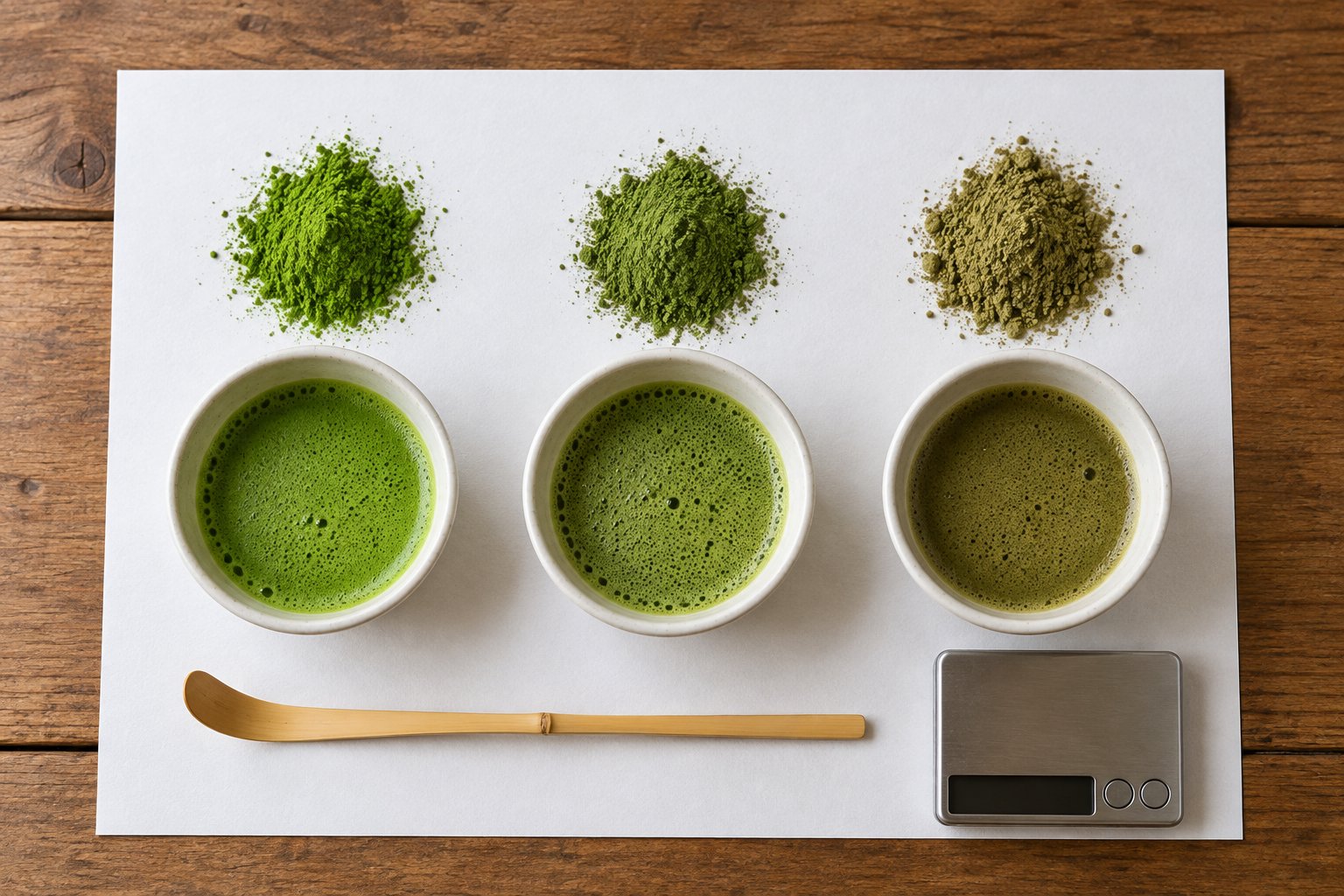
All three ITO EN recipes use Culinary Matcha (matcha for cooking). For a smoothie mixed with fruit and milk, you can start testing with latte or ingredient grades rather than a high grade meant for drinking straight.
Choosing a grade
From here on, this is our view. For recipes with a lot of fruit, try changing the grams of matcha and comparing the taste before moving up a grade. If you use plant-based milk, compare with the milk your café uses, as in matcha latte with oat milk. Grade differences are on our grades page, and choosing matcha for lattes is covered in matcha for café lattes.
The cost formula
Matcha cost per cup = grams of matcha used × buying price per kg ÷ 1,000. Add fruit (grams per cup × price per gram), liquid, protein powder, sweetener, toppings, and the cup, lid and straw to get the ingredient cost. For a bowl, include the bowl and spoon. How matcha prices are set is covered in why matcha is so expensive.
Adding it to your menu
Omakase Matcha sells matcha sourced from Japan’s growing regions from 1kg, and you can request up to 3 samples. Make the smoothie with your own fruit and milk, and compare the taste at 2g and 3g before deciding, which helps narrow down the grade to buy.
Sources
- Cambridge Dictionary, “smoothie” https://dictionary.cambridge.org/dictionary/english/smoothie
- Cambridge Dictionary, “frappe” https://dictionary.cambridge.org/dictionary/english/frappe
- MAFF, Taste of Japan, “Matcha smoothie” https://japan-food.jetro.go.jp/en/recipe/118.html
- ITO EN, “Tropical Matcha Smoothie” https://itoen.com/blogs/recipes/tropical-matcha-smoothie
- ITO EN, “Berry Matcha Smoothie” https://itoen.com/blogs/recipes/berry-matcha-smoothie
- ITO EN, “Matcha Superfood Smoothie” https://itoen.com/blogs/recipes/matcha-superfood-smoothie
- Vitamix, “How to Make a Creamy Matcha Oat Smoothie” https://www.vitamix.com/mx/en_us/articles/how-to-make-a-creamy-matcha-oat-smoothie
- Vitamix, “Four Causes of Beverage Inconsistency” https://www.vitamix.com/us/en_us/articles/four-causes-of-beverage-inconsistency
- Bob’s Red Mill, “Matcha Mango Smoothie” https://bobsredmill.com/recipes/how-to-make/matcha-mango-smoothie
- Singapore Food Agency, “A Guide to Food Labelling and Advertisements” https://www.sfa.gov.sg/docs/default-source/food-information/labelling-and-packaging-information/a-guide-to-food-labelling-and-advertisements.pdf
- Singapore Food Agency (SFA), “Listeria Risk in Cut Fruits” https://www.sfa.gov.sg/food-information/risk-at-a-glance/listeria-cut-fruits
- U.S. Food and Drug Administration, “Food Code 2022” https://www.fda.gov/media/164194/download
- Ministry of Health Singapore (MOH), “Implementation of Nutri-Grade requirements for freshly prepared beverages from 30 December 2023” https://www.moh.gov.sg/newsroom/implementation-of-nutri-grade-requirements-for-freshly-prepared-beverages-from-30-december-2023/
- Health Promotion Board Singapore (HPB), “Measures for Nutri-Grade” https://hpb.gov.sg/healthy-living/food-beverage/nutri-grade
- Ministry of Education, Culture, Sports, Science and Technology, “日本食品標準成分表(八訂)増補2023年” (Standard Tables of Food Composition in Japan 2020, Eighth Revised Edition, Supplement 2023, in Japanese) https://www.mext.go.jp/a_menu/syokuhinseibun/mext_00001.html