
 Reviewed by: Takahiro Sugiyama (CEO, meguri Inc.)
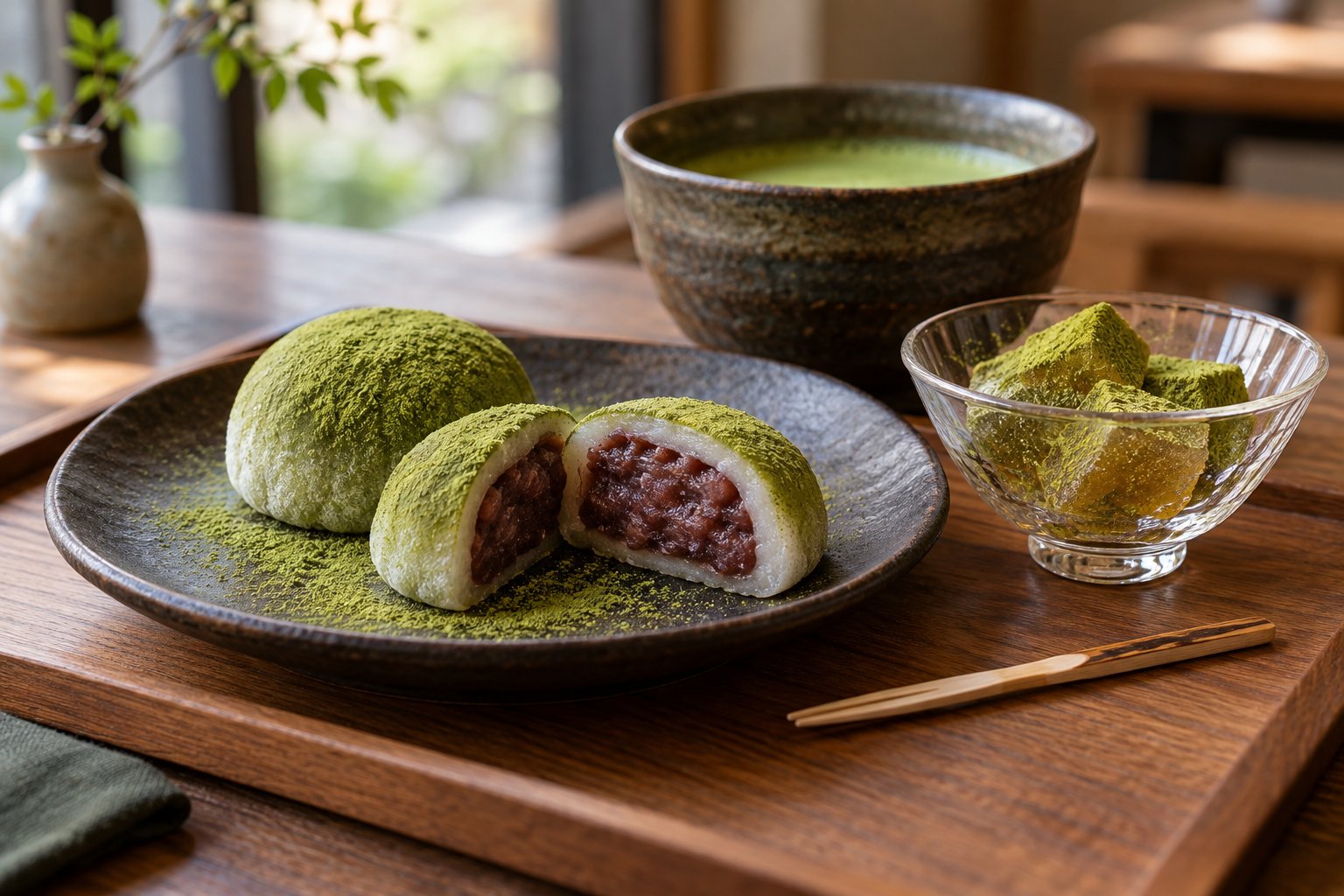
Matcha daifuku and matcha warabi mochi are Japanese sweets that a matcha latte café can make without an oven, and they show off the green color. Mochi also hardens over time, and every year people choke on it. We checked flour types, matcha amounts, the time from making to serving and how to serve it safely against materials from Japanese public bodies and companies.
What is matcha mochi? Daifuku, shiratama and warabi mochi
Sweets called “matcha mochi” in English fall into two broad groups: daifuku and shiratama, made from glutinous rice flour, and warabi mochi, made by cooking starch until it sets. Both are chewy, but the ingredients and methods are different.
Daifuku and shiratama, made from glutinous rice flour
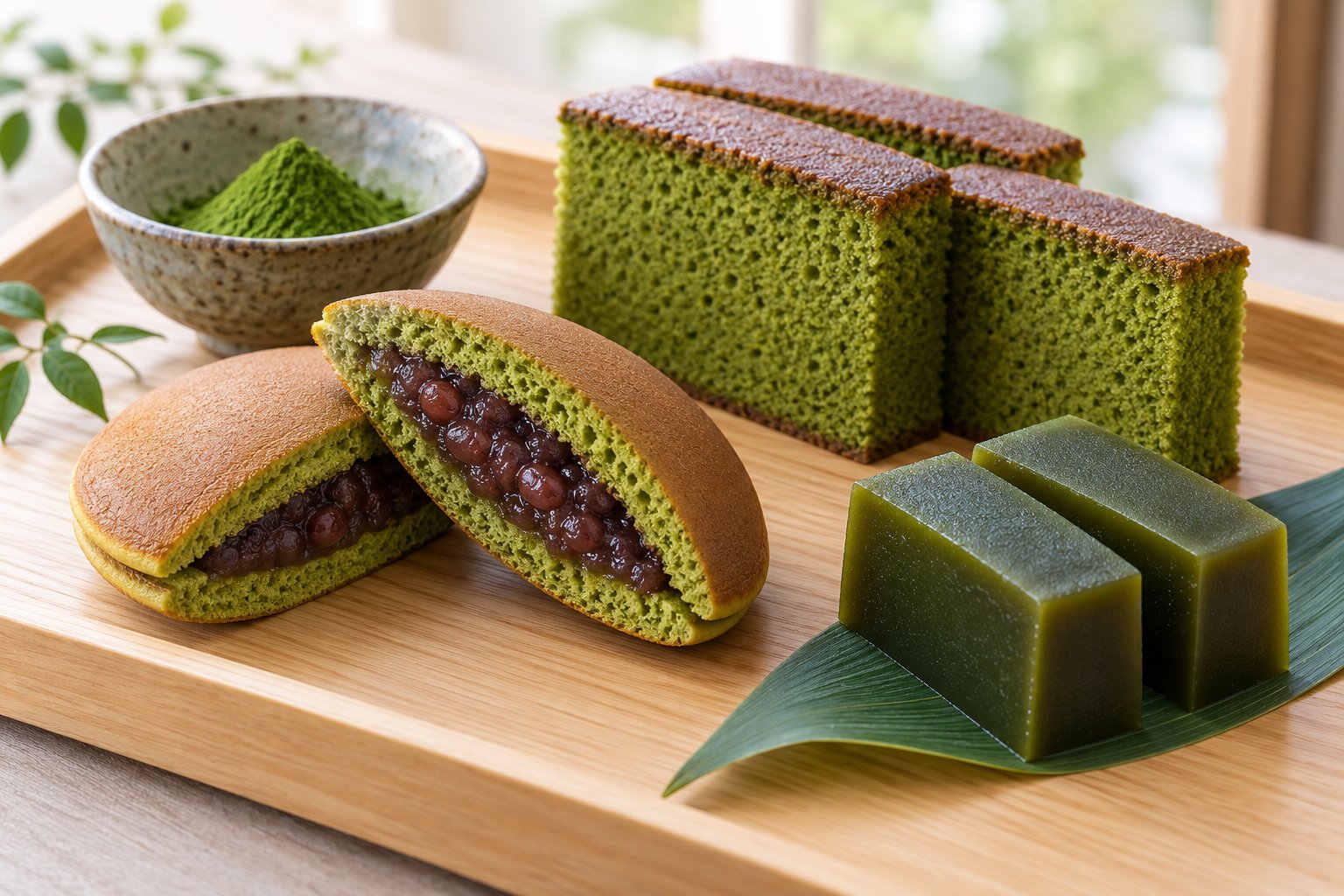
Daifuku is a sweet with a thin dough of glutinous rice flour wrapped around a filling of sweet bean paste (anko). Shiratama are small dumplings made by kneading shiratamako with water, rolling them into balls and boiling them. The Tokai Regional Agricultural Administration Office of MAFF lists shiratamako as an ingredient for daifuku, gyuhi (a soft dough of glutinous rice flour kneaded with sugar) and shiratama dumplings.
Matcha can go into three places: mixed into the dough, mixed into the filling, or dusted on top.
Warabi mochi, made by cooking starch
Warabi mochi is made by cooking flour, water and sugar in a pan, then cooling it until it sets. MAFF’s “Nippon Traditional Foods Encyclopedia” introduces warabi mochi as a traditional food of Nara Prefecture, eaten dusted with kinako (roasted soybean flour) or topped with kuromitsu (brown sugar syrup). Matcha warabi mochi is made by mixing matcha into the dough or coating the finished pieces in matcha.
Shiratamako, mochiko, joshinko and warabiko
Shiratamako and mochiko are made from glutinous rice, joshinko from non-glutinous rice (the rice people cook and eat every day), and warabiko is not rice at all but starch from a plant root. Different flours change the texture and how fast the sweet hardens.
Three rice flours
| Flour | Rice | How it is made | Main uses |
|---|---|---|---|
| Shiratamako | Glutinous rice | Rice soaked in water, then ground while water is added (wet milling) | Shiratama dumplings, gyuhi, daifuku |
| Mochiko | Glutinous rice | Same as joshinko (washed, drained, milled and dried) | Daifuku, gyuhi, monaka |
| Joshinko | Non-glutinous rice | Washed, drained, milled while slightly damp, then dried | Dango, kashiwa mochi, kusa mochi |
The source is the MAFF Tokai Regional Agricultural Administration Office page “Types and uses of rice flour.” MAFF’s page “Types and characteristics of rice flour” explains that fine mochiko is sometimes called “gyuhiko,” and that shiratamako is even finer than gyuhiko, with most components other than starch washed out.
In English, glutinous rice flour is also called sweet rice flour. The US mochi ice cream maker mentioned later lists sweet rice flour as a dough ingredient. In the uses column of the Tokai office table, the flours listed for daifuku are shiratamako and mochiko, not joshinko.
Warabiko and the starches used instead
MAFF explains that warabiko is a starch made by pounding and crushing warabi roots, then repeatedly soaking them in water and drying them. Because it is taken from small roots, it takes a lot of work, and it has been treated as an expensive ingredient.
Source: MAFF, “にっぽん伝統食図鑑 わらびもち” (Nippon Traditional Foods Encyclopedia: Warabi mochi, in Japanese) https://www.maff.go.jp/j/keikaku/syokubunka/traditional-foods/menu/warabimoti.html
The same page says that warabi mochi sold to the general public is sometimes made with starch from sweet potatoes or other potatoes instead, and that warabi mochi made only with warabiko is known for its black gloss and strong stickiness. For flour sold as “warabi mochi flour,” check the ingredient label to see which starch it is before you buy. We expect clear warabi mochi and dark warabi mochi to look different once matcha is mixed in (our view).
Which flour to choose for a shop
Daifuku dough uses shiratamako or mochiko, shiratama uses shiratamako, and warabi mochi uses warabiko or another starch flour. MAFF writes that for glutinous rice flour, ingredients that harden quickly are preferred for products that need to set, such as mochi and rice crackers, while ingredients that harden slowly are preferred for daifuku and similar sweets. Telling your supplier whether the flour is for daifuku or for mochi makes the choice easier (our suggestion).
Matcha amounts in official recipes
Of four official recipes from Japanese public bodies and companies, only Mie Prefecture’s warabi mochi gave matcha in grams: 2g of matcha for 50g of flour (4%). The other three give it in teaspoons or as “what is left from the matcha jelly,” so the weight is not known.
Comparing four official recipes
| Source | Sweet | Yield | Flour | Matcha | Where matcha goes in |
|---|---|---|---|---|---|
| Mie Prefecture (Ise tea warabi mochi) | Warabi mochi | 4 servings | Warabiko 50g | 2g (dissolved in 10g of water at about 80°C) | Mixed into the cooked dough |
| Toshiba Lifestyle (home appliance maker) | Matcha cream daifuku | 5 pieces | Shiratamako 50g | 1 teaspoon | Mixed with the flour and sugar first |
| Meiji (food company) | Matcha shiratama with ice cream | 2 servings | Shiratamako 50g | 1/2 teaspoon | Mixed with the flour first |
| Saitama Prefecture (Sayama tea shiratama anmitsu, winning recipe from a parent and child cooking contest) | Matcha shiratama | 4 servings | Shiratamako 20g | What is left in the bowl used to dissolve matcha for the jelly | Flour and water mixed in the same bowl |
Mie Prefecture’s recipe comes to 0.5g of matcha per serving (our calculation). Toshiba’s recipe divides a dough of 50g shiratamako, 25g sugar and 80ml water into 5 pieces, filled with whipped cream wrapped in white bean paste.
What the table shows
In all four, one batch of dough uses only 20–50g of flour, and the matcha is 1/2 to 1 teaspoon for 50g of flour, or 4% of the flour. A teaspoon of matcha weighs more or less depending on how it is levelled and how fine the powder is, so weigh it in grams in your shop and set your own standard.
Matcha flavor and color can come from the dough and also from matcha dusted on top. If you coat warabi mochi in matcha, count both the matcha in the dough and the matcha for coating in the amount per piece.
Daifuku with matcha in the filling
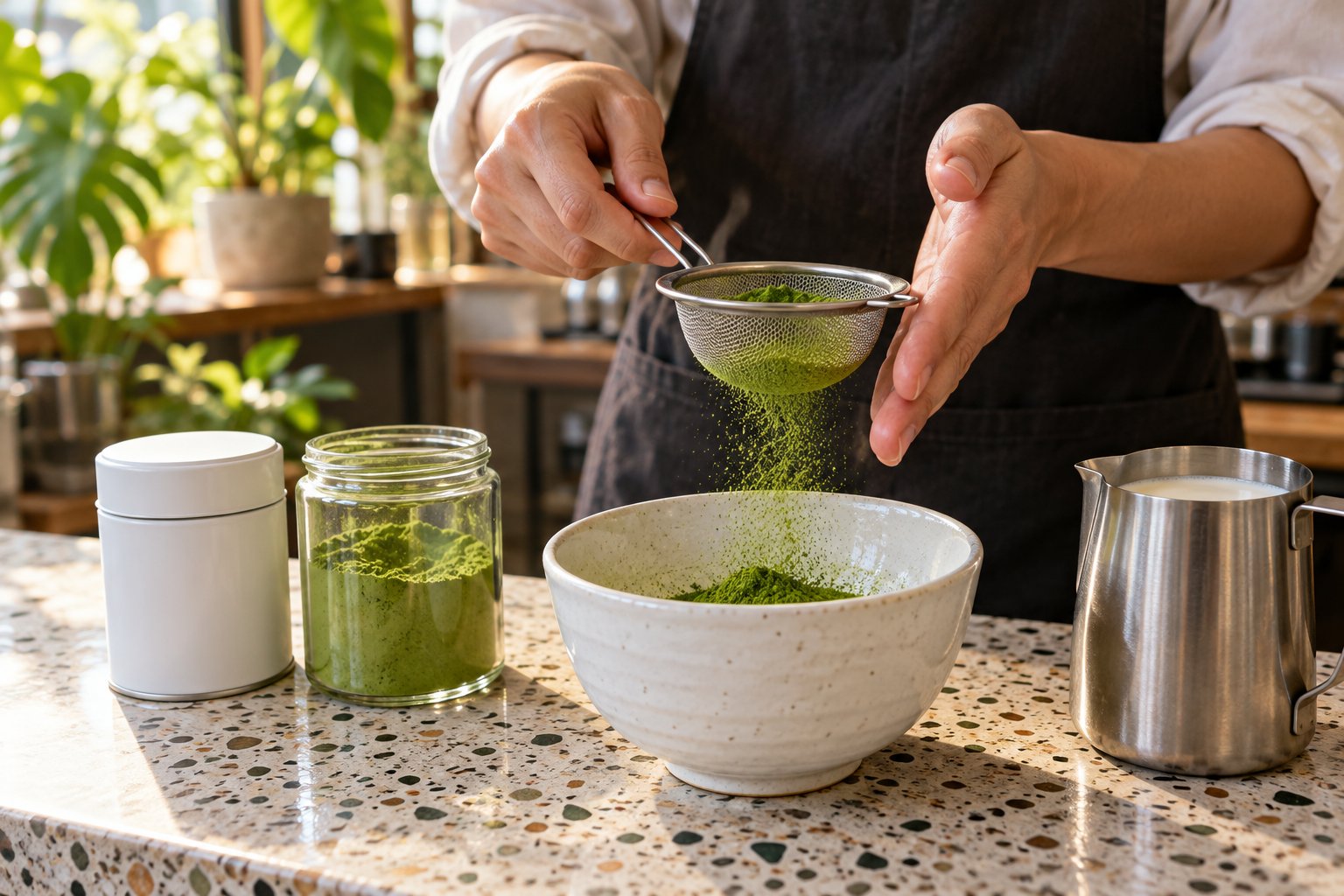
Toshiba’s recipe puts matcha in the dough and Meiji’s puts it in the shiratama. If you mix matcha into the filling instead of the dough, you get a white daifuku with a green filling, so you can change the look by choosing dough or filling (our suggestion). When mixing it into white bean paste, dissolving the matcha in a little hot water first makes it easier to blend in (our suggestion).
How to make it and how to mix in matcha
In the official recipes, matcha is mixed with the flour at the start for rice flour dough, and for warabi mochi it is dissolved in hot water and added after the dough is cooked. Both orders help prevent lumps.
Daifuku dough: mix the flour and matcha first
Toshiba’s recipe puts shiratamako, sugar and matcha in a heatproof bowl, mixes them lightly, then adds water little by little and mixes so no lumps form. It is heated in a microwave (500W) for about 1 minute 10 seconds and mixed well, then heated again for the same time and mixed until it turns translucent. The dough is turned out onto a tray dusted with potato starch, left to cool, divided into 5 and wrapped around the filling.
Shiratama: add liquid little by little
Meiji’s recipe adds three quarters of the milk to the shiratamako and matcha and leaves it for about 10 minutes, then adds the rest little by little until the dough is as soft as an earlobe. The recipe says shiratamako does not mix easily with milk and the dough changes with humidity, so the liquid should not go in all at once. The shaped shiratama are boiled for 1–2 minutes after they float, then put into cold water.
Warabi mochi: add matcha dissolved in hot water later
Mie Prefecture’s recipe mixes warabiko, sugar and water, strains it, and cooks it over high heat while stirring with a wooden spatula. Matcha dissolved in water at about 80°C is added once the dough has come together. The dough is piped into ice water from a piping bag and cut into bite-size pieces. How to dissolve matcha without lumps is also covered in Matcha Syrup.
Why it hardens, and the time from making to serving
Mochi gets harder as its temperature falls. In a conference presentation by an Aichi Prefecture research institute, gyuhi measured at refrigerator temperature (5°C) was harder than at 20°C for every variety tested. If you serve matcha mochi chilled, you need to set when to make it and when to serve it.
It hardens when cold
Japan’s Consumer Affairs Agency explains that mochi gets harder as its temperature falls. In an abstract presented at the 2024 annual meeting of the Japanese Society for Food Science and Technology, researchers at an Aichi Prefecture research institute (the Food Research Center of the Aichi Center for Industry and Science Technology) made gyuhi from the flour of eight glutinous rice varieties, stored it at 5°C, and measured hardness and other properties with the gyuhi at 5°C and at 20°C. Every variety was harder at 5°C than at 20°C, and 6 of the 8 varieties had lost elasticity after 7 days compared with after 1 day. This was a conference presentation, not a peer-reviewed paper.
It also depends on the rice variety
NARO (Japan’s national research organization for agriculture and food) has reported that the structure of amylopectin, a component of glutinous rice starch, is related to how easily mochi hardens. In the Aichi study above, the slow-hardening variety “Yawakoimochi” kept almost the same elasticity after 7 days as after 1 day. If the flour maker or the rice behind the flour changes, the same recipe can harden at a different speed.
How to decide in the shop
Check the texture of chilled dough before serving. Matching the amount you make to what you can sell that day means you never have to serve hardened dough (our suggestion). Daifuku filled with cream must be kept chilled; how to handle cream and chilling temperatures in several countries is covered in Matcha Tiramisu. Storage of matcha itself is in Matcha Shelf Life and Storage.
Serving mochi without choking
According to the Tokyo Fire Department, 338 people in its service area were taken to hospital by ambulance after choking on mochi and similar foods in the five years from 2020 to 2024, and about 90% or more of them were 65 or older. A shop that serves mochi can reduce the risk through bite size and how it serves the sweet.
Figures from the Tokyo Fire Department and the Consumer Affairs Agency
The Tokyo Fire Department’s service area is Tokyo excluding Inagi city and the islands, and the figures include dango and similar foods. The most cases were in January (135 people), followed by December (42 people), and about 70% of the people taken to hospital were diagnosed as moderate or worse, meaning they needed hospital admission or were in a more serious condition.
| Year | People taken to hospital |
|---|---|
| 2020 | 81 |
| 2021 | 57 |
| 2022 | 73 |
| 2023 | 64 |
| 2024 | 63 |
| Total | 338 |
Source: Tokyo Fire Department, “餅などによる窒息事故に注意!” (Beware of choking on mochi and similar foods, in Japanese) https://www.tfd.metro.tokyo.lg.jp/lfe/nichijo/mochi.html
Citing Japan’s vital statistics from the Ministry of Health, Labour and Welfare, the Consumer Affairs Agency notes that 4,696 people died in 2022 from food blocking the airway (“inhalation of food causing obstruction of the respiratory tract”), and that 4,297 of them were 65 or older. It also explains that at around the temperature inside the mouth (about 40°C), pieces of mochi tend to stick to each other and to the throat.
What the authorities recommend
The Tokyo Fire Department recommends cutting mochi into small pieces that are easy to eat, chewing slowly and well before swallowing, watching children and older people while they eat, moistening the throat with tea or soup before eating, and learning first aid for choking. The Consumer Affairs Agency also lists cutting mochi small, putting only as much in the mouth as can be eaten comfortably, moistening the throat with tea or soup, chewing slowly and well, and having people nearby keep an eye on older people. We did not find any warnings issued specifically about mochi by authorities in Singapore or Thailand.
What a shop can do
- Cut shiratama and warabi mochi to a size that can be eaten in one bite. Cut daifuku before serving, or make them smaller
- Serve with tea or another drink, so customers can moisten their throat first
- Write on the menu or a card that it should be cut small and chewed well
- Ask customers with children or older people whether they would like it cut
These points apply the advice of the Tokyo Fire Department and the Consumer Affairs Agency to how a shop serves mochi; they are not instructions the authorities issued for shops (our suggestion). In countries where many customers are eating mochi for the first time, a short note on how to eat it helps get the message across.
Allergens and labelling
Rice is not on the list of allergens that must be declared in Singapore, Thailand, the US or Japan. Declarations come from the ingredients used with it, such as bean paste, cream and kinako.
Watch the ingredients used with it
| Ingredient | Allergen |
|---|---|
| Kinako (roasted soybean flour) | Soybean |
| Cream, milk | Milk |
| Mochi ice cream dough (example from a US maker) | Egg white (egg) |
The Singapore Food Agency lists soybeans (in the same group as peanuts) among the ingredients that must be declared on prepacked food, and Thailand’s Notification No. 450 also covers soybean. Soybeans are among the nine major food allergens in the US. In Japan, soybean is one of 20 items for which labelling is recommended. My/Mo, a US mochi ice cream maker, uses sweet rice flour and egg whites in the dough of its matcha flavor and labels it “Contains: Milk, Egg.” Matcha ice cream recipes are compared in Matcha Ice Cream and Soft Serve.
Labels when you serve it in a shop
Labelling rules by country, and the conditions under which food made and served in the shop is exempt from labelling, are covered in Matcha Cookies. Even when no label is required, writing on the menu that an item contains soybean or milk lets customers check before they order (our suggestion). How to check ingredients when serving in a halal-certified shop is in Halal Matcha.
Grades that suit it, and the cost per piece
Matcha mochi is not baked for a long time, so it shows the color and aroma of matcha more easily than baked goods. The matcha cost per piece is calculated by adding the matcha in the dough and the matcha used for coating.
Grades that suit it
Matcha’s green fades easily with heat, and turns brownish in baked goods. Adding matcha after the dough is cooked, as in Mie Prefecture’s warabi mochi, or dusting it on at the end shortens the time the matcha is exposed to heat. Matcha dusted on top touches the mouth directly, so one option is to use different grades for the dough and for the coating (our view). What grade names mean and how they differ is explained in Matcha Grades, and how to choose matcha for each kind of sweet is in Matcha for Baking.
Matcha cost per piece
The matcha cost per piece is “buying price per kg ÷ 1,000 × (matcha in the dough per piece + matcha for coating per piece).” With Mie Prefecture’s recipe, the matcha in the dough is 0.5g per serving (our calculation). If you use a recipe written in teaspoons, weigh a teaspoon of your matcha in the shop and convert it to grams before using the formula.
Divide the cost of flour, sugar, bean paste, kinako and containers per piece and add them too, and include in the cost anything you threw away because it did not sell that day. How matcha prices are set is explained in Matcha Price.
Sources
- MAFF, “米粉の種類と特性” (Types and characteristics of rice flour, in Japanese) https://www.maff.go.jp/j/syouan/keikaku/soukatu/okome_summary/08/rice_flour_charac_teristic_01.html
- MAFF, “米粉の種類と特性(米粉の用途)” (Types and characteristics of rice flour: uses, in Japanese) https://www.maff.go.jp/j/syouan/keikaku/soukatu/okome_summary/08/rice_flour_charac_teristic_04.html
- MAFF Tokai Regional Agricultural Administration Office, “米粉の種類と用途” (Types and uses of rice flour, in Japanese) https://www.maff.go.jp/tokai/seisan/shinko/komeko/type.html
- MAFF, “にっぽん伝統食図鑑 わらびもち” (Nippon Traditional Foods Encyclopedia: Warabi mochi, in Japanese) https://www.maff.go.jp/j/keikaku/syokubunka/traditional-foods/menu/warabimoti.html
- Mie Prefecture, “伊勢茶わらび餅” (Ise tea warabi mochi, in Japanese) https://www.pref.mie.lg.jp/NOAN/HP/m0110400060_00043.htm
- Saitama Prefecture, “狭山茶を使った抹茶の白玉あんみつ” (Matcha shiratama anmitsu with Sayama tea, in Japanese) https://www.pref.saitama.lg.jp/a0902/wassyoi/recipe/47.html
- Toshiba Lifestyle, “抹茶クリーム大福” (Matcha cream daifuku, in Japanese) https://www.toshiba-lifestyle.com/jp/microwaves/recipes/detail/609/
- Meiji, “抹茶白玉アイス” (Matcha shiratama with ice cream, in Japanese) https://www.meiji.co.jp/meiji-shokuiku/shokuikurecipe/recipe/0007.html
- Consumer Affairs Agency, “コラムVol.5 冬に増加する高齢者の事故に注意! 餅による窒息” (Column Vol.5: Choking on mochi, in Japanese) https://www.caa.go.jp/policies/policy/consumer_safety/child/project_001/mail/20231227/
- Tokyo Fire Department, “餅などによる窒息事故に注意!” (Beware of choking on mochi and similar foods, in Japanese) https://www.tfd.metro.tokyo.lg.jp/lfe/nichijo/mochi.html
- NARO, “もちの硬化性とアミロペクチン構造の関連” (Mochi hardening and amylopectin structure, in Japanese) https://www.naro.go.jp/PUBLICITY_REPORT/publication/archive/files/H13digest-33.pdf
- Hasegawa S. et al., “短鎖アミロペクチン米を利用した求肥の低温における物性の特性評価” (Physical properties at low temperature of gyuhi made with short-chain amylopectin rice), abstracts of the 71st annual meeting of the Japanese Society for Food Science and Technology (2024, in Japanese) https://www.jstage.jst.go.jp/article/aamjsfst/71/0/71_97/_article/-char/ja
- My/Mo, “Matcha Green Tea” https://www.mymochi.com/mochi-flavors/green-tea/
- Singapore Food Agency, “Food Allergy & Intolerance” https://www.sfa.gov.sg/food-safety-tips/food-risk-concerns/food-allergy-intolerance
- Thai FDA, Ministry of Public Health Notification No. 450 (unofficial English translation) https://food.fda.moph.go.th/media.php?id=657392349080592384&name=P450_EN.pdf
- U.S. Food and Drug Administration, “Food Allergies” https://www.fda.gov/food/nutrition-food-labeling-and-critical-foods/food-allergies
- Consumer Affairs Agency, “食物アレルギー表示に関する情報” handbook (Food allergy labelling handbook, April 2026, in Japanese) https://www.caa.go.jp/policies/policy/food_labeling/food_sanitation/allergy/assets/food_labeling_cms204_260401_02.pdf