
 Reviewed by: Takahiro Sugiyama (CEO, meguri Inc.)
Matcha brownies are an easy item for a café that already serves matcha lattes to add to its pastry case. You bake one slab in a pan and cut it, so you get many pieces for the prep time. On the other hand, overbaking turns the green brownish, and matcha as a share of flour differs more than tenfold between recipes. We compare official recipes from tea companies, a baking supplier and a flour miller to look at the matcha amount, baking to keep the green, recipes for a moist texture, cutting and storage in hot climates, and matcha per piece.
Three types of matcha brownies
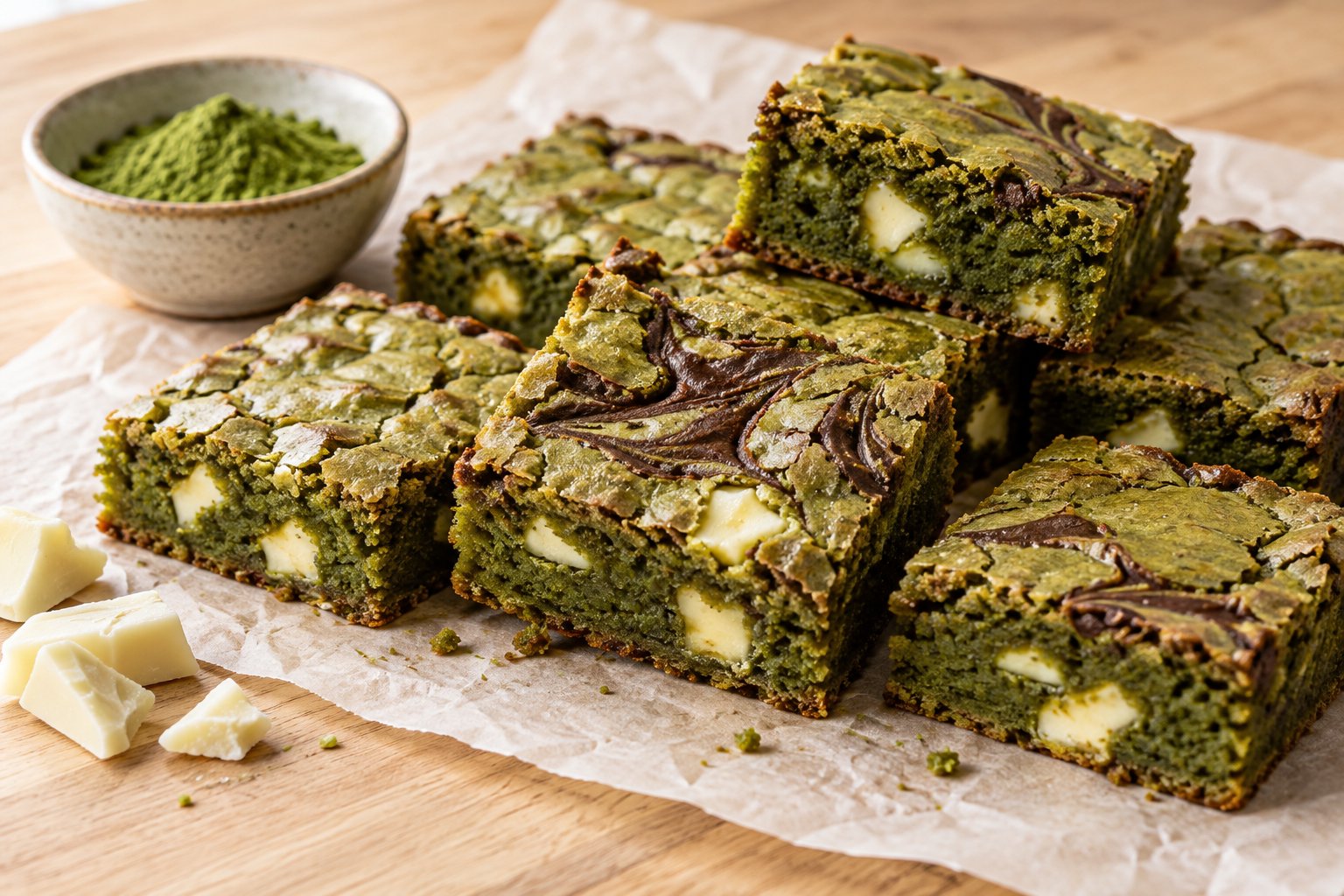
Matcha brownies baked in a shop fall into three types: matcha mixed into a white chocolate batter, a marble of cocoa or dark chocolate batter with matcha batter, and blondies. The type changes how the green shows and how much matcha you use.
Matcha in a white chocolate batter
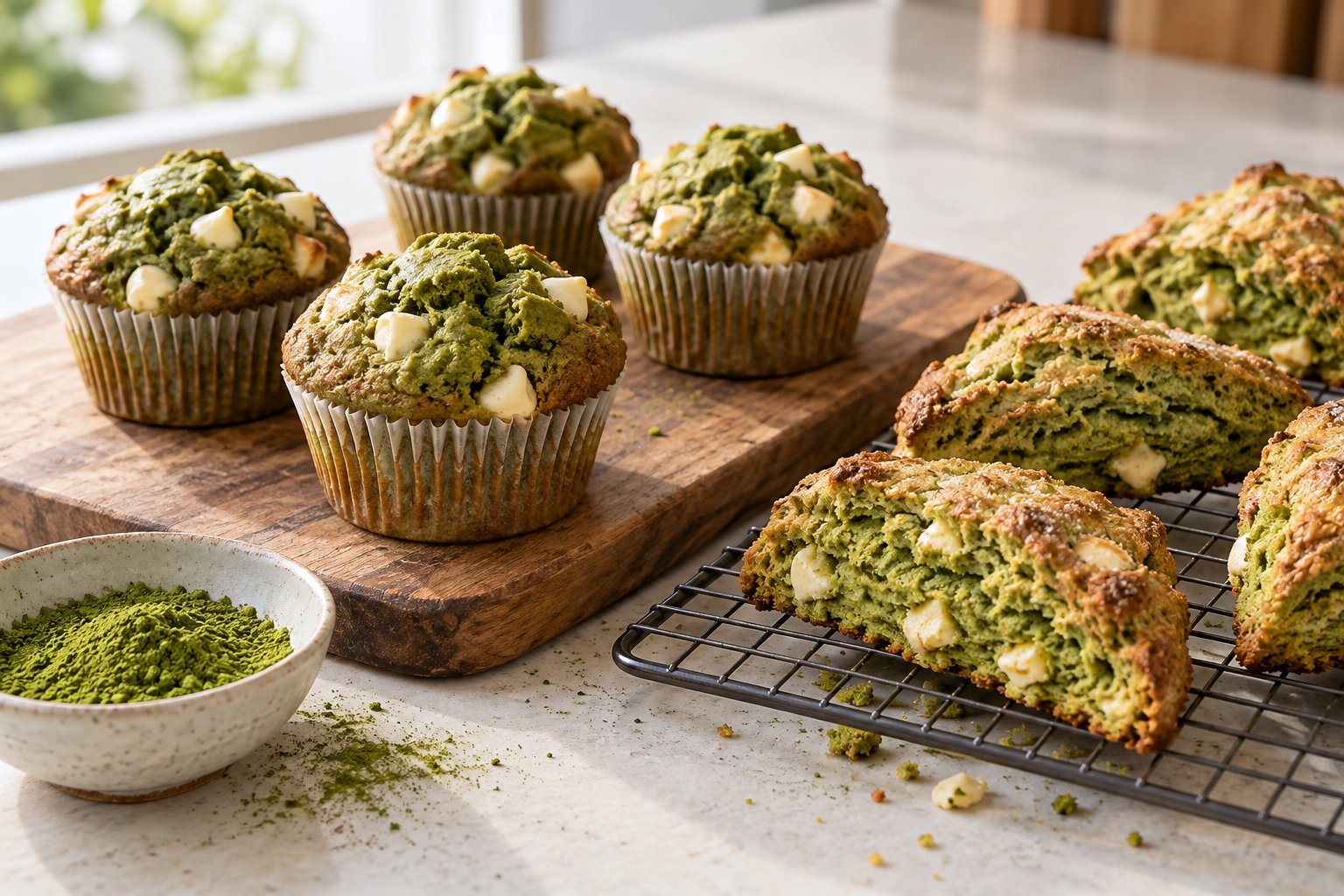
The Japanese official recipes we compared all skip cocoa. They melt white chocolate with butter (or oil), then mix in egg, sugar, flour and matcha before baking. These are the recipes from Tomizawa Shoten (a Japanese baking ingredient supplier), Chiran Ichibanyama Farm (a tea shop in Kagoshima) and Seven Premium (a Japanese retailer). The whole batter turns green, so the matcha color shows across the cut face.
How to handle white chocolate and the temperatures for melting it are covered in Matcha chocolate for cafés.
Marble with dark chocolate or cocoa
Some recipes from US matcha sellers layer matcha batter with a brown brownie batter. Mizuba Tea spreads two thirds of a cocoa batter in the pan, pours in a matcha cream cheese, drops the rest of the batter on top, and swirls with a toothpick or knife. AIYA America bakes a matcha cheesecake layer on top of a cocoa batter. Matcha.com puts black sesame paste on a white chocolate matcha batter and swirls it into lines with a toothpick.
Brown and green side by side make the cut face eye-catching. Brownies with a cream cheese layer are handled in the refrigerator, like cheesecake (Matcha cheesecake).
Blondies
Blondies are bars made without cocoa and flavored with brown sugar (sugar that is not fully refined). The US flour miller King Arthur Baking says brown sugar gives them a caramel-like flavor. A white chocolate matcha brownie is close to a blondie in that it uses no cocoa. Brown sugar is dark, so if you want to show the green, decide the share of white sugar by test baking (our suggestion).
Comparing matcha amounts in official recipes
In four official recipes that give matcha in grams, matcha was 4–50% of the flour and 5–25% of the white chocolate. We calculated the shares by dividing the weight of matcha by the weight of flour and of white chocolate. Only Tomizawa Shoten’s “Moist and dense” recipe, which keeps the cake flour at 40g, reaches 50% of the flour. The other three were 4–29%.
Share of flour and of white chocolate
| Source | Pan | Matcha | Flour | White chocolate | Matcha / flour | Matcha / white chocolate | Baking |
|---|---|---|---|---|---|---|---|
| Tomizawa Shoten, “Moist and dense matcha brownies” | 15cm square | 20g | Cake flour 40g | 150g | 50% | about 13% | 170°C, 30–35 min |
| Chiran Ichibanyama Farm (tea shop in Kagoshima) | Not stated | 20g | Cake flour 70g | 80g | about 29% | 25% | 160°C, about 20 min |
| Tomizawa Shoten, “Rice flour matcha brownies” | 18×9cm loaf pan | 8g | Rice flour 40g | 80g | 20% | 10% | 180°C, about 20 min |
| Tomizawa Shoten, “Matcha brownies with pancake mix” | 15cm square | 3g | Pancake mix 75g | 60g (plus 20g on top) | 4% | 5% | 160°C, 30–35 min |
| Seven Premium | Not stated | 2 tbsp | Cake flour 80g | 80g | By volume | By volume | 170°C, 12–15 min |
| Matcha.com (US matcha seller) | Not stated | 2 tbsp | 1 cup all-purpose flour | 4 oz | By volume | By volume | 350°F (about 177°C), about 30 min |
Chiran Ichibanyama Farm’s recipe lists matcha 20g, 2 eggs, white chocolate 80g, unsalted butter 40g, cream 50cc, cake flour 70g, baking powder 2g and granulated sugar 40g, with nuts and white chocolate on top as you like.
Source: Chiran Ichibanyama Farm, “濃い抹茶のブラウニー【かんたんレシピ】” (in Japanese) https://blog.chirancha.net/610/
Where the difference comes from
Tomizawa Shoten’s “Moist and dense” recipe uses only 40g cake flour and builds the batter with 150g white chocolate and 60g cream. Matcha is 50% of the flour, but about 13% of the white chocolate. The pancake mix recipe uses 3g matcha for a pale green. Do not compare by the share of flour alone. Look at the share of white chocolate as well.
The upper end of the flour share was higher than for matcha cookies (about 2.7–12.5% of flour). The cookie comparison is in Matcha cookies for cafés, and cakes and other baked goods are in Matcha for Baking.
Adding the matcha
Tomizawa Shoten’s “Moist and dense” and rice flour recipes, Chiran Ichibanyama Farm and Seven Premium combine matcha with the flour and sift them together. Tomizawa Shoten’s pancake mix recipe says that mixing the matcha into the pancake mix first saves sifting and avoids lumps. Matcha.com whisks the matcha straight into the melted butter and white chocolate, then adds it to the egg mixture. A tablespoon of matcha weighs differently depending on how fine the powder is, so record matcha in grams in your shop recipe.
Oven temperature and time to keep the green
The official recipes we compared bake at 160–180°C. Baking at a lower temperature and taking the pan out while the center is still moist helps keep the green (our view). How heat changes matcha’s green is explained with research in Matcha for Baking.
Temperatures and times in official recipes
| Temperature | Recipes | Time |
|---|---|---|
| 160°C | Chiran Ichibanyama Farm, Tomizawa Shoten (pancake mix) | about 20 min, 30–35 min |
| 170°C | Tomizawa Shoten (moist and dense), Seven Premium | 30–35 min, 12–15 min |
| about 177°C (350°F) | Matcha.com, Mizuba Tea, AIYA America | 30–35 min |
| 180°C | Tomizawa Shoten (rice flour) | about 20 min |
Seven Premium’s 12–15 minutes and Tomizawa Shoten’s 30–35 minutes are both at 170°C. Baking time depends not only on temperature but on pan size and batter depth. In “Our Ultimate Chewy Brownies” (325°F for 30 to 40 minutes), King Arthur Baking says the time can extend to as much as 55 minutes depending on the type of metal pan.
Telling when they are done
The Japanese recipes treat brownies as done when a skewer comes out without raw batter. King Arthur Baking publishes a recipe that treats them as done when a toothpick comes out with some moist crumbs, or when a thermometer reads 220°F (about 104°C) in the center. Rather than relying on a skewer alone, measure the center temperature once and make it your shop’s standard, so color and texture stay the same from batch to batch (our suggestion).
What you can do in your shop
The following are our suggestions based on the sources above.
- Start at 160–170°C and check the color and a skewer at the shorter time given in the recipe
- If the top starts to brown, cover with foil to finish baking
- Photograph the cut face under the same light right after baking, the next day, and on day 3
In a matcha cookie recipe, King Arthur Baking says ceremonial grade (sold for drinking) gives a more vibrant green than culinary grade (sold for baking). There is no official standard for these grade names, so check what you are comparing in Matcha grades.
Recipes for a moist, fudgy texture
Fudgy brownies (dense and moist) use less flour and egg, and are made with melted butter or oil. King Arthur Baking explains the texture differences from the formulas in an article comparing its own brownie recipes.
Ratio of flour and egg
King Arthur Baking says fudgy brownies tend to use oil or melted butter, have a lower ratio of eggs and flour, and add no extra liquid or leavening. Cakey brownies have more egg and flour, and add liquid such as water or coffee, or leavening. It also says the more flour, the cakier the brownie, and less flour gives a fudgier, more compact crumb. It adds that fudgy brownies use cocoa powder instead of melted chocolate, so the explanation assumes cocoa brownies.
In King Arthur Baking’s table, with flour as 100%, Fudge Brownies have 126% butter/oil, 248% sugar, 111% eggs and no liquid, while Cakey Brownies have 139% eggs and 63% liquid.
Source: King Arthur Baking, “Types of brownies: fudgy, chewy, and cakey explained” https://www.kingarthurbaking.com/blog/2025/05/21/best-brownie-recipe
Applied to the official matcha brownie recipes, Tomizawa Shoten’s “Moist and dense” uses 40g cake flour for 150g white chocolate and no leavening. Chiran Ichibanyama Farm and Tomizawa Shoten’s rice flour recipe use baking powder. For fudgy brownies, start test baking from a recipe with little flour and no leavening (our view).
Mixing without adding air
King Arthur Baking says that melting the butter and sugar together instead of creaming them adds no air to the batter and gives a dense, fudgy center. The matcha brownie recipes we compared also mix ingredients one by one into melted white chocolate and butter. Whipping air into the eggs or butter moves the texture toward a lighter, cake-like crumb (our view).
Chilling and resting
Chiran Ichibanyama Farm says resting the brownies in the refrigerator for about an hour makes them moister. Tomizawa Shoten’s pancake mix recipe says they are crisp outside and soft inside fresh from the oven, and become moist with the flavors settling from the next day. Some recipes say brownies become moister the next day, so taste them both on the baking day and the day after.
How to cut
Cool brownies completely, then chill them in the refrigerator before cutting for clean, even edges. Decide how many pieces to cut from one pan before baking.
Cool, chill, then cut
| Source | Steps before cutting |
|---|---|
| Tomizawa Shoten (moist and dense) | Cool in the pan, wrap, chill in the refrigerator, and cut into 9 once fully cold |
| Seven Premium | Cool in the pan and cut by pressing the knife straight down. Chilling in the refrigerator makes them even easier to cut |
| King Arthur Baking | After cooling to room temperature, chill for 1 to 2 hours in the refrigerator for easiest slicing |
Seven Premium says freshly baked brownies crumble easily. King Arthur Baking says that probing the center with a toothpick or knife tip to check doneness leaves a small divot, and you can simply cut around it.
How many pieces per pan
Tomizawa Shoten’s 15cm square pan is cut into 9, so each piece is about 5cm square. King Arthur Baking’s “Big Batch Brownies” are baked in a half-sheet pan of about 13 × 18 inches (about 33 × 46cm) outside, giving 48 brownies of 2 inches (about 5cm) square. A larger pan makes a thinner layer with the same recipe and changes the baking time, so measure the time and center temperature again when you change pans.
Shelf life and storage in hot climates
For brownie shelf life, a US flour miller gives 5 to 6 days at room temperature for home bakers, and a Belgian chocolate maker gives 3 days refrigerated at 4°C for professionals. On a shop counter in a hot climate, plan on refrigeration.
Storage guidance from the makers
| Source | Item | Storage |
|---|---|---|
| King Arthur Baking | Fudge Brownies, Big Batch Brownies (home) | Well wrapped, 5 to 6 days at room temperature. Freeze for longer |
| King Arthur Baking | Blondies (home) | Well wrapped, up to a week at room temperature |
| Callebaut | Classic Chocolate Brownies (professional, 20 pieces) | 3 days refrigerated at 4°C |
| Tomizawa Shoten | Moist and dense matcha brownies | Once cooled, wrap and chill in the refrigerator. Indoors is fine in the cold season |
| Tomizawa Shoten | Matcha brownies with pancake mix | Keep out of light for storage over several days. For home use, wrap in foil at room temperature |
King Arthur Baking’s days are for cocoa brownies kept in a US home. None of the official matcha brownie recipes we compared gave a number of days.
On the counter in a hot climate
Singapore’s monthly mean temperature is 26.8–28.6°C (Meteorological Service Singapore, 1991–2020 normals). Tomizawa Shoten’s “Moist and dense” recipe allows indoor storage only in the cold season, and its pancake mix recipe recommends room temperature only for home use. Some recipes also use cream or cream cheese. In a hot climate, keep brownies in an air-conditioned spot or a refrigerated case, and set the date only after storing your own recipe and checking taste, texture and color (our suggestion).
Tomizawa Shoten writes that matcha fades and loses flavor in light, so brownies kept for several days should be stored away from light. Keeping them out from under display case lights for long also helps keep the green. The melting temperature of chocolate and bloom (a white film on the surface) are covered in Matcha chocolate for cafés, and storing the matcha powder itself in hot climates in Matcha shelf life.
Selling individually wrapped pieces
If you sell pieces in bags or supply other shops, follow the labelling and allergen rules of the country where you sell. Matcha brownies contain wheat (except the rice flour recipe), milk and egg, plus tree nuts if you use walnuts or almonds. Labelling rules in Singapore, Thailand and Indonesia are covered in Matcha cookies for cafés.
Matcha per piece and its cost
The matcha cost per piece is “buying price per kg ÷ 1,000 × grams of matcha per piece”. Grams per piece is the matcha in one pan divided by the number of pieces.
Matcha in one piece
| Recipe | Matcha per pan | Pieces | Matcha per piece |
|---|---|---|---|
| Tomizawa Shoten (moist and dense, 15cm square) | 20g | 9 (stated in the recipe) | about 2.2g |
| Tomizawa Shoten (rice flour, 18×9cm loaf pan) | 8g | 6 (our assumption) | about 1.3g |
| Tomizawa Shoten (pancake mix, 15cm square) | 3g | 9 (our assumption) | about 0.33g |
The per-piece figures are our calculations. Cutting the same 15cm square pan into 9 (assumed for the pancake mix recipe), matcha per piece ranges from about 0.33g to about 2.2g, about 7 times apart, depending on the recipe. Matcha per latte is compared in How to Make a Hot Matcha Latte.
What goes into the cost
Besides matcha, include white chocolate, butter, egg, flour and nuts, the bag and label, and trimmed edges and unsold pieces in the cost per piece. If you dust matcha on top, weigh that too and add it. How the price per kg of matcha is set is covered in How matcha prices are set.
Choosing matcha for brownies
Decide by test baking in your own recipe whether to use the same matcha as your lattes or a separate one for baking.
What to check
- Whether the ingredient is 100% matcha. A latte mix with sugar or milk powder will not give enough matcha at the recipe amount
- Whether you can keep buying the same specification. A different lot may change the green after baking
- If your recipe uses around 2g of matcha per piece, use the formula above to work out the per-piece difference when you move to a higher grade
Test baking steps
- Bake each candidate matcha in your shop’s recipe with the same amount of matcha
- Photograph the cut face under the same light right after baking, the next day, and on day 3
- Taste for the balance of bitterness and white chocolate sweetness, and decide together with the matcha cost per piece and your selling price
Omakase Matcha supplies matcha from Uji, Yame, Shizuoka, Kagoshima and Miyazaki, with orders from 1kg and up to 3 samples. Request matcha for test baking from Samples, and see how regions differ in Origins.
Sources
- Tomizawa Shoten, “しっとりみっちり抹茶のブラウニー” (in Japanese) https://tomiz.com/recipe/pro/detail/20250813103820
- Tomizawa Shoten, “米粉の抹茶ブラウニー” (in Japanese) https://tomiz.com/recipe/pro/detail/20190522172917
- Tomizawa Shoten, “ホットケーキミックスで作る♪抹茶ブラウニー” (in Japanese) https://tomiz.com/recipe/pro/detail/20220511021835
- Chiran Ichibanyama Farm, “濃い抹茶のブラウニー【かんたんレシピ】” (in Japanese) https://blog.chirancha.net/610/
- Seven Premium, “ほろ苦くまろやかな甘さ。抹茶ブラウニーのレシピ” (in Japanese) https://7premium.jp/recipe/search/detail?id=9413
- Matcha.com, “Black Sesame Matcha Brownies” https://matcha.com/blogs/recipes/black-sesame-matcha-brownies
- Mizuba Tea, “Matcha Swirl Brownies” https://mizubatea.com/blogs/recipes/matcha-swirl-brownies
- AIYA America, “Matcha Cheesecake Brownies” https://aiya-america.com/matcha-cheesecake-brownies/
- King Arthur Baking, “Types of brownies: fudgy, chewy, and cakey explained” https://www.kingarthurbaking.com/blog/2025/05/21/best-brownie-recipe
- King Arthur Baking, “Our trick for truly chewy, crackly brownies” https://www.kingarthurbaking.com/blog/2022/07/04/our-trick-for-truly-chewy-crackly-brownies
- King Arthur Baking, “Our Ultimate Chewy Brownies” https://www.kingarthurbaking.com/recipes/our-ultimate-chewy-brownies-recipe
- King Arthur Baking, “Fudge Brownies” https://www.kingarthurbaking.com/recipes/fudge-brownies-recipe
- King Arthur Baking, “Big Batch Brownies” https://www.kingarthurbaking.com/recipes/big-batch-brownies-recipe
- King Arthur Baking, “Blondies” https://www.kingarthurbaking.com/recipes/blondies-recipe
- King Arthur Baking, “Glazed Matcha Cookies” https://www.kingarthurbaking.com/recipes/glazed-matcha-cookies-recipe
- Callebaut, “Classic Chocolate Brownies” https://www.callebaut.com/en-AE/recipes/classic-chocolate-brownies/3552
- Meteorological Service Singapore, “Climate of Singapore” https://www.weather.gov.sg/climate-climate-of-singapore/