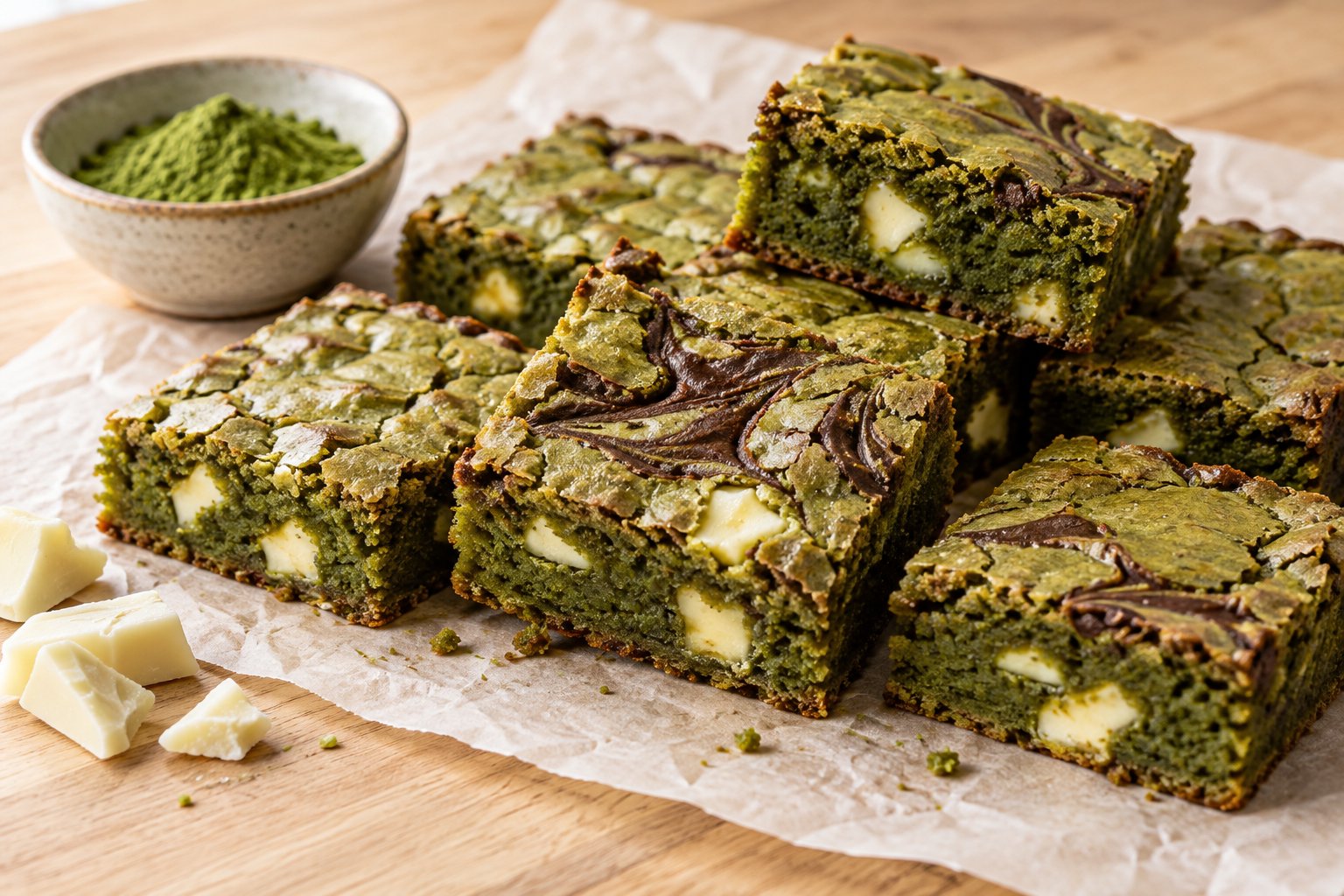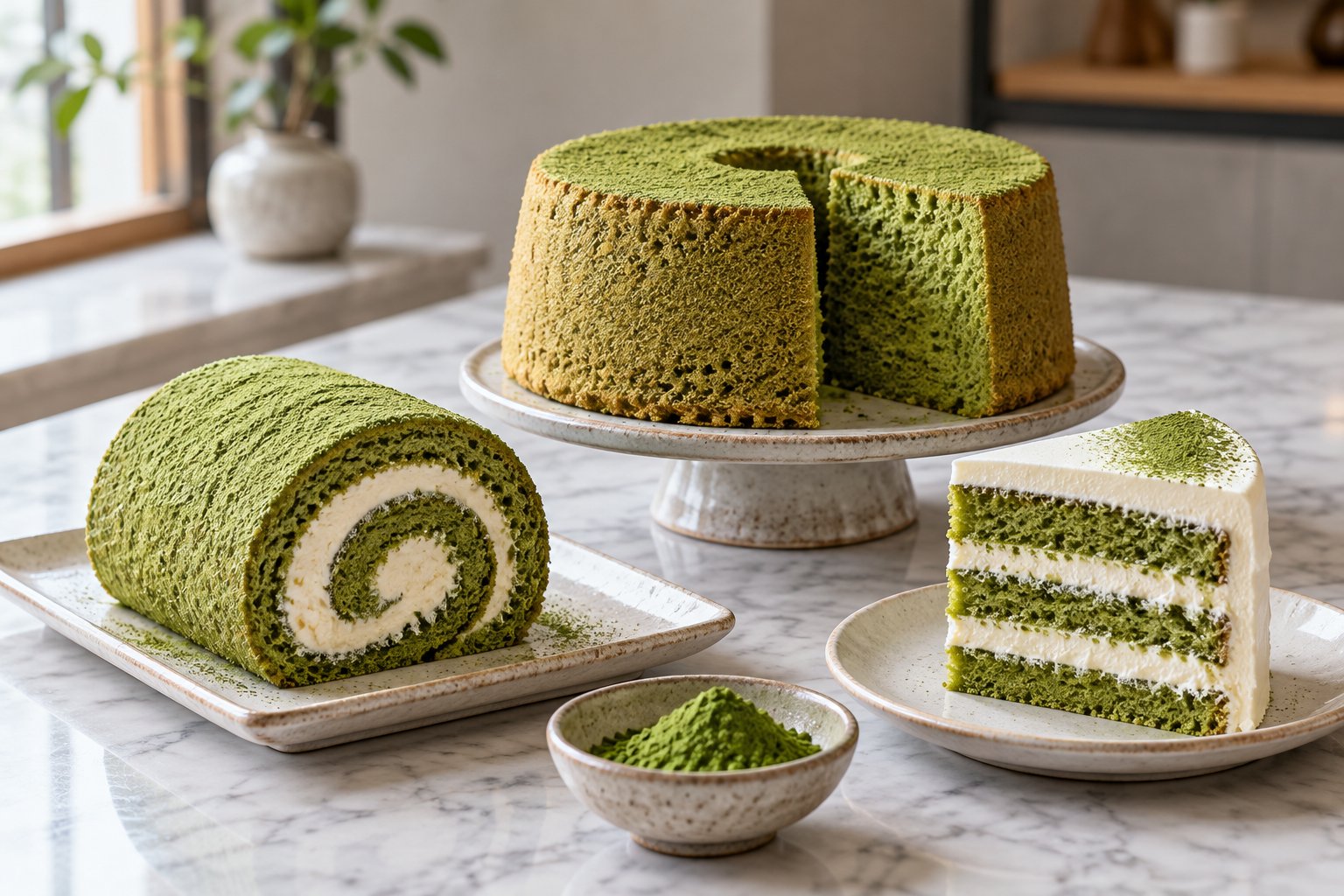

 Reviewed by: Takahiro Sugiyama (CEO, meguri Inc.)
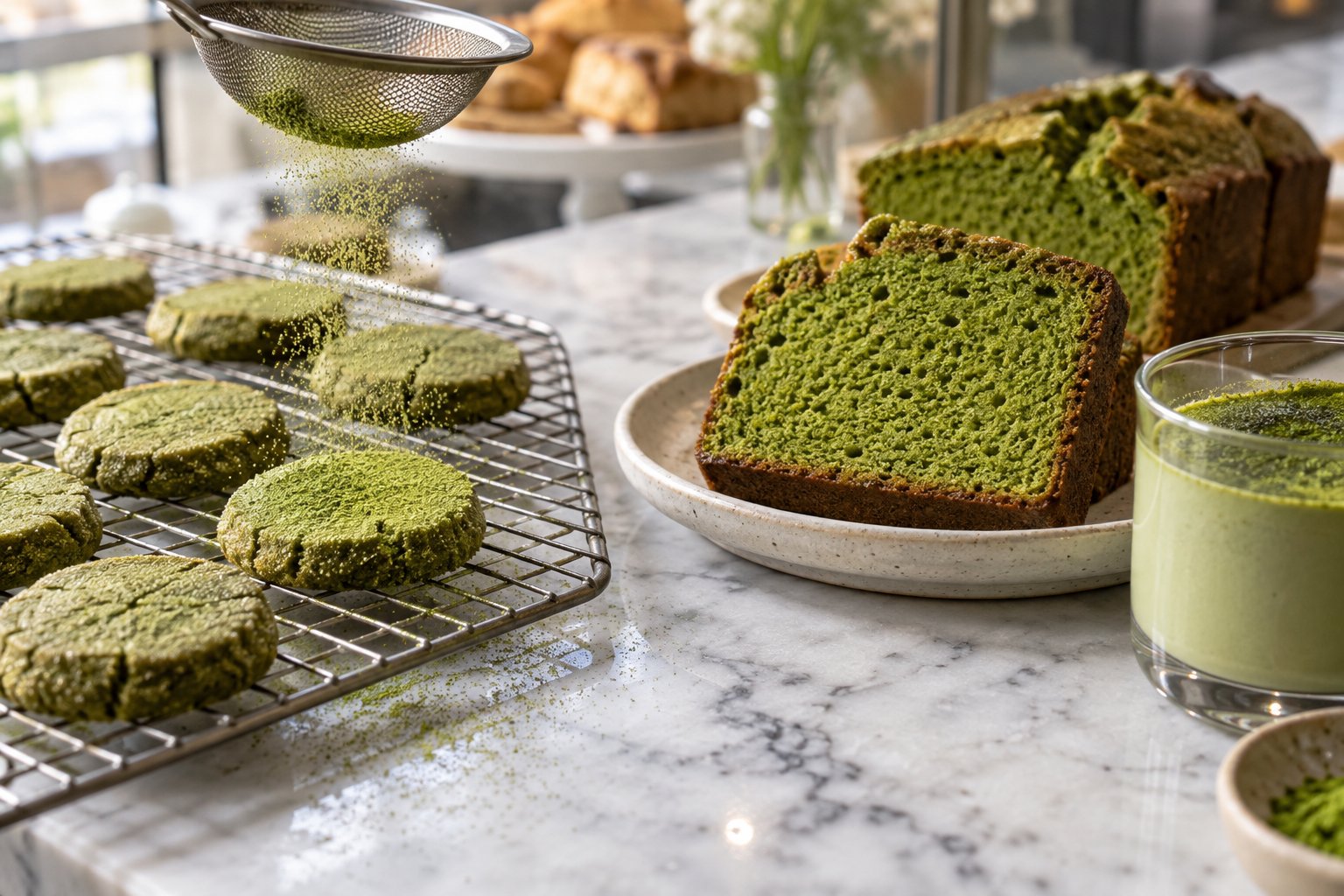
Some cafés want to use the matcha they already use for lattes in baked goods and desserts too. But matcha’s green fades easily in the oven, and the same matcha can give very different color and bitterness depending on the amount and the method. Here we compare, as percentages, the recipes published by tea companies and government bodies, check why the color changes using research papers, and then go through grades for sweets, mixing, the cost per cake, and what to check when buying.
Matcha for baking: the basics
Matcha goes into the batter or cream as a whole powder, so its color and taste show directly in the finished dessert. That is why the amount and the grade you choose change the result.
Matcha, and the names of grades
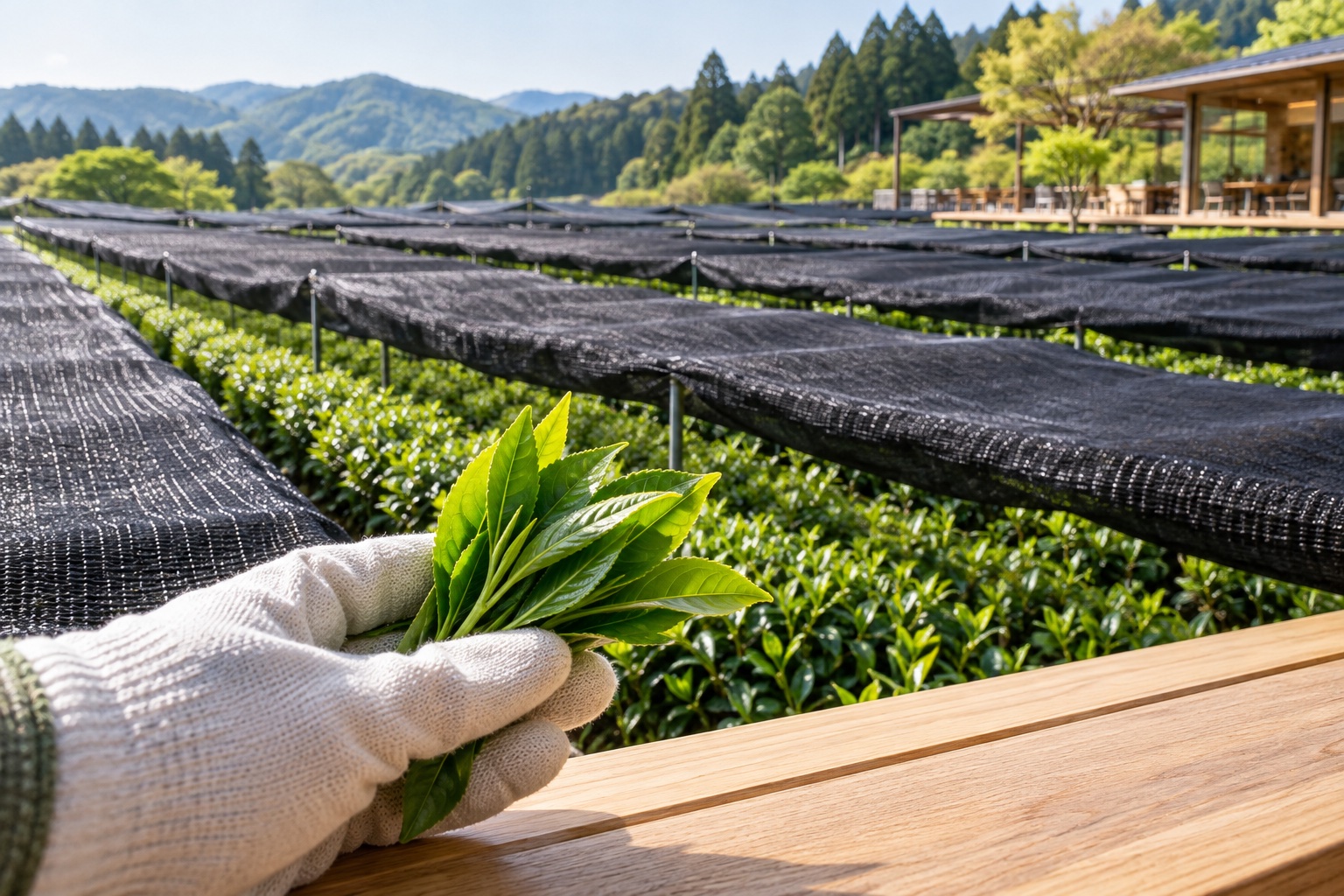
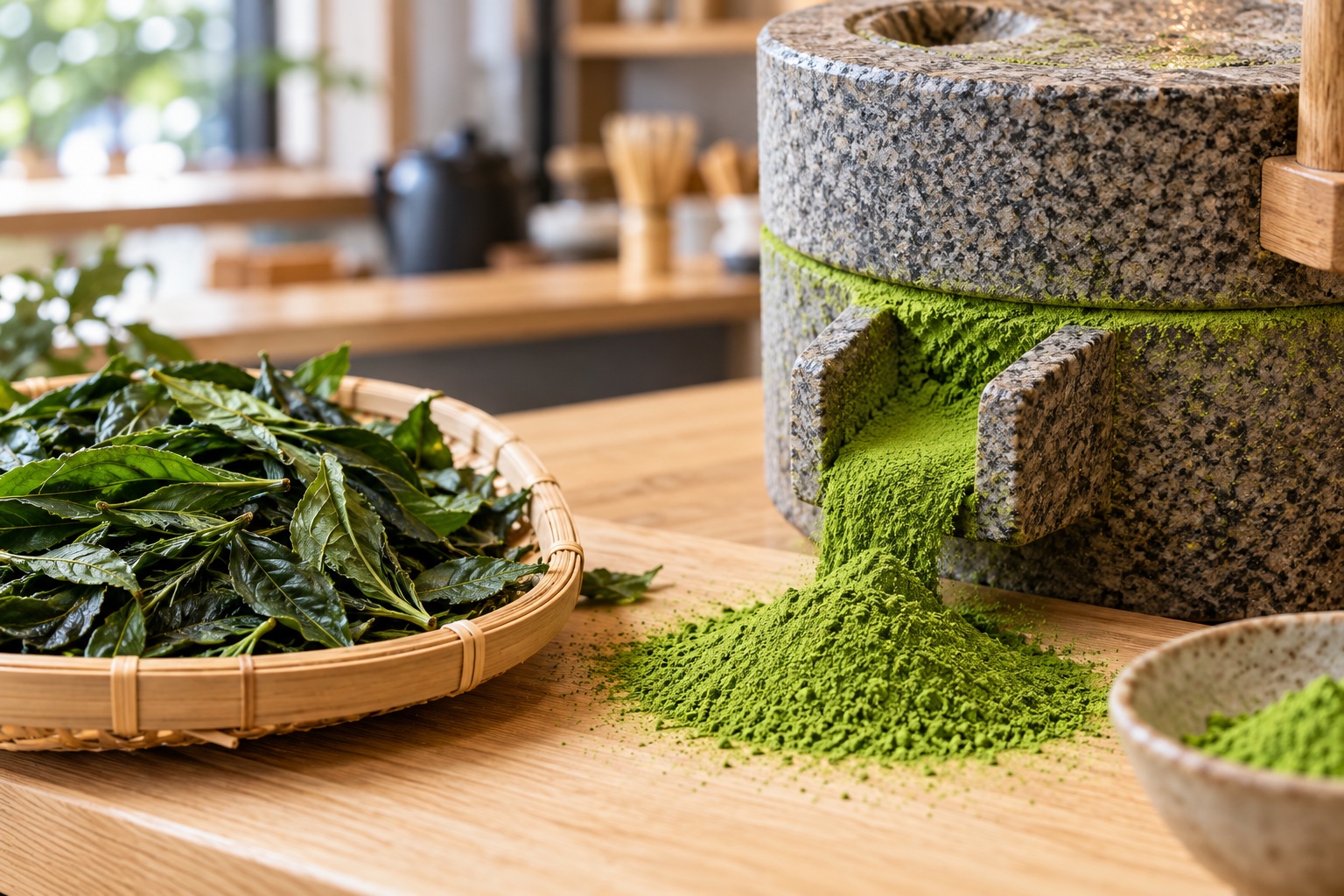
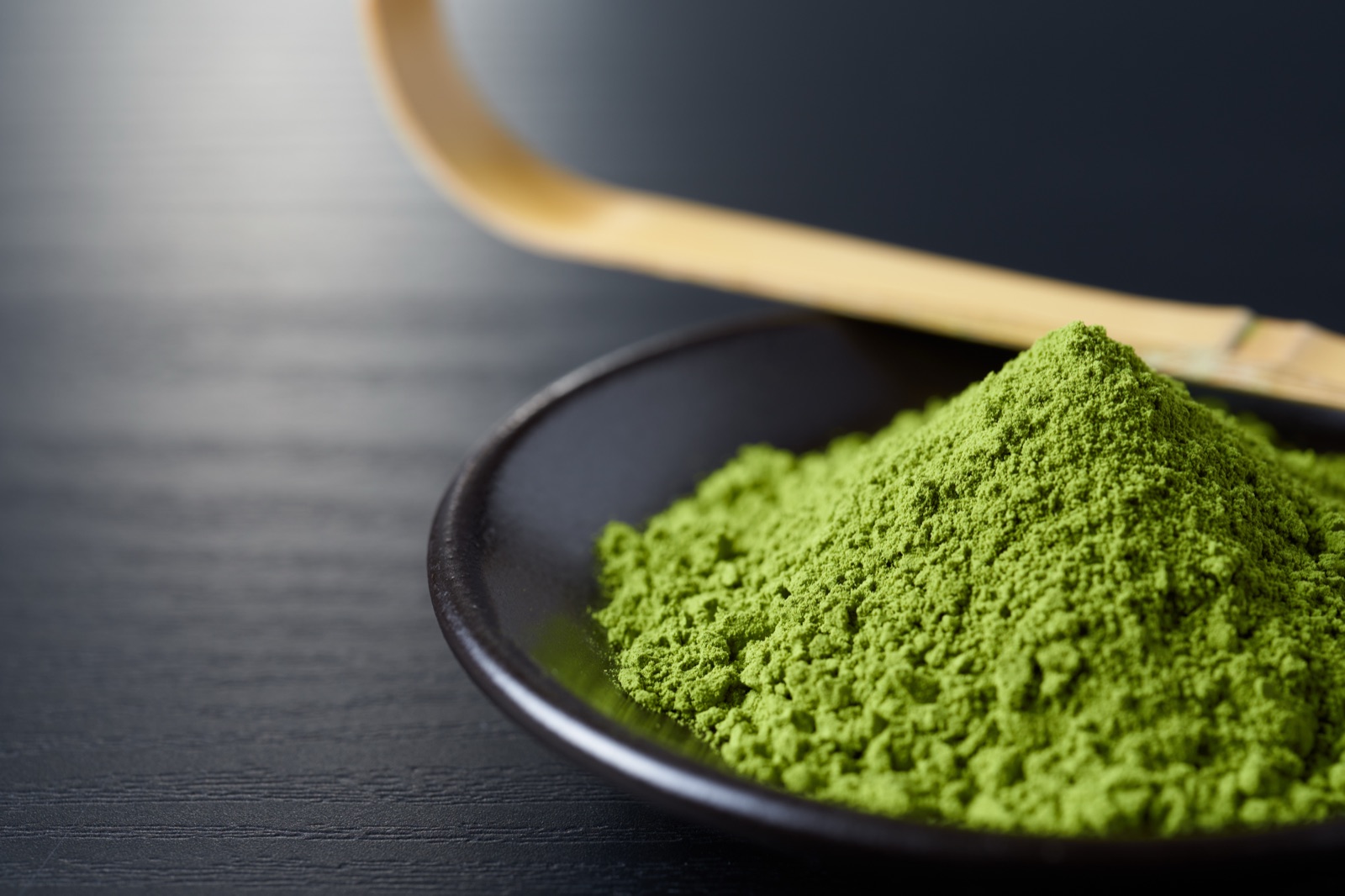
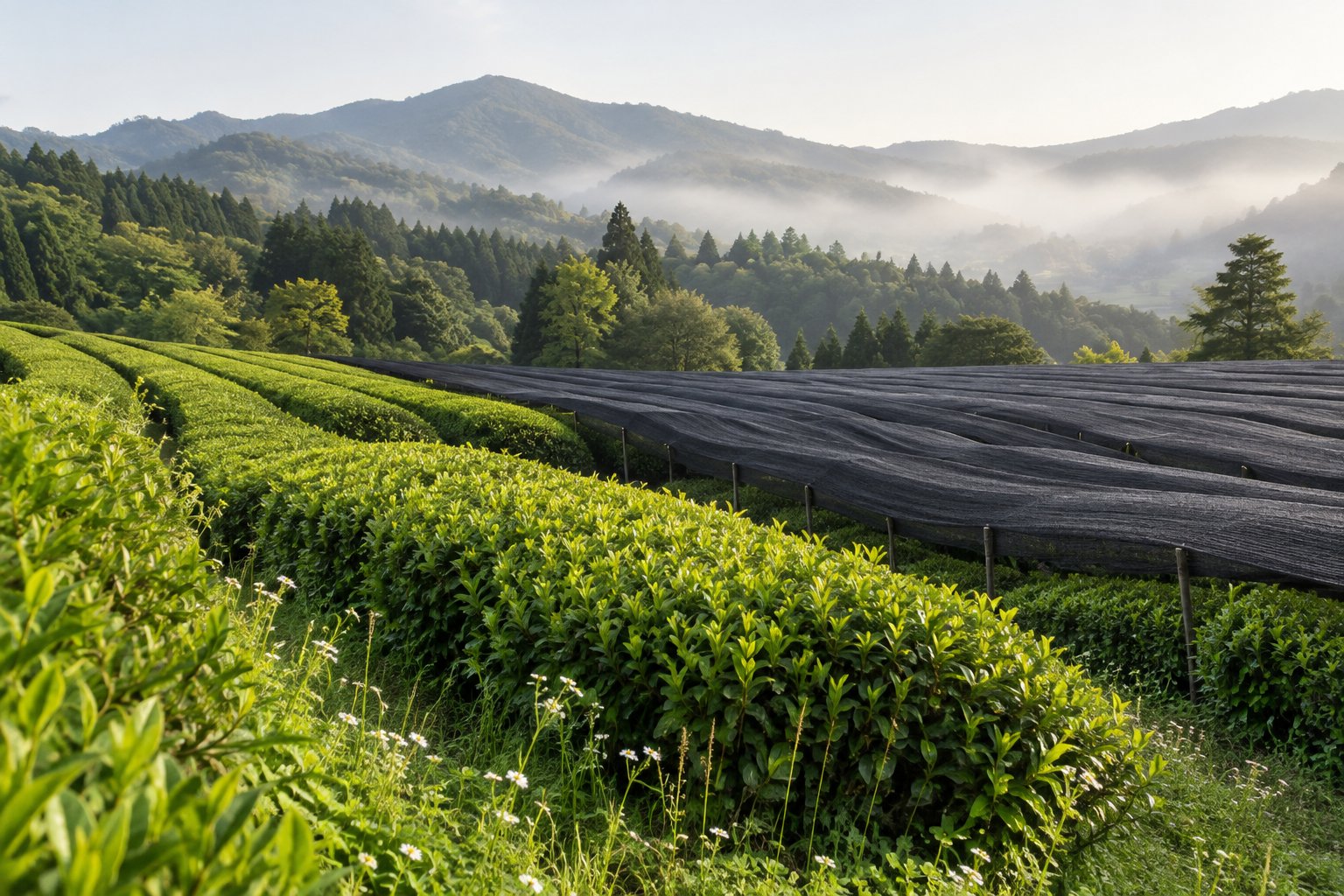
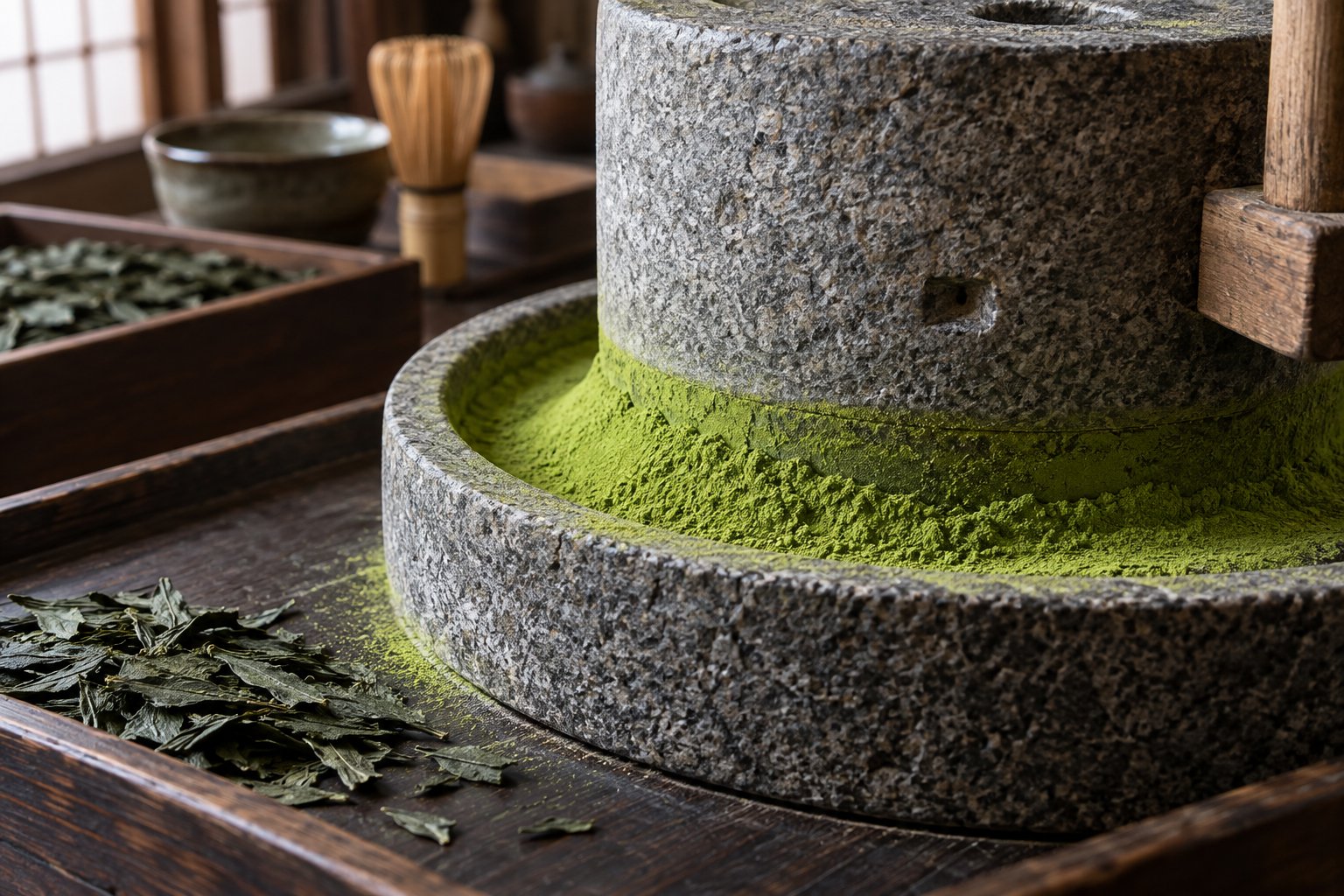
Matcha is tencha (tea leaves grown under cover before picking, then steamed and dried without rolling) ground into a fine powder. Because you consume the ground leaf, putting it into a dessert means eating the whole tea leaf.
“For baking”, “culinary” and “ceremonial” are names sellers attach as a guide to use. Neither Japan’s industry labelling standard nor the international standard has these categories. Compare what is inside by harvest and raw material, not by the name. More detail is in matcha grades.
Use 100% matcha powder
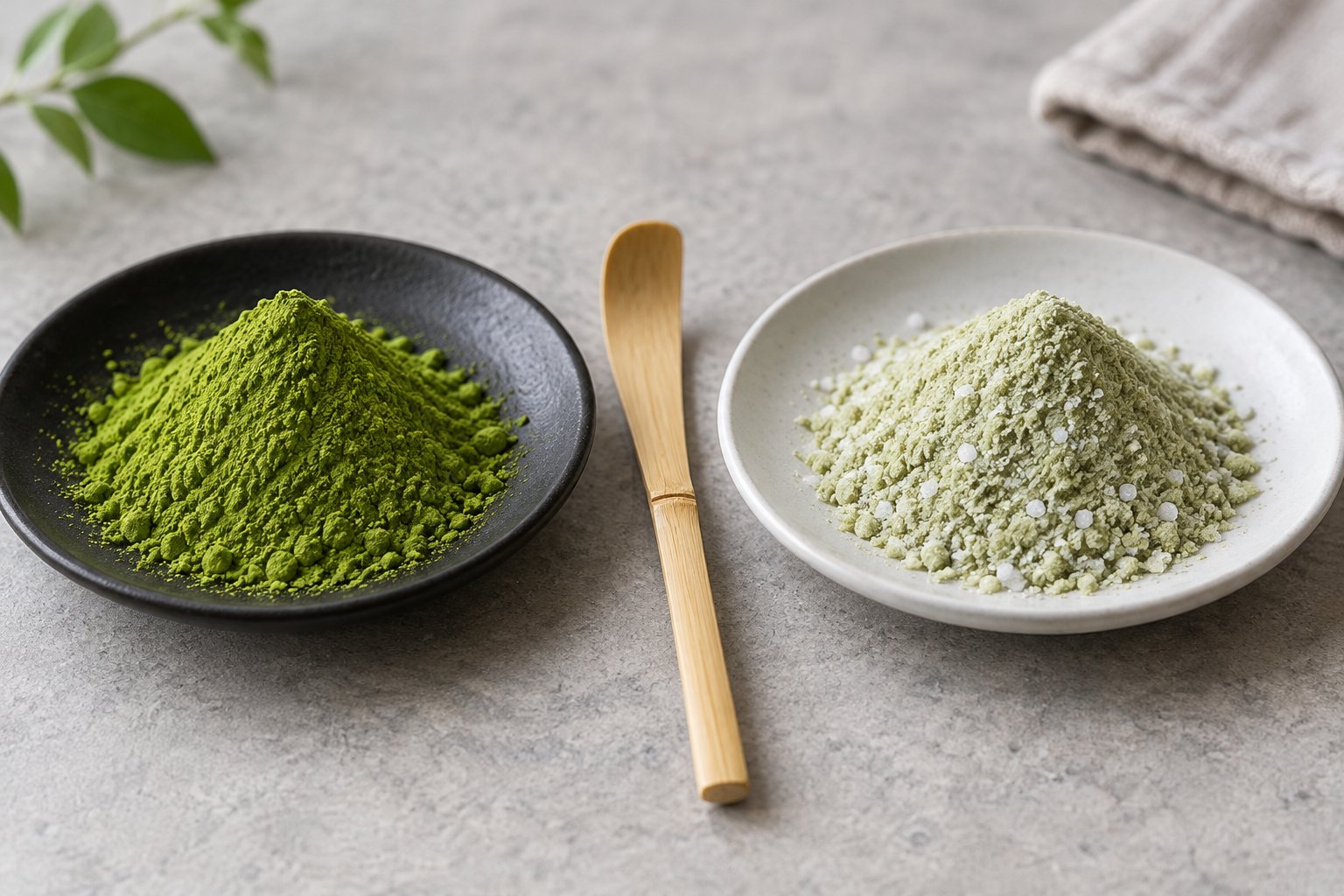
The amounts in dessert recipes assume a powder that is only matcha. If you use the same amount of a latte mix with sugar or milk powder, or a product processed to dissolve easily, you will not get enough matcha. How to tell from the ingredients is covered in pure matcha.
Why matcha changes color in baked goods and desserts
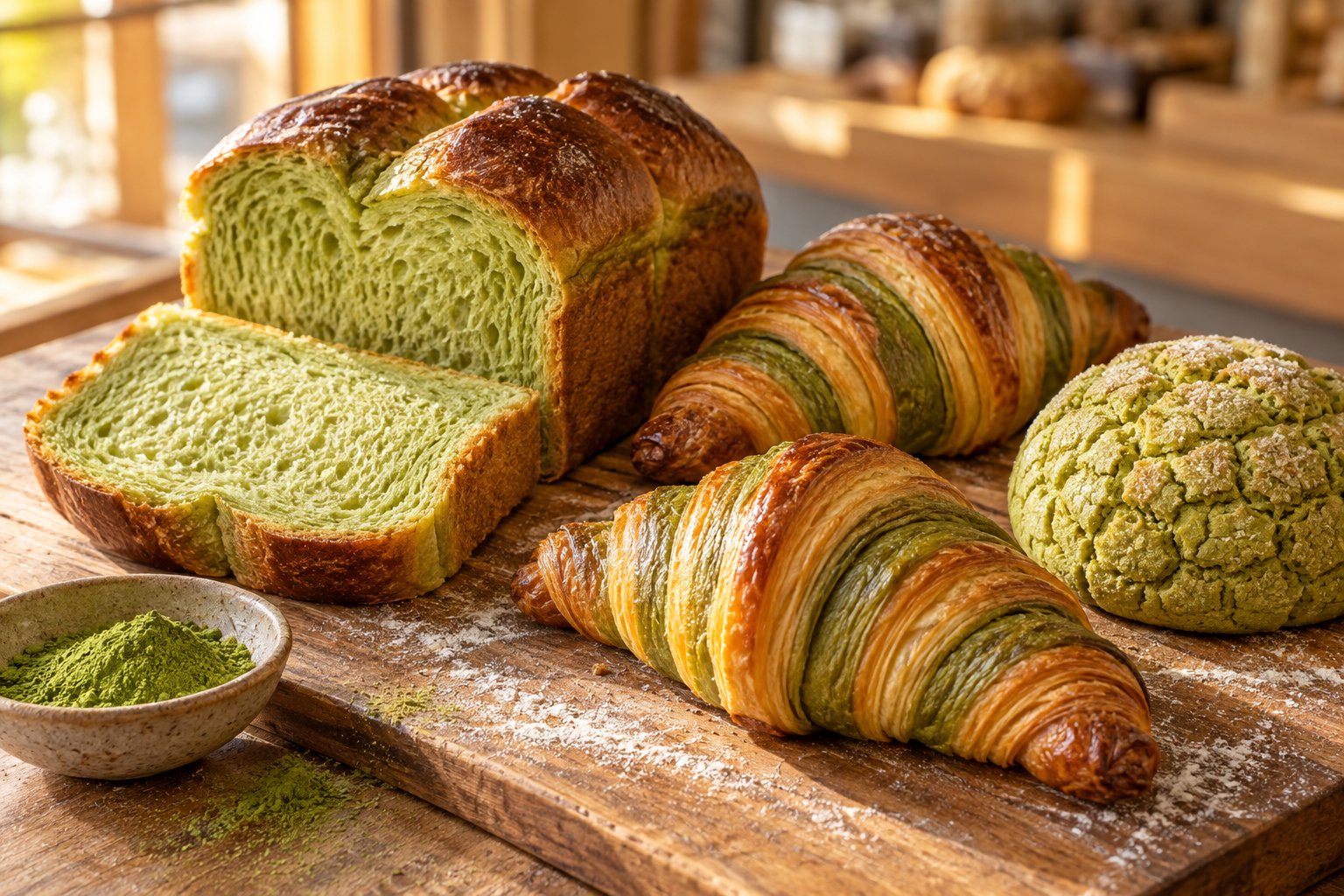
Matcha’s green turns olive when heat or acid removes the magnesium from chlorophyll. With stronger heating, the breakdown of chlorophyll itself and the browning reaction add to this, and the color moves toward brownish-yellow.
Heat removes the magnesium
Matcha’s green comes from chlorophyll and the substances it changes into. In a study published in the food science journal Foods in 2022, green tea powder was heated in a microwave and the color change was measured. While heating was mild, the magnesium at the center of the chlorophyll was lost and pheophytin (an olive-colored substance) and other compounds formed. With stronger heating, chlorophyll broke down, and with even stronger heating the Maillard reaction between sugars and amino acids (the reaction that browns food) was added.
In the same study, in tests with the powder 12–20mm thick, the color was reported to change clearly from green to yellow when the powder reached about 97–114°C. In tests with the powder 2mm thick and longer heating times, the value that shows how green it is fell almost to 0 under the longest condition. These were microwave tests, so the temperatures and times cannot be applied directly to an oven. A 2024 study on drying tencha also showed that heat removes magnesium from chlorophyll and turns it into pheophytin.
Acid speeds it up
The reaction that forms pheophytin replaces the magnesium at the center with two hydrogens. A 2023 review (a paper that summarizes earlier studies) on the processing of green table olives (olives cured in brine and similar for eating) states that this reaction is favored by acidic and mild heat conditions, and that bright green turns olive brown. A study by NARO (Japan’s national agriculture and food research organization) on tea shoots steamed during tea processing also lists pH (how acidic or alkaline something is), after steaming time and chlorophyll content, as a factor that affects color.
Light also fades the color
Color keeps fading after baking because of light. In a presentation at the 2024 annual meeting of the Japanese Society for Food Science and Technology, a green tea solution made with matcha changed color when exposed to light, and the authors inferred that this was caused by the breakdown of chlorophyll and by compounds formed when chlorophyll reacts with catechins (the astringent compounds in tea). Yamamasa Koyamaen, an established tea company in Kyoto, also explains that matcha can turn a reddish color when heated and fades with light, and that the same happens when it is used as an ingredient in sweets. As an example, it mentions matcha cake fading after being displayed for a long time under lights in a showcase.
In baked goods, color and bitterness decide how well they are liked
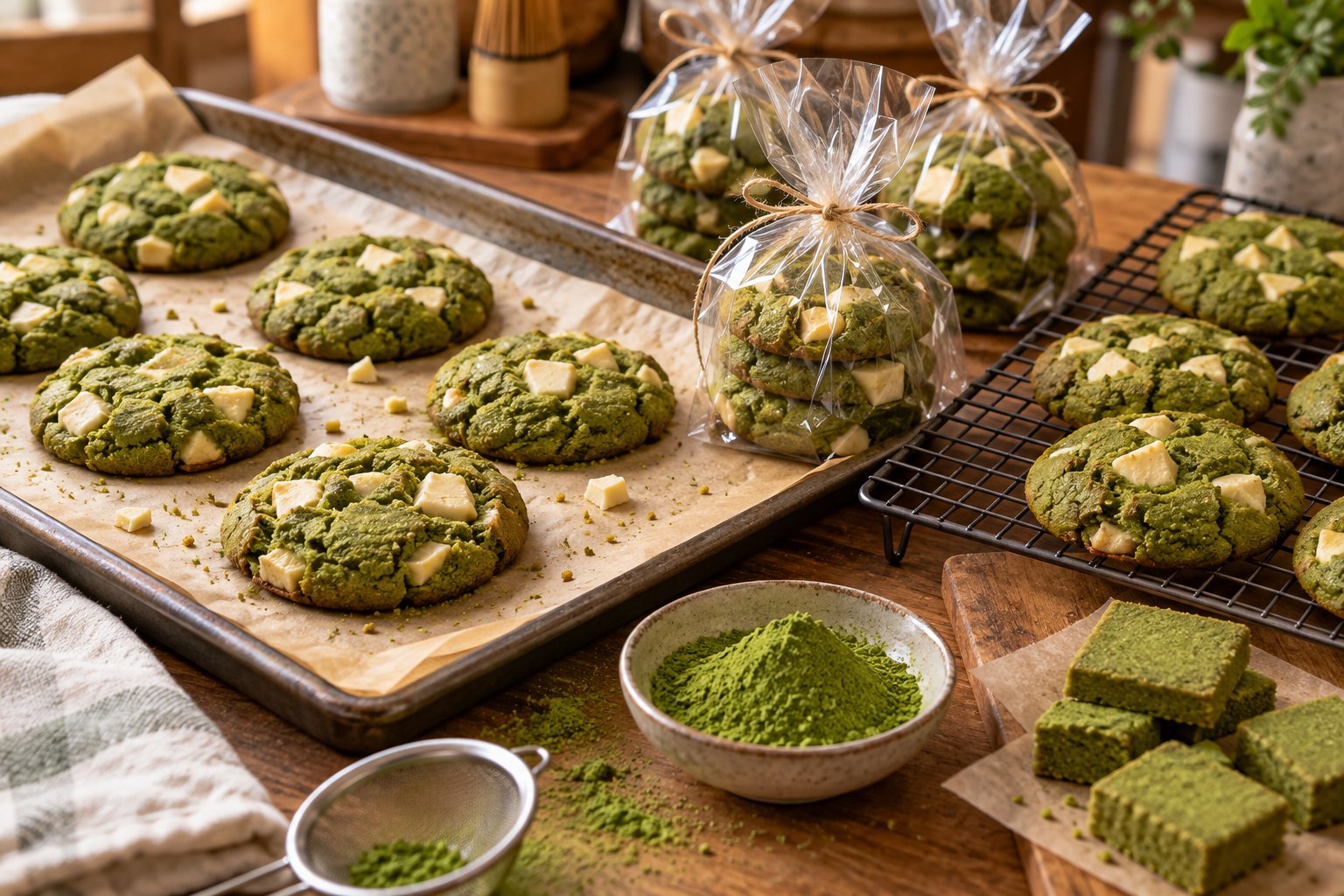
In a study at a UK university, shortbread made with 2g, 4g or 6g of matcha per 100g of flour was baked at 180°C for 15 minutes and rated by tasters. The more matcha, the lower the ratings, and the main factors affecting acceptability were color and bitterness. Darker green and brown biscuits got lower scores for appearance. More matcha is not always better, so decide the amount by balancing color and bitterness.
Grades suited to sweets
An established tea company’s guide recommends grades up to processing grade No. 1 for baked doughs, and drinking grades for ice cream and cream, where the flavor comes through as it is. Baking changes the aroma and color, so grades are divided by use.
Yamamasa Koyamaen’s guide by use
For food processing, Yamamasa Koyamaen offers four drinking grades and five processing grades (Toku A, Toku B, and No. 1 to No. 3). It uses no coloring or flavoring. In its chart by use, matcha drinks and sprinkling use drinking grades, ice cream, cream and pudding use drinking grades through processing grade Toku B, and doughs for baked goods such as bread, cookies and sponge use the lower drinking grades through processing grade No. 1.
| Use (Yamamasa Koyamaen’s chart) | Range of grades |
|---|---|
| Japanese and Western dishes, matcha drinks (green tea, matcha latte and so on), sprinkling as is | Shiho no Kaori and above to Maki no Shiro and above (drinking grades) |
| Ice cream, cream, matcha sauce, chocolate, jelly, pudding | Drinking grades to processing grade Toku B |
| Bean paste and steamed sweets such as yokan, bread, doughs for baked goods such as rice crackers, cookies and sponge | Maki no Shiro and above to processing grade No. 1 |
| Fish paste products, matcha salt, noodles such as cha soba, furikake | Processing grade Toku A to No. 3 |
Source: Yamamasa Koyamaen, “加工用抹茶・他パウダー(業務用・製菓用)” (Matcha and other powders for processing, for business and confectionery use) https://www.yamamasa-koyamaen.co.jp/product/for-processing.html
The company says matcha is a secondary ingredient that adds flavor and value to food, and that by setting aside budget for a higher grade, you get a product with richer matcha flavor that stands out.
What overseas “culinary” matcha is made from
Among overseas sellers, AIYA America says its culinary matcha is from the summer harvest, and Jade Leaf says its culinary grade uses second harvest and later leaves. Jade Leaf describes the color as a more subdued green. How composition and price differ by harvest is covered in “Harvest makes about a twofold difference in price” in matcha grades.
The raw matcha’s green also differs
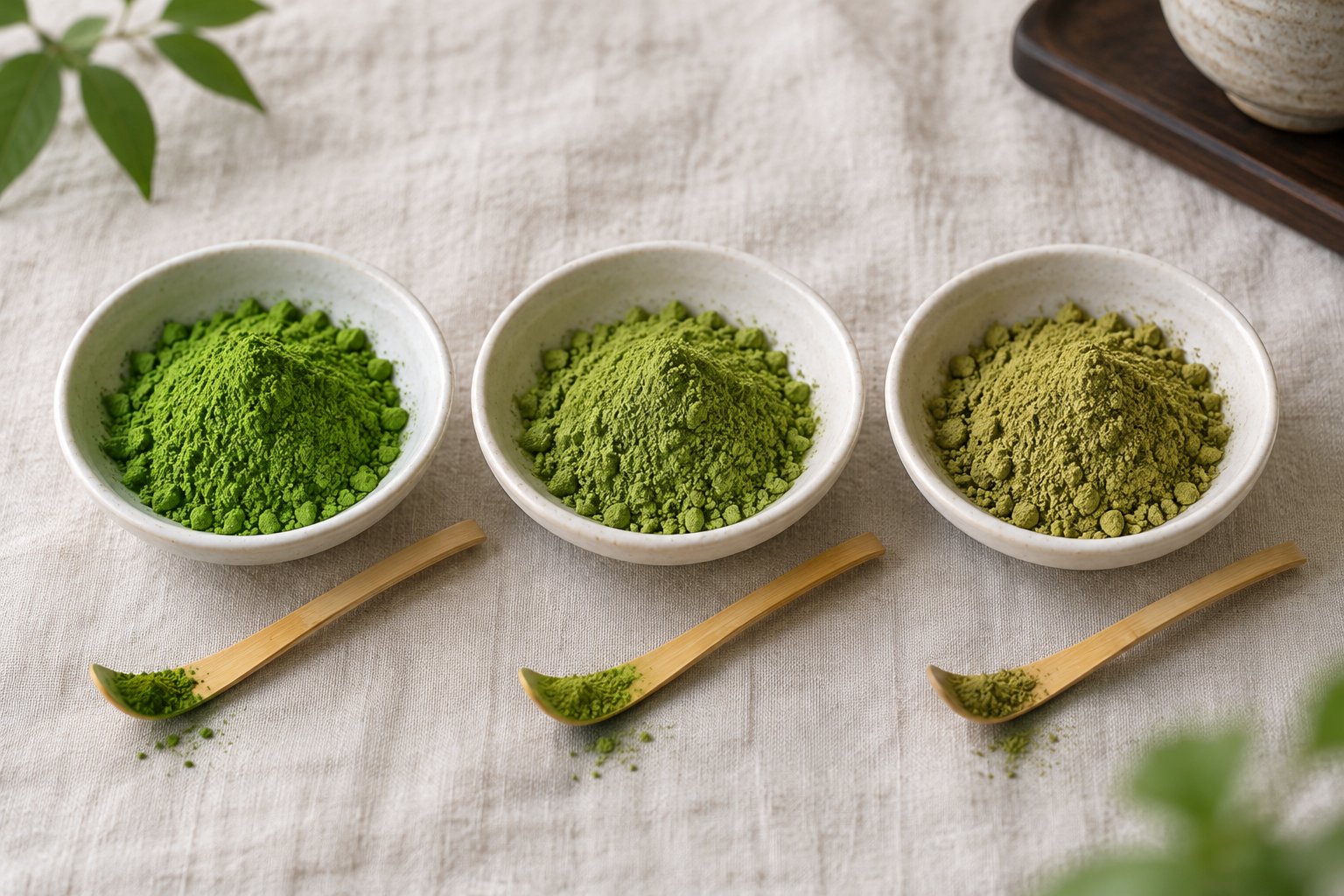
A NARO study of 25 powdered green teas sold in the US found that more expensive samples tended to contain more chlorophyll, and treats the rate of conversion to pheophytin as an indicator of deteriorated color. The tea research division of Kagoshima Prefecture’s agricultural research center also reports that the more chlorophyll in the fresh leaf and the thinner the leaf, the deeper and brighter green the matcha. How much green remains after baking also depends on how green the matcha is before baking.
Matcha ratios in official recipes compared
Comparing official recipes from tea companies and government bodies that give the matcha in grams, matcha was about 7–17% of the flour in baked goods (3 recipes) and about 3–8% of the liquid in recipes where it is mixed into a liquid (4 recipes). Our editors calculated the percentages by dividing the weight of matcha by the weight of the ingredients listed in the table (counting 1ml as 1g).
Baked goods (share of flour)
| Source | Dessert | Matcha | Flour | Matcha to flour | Baking |
|---|---|---|---|---|---|
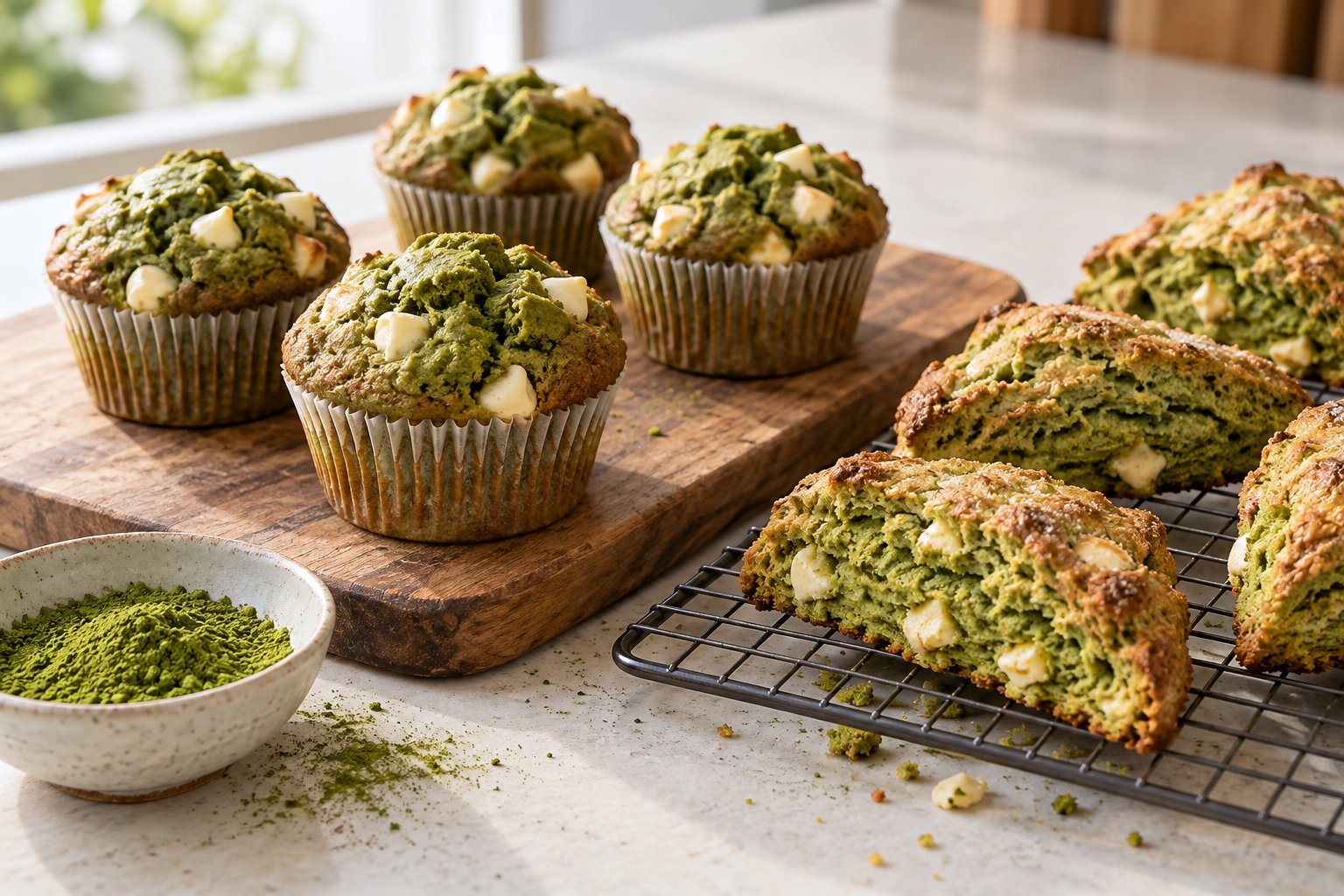
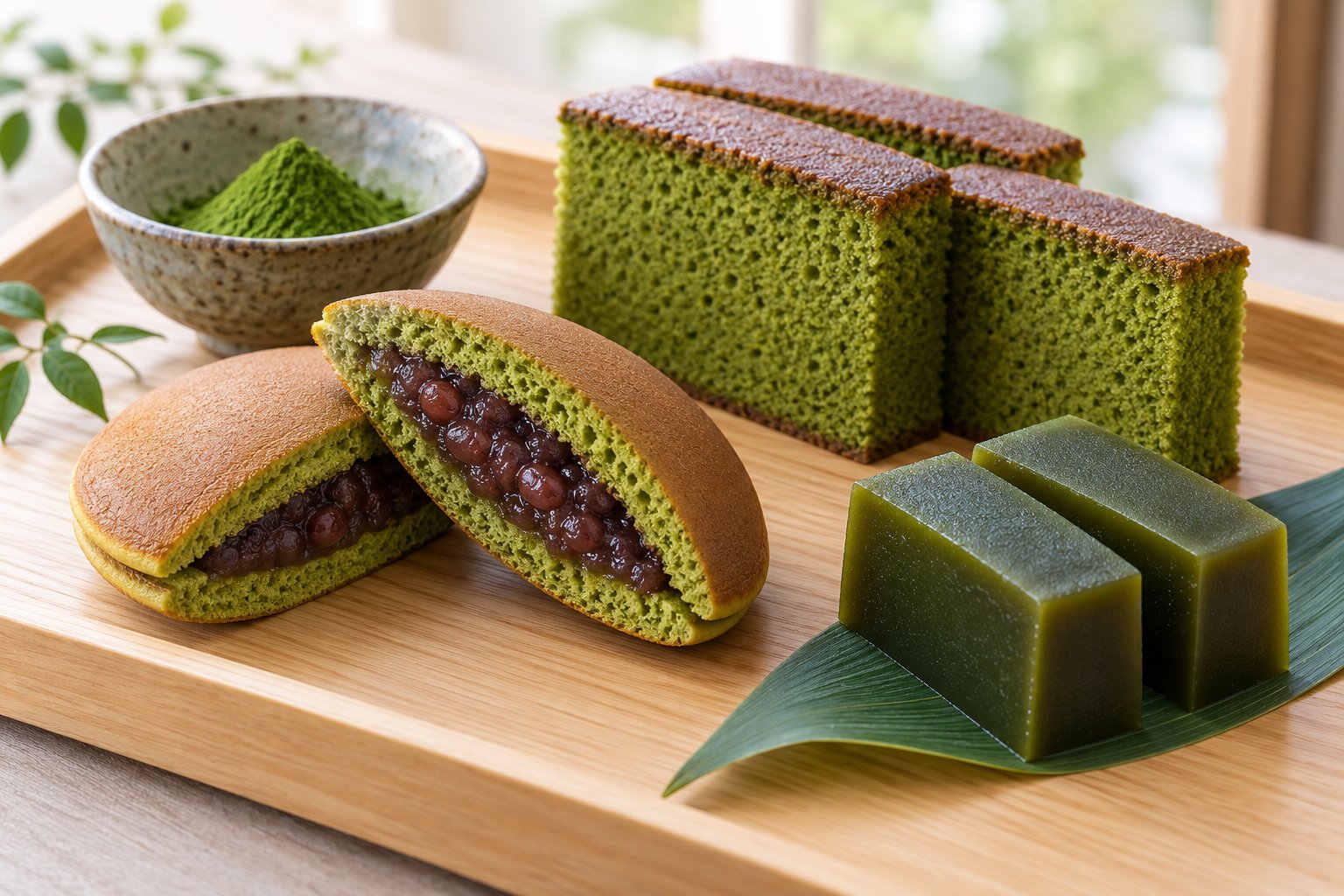
| Ito En | Matcha Taiwanese castella (one 15cm square) | 10g | 60g cake flour | about 17% | 140°C for 60–70 minutes in a water bath |
| Fukujuen group (a Kyoto tea company; Ujinotsuyu Seicha and Fukujuen in the group publish the same recipe) | Matcha roll cake sponge | 8g | 50g flour | 16% | 180°C for about 15 minutes |
| Nishio city (top prize in a recipe contest published by the city) | Matcha cupcakes (4 servings) | 10g | 150g flour | about 6.7% | 170°C for about 25 minutes |
| Ito En | Matcha cookies (about 30) | 2 tbsp | 200g cake flour | not given in grams | 170°C for 15 minutes |
| Ito En | Matcha chiffon cake (18cm pan) | a little over 3 tbsp | 120g cake flour | not given in grams | 170–180°C for 40–50 minutes |
| AIYA America (a US matcha seller) | Matcha pound cake (2 loaves) | 2 tbsp | 3 cups all-purpose flour | by volume | 325 degrees (apparently Fahrenheit, about 163°C) for about 1 hour 30 minutes |
| Matcha.com (a US matcha seller) | Matcha shortbread | 2 tsp | 1.5 cups all-purpose flour | by volume | 350°F (about 177°C) for 10 minutes |
The shortbread study mentioned above used 2–6% relative to the flour. Egg-rich, airy batters such as the Taiwanese castella and the roll cake use little flour, so the share of matcha relative to the flour is higher.
Source: Ito En, “お菓子研究家 福田淳子氏監修!抹茶台湾カステラ” (Matcha Taiwanese castella supervised by confectionery researcher Junko Fukuda) https://www.itoen.jp/recipe/45856/
Ito En’s recipe uses its “Oi Ocha Matcha 30g” product. The cake flour (60g) and matcha (10g, 4 teaspoons) are combined and sifted twice, and the oven is preheated to 140°C.
Creams, syrups, ice cream and pudding (share of liquid)
| Source | Dessert | Matcha | Combined with | Matcha share |
|---|---|---|---|---|
| Yamamasa Koyamaen (the company’s recipe on Tiger Corporation’s site, made in a blender) | Matcha tiramisu syrup (8 servings) | 10g | 150mL water, 20g granulated sugar | about 5.9% |
| Fukujuen group | Matcha cream for the roll cake | 10g | 200cc cream, 15–20g sugar | about 4.5–4.7% |
| MAFF public magazine aff (March 2025) | Matcha sauce for almond tofu (5 servings) | 8g | 170ml milk, 70ml cream, 30g cane sugar, 8g cornstarch | about 2.9% |
| Nakamura Tokichi Honten (a tea company in Uji, Kyoto) | Matcha tiramisu syrup (4 glasses) | 5g | 60ml hot water at 70–80°C, 2 tsp cane sugar | about 8.3% of the water |
| Fukujuen group | Matcha ice cream | 1 tbsp | 300ml milk, 100ml cream, 3 egg yolks, 75g sugar | not given in grams |
| Ito En | Matcha pudding (set with gelatin, 4) | 1 tbsp | 200cc milk, 200cc cream, 40g sugar | not given in grams |
| AIYA America | Matcha ice cream (no eggs) | 4 tsp | 2 cups cream, 1 cup whole milk, 2/3 cup plus 2 tbsp sugar | by volume |
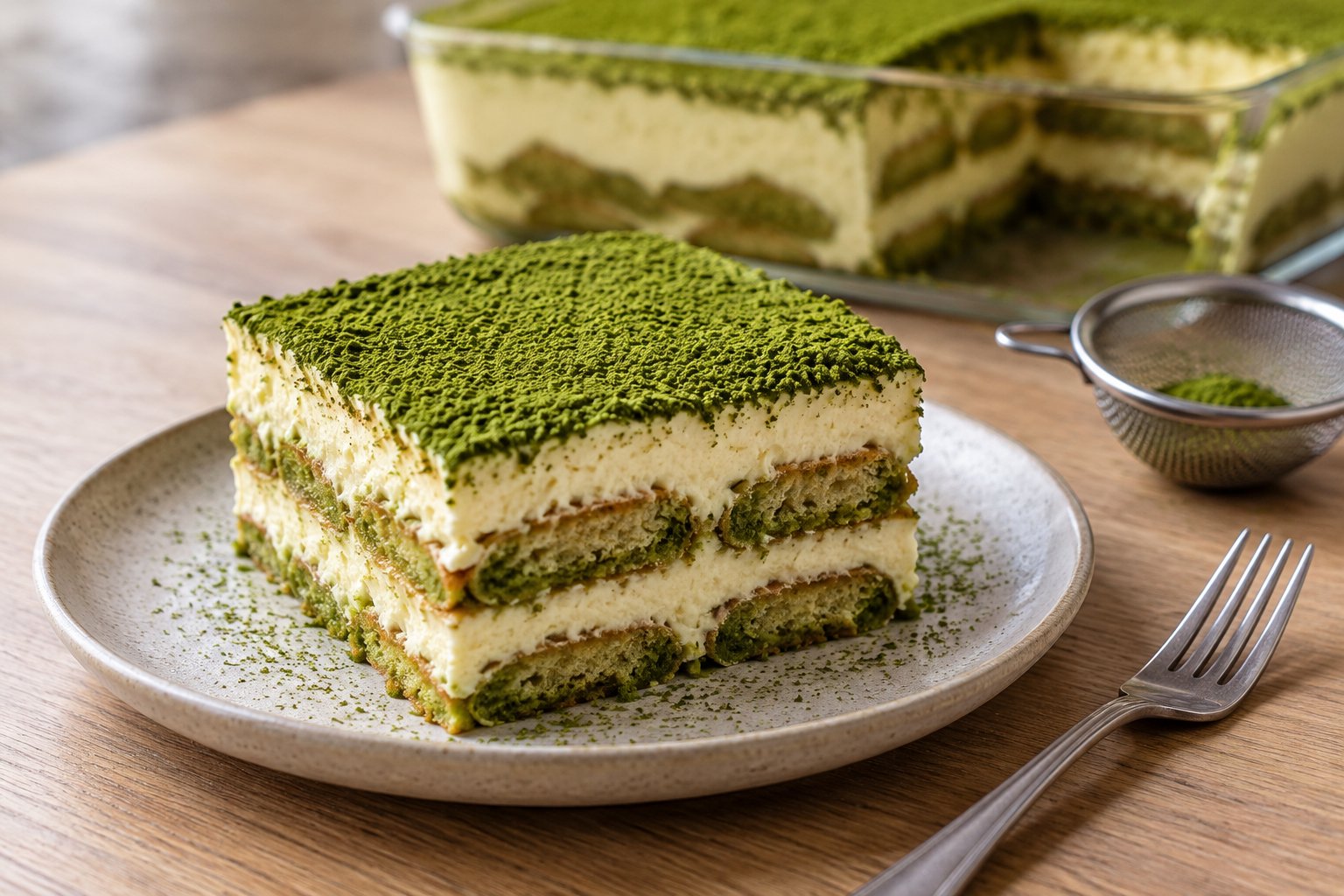
For tiramisu, the matcha is dissolved in a syrup that soaks the sponge, and matcha is dusted on top. Dividing the 10g of matcha in Yamamasa Koyamaen’s recipe by the total of mascarpone, cream, sponge, water and sugar gives less than 1% for the whole tiramisu (our editors’ calculation).
Watch out for tablespoons and teaspoons
Ito En’s Taiwanese castella gives “10g (4 teaspoons)” and Nakamura Tokichi Honten’s tiramisu gives “5g (2 teaspoons)”, so in both, 1 teaspoon is 2.5g (our editors’ calculation). But the weight of a spoonful of matcha changes with whether it was sifted and how fine the powder is. When you fix a recipe for your shop, weigh the matcha in grams and record it. The bigger the batch, the more differences in a spoonful show up as differences in color and bitterness.
Mixing matcha into batter and preventing lumps
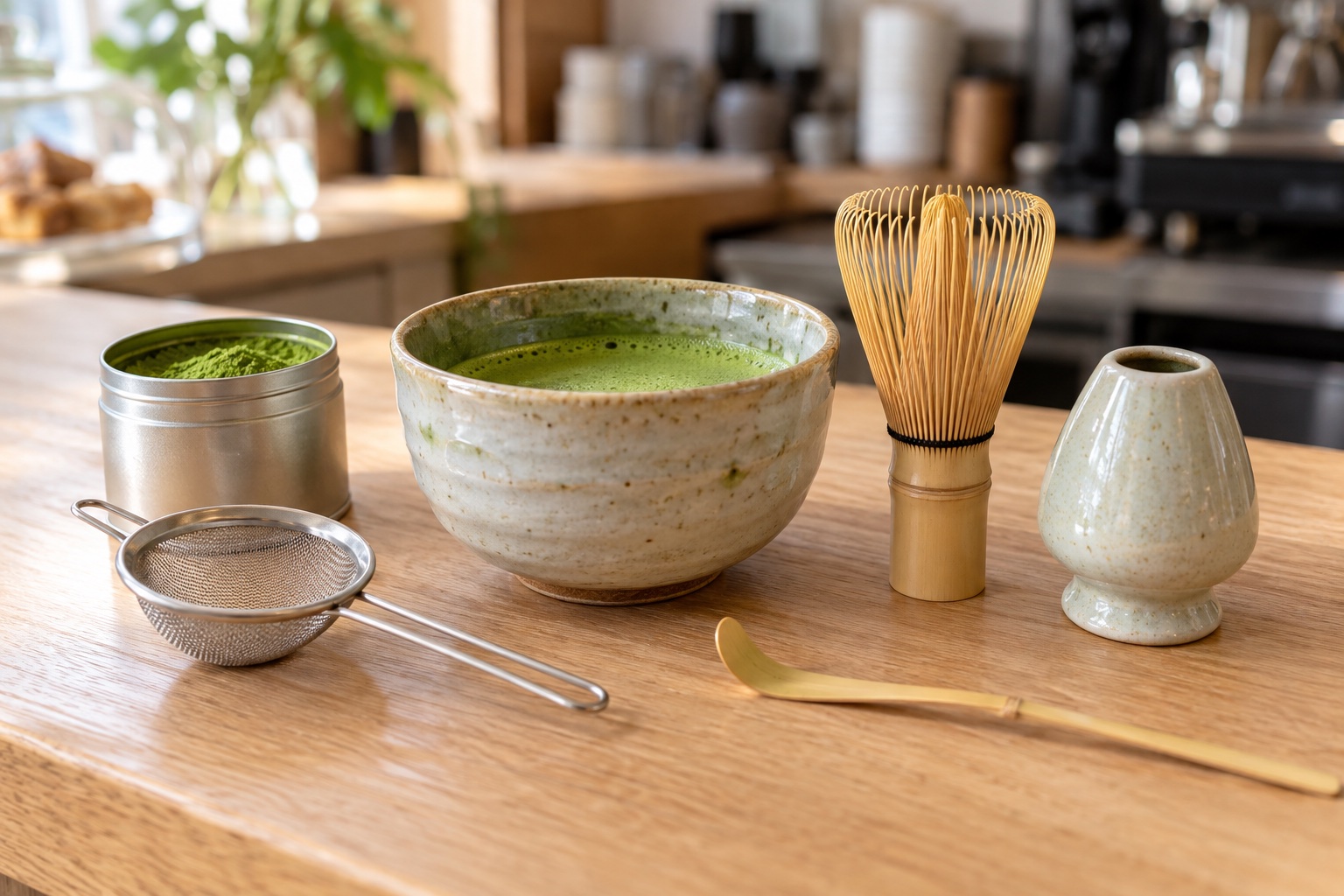
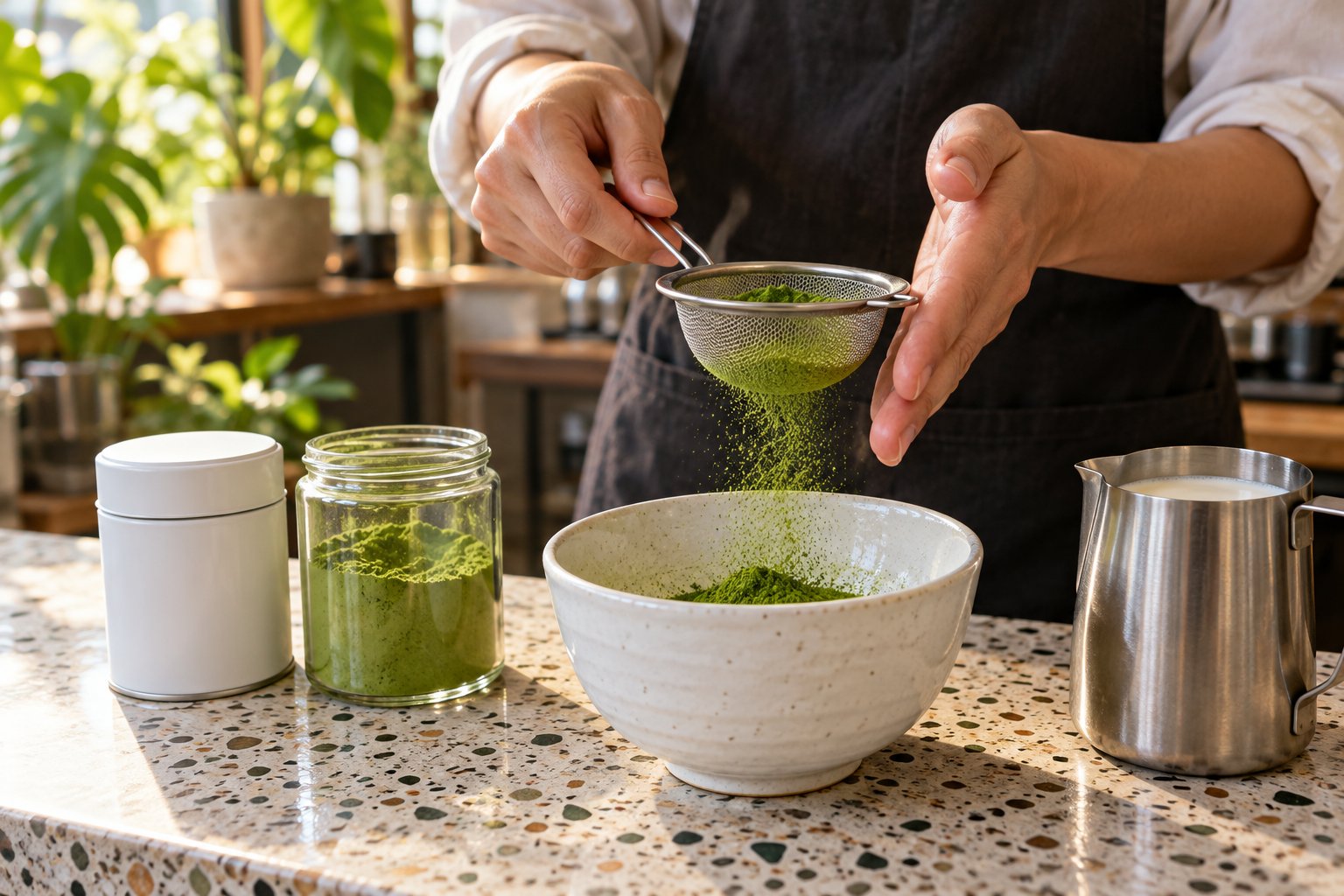
For baked goods, sift the matcha with the flour; for things mixed into a liquid, make a paste with a small amount of liquid first and then spread it out. The steps in official recipes mostly follow these two methods.
Sift with the flour (baked goods)
- Ito En’s Taiwanese castella: combine the cake flour and matcha and sift twice
- Nishio city’s cupcakes: sift the flour, matcha and baking powder before adding
- Ito En’s cookies and chiffon: mix the matcha with the cake flour and other dry ingredients before adding
- Matcha.com: sift the matcha before adding it to the flour
In the Fukujuen group’s roll cake, the matcha for the sponge is first mixed with the egg yolks and sugar, and the flour is sifted separately and added. For the cream, the matcha and sugar are rubbed together, then made into a paste with a small amount of cream.
Matcha is a fine powder of about 10 microns (0.01mm), and it clumps because of static electricity and the weight of the powder during storage. Sifting breaks up the clumps, and mixing with the flour spreads the matcha through the batter. Why lumps form is covered in “How to prevent lumps” in how to make matcha.
Make a paste with a little liquid (ice cream, pudding, sauce, tiramisu)
- The Fukujuen group’s matcha ice cream: add 2 tbsp of the warmed milk and cream, work it into a paste with no lumps, then add another 2 tbsp
- Ito En’s matcha pudding: work the matcha into a paste with 1 tbsp of water, then add the warm milk mixture little by little
- The matcha sauce in the MAFF public magazine: always sift the matcha through a tea strainer to break it up as it goes in, then add the warmed liquid little by little
- Nakamura Tokichi Honten’s tiramisu: sift the matcha through a tea strainer, then dissolve it in hot water at 70–80°C
The common step is not to pour all the liquid onto the matcha at once, but to make a paste with a little liquid first and then spread it out. How to dissolve matcha for syrups is covered in matcha syrup.
What you can do to keep the color
Neither research nor official recipes show a way to keep baked goods as green as before baking. With that in mind, here is what the sources say, kept separate from our editors’ suggestions.
What the sources say
- The stronger and longer the heating, the more green is lost (the study heating green tea powder)
- Chlorophyll turns into pheophytin more easily in acidic conditions (the review on olive processing). pH also affects the color of steamed tea shoots (the NARO study)
- Light also changes the color and fades the green. Matcha cake fades when lit for a long time in a showcase (the presentation at the Japanese Society for Food Science and Technology, Yamamasa Koyamaen)
- Heating changes matcha’s color and aroma, so temperature and time need adjusting (Yamamasa Koyamaen)
- Matcha dusted on top keeps its bright color longer if sifted just before eating (Nakamura Tokichi Honten’s tiramisu recipe)
- More expensive powdered green teas tend to contain more chlorophyll, and the more chlorophyll in the fresh leaf, the deeper the matcha’s green (NARO, Kagoshima Prefecture’s research center)
What a shop can do (our editors’ suggestions)
- Use matcha in sweets that are not browned strongly (steam-baked, or baked at lower temperatures)
- When combining matcha with strongly acidic ingredients such as lemon juice or yogurt, check the color in a test batch
- Add matcha after baking where you want the green to show (cream, sauce, matcha dusted on top)
- Keep the showcase away from direct sunlight and strong lighting, and put out only what you made that day
- Bake each grade of matcha in the same recipe and photograph the color after baking
How light and temperature affect matcha powder itself, and storage guidelines, are covered in matcha shelf life.
Matcha cost per cake or per piece
Work out the matcha cost of one cake as “price per kg ÷ 1,000 × grams used per cake”, then divide by the number of slices. It is the same formula as for a matcha latte.
Matcha per cake or per piece
Using the amounts in official recipes, the matcha used per cake or per piece is as follows (our editors’ calculations). To get the matcha cost, multiply these grams by the price per kg ÷ 1,000. How the price per kg is set is covered in what decides the price of matcha.
| Menu item | Matcha |
|---|---|
| One matcha latte (Ippodo Tea’s recipe) | 3g |
| One matcha Taiwanese castella (Ito En) | 10g |
| One matcha roll cake (Fukujuen group, 8g in the sponge and 10g in the cream) | 18g |
| One serving of matcha tiramisu (Yamamasa Koyamaen, 10g for 8 servings) | 1.25g (not counting the matcha dusted on top) |
| One matcha tiramisu (Nakamura Tokichi Honten’s syrup, 5g for 4) | 1.25g (not counting the matcha dusted on top) |
| One matcha sauce (MAFF public magazine, 8g for 5) | 1.6g |
In this table, the tiramisu and the sauce use less than half the matcha of one latte per piece. Even if you move to a higher grade, the difference per piece is small. A Taiwanese castella cut into 9 pieces has about 1.1g of matcha per piece.
The difference when you change grade
The difference per cake when you change grade is the difference in price per kg ÷ 1,000 × grams used per cake. For a Taiwanese castella with 10g of matcha, the difference per cake is one hundredth of the difference in price per kg. Cut into 9 pieces, the difference per piece is a ninth of that again. Besides matcha, include eggs, dairy, sugar, packaging and anything thrown away after a failed bake in the cost. How to think about latte costs is in how to choose matcha for café lattes.
What to check when buying
Check the ingredients, harvest and raw material in documents rather than the grade name, and decide after a test bake with your own recipe. Whether to use the same matcha as for lattes or a separate one for sweets is also decided by the test results.
Items to check in documents and labels
| Item | What to look for |
|---|---|
| Ingredients | Is it 100% matcha? Is there no sugar, milk powder, dietary fiber and the like? |
| Raw material | Is it matcha ground from tencha, or powdered tea made from sencha or similar? |
| Harvest | First flush, or second flush and later? If blended, the proportions |
| Origin | Is the prefecture or region stated? |
| Coloring and flavoring | Are none used? |
| Lot | Can you keep buying the same specification? Is there a certificate of analysis for each lot? |
| Storage and best-before date | Is there enough time between purchase and using it up? |
How to read heavy metal test documents is covered in matcha lead testing.
What to compare in a test bake
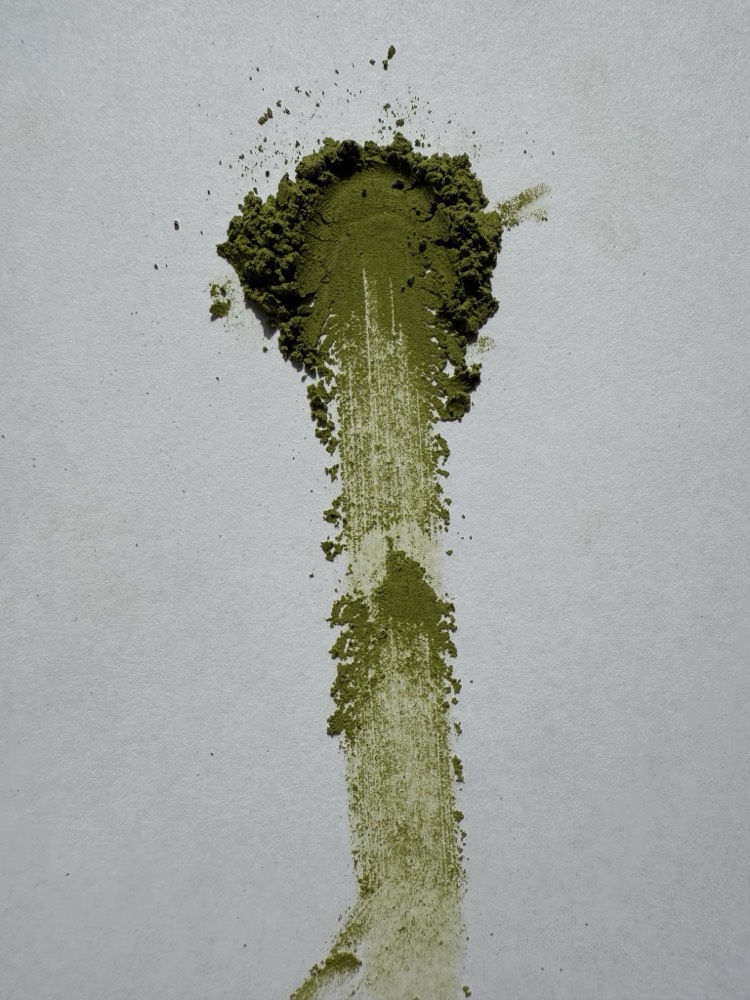
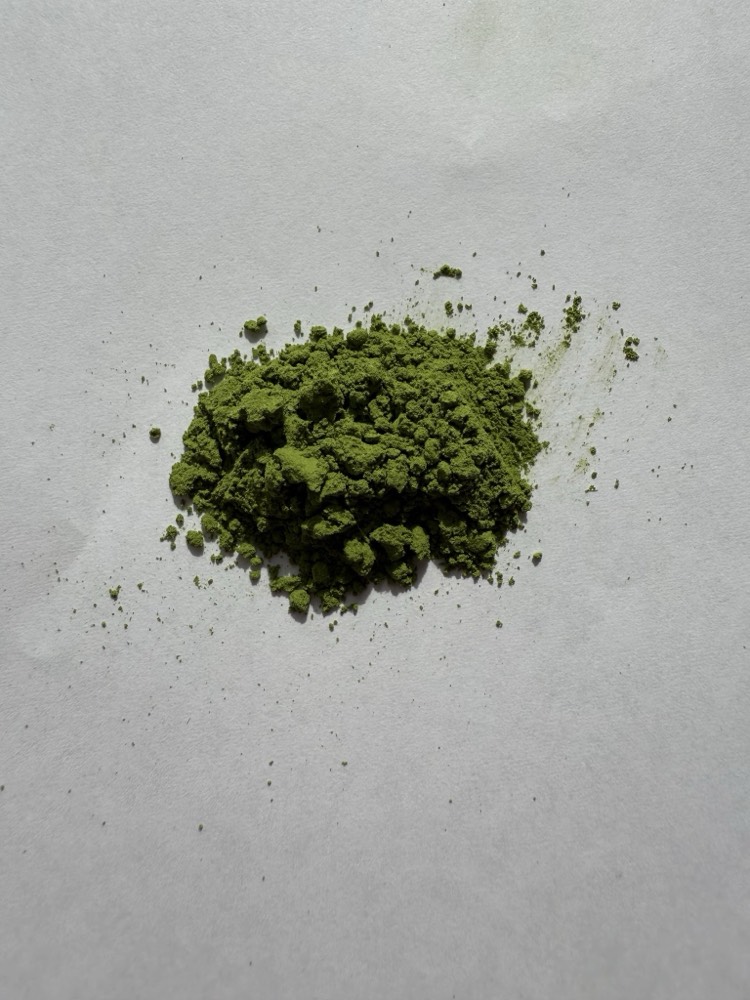
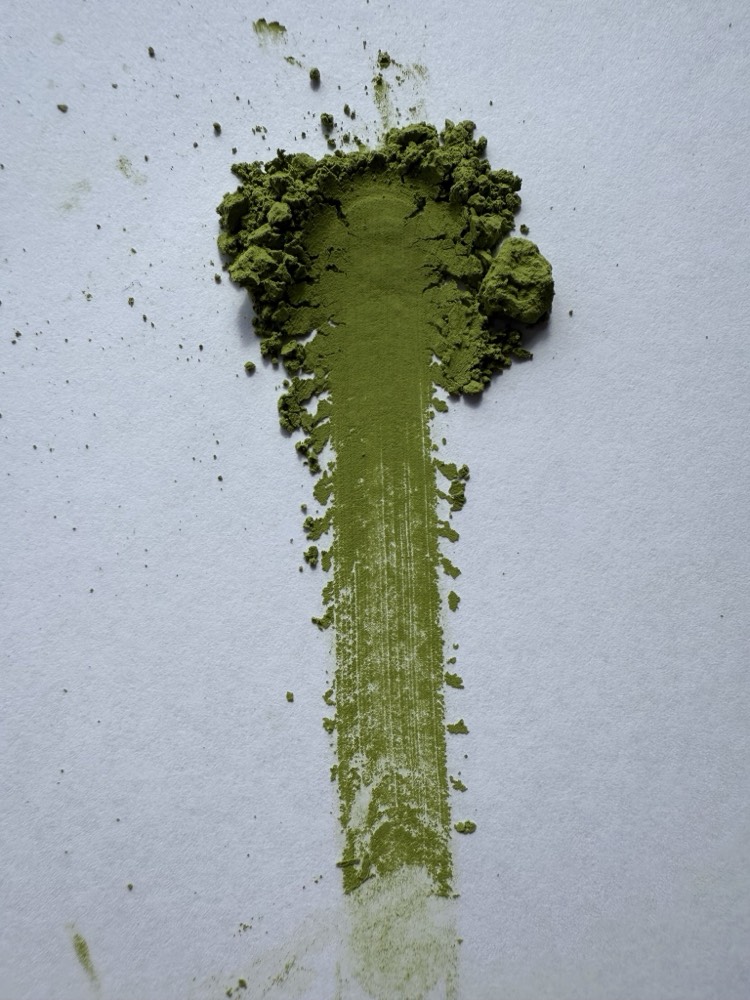
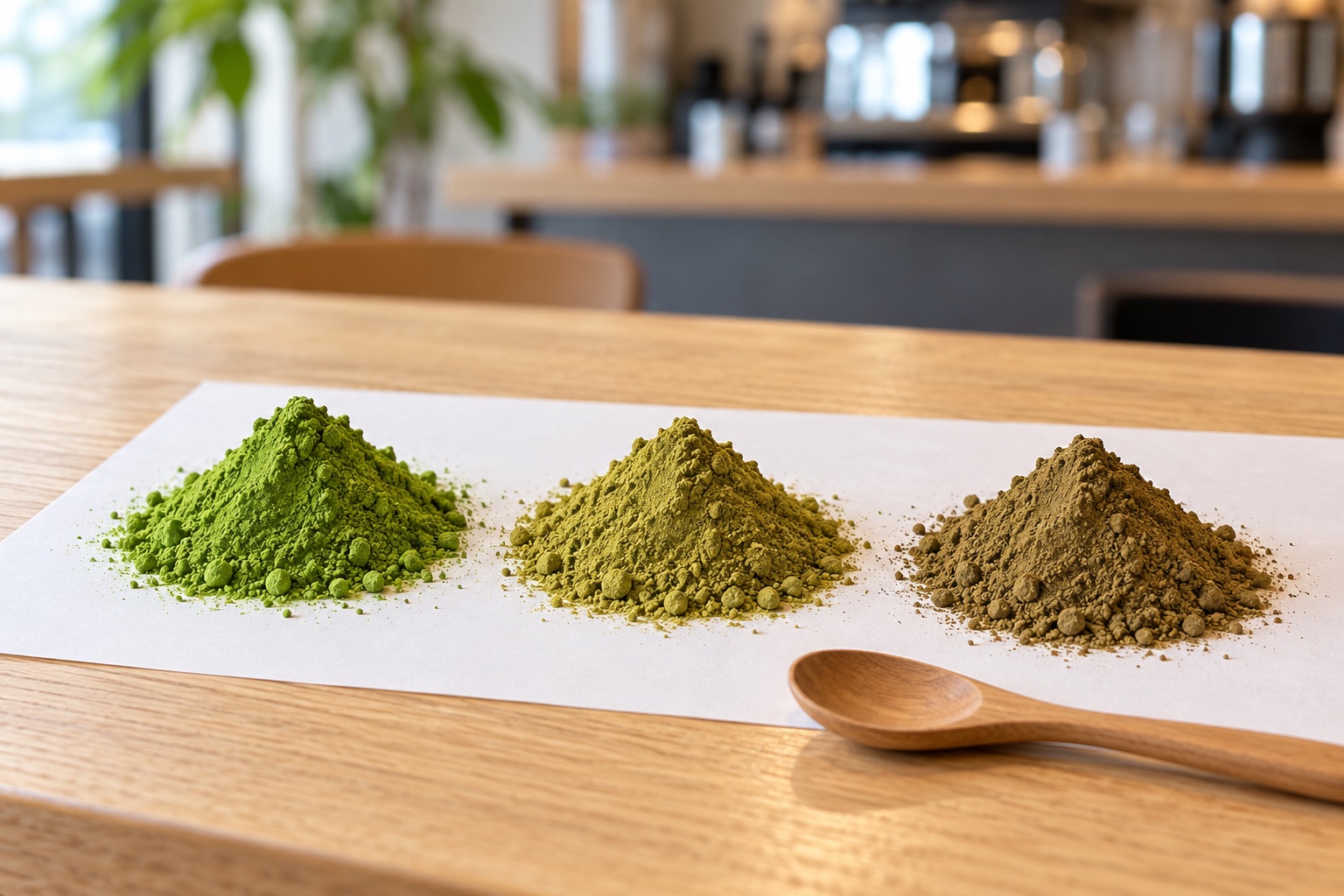
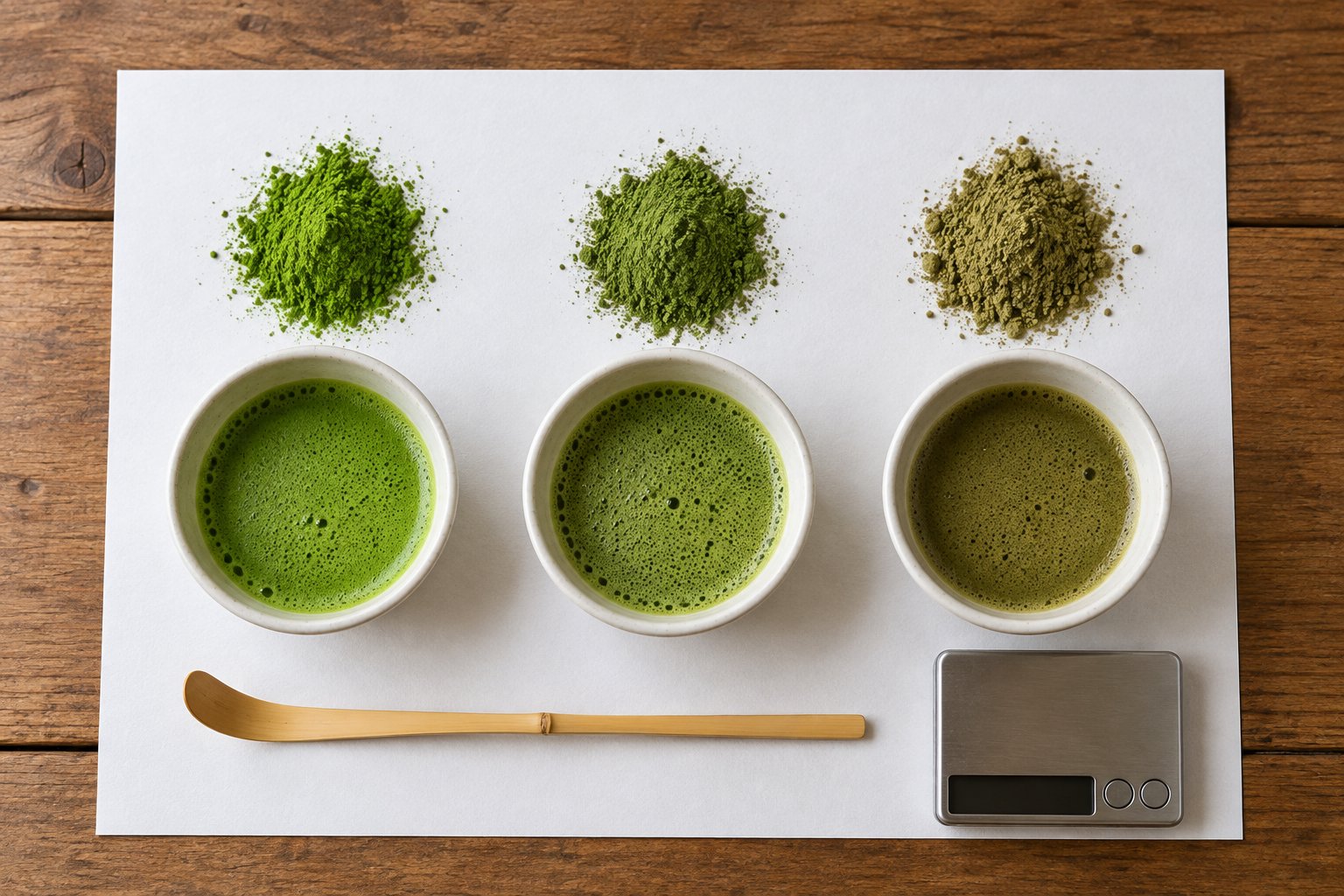
- Lay the candidate matcha side by side on white paper and compare the color before baking
- Bake your shop’s recipe with only the matcha changed, at the same amount, and compare the color just after baking and the next day
- For menu items that are not baked, such as cream or ice cream, compare the color when freshly made and a few hours later
- Taste to check that the bitterness is not too strong and that it balances the sweetness
- Work out the matcha cost per cake or per piece and decide together with the selling price
Omakase Matcha’s matcha is for lattes, and we handle matcha from Uji, Yame, Shizuoka, Kagoshima and Miyazaki. Orders start from 1kg, you can request up to 3 samples, and we can help adjust blends to suit your menu. Differences between regions are in matcha origins, and you can request samples for test batches from samples.
Sources
- Wang et al., “The Effect of Microwave Radiation on the Green Color Loss of Green Tea Powder,” Foods (2022) https://pmc.ncbi.nlm.nih.gov/articles/PMC9407078/
- Mao et al., “Effect of different drying temperature settings on the color characteristics of Tencha,” Food Chemistry: X (2024) https://pmc.ncbi.nlm.nih.gov/articles/PMC11584762/
- Ambra et al., “The Fate of Chlorophylls in Alkali-Treated Green Table Olives: A Review,” Molecules (2023) https://pmc.ncbi.nlm.nih.gov/articles/PMC10534587/
- Hirono et al. (NARO), Journal of the Science of Food and Agriculture 104(15) (2024) https://pubmed.ncbi.nlm.nih.gov/39101245/
- Horie et al., “Comparison of the Chemical Components of Powdered Green Tea Sold in the US,” JARQ 52(2) (2018) https://www.jircas.go.jp/sites/default/files/publication/jarq/jarq52-02_143-147.pdf
- Phongnarisorn et al., “Enrichment of Biscuits with Matcha Green Tea Powder: Its Impact on Consumer Acceptability and Acute Metabolic Response,” Foods (2018) https://pmc.ncbi.nlm.nih.gov/articles/PMC5848121/
- Yasuda et al., “光照射による緑茶の色と成分の変化” (Changes in the color and components of green tea under light, abstract, 71st annual meeting of the Japanese Society for Food Science and Technology, 2024, in Japanese) https://www.jstage.jst.go.jp/article/aamjsfst/71/0/71_45/_article/-char/ja
- Kagoshima Prefectural Institute for Agricultural Development, Tea Division, “炒蒸機とネット型乾燥機を用いて製造した加工用てん茶・抹茶の品種別色の特徴” (Color characteristics by cultivar of processing tencha and matcha, in Japanese) https://www.pref.kagoshima.jp/ag11/pop-tech/nenndo/documents/56364_20201113082445-1.pdf
- Yamamasa Koyamaen, “加工用抹茶・他パウダー(業務用・製菓用)” (Matcha and other powders for processing, in Japanese) https://www.yamamasa-koyamaen.co.jp/product/for-processing.html
- Yamamasa Koyamaen, “抹茶の取扱い” (Handling matcha, in Japanese) https://www.yamamasa-koyamaen.co.jp/matcha/basic/handling.html
- Ito En, “お菓子研究家 福田淳子氏監修!抹茶台湾カステラ” (Matcha Taiwanese castella, in Japanese) https://www.itoen.jp/recipe/45856/
- Ito En, “抹茶クッキー” (Matcha cookies, in Japanese) https://www.itoen.jp/recipe/39906/
- Ito En, “抹茶シフォンケーキ” (Matcha chiffon cake, in Japanese) https://www.itoen.jp/recipe/39913/
- Ito En, “抹茶プリン黒みつソース” (Matcha pudding with black syrup sauce, in Japanese) https://www.itoen.jp/recipe/39880/
- Ito En, “お〜いお茶 抹茶 30g” (Oi Ocha Matcha 30g, in Japanese) https://www.itoen.jp/products/41489/
- Ujinotsuyu Seicha, “抹茶ロールケーキ” (Matcha roll cake, in Japanese) https://www.ujinotsuyu.co.jp/recipe/matcha/2024-09-30-04-31-32
- Fukujuen, “抹茶レシピ” (Matcha recipes: matcha roll cake and matcha ice cream, in Japanese) https://shop.fukujuen.com/n/matcha-recipe/
- Ujinotsuyu Seicha, “宇治の露について” (About Ujinotsuyu, in Japanese) https://www.ujinotsuyu.co.jp/about
- Ujinotsuyu Seicha, “抹茶アイス” (Matcha ice cream, in Japanese) https://www.ujinotsuyu.co.jp/recipe/matcha/2024-09-30-04-31-31
- Nakamura Tokichi Honten, “抹茶ティラミス” (Matcha tiramisu, in Japanese) https://tokichi.jp/blogs/life-with-cha/recipe-matcha-tiramisu
- Tiger Corporation, “【山政小山園】抹茶ティラミス” (Yamamasa Koyamaen matcha tiramisu, in Japanese) https://www.tiger-corporation.com/en/jpn/feature/recipe/matcha-tiramisu/
- MAFF, public magazine aff, March 2025, “抹茶スイーツ” (Matcha sweets, in Japanese) https://www.maff.go.jp/j/pr/aff/2503/wasweets05.html
- Nishio city, “道の駅にしお岡ノ山『西尾の抹茶』アイデアレシピコンテスト 優秀作品集” (Nishio matcha idea recipe contest, winning entries, in Japanese) https://www.city.nishio.aichi.jp/_res/projects/default_project/_page_/001/006/944/sweets.pdf
- AIYA America, “Matcha Pound Cake” https://aiya-america.com/matcha-pound-cake/
- AIYA America, “Matcha Ice Cream” https://aiya-america.com/matcha-ice-cream/
- AIYA America, “The Different Grades of Matcha” https://aiya-america.com/blog/the-different-grades-of-matcha
- Matcha.com, “Matcha Shortbread Cookies” https://matcha.com/blogs/recipes/matcha-shortbread-cookies
- Jade Leaf, “Everything You Need to Know About Ceremonial and Culinary Grade Matcha” https://www.jadeleafmatcha.com/blogs/matcha-guide/everything-you-need-to-know-about-ceremonial-and-culinary-grade-matcha
- Ippodo Tea, “Matcha Latte Recipe” https://ippodotea.com/blogs/recipes-to-brew-japanese-tea/matcha-latte-recipe