
 Reviewed by: Takahiro Sugiyama (CEO, meguri Inc.)
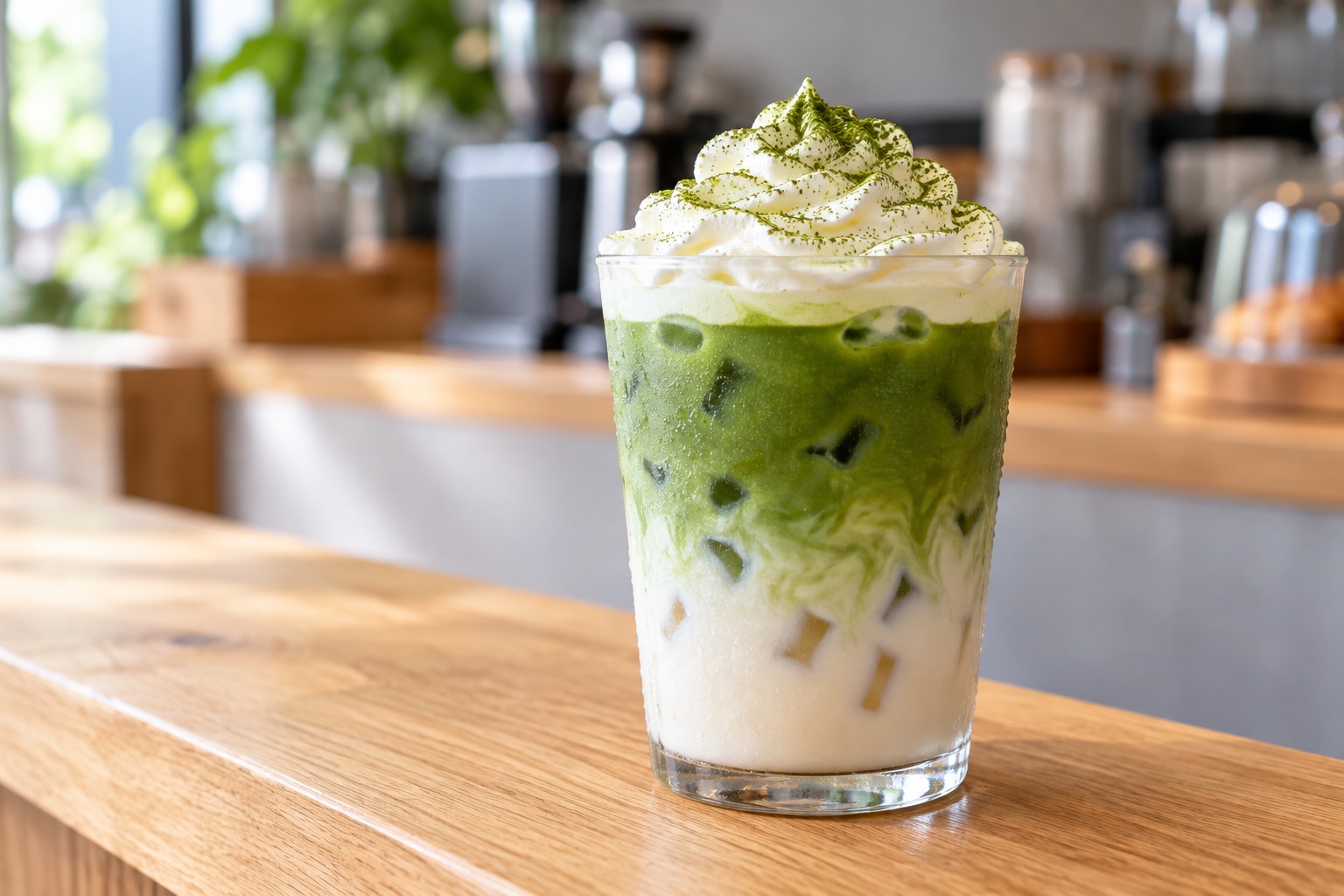
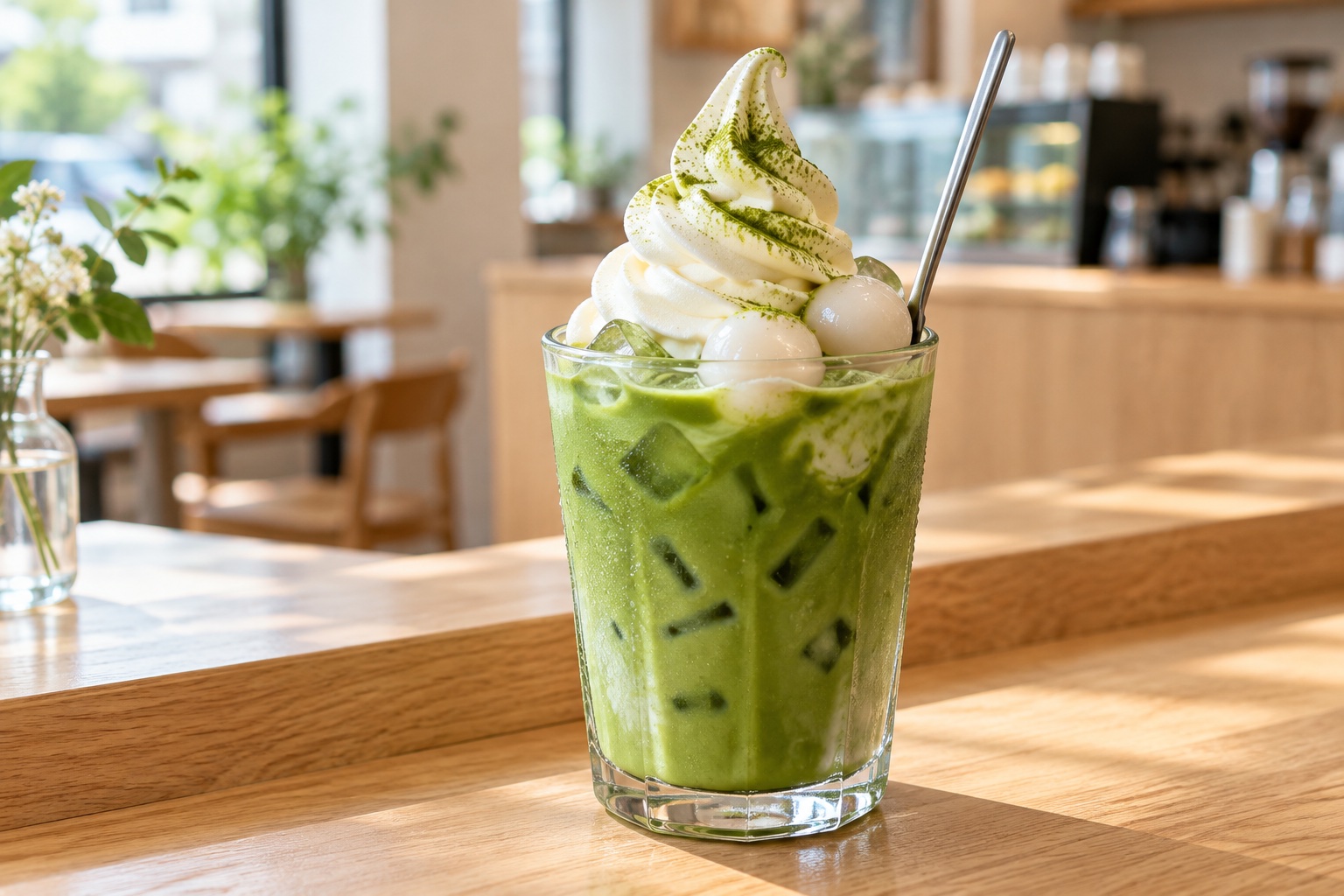
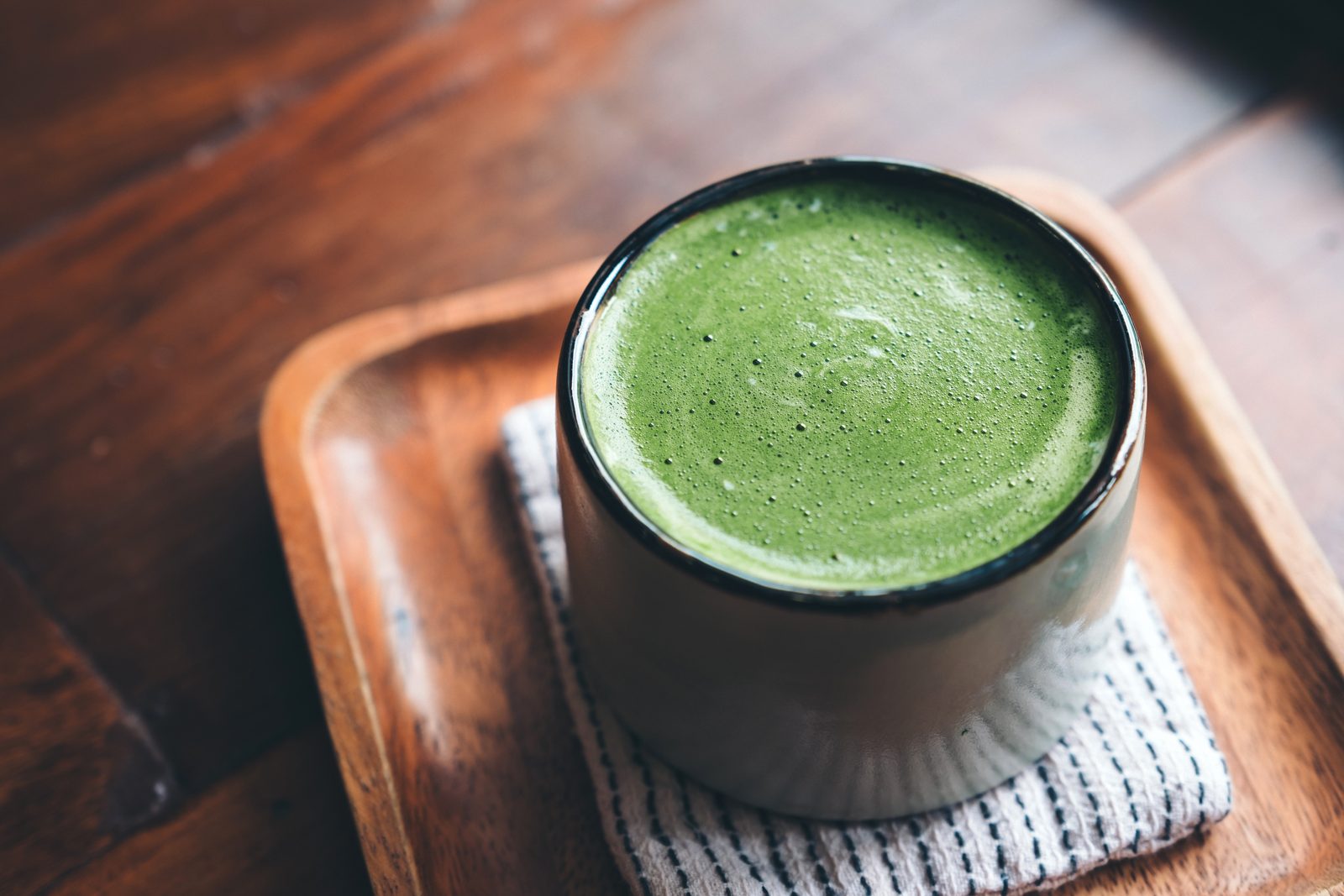
Starbucks Singapore publishes the nutrition of its matcha lattes per 100mL, and lists both the “Matcha Latte” made with milk and the “Low-fat Matcha Latte (Less Sweet)” made with low-fat milk. Starbucks Indonesia also serves a “Green Tea Latte,” matcha mixed with milk. The calories in a matcha latte are decided by the milk and the sweetener more than by the matcha. This page shows how to work out one cup’s value from the grams of each ingredient and their kcal per 100g, using Japan’s food composition tables, the US Department of Agriculture database and manufacturers’ labels.
What decides the calories in a matcha latte
Almost all the calories in a matcha latte come from the milk and the sweetener. The matcha powder is 2 to 3g per cup, about 5 to 7kcal. With the same matcha, the type and amount of milk and the sweetness level can change one cup by 100kcal or more.
Calories in matcha powder
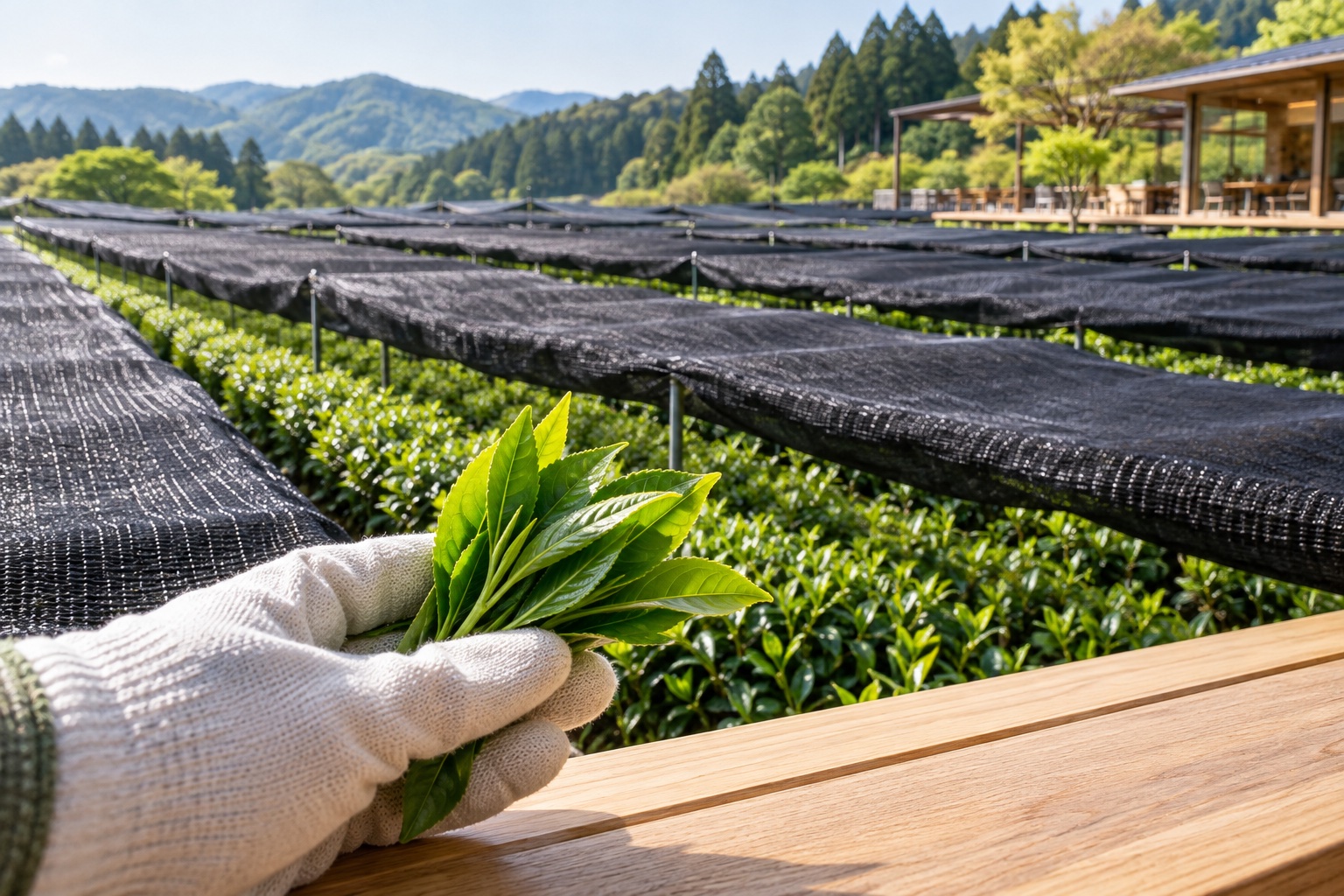
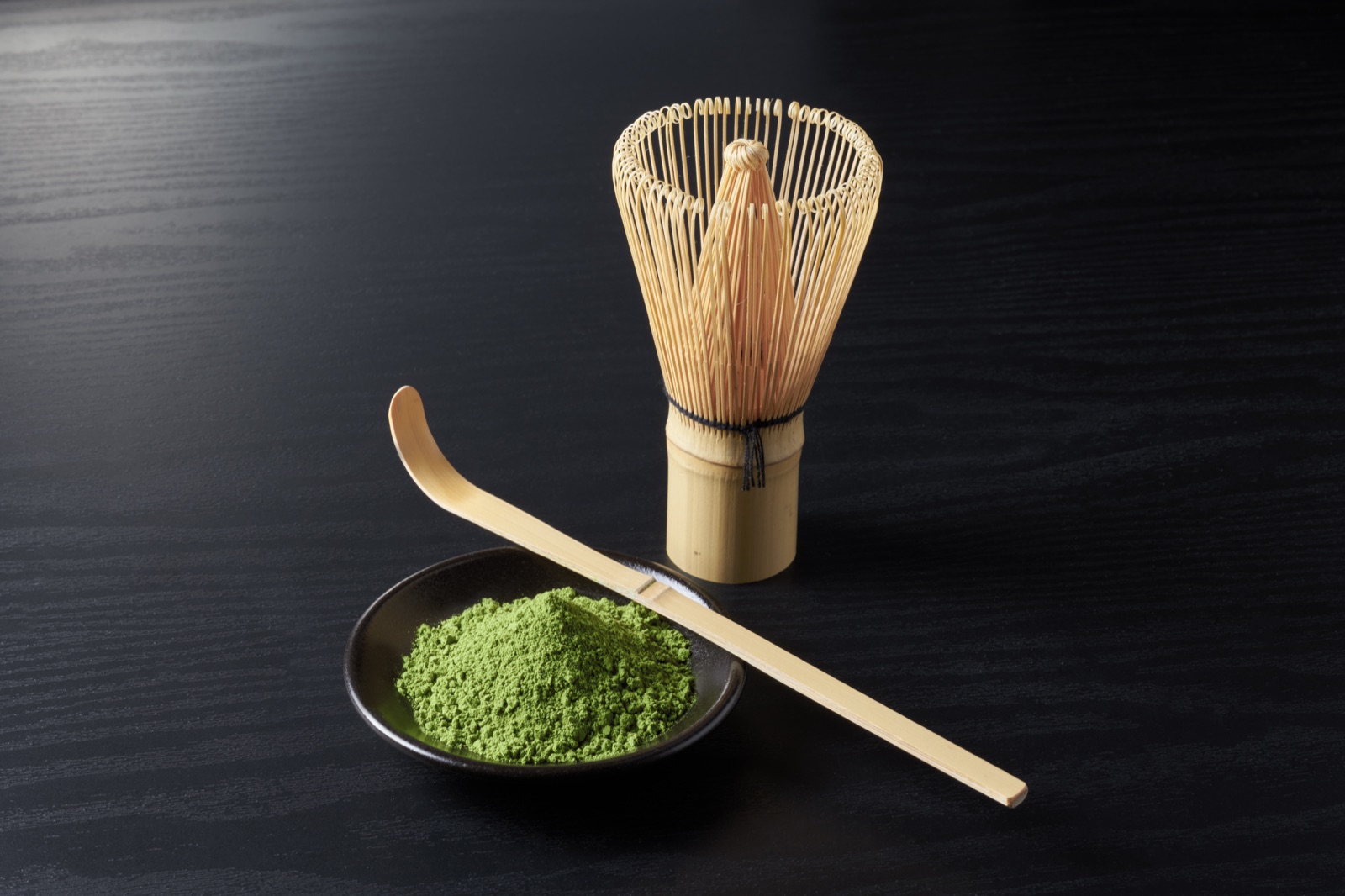
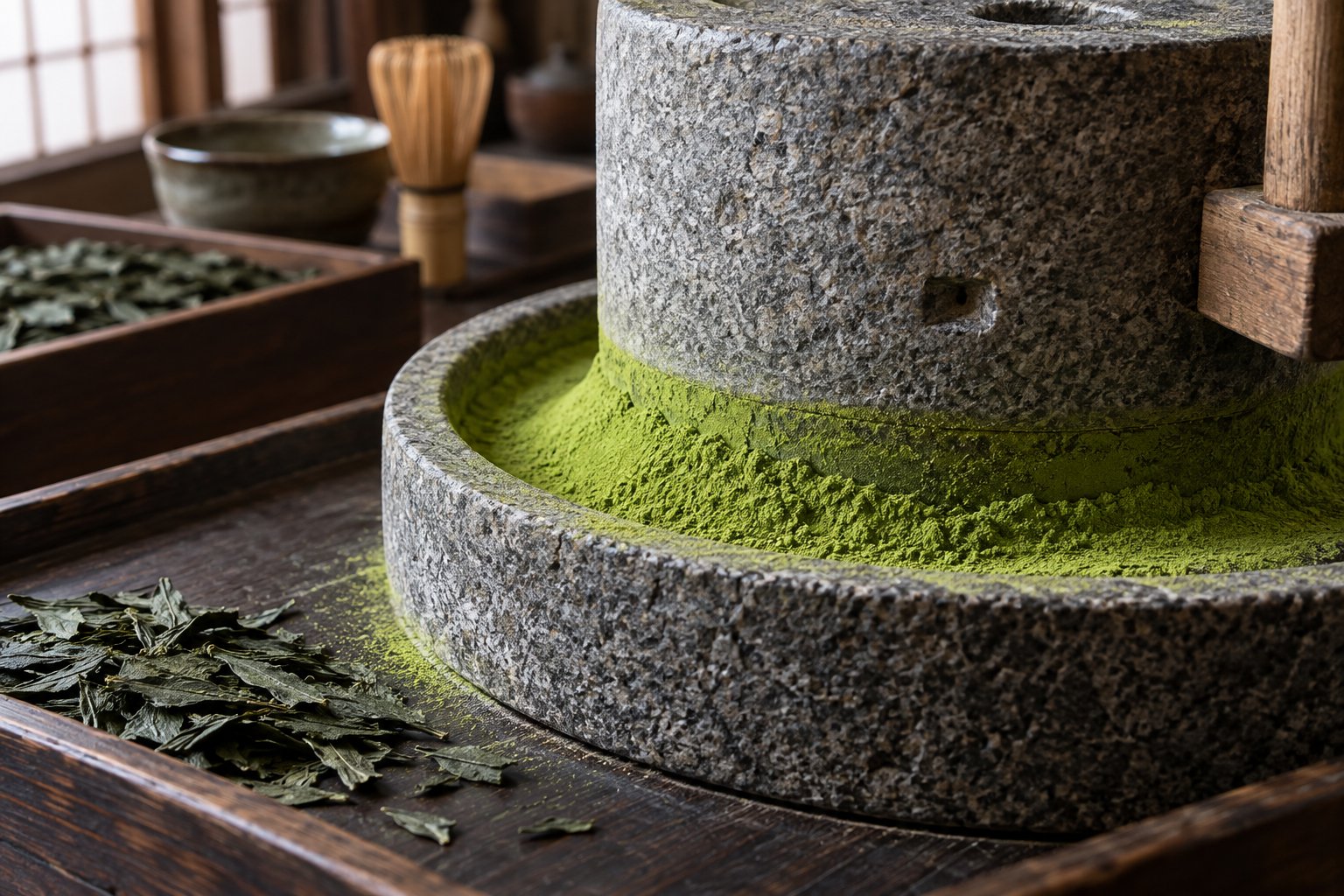
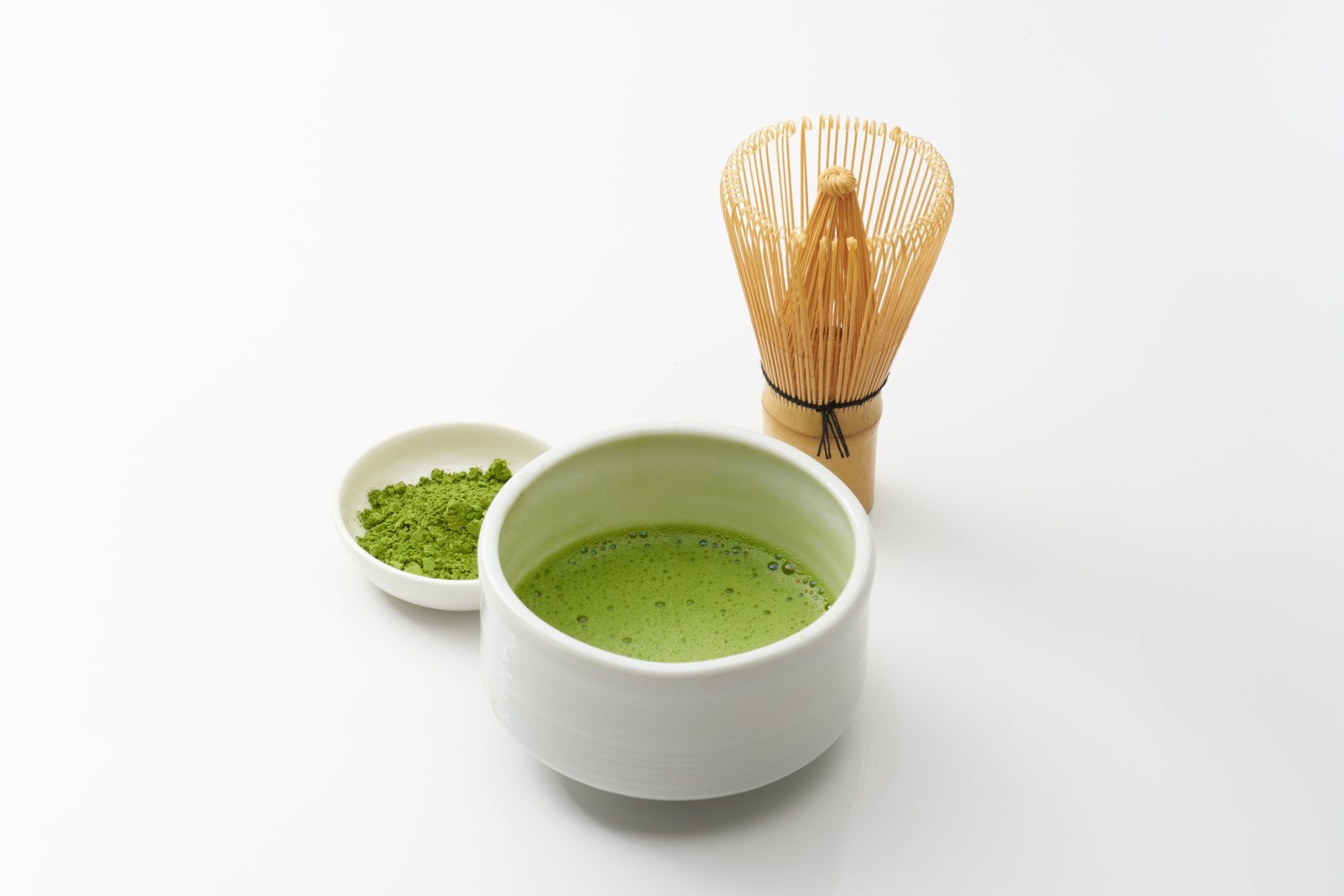
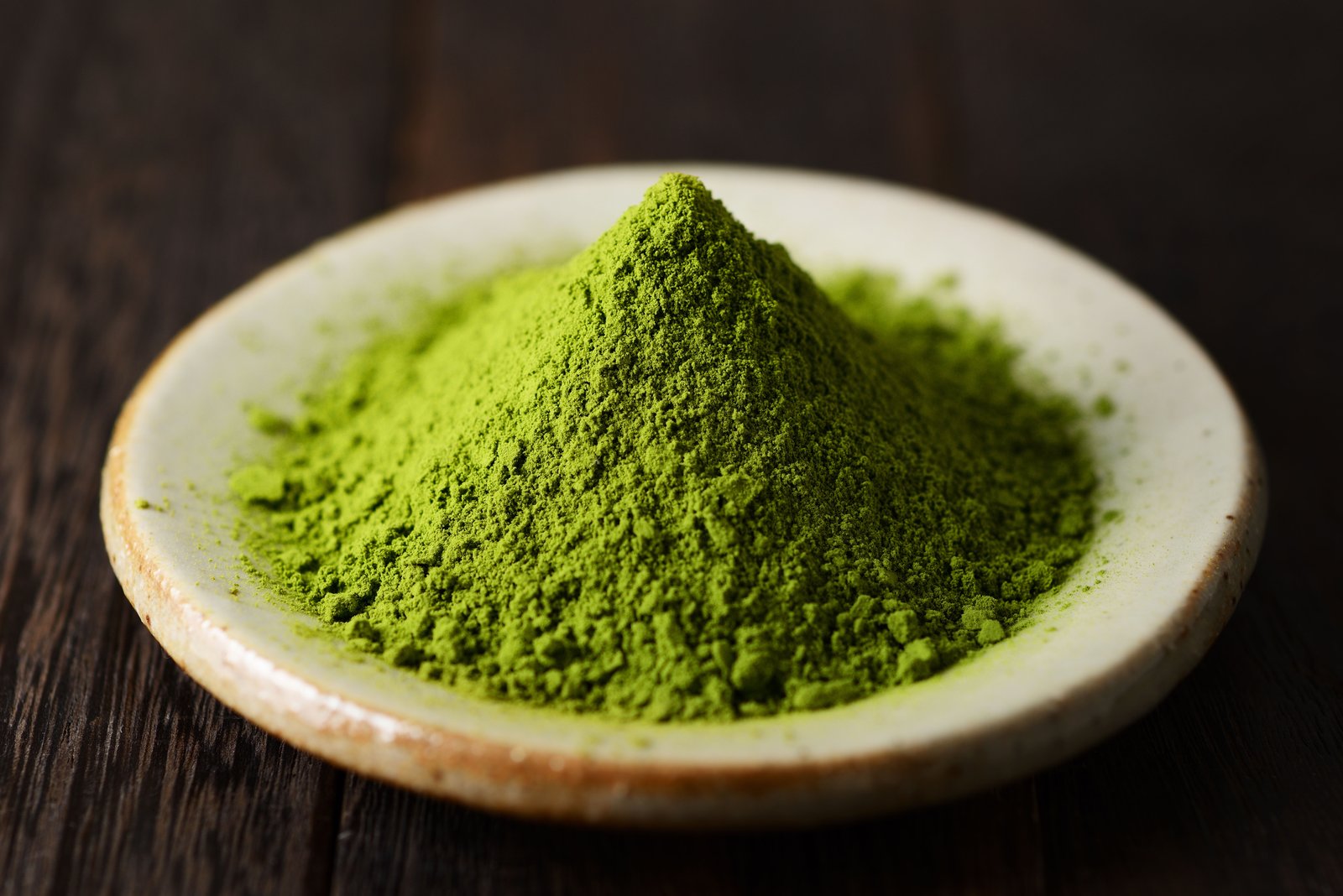
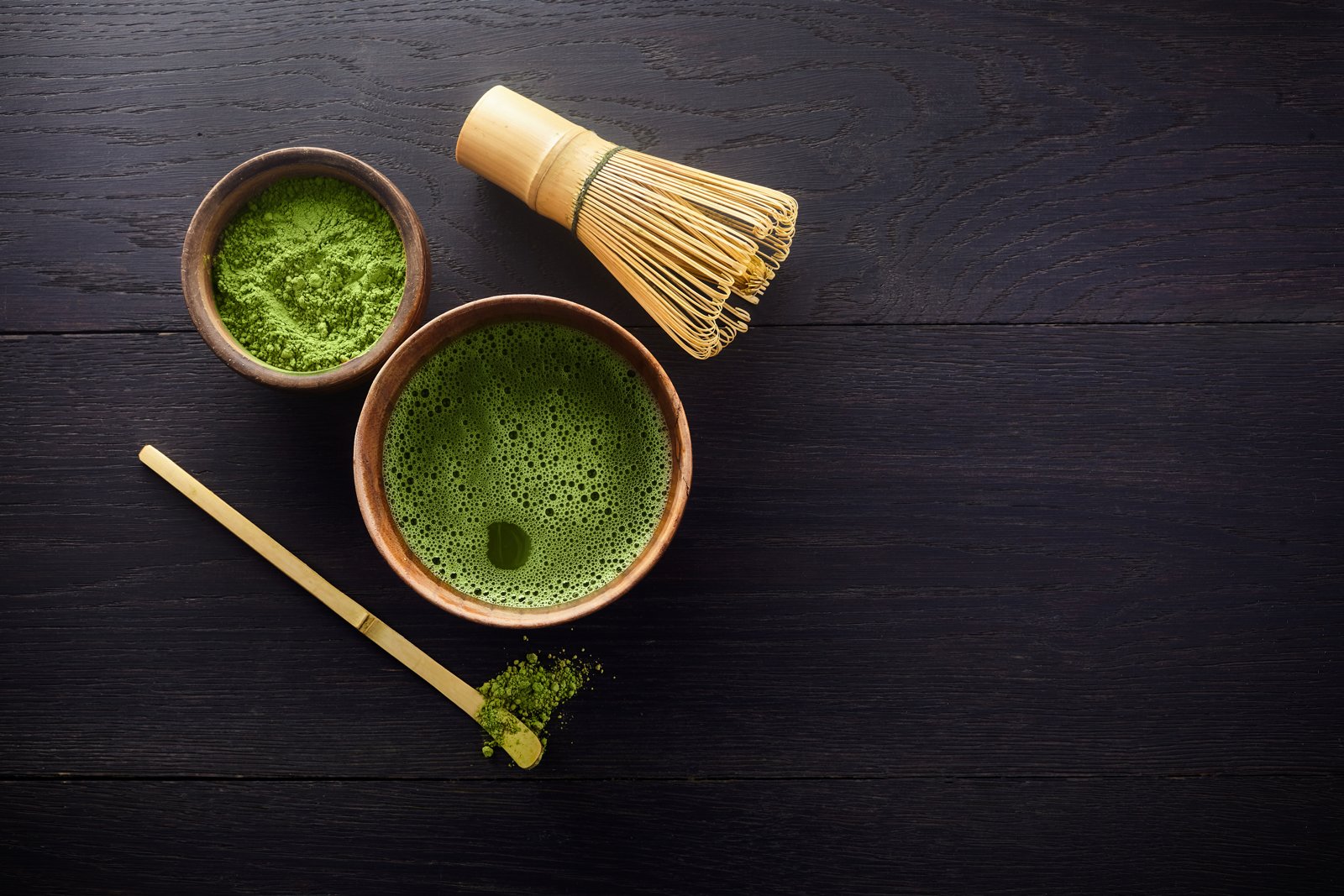
In the Standard Tables of Food Composition in Japan (8th revised edition, 2023 supplement) from the Ministry of Education, Culture, Sports, Science and Technology, matcha has 237kcal per 100g, with 5.3g of fat, of which 0.68g is saturated fatty acids. That is about 2.4kcal per gram. Matcha is tencha (tea leaves grown under shade and dried without rolling) ground into a fine powder, and you drink the whole powder. Even so, the amount in one cup is small, so it is a small part of the whole latte.
| Matcha per cup | Calories (calculated) |
|---|---|
| 2g | about 4.7kcal |
| 2.5g | about 5.9kcal |
| 3g | about 7.1kcal |
| 4g | about 9.5kcal |
Figures published by a chain
Starbucks Singapore publishes its Matcha Latte as 76kcal, 2.4g of saturated fat and 6.5g of total sugars (of which 3.7g lactose) per 100mL. The Low-fat Matcha Latte (Less Sweet), made with low-fat milk and less sweetness, is 56kcal per 100mL, with 0.9g of saturated fat. For both, the page states that the grade is based on the default preparation before ice is added.
The Matcha Latte page shows a Nutri-Grade C mark marked “3% sugar,” and per 100mL: energy 76kcal, protein 3.6g, fat 3.7g, saturated fat 2.4g, carbohydrate 7.2g, total sugars 6.5g and lactose 3.7g. Source: Starbucks Singapore, “Matcha Latte” https://www.starbucks.com.sg/menu/beverages/teavana-tea/matcha-latte
Even at the same shop, changing the milk and the sweetness changes a matcha latte by 20kcal per 100mL. Multiply by the cup size and the difference per cup becomes even larger.
Why the numbers online vary
Search for “matcha latte calories” in English and you find wide ranges such as 65 to 205kcal or 120 to 240kcal per cup. None of the consumer articles we read gave a source for their numbers, and some gave conflicting values for milk within the same article. The numbers vary because each article assumes a different cup size, type and amount of milk, and amount of sweetener. For a shop, the numbers to use are the ones worked out from its own recipe.
How to calculate one cup’s calories
To calculate one cup, work out “grams used × kcal per 100g ÷ 100” for each ingredient and add them up. Take the per 100g values from a public food composition database or from the nutrition label of the product you use.
The formula
- Matcha: grams used × 237 ÷ 100
- Milk: grams used × the milk’s kcal per 100g ÷ 100
- Sweetener: grams used (mL for syrup) × kcal per 100g (or per mL)
- Hot water, water and ice: 0kcal
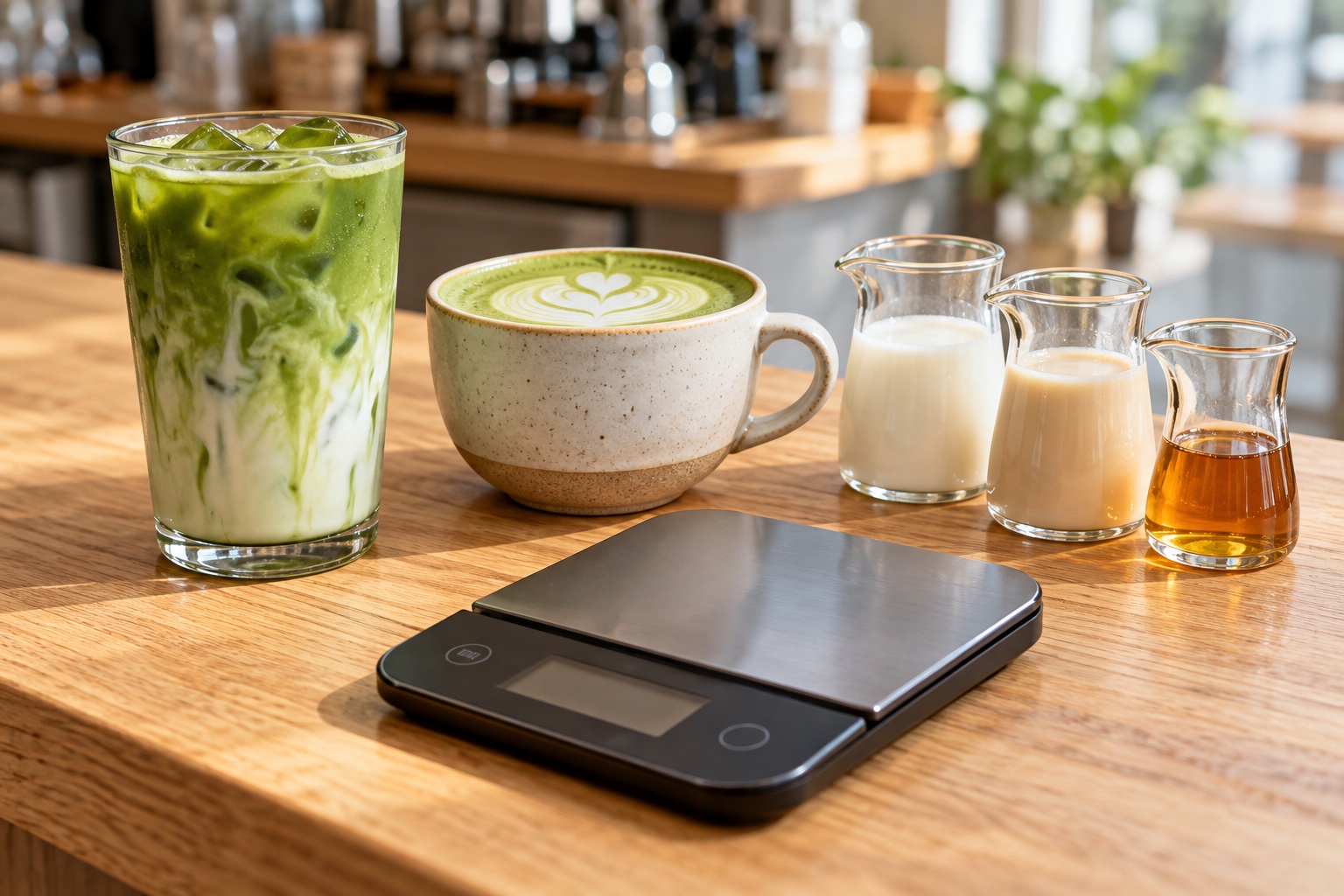
For example, 3g of matcha, 250g of milk and 10g of sugar gives 7.1 + 152.5 + 39.1, about 199kcal. Milk measured in ml with a measuring cup is also calculated in this article as 1ml = 1g. To match the values on a label, weigh the ingredients in grams on a scale.
Which data to use
| Data | Best for |
|---|---|
| Standard Tables of Food Composition in Japan (Ministry of Education, Culture, Sports, Science and Technology) | Milk, soy milk, sugar, condensed milk, matcha |
| FoodData Central (US Department of Agriculture, USDA) | US milk (whole, 2%, 1%, nonfat), plant-based milks |
| Product nutrition labels (packaging, official websites) | Ingredients that vary by brand, such as oat milk, syrup and coconut drinks |
Even among full-fat milks, Japanese whole milk has 3.8g of fat and 2.33g of saturated fatty acids per 100g, while USDA whole milk (3.25% milkfat) has 3.25g of fat and 1.86g of saturated fat, and both have 61kcal. The calories are the same but the saturated fat is not, so for Nutri-Grade calculations, use the data closest to the milk your shop uses.
The methods allowed under US rules
The US federal rule (21 CFR 101.11) requires a “reasonable basis” for the nutrition values on a menu, and allows them to be determined from nutrient databases, cookbooks, laboratory analyses, the nutrition labels on packaged foods and similar sources. When calories are worked out from the amounts of nutrients, the method of multiplying protein and carbohydrate by 4kcal per gram and fat by 9kcal is also set out in the nutrition labelling rule (21 CFR 101.9).
Calculation tables by ingredient
Multiply the per 100g values in the tables below by the grams used in one cup to get each ingredient’s calories and saturated fat. Milk values change by brand even within the same type, so if you have the label of the product you buy, use that.
Matcha and milk
| Ingredient (source) | Energy | Fat | Saturated fat | Sugars |
|---|---|---|---|---|
| Matcha (Japan tables) | 237kcal | 5.3g | 0.68g | n/a |
| Whole milk (Japan tables) | 61kcal | 3.8g | 2.33g | lactose 4.4g |
| Processed milk, low fat (Japan tables) | 42kcal | 1.0g | 0.67g | lactose 4.9g |
| Skim milk (Japan tables) | 31kcal | 0.1g | 0.05g | lactose 4.6g |
| Soy milk (Japan tables) | 43kcal | 2.8g | 0.39g | 0.9g |
| Prepared soy milk (Japan tables) | 61kcal | 3.6g | 0.50g | 1.8g |
| Whole milk 3.25% (USDA) | 61kcal | 3.25g | 1.86g | 5.05g |
| Reduced-fat milk 2% (USDA) | 50kcal | 1.98g | 1.26g | 5.06g |
| Low-fat milk 1% (USDA) | 42kcal | 0.97g | 0.633g | 5.2g |
| Nonfat milk (USDA) | 34kcal | 0.08g | 0.056g | 5.09g |
| Oat milk, unsweetened, refrigerated (USDA) | 48kcal | 2.75g | not listed | 2.32g |
| Oatly Barista Edition, UK, chilled (per 100ml) | 61kcal | 3.0g | 0.3g | 3.4g |
| Coconut milk beverage, sweetened (USDA) | 31kcal | 2.08g | 2.08g | 2.5g |
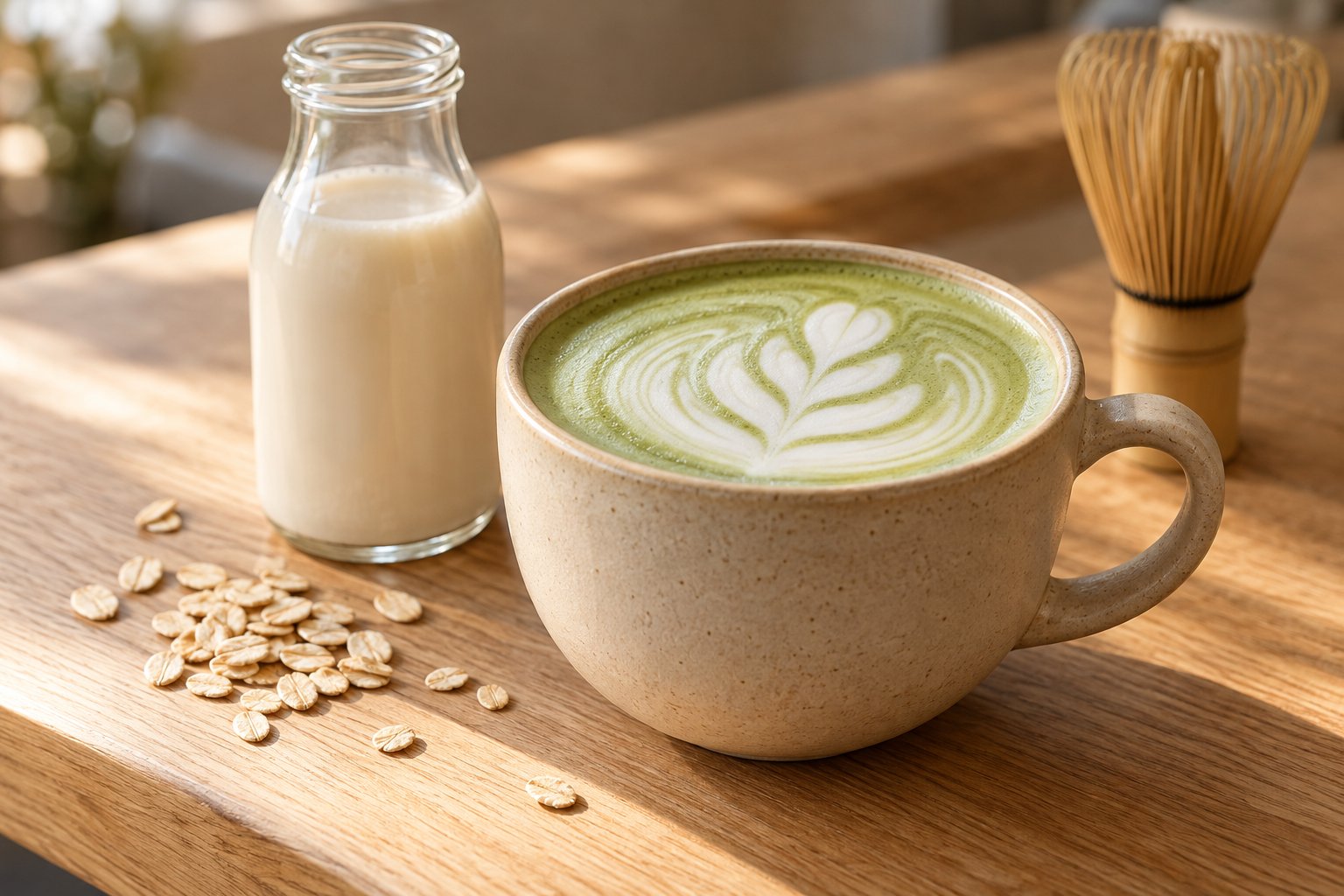
USDA’s oat milk energy is calculated with general conversion factors, and no saturated fat value is listed. Oatly’s barista version is a product with less protein and added rapeseed oil, and has about 13kcal more per 100ml than the USDA unsweetened product. The differences in composition between oat milk and dairy milk are covered in the oat milk matcha latte.
Coconut varies widely by product
In USDA’s values, coconut milk beverage in a carton is 31kcal per 100g, but canned coconut milk is 197kcal, with 18.9g of saturated fat. Using canned coconut milk adds a lot of calories and saturated fat even in small amounts. The differences between coconut ingredients, and recipes, are covered in how to make cloud matcha and coconut matcha latte.
Sweeteners
| Sweetener (source) | Energy | Sugars |
|---|---|---|
| Jōhakutō, Japanese soft white sugar (Japan tables) | 391kcal/100g | sucrose 97.9g |
| Granulated sugar (Japan tables) | 394kcal/100g | n/a |
| Granulated sugar (USDA) | 387kcal/100g | 99.8g |
| Sweetened condensed milk (Japan tables) | 314kcal/100g | sucrose 44.1g, lactose 9.1g |
| Monin Pure Cane Syrup (US label) | 25kcal/7.5mL | 6g/7.5mL |
Sweetened condensed milk has 5.59g of saturated fatty acids per 100g, so it adds saturated fat along with sweetness.
How switching milk changes one cup
For 250g of milk, whole milk is 152.5kcal, low-fat milk is 105kcal and skim milk is 77.5kcal, so the milk alone makes a difference of up to 75kcal. Soy milk is almost the same as low-fat milk, and prepared soy milk and barista oat milk are about the same as whole milk.
Calculations by amount of milk
| Milk | 150g | 250g |
|---|---|---|
| Whole milk (Japan tables) | 91.5kcal | 152.5kcal |
| Low-fat processed milk (Japan tables) | 63kcal | 105kcal |
| Skim milk (Japan tables) | 46.5kcal | 77.5kcal |
| Soy milk (Japan tables) | 64.5kcal | 107.5kcal |
| Prepared soy milk (Japan tables) | 91.5kcal | 152.5kcal |
| Reduced-fat milk 2% (USDA) | 75kcal | 125kcal |
| Oat milk, unsweetened (USDA) | 72.5kcal | 120.8kcal |
| Oatly Barista Edition (UK) | 91.5kcal | 152.5kcal |
| Coconut milk beverage, sweetened (USDA) | 46.5kcal | 77.5kcal |
For Oatly, the per 100ml label value is applied as 1ml = 1g.
Plant-based milk does not always mean fewer calories
You cannot say that switching to plant-based milk always lowers the calories. In the table above, plain “soy milk” in the Japanese tables is about 30% lower than whole milk, while prepared soy milk and barista oat milk have the same 61kcal as whole milk. Some products contain added vegetable oil, so work out menu values from the brand’s label.
Keep a value for each option
If customers can choose their milk, calculate one cup’s value for each option. Under the US rule covered below, two options are shown with a slash and three or more as a range. How to make the drink with milk other than dairy milk is covered in the section on plant-based milk in how to make a hot matcha latte.
How adding sweetener changes one cup
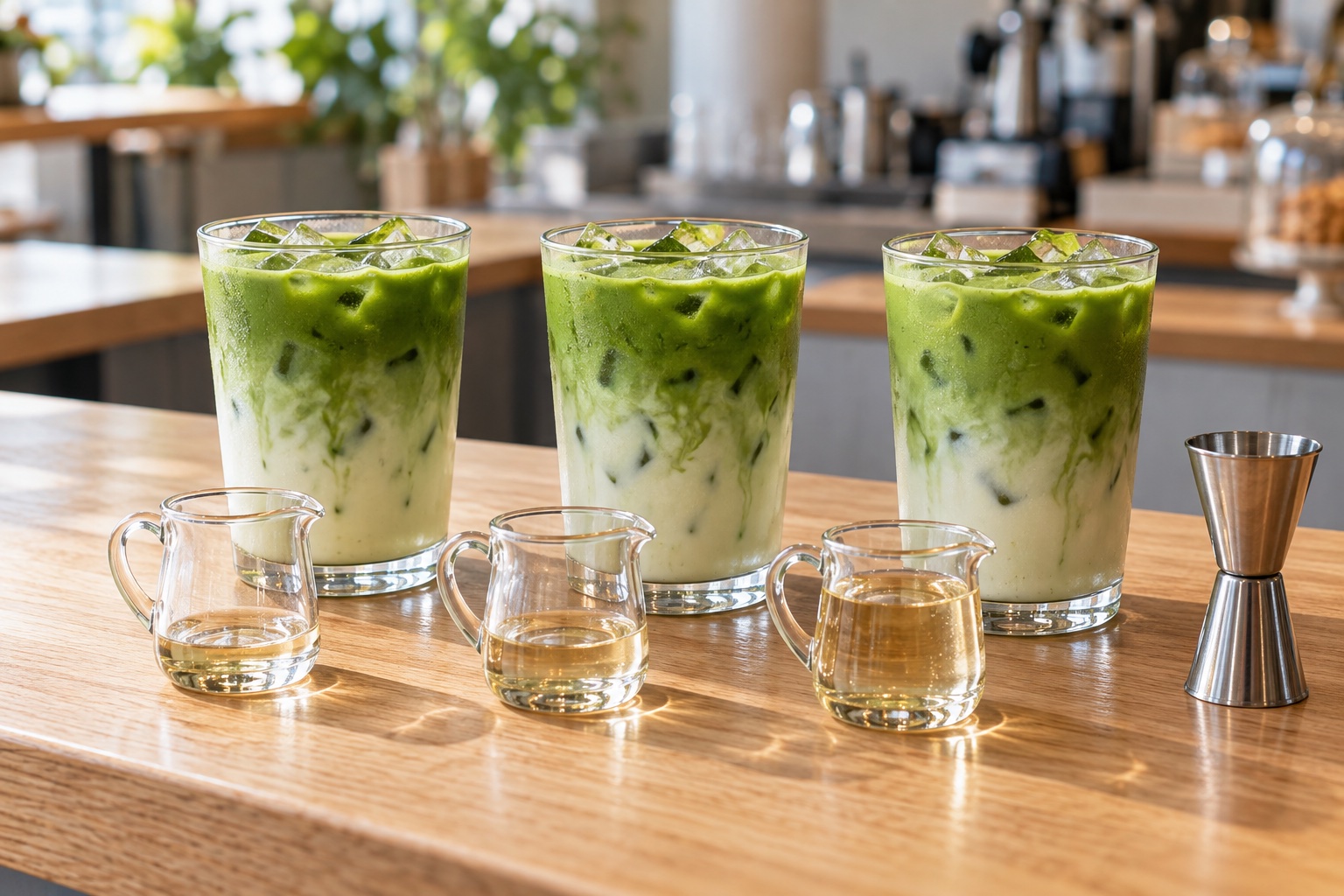
Sugar is about 3.9kcal per gram, so each step up in sweetness adds about 4 times the added grams of sugar in kcal. If you set your sweetness levels in grams of sugar, you can work out the calories for each level with the same table.
Calories by sweetness level
Thailand’s Department of Health gives the sugar in a 16oz iced tea or milk tea as 6.6 teaspoons at 100%, 3.3 at 50% and 1.7 at 25%. Converted to grams with the same page’s “4g of sugar = 1 teaspoon,” that is about 26.4g, 13.2g and 6.8g, and multiplied by jōhakutō’s 391kcal/100g it gives the following.
| Sweetness | Sugar | Calories (calculated) |
|---|---|---|
| 0% | 0g | 0kcal |
| 25% | 6.8g | about 26.6kcal |
| 50% | 13.2g | about 51.6kcal |
| 100% | 26.4g | about 103.2kcal |
How to set sweetness levels in grams of sugar, and the sugar rules in Thailand, Singapore and Indonesia, are covered in sugar levels for matcha drinks.
Syrup and condensed milk
Monin’s Pure Cane Syrup is labelled at 25kcal per 7.5mL (one pump). Two pumps is 50kcal and four pumps is 100kcal. For syrup made in the shop, calculate from the grams of sugar used. How to make and store it is covered in how to make matcha syrup.
Sweetened condensed milk is about 62.8kcal for 20g, and also adds about 1.1g of saturated fatty acids. A matcha latte sweetened with condensed milk has more saturated fat than one made equally sweet with sugar.
When using a sweetened powder
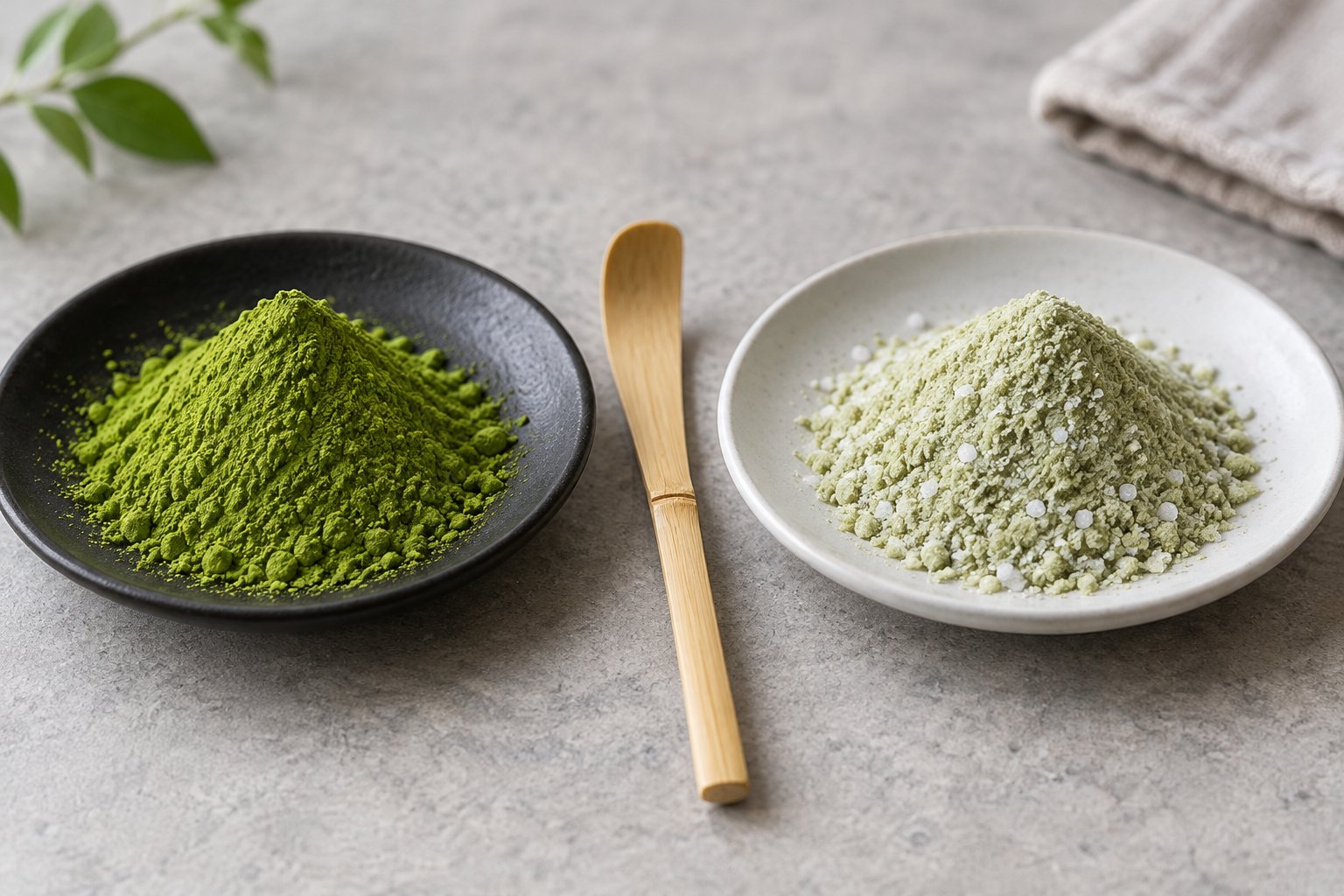
A matcha powder mixed with sugar (a latte mix) makes the powder itself much higher in calories. Kurasu also publishes a recipe that makes one cup’s base from 12.5g of sweetened matcha powder. In that case the matcha values from the composition tables do not apply, so calculate from the nutrition label on the bag.
Calculating one cup’s calories for official recipes
Calculating official recipes that give amounts in grams with the composition table values gives about 117kcal for Kurasu’s hot latte, and a range of about 85 to 263kcal for an iced drink of about 16oz depending on the sweetness and milk. All are our own calculations, not analyses of a cup made in a shop.
Three official recipes
| Recipe | Ingredients | Calories (calculated) |
|---|---|---|
| Kurasu (a coffee and tea shop in Kyoto), hot | 2.5g matcha, 5g sugar, 20g hot water, 150g milk | about 117kcal |
| Ito En, hot | 3g matcha, 30ml hot water, 150g milk (syrup to taste, separate) | about 99kcal + syrup |
| Ito En, iced | 3g matcha, 30ml hot water, 130g milk (syrup to taste, separate) | about 86kcal + syrup |
| Ministry of Agriculture, Forestry and Fisheries (MAFF), aff magazine | 1 teaspoon matcha, about 20ml hot water, 100ml milk, 3g sugar | about 73kcal + matcha |
Ito En says to add 5 to 10g of syrup to taste. The type is not stated, so add it using the label of the syrup you use. The MAFF recipe does not give the matcha in grams, so we calculated it without the matcha. With Kurasu’s recipe, switching the milk gives about 89kcal with low-fat processed milk, about 90kcal with soy milk and about 72kcal with skim milk.
Calculating an iced drink of about 16oz
This example assumes an iced drink in a cup of about 16oz: 3g of matcha, 30g of hot water and 250g of milk, plus sugar for each sweetness level. Ice is not included.
| Milk | 0% sweet | 25% (6.8g) | 50% (13.2g) | 100% (26.4g) |
|---|---|---|---|---|
| Whole milk | about 160kcal | about 186kcal | about 211kcal | about 263kcal |
| Low-fat processed milk | about 112kcal | about 139kcal | about 164kcal | about 215kcal |
| Skim milk | about 85kcal | about 111kcal | about 136kcal | about 188kcal |
| Soy milk | about 115kcal | about 141kcal | about 166kcal | about 218kcal |
Comparing with a chain’s values
Kurasu’s hot latte is about 117kcal for about 177g of liquid, so about 66kcal per 100g. Starbucks Singapore’s Matcha Latte is 76kcal per 100mL, and its sugar after subtracting lactose from total sugars is 2.8g. When comparing your values with a chain’s, compare per 100mL, not per cup.
Nutrition labelling on menus
Singapore’s Nutri-Grade sets the grade from sugar and saturated fat per 100ml, not from calories, so in a matcha latte the saturated fat in the milk decides the grade. In the US, large chains are required to show calories on their menus.
Singapore: the grade changes with milk and sweetness
According to HealthHub from Singapore’s Ministry of Health, Nutri-Grade gives a grade for sugar and for saturated fat per 100ml separately and uses the poorer one. For saturated fat, 0.7g or less is A, 1.2g or less is B, 2.8g or less is C, and above that is D. According to the Health Promotion Board (HPB), sugar is total sugars minus any declared lactose and galactose. That means maltose in oat milk and sucrose in soy milk count as sugar.
The grades for the 16oz example above (calculated on the liquid before ice) are as follows. For dairy milk, its sugar is subtracted as lactose.
| Milk | Saturated fat (per 100ml) | Sugar at 50% sweet (per 100ml) | Grade (poorer one) |
|---|---|---|---|
| Whole milk | about 1.97g (C) | about 4.5g (B) | C |
| Low-fat processed milk | about 0.57g (A) | about 4.5g (B) | B |
| Soy milk | about 0.33g (A) | about 5.2g (C) | C |
| Oatly Barista Edition | about 0.25g (A) | about 7.3g (C) | C |
| Coconut milk beverage, sweetened | about 1.76g (C) | about 6.6g (C) | C |
Switching to low-fat milk lowers the grade from C to B, while plant-based milks are grade C at 50% sweetness because the sugar in the milk is counted. At Starbucks Singapore too, the Matcha Latte with milk is shown as C and the low-fat Less Sweet as B. HPB covers freshly made drinks from 30 December 2023, with interim measures for businesses with annual sales of S$1 million or less and fewer than 10 outlets. How to state the basis of the grade for drinks with selectable sweetness is covered in sugar levels for matcha drinks.
US: calorie labelling for chains with 20 or more locations
The US Food and Drug Administration (FDA) requires chains of 20 or more locations selling substantially the same menu items under the same name to show calories on menus and menu boards. On request, they must provide nutrition information such as saturated fat and sugars in writing, and post a statement to the effect that 2,000kcal a day is used for general nutrition advice but calorie needs vary. The rules have applied since 7 May 2018.
Source: US Food and Drug Administration (FDA), “Menu Labeling Requirements” https://www.fda.gov/food/nutrition-food-labeling-and-critical-foods/menu-labeling-requirements
How to write it in the US: rounding, options and ice
The parts of the federal rule (21 CFR 101.11) that apply to a matcha latte are as follows.
- Rounding: up to 50kcal, in 5kcal steps; above 50kcal, in 10kcal steps. The about 211kcal above becomes “210 Cal”
- Options: with two milks, a slash such as “160/210”; with three or more, a range such as “110-210”
- Ice: for drinks made by staff, use the full cup volume without ice. If there is a set pour amount or a set amount of ice, use that amount
In Indonesia, grades for sugar, salt and fat in freshly made drinks (Nutri-Level) were set in 2026. The details are in the Indonesia section of sugar levels for matcha drinks.
Where calculations drift, and what to check when buying
The calculated values assume that the amounts going into each cup are the same every time. The real cup drifts with how the milk is poured, the amount of foam and toppings, so set how to measure on a recipe card.
Where it drifts
- Amount of milk: the amount of steamed foam changes how much milk fits in the cup. Set the pour in grams
- Ice: in iced drinks, the amount of ice changes the amount of milk. Set the amount of ice and calculate with the milk that fits
- Toppings: calculate cream, sauces and pearls separately and add them
- Data differences: even for the same milk, saturated fat differs between the Japanese tables, USDA and the product label
Work out the cost per cup with the same table
The “grams per cup” used for calories can be used as they are for the cost per cup. Matcha cost is “purchase price per kg ÷ 1,000 × grams used per cup,” and milk and sweetener are “purchase price per pack ÷ volume × amount used per cup.” Listing cost and calories side by side for each type of milk also makes it easier to set surcharges for options. How to set the selling price is covered in matcha latte prices, and how the purchase price of matcha is decided in how matcha prices are set.
Labels to check when buying
- Milk: energy, saturated fat and sugars per 100ml (for plant-based milks, also the type of sugar)
- Syrup: serving size, energy and total sugars
- Matcha powder: whether the only ingredient is matcha, or whether it contains sugar or creamer
- Condensed milk and latte mixes: saturated fat and sugars
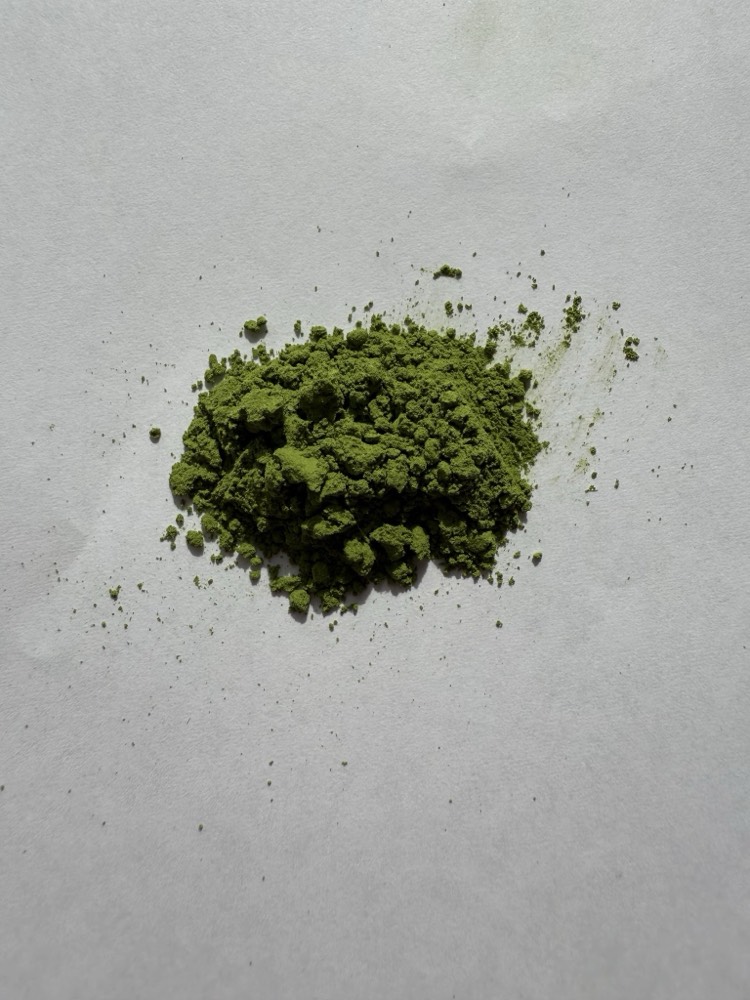
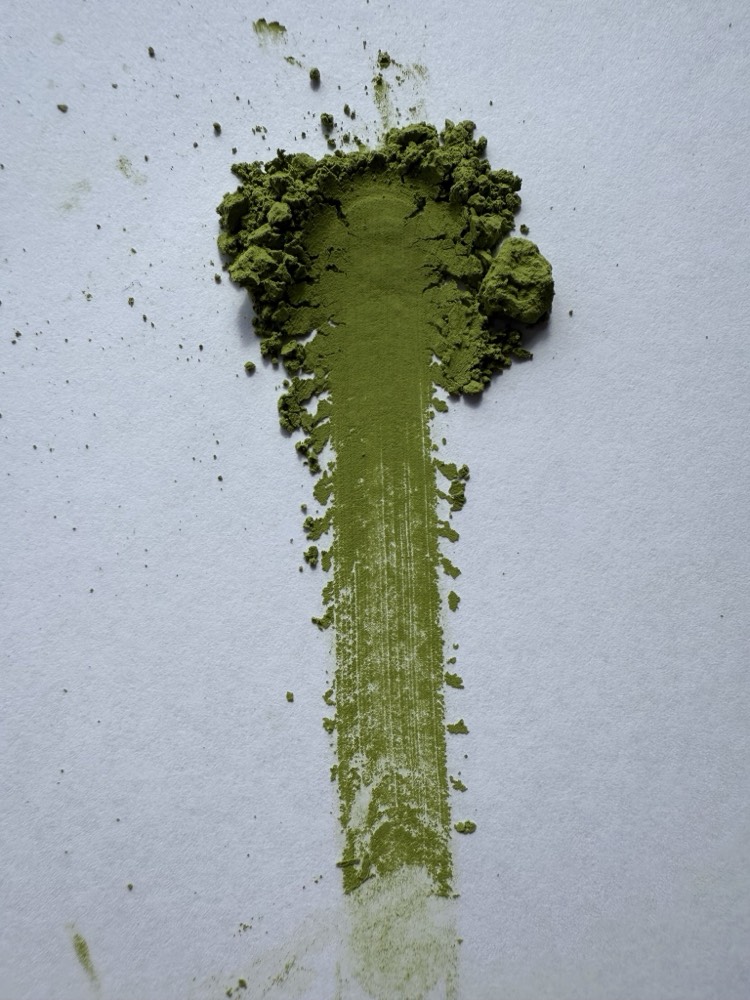
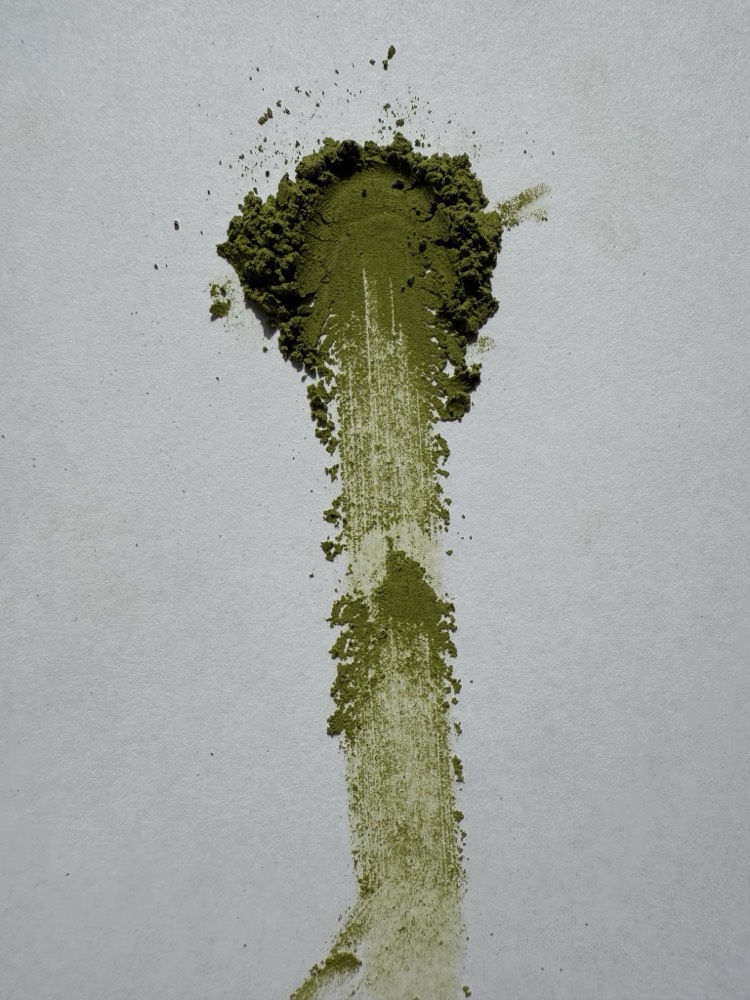
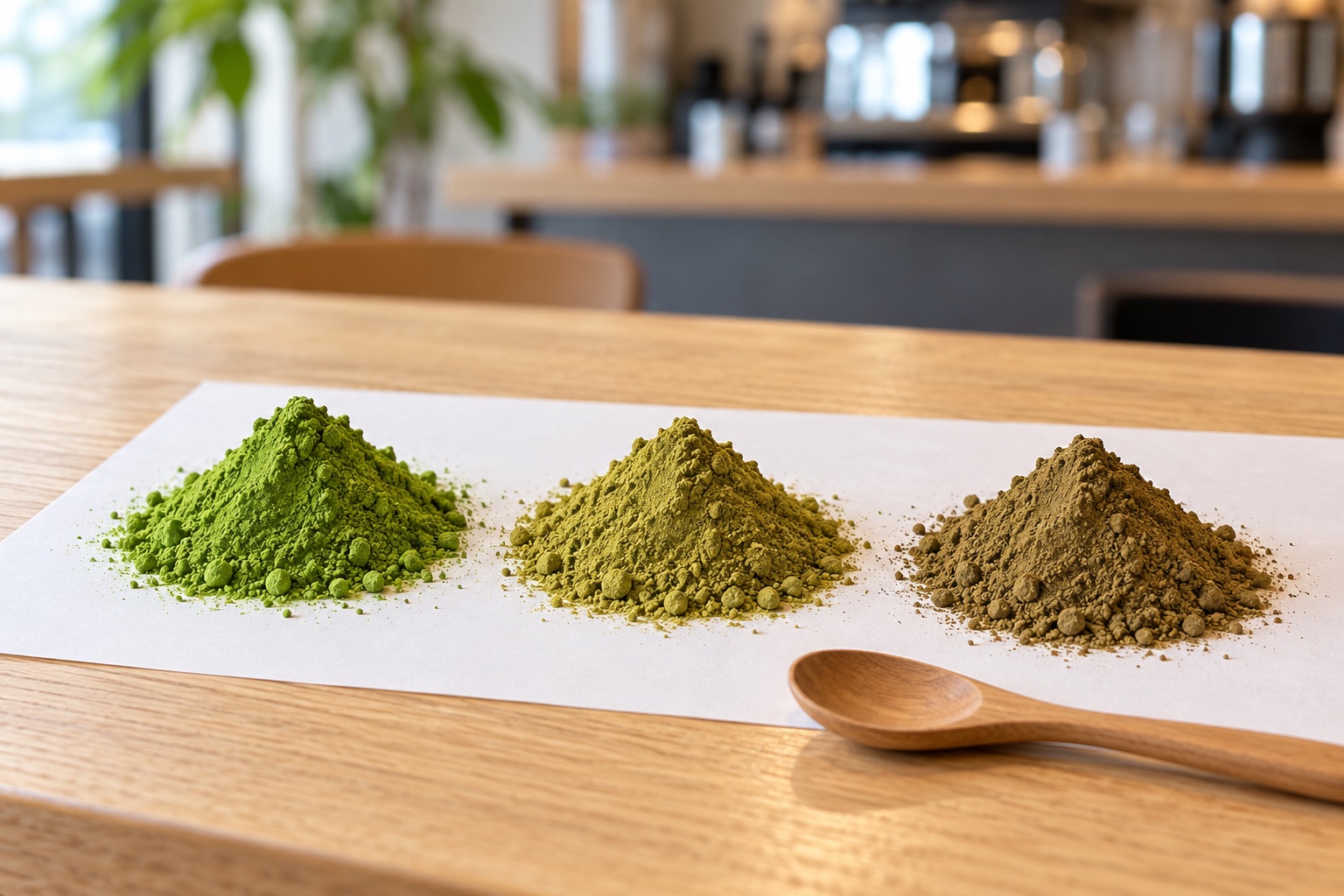
If the powder is matcha only, the matcha’s calories per cup can be calculated with the composition table values. Omakase Matcha supplies matcha sourced from the growing regions of Uji, Yame, Kagoshima, Shizuoka and Miyazaki from 1kg, and you can choose 3 samples.
Sources
- Ministry of Education, Culture, Sports, Science and Technology, Food Composition Database (Standard Tables of Food Composition in Japan, 8th revised edition, 2023 supplement), matcha (in Japanese) https://fooddb.mext.go.jp/details/details.pl?ITEM_NO=16_16035_8
- Same database, matcha, fatty acids (in Japanese) https://fooddb.mext.go.jp/details/details.pl?ITEM_NO=16_16035_8&MODE=4
- Same database, whole milk (in Japanese) https://fooddb.mext.go.jp/details/details.pl?ITEM_NO=13_13003_7
- Same database, processed milk, low fat (in Japanese) https://fooddb.mext.go.jp/details/details.pl?ITEM_NO=13_13005_7
- Same database, skim milk (in Japanese) https://fooddb.mext.go.jp/details/details.pl?ITEM_NO=13_13006_7
- Same database, soy milk (in Japanese) https://fooddb.mext.go.jp/details/details.pl?ITEM_NO=4_04052_8
- Same database, prepared soy milk (in Japanese) https://fooddb.mext.go.jp/details/details.pl?ITEM_NO=4_04053_8
- Same database, jōhakutō, soft white sugar (in Japanese) https://fooddb.mext.go.jp/details/details.pl?ITEM_NO=3_03003_8
- Same database, granulated sugar (in Japanese) https://fooddb.mext.go.jp/details/details.pl?ITEM_NO=3_03005_8
- Same database, sweetened condensed milk (in Japanese) https://fooddb.mext.go.jp/details/details.pl?ITEM_NO=13_13013_7
- USDA FoodData Central, “Milk, whole, 3.25% milkfat, with added vitamin D” https://fdc.nal.usda.gov/food-details/171265/nutrients
- USDA FoodData Central, “Milk, reduced fat, fluid, 2% milkfat, with added vitamin A and vitamin D” https://fdc.nal.usda.gov/food-details/171267/nutrients
- USDA FoodData Central, “Milk, lowfat, fluid, 1% milkfat, with added vitamin A and vitamin D” https://fdc.nal.usda.gov/food-details/170872/nutrients
- USDA FoodData Central, “Milk, nonfat, fluid, with added vitamin A and vitamin D (fat free or skim)” https://fdc.nal.usda.gov/food-details/171269/nutrients
- USDA FoodData Central, “Oat milk, unsweetened, plain, refrigerated” https://fdc.nal.usda.gov/food-details/2257046/nutrients
- USDA FoodData Central, “Beverages, coconut milk, sweetened, fortified with calcium, vitamins A, B12, D2” https://fdc.nal.usda.gov/food-details/174116/nutrients
- USDA FoodData Central, “Nuts, coconut milk, canned (liquid expressed from grated meat and water)” https://fdc.nal.usda.gov/food-details/170173/nutrients
- USDA FoodData Central, “Sugars, granulated” https://fdc.nal.usda.gov/food-details/169655/nutrients
- Oatly, “Chilled Oat Drink Barista Edition” https://www.oatly.com/en-gb/products/chilled-oat-drink/chilled-oat-drink-barista-edition-1l
- Monin US, “Pure Cane Syrup” https://monin.us/products/pure-cane-syrup
- Starbucks Singapore, “Matcha Latte” https://www.starbucks.com.sg/menu/beverages/teavana-tea/matcha-latte
- Starbucks Singapore, “Low-fat Matcha Latte (Less Sweet)” https://www.starbucks.com.sg/low-fat-matcha-latte-less-sweet
- Starbucks Indonesia, “Green Tea Latte” https://www.starbucks.co.id/menu/beverage-list/others/teas/tea-latte/green-tea-latte
- Kurasu, “Matcha Recipe” https://kurasu.kyoto/blogs/recipe/matcha-recipe
- Ito En, “茶リスタ 小山和裕氏監修!本格抹茶ラテ” (Authentic matcha latte, in Japanese) https://www.itoen.jp/recipe/45614/
- MAFF, aff magazine April 2017, “抹茶を使ったおいしいレシピ” (Recipes using matcha, in Japanese) https://www.maff.go.jp/j/pr/aff/1704/spe2_02.html
- Thailand Department of Health, Bureau of Dental Health, “ภารกิจสำรวจเครื่องดื่มหวานน้อยในร้านค้าชุมชน” (in Thai) https://dental.anamai.moph.go.th/th/hl4/
- Ministry of Health Singapore, HealthHub, “Nutri-Grade Mark” https://www.healthhub.sg/programmes/nutrition-hub/nutri-grade-mark
- Health Promotion Board (HPB), “Measures for Nutri-Grade” https://hpb.gov.sg/healthy-living/food-beverage/nutri-grade
- US Food and Drug Administration (FDA), “Menu Labeling Requirements” https://www.fda.gov/food/nutrition-food-labeling-and-critical-foods/menu-labeling-requirements
- US Code of Federal Regulations, 21 CFR 101.11, “Nutrition labeling of standard menu items in covered establishments” https://www.ecfr.gov/current/title-21/chapter-I/subchapter-B/part-101/subpart-A/section-101.11
- US Code of Federal Regulations, 21 CFR 101.9, “Nutrition labeling of food” https://www.ecfr.gov/current/title-21/chapter-I/subchapter-B/part-101/subpart-A/section-101.9