
 Reviewed by: Takahiro Sugiyama (CEO, meguri Inc.)
Some cafés in Singapore, Malaysia and Thailand serve many Muslim customers. When you serve matcha lattes, customers or business partners may ask “Is matcha halal?” or “What should we check?” Religious rulings belong to each country’s certification body, so this article adds no judgement of our own and relies only on the official wording of MUIS, JAKIM, CICOT and the Thai standard.
What is halal matcha?
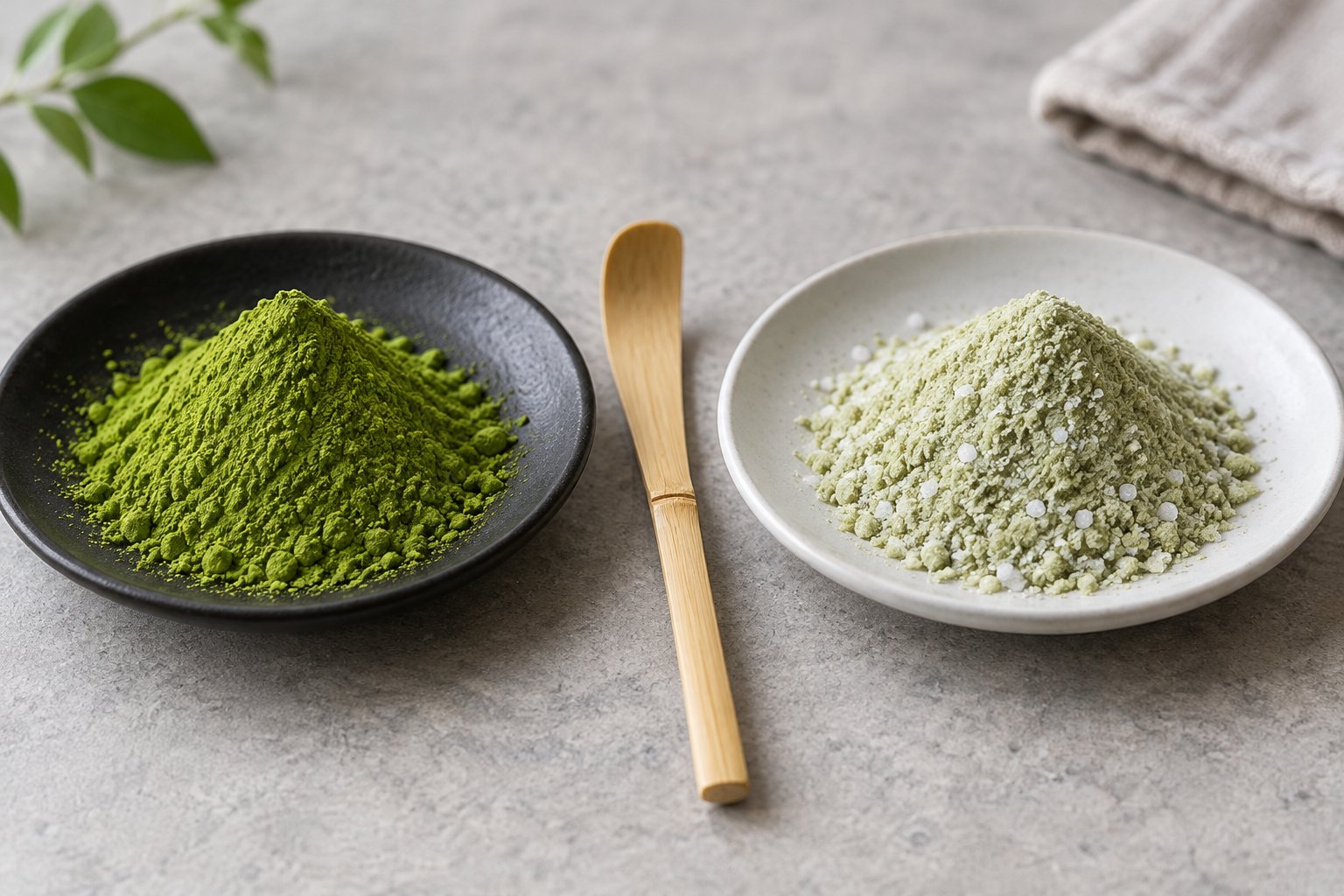
Whether something is halal (permitted under Islamic law) is checked against the standards of each country’s certification body. Matcha is tea leaves ground into powder. Separately from whether the raw material is a plant, the bodies and the standard set conditions on processing, added ingredients and equipment.
What MUIS says
MUIS (Majlis Ugama Islam Singapura, the Islamic Religious Council of Singapore) states that most food and drinks are considered halal unless they are stated clearly in the Quran and Hadith (the sayings of the Prophet) as forbidden. For processed food, it lists four conditions:
- It does not contain components or products of non-halal animals, or of animals not slaughtered according to Islamic law
- It does not contain anything non-halal, in large or small quantities
- It is made with equipment and facilities free from cross-mixing with non-halal substances
- It is kept fully separated from food that does not meet these requirements during preparation, processing, storage and transport
What the Thai standard says
Thai Agricultural Standard TAS 8400-2025 (Halal Food, published in the Royal Gazette on 3 February 2026) states that all plants are halal, and poisonous or harmful plants are not halal unless the poison or harm is removed. Products made from plants must follow the procedures in the standard. Products and drinks containing alcohol are treated as food prohibited under Islamic law and may not be used in cooking.
The certification the standard requires
The same standard states that halal food certified under it must follow Islamic law and be certified by an Islamic organisation. In Malaysia, imported food can only be described as halal with certification from a foreign body recognised by JAKIM, or by meeting the requirements (see below).
Ingredients that add more to check: mixes, flavourings, dairy and equipment
Even if plain matcha powder needs few checks, latte mixes, flavourings, milk and shop equipment add more. MUIS sorts the ingredients used in eating establishment certification into four risk levels.
MUIS ingredient categories
The categories MUIS sets out in an annex to its certification conditions for Eating Establishments are as follows.
| Category | MUIS definition | Examples | Documents required |
|---|---|---|---|
| Low | Mainly from non-animal sources, unprocessed or minimally processed | Vegetables, fruits, rice, salt and sugar, ice, spices | Specification or label |
| Medium-Low | From non-animal sources, processed without animal-based additives | Soy bean products, flour, vegetable oil, food additives not of animal origin | MUIS questionnaire if necessary |
| Medium-High | Highly processed, may involve fermentation, or with animal-derived substances added | Dairy products, enzymes, animal-derived E400s additives, confectionery | Questionnaire; MUIS-recognised certificate or laboratory analysis report if necessary |
| High | Contain flavouring, gelatine, or meat and its derivatives | Flavourings, gelatine, meat | Halal certificate from MUIS or a MUIS-recognised body |
Matcha itself is not named among the examples in this table. Which category it falls under is at MUIS’s discretion. MUIS notes that the table is a general guideline and that it may request additional documents where necessary.
Source: MUIS, “Halal Certification Conditions: Eating Establishment Scheme (Category 1) Version 4.2”, Annex A https://go.gov.sg/hcc-eec1-v4-2
Latte mixes and flavourings
Latte mixes that blend sugar, milk powder, flavourings and other ingredients add one more thing to check for every ingredient. In the MUIS categories, flavourings are High and need a halal certificate from MUIS or a MUIS-recognised body. If you use matcha syrups or flavoured powders, check whether the ingredients include flavourings.
On lecithin, an emulsifier (an additive that helps oil and water mix) often used in mixes, MUIS explains that it is halal if it comes from plants and non-halal if it comes from pigs or other animals not slaughtered according to Islamic law, and that until the status is clear it is Syubhah (doubtful) and should be avoided. On a mix specification, check the source of the emulsifier too.
Milk and equipment
Milk for lattes is a dairy product, which is Medium-High in the MUIS categories. For equipment, the MUIS conditions require that equipment and utensils which come into contact with pork or its derivatives are reported to MUIS and undergo ritual cleansing by MUIS. The Thai standard also requires food service to clearly separate tools and utensils and use them only for halal food.
How certification works in three countries: MUIS, JAKIM and CICOT
MUIS in Singapore, JAKIM in Malaysia and CICOT in Thailand are the main halal certification bodies. Certificates for matcha made in Japan are checked against each body’s list of recognised foreign certifiers.
| Country | Body | Imported products |
|---|---|---|
| Singapore | MUIS (Islamic Religious Council of Singapore) | Does not certify food made overseas; relies on foreign certification bodies it recognises (FHCB) |
| Malaysia | JAKIM (Department of Islamic Development Malaysia) | Without certification from a foreign body recognised by JAKIM, or meeting the requirements, the food cannot be described as halal |
| Thailand | CICOT (Central Islamic Council of Thailand) | Publishes the foreign bodies it recognises |
Singapore: MUIS
Under the Administration of Muslim Law Act (AMLA), MUIS holds the sole legal power to issue halal certificates in Singapore. Issuing a certificate, or using the MUIS halal certification mark or any colourable imitation of it, without approval can lead to a fine of up to 10,000 Singapore dollars, imprisonment of up to 12 months, or both.
MUIS does not certify food made overseas. Imported products are certified by foreign certification bodies that MUIS recognises. MUIS recognition is valid for 3 years, and the names and marks of recognised bodies are published on the MUIS website.
Malaysia: JAKIM
The list JAKIM publishes quotes Malaysia’s 2011 order on the certification and marking of halal. Paragraph 5 (1) and (2) of the Trade Descriptions (Certification and Marking of Halal) Order 2011, as quoted in the list, says:
- All imported food and goods marketed in Malaysia shall not be described as halal unless they comply with the requirements or are certified as halal by a foreign halal certification body recognised by JAKIM
- The importer or manufacturer of food and goods certified by such a body shall mark the name of that certification body on them
Source: JAKIM, “The Recognized Foreign Halal Certification Bodies & Authorities” (effective 21 August 2026) https://www.halal.gov.my/pdf/cb/FHCB21August2026.pdf
Imported food sold in Malaysia cannot be described as halal unless it meets the requirements or is certified by a foreign body recognised by JAKIM. For certified food, the importer or manufacturer marks the name of the certification body.
Thailand: CICOT
CICOT’s certification rules (R-CICOT-01) define the halal product certificate as issued by the provincial Islamic committee, and the permit to use the halal mark as issued by CICOT. Applicants are described as seeking certification voluntarily.
Japanese certifiers recognised by all three bodies
As of 20 October 2026, five Japanese bodies appear on all three lists of MUIS, JAKIM and CICOT. Which lists a body appears on differs.
Comparing the lists
We compared each body’s public list on 20 October 2026. Names are based on the English names in each list (the wording differs slightly between lists).
| Body (as listed) | MUIS | JAKIM | CICOT |
|---|---|---|---|
| Japan Halal Foundation (JHF) | Yes (until 20 July 2029) | Yes | Yes |
| Muslim Professional Japan Association (MPJA) | Yes (until 7 July 2029) | Yes | Yes |
| Japan Islamic Trust (JIT) | Yes (until 9 March 2029) | Yes | Yes |
| Japan Muslim Association (JMA) | Yes (until 2 February 2029) | Yes | Yes |
| NPO Japan Halal Association (JHA) | Yes (until 17 December 2028) | Yes | Yes |
| Nippon Asia Halal Association (NAHA) | Not listed | Yes | Yes |
| Japan Global Halal Certification Body (JGH) | Not listed | Not listed | Yes |
| Japan Halal Certification Promotion Organization (JHCPO) | Not listed | Not listed | Yes |
| LPPOM-JAPAN | Not listed | Not listed | Yes |
Dates in the MUIS column are the end of the recognition validity period shown in the MUIS list. The JAKIM list is the version effective 21 August 2026 and contains 96 bodies from 49 countries and regions. In the CICOT list, all nine Japanese bodies were shown as “Active”.
The lists change
MUIS and JAKIM both set the validity of recognition for foreign bodies at 3 years. MUIS strongly advises checking the latest list of MUIS-recognised bodies before buying ingredients. When you receive a certificate, check the certifier’s name against the list on that day.
When a café in Singapore applies for MUIS certification
MUIS halal certification is voluntary; if you apply, it is under the Eating Establishment (EE) scheme. The conditions are set out in Version 4.2, issued on 7 September 2026.
The two EE categories
The EE scheme is issued to retail food establishments such as restaurants, snack bars, bakeries, stalls in food courts and temporary stalls at bazaars and trade fairs. In the MUIS documents, Category 1 covers hawker stalls, snack bars and bakeries, school canteen stalls and short-term stalls, and Category 2 covers restaurants, kiosks, chain outlets and others. Franchise and chain outlets fall under Category 2 whatever type of establishment they are. Snack bars and bakeries with a central kitchen also fall under Category 2.
Main conditions
| Condition | Category 1 | Category 2 |
|---|---|---|
| Permanent Muslim staff | At least 1 | At least 2 (one appointed as Halal Assurance Officer) |
| Ingredients | Use only halal ingredients declared to MUIS. Back them with a specification or label before purchase | Same |
| Labelling | Delivery orders, invoices and ingredients in English, with product name, manufacturer name and address | Same |
| Certificates | Invalid if the certified item is repacked outside the premises where it was certified | Same |
In Category 1, at least the owner representative must also hold a valid MUIS Halal Competency Assessment (HCA) certificate. GoBusiness gives an estimated processing time of 40 to 60 days and a validity of 1 to 3 years.
Watch out for repacked matcha
Under the MUIS conditions, a halal certificate is no longer valid if the certified item is repacked outside the premises where it was certified. If a distributor imports matcha in large bags and sells it in smaller packs, check where it was repacked. Shop licences are covered in How to Start a Matcha Cafe, and import procedures in How to Import Matcha into Singapore.
What shops in Thailand and Malaysia should check
In Thailand, look at CICOT and the TAS 8400-2025 standard; in Malaysia, look at the list of bodies JAKIM recognises. In both, whether the shop itself claims to be halal is a separate question from the certificate for the matcha it buys.
Thailand: shop requirements and permit periods
TAS 8400-2025 requires food service to clearly separate tools and utensils and use them only for halal food, and not to serve alcoholic drinks. In a notice dated 6 July 2026, CICOT explained that under its 2025 regulation, the period of the permit to use the halal mark changed from 1 year to 2 or 3 years. Conditions for the 2- or 3-year period include having held the permit for at least 2 consecutive years. Import procedures for Thailand are in How to Import Matcha into Thailand.
Malaysia: labelling imported products
In Malaysia, selling imported matcha as halal requires certification from a foreign body recognised by JAKIM, or meeting the requirements, and the name of the certification body is marked on the food. For Japanese matcha, check whether the certificate is from one of the 6 bodies on the JAKIM list.
Documents to ask your supplier for
Ask for three documents for each product: a copy of the certificate, the ingredient specification and a certificate of analysis (COA). Read the certificate down to the certifier, what it covers and the expiry date.
Documents and what to check
| Document | What to check |
|---|---|
| Copy of the halal certificate | Certifier’s name, product name and production site covered, expiry date. Whether the certifier is on the list of the authority in your country |
| Ingredient specification | Whether it is matcha only. For mixes, the source of flavourings, emulsifiers and dairy, and whether the flavourings use alcohol |
| Certificate of analysis (COA) | Test results for each lot. Whether the lot number matches the bags you received |
| Repacking | Whether it was packed at the certified site or repacked elsewhere |
How to tell plain matcha from powders mixed with sugar or milk is covered in Pure Matcha, and what to check in a quote in Bulk Matcha: How to Buy Matcha Wholesale.
How to read a certificate
Check that the product name on the certificate matches the product you are buying. A certificate for another product from the same company, or from a different factory, does not cover the matcha you are buying. Also check that it has not expired, and ask when it is due for renewal.
When you ask Omakase Matcha
If you need a halal certificate, ask for the certificate for each product: the issuing body and validity can be confirmed product by product. When you request a quote or samples, tell us your country and which list (MUIS, JAKIM or CICOT) the certifier needs to be on.
Sources
- MUIS, “About” https://www.muis.gov.sg/halal/about/
- MUIS, “For consumers” https://www.muis.gov.sg/halal/for-consumers/
- MUIS, “Foreign Halal Certification Bodies (FHCB)” https://www.muis.gov.sg/halal/fhcb/
- MUIS e-Service, “FHCB” (list of MUIS-recognised foreign certification bodies, accessed 20 October 2026) https://halal.muis.gov.sg/fhcb
- MUIS, “Scheme types & eligibility criteria” https://www.muis.gov.sg/halal/for-business/scheme-types---eligibility-criteria/
- MUIS, “Halal Certification Conditions: Eating Establishment Scheme (Category 1) Version 4.2” https://go.gov.sg/hcc-eec1-v4-2
- MUIS, “Halal Certification Conditions: Eating Establishment Scheme (Category 2) Version 4.2” https://go.gov.sg/hcc-eec2-v4-2
- MUIS, “Eating Establishment Scheme - Categories 1 & 2” https://isomer-user-content.by.gov.sg/48/ac48e97a-8402-4a14-83db-74c34baf9df4/Eating%20Establishment%20Scheme%20%20Catergories%201%20%2022022.pdf
- GoBusiness, “Halal Certification” https://licensing.gobusiness.gov.sg/licence-directory/muis/halal-certification
- JAKIM, “The Recognized Foreign Halal Certification Bodies & Authorities” (effective 21 August 2026) https://www.halal.gov.my/pdf/cb/FHCB21August2026.pdf
- CICOT, “Recognised Halal Certification Bodies” https://www.halal.or.th/en/foreign_halal_cb/search
- CICOT, “R-CICOT-01 หลักเกณฑ์และเงื่อนไขว่าด้วยการตรวจสอบและการรับรองฮาลาล” (Rules and conditions for halal inspection and certification, in Thai) https://www.halal.or.th/storages/documents/manage/221_156.pdf
- CICOT Halal Affairs Department, Notice No. 5/2569 (in Thai) https://www.halal.or.th/storages/documents/manage/239_186.pdf
- National Bureau of Agricultural Commodity and Food Standards (ACFS), “มกษ. 8400-2568 อาหารฮาลาล” (TAS 8400-2025 Halal Food, in Thai) https://www.halal.or.th/storages/documents/manage/250_221.pdf