Reviewed by: Takahiro Sugiyama (CEO, meguri Inc.)

On wholesale sites and online shops outside Japan, matcha is sold under grades such as “Ceremonial,” “Latte” and “Culinary.” These names have no official standard, and the same name can mean different things from one seller to the next. If you check the harvest, shading and milling behind the grades against Japanese statistics and research, you can compare matcha by what it is, not by its label.
What are matcha grades?
Matcha grades are names that sellers give as a guide to how the matcha is meant to be used. Neither Japan’s industry labelling standard nor the international standard that classifies tea types has ceremonial, latte or culinary categories.
The three common names
Matcha sold outside Japan often carries names like these:
- Ceremonial: matcha meant to be whisked with hot water alone and drunk straight
- Latte: matcha meant to be mixed with milk or sweeteners. Some sellers call it “Premium,” “Cafe” or “Daily”
- Culinary: matcha meant to be mixed into sweets, cooking or sweet drinks
Some sellers use only two grades, ceremonial and culinary, while others divide them further. Matcha specialty shops and online stores in Thailand use the same three names in English.
Japan’s labelling standard only defines what matcha is
The Green Tea Labelling Standard of the Japan Tea Central Public Interest Incorporated Association (last revised on 10 July 2026) defines matcha as tencha ground into a fine powder with a tea mill or similar. Tencha (the tea leaves used as the raw material for matcha) comes from tea fields covered with reed screens, straw mats or shade cloth for about two to three weeks before picking. The leaves are steamed and then dried without rolling.
The standard sets no grades. Instead, it prohibits labels such as “best,” “top grade,” “specially selected” and “finest” when they have no objective basis, treating them as vague labels. Japan’s standard decides whether a product is matcha, not which grade it is.
ISO 20715:2023 only classifies tea types
ISO 20715:2023 is an international standard that classifies the types of tea made from the tea plant (Camellia sinensis). It was published in March 2023 and applies to the production, scientific research, teaching, trade and inspection of tea.
| Item | ISO 20715:2023 official page |
|---|---|
| Title | Tea — Classification of tea types |
| Scope | Establishes a classification for the types of tea produced from Camellia sinensis |
| Applies to | Production, scientific research, teaching, trade and inspection of tea |
| Publication date | 2023-03 |
Source: ISO, “ISO 20715:2023 Tea — Classification of tea types” https://www.iso.org/standard/75419.html
The standard defines matcha tea as one type of green tea: young leaves and buds grown in the shade, steamed, dried without rolling, then finely ground into powder. The types are divided by processing method, and the table of contents shows no item that divides matcha further into grades.
Ceremonial vs latte vs culinary matcha
According to sellers, the three grades are divided mainly by harvest and milling, which changes color, taste and use. Each seller draws the lines differently, so the table below shows tendencies common in the descriptions of sellers outside Japan.
Comparison table
| Item | Ceremonial | Latte | Culinary |
|---|---|---|---|
| Harvest, as described | First flush | First flush only, or first and second flush blended | Second flush and later |
| Milling, as described | Often stone-milled | Often machine-milled | Machine-milled |
| Color | Bright, vivid green | Vivid to slightly deep green | Green with a yellowish or dull tone |
| Whisked with hot water | Strong umami, mild astringency | Somewhat more astringent and bitter | Astringent and bitter |
| Mixed with milk | Matcha flavor fades easily | Color and flavor tend to hold | Color tends to turn dull |
| Best used for | Drinking straight, whisked with hot water | Lattes, sweet drinks | Baked goods, ice cream |
The contents can overlap
Because there is no shared standard for where the lines fall, one seller’s “Latte” and another seller’s “Ceremonial” can have the same harvest and milling. Comparing what is inside, by harvest, composition and milling as in the sections below, is more reliable than comparing the grade names side by side.
Harvest makes about a twofold difference in price
Tencha, the raw material for matcha, averaged 10,030 yen per kg for first flush and 4,950 yen for second flush across Japan in the 2025 crop. The harvest (which picking of the year the tea comes from) makes about a twofold difference in the price of the raw material.
Tencha and sencha prices by harvest
These are the 2025 crop prices for aracha (tea leaves steamed and dried after picking, before final processing), from a MAFF (Japan’s Ministry of Agriculture, Forestry and Fisheries) report based on a survey by the National Federation of Tea Producers’ Associations.
| 2025 crop (Japan) | First flush | Second flush | Third flush | Autumn/winter | Average of all harvests |
|---|---|---|---|---|---|
| Tencha | 10,030 yen | 4,950 yen | ― | ― | 8,562 yen |
| Sencha | 2,278 yen | 1,321 yen | 1,378 yen | 1,807 yen | 1,746 yen |
Prices are per kg. “―” means the report gives no figure.
Even second flush tencha costs more than twice as much as first flush sencha. On the average of all harvests, tencha cost about 4.9 times as much as sencha. How prices rose and where they stand in 2026 is covered in Is There Still a Matcha Shortage?.
Second flush has more astringent compounds
Minamikyushu city, the home of Chiran tea, explains that second flush grows in a season with longer hours of sunlight than first flush, so it contains more catechins and caffeine, the sources of bitterness and astringency, and less umami and sweetness. Sellers’ descriptions, first flush for matcha whisked with hot water alone and second flush or later for matcha mixed with milk or sugar, follow this difference in composition.
Third flush and later tencha do not appear in the statistics
The table above gives no price for third flush or autumn/winter tencha. A paper by Yoriyuki Nakamura of the University of Shizuoka states that tencha is made not only in the first flush season but also in the second flush and autumn/winter seasons, with large differences in quality. It also introduces the view that second flush and autumn/winter tencha increased as matcha came to be used not only for the tea ceremony but also as an ingredient in sweets, food and drinks.
Japan’s labelling standard calls autumn tencha and similar teas “tencha for food processing” and treats them as raw material used mainly for food processing. A category close in idea to “culinary” outside Japan exists in Japan too, at the raw material stage.
Shading and theanine: higher-priced matcha has more umami compounds
Higher-priced Japanese matcha tends to contain more theanine, the source of umami. When NARO (Japan’s National Agriculture and Food Research Organization) tested 56 samples of Japanese matcha, only 1 had 1% theanine or less, while all 6 samples of commercial powdered tea had 1% or less.
Shading increases umami and green color
Shade growing (covering the tea field before picking to block sunlight) is the step that creates matcha’s taste and color. Nakamura’s paper summarizes that shading increases dimethyl sulfide (a compound with a seaweed-like aroma), amino acids such as theanine, and chlorophyll. According to NARO, shading lowers epigallocatechin (EGC), a type of catechin, while epigallocatechin gallate (EGCG) does not change.
Matcha and powdered tea can be told apart by composition
NARO states that three measures are effective as indicators for identifying matcha: the amount of theanine, the ratio of EGCG to EGC, and a green color indicator linked to chlorophyll. The green color indicator was above a set value for every matcha sample regardless of price, and no powdered tea sample exceeded it.
| NARO findings (translated) |
|---|
| Higher-priced matcha tends to contain more theanine. Of 56 matcha samples, 1 had 1% theanine or less. None of 6 commercial powdered tea samples exceeded 1%. |
| Shading does not change EGCG but lowers EGC. Higher-priced matcha has a higher EGCG/EGC ratio. 1 of 56 matcha samples had a ratio of 2 or less, and 2 of 6 powdered tea samples had a ratio above 2. |
| The green color indicator (A664) correlates closely with chlorophyll content. All matcha samples were 0.4 or above regardless of price. No powdered tea sample exceeded this value. |
| Theanine content, the EGCG/EGC ratio and A664 are effective as indicators that define matcha. |
Source: NARO, “国産抹茶の価格と化学成分含有量の関係” (Relationship between price and chemical composition of Japanese matcha) https://www.naro.go.jp/project/results/4th_laboratory/nifts/2018/nifts18_s16.html
NARO says these results will be used in drafting the definition of matcha at ISO. Nakamura’s paper states that products labelled as matcha may, in rare cases, contain powdered tea and similar products, but that the actual situation is not known. Under Japan’s standard, powdered tea made by grinding tea with a grinder or similar is a different tea from matcha.
Milling, particle size and color
Among Japanese matcha sold in Japan, matcha with more uniform particle size cost more, and in a survey of Shizuoka matcha, particle uniformity fell as the harvest got later. In Nakamura’s paper, among Japanese matcha sold in Japan, the type with fine, uniform particles averaged 6,902 yen per 100 g, while the type with uneven particle sizes averaged 1,572 yen.
Stone mills and machines break the leaves differently
Besides stone mills, tencha is ground with ball mills, air-flow mills, layered mills and other machines. According to Nakamura’s paper, stone mills and layered mills grind the leaves with a shearing action, ball mills crush them by compression, and air-flow mills break them by impact. Japan’s labelling standard includes any method in “tea mill or similar” as long as it works like a stone mill. Matcha ground by a machine that works like a stone mill is still matcha if the raw material is tencha.
Harvest and particle uniformity
The same paper also studied Shizuoka matcha whose harvest was clearly known. The share of the uniform-particle type was as follows.
| Harvest season | Share of uniform-particle type |
|---|---|
| First flush | 100% |
| Second flush | 75% |
| Autumn/winter | 62.5% |
The later the harvest, the lower the share of the uniform-particle type.
Color is linked to price
In Nakamura’s paper, higher-priced matcha tended to be greener, and cheaper matcha tended to look reddish. Among matcha bought outside Japan for 2,000 yen per 100 g or less, many samples were strongly reddish. Color is linked to chlorophyll content, and it is the first thing you can compare when buying.
Pitfalls of grade labels
If you buy by grade name alone, the matcha that arrives may not suit your menu. Four mismatches can happen:
- The name does not match the contents: with no official standard, “Ceremonial” does not guarantee first flush only or stone milling only
- Each seller draws the lines differently: one wholesaler’s “Latte” and another’s “Ceremonial” can be the same tea
- Powder that is not matcha gets mixed in: a researcher points out that products labelled as matcha may, in rare cases, contain powdered tea and similar products
- Quality changes by lot: tea is a farm product, so color and taste shift by year and harvest
The head of an importer of Japanese tea in Thailand told JETRO (the Japan External Trade Organization) that in Thailand there are inconsistent labels and mixing with tea from other countries, and some products are priced far out of line with their quality. Even when the names are the same, choose a supplier by whether it can provide documents on origin, harvest and raw material.
What to check when buying, and how to compare samples
Decide by the specification sheet and the product itself, not the grade name. At the inquiry stage, ask for the following.
What to check on the specification sheet
| Item | What to look for |
|---|---|
| Harvest | First flush only, or including second flush and later. If blended, the ratio |
| Raw material | Whether it is tencha (not powdered tea) |
| Origin | Whether the prefecture or region is stated |
| Milling | Stone mill or machine |
| Certificate of analysis | Whether test results for composition, microbes and so on (COA) are issued for each lot |
| Residual pesticide test | Whether there are test results that meet the standards of the importing country |
| Next lot | Whether the same specification can be supplied continuously |
How to read heavy metal test documents is covered in Lead in Matcha.
How to compare samples
Once you have the documents, compare samples side by side.
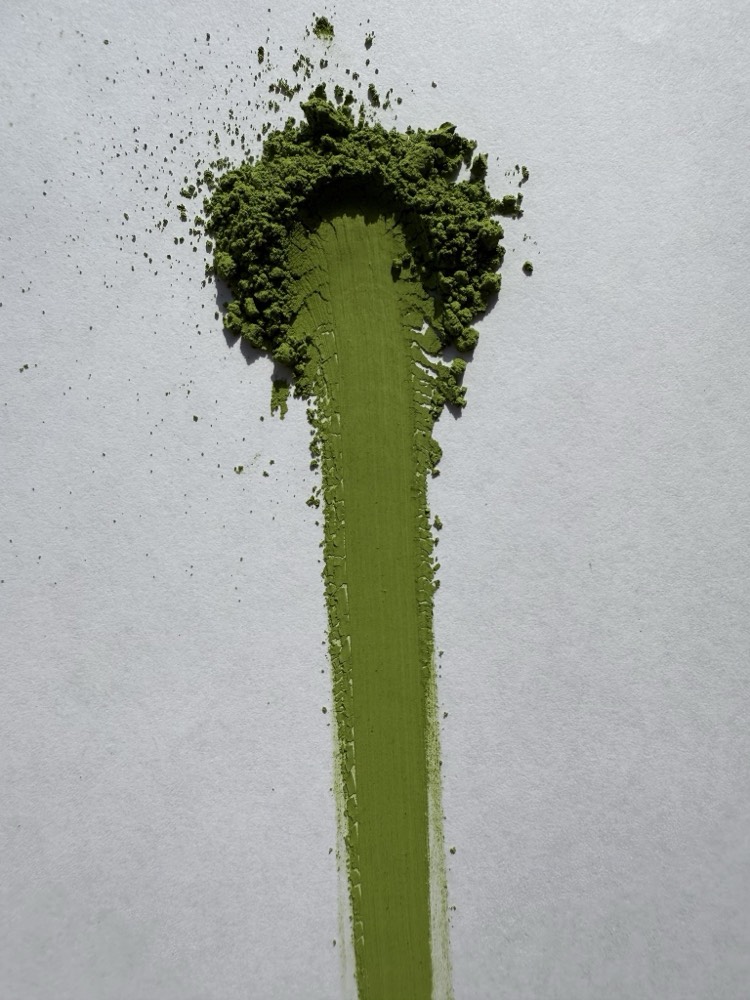
- Put a little of each powder on white paper and compare the colors
- Whisk the same amount at the same water temperature, and compare aroma, astringency and the fineness of the foam
- Mix each with the milk your café uses, and see how much color and flavor remain right after making it and 10 minutes later
- If you will use it in sweet drinks or baked goods, make a test batch with that recipe
- Compare the price per kg converted to the grams used per cup
Step 3 matters most when deciding the grade. Color and flavor can change depending on whether you use cow’s milk, oat milk or soy milk, so test with the milk your café actually uses. The basics of whisking are in How to Make Matcha.
How to choose by menu item
Choose the grade by how each drink or dish is made and what it sells for. One café can use different matcha for straight matcha and for lattes.
Straight (whisked with hot water)
Choose first flush tencha ground to fine, even particles. Because it is whisked with hot water alone, the flavor of the matcha itself comes through without milk or sweeteners covering it.
Lattes
Start with matcha sold for lattes. In drinks with a lot of milk, matcha with a stronger flavor than ceremonial grade can keep the matcha character better. If you want aroma at the front, first flush only is a candidate. If flavor strength and cost come first, a blend of first and second flush is a candidate. Recipes and cost per cup are covered in How to Choose Matcha for Café Lattes.
Sweet drinks
Drinks made with syrup or condensed milk need astringency that stands up to the sweetness. Stronger-tasting latte matcha, or matcha made from second flush and later, works well. If the color is part of the drink’s appeal, also check the color after adding the sweetener.
Baked goods and ice cream
Most sellers recommend matcha sold as culinary grade for baked goods and ice cream. For products where you want the finished green to show, add stronger-colored latte matcha to your test batches and compare. Decide by whether cost or appearance comes first.
Omakase Matcha grades
All Omakase Matcha is made for lattes. We do not use names such as ceremonial, and we divide our matcha into three grades by harvest and milling.
- Premium: first flush only, stone-milled
- Standard: first flush, or first and second flush blended, machine-milled
- Basic: second flush and later leaves
The differences are explained on Grades, and the regions we work with are on Origins. We send up to 3 samples, accept orders from 1 kg, and can adjust the blend to suit your café’s milk. Once you know which grades you want to compare, apply through Sample request.
Sources
- Japan Tea Central Public Interest Incorporated Association, “緑茶の表示基準” (Green Tea Labelling Standard, last revised 10 July 2026, in Japanese) https://www.nihon-cha.or.jp/pdf/hyoujikijyun.pdf
- ISO, “ISO 20715:2023 Tea — Classification of tea types” https://www.iso.org/standard/75419.html
- ISO 20715:2023 (preview) https://cdn.standards.iteh.ai/samples/75419/b937ca9e8b964f538549fe9a8cae15b5/ISO-20715-2023.pdf
- MAFF, “茶をめぐる情勢(令和8年10月)” (The situation of tea, October 2026, in Japanese) https://www.maff.go.jp/j/seisan/tokusan/cha/attach/pdf/ocha-201.pdf
- NARO, “国産抹茶の価格と化学成分含有量の関係” (Relationship between price and chemical composition of Japanese matcha, in Japanese) https://www.naro.go.jp/project/results/4th_laboratory/nifts/2018/nifts18_s16.html
- Yoriyuki Nakamura, “国内における抹茶(碾茶)生産の推移と科学的特性” (Trends in matcha (tencha) production in Japan and its scientific characteristics, Tea Science Center, University of Shizuoka, in Japanese) https://dfns.u-shizuoka-ken.ac.jp/labs/tsc/thesis/0410.pdf
- Minamikyushu city, “二番茶・三番茶・四番茶・秋冬番茶” (Second, third, fourth and autumn/winter flush, in Japanese) https://www.city.minamikyushu.lg.jp/chirancha/ajiwau/chirancha_shurui/8903.html
- JETRO, “抹茶ブームを経て本格的な普及段階に移行するASEAN日本茶市場” (ASEAN’s Japanese tea market moves into a stage of full adoption after the matcha boom, 18 May 2026, in Japanese) https://www.jetro.go.jp/biz/areareports/2026/d7cf7db2e5a71454.html