
 Reviewed by: Takahiro Sugiyama (CEO, meguri Inc.)
Alongside “Uji matcha,” cafés and online shops overseas also sell matcha labelled “Yame matcha.” Yame is a tea region in southern Fukuoka Prefecture, known for gyokuro (a premium green tea grown under shade before picking). Checking public sources for what the name Yame matcha refers to, and how much of its raw material is made, makes it easier to compare what suppliers tell you.
What is Yame matcha?
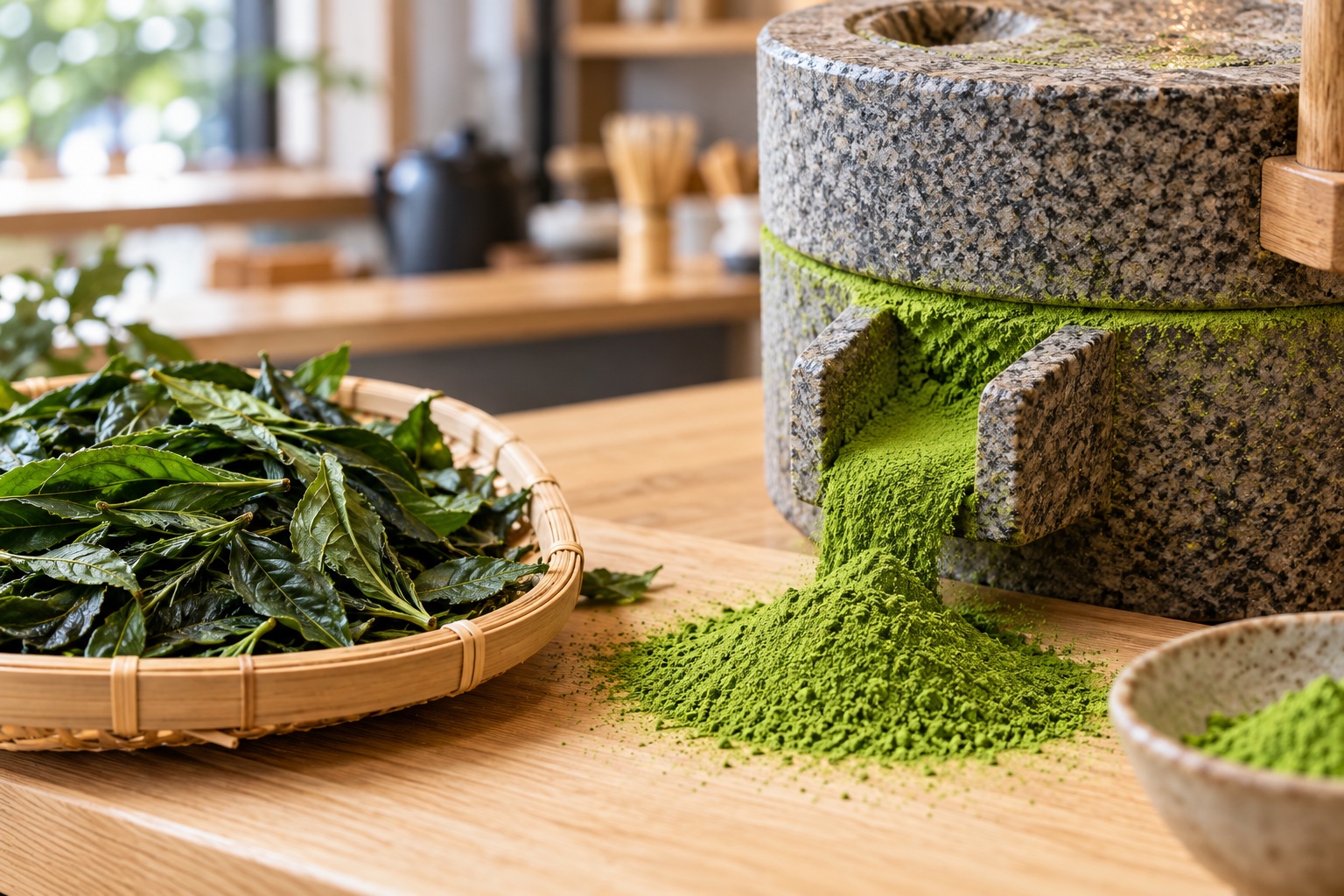
Yame matcha is matcha made from aracha produced in Yame city, Fukuoka Prefecture, and the surrounding area, and finished inside Fukuoka Prefecture. It is registered with the Japan Patent Office as a regional collective trademark (a trademark that combines the name of a region with the name of a product). Aracha is tea before final processing: picked leaves that have been steamed and dried at a factory in the growing area.
The conditions registered with the Japan Patent Office
The regional collective trademark “Yame matcha” (registration number 6266776) covers matcha that meets the following conditions:
- It uses aracha made by tea growers in Fukuoka Prefecture
- The aracha is made in Yame city, Fukuoka Prefecture, and the surrounding area
- It is finished inside Fukuoka Prefecture
The holders are two organisations: the Fukuoka Prefecture Tea Commerce and Industry Cooperative, based in Yame city, and the National Federation of Agricultural Cooperative Associations (JA Zen-Noh).
| Item | Registered content (translated) |
|---|---|
| Trademark | 八女抹茶 (Yame matcha), registration number 6266776 |
| Holders | Fukuoka Prefecture Tea Commerce and Industry Cooperative; National Federation of Agricultural Cooperative Associations |
| Designated goods | Matcha made from aracha produced by tea growers in Fukuoka Prefecture in Yame city, Fukuoka Prefecture, and the surrounding area, and finished inside Fukuoka Prefecture |
Source: Japan Patent Office, “商標登録第6266776号 八女抹茶” (Trademark registration No. 6266776, Yame matcha) https://www.jpo.go.jp/system/trademark/gaiyo/chidan/shoukai/ichiran/6266776.html
What the holders say
In the “Features of the goods and services” section of the same page, the holders explain that gyokuro production is active in Yame’s mountain areas, and that they use these gyokuro growing techniques to make matcha. In the Japan Patent Office’s list of regional collective trademarks (checked on 13 October 2026), there are five trademarks with “matcha” in the name: Yame matcha, Uji matcha, Nishio no matcha, Kakegawa matcha and Kawagoe matcha.
Yame tea, Yame matcha and Yame Dento Hon Gyokuro: the differences
Teas with the Yame name are covered by trademarks and a GI, and the only one registered as a national GI is gyokuro. Matcha is not covered by the GI. A GI (geographical indication) is a system in which the Japanese government protects the link between a region and the quality of its product.
The three names compared
| Name | System | Tea covered | Area |
|---|---|---|---|
| 八女茶 (Yame tea) | Japan Patent Office regional collective trademark (No. 5116871) | Green tea | Aracha from Yame city and the surrounding area (including areas of Kumamoto and Saga prefectures next to the Yame area), finished inside Fukuoka Prefecture |
| 八女抹茶 (Yame matcha) | Japan Patent Office regional collective trademark (No. 6266776) | Matcha | Aracha from Yame city and the surrounding area, finished inside Fukuoka Prefecture |
| 八女伝統本玉露 (Yame Dento Hon Gyokuro) | MAFF GI (No. 5) | Gyokuro | Grown in the hilly and mountain areas of Yame city and nearby municipalities, finished inside Fukuoka Prefecture |
The Yame tea trademark states that it also includes aracha made in the parts of Kumamoto and Saga prefectures next to the Yame area. The Yame matcha trademark has no such note.
The Yame Dento Hon Gyokuro GI is a gyokuro GI
Yame Dento Hon Gyokuro was registered as GI No. 5 on 22 December 2015. Its registered specification sets the final product as finished gyokuro. The GI conditions are as follows:
- The tea bushes are not trimmed into an arched shape; their natural form is kept (natural training)
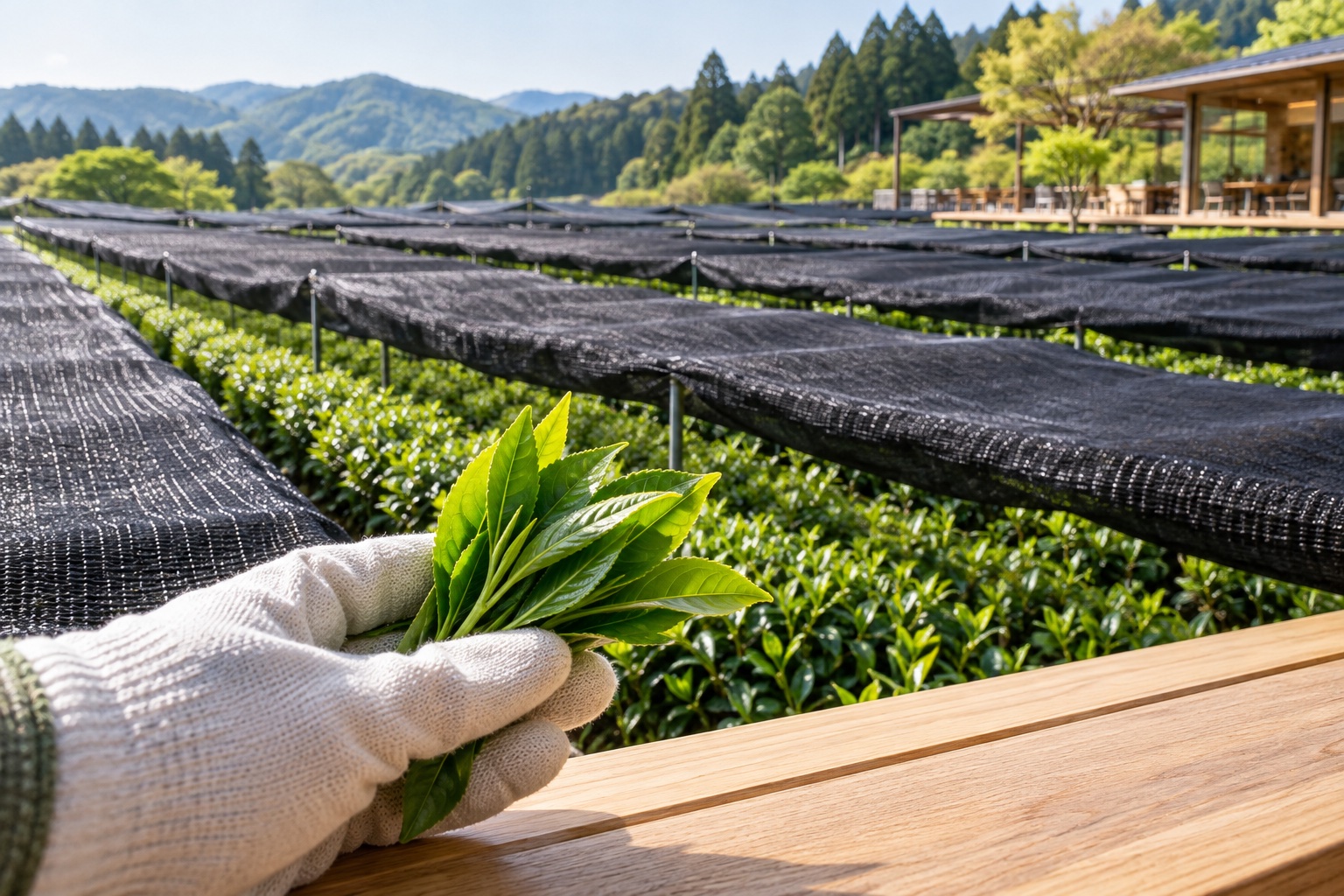
- A shelf frame is built over the field and covered with rice straw or sumaki (a coarse weave of rice straw and reeds)
- In the final stage about 90 to 98% of sunlight is blocked, and the tea is covered for 16 days or more (about 20 days)
- Only the soft parts of the new shoots are picked, by hand
| Item | Registered content (translated) |
|---|---|
| Registration date | 22 December 2015 |
| Registration number | No. 5 |
| Name | 八女伝統本玉露, Traditional Authentic YAME GYOKURO |
| Production area | Inside Fukuoka Prefecture |
| Characteristics | The tea is covered with natural materials such as rice straw before harvest |
| Link with the region | Production methods such as shelf covering (indirect covering) with natural materials such as rice straw, natural training and hand-picking have been kept for more than 110 years |
Source: MAFF, “第5号:八女伝統本玉露” (No. 5: Yame Dento Hon Gyokuro) https://www.maff.go.jp/j/shokusan/gi_act/register/0005/index.html
The GI conditions apply to gyokuro, not to Yame matcha. For green tea as a whole, including matcha, there is the GI “Japanese Tea,” registered on 10 July 2026.
Where Yame is and the history of its tea
Yame is a tea region in southern Fukuoka Prefecture, in the Yabe River basin, where gyokuro has been made in the hilly and mountain areas. Fukuoka Prefecture explains that the large difference between day and night temperatures, which makes fog likely, suits tea growing.
Climate
The GI specification gives the climate of the Yame Dento Hon Gyokuro area as an average annual temperature of 15.2°C and annual rainfall of 2,019 mm (normal values at the Japan Meteorological Agency’s Kurogi AMeDAS station). Articles by overseas shops give Yame’s rainfall as 1,300 to 1,400 mm in one case and 1,600 to 2,400 mm in another, so the figures do not agree.
History
According to the specification, Yame tea is said to have begun in 1423, when the Zen priest Eirin Shuzui founded Reiganji temple in what is now Kurogi town, Yame city, and planted tea seeds he had brought back from China. At first the area mainly made sencha, but it was found to suit gyokuro, and full-scale production of Yame Dento Hon Gyokuro began in 1904 in the former Hoshino village (now Hoshino village, Yame city). 2023 marked 600 years since the start of Yame tea, and Fukuoka Prefecture’s public relations magazine ran a feature on it.
Tencha production in Fukuoka Prefecture
Fukuoka Prefecture produced 280 tonnes of tencha (the tea leaves used as the raw material for matcha) in 2025, about 4% of Japan’s total. The largest type of aracha in Fukuoka is sencha (865 tonnes), and MAFF data puts Fukuoka third in Japan for gyokuro production.
Tencha by prefecture (2025 harvest)
According to the National Federation of Tea Producers’ Associations, Japan produced 6,278 tonnes of tencha in 2025.
| Prefecture | Tencha | Share of Japan | All aracha | Tencha share of aracha |
|---|---|---|---|---|
| Kagoshima | 2,670 tonnes | About 43% | 30,000 tonnes | About 9% |
| Kyoto | 989 tonnes | About 16% | 2,121 tonnes | About 47% |
| Shizuoka | 875 tonnes | About 14% | 24,100 tonnes | About 4% |
| Aichi | 463 tonnes | About 7% | 561 tonnes | About 83% |
| Mie | 398 tonnes | About 6% | 4,805 tonnes | About 8% |
| Miyazaki | 304 tonnes | About 5% | 3,109 tonnes | About 10% |
| Fukuoka | 280 tonnes | About 4% | 1,486 tonnes | About 19% |
Shares are calculated from the National Federation of Tea Producers’ Associations figures. The Fukuoka figures cover the whole prefecture; we found no statistics showing tencha volume for the Yame area alone.
Yame tencha by volume
Fukuoka Prefecture’s tencha is about one tenth of Kagoshima’s and about 30% of Kyoto’s. The Fukuoka Agriculture and Forestry Research Center writes that, as demand for matcha grows and machine-picked tencha spreads, Fukuoka is a small tencha region and needs to set itself apart from the large ones.
How tea is shaded in Yame
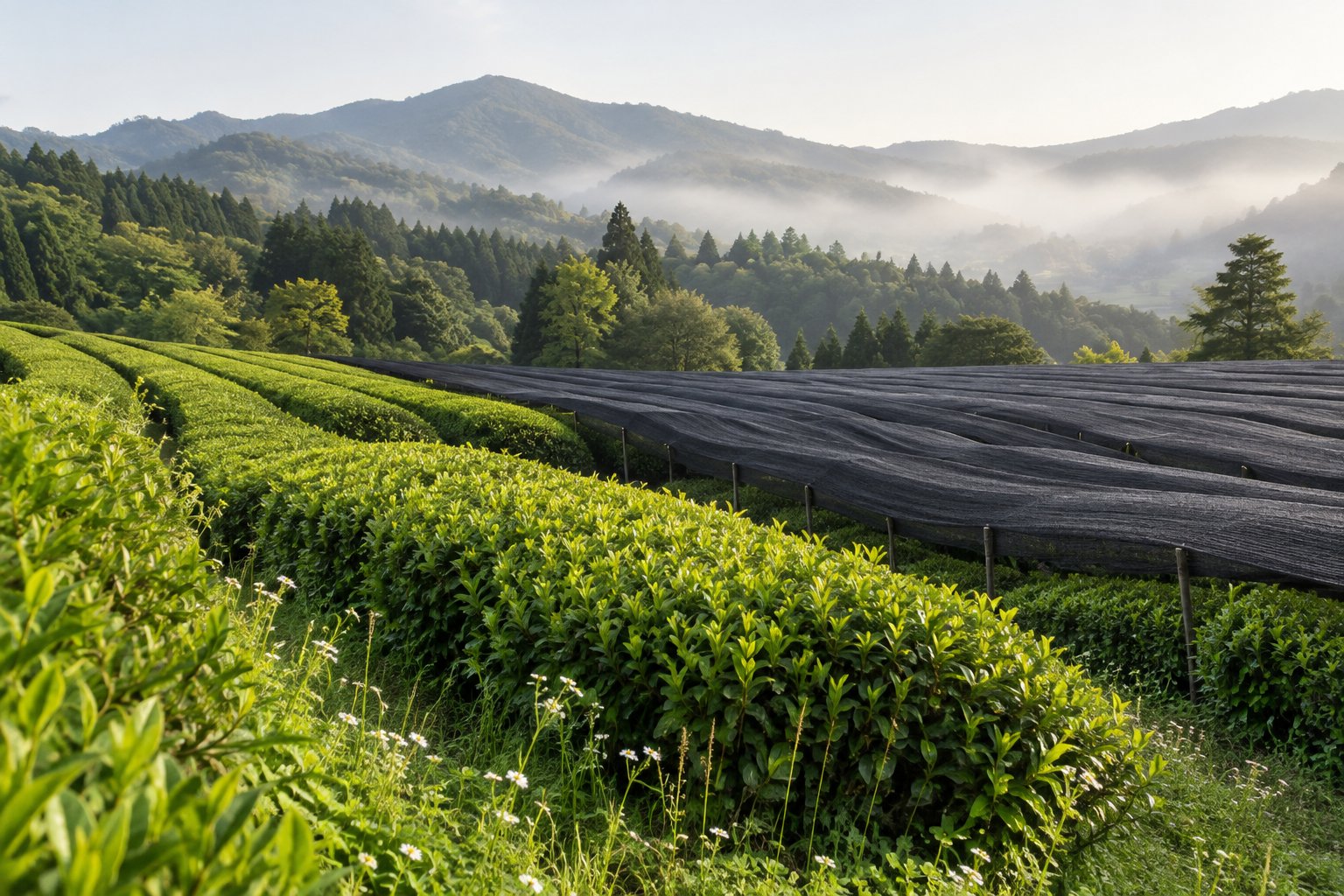
Yame Dento Hon Gyokuro is covered with rice straw laid on a shelf frame. For tencha, the Fukuoka research center is testing improvements to the conventional method of laying black synthetic netting directly on the tea bushes. Shading blocks sunlight before picking. The GI specification says Yame Dento Hon Gyokuro contains more amino acids such as theanine, a source of umami, and fewer catechins, a source of astringency.
Shading of gyokuro and tencha compared
| Tea | How it is covered | Covering period | Picking | Source |
|---|---|---|---|---|
| Yame Dento Hon Gyokuro | Rice straw and sumaki on a shelf frame (shelf covering) | 16 days or more (about 20 days) | By hand | GI specification |
| Tencha (the conventional method compared by Fukuoka’s research center) | Black kanreisha (synthetic shade netting) laid directly on the tea bushes (direct covering) | 20 days in total | Not stated | Fukuoka Agriculture and Forestry Research Center |
| Tencha (national definition) | Picked from fields covered with kanreisha or similar materials | About 2 to 3 weeks | — | MAFF |
Fukuoka’s two-stage covering
The Yame branch of the Fukuoka Agriculture and Forestry Research Center has set out “two-stage covering” as a way to raise tencha quality under direct covering. When two leaves of the first-flush shoots have opened, black kanreisha that blocks 60 to 70% of sunlight is laid on the bushes. Five days later, kanreisha that blocks 80 to 85% is laid on top, and the tea is covered for 20 days in total. In the center’s evaluation, the total score of the sensory evaluation, which scores appearance, aroma, taste and other items, was higher than with the conventional method of using only the 80 to 85% kanreisha. The extra layer needs more materials and more labour.
We found no statistics showing how much of Fukuoka’s tencha field area uses shelf covering and how much uses direct covering.
How Yame compares with Uji and Kagoshima
The trademark conditions and production volumes clearly differ, but there is no public data showing that one tastes better than another. Overseas shops and personal blogs describe Yame matcha as “sweet and mellow” in some cases and “grassy” in others, and some of these are based on tasting a single product.
What public sources allow you to compare
| Item | Yame matcha (Fukuoka) | Uji matcha (Kyoto) | Kagoshima |
|---|---|---|---|
| Rules for the name | Regional collective trademark. Aracha from Yame city and the surrounding area, finished inside Fukuoka Prefecture | Regional collective trademark. Tea from Kyoto, Nara, Shiga and Mie, finished inside Kyoto Prefecture by a Kyoto-based company | The Japan Patent Office list has no regional collective trademark for Kagoshima matcha |
| Tencha (2025 harvest) | 280 tonnes | 989 tonnes | 2,670 tonnes |
| Tencha share of aracha | About 19% | About 47% | About 9% |
| Feature in national data | Third in Japan for gyokuro | Second in Japan for gyokuro and tencha | First in Japan for tencha |
Figures are for each whole prefecture (National Federation of Tea Producers’ Associations, 2025 harvest). Features are from MAFF’s “The situation of tea.” The definition of Uji matcha is covered in detail in What Is Uji Matcha?
The awards are in the gyokuro section
Yame is known for its awards at the National Tea Fair competition. According to Fukuoka Prefecture, Yame city received the production area award in the “gyokuro section” for 25 years in a row up to 2025. This is the result of judging gyokuro, not the section for tencha, the raw material for matcha. The prefecture’s own tea competition (the Fukuoka Prefecture Tea Fair), held every year by the Fukuoka Prefecture Federation of Tea Growers’ Associations, also had two sections in 2026: sencha and gyokuro. When a supplier says the tea is from an “award-winning region,” check which section the award was in.
Yame matcha in Thailand and Singapore
Fukuoka Prefecture’s Bangkok office reports that in Thailand, matcha from high-volume regions used to have the advantage, but more customers now enjoy differences in flavour by region, and specialist shops serving them have appeared. According to the December 2023 report, most restaurants and cafés in Thailand did not pay much attention to the taste of tea, so tea from Kagoshima, Kyoto and Shizuoka, which produce a lot of tencha, had the advantage over Yame tea.
What the report says
The report says that more consumers enjoy differences in matcha flavour by cultivar and region, and that the flavour and aroma of Yame tea are highly rated in Thailand. It also describes a matcha specialist café in Bangkok that mainly uses Yame tea and Uji tea, whose owner has visited Fukuoka and Kyoto and talked directly with growers and tea merchants. The report says that inviting such shops to the growing region to see the tea fields and factories would be a starting point for trade.
We found no similar report about Singapore.
What to check when buying “Yame matcha” overseas
Even if a product says “Yame,” how much of its raw material is Yame tea varies by product. Under the “Green Tea Labelling Standard” of the Japan Tea Central Public Interest Incorporated Association (a voluntary industry standard), a region name may be shown on the label only if at least 50% of the raw material comes from that region, and if it is less than 100%, the label must make clear that it is a blend.
What to confirm with your supplier
When buying matcha as Yame matcha, confirm the following in writing:
- Where the aracha was made: whether it is from Yame city and the surrounding area, and whether the municipality is known
- Where it was finished: whether it was finished inside Fukuoka Prefecture
- The share of Yame raw material: whether it is 100% or a blend with other regions
- How it was shaded and picked: shelf covering or direct covering, hand-picked or machine-picked
- If it says “award-winning” or “GI”: which section the award was in, and which GI (Yame Dento Hon Gyokuro is a gyokuro GI)
The order to choose in for a café
The right grade depends on whether you use the matcha for lattes or whisk it and serve it straight. Decide the use first (Matcha grades), work out the buying price you can afford from the cost per cup (How to Choose Matcha for Café Lattes), then taste Yame matcha side by side with matcha from other regions such as Uji and Kagoshima under the same conditions. Why prices are rising is covered in Is There a Matcha Shortage?, and the regions Omakase Matcha works with are listed on Origins.
Sources
- Japan Patent Office, “商標登録第6266776号 八女抹茶” (Trademark registration No. 6266776, Yame matcha, in Japanese) https://www.jpo.go.jp/system/trademark/gaiyo/chidan/shoukai/ichiran/6266776.html
- Japan Patent Office, “商標登録第5116871号 八女茶” (Trademark registration No. 5116871, Yame tea, in Japanese) https://www.jpo.go.jp/system/trademark/gaiyo/chidan/shoukai/ichiran/5116871.html
- Japan Patent Office, “商標登録第6226519号 宇治抹茶” (Trademark registration No. 6226519, Uji matcha, in Japanese) https://www.jpo.go.jp/system/trademark/gaiyo/chidan/shoukai/ichiran/6226519.html
- Japan Patent Office, “地域団体商標登録案件一覧” (List of registered regional collective trademarks, in Japanese) https://www.jpo.go.jp/system/trademark/gaiyo/chidan/shoukai/ichiran/index.html
- MAFF, “第5号:八女伝統本玉露” (No. 5: Yame Dento Hon Gyokuro, in Japanese) https://www.maff.go.jp/j/shokusan/gi_act/register/0005/index.html
- MAFF, “八女伝統本玉露 明細書” (Yame Dento Hon Gyokuro specification, in Japanese) https://www.maff.go.jp/j/shokusan/gi_act/register/0005/pdf/0005_specification.pdf
- MAFF, “茶をめぐる情勢(令和8年10月)” (The situation of tea, October 2026, in Japanese) https://www.maff.go.jp/j/seisan/tokusan/cha/attach/pdf/ocha-201.pdf
- Aichi Prefecture, “2025年産茶の生産状況” (Tea production in 2025, National Federation of Tea Producers’ Associations survey, in Japanese) https://www.pref.aichi.jp/uploaded/attachment/622005.pdf
- Fukuoka Agriculture and Forestry Research Center, “直掛けてん茶の品質を高める二段階被覆技術” (Two-stage covering to raise the quality of directly covered tencha, in Japanese) https://www.farc.pref.fukuoka.jp/farc/seika/r06/06-15.pdf
- Fukuoka Prefecture, “グラフふくおか 2023秋 福岡の八女茶 発祥600年” (Graph Fukuoka, autumn 2023: 600 years of Fukuoka’s Yame tea, in Japanese) https://www.pref.fukuoka.lg.jp/somu/graph-f/2023autumn/special/index.html
- Fukuoka Prefecture, press release on Yame tea tea bags from the National Tea Fair competition (30 October 2025, in Japanese) https://www.pref.fukuoka.lg.jp/press-release/yametea-omotesenke251108.html
- Fukuoka Prefecture, press release on the Fukuoka Prefecture Tea Fair winners’ visit to the governor (19 June 2026, in Japanese) https://www.pref.fukuoka.lg.jp/press-release/yamecha20260625courtesyvisit.html
- Fukuoka Prefecture Bangkok Office, “タイの日本茶の市場動向と八女茶輸出拡大に向けた取組について” (Japanese tea market trends in Thailand and efforts to expand Yame tea exports, 20 December 2023, in Japanese) https://www.pref.fukuoka.lg.jp/uploaded/attachment/209294.pdf
- Japan Tea Central Public Interest Incorporated Association, “緑茶の表示基準” (Green Tea Labelling Standard, in Japanese) https://www.nihon-cha.or.jp/pdf/hyoujikijyun.pdf