
 Reviewed by: Takahiro Sugiyama (CEO, meguri Inc.)
Search for matcha powder (bubuk matcha) in Indonesia and you will mostly find marketplace product pages and recommendation articles listing household bags. If your café uses matcha in lattes every day, you need to check quantity and price, and also whether the bag is an import properly registered in Indonesia, whether it has halal certification, and whether it is pure matcha. We checked who takes on what under each way of buying, using public information from Indonesia’s Food and Drug Authority (BPOM), the Halal Product Assurance Agency (BPJPH), the Directorate General of Taxes and the Ministry of Finance as of 20 October 2026.
Three ways to buy matcha powder in Indonesia
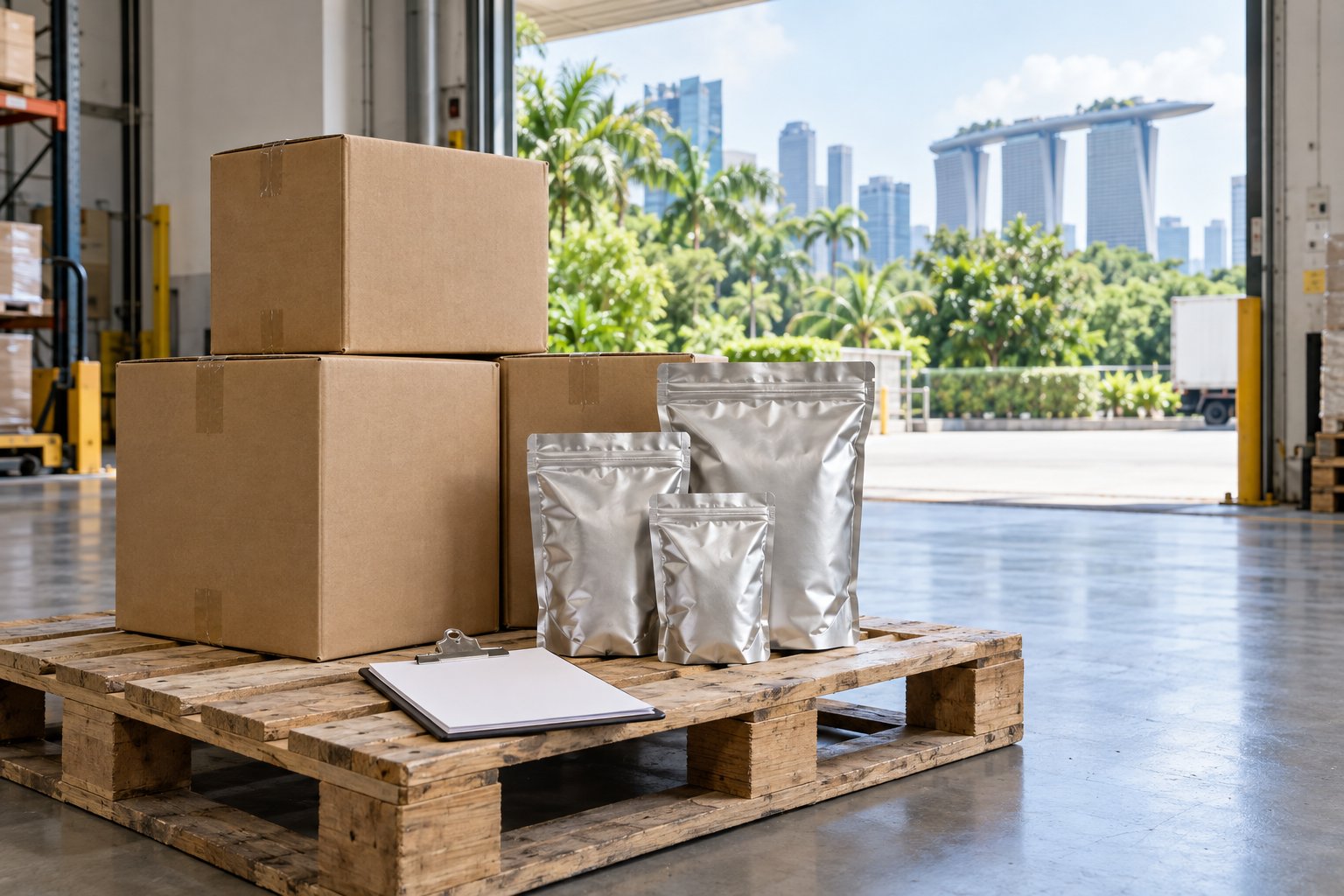
A café can buy matcha for business use in three ways: from a local importer, by importing it from Japan itself, or in small amounts online. Which one you choose decides who holds the BPOM distribution permit and the halal certificate registration.
To import packaged processed food for sale in Indonesia, the importing company obtains a BPOM distribution permit for each product (numbers for imports start with “ML”, so it is called an ML number) and an import permit (SKI) for each import. Whichever way you buy, someone holding these permits has imported it.
Mandatory halal certification for imported food and drinks was scheduled to start on 18 October 2026. On 16 to 17 October 2026, the government (the Coordinating Ministry for Economic Affairs) announced that for imported food and drinks it would be postponed to 18 October 2028, to be done by amending Government Regulation No. 42 of 2024 (the amendment had not been promulgated as of 20 October 2026). Business customers may ask for a halal certificate even before the requirement starts, so we include it in the comparison.
| Local importer or wholesaler | Import from Japan yourself | Online (Tokopedia, Shopee, etc.) | |
|---|---|---|---|
| ML number and SKI for each shipment | Held by the importer | Obtained by your company | Depends on the seller. Some products show no number |
| Halal certificate registration | The importer registers the Japanese certificate | Your company registers it | Often just the single word “Halal” |
| Customs clearance, duty and import taxes | Importer | Your company or a customs broker | Not needed (assuming the seller has handled it) |
| How visible origin and lot are | Depends on the importer’s documents | You get them directly from the seller | Often only what the product page shows |
| Suits | Shops buying regularly, shops that do not want to handle procedures | Shops and chains that use a lot | Testing recipes, before opening, menu development |
Importer qualifications, the documents for the distribution permit application and the halal certification procedure are covered in How to Import Matcha into Indonesia. Here we focus on which way of buying a café should choose and what to check.
Japan’s exports of powdered green tea, including matcha, to Indonesia
From January to August 2026, Japan exported 106,940kg of powdered green tea to Indonesia, 80.7% of the same period a year earlier. While volume fell, export value rose to 161.5% of the same period a year earlier, and the unit price rose from 2,728 yen per kg to 5,462 yen.
The figures below are from the Japan Tea Export Council, compiled from Japan’s trade statistics (Ministry of Finance) and other data.
| January to August 2025 | January to August 2026 | Year on year | |
|---|---|---|---|
| Powdered: export volume | 132,568kg | 106,940kg | 80.7% |
| Powdered: export value | 361.67 million yen | 584.09 million yen | 161.5% |
| Powdered: unit price per kg | 2,728 yen | 5,462 yen | |
| All green tea: export volume | 165,109kg | 133,342kg | 80.8% |
| All green tea: export value | 416.61 million yen | 651.84 million yen | 156.5% |
Indonesia ranks 19th among destinations (18th in the same period a year earlier). Powdered tea makes up 90% of export value, so most Japanese green tea reaching Indonesia is in powder form. Japan’s trade statistics (Ministry of Finance) for the full year 2025 show 216,625kg of powdered tea worth 715.40 million yen.
According to MAFF (Japan’s Ministry of Agriculture, Forestry and Fisheries), “powdered” in these statistics combines matcha with powdered tea made by grinding tea in a mill or similar, so it is not a figure for matcha alone. Why raw material prices in Japan rose is covered in Is There a Matcha Shortage?, and how export unit prices moved year by year in Why Is Matcha So Expensive?
Buying from a local importer
When you buy from an importer in Indonesia, the importer takes care of the ML number, the SKI for each shipment, halal certificate registration, customs clearance, duty and taxes. Your café can receive the matcha without handling import procedures.
What to ask the importer
In exchange for skipping the procedures, it can be harder to see where and when the matcha was made. First, ask for the ML number and the product name registered with BPOM. How to look up the number is explained later.
Next, ask for the halal certificate number and expiry date, and whether that certificate is registered in Indonesia. A certificate from a Japanese certification body is used when it is from a body with mutual recognition with BPJPH and the importer registers it in BPJPH’s system (SIHALAL).
Also ask for the origin and harvest, the lot number and a certificate of analysis (COA, a document showing composition and test results) for each lot, pesticide residue test results, and the production date and how long the matcha will have left before its best-before date when it arrives. For “green tea and black tea”, Indonesia requires pesticide residues to be tested lot by lot at a Japanese laboratory registered with Indonesia, with a certificate of analysis attached (Decree of the Head of the Quarantine Agency No. 2314 of 2025). The item name does not mention matcha, but there is also nothing stating that powder is excluded.
Minimum quantity and delivery units
How much you can buy at a time and the delivery units are set by each importer. Work out your monthly usage first, then decide how many bags to receive and how often. How to calculate usage is covered in Bulk Matcha: How to Buy Matcha Wholesale.
Importing from Japan yourself
If you buy directly from a company in Japan, your company becomes the importer, obtains an ML number for each matcha product and an SKI for each shipment, and registers the halal certificate. There are more procedures, but you receive origin and lot documents directly from the seller.
What you need to import yourself
| Item | Details |
|---|---|
| Importer qualification | The business identification number (NIB) also serves as the importer identification number (API). Importing to buy and resell requires API-U |
| Distribution permit (ML number) | Only an importer appointed by the Japanese company can apply. Submit an appointment agreement with the Japanese company (certified by a Japanese notary, chamber of commerce or similar), a health certificate or certificate of free sale issued by Japanese authorities, a draft label and other documents. Valid for 5 years |
| Import permit (SKI) | For processed food, obtained for each import |
| Halal certification | The requirement for imported food and drinks was scheduled to start on 18 October 2026, but the government announced it would be postponed to 18 October 2028 (the regulation amendment had not been promulgated as of 20 October 2026). Business customers may ask for it even before the requirement starts. The importer registers the Japanese certificate with BPJPH. The pre-shipment halal check for each shipment (the LPPH report) has been announced for abolition |
| Labels | Print the product name, ingredients, net content, importer’s name and address, production date and lot, best-before date, distribution permit number and other items in Indonesian. The label must be attached when the goods enter Indonesia and be the same as the label approved with the permit |
| Duty | 0% under the Indonesia-Japan Economic Partnership Agreement (IJEPA) (a Japanese certificate of origin is required). 5% without the agreement |
The review time for an ML number depends on the risk category the system assigns. Under BPOM Regulation No. 23 of 2023, medium-low risk takes up to 1 business day from payment confirmation, medium-high risk up to 5 business days, and high risk up to 30 business days for evaluation. We could not confirm which category matcha falls into.
In the IJEPA tariff schedule of Minister of Finance Regulation No. 60 of 2026, both 0902.10 and 0902.20, which cover matcha, are 0%. Under the Regional Comprehensive Economic Partnership (RCEP), the rate from April 2026 to March 2027 is 2.0% for powder in retail packaging (0902.10.90) and 3.0% for powder in other packaging (0902.20.90). At import, PPN and prepaid income tax (PPh22: 2.5% of the import value with an importer identification number, 7.5% without) also apply in addition to duty.
Only an importer appointed by the Japanese company can apply for an ML number. When the appointment agreement ends, the permit also loses effect (BPOM Regulation No. 23 of 2023, Articles 9 and 11). Even if a Japanese seller already supplies the same matcha to another importer, if you import it yourself you are appointed by the Japanese company and obtain your own number.
Receiving samples
Tasting samples to decide whether to place an order can be received by Japan Post EMS. The standard delivery time for EMS sent from Tokyo is 8 days. From 1 April 2026, if the recipient does not have a 16-digit Indonesian tax office number, a passport number or similar must be written instead.
On the SKI import permit, BPOM Regulation No. 28 of 2023 states that goods imported for research, product development or exhibitions cannot be used for market testing (Article 38). Once you put the drink on your menu and start selling, you first need an importer (with an ML number). Business customers may also ask for halal certification even before the requirement starts.
Shipping terms change who pays
The shipping terms you agree with the Japanese seller change who pays duty and taxes. Under DAP (delivered at place), the seller delivers to the named place, and the buyer handles import clearance, duty and taxes. If you buy on DAP terms, add duty, PPN and PPh22 yourself to the product price and shipping in the quote before comparing.
Buying small amounts online
Buying bags on marketplaces such as Tokopedia and Shopee suits testing recipes before opening, or shops with few matcha items on the menu. However, many products show no import number or contents, so read the product page before buying.
Price range of 1kg matcha powder online
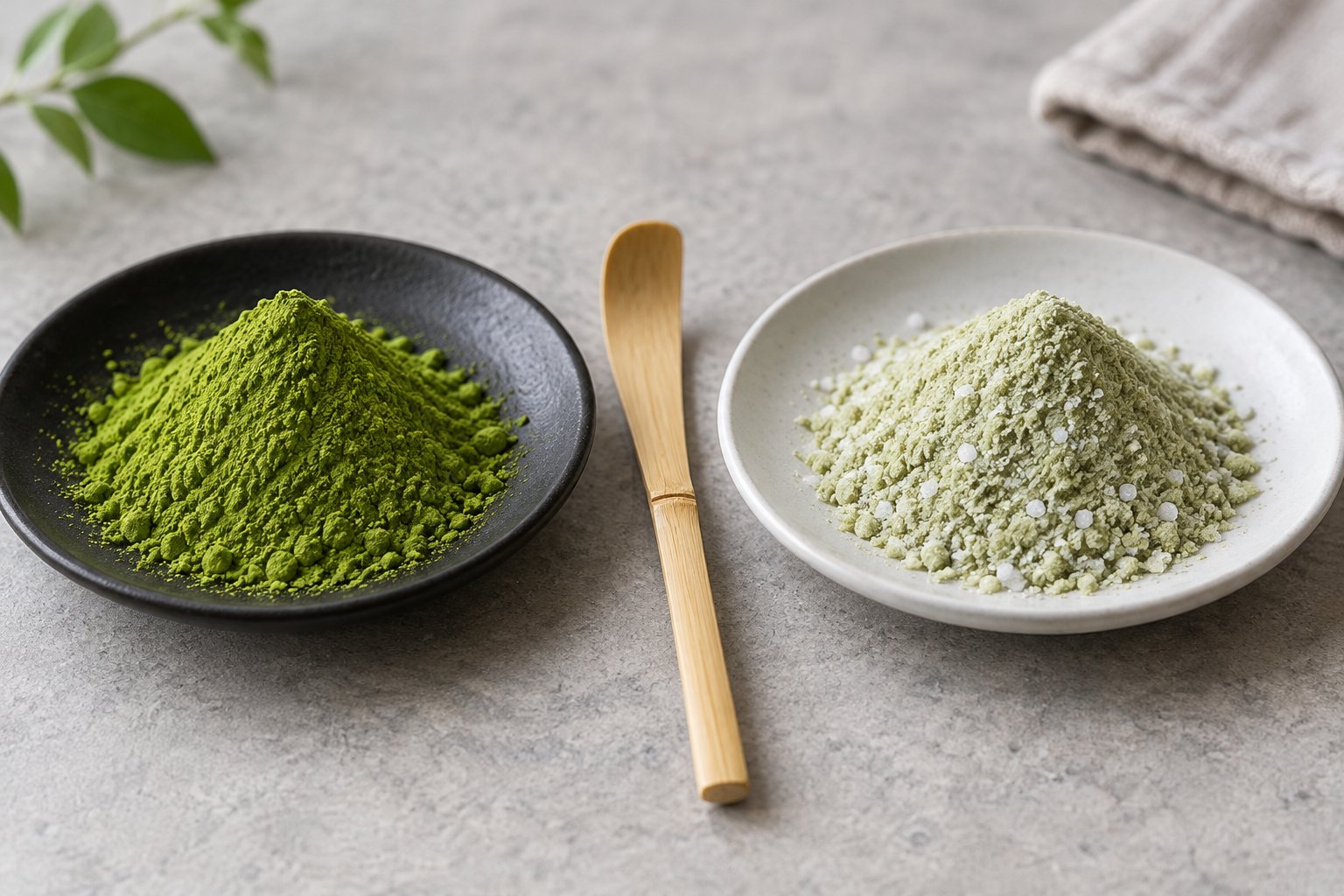
When we searched Tokopedia for “matcha powder 1kg” on 20 October 2026, 720 results were shown. Opening the top 30 product pages, only about 5 were pure matcha powder, and the rest were powders mixed with sugar or non-dairy creamer, or ice cream bases.
| Contents | Price per 1kg (20 October 2026, Tokopedia) | What the listings tend to show |
|---|---|---|
| Pure matcha powder (“Pure Matcha” etc.) | About 440,000 to 1,340,000 rupiah | Many give an origin such as “Uji”. Some show no BPOM number |
| Latte blend powder (matcha mixed with sugar, creamer, etc.) | About 250,000 to 410,000 rupiah | Often sold under names like “matcha powder” or “Premium Matcha” |
| Sweetened drink powder (matcha flavour) | About 50,000 to 100,000 rupiah (Rp49,500 to 95,000) | Many show no origin |
Even within the same “matcha powder 1kg” search results, pure matcha powder sits in a higher price range than powders mixed with sugar and other ingredients. Mixed powders use more per cup and have a fixed sweetness, so you cannot compare them with pure matcha by the price per kg alone. Matcha and recipes suited to lattes are covered in How to Choose Matcha for Café Lattes.
Look at the number shown
Even among products claiming to be imported from Japan, we found none whose product page showed an ML number for imports. Some showed a number for food made in Indonesia (MD) or a number for household-scale producers (P-IRT). If a bag that says it is from Japan carries MD or P-IRT, ask the seller which step was done in Indonesia (repacking, or blending with other ingredients, for example).
BPOM Regulation No. 8 of 2020 requires processed food sold online to have a distribution permit (Article 16(1)). The exceptions are ready-to-eat prepared food, and products a business uses as raw materials and does not sell directly to consumers (Article 16(2)). For products that show no number, check the registration using the method in the next section before using them.
Telling imports apart by BPOM number and registered product name
To check whether matcha sold in Indonesia is a properly registered import, see whether the number on the bag starts with ML and look it up on BPOM’s search site (cek BPOM). The registered product name also tells you whether the contents are tea itself, a drink powder or a flavouring.
How MD, ML and P-IRT differ
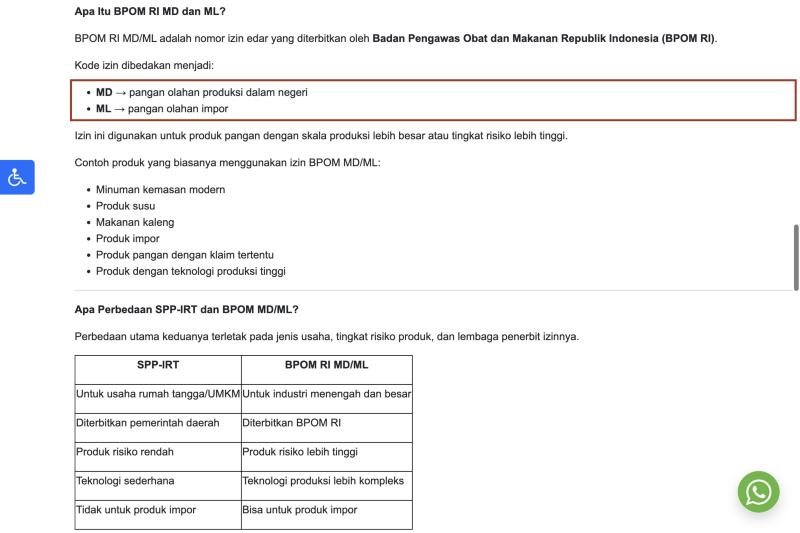 Source: BPOM intelligence unit, “Mengenal Izin Edar Pangan, Apa Bedanya SPP-IRT dan BPOM RI MD/ML?” https://intelijen.pom.go.id/hot-issue/mengenal-izin-edar-pangan-apa-bedanya-spp-irt-dan-bpom-ri-md-ml
According to BPOM’s explainer (published 19 May 2026), food numbers are divided as follows.
| Number | What it shows | Issued by |
|---|---|---|
| MD | Processed food made in Indonesia | BPOM |
| ML | Imported processed food | BPOM |
| P-IRT (SPP-IRT) | Low-risk food made by household-scale and small producers in Indonesia. Cannot be used for imports | Local government |
If matcha imported from Japan is sold as it is, the number will be ML. BPOM states clearly that P-IRT cannot be used for imports.
Looking it up on cek BPOM
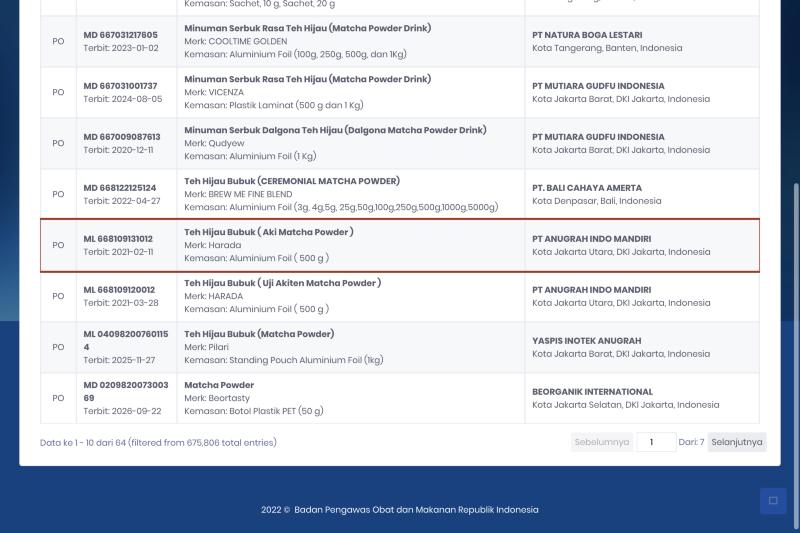 Source: BPOM, “Cek Produk BPOM” https://cekbpom.pom.go.id/all-produk?query=matcha%20powder
On BPOM’s search site (cekbpom.pom.go.id), you can search by product name, brand, number or registrant. The results show the type, number, issue date, registered product name, brand, packaging and registrant. Entering a number shows a single result.
When we searched “matcha powder” on 20 October 2026, there were 62 food registrations, of which 7 were ML and the rest MD. There were 3 ML registrations for tea itself (product name Teh Hijau Bubuk) in 1kg packaging. If the product name, packaging or registrant shown differs from the bag in your hand, or the number cannot be found, stop buying that bag and check with the seller.
Telling the contents apart by registered product name
Most product names in the results are the name of the category registered with BPOM, with the brand-level product name in brackets. Some are registered under a product name alone, without a category. The “matcha powder” results included category names such as these.
| Registered product name | Contents |
|---|---|
| Teh Hijau Bubuk | Green tea powder. Tea itself |
| Minuman Serbuk (Rasa) Teh Hijau | Green tea (flavour) drink powder. Often mixed with sugar and other ingredients |
| Bahan Tambahan Pangan Campuran Perisa Teh Hijau dan Pewarna | A food additive mixing green tea flavouring and colouring |
Even when the product name says “Matcha Powder”, there are cases where the registered product name is a food additive of flavouring and colouring. If you are looking for pure matcha powder, check that the product name is “Teh Hijau Bubuk”. However, there are also cases of “Pure Matcha Powder” registered under a drink powder name, so check both the product name and the ingredients list.
Checking halal labelling
The government has announced that mandatory halal certification for imported food and drinks will be postponed to 18 October 2028. It was originally scheduled to start on 18 October 2026, and the postponement was announced by the Coordinating Ministry for Economic Affairs on 16 to 17 October 2026. It is to be done by amending Government Regulation No. 42 of 2024, and the amendment has not yet been promulgated (as of 20 October 2026). Business customers may ask for a halal certificate even before the requirement starts.
Is matcha exempt from certification?
The Minister of Religious Affairs Decree (No. 1360 of 2021), which sets out materials exempt from halal certification, lists materials of plant origin that are unprocessed or only physically processed, with no other ingredients added. It lists 33 items (numbered up to 34, with number 25 missing), including fresh fruit, dried vegetables, grains, dried seaweed, cocoa powder, and menthol and peppermint oil, and tea or green tea is not mentioned.
We found no document in which BPJPH has decided whether matcha’s steps of steaming, drying and grinding count as “only physical processing”. Since there is no basis for concluding that matcha does not need certification, check the halal certificate number when buying.
“Halal” on marketplace listings
On Tokopedia’s 1kg product pages, many products simply say “Halal”, “100% Halal” or “Halal Certified”, and only some give a certificate number. If no number is shown, ask the seller for the number and the certification body.
BPJPH explains that halal-certified products can be traced through the search accessed from halal.go.id (info.halal.go.id/cari/) (article from November 2022). For a certificate obtained in Japan, check the name of the certification body and the record of the importer’s registration in Indonesia. A BPJPH article names Japan Islamic Trust (JIT) and Japan Muslim Association (JMA) as Japanese bodies with mutual recognition, but we could not confirm the list as of 2026.
Check each ingredient in mixed powders
Powders mixed with sugar, creamer, milk powder or flavouring need halal checks for ingredients other than matcha too. How halal certification works, and which ingredients add more to check, are covered in What Is Halal Matcha?
PPN and the tax on café drinks
Indonesia’s PPN (value added tax) rate is 12%, but for goods other than luxury goods the tax base is set at 11/12, so the actual burden is 11%. Drinks a café serves in the shop, on the other hand, are outside PPN and subject to a local tax.
Whether the seller is a PKP decides whether a tax invoice is issued
According to Indonesia’s Directorate General of Taxes, small businesses with annual turnover of 4.8 billion rupiah or less do not have to become taxable entrepreneurs (PKP), and in that case they do not issue tax invoices (faktur pajak) or file PPN returns (Minister of Finance Regulation No. 197 of 2013, from 1 January 2014).
| Way of buying | Who pays PPN | What your café should check |
|---|---|---|
| Local importer | Added to the invoice if the importer is a PKP | Whether a faktur pajak is issued |
| Importing yourself (DAP etc.) | Your company pays it at customs on import (sometimes through a customs broker) | The cost including duty, PPN and PPh22 |
| Online | Included in the price if the seller is a PKP | Small sellers are often not PKPs |
Drinks served in the shop are subject to the local tax PBJT
According to the Directorate General of Taxes, food and drink served at hotels, restaurants, eateries, stalls and similar, including takeaway and catering, is outside PPN (Article 4A of the PPN Law). Instead, the local tax PBJT (tax on certain goods and services) applies, with the rate set by local regulation and capped at 10%.
We could not confirm from official sources whether PPN paid on purchases can be deducted. Calculate your cost with PPN included, and check with a tax adviser whether it can be deducted. Duty and import taxes are covered in more detail in How to Import Matcha into Indonesia.
Storage, comparing quotes, and a checklist before you sign
Matcha keeps its quality more easily at 25°C or below, and deteriorates quickly in hot places. Compare quotes by lining up what is inside, not grade names, and by the matcha cost per cup including the cost of getting it to you.
Keep it cool from the day it arrives
In a storage test of raw matcha for processing, published in the Tea Research Journal (Japan), the matcha kept its product characteristics for 24 weeks at 25°C or below, while at 37°C it was usable for only 3 to 4 weeks. Yamamasa Koyamaen, a Kyoto tea merchant, recommends storing unopened matcha in the freezer, refrigerator or similar, and bringing it back to room temperature before opening. After opening, Ippodo Tea recommends using it within a month.
With an importer, check temperature control in the warehouse and delivery. If you import yourself, allow for days held at customs and plan how the matcha gets from arrival into your shop’s refrigerator. Online, check where the seller stores it. How to choose bag sizes is covered in Does Matcha Go Bad?
Line up what is inside
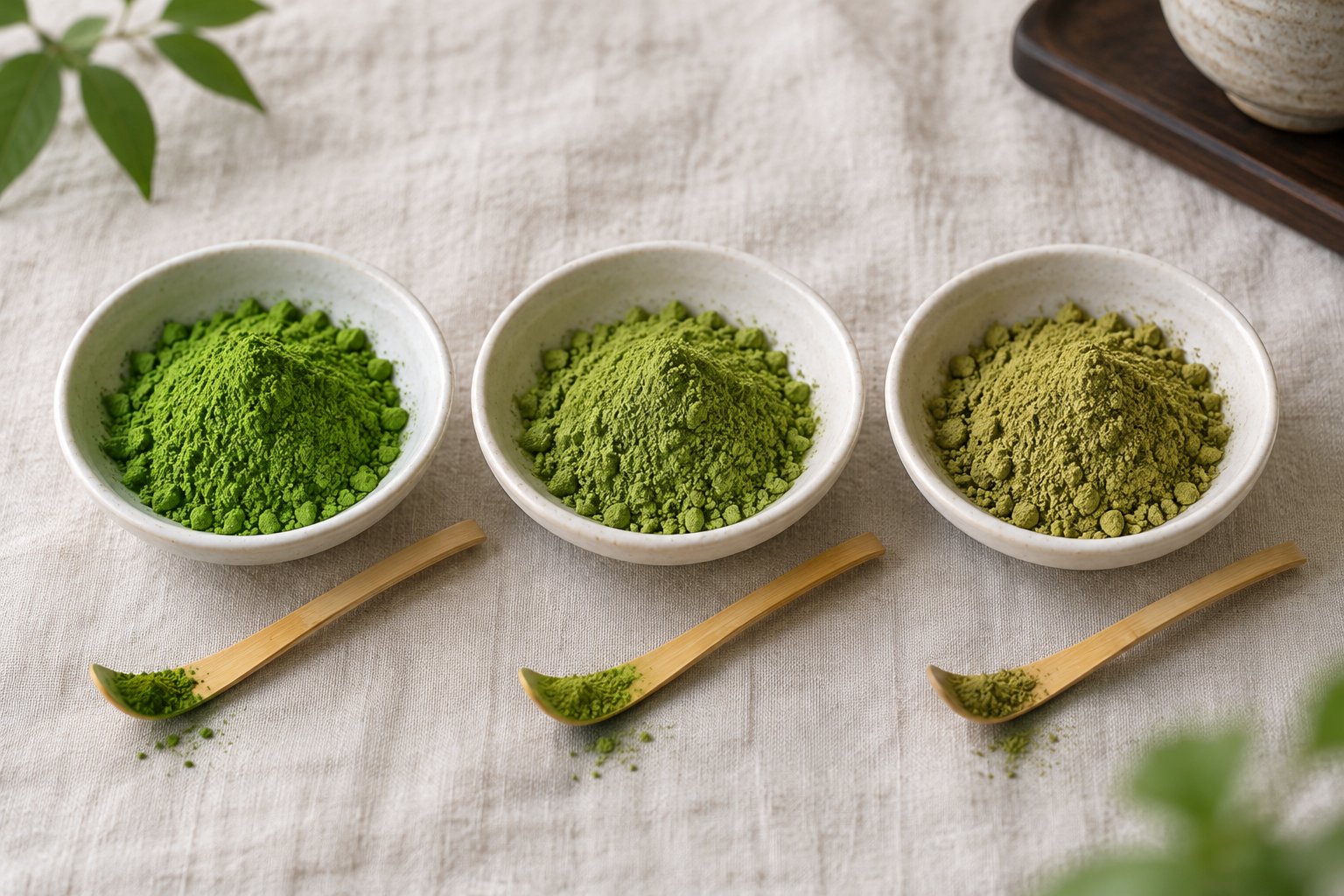
Grade names such as “ceremonial,” “premium” and “culinary” are labels sellers use as a guide to how the matcha is meant to be used. Put the following side by side for each quote.
| Item | What to check |
|---|---|
| Contents | Pure matcha, or containing sugar, creamer or similar |
| Harvest | First flush only, or including second flush and later |
| Origin | Prefecture, and the breakdown if blended |
| Lot and COA | Lot number and the certificate of analysis for that lot |
| Pesticide residues | Test results from a registered laboratory |
| Packing and dates | Amount per bag, production date, time left before the best-before date |
How grades differ is covered in Matcha grades.
Work out the matcha cost per cup
- Work out the delivered price per kg (product + shipping + duty and customs costs + PPN if you cannot deduct it)
- Matcha cost per cup = delivered price per kg ÷ 1,000 × grams used per cup
As a hypothetical example, if matcha costs 600,000 rupiah per kg delivered and you use 3g per cup, the matcha cost is 1,800 rupiah. Mixed powders with sugar and other ingredients use more per cup, so redoing the same calculation with the amount per cup shows the cost difference from pure matcha powder.
What to check before you sign
- Registration: whether the number on the bag starts with ML, can be found on cek BPOM, and the registered product name, packaging and registrant match
- Halal: the certificate number and expiry date, the certification body, and whether it is registered in Indonesia
- Documents: whether origin, harvest and lot number match between the bags you receive and the documents; whether a COA for each lot and pesticide residue test results are provided
- Labels: whether an Indonesian label is attached
- Price: whether shipping, duty, customs costs and PPN are shown on separate lines; whether a faktur pajak is issued
- Storage and quantity: how many months remain before the best-before date on arrival; whether one bag can be used up within a month of opening
Buying from Omakase Matcha
Omakase Matcha supplies matcha bought from the Uji, Yame, Kagoshima, Shizuoka and Miyazaki regions, from 1kg. To Indonesia, we deliver by EMS in about 8 days. We ship DAP, with duties and taxes paid by your shop on receipt, and payment is in advance by Wise or PayPal.
Some of our products are halal certified. The halal requirement for imported food and drinks has been announced as postponed to 18 October 2028, but business customers may ask for a certificate even before then. Whether a certificate is accepted in Indonesia depends on whether the certification body is recognised by BPJPH, so we check and let you know product by product. To buy on an ongoing basis, the importing company’s ML number is needed, so if you do not yet have an importer, talk to us about how to proceed.
If you want to taste before ordering, you can request up to 3 samples. Terms are on the Indonesia wholesale page.
Sources
Checked: 20 October 2026
- Japan Tea Export Council, “緑茶の国別・形状別輸出実績 2026年1〜8月” (Green tea exports by country and form, January to August 2026, in Japanese) https://nihon-cha.or.jp/export/wordpress/wp-content/uploads/2026-08_cha_export.pdf
- Ministry of Finance (Japan), Trade Statistics, exports by commodity and country (2025, Indonesia, 0902.10/0902.20, in Japanese) https://www.customs.go.jp/toukei/srch/index.htm?M=01&P=1,1,,,,,,,,4,1,2025,0,0,0,2,090210,090220,,,,,,,,,6,118,,,,,,,,,,,,,,,,,,,,,20
- MAFF, “茶をめぐる情勢(令和8年10月)” (The situation of tea, October 2026, in Japanese) https://www.maff.go.jp/j/seisan/tokusan/cha/attach/pdf/ocha-201.pdf
- Indonesian Food and Drug Authority (BPOM), “Mengenal Izin Edar Pangan: Apa Bedanya SPP-IRT dan BPOM RI MD/ML” (19 May 2026) https://intelijen.pom.go.id/hot-issue/mengenal-izin-edar-pangan-apa-bedanya-spp-irt-dan-bpom-ri-md-ml
- Indonesian Food and Drug Authority (BPOM), “Cek Produk BPOM” https://cekbpom.pom.go.id/
- Indonesian Food and Drug Authority (BPOM), Regulation No. 23 of 2023 on processed food registration https://jdih.pom.go.id/download/rule/1518/23/2023/Peraturan%20Badan%20Pengawas%20Obat%20dan%20Makanan%20Nomor%2023%20Tahun%202023%20tentang%20Registrasi%20Pangan%20Olahan
- Indonesian Food and Drug Authority (BPOM), Regulation No. 28 of 2023 (import permits) (text on pasal.id) https://pasal.id/peraturan/perban/peraturan-bpom-no-28-tahun-2023
- Indonesian Food and Drug Authority (BPOM), Regulation No. 8 of 2020, Article 16 (processed food sold online) (text on pasal.id) https://pasal.id/peraturan/perban/peraturan-bpom-no-8-tahun-2020
- Indonesian Food and Drug Authority (BPOM), Regulation No. 31 of 2018 (processed food labelling, amended by No. 20 of 2021) (text on pasal.id) https://pasal.id/peraturan/perban/peraturan-bpom-no-31-tahun-2018
- Baker McKenzie, “Indonesia: New Import Framework Brings Greater Clarity for Importers” (November 2025) https://www.bakermckenzie.com/en/insight/publications/alerts/2025/11/indonesia-new-import-framework-brings-greater-clarity-for-importers
- Halal Product Assurance Agency (BPJPH), the 17 October 2026 deadline and how foreign products are treated (21 October 2024) https://bpjph.halal.go.id/read/bpjph-17-oktober-2026-produk-makanan-minuman-umk-harus-sudah-bersertifikat-halal-bagaimana-dengan-produk-luar-negeri
- ANTARA, “Pemerintah memperpanjang penahapan sertifikasi halal hingga 2028” (17 October 2026) https://www.antaranews.com/berita/5793025/pemerintah-memperpanjang-penahapan-sertifikasi-halal-hingga-2028
- Coordinating Ministry for Economic Affairs, “Pemerintah Sesuaikan Masa Penahapan Kewajiban Bersertifikat Halal dengan Memperhatikan Kesiapan Ekosistem dan Pemangku Kepentingan” (16 October 2026, in Indonesian) https://www.ekon.go.id/publikasi/detail/7161/pemerintah-sesuaikan-masa-penahapan-kewajiban-bersertifikat-halal-dengan-memperhatikan-kesiapan-ekosistem-dan-pemangku-kepentingan
- Halal Product Assurance Agency (BPJPH), Regulation No. 4 of 2026 (pre-shipment halal checks, announced for abolition) https://peraturan.go.id/id/peraturan-bpjph-no-4-tahun-2026
- Minister of Religious Affairs Decree No. 1360 of 2021, “Materials exempt from mandatory halal certification” https://lph.uin-alauddin.ac.id/assets/download/KMA_1360_Tahun_2021_tentang_Bahan_yang_Dikecualikan_dari_Kewajiban_Bersertifikat_Halal(rev).pdf
- Halal Product Assurance Agency (BPJPH), “Penting Diketahui, Ini Bahan yang Dikecualikan dari Kewajiban Bersertifikat Halal” https://bpjph.halal.go.id/read/penting-diketahui-ini-bahan-yang-dikecualikan-dari-kewajiban-bersertifikat-halal
- Halal Product Assurance Agency (BPJPH), “Cek Status Sertifikasi Halal Produk di halal.go.id, Ini Caranya” (November 2022) https://bpjph.halal.go.id/detail/cek-status-sertifikasi-halal-produk-di-halal-go-id-ini-caranya/
- Halal Product Assurance Agency (BPJPH), “Indonesia-Jepang Bahas Penguatan Kerja Sama Jaminan Produk Halal” https://bpjph.halal.go.id/read/indonesia-jepang-bahas-penguatan-kerja-sama-jaminan-produk-halal
- Tilleke & Gibbins, “Foreign Halal Certificate Registration in Indonesia” https://www.tilleke.com/insights/foreign-halal-certificate-registration-in-indonesia/4/
- Ministry of Finance (Indonesia), Minister of Finance Regulation No. 60 of 2026 (IJEPA tariff schedule) https://jdih.kemenkeu.go.id/api/download/7908de01-c644-403d-8cc1-362998327b55/2026pmkeuangan060.pdf
- Ministry of Finance (Indonesia), Minister of Finance Regulation No. 225 of 2022 (RCEP tariff schedule, Japan) https://jdih.kemenkeu.go.id/api/download/e71e2ec0-dd4d-4d98-b101-6c2eab675da7/225~PMK.010~2022Per.pdf
- Ministry of Finance (Indonesia), Minister of Finance Regulation No. 26 of 2022 (tariff classification and rates) https://jdih.kemenkeu.go.id/api/download/04d90736-33d5-4b72-92a3-0d2b7c6bb8bd/26~PMK.010~2022Per.pdf
- Ministry of Finance (Indonesia), Minister of Finance Regulation No. 51 of 2025 (income tax at import, PPh22) https://jdih.kemenkeu.go.id/api/download/2b4a88f1-0b7e-430c-aba7-b44dd401765d/2025pmkeuangan051.pdf
- Directorate General of Taxes (Indonesia), explainer on 12% PPN and the 11/12 tax base https://www.pajak.go.id/en/node/113453
- Directorate General of Taxes (Indonesia), “Batasan Omzet Pengusaha Kecil Wajib PPN Dinaikkan” https://www.pajak.go.id/id/siaran-pers/batasan-omzet-pengusaha-kecil-wajib-ppn-dinaikkan
- Directorate General of Taxes (Indonesia), “Makan di Restoran Tidak Kena PPN” (19 May 2022) https://www.pajak.go.id/id/artikel/makan-di-restoran-tidak-kena-ppn
- MAFF, pesticide residue testing of tea for Indonesia and registered laboratories (in Japanese) https://www.maff.go.jp/j/shokusan/export/id_lab.html
- Japan Post, sending conditions by country (Indonesia, in Japanese) https://www.post.japanpost.jp/cgi-kokusai/nonmailable_articles.php?cid=102
- Japan Post, recipient number requirement for items to Indonesia (notice of 24 March 2026, in Japanese) https://www.post.japanpost.jp/service/send/oversea/information/2026/0324_01.html
- Japan Post, “EMSお届け日数表(東京)” (EMS delivery days from Tokyo, in Japanese) https://www.post.japanpost.jp/send/oversea/date/ems/tokyo.html
- Haraguchi et al., “原料抹茶の保存条件が品質に与える影響” (Effect of storage conditions on the quality of raw matcha), Tea Research Journal No. 93 (2002), in Japanese https://www.jstage.jst.go.jp/article/cha1953/2002/93/2002_93_1/_pdf
- Yamamasa Koyamaen, “抹茶の取扱い” (Handling matcha, in Japanese) https://www.yamamasa-koyamaen.co.jp/matcha/basic/handling.html
- Ippodo Tea, “How to Keep Your Matcha Fresh” https://ippodotea.com/blogs/ippodo-tea-blog/how-to-keep-your-matcha-fresh