
 Reviewed by: Takahiro Sugiyama (CEO, meguri Inc.)
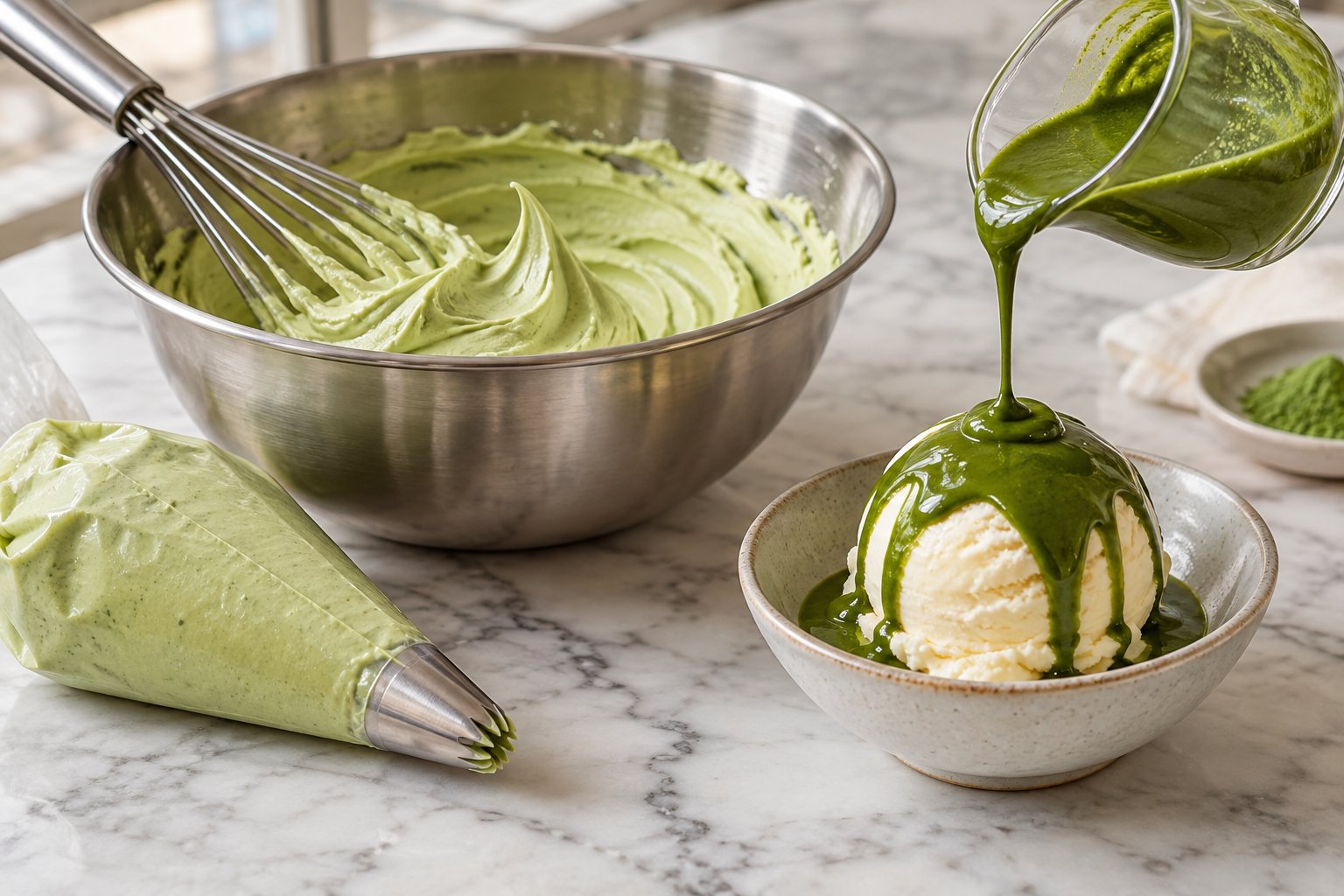
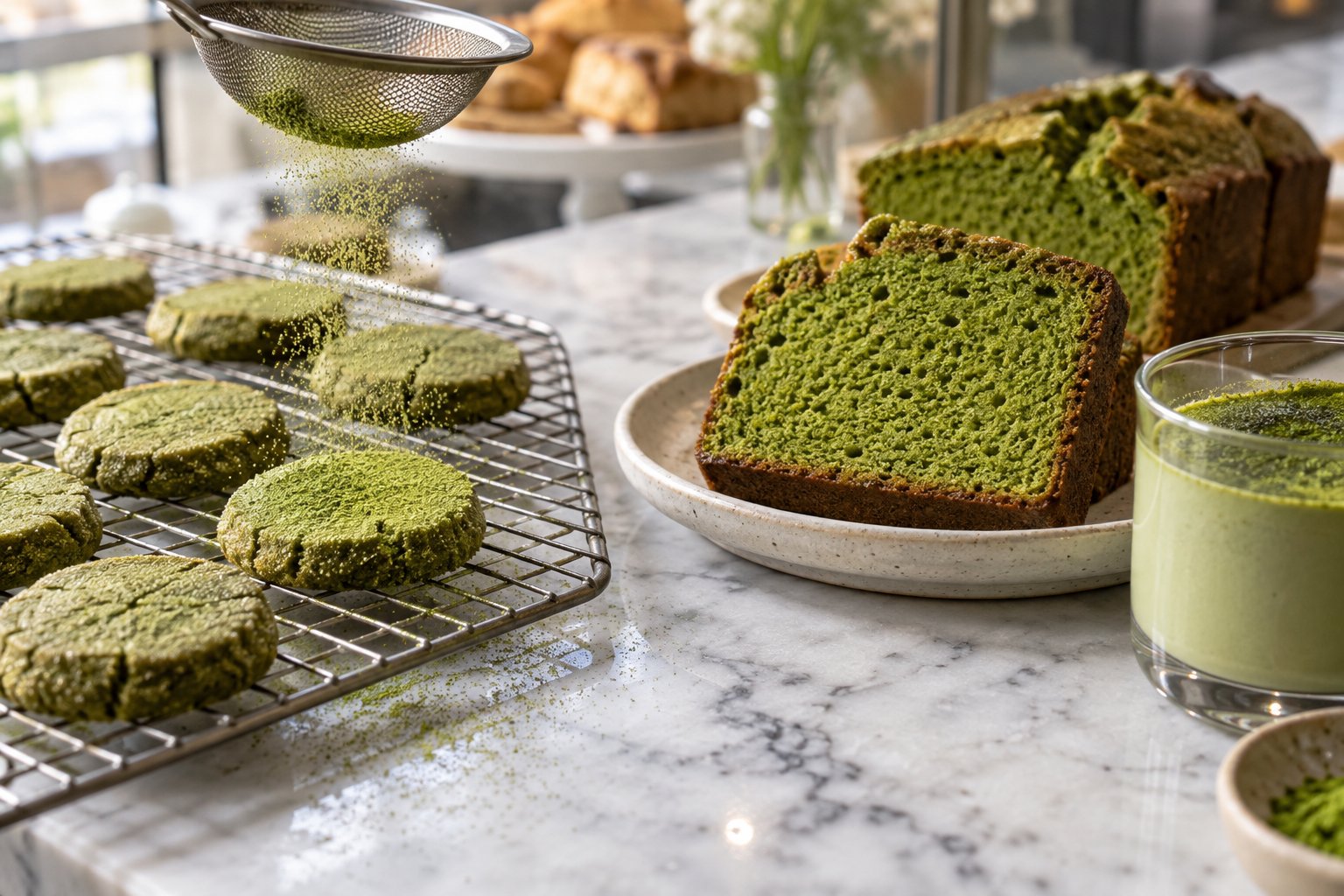
Matcha cream and matcha sauce are parts you can reuse across a café menu: on top of a latte, beside pancakes, inside a parfait glass, on shaved ice. But matcha is a fine powder that does not dissolve in water, so if it is mixed the wrong way it leaves lumps, and over time the colour fades and the powder settles. We compared the matcha amounts and steps in official recipes from dairy companies, tea companies and baking supplies shops, and added the storage standards for prep and the matcha per serving.
What are matcha cream and matcha sauce? Three creams and three sauces for cafés
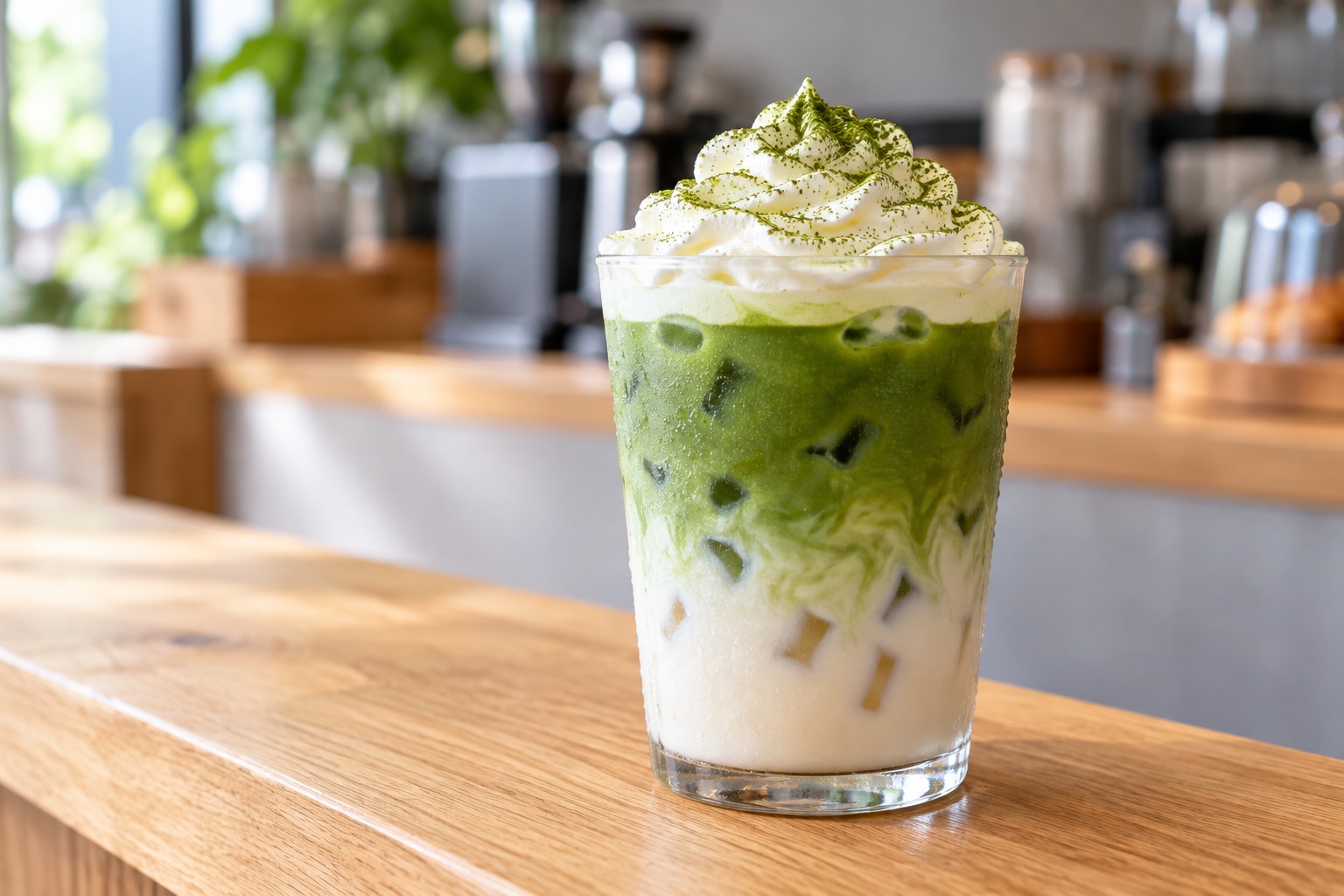
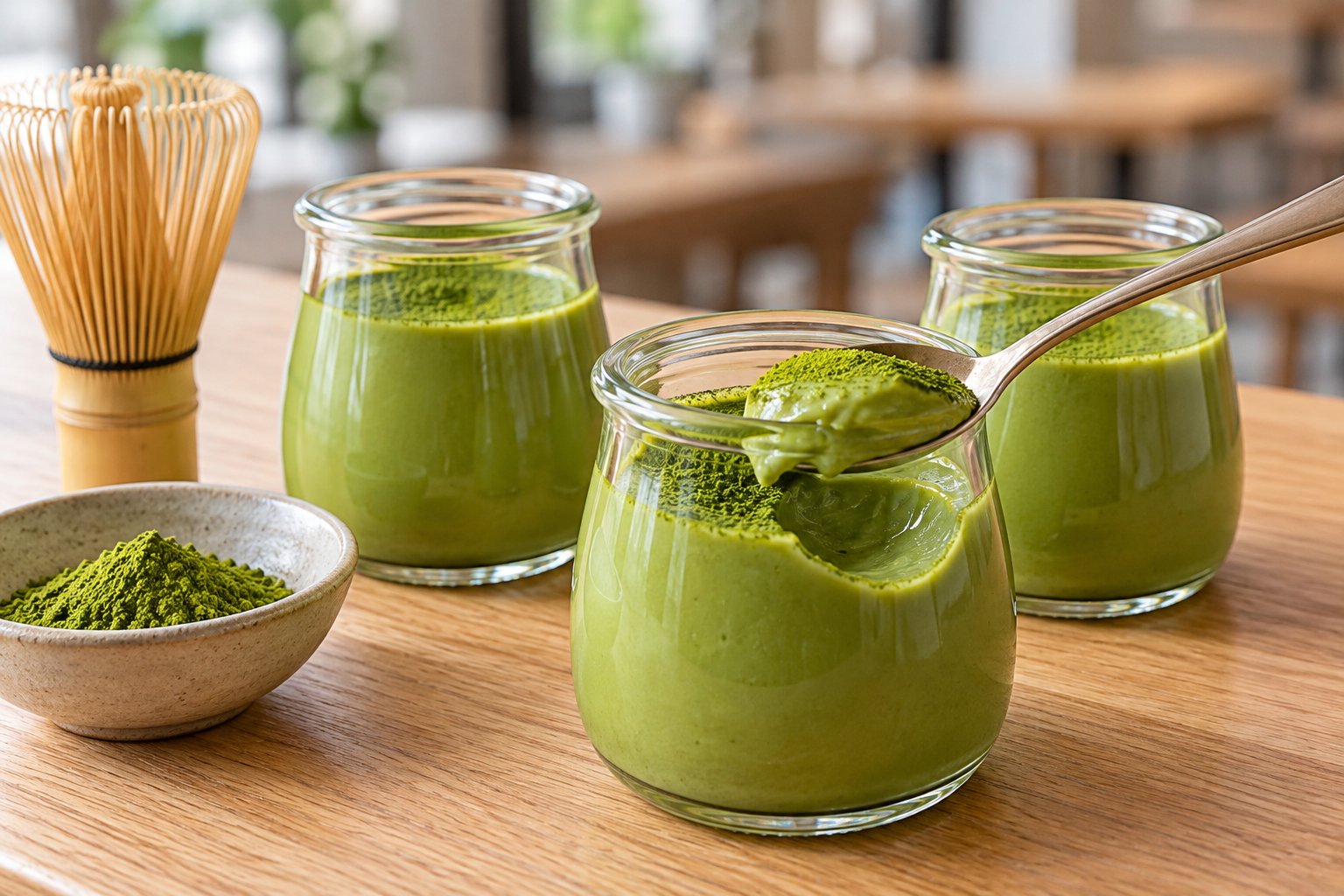
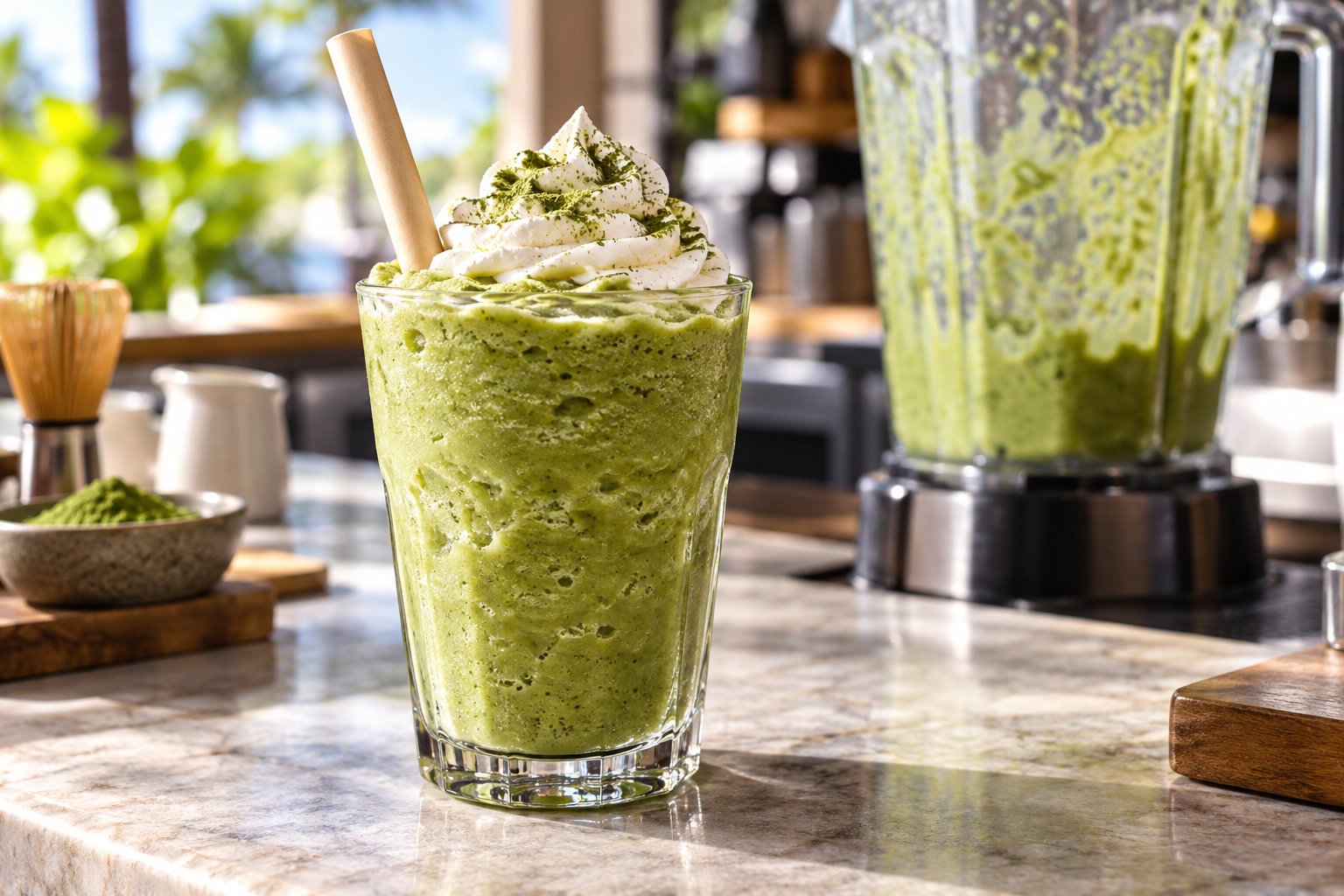
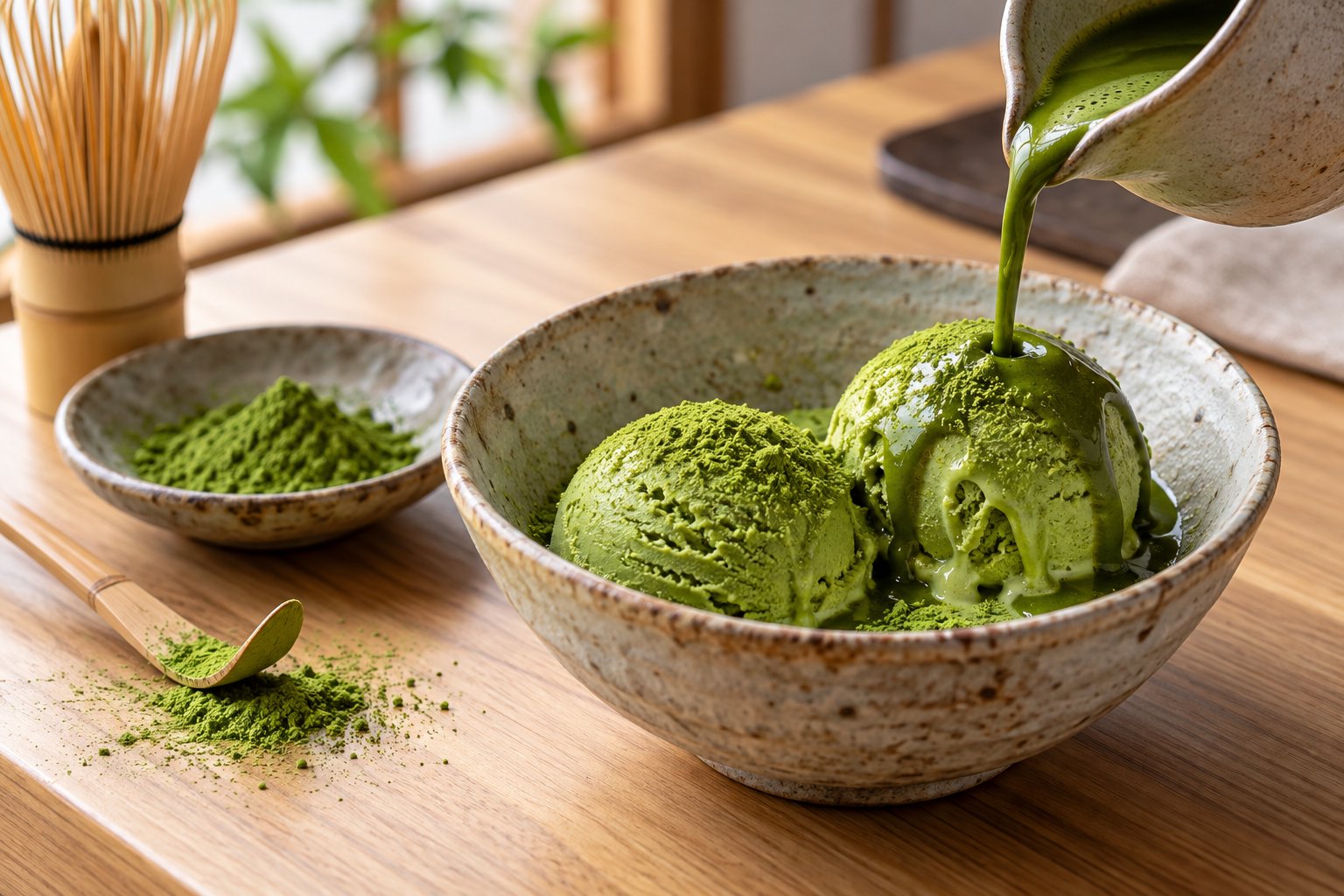
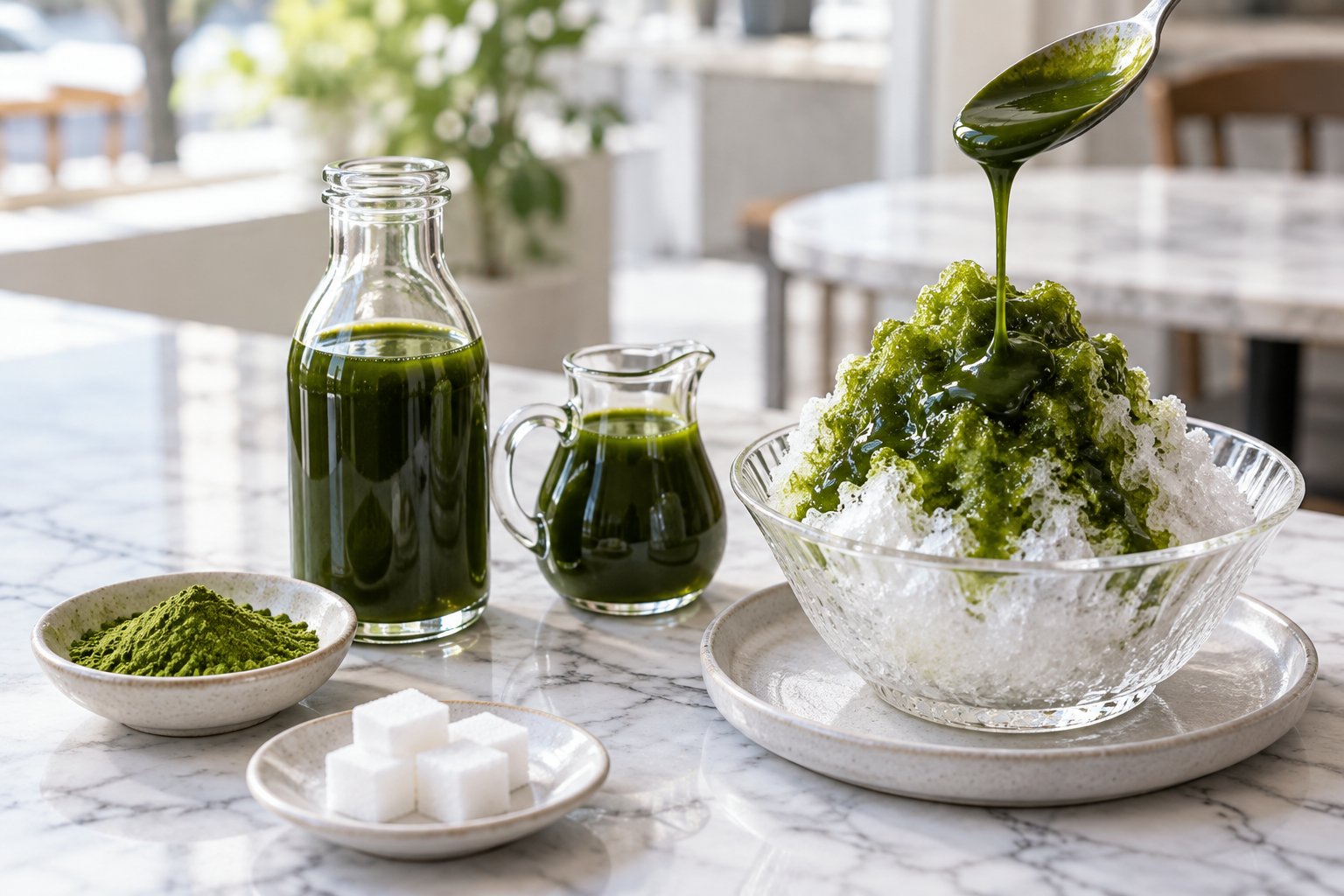
Matcha cream is whipped cream, custard or ganache (chocolate mixed with cream) with matcha added, and matcha sauce is matcha thinned with hot water, condensed milk, white chocolate or similar, to be poured over food. Each one takes the matcha at a different point and temperature, so the things to watch also differ.
The parts covered here
| Type | Base | When the matcha goes in | Main uses |
|---|---|---|---|
| Matcha whipped cream | Fresh cream (or vegetable-fat whipping cream) | Before or during whipping | Lattes, pancakes, parfaits, cakes |
| Matcha custard | Milk, egg yolk, sugar and flour cooked together | Before or after cooking | Choux, pies, filling for cakes |
| Matcha ganache | White chocolate and cream | When combined with the melted chocolate | Nama chocolate, sauce |
| Hot-water sauce | Hot water (sometimes with sugar or starch) | Dissolved first | Ice cream, shiratama, shaved ice |
| Condensed milk sauce | Sweetened condensed milk | After dissolving in a little milk | Shiratama, shaved ice, parfaits |
| White chocolate sauce | White chocolate with extra cream | When combined with the melted chocolate | Fruit, ice cream |
Shiratama are small rice flour dumplings. Ganache is compared in detail in How to Make Matcha Chocolate, and syrup made with sugar water in How to Make Matcha Syrup.
Ready-made products also exist
Matcha cream and matcha sauce are also sold as commercial products for filling and topping bread and sweets. Whether to make your own or buy them depends on how much you use a day and how much control you want over the matcha aroma and colour. For ready-made products, read the ingredient list to see where matcha sits in it and whether colourings or flavourings are added. How to read the list is the same as in the section on reading the ingredient labels of commercial matcha syrup in How to Make Matcha Syrup.
Matcha whipped cream: how much matcha official recipes use
In official recipes, matcha whipped cream used matcha at about 1 to 6% of the cream. Six of the eight recipes fall between 2.5 and 5%.
Eight recipes compared
| Source | Cream | Matcha | Sugar | Matcha as % of cream |
|---|---|---|---|---|
| Nakazawa (a fresh cream maker), basic recipe | 100ml | 1g | 1 tablespoon | about 1% |
| Morinaga & Co. (Kyoto matcha hotcakes) | 20g | 0.5g | 3g | 2.5% |
| Tomizawa Shoten (matcha custard dacquoise cake) | 50ml | 1/2 teaspoon | 5g | about 2.5% (converted) |
| Seven Premium | 200ml | 6g | 25g granulated sugar | 3% |
| Tomizawa Shoten (top of the square shortcake) | 120g | 5g | - | about 4.2% |
| Ito En (matcha whipped cream) | 100ml (milk fat 40% or more) | 5g | 20g granulated sugar | 5% |
| Fukujuen group (roll cake) | 200cc | 10g | - | 5% |
| Tomizawa Shoten (decorated cake) | 250g (milk fat 36%) | 15g | - | 6% |
The percentages are our own calculation, taking 1ml as 1g. For teaspoon conversions we follow Ito En, which writes 5g of matcha as “2 teaspoons”, and take 1 teaspoon as 2.5g. Tomizawa Shoten is a Japanese baking supplies shop, and Fukujuen is a Kyoto tea company.
Source: Nakazawa, “色物クリーム” (Flavoured creams, in Japanese) https://www.nakazawa.co.jp/chiebukuro/?mode=chiebukuro03
Choosing the ratio
Seven Premium says that too little matcha makes the flavour flat, and uses 2 to 3% of the cream as its guide. Where a lot of cream is eaten, such as spreading or piping it over a cake, some recipes go up to 4 to 6%, like Tomizawa Shoten. In your café, make three batches at 2.5%, 4% and 6% with the same amount of sugar and taste each with the menu item it goes on; the difference becomes clear (our suggestion). How to use it in cakes is covered in Matcha Cake, and in parfaits in Matcha Parfait.
Mixing without lumps
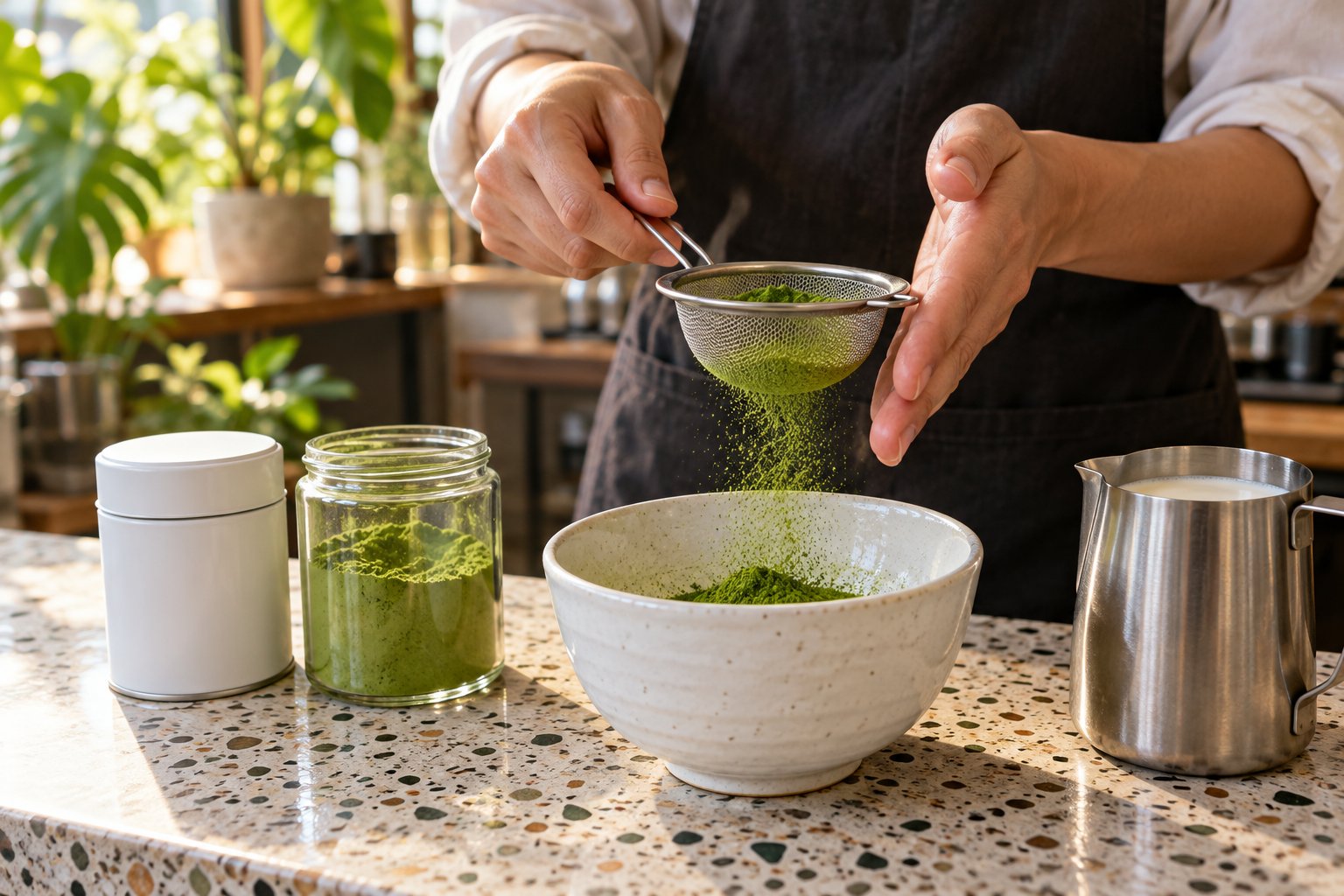
The step common to official recipes is to mix the matcha well with sugar, make a paste with a small amount of liquid, and then add the rest of the liquid. If the powder goes straight into a large amount of cream, undissolved specks remain.
Four ways to add the matcha
| Method | Example from an official recipe |
|---|---|
| Mix with sugar, dissolve in a little cream | Nakazawa: add 10ml of cream, dissolve completely over a hot water bath, then add the remaining 90ml. Seven Premium: make a paste with about 50ml of cream, then add the rest |
| Mix with sugar, make a paste with hot water | Ito En: add 2 teaspoons of hot water to sifted matcha and granulated sugar, then add the cream a little at a time |
| Dissolve in water and add during whipping | Tomizawa Shoten (dacquoise): whip until about as thick as yoghurt, add matcha dissolved in water, then keep whipping |
| Add as powder | Morinaga & Co.: add 0.5g of matcha to the cream and sugar and whip |
The Morinaga & Co. recipe that adds the powder directly uses only 2.5% matcha. The more matcha a recipe uses, the more it needs the step of dissolving it first (our interpretation).
Sift and dissolve fully
According to Yamamasa Koyamaen, matcha is a fine powder of about 10 microns that easily forms lumps, and sifting it just before use prevents this. Seven Premium also writes that mixing until no powdery bits remain at all keeps lumps from forming. At the paste stage, keep mixing until you see no specks when you lift some on a spatula, and only then move on (our suggestion).
Over-whipping, splitting and weeping, and holding shape in a piping bag
Whipped cream fails when it warms up and when it is whipped too far. Keep it cold, stop a little short of the firmness you want, and re-whip just before piping.
Keep it cold and stop short
Takanashi Milk recommends keeping the cream at 3 to 7°C with ice water even while whipping, and writes that ice packs should not replace ice water because they do not lower the temperature as well. With an electric mixer, switch to a hand whisk once the cream starts to thicken. Once it thickens it stiffens all at once, and cream that has split from over-whipping does not return to its original state. Nakazawa recommends stopping a little before the firmness you want and whipping again just before spreading or piping.
Sugar, sweet ingredients and acid make splitting more likely
According to Takanashi Milk, more sugar lowers the fat content of the cream as a whole and the result is looser. Nakazawa writes that thick ingredients such as starch syrup or chocolate syrup should go in when the cream is whipped to 50 to 60% (on the Japanese scale, where 100% is fully whipped), and heavy jam at 70%, and that very sour jam tends to make the cream split. If you sweeten matcha cream with condensed milk or syrup, add it partway through in the same way (our suggestion).
Vegetable-fat whipping cream and dairy cream
| Japanese label | What it is | Character |
|---|---|---|
| Product type “cream” (クリーム) | Made from raw milk or milk, milk fat 18.0% or more. No vegetable fat or additives such as emulsifiers or stabilisers at all | The milk flavour comes through. Once it splits from over-whipping, it does not come back |
| Product name “food made mainly from milk etc.” (乳等を主要原料とする食品), milk fat only | Emulsifiers and stabilisers added | Harder to split and easy to use |
| Same, mixed fat | Part of the milk fat replaced with vegetable fat such as coconut or palm oil | - |
| Same, vegetable fat | All of the milk fat replaced with vegetable fat | Light, clean flavour |
The table is from Takanashi Milk’s Q&A (the standard for “cream” is set by Japan’s ministerial ordinance on milk and milk products). Nakazawa explains that creams made with vegetable fat or additives are designed not to turn grainy and to stay neat for longer after piping. A study from Rakuno Gakuen University (2000) also reported that the amount of water released from whipped cream (weeping) is larger for dairy cream than for vegetable cream. Megmilk Snow Brand says its matcha cream parfait can be made with either fresh cream or 40% vegetable-fat whipping cream. When you buy in Singapore or Thailand, check the fat content on the label and whether the ingredients include vegetable fat or emulsifiers.
Holding shape in a piping bag
Nakazawa explains that cream for sweets should have 35 to 50% milk fat, and that lower-fat cream at 40% or less holds more air than high-fat cream. On piping, it lists the following:
- Gripping the piping bag with both hands warms the cream and makes it rough. Push with one hand and only support with the other
- With a star tip, cream that is too soft does not show the pattern, and cream that is too firm makes the pattern ragged
- For anything that goes in the mouth, disposable plastic bags are better for hygiene
If you want piped cream to hold its shape longer in a display case or a hot shop, try a whipping cream with less milk fat or one blended with vegetable fat; if you pipe to order, use dairy-only cream. That is one way to divide them (our suggestion).
How to make matcha custard
In official recipes, matcha custard used matcha at about 0.8 to 5% of the milk or other liquid (one recipe is measured against the finished custard). There are two ways: sift the matcha with the flour and cook it in, or mix it into the custard after cooking.
Five recipes compared
| Source | Liquid | Matcha | Matcha as % of liquid | When the matcha goes in |
|---|---|---|---|---|
| Tomizawa Shoten (matcha custard dacquoise cake) | 300ml milk | 1 teaspoon | about 0.8% (converted) | Sifted with the flour, before cooking |
| Tomizawa Shoten (easy microwave custard) | 180ml milk | 4.5g | 2.5% | After cooking, after the butter, through a tea strainer |
| Ito En (matcha cream puffs, no egg) | 100cc milk, 100cc cream | 2 teaspoons | 2.5% (converted) | Mixed with sugar, before cooking |
| Tomizawa Shoten (variation on rich basic custard) | about 100g finished custard | 4g | about 4% of the finished custard | After cooking |
| Ito En (matcha custard pie) | 200cc milk | 4 teaspoons | 5% (converted) | Sifted with the flour, before cooking |
The percentages are our own calculation, taking 1 teaspoon as 2.5g.
Before or after cooking
Ito En and Tomizawa Shoten (dacquoise) mix the matcha with sugar or flour first, thin it with milk and cook it. The other two Tomizawa Shoten recipes cook a plain custard and then mix in the matcha, so one batch can be split into plain, matcha and other flavours, and the matcha is not heated for long. Yamamasa Koyamaen explains that heating can reduce matcha’s flavour and turn its colour reddish, so if colour comes first, try adding it after cooking (our suggestion).
Rapid chilling and adjusting the texture
Nakazawa writes that starch spoils most easily at room temperature, so the custard should be spread thin, wrapped in plastic film and chilled quickly. If the surface dries, lumps remain when you mix it later, so press the film onto the surface. Once it is cold, mix with a rubber spatula and keep some body if you will pipe it or use it as a filling, or break the body with a whisk if you want it soft and flowing, as in choux, to get the texture you need.
How to make matcha sauce: hot water, condensed milk or white chocolate
Matcha sauce falls into four types: dissolved in hot water, thickened with starch, thinned with condensed milk, or thinned with white chocolate and cream. The type and amount of liquid change how it flows when poured and how easily the matcha settles.
Dissolving in hot water and thickening
| Source | Recipe | Result |
|---|---|---|
| Ito En (matcha affogato, 1 serving) | 1 teaspoon matcha, 20ml hot water | A sauce with no sugar. It notes that adding gum syrup turns it into a syrup for shaved ice |
| NHK “Kyou no Ryouri” (shiratama and azuki with matcha sauce, 2 servings) | 1 teaspoon matcha, 1 tablespoon sugar, 1/5 teaspoon potato starch, 2 tablespoons boiling water | Microwaved for 20 seconds and then 10 seconds to thicken |
NHK’s recipe mixes the matcha, sugar and potato starch well first, so that no lumps form, and then adds the boiling water. Thickening with starch helps the sauce stay on shiratama or ice cream (our interpretation).
Thinning with condensed milk
Source: Megmilk Snow Brand, “白玉だんごの抹茶ミルクソース” (Shiratama dumplings with matcha milk sauce, in Japanese) https://www.meg-snow.com/fun/kurihara-recipe/backnumber/201204/recipe_02.html
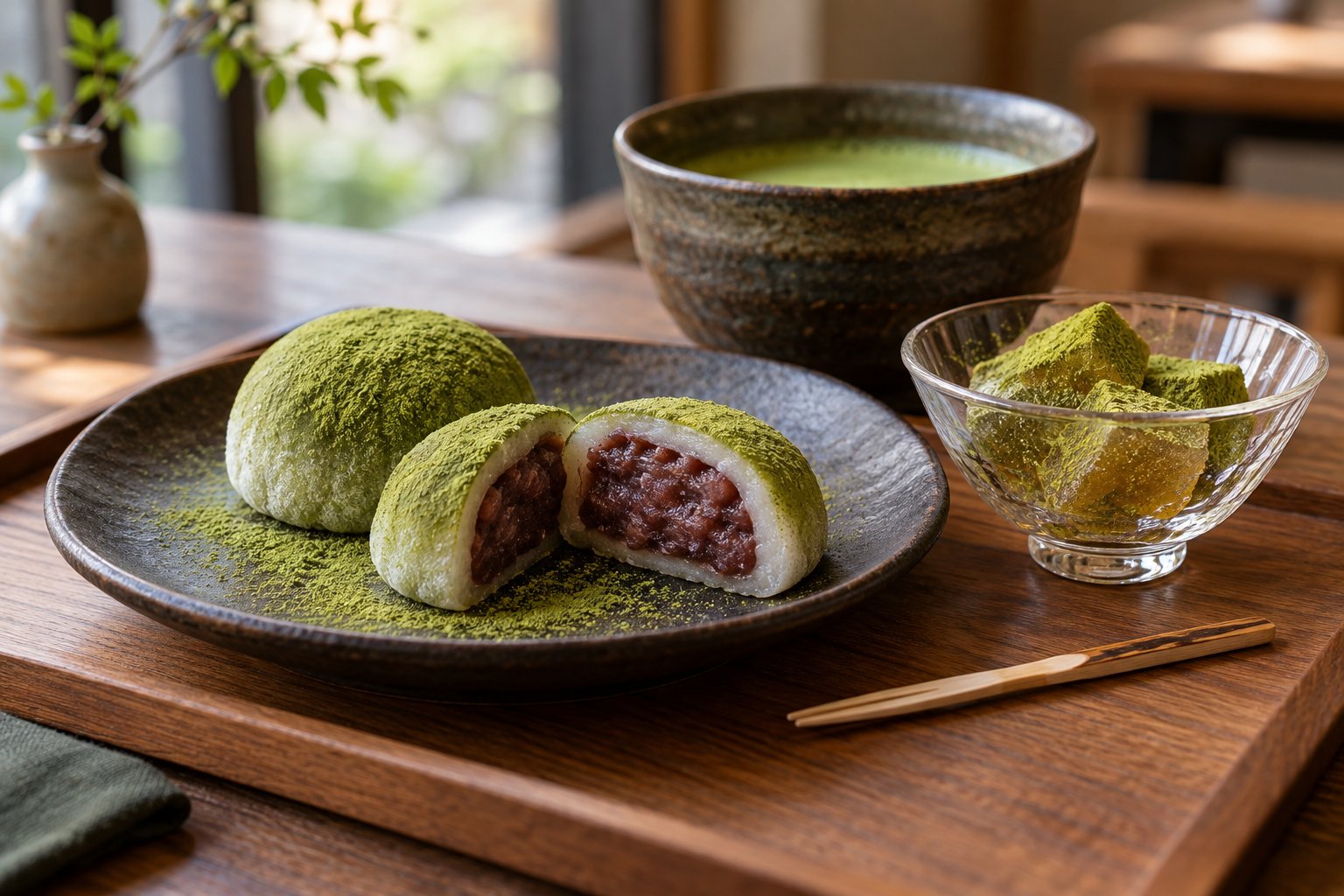
Megmilk Snow Brand’s matcha milk sauce (for 4 large dumplings) uses 1/2 to 1 teaspoon of matcha for 1/4 cup (50ml) of condensed milk. Rather than putting the matcha straight into the condensed milk, it dissolves it first in 1/2 tablespoon of warmed milk. Morinaga Milk’s Japanese-style parfait mixes 20g of sweetened condensed milk and 3g of matcha into 100g of yoghurt and puts it in the glass. How to pair condensed milk with matcha shaved ice is covered in Matcha Kakigori.
Thinning with white chocolate and cream
| Source | White chocolate : cream | Matcha | Result |
|---|---|---|---|
| Nakazawa (basic ganache) | 3:1 (the worked example is 60g to 25ml) | - | Set, then piped or rolled |
| Megmilk Snow Brand (matcha nama chocolate) | 2:1 (200g to 100ml) | 10g (5% of the chocolate) | Chilled until set, then cut |
| Nakamura Tokichi Honten (matcha ganache) | 1:1 (200g to 200g) | 17g (8.5% of the chocolate) | A sauce for dipping fruit |
Nakazawa writes that adding plenty of liquid cream to ganache turns it into a sauce to pour over ice cream. The higher the share of cream, the more it changes from something you set into a sauce you pour. Nakazawa brings the white chocolate to 42 to 45°C, adds first 1/3 of the boiled cream and then the rest a little at a time to emulsify it (oil separating out means there is not enough liquid). How to fix a split ganache is in How to Make Matcha Chocolate.
Keeping the colour and stopping the matcha from settling
Matcha’s green fades with light and heat, and the powder does not dissolve but only floats in the liquid, so over time the colour changes and, in a thin sauce, the matcha collects at the bottom. The batch size and where you keep it help prevent this.
Colour fades with light and time
According to Yamamasa Koyamaen, matcha fades under both sunlight and artificial light, and a matcha cake left under display case lighting for a long time loses its colour. Do not leave piped matcha cream or sauced desserts sitting under the lights. Why matcha turns yellow or brown is explained in Matcha Colour.
Thinner sauces settle more
A 2003 study reported that matcha does not dissolve in water but stays as fine particles suspended in it, and that finer matcha (3.2µm) settles more slowly than normal matcha (average particle size 11.5µm). A sauce made only by dissolving matcha in hot water tends to leave matcha at the bottom if made in advance. These measures are possible (our suggestion):
- Make hot-water sauce only as needed, or shake or stir it well before use
- Thicken it with potato starch or condensed milk so the liquid has more body
- Write the time it was made and “shake before use” on the sauce bottle
Batch size and standards for cold storage
We could not find any public figure for how many days matcha cream or matcha sauce keeps. Set your shop’s own number of days from the public standards for heating, chilling and cold storage, and from the dates on the dairy products you used.
Public standards
| Source | Content |
|---|---|
| Japan Ministry of Health, Labour and Welfare, Hygiene Management Manual for Large-Scale Cooking Facilities | Food that is cooked should reach 75°C at the centre for 1 minute or more |
| Same | Cooked food being chilled should be brought to around 20°C at the centre within 30 minutes (or around 10°C within 60 minutes), with the start and end times of chilling recorded |
| Same | Cream as a raw material is stored at 10°C or below. Cooked food should preferably be eaten within 2 hours of cooking |
| US FDA, Food Code 2026 | Refrigerated food made on site and kept for more than 24 hours: up to 7 days at 5°C or below, with the day of preparation counted as day 1 and a date mark |
The Japanese manual applies to facilities that serve the same menu to 300 or more people at a time or 750 or more a day, but the ministry’s notice asks small and medium facilities to follow its intent as well. The conditions for using something outside the fridge for a set time are in Matcha Cold Foam.
When to prepare each part
| Part | When to make it | Basis |
|---|---|---|
| Matcha whipped cream | Whip just before use. Stop short, refrigerate, and re-whip before piping | Seven Premium says leaving it after whipping causes splitting. Nakazawa stops short and re-whips just before use |
| Matcha custard | Cook the day before or that morning, chill quickly and refrigerate (our suggestion) | Nakazawa says to chill quickly because starch spoils easily at room temperature |
| Hot-water sauce | As needed, or only enough for a short time | Because the matcha settles and the colour changes (our suggestion) |
| Condensed milk or white chocolate sauce | Enough for one day. Refrigerated | Nakazawa writes that ganache should be kept in the fridge and used up early |
On freezing whipped cream, Takanashi Milk says it can be frozen in small portions but cannot be used for decoration. Not freezing it, and whipping only what you use each day, is the safer choice (our suggestion). Make the number of days you set shorter than the dates on the cream, milk and eggs you used, and write the date and time made on the container. How to store the matcha powder itself is in Matcha Shelf Life and Storage.
Matching parts to drinks and desserts, and matcha per serving
The matcha per serving can be worked out from the amount of cream or sauce and its matcha ratio. Calculated from official recipe amounts, a serving uses about 0.3 to 2.5g, often less than the matcha in one latte (2 to 3g).
Parts by menu item and matcha per serving
| Menu item | Suitable parts | Matcha per serving (our calculation) |
|---|---|---|
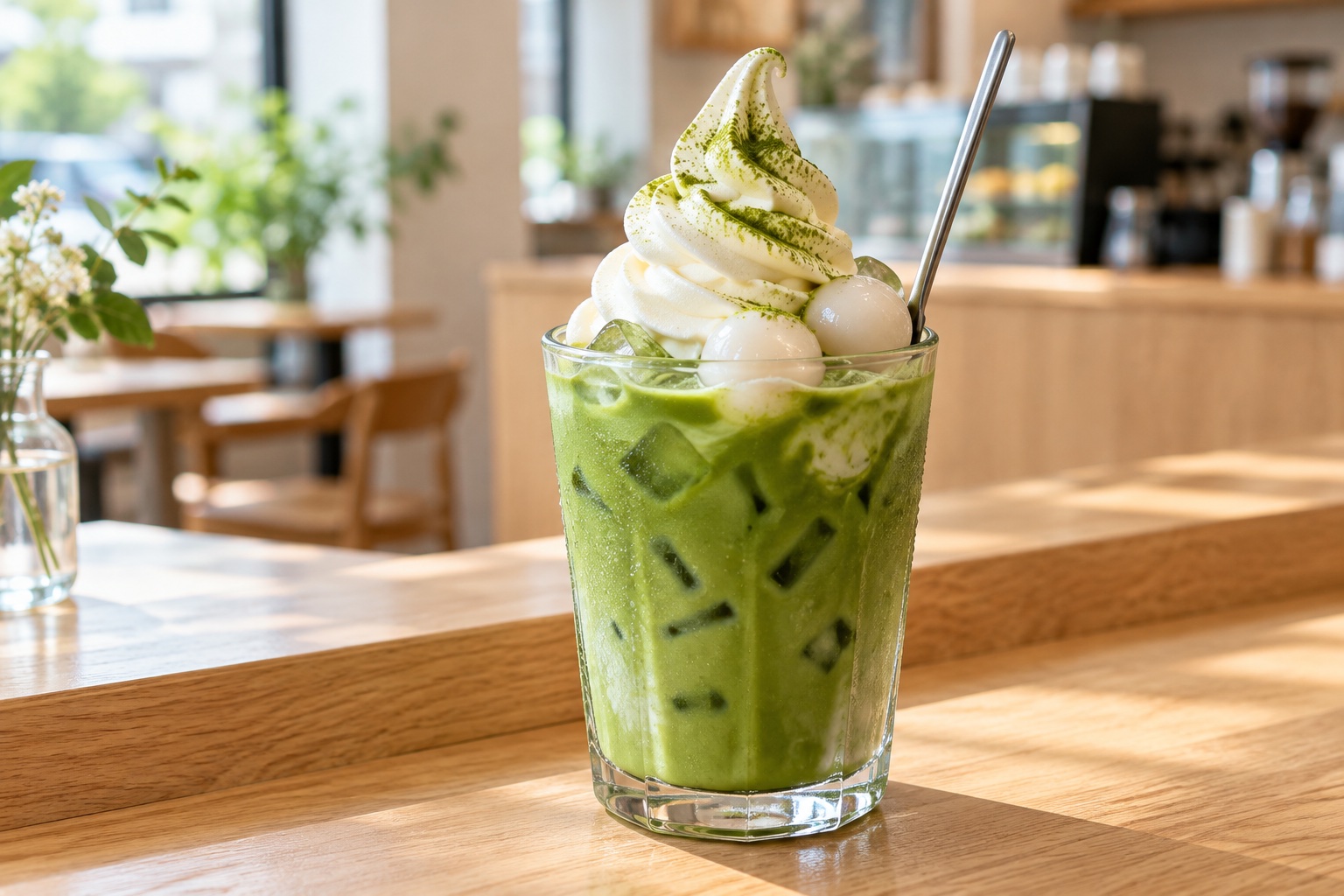
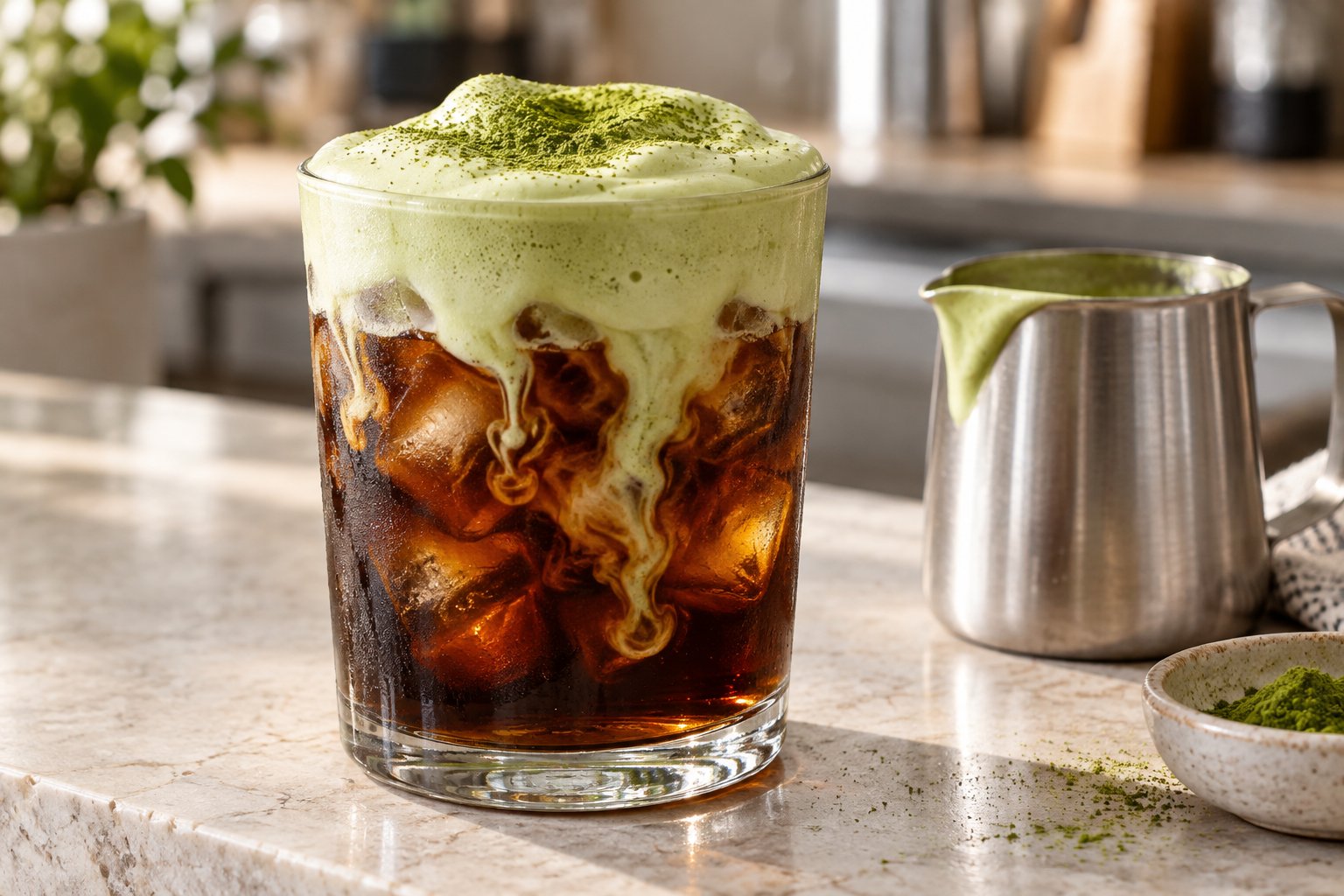
| On top of a latte or cold brew | Matcha whipped cream, cold foam | 20 to 60ml of cream at 3% gives about 0.6 to 1.8g. Oatly’s cold foam uses 1.5 to 2g per 50ml |
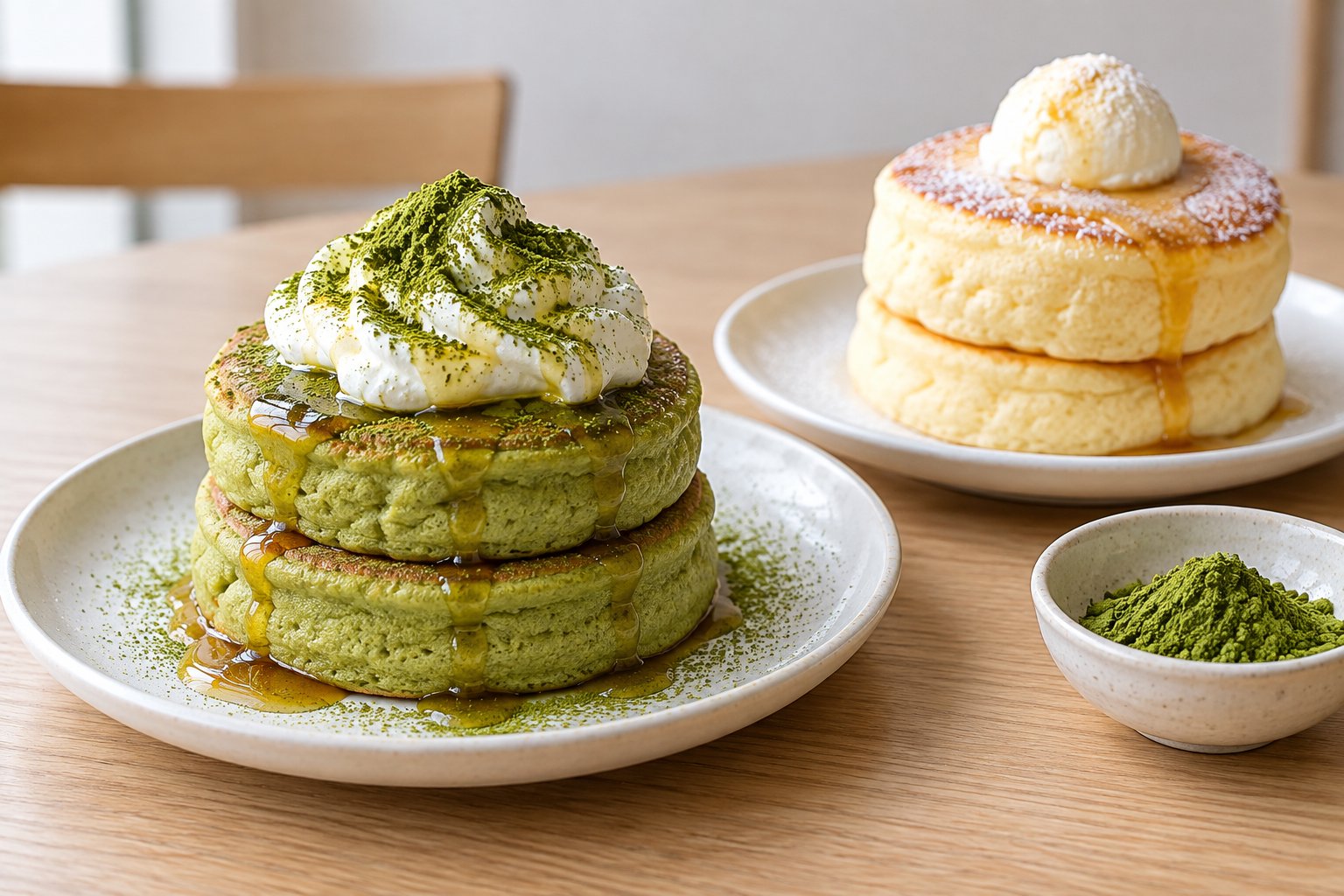
| Pancakes | Matcha whipped cream, condensed milk sauce | Morinaga & Co.: 0.5g in 20g of cream |
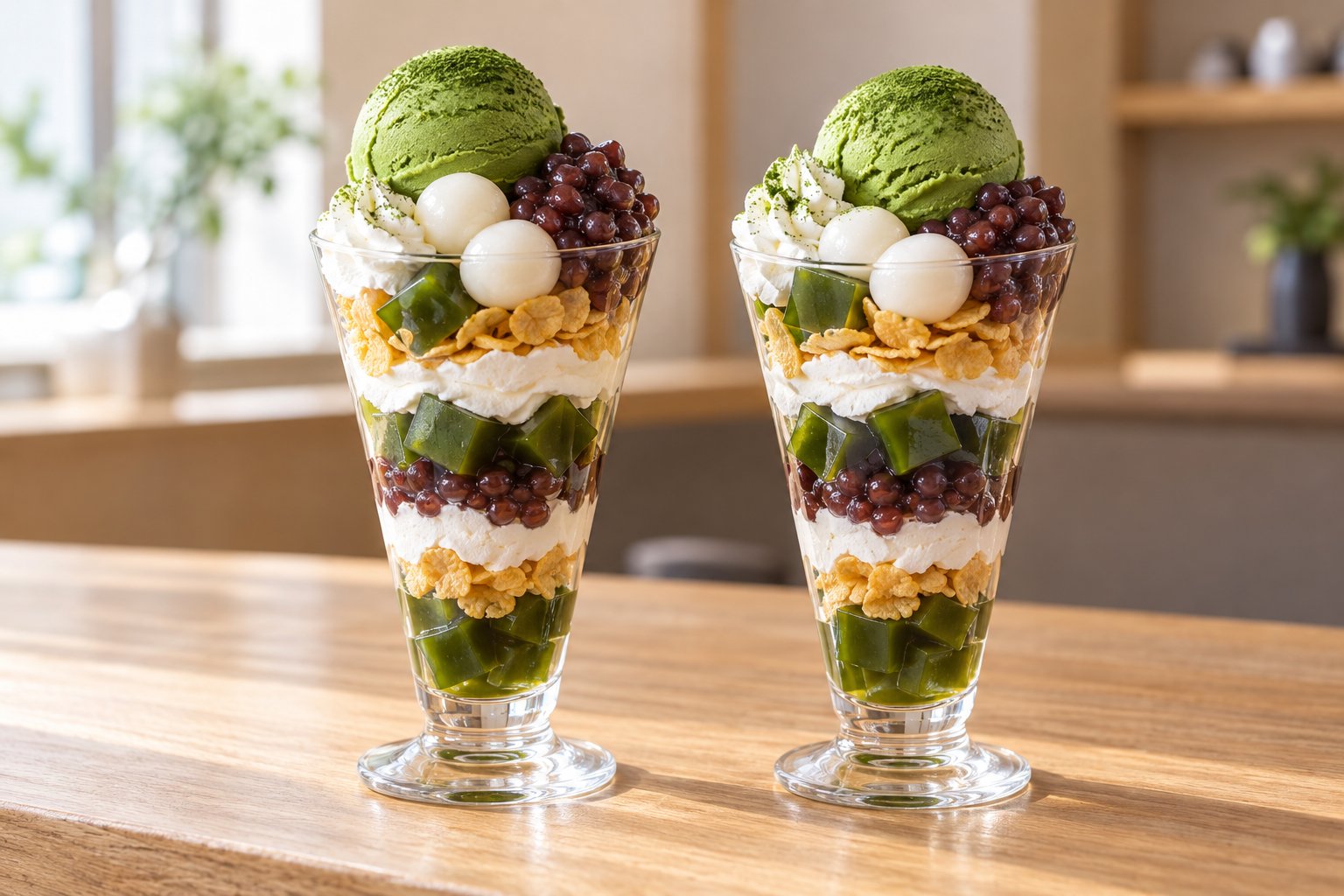
| Parfait | Matcha whipped cream, custard, sauce | Kumitasu’s cream: 3g for 2 parfaits, 1.5g each |
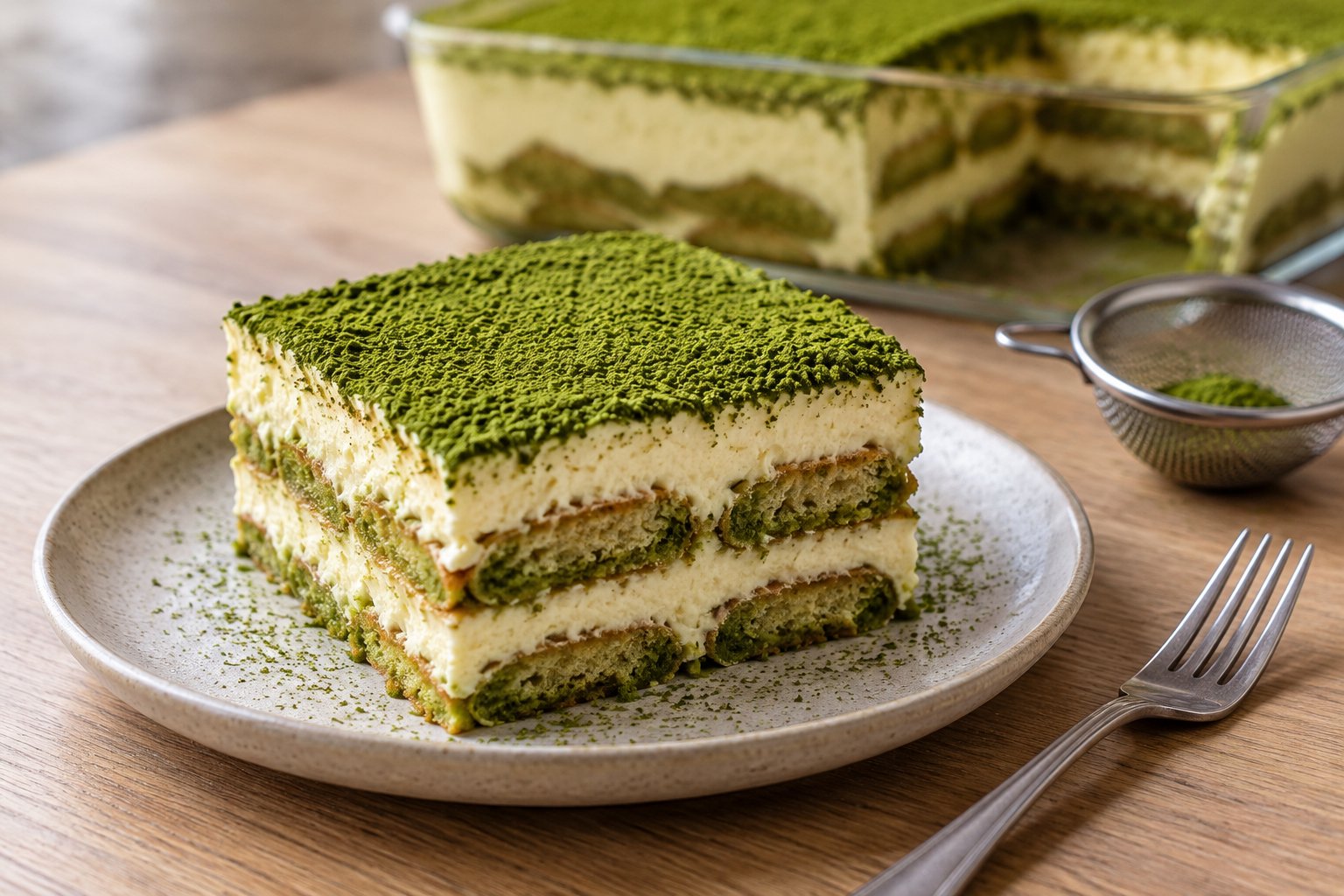
| Cake | Matcha whipped cream at 4 to 6%, custard | Tomizawa Shoten’s decorated cake: 15g in the cream, 2.5g per slice if cut into 6 |
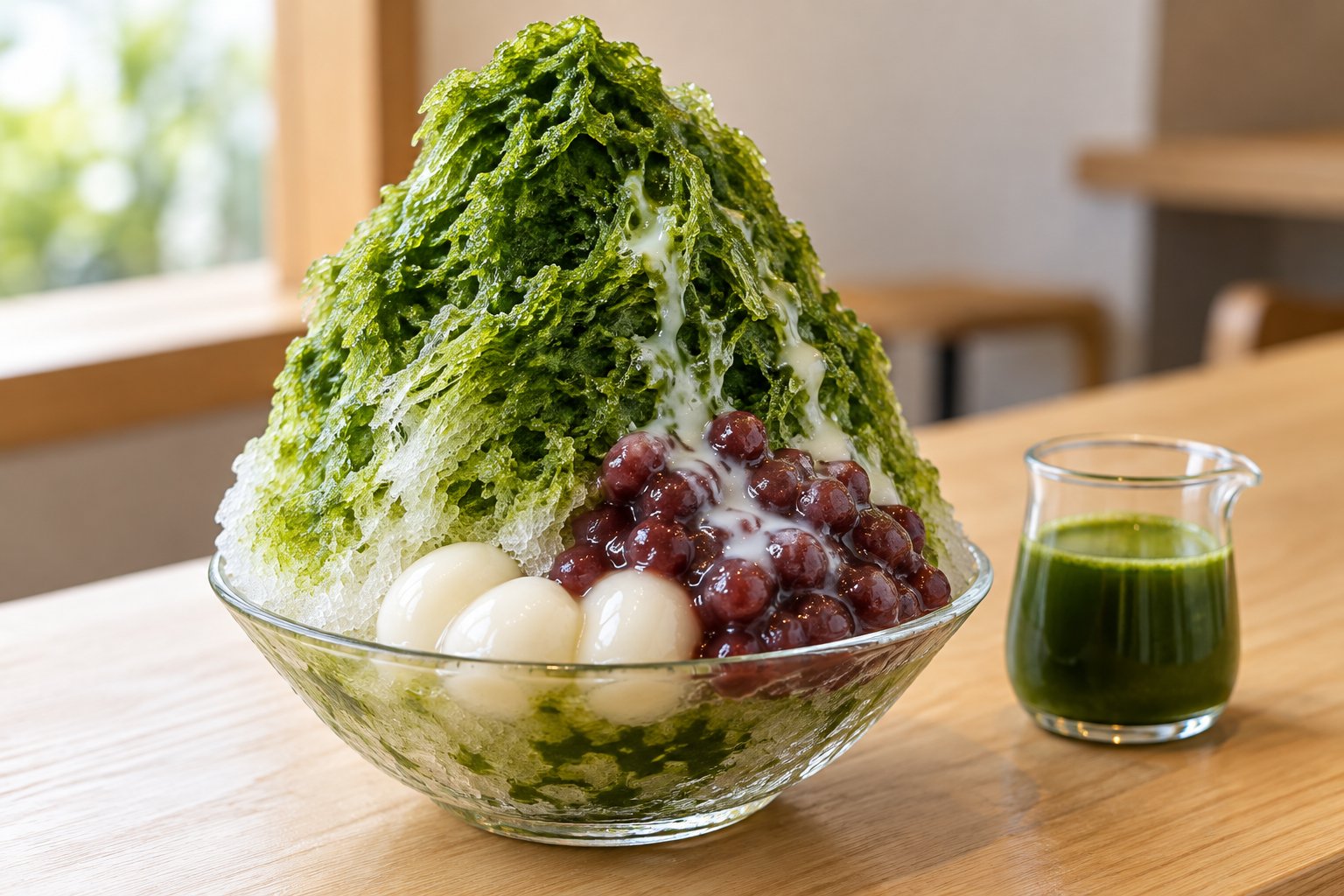
| Shaved ice, shiratama | Condensed milk sauce, thickened sauce | Megmilk Snow Brand’s matcha milk sauce: 1/2 to 1 teaspoon for 4 large dumplings, about 0.3 to 0.6g each. NHK’s sauce: 1/2 teaspoon per serving (about 1.25g) |
| Ice cream, affogato | Hot-water sauce, white chocolate sauce | Ito En: 1 teaspoon per serving (about 2.5g) |
We take 1 teaspoon as 2.5g. The Kumitasu servings and the number of cake slices follow the calculations in Matcha Parfait and Matcha Cake. Drinks topped with cream are covered in Matcha Einspänner, and the matcha in one latte in How to Make a Hot Matcha Latte.
Working out the matcha cost per serving
The matcha cost per serving is “buying price per kg ÷ 1,000 × grams of matcha per serving”. Add what you made but threw away, and any matcha dusted on top. How the price per kg is set is explained in How Matcha Prices Are Set.
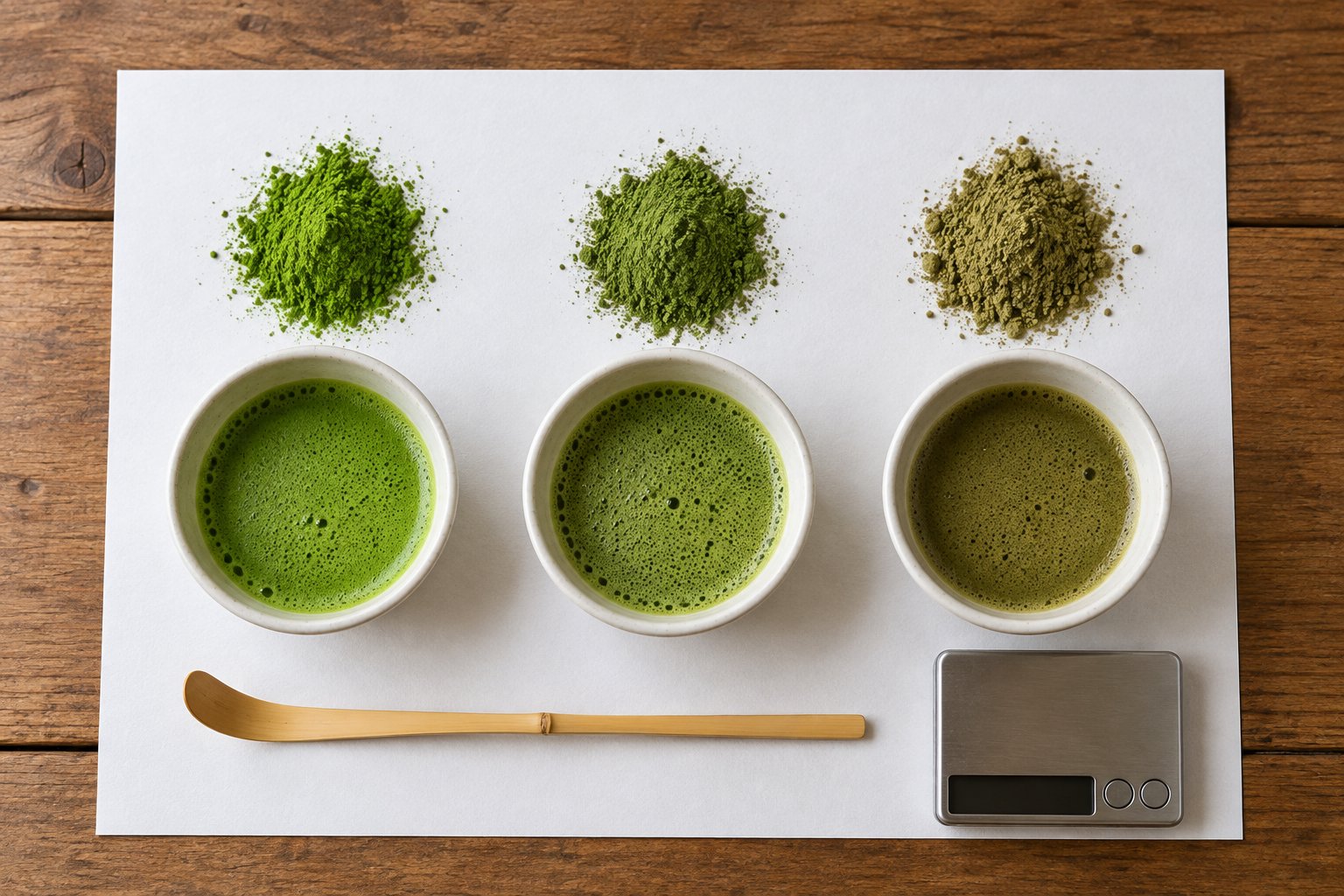
Choosing the grade by testing
For ice cream, cream and matcha sauce, Yamamasa Koyamaen gives a range from drinking grades down to its processing grade Toku-B, to make use of the matcha flavour. Whipped cream and hot-water sauce are not heated, so the matcha aroma and colour come through easily (our view). Make cream and sauce with the matcha you use for lattes and with the next grade down, and compare colour and bitterness; this tells you whether to use a separate matcha for these parts (our suggestion). The differences between grades are explained in Matcha Grades.
Omakase Matcha supplies matcha from Uji, Yame, Shizuoka, Kagoshima and Miyazaki, with orders from 1kg and up to 3 samples. To compare colour and bitterness in cream and sauce, request matcha from Samples.
Sources
- Nakazawa, “色物クリーム” (Flavoured creams, in Japanese) https://www.nakazawa.co.jp/chiebukuro/?mode=chiebukuro03
- Nakazawa, “クリーム” (Cream, in Japanese) https://www.nakazawa.co.jp/chiebukuro/?mode=chiebukuro01
- Nakazawa, “カスタードクリーム” (Custard cream, in Japanese) https://www.nakazawa.co.jp/chiebukuro/?mode=chiebukuro09
- Nakazawa, “ガナッシュクリーム” (Ganache, in Japanese) https://www.nakazawa.co.jp/chiebukuro/?mode=chiebukuro11
- Nakazawa, “口金・絞り袋の種類と使い方” (Piping tips and bags, in Japanese) https://www.nakazawa.co.jp/chiebukuro/?mode=chiebukuro15
- Takanashi Milk, “種類別『クリーム』とはなんですか?” (What is the product type “cream”?, in Japanese) https://www.takanashi-milk.co.jp/qa/detail/326
- Takanashi Milk, “名称『乳等を主要原料とする食品』とはなんですか?” (What is “food made mainly from milk etc.”?, in Japanese) https://www.takanashi-milk.co.jp/qa/detail/327
- Takanashi Milk, “電動ホイッパーを使うときはどうしたらよいですか?” (Using an electric mixer, in Japanese) https://www.takanashi-milk.co.jp/qa/detail/331
- Takanashi Milk, “クリームは冷凍できますか?” (Can cream be frozen?, in Japanese) https://www.takanashi-milk.co.jp/qa/detail/334
- Takanashi Milk, “なかなか泡立たないのですが” (The cream will not whip, in Japanese) https://www.takanashi-milk.co.jp/qa/detail/341
- Takanashi Milk, “なぜホイップ時に氷水をあてるのでしょうか?” (Why use ice water when whipping?, in Japanese) https://www.takanashi-milk.co.jp/qa/detail/343
- Seven Premium, “ふんわり『抹茶クリーム』のレシピ” (Fluffy matcha cream recipe, in Japanese) https://7premium.jp/recipe/search/detail?id=9356
- Ito En, “お菓子研究家 福田淳子氏監修!抹茶ホイップと小倉みかんのサンド” (Matcha whipped cream, azuki and mandarin sandwich, in Japanese) https://www.itoen.jp/recipe/45852/
- Ito En, “抹茶シュークリーム” (Matcha cream puffs, in Japanese) https://www.itoen.jp/recipe/40001/
- Ito En, “抹茶カスタードパイ” (Matcha custard pie, in Japanese) https://www.itoen.jp/recipe/39917/
- Ito En, “抹茶アフォガート” (Matcha affogato, in Japanese) https://www.itoen.jp/recipe/39908/
- Tomizawa Shoten, “抹茶カスタードダックワーズケーキ” (Matcha custard dacquoise cake, in Japanese) https://tomiz.com/recipe/pro/detail/20190516093737
- Tomizawa Shoten, “パティシエレシピ♪レンジで簡単カスタード(プレーン/チョコ/抹茶)” (Easy microwave custard, in Japanese) https://tomiz.com/recipe/pro/detail/20230130005048
- Tomizawa Shoten, “基本の濃厚カスタードクリームと応用カスタードクリーム2種” (Rich basic custard and two variations, in Japanese) https://tomiz.com/recipe/pro/detail/20220302005721
- Tomizawa Shoten, “抹茶の和風スクエアショートケーキ” (Japanese-style matcha square shortcake, in Japanese) https://tomiz.com/recipe/pro/detail/20231205163417
- Tomizawa Shoten, “【抹茶の基本スイーツ】抹茶のデコレーションケーキ” (Matcha decorated cake, in Japanese) https://tomiz.com/recipe/pro/detail/20220216104120
- Morinaga & Co., “京のお抹茶ホットケーキ・京のほうじ茶ホットケーキ” (Kyoto matcha and hojicha hotcakes, in Japanese) https://www.morinaga.co.jp/recipe/detail/1075
- Morinaga Milk, “抹茶×ビヒダス 簡単!和風パフェ” (Easy Japanese-style parfait with matcha and yoghurt, in Japanese) https://www.morinagamilk.co.jp/recipe/detail/recipe.php?id=01122Y
- Megmilk Snow Brand, “白玉だんごの抹茶ミルクソース” (Shiratama dumplings with matcha milk sauce, April 2012, in Japanese) https://www.meg-snow.com/fun/kurihara-recipe/backnumber/201204/recipe_02.html
- Megmilk Snow Brand, “抹茶生チョコ” (Matcha nama chocolate, in Japanese) https://www.meg-snow.com/recipe/detail/10248.html
- Megmilk Snow Brand, “抹茶クリームパフェ” (Matcha cream parfait, in Japanese) https://www.meg-snow.com/recipe/detail/10562.html
- NHK, “みんなのきょうの料理 白玉小豆 抹茶ソースかけ” (Shiratama and azuki with matcha sauce, 11 February 2008, in Japanese) https://www.kyounoryouri.jp/recipe/16643_白玉小豆%20抹茶ソースかけ.html
- Nakamura Tokichi Honten, “Indulge in the Depth of Matcha Ganache” https://global.tokichi.jp/blogs/life-with-tea/indulge-in-the-depth-of-matcha-ganache
- Kumitasu, “抹茶白玉パフェ(乳不使用)” (Matcha shiratama parfait, dairy-free, in Japanese) https://www.kumitasu.com/contents/recipe/3927
- Oatly, “Introducing Oatly Barista Cold Foam” https://www.oatly.com/things-we-do/stories/barista-cold-foam
- Yamamasa Koyamaen, “抹茶の取扱い” (Handling matcha, in Japanese) https://www.yamamasa-koyamaen.co.jp/matcha/basic/handling.html
- Yamamasa Koyamaen, “加工用抹茶・他パウダー(業務用・製菓用)” (Matcha for food processing, in Japanese) https://www.yamamasa-koyamaen.co.jp/product/for-processing.html
- Kazumi Yamaguchi, Masato Ishioroshi, Kunihiko Samejima, “ホイップクリームの性状に関する研究 第2報” (Study on the properties of whipped cream, part 2), Milk Science 49(3), 2000 (in Japanese) https://www.jstage.jst.go.jp/article/milk/49/3/49_139/_article/-char/ja/
- Haraguchi, Imada, Sawamura, “Production and characterization of fine matcha for processed food”, Journal of the Japanese Society for Food Science and Technology 50(10), 2003 https://agris.fao.org/search/en/records/647242e92c1d629bc9792fac
- Ministry of Health, Labour and Welfare, “大量調理施設衛生管理マニュアル” (Hygiene Management Manual for Large-Scale Cooking Facilities, last revised 16 June 2017, in Japanese) https://www.mhlw.go.jp/file/06-Seisakujouhou-11130500-Shokuhinanzenbu/0000168026.pdf
- U.S. Food and Drug Administration, “FDA Food Code 2026” https://www.fda.gov/food/fda-food-code/food-code-2026