
 Reviewed by: Takahiro Sugiyama (CEO, meguri Inc.)
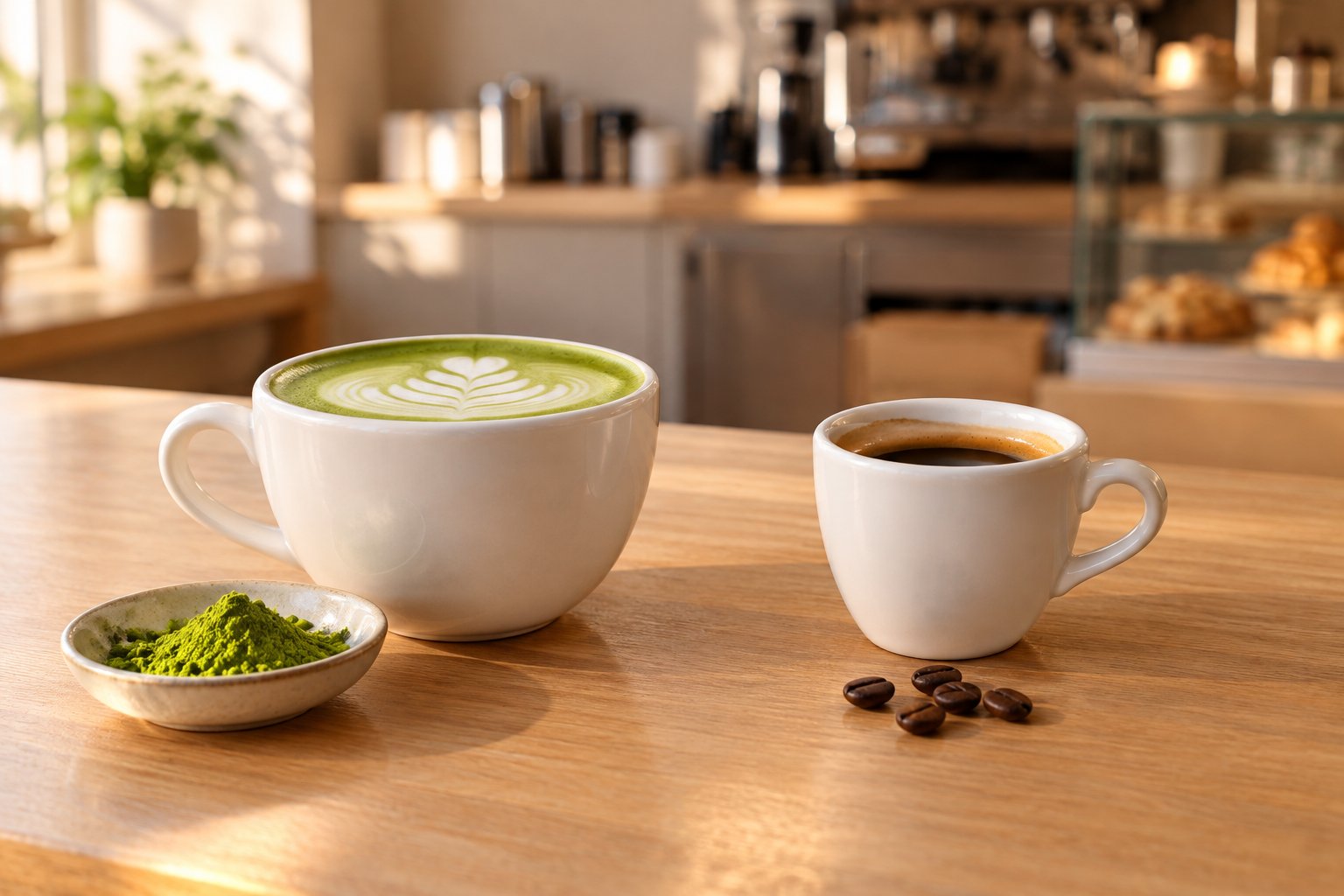
Café customers who order a matcha latte sometimes ask how much caffeine is in it. Because matcha is drunk as a whole powder, the caffeine in a cup depends almost entirely on how many grams of matcha go into it. Calculating each cup from Japan’s food composition tables and setting the results next to coffee and other teas lets you answer using the amounts on your own menu.
Does matcha have caffeine?
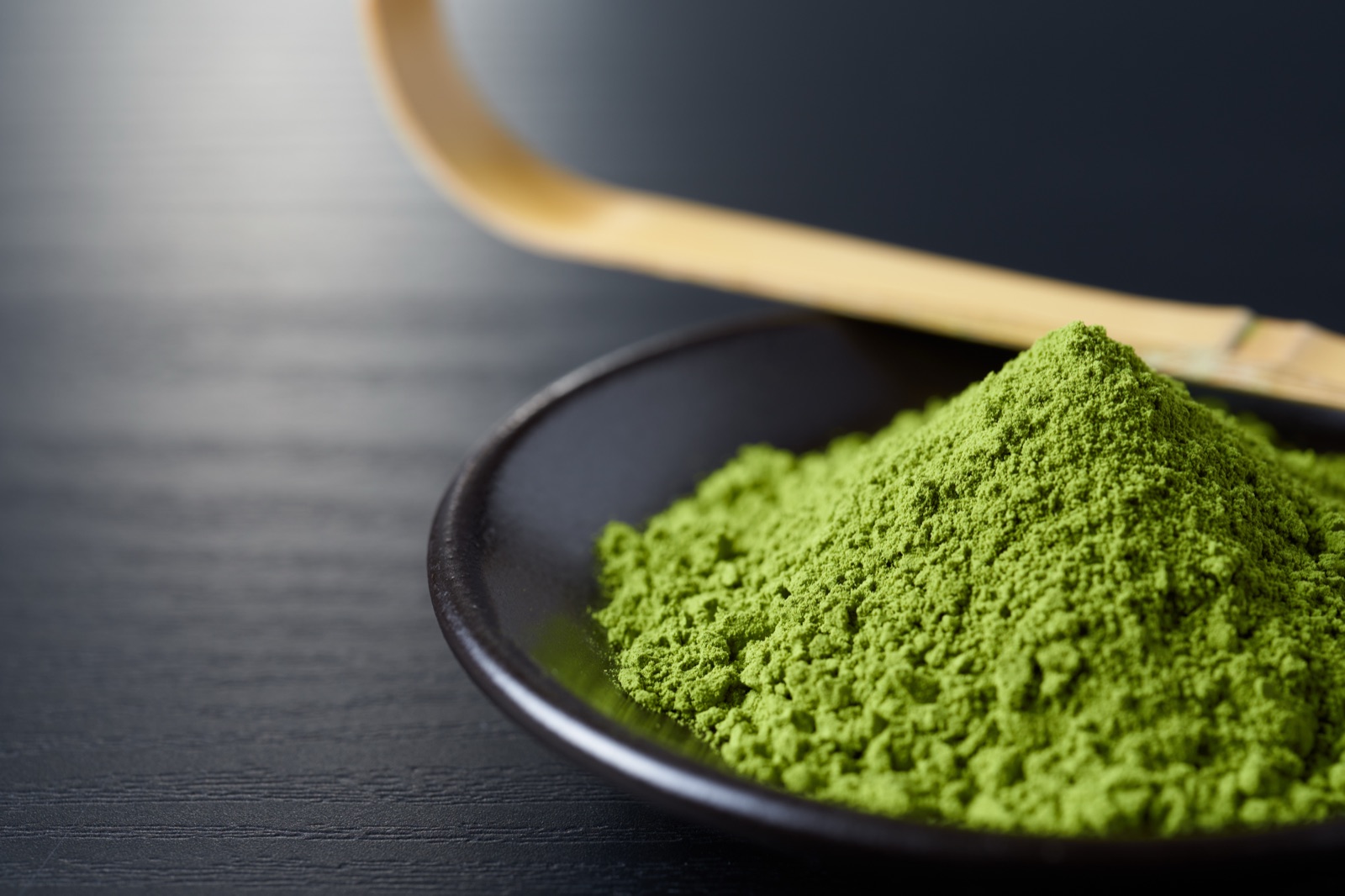
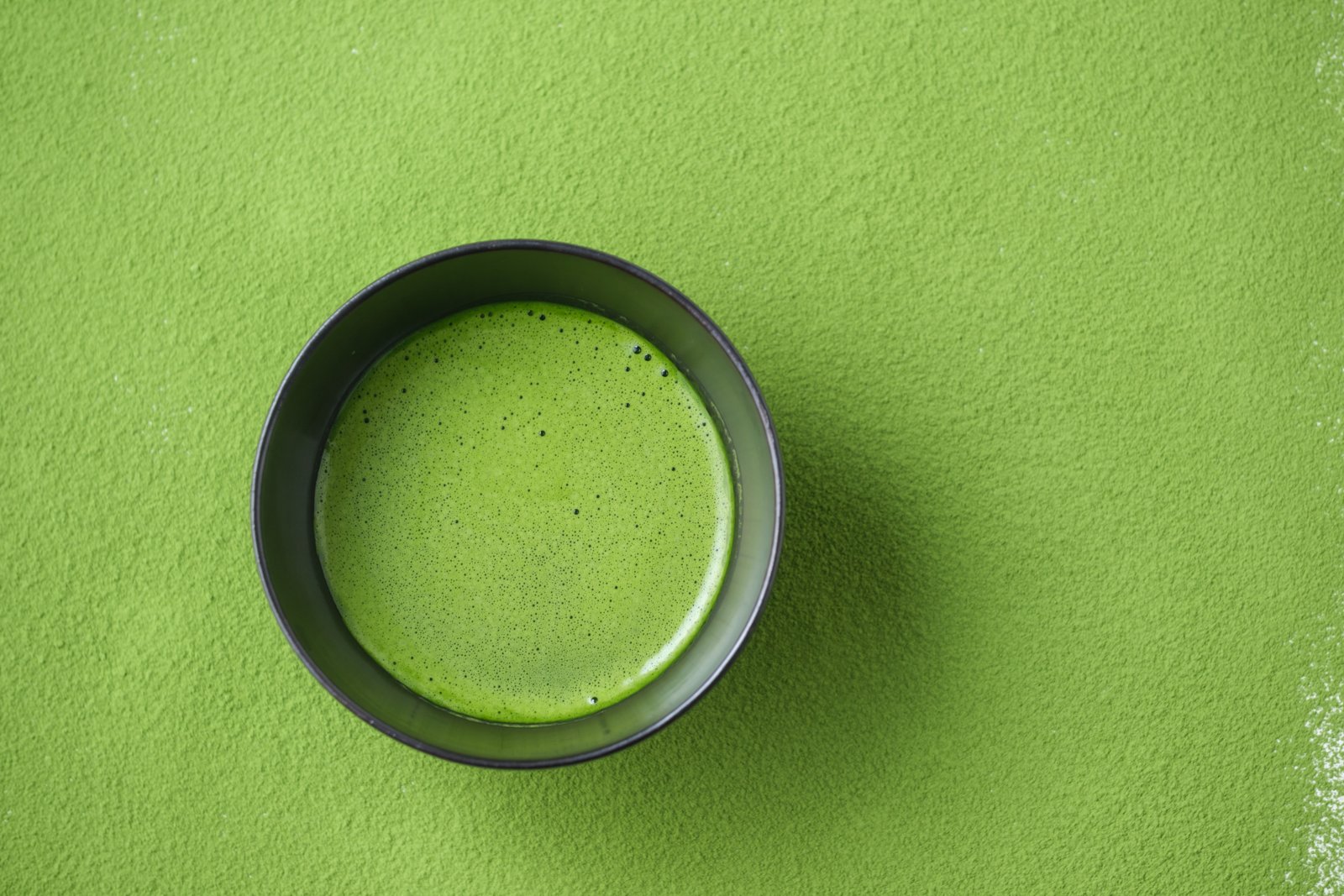
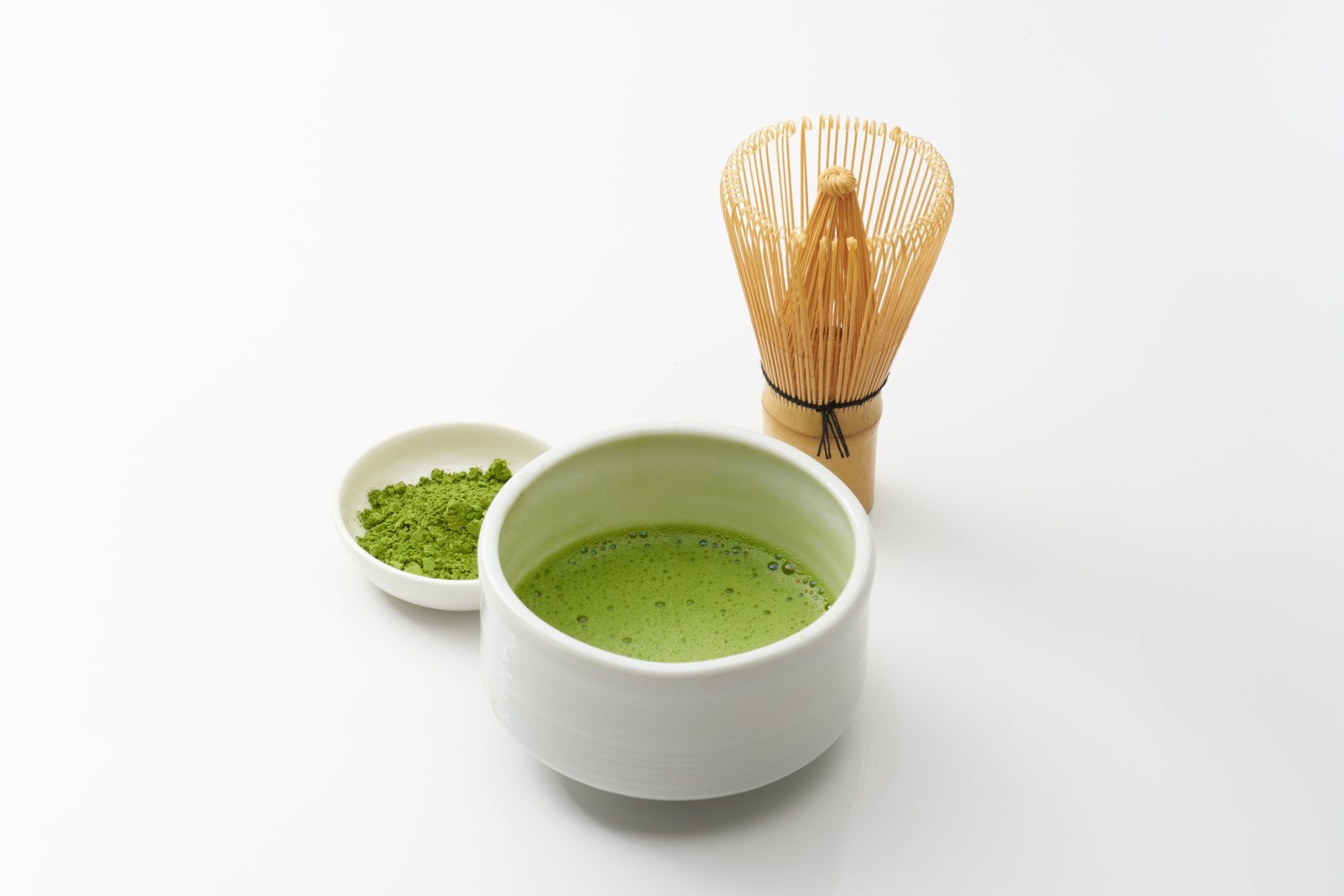
Yes. Matcha contains caffeine, and the Standard Tables of Food Composition in Japan list 3.2g per 100g. Because the powder is mixed into water and the whole leaf is drunk, you take in all the caffeine in the amount you use.
The value in the Standard Tables
According to the Standard Tables of Food Composition in Japan (8th revised edition, 2023 supplement), published by MEXT (Japan’s Ministry of Education, Culture, Sports, Science and Technology) and called “the Standard Tables” below, matcha (tea) contains 3.2g of caffeine per 100g. That is 32mg per gram.
The Standard Tables note that tea varies a lot in composition between high-grade and low-grade products, and mainly medium-grade tea was analysed. Values change with grade, so the calculated figures below are a guide.
Japan’s Food Safety Commission also calculates per cup
The fact sheet “Caffeine in food” from the Food Safety Commission of Japan (part of the Cabinet Office) takes one cup of matcha as 1.5g of matcha and gives 48mg of caffeine. It also lists matcha’s caffeine as 3.2g per 100g, and 1.5g multiplied by 32mg per gram gives 48mg. The calculations below use the same method.
Caffeine in one cup of matcha: usucha, latte and koicha
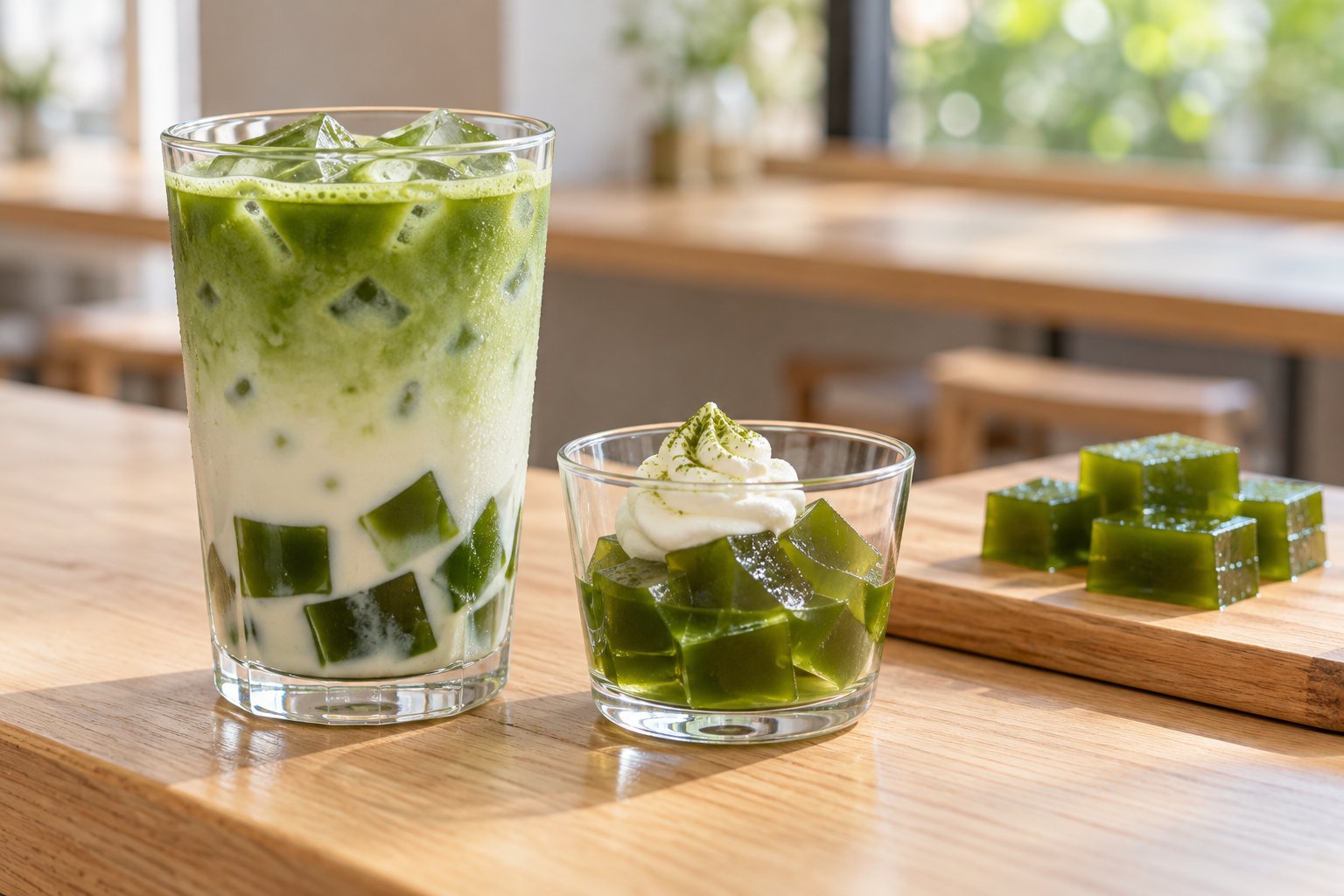
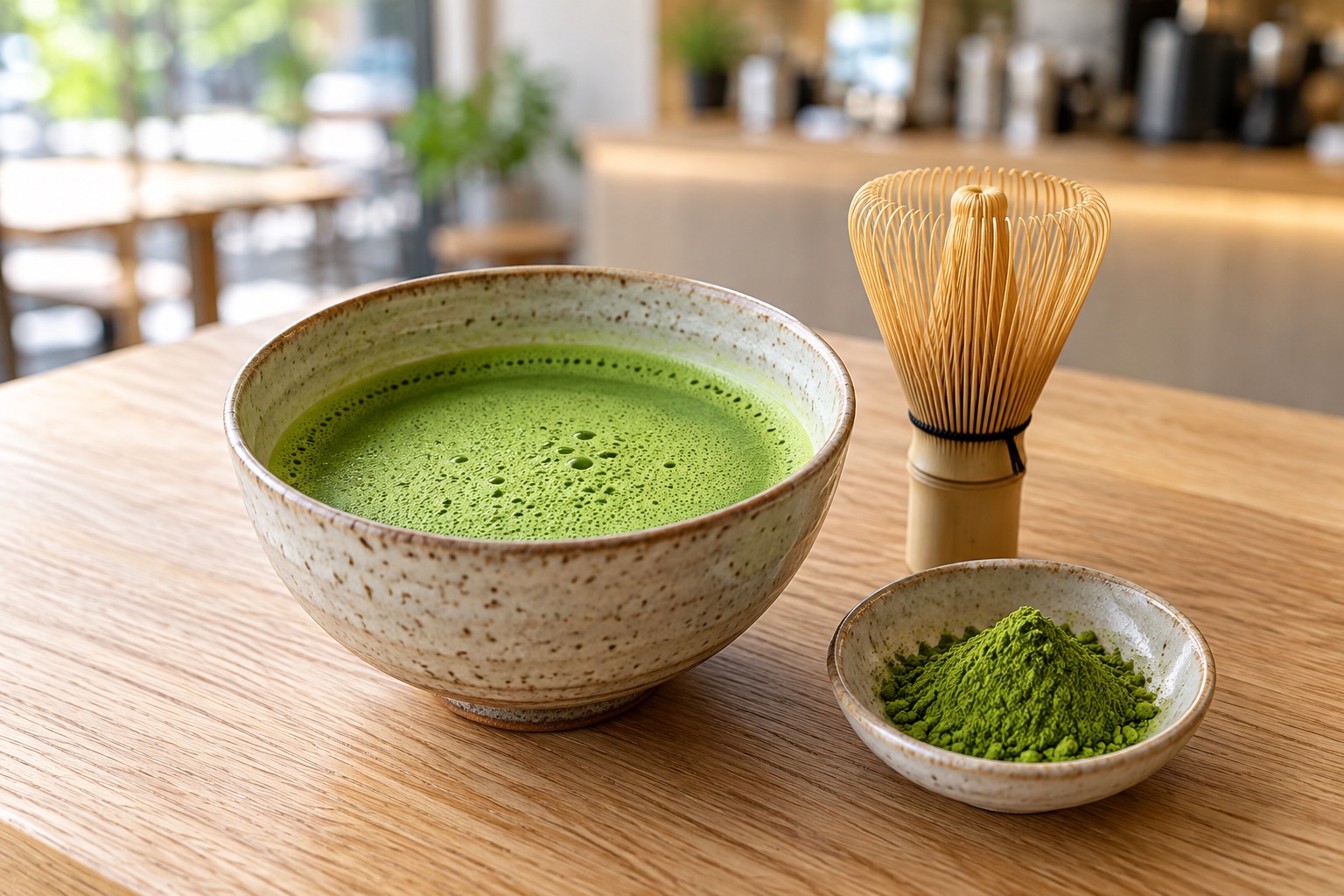
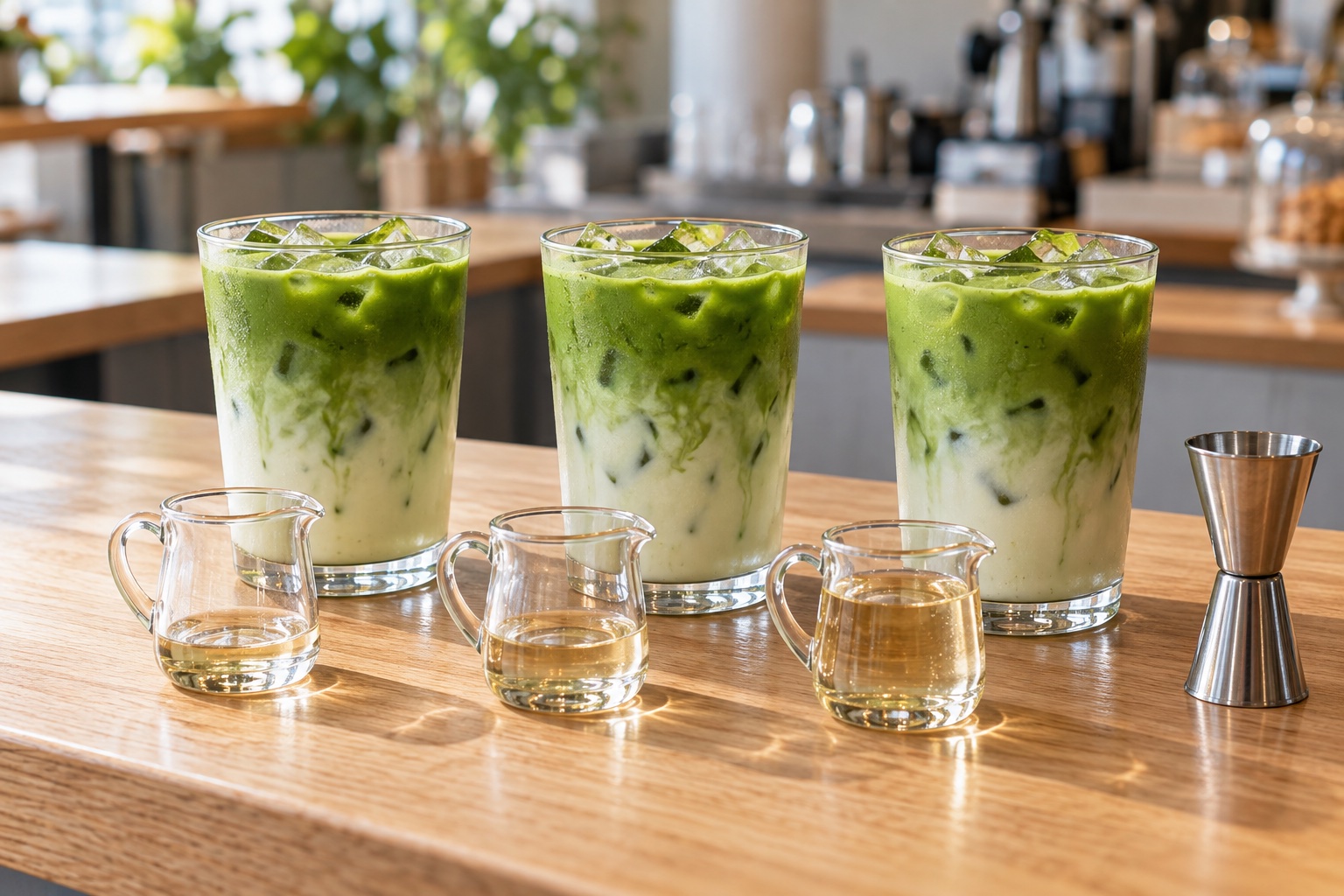
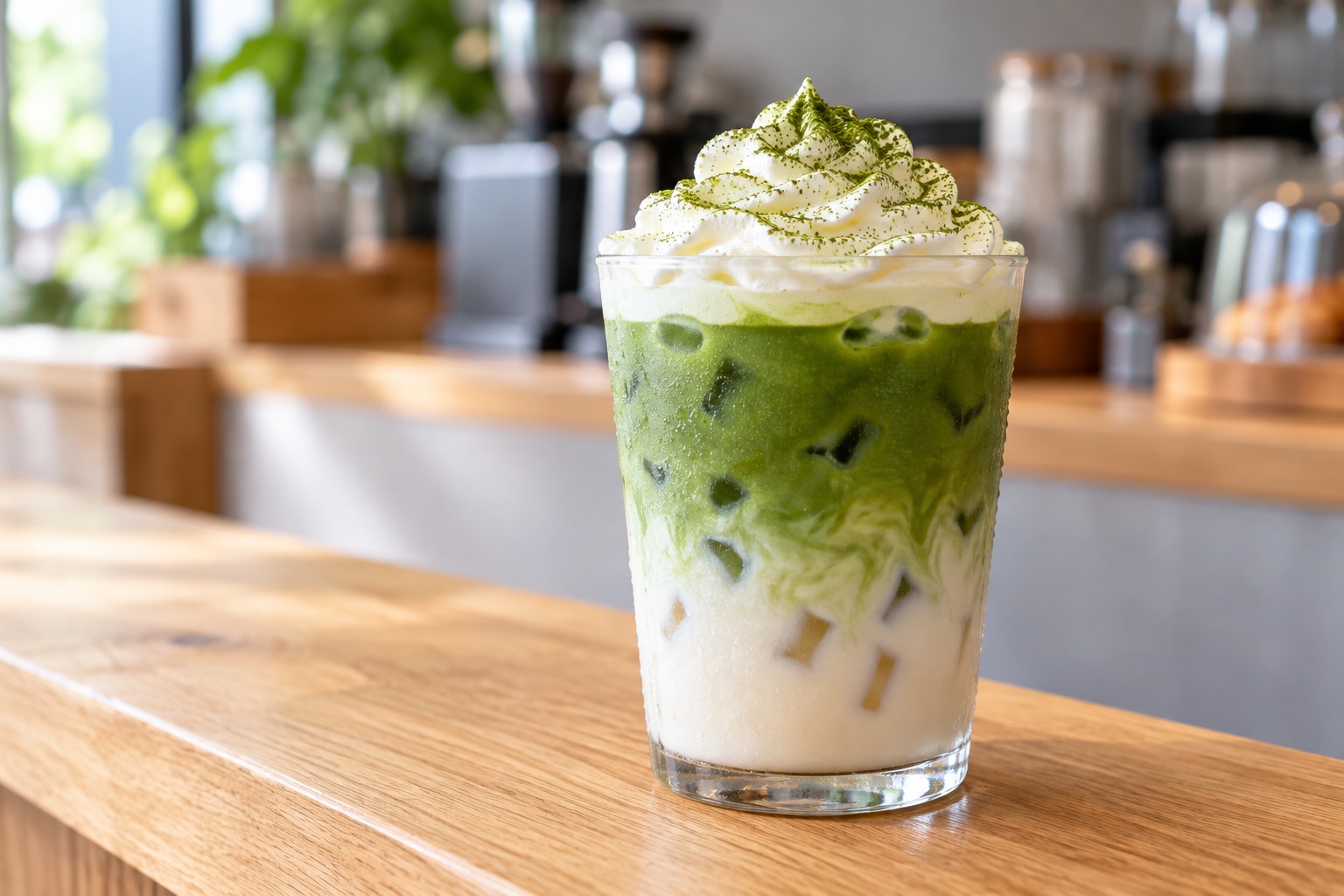
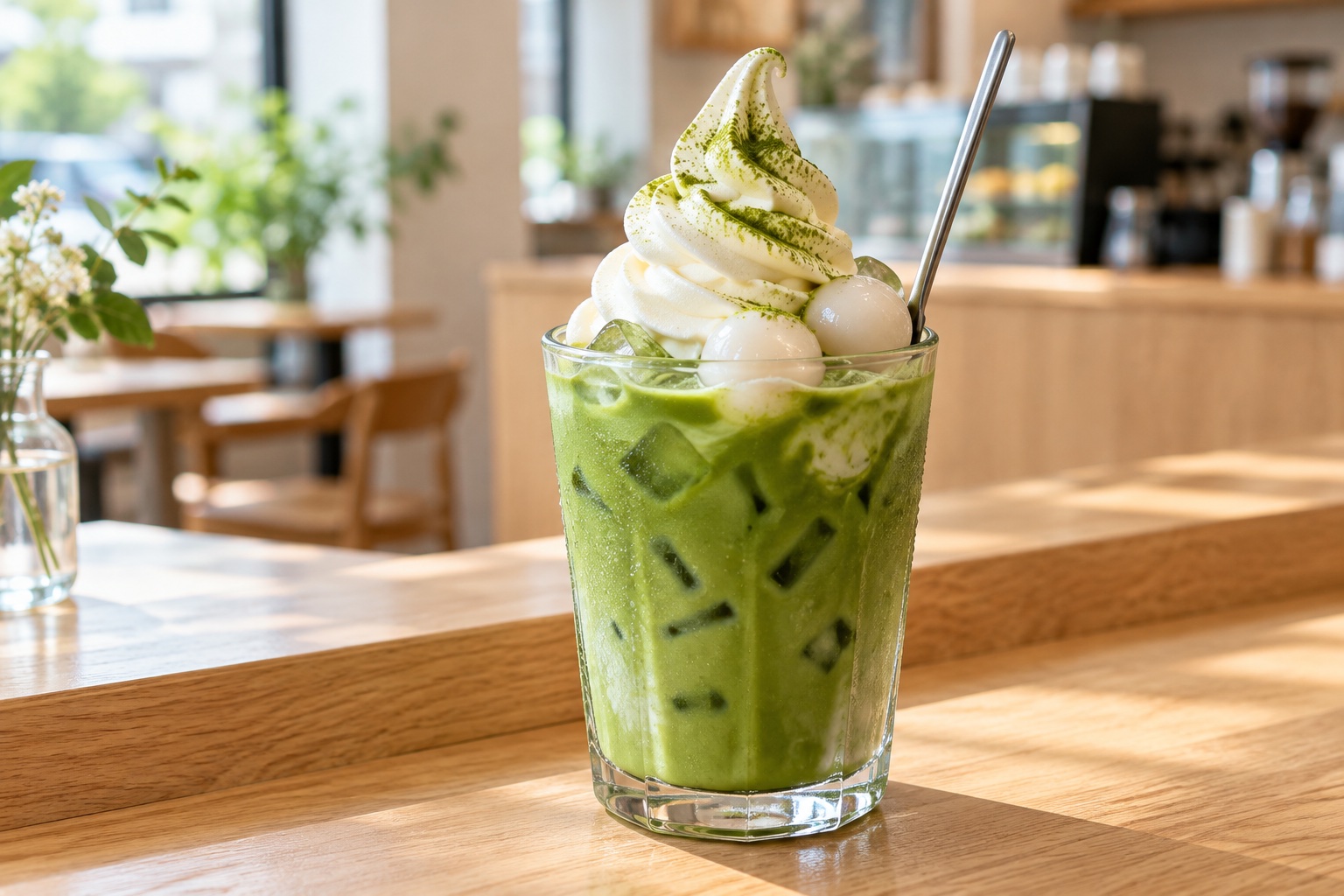
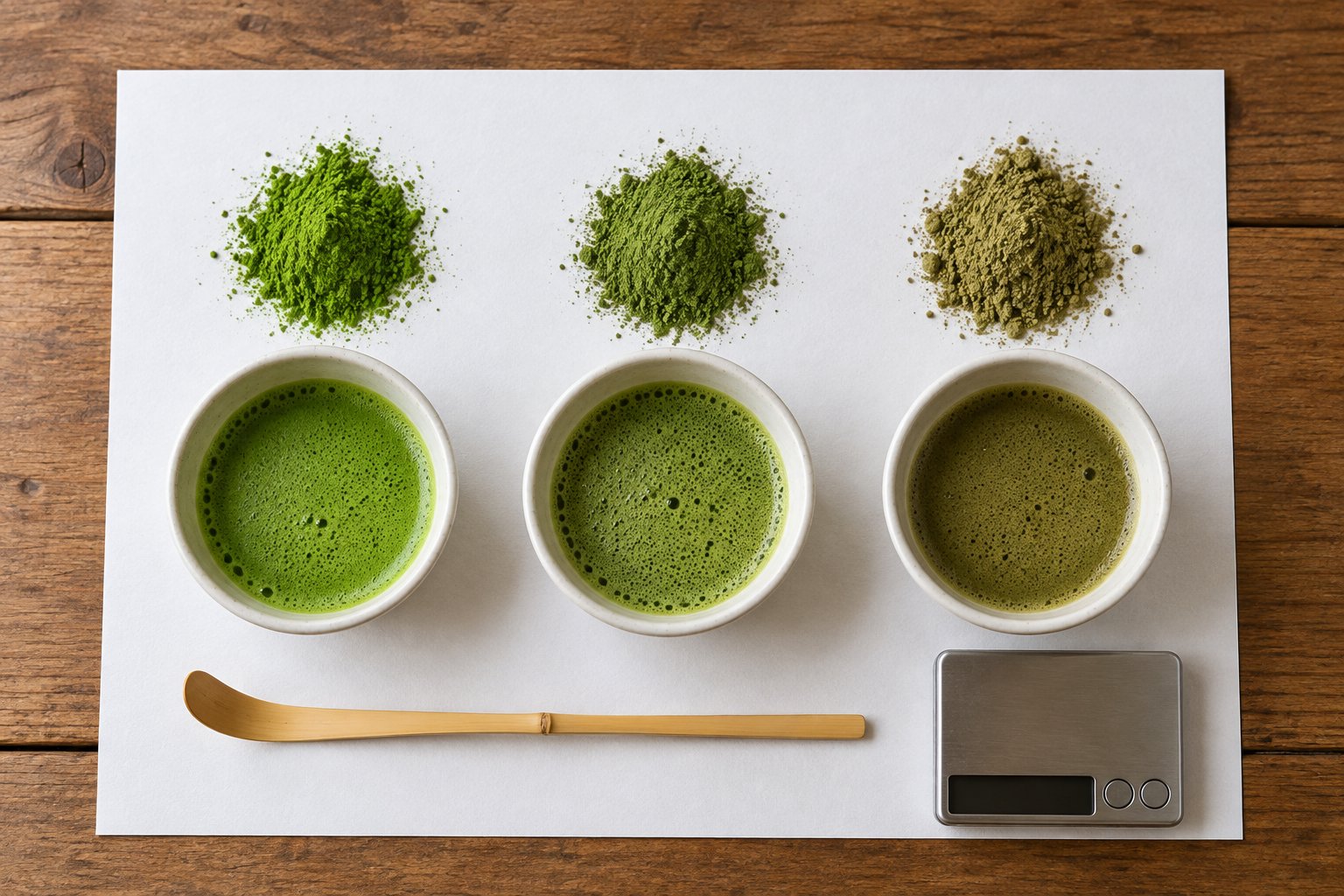
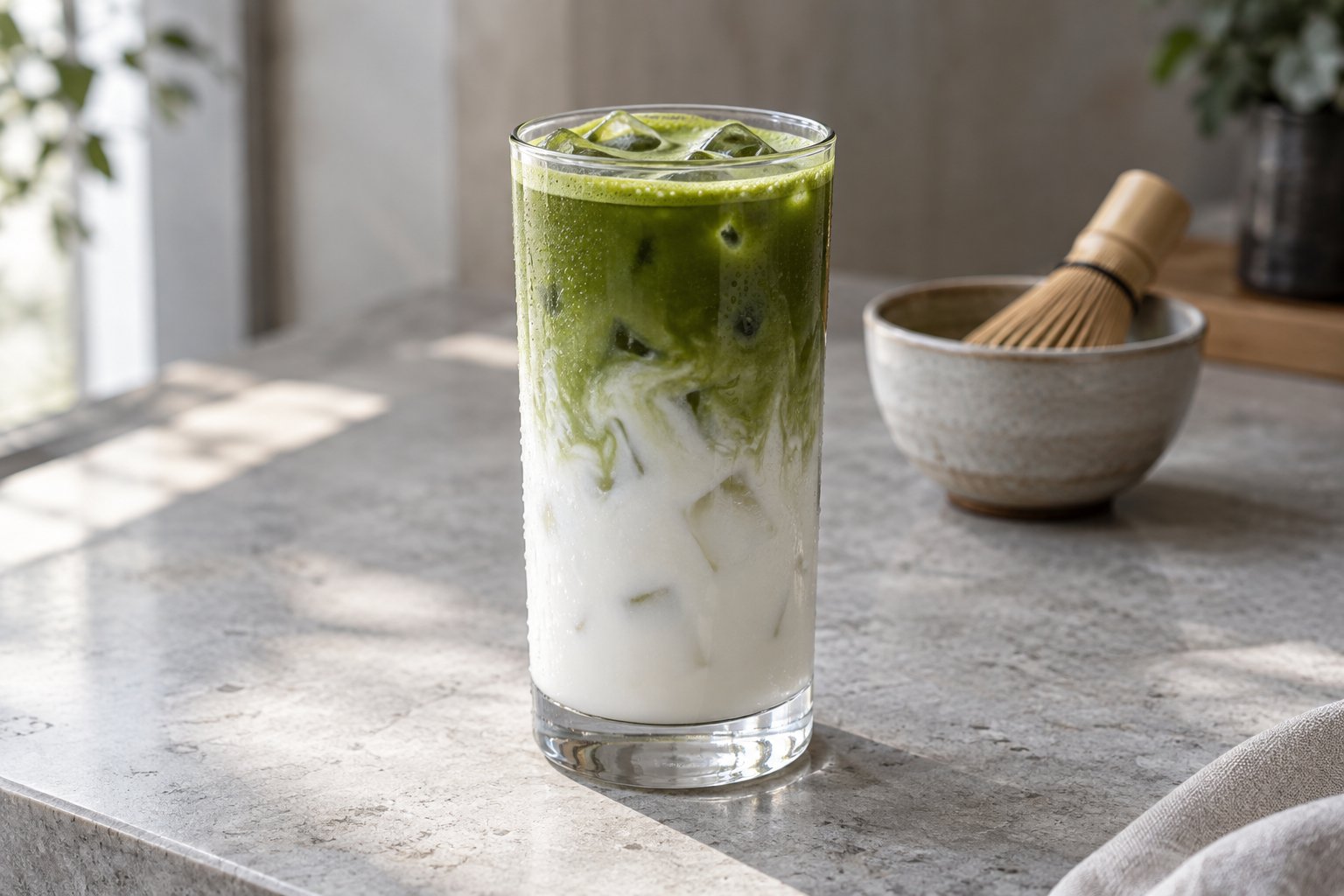
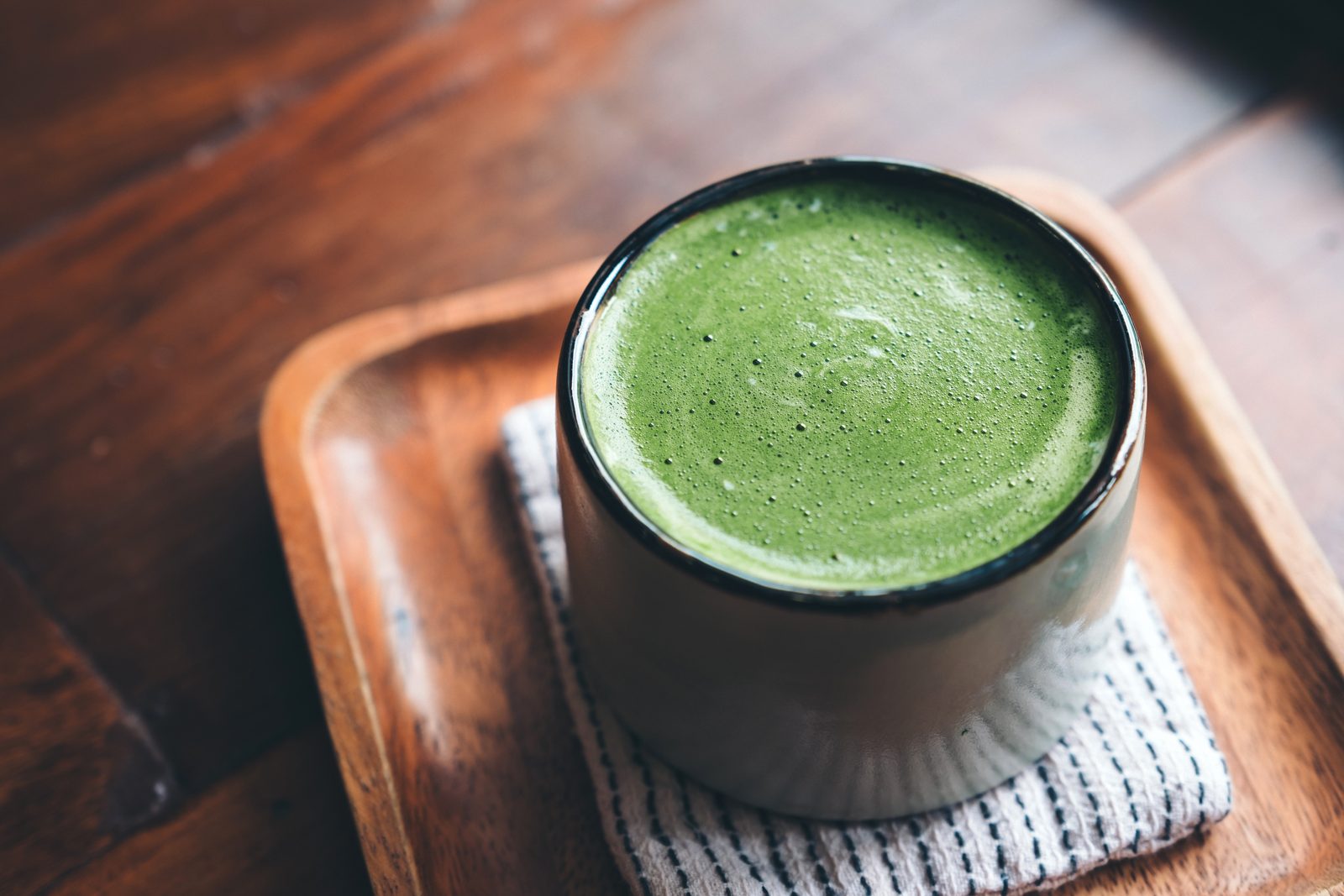
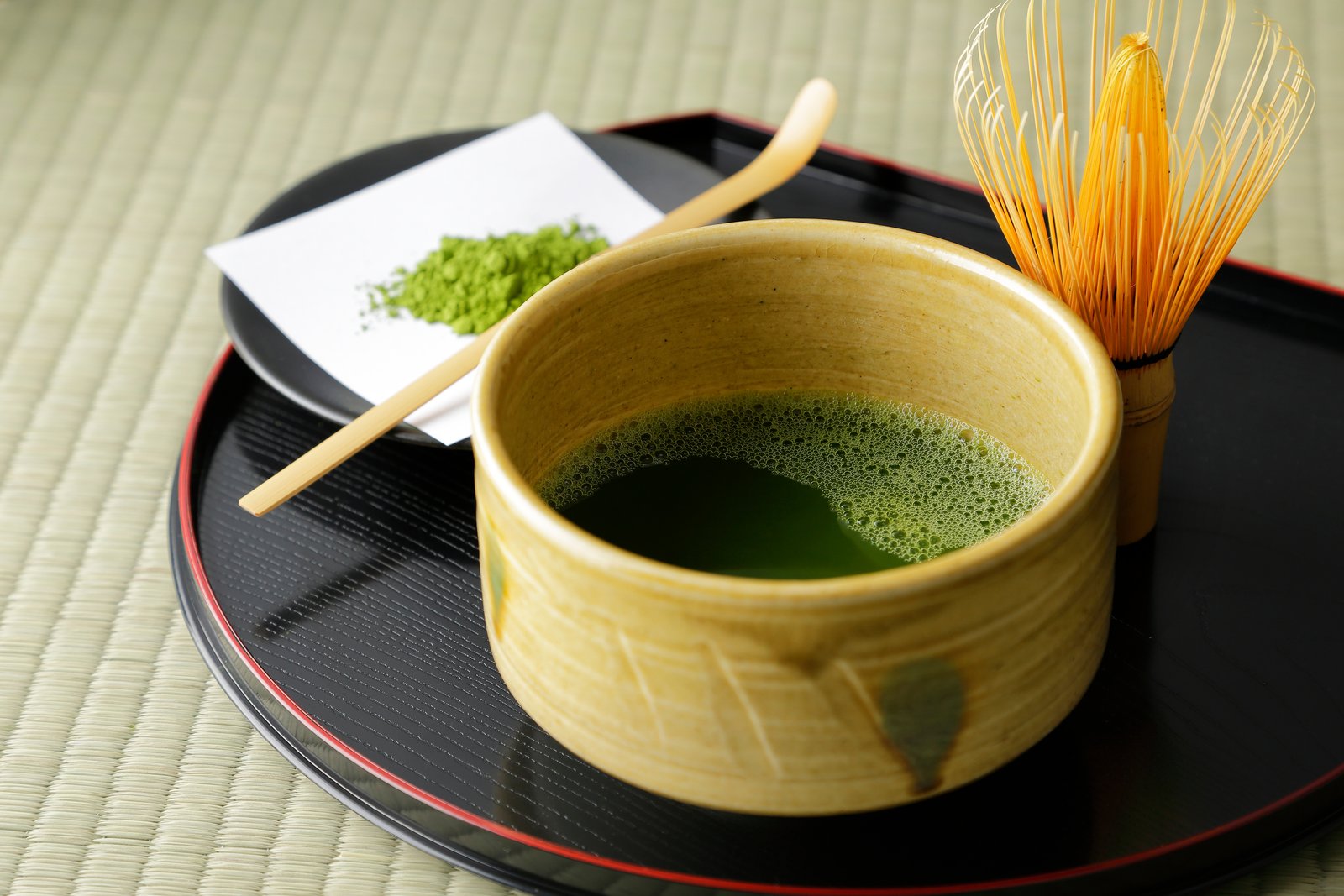
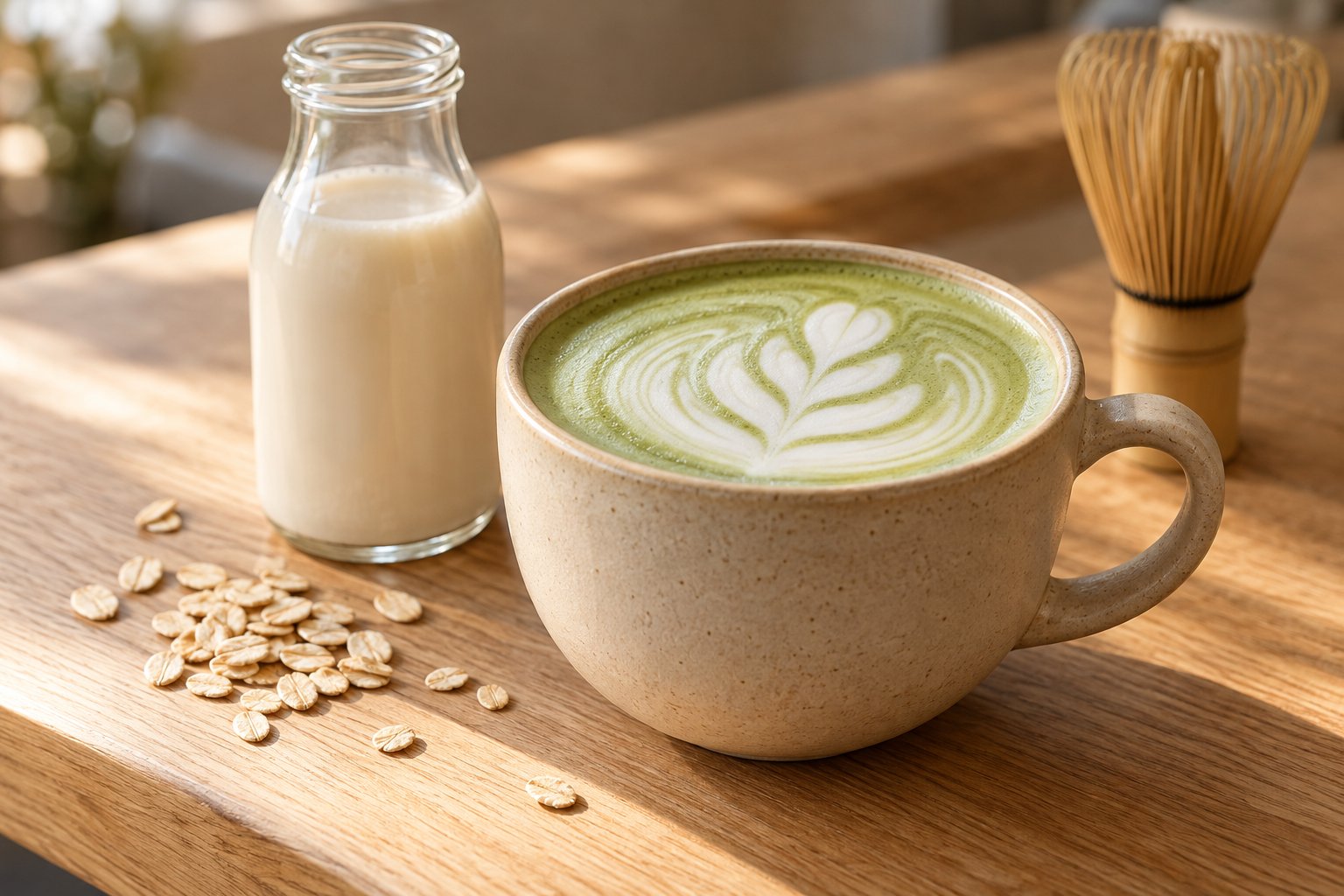
One cup contains 64mg with 2g of matcha for usucha (thin tea), 96mg with 3g for a matcha latte and 128mg with 4g for koicha (thick tea), calculated from the Standard Tables value. Even within “one cup of matcha,” the difference is more than double depending on the amount used.
Calculated values by amount
The amounts of matcha come from the methods of public bodies and a long-established Kyoto tea merchant.
| Type of cup | Matcha used | Caffeine (calculated) | Source of the amount |
|---|---|---|---|
| Usucha (smaller) | 1.5g | 48mg | Food Safety Commission of Japan |
| Usucha | About 2g (70mL water) | 64mg | Kyoto Prefectural Tea Research Institute |
| Matcha latte | 3g (90ml water plus milk) | 96mg | Ippodo Tea |
| Koicha | 4g (30ml water) | 128mg | Ippodo Tea |
The calculation is “grams of matcha × 32mg.” If your café uses 2.5g per cup, that is 80mg; with 5g it is 160mg.
Water and milk do not change it
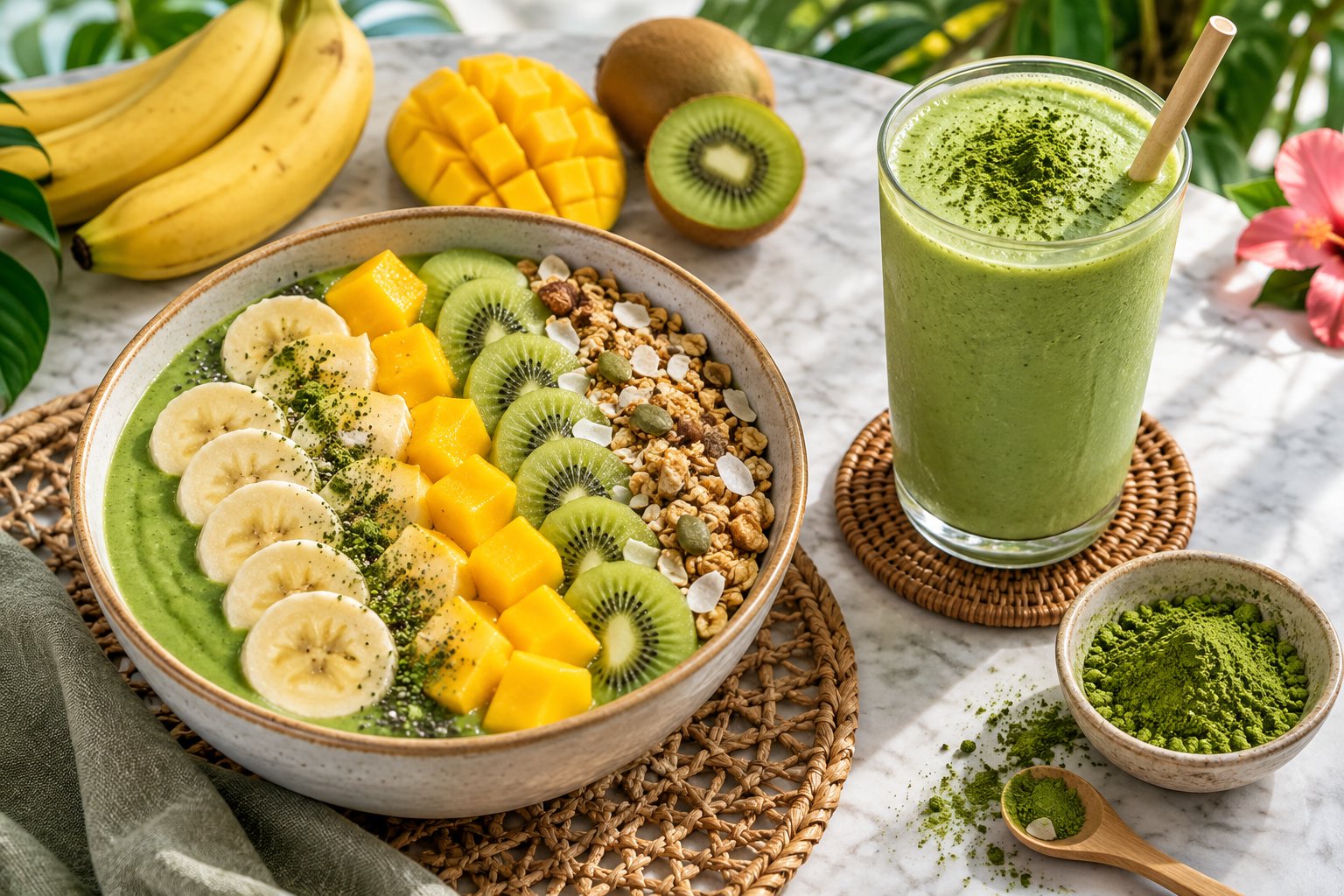
The caffeine in a matcha latte stays the same however much milk or water you add, as long as the amount of matcha is the same. If you make the cup bigger and add more matcha, the caffeine rises by that amount. The difference between usucha and koicha, and how to whisk each, is covered in How to Make Matcha.
Matcha vs coffee, black tea, sencha, gyokuro and hojicha
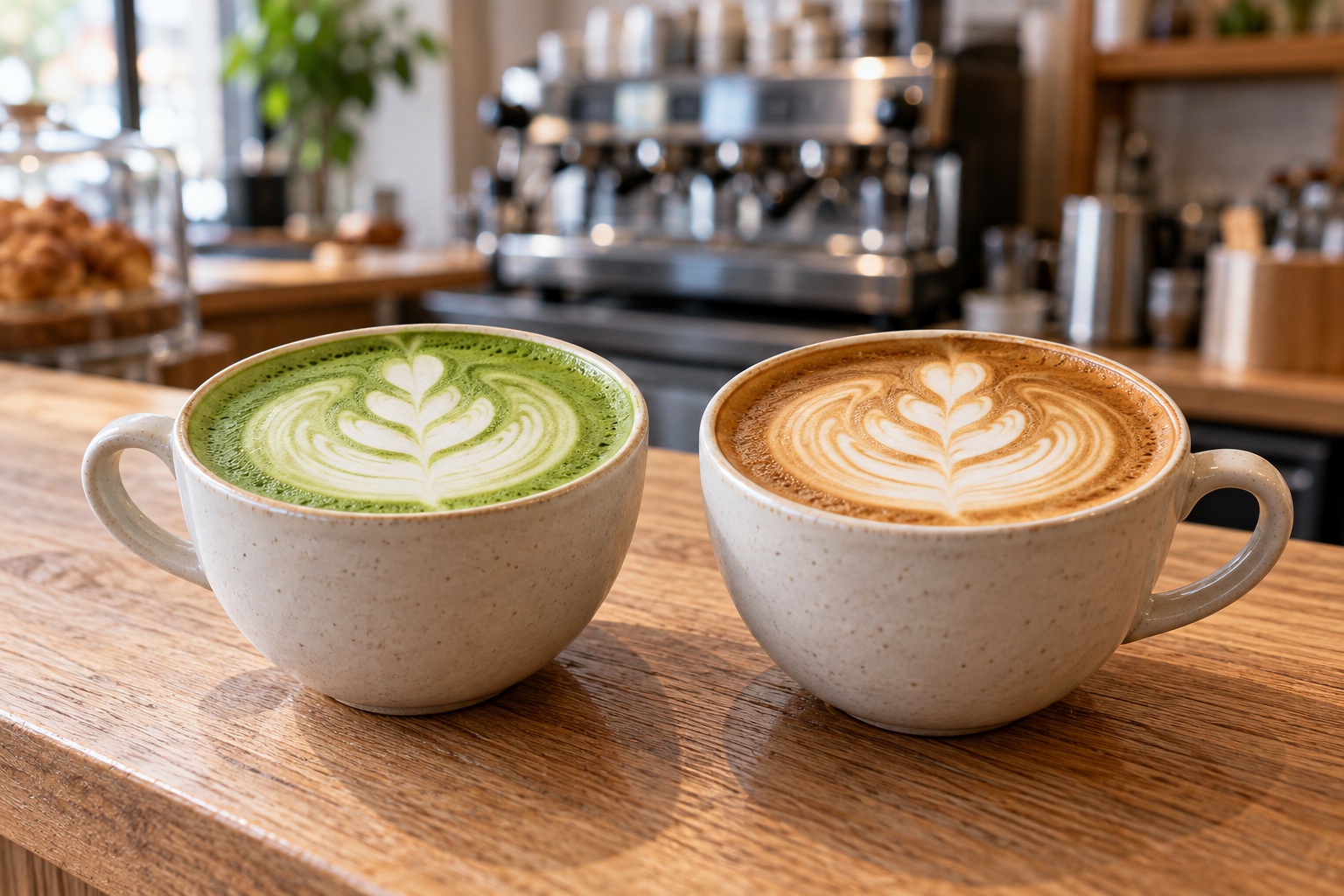
Per 100g of infusion in the Standard Tables, gyokuro has 160mg, coffee 60mg, black tea 30mg, and sencha and hojicha 20mg. The 64mg in 2g of matcha (calculated) equals about 107g of coffee infusion.
Values per 100g of infusion
The Standard Tables analyse tea and coffee infusions made with a fixed brewing method. Because the value changes when the brewing method changes, the methods are listed too.
| Drink | Caffeine (per 100g of infusion) | Brewing method in the Standard Tables |
|---|---|---|
| Gyokuro (shaded leaf tea) | 160mg | 10g of tea, 60mL of water at 60°C, 2.5 minutes |
| Coffee | 60mg | 10g of ground coffee, 150mL of boiling water |
| Black tea | 30mg | 5g of tea, 360mL of boiling water, 1.5 to 4 minutes |
| Sencha (everyday green tea) | 20mg | 10g of tea, 430mL of water at 90°C, 1 minute |
| Hojicha (roasted green tea) | 20mg | 15g of tea, 650mL of water at 90°C, 0.5 minutes |
| Oolong tea | 20mg | 15g of tea, 650mL of water at 90°C, 0.5 minutes |
| Bancha (coarse green tea) | 10mg | 15g of tea, 650mL of water at 90°C, 0.5 minutes |
The Food Safety Commission of Japan’s fact sheet gives the same values per 100ml for coffee, gyokuro, black tea, sencha and oolong tea, and also lists instant coffee at 57mg per 100ml.
Source: Food Safety Commission of Japan, “食品中のカフェイン” (Caffeine in food, fact sheet, in Japanese) https://www.fsc.go.jp/factsheets/index.data/factsheets_caffeine.pdf
Gyokuro is brewed with little water
The 160mg for gyokuro is the value for 10g of leaves brewed in only 60mL of water. The sencha value is for 10g of leaves in 430mL and the hojicha value for 15g in 650mL, both with more water for the amount of leaves. When comparing infusions, look at the brewing method as well.
Matcha can be calculated once you fix the amount
With infusions, the caffeine that comes out changes with the amount of leaves, the water temperature and the time. Because matcha is drunk as a whole powder, you can calculate the caffeine once you fix the number of grams. How matcha and sencha differ in composition is compared in detail in Matcha vs Green Tea.
Matcha latte vs energy drinks
A matcha latte with 3g of matcha comes to 96mg by calculation, while energy drinks vary widely by product, from 36 to 150mg per bottle or can. Comparing the amount in one cup or one can makes this easier to see.
Values for energy drinks
In the Food Safety Commission of Japan’s fact sheet, energy drinks and drinks sold to stay awake contain 32 to 300mg of caffeine per 100ml, or 36 to 150mg per bottle or can. It says that some contain as much caffeine in one can or bottle as two cups of coffee.
The US Food and Drug Administration (FDA) gives, per 12 fluid ounces (about 355ml), 41 to 246mg for energy drinks, 113 to 247mg for regular brewed coffee and 37mg for green tea.
Side by side, one cup at a time
| Drink | Caffeine | Source |
|---|---|---|
| Usucha (2g of matcha) | 64mg (calculated) | Standard Tables, Kyoto Prefectural Tea Research Institute |
| Matcha latte (3g of matcha) | 96mg (calculated) | Standard Tables, Ippodo Tea |
| Koicha (4g of matcha) | 128mg (calculated) | Standard Tables, Ippodo Tea |
| Energy drink, 1 can or bottle | 36 to 150mg | Food Safety Commission of Japan |
| Coffee, 237ml | 135mg (average) | Health Canada |
| Black or green tea, 237ml | 30 to 50mg | Health Canada |
Health Canada’s values are average amounts for brewed coffee and tea. A large matcha latte made with more matcha can contain about as much caffeine as one energy drink. Latte recipes are covered in How to Choose Matcha for Café Lattes.
Daily caffeine guidance from public bodies
The European Food Safety Authority (EFSA) says caffeine intakes of up to 400mg a day for healthy adults, and up to 200mg a day during pregnancy and breastfeeding, do not raise safety concerns. Japan has not set an acceptable daily intake for caffeine.
Values from public bodies
| Body | Healthy adults | Pregnancy and breastfeeding | Children and adolescents |
|---|---|---|---|
| European Food Safety Authority (EFSA) | Up to 400mg a day. Up to 200mg in a single dose | Up to 200mg a day | 3mg per kg of body weight a day |
| Health Canada | Up to 400mg a day | Up to 300mg a day (the same when planning a pregnancy) | Up to 2.5mg per kg of body weight a day |
| US Food and Drug Administration (FDA) | 400mg a day is an amount not generally associated with negative effects in most adults | Talk to a health care provider about whether to limit caffeine | Avoid drinks containing caffeine under age 2 (cited from the Dietary Guidelines for Americans) |
| Singapore Ministry of Health | There is currently no recognised health-based guidance for caffeine intake (a statement not limited to any age group) | Not stated | Children under 12 should avoid caffeine. Ages 12 to 18: up to 100mg a day |
| Japan (Ministry of Health, Labour and Welfare) | No acceptable daily intake has been set | ― | ― |
The Singapore values are local paediatric advice that the Ministry of Health gave in a parliamentary answer on 8 October 2026. The Ministry said the 100mg for ages 12 to 18 is equivalent to around one cup of coffee.
Source: Singapore Ministry of Health, “Protecting children and youths from caffeine overconsumption through mandatory labelling, health warnings and published consumption guidelines” (8 October 2026) https://www.moh.gov.sg/newsroom/protecting-children-and-youths-from-caffeine-overconsumption-through-mandatory-labelling--health-warnings-and-published-consumption-guidelines/
The guidance covers all foods and drinks
Every one of these values is the total of all caffeine taken in a day, from coffee, tea, chocolate and so on. None of them is a limit on how many cups of matcha alone.
The Food Safety Commission of Japan says sensitivity to caffeine varies widely from person to person. Where an individual decision is needed, for example during pregnancy or for children, the reliable approach is to tell customers to check with a doctor or other professional.
Why the caffeine in matcha varies
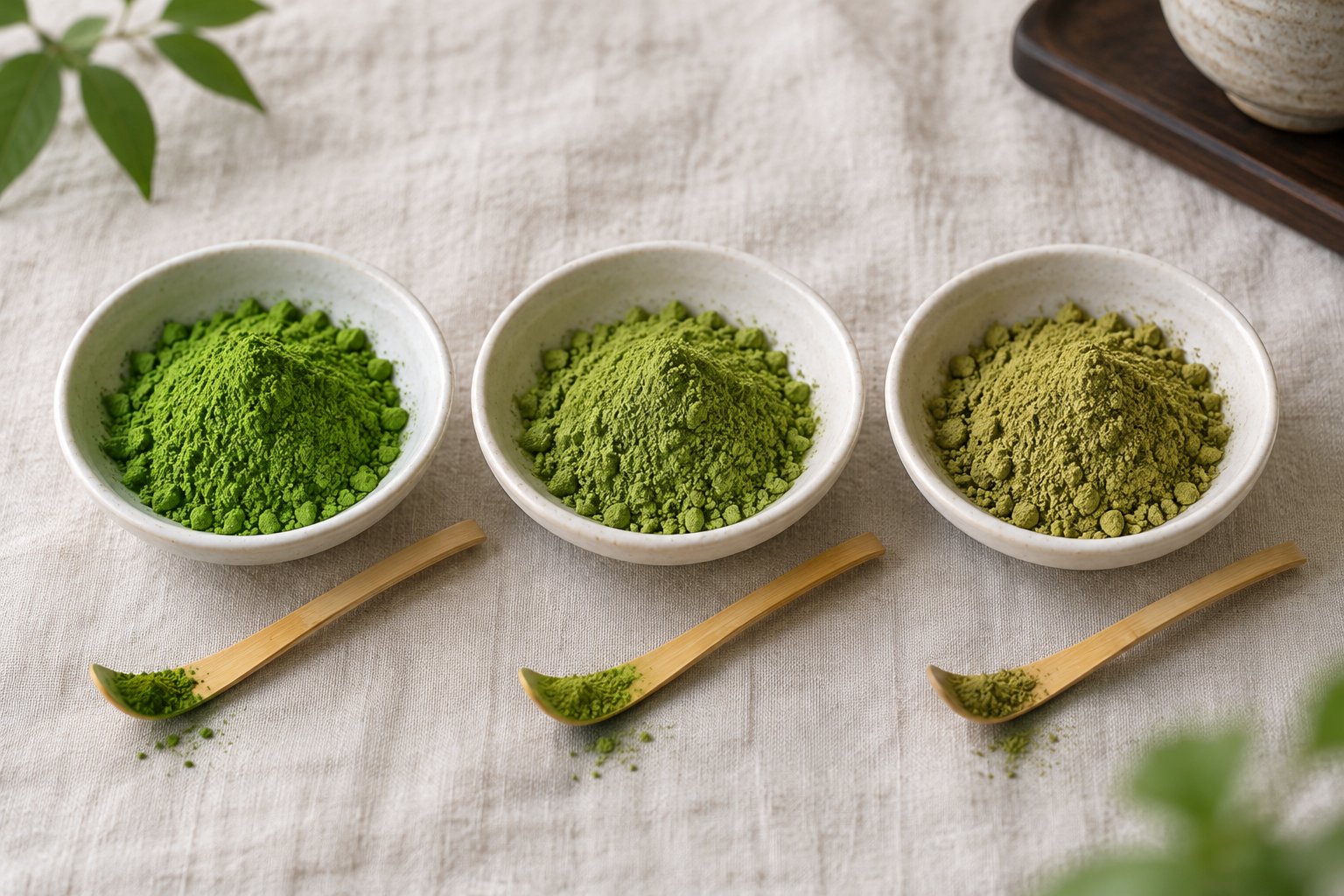
The caffeine in matcha changes with the number of grams used per cup and with the grade and harvest season of the matcha itself. The calculated values here are a guide based on the Standard Tables value for medium-grade tea.
Amount used
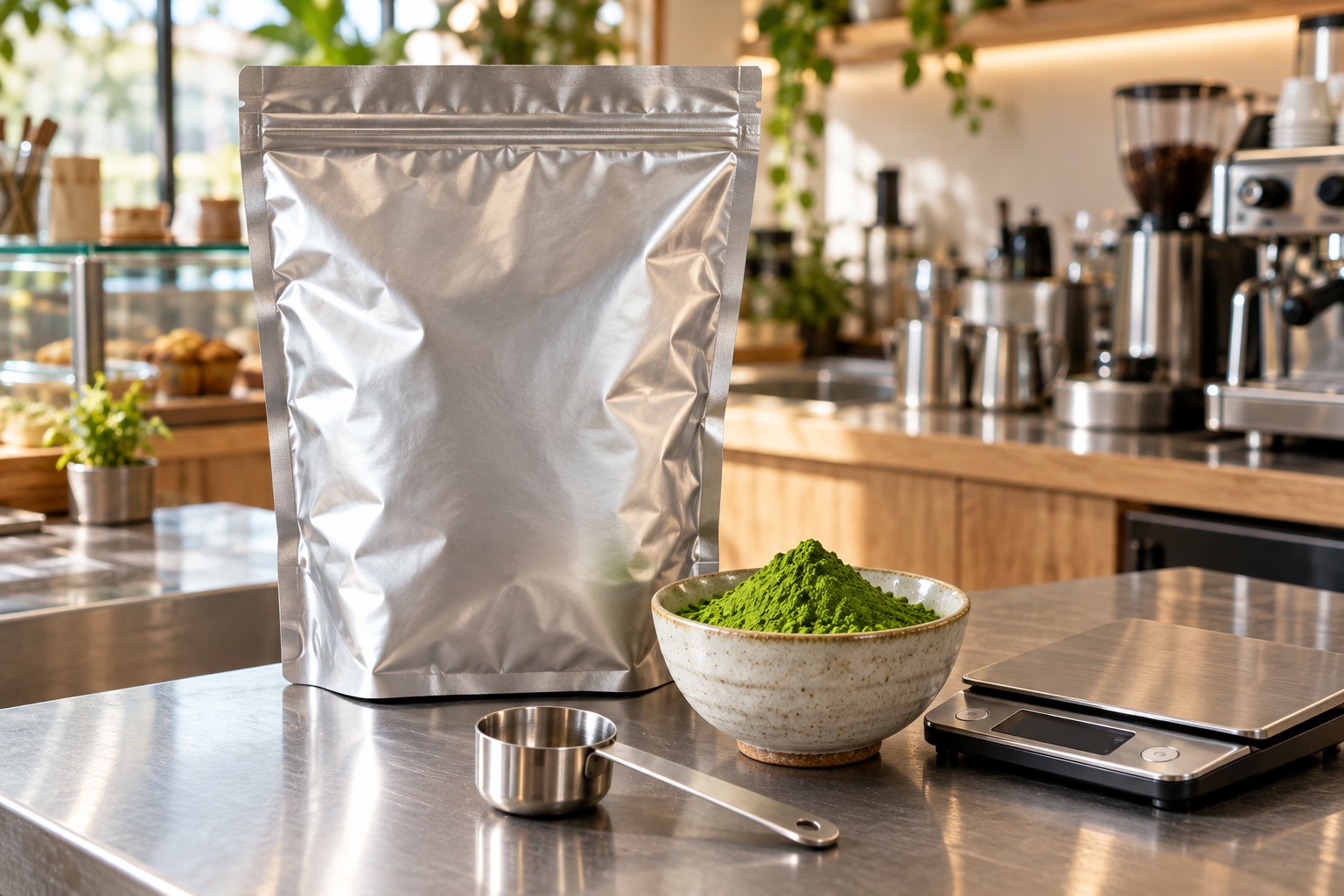
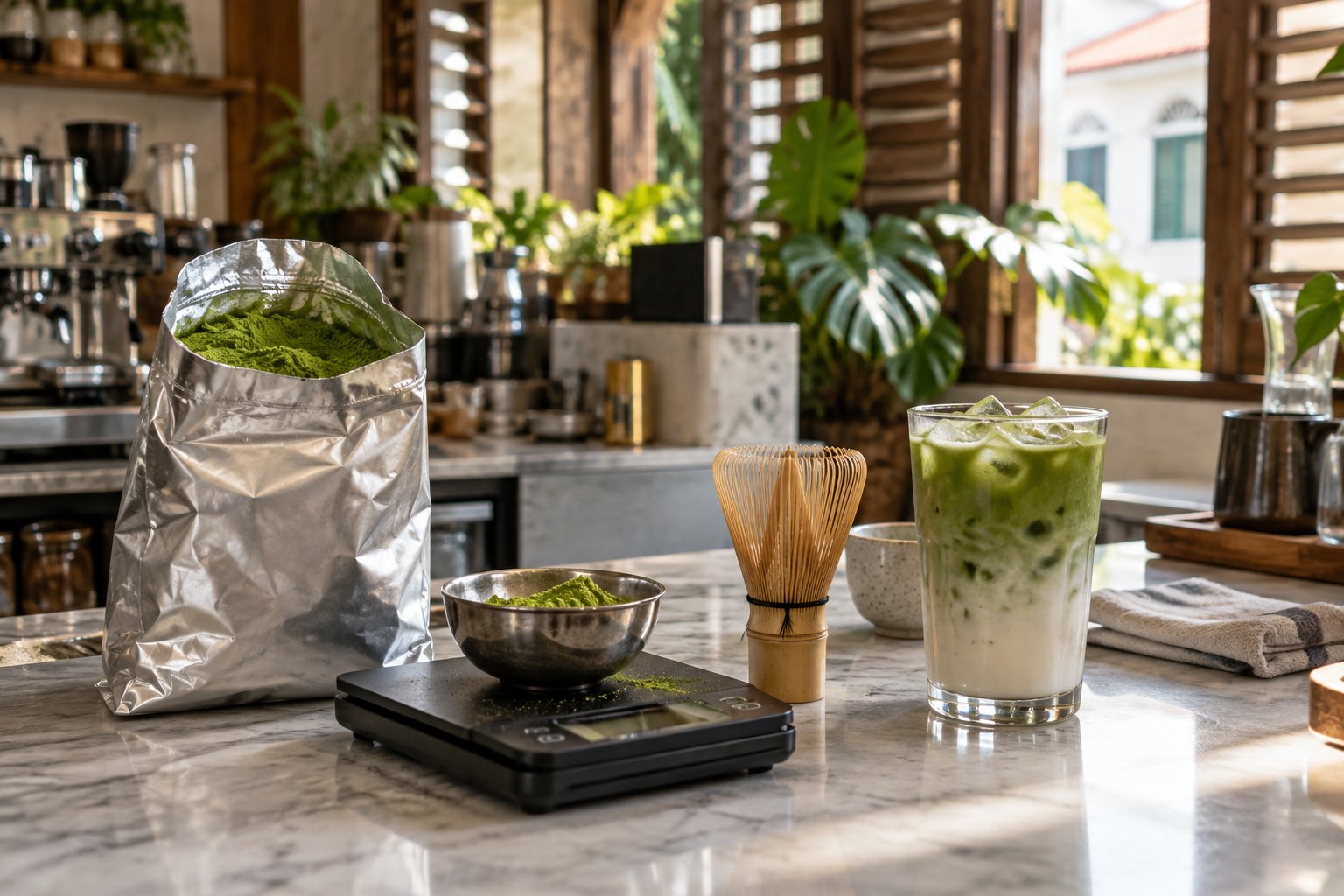
By calculation, caffeine rises in proportion to the amount of matcha used per cup. Measuring with a spoon varies from cup to cup, so if your café weighs matcha in grams, the caffeine can also be kept consistent by calculation.
Grade and harvest season
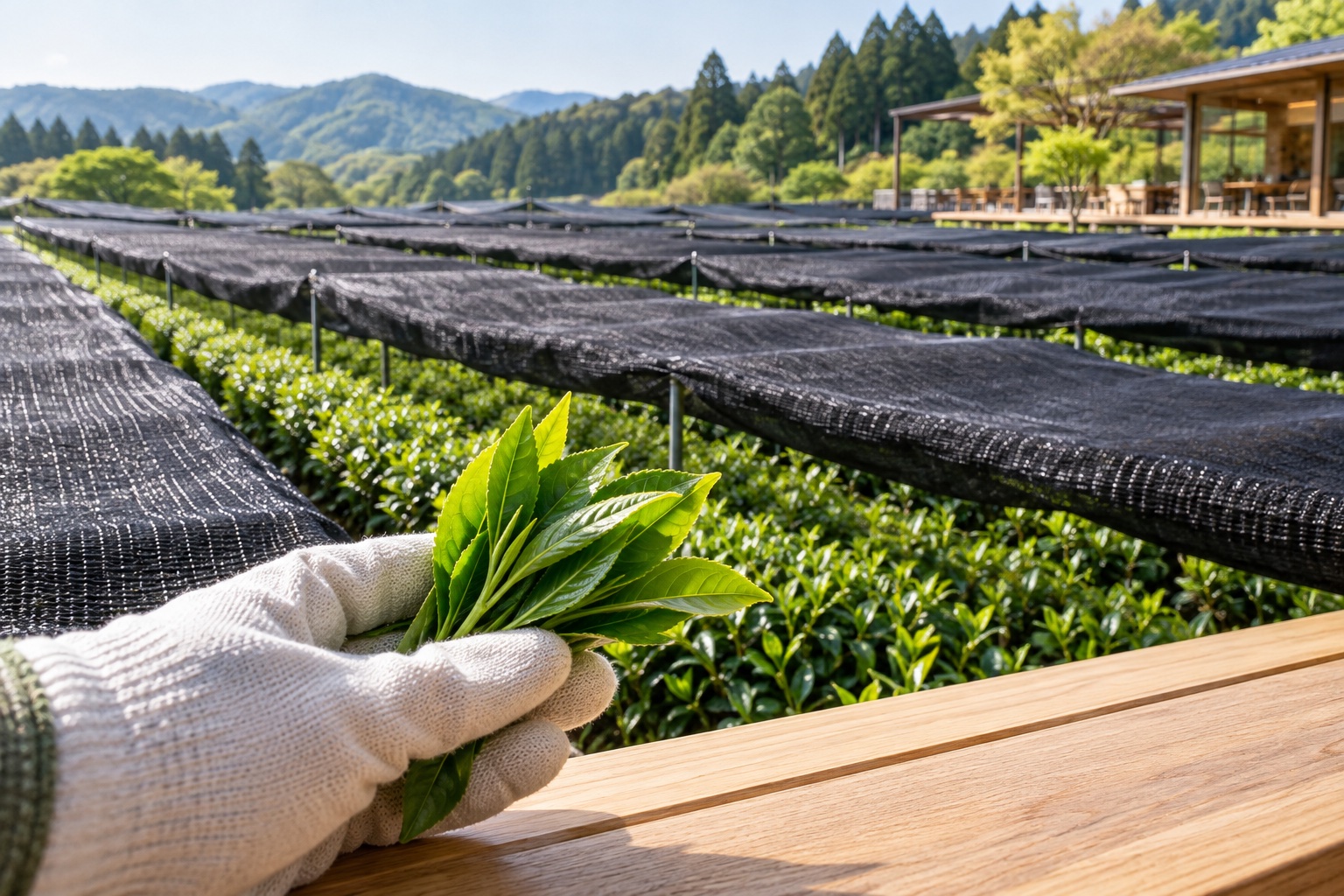
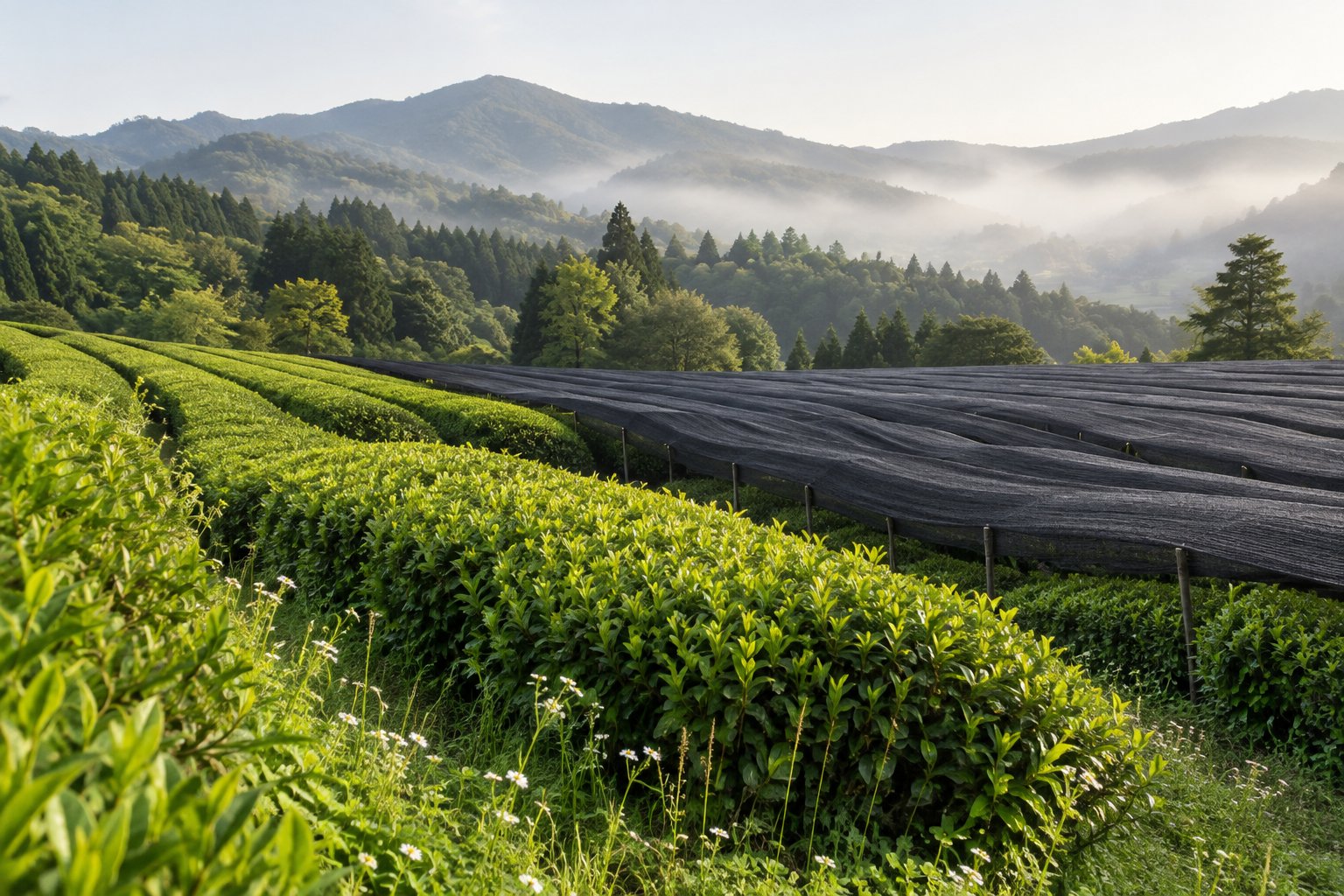
The Standard Tables say tea varies a lot in composition between high-grade and low-grade products. Minamikyushu City in Kagoshima Prefecture explains that second-flush Chiran tea grows in a season with longer hours of sunshine than first flush, so it contains more catechins and caffeine. If you use second-flush or later matcha for lattes, the value may differ from the Standard Tables. How grades differ is covered in Matcha Grades.
If you need an exact value, ask your supplier for analysis results or send a sample to a testing laboratory.
Theanine and caffeine: what studies show
The two studies we checked for this article did not test whether theanine softens the effects of caffeine. There are studies of caffeine taken together with theanine and of matcha itself, but the numbers of participants are small and the results are limited.
Matcha has more theanine than sencha
According to NARO (Japan’s National Agriculture and Food Research Organization), matcha contains more amino acids such as theanine, a source of umami, than sencha. Theanine is not one of the items in the Standard Tables.
A study of caffeine taken with theanine
In a study published in 2008 by researchers at Unilever’s research and development site in the UK, 27 healthy people compared three treatments: 50mg of caffeine alone, 50mg of caffeine with 100mg of theanine, and a placebo. When caffeine and theanine were taken together, speed and accuracy on an attention-switching task improved at 60 minutes compared with the placebo.
A study of matcha itself
In a study published in 2017 by Wageningen University in the Netherlands, 23 people compared a drink and other products containing 4g of matcha with placebos. After the matcha products, there were mainly improvements in tasks measuring basic attention and speed of response, while other tasks showed almost no difference and there was no significant change in mood. The researchers describe the effects as slight.
Both studies had few participants and looked at a short time after a single serving. On menus and in shop descriptions, avoid wording that states what theanine does as fact.
Caffeine on café menus
Official rules and discussions in Singapore and Thailand focus on packaged drinks and drinks high in caffeine. For matcha lattes made in your café, it helps to be able to answer by calculating from the grams of matcha in each cup.
Singapore
In Parliament in October 2026, a member asked whether drinks above a set caffeine level should be required to show caffeine in milligrams and carry a front-of-pack advisory. The Ministry of Health replied that it is closely monitoring local consumption and international developments, and does not rule out additional measures should the risk assessment change. It said high-caffeine energy drinks have accounted for less than 1% of sales of sugar-sweetened beverages since 2017.
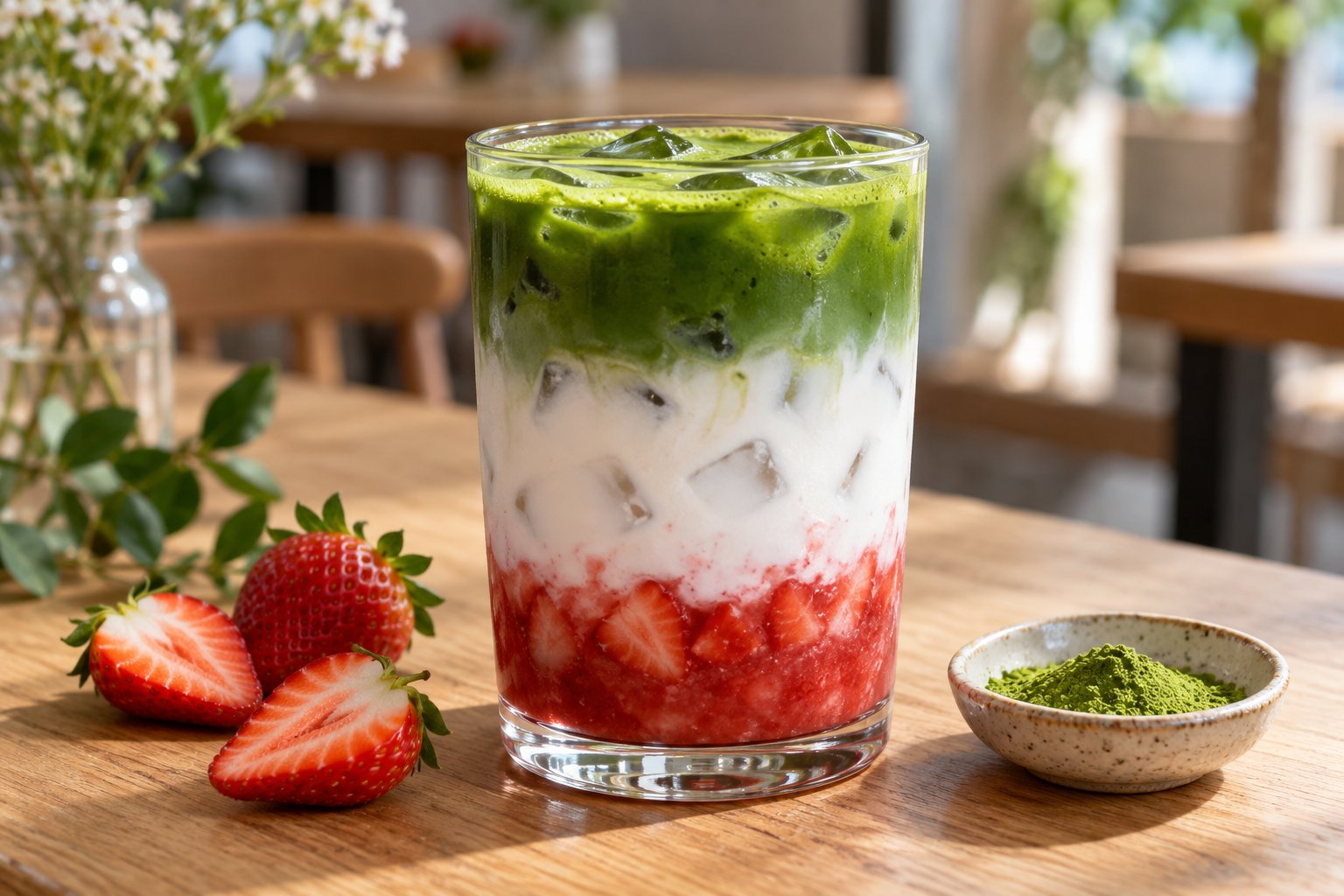
According to Singapore’s Health Promotion Board (HPB), since 30 December 2023 freshly prepared drinks sold in specified settings have also been covered by Nutri-Grade, a label based on sugar and saturated fat. This is covered in Strawberry Matcha Latte.
Thailand
Thailand’s Ministry of Public Health Notification No. 356 (2013) sets the rules for beverages in sealed containers. Certain beverages that use flavouring naturally containing caffeine must show “มีกาเฟอีน” (contains caffeine), and other beverages with added caffeine must show a warning, in red letters inside a box with a white background, that includes not drinking more than 2 (cans or similar) a day and that children and pregnant women should not drink it. The clause that sets out how beverages are classified was amended by Notification No. 465 in 2025.
What a café can do (our view)
Apart from labelling rules, having these three things ready makes it easier to answer when customers ask:
- Fix the grams of matcha used per cup for each menu item
- Work out the value with “grams × 32mg” and say that it is a calculated figure
- For customers who want less caffeine, offer a size with less matcha or another drink
If you sell bottled matcha drinks in Thailand, check the text of the notifications from the Thai FDA to see whether Notification No. 356 applies and whether caffeine labelling is required. Iced lattes are covered in Iced Matcha Latte, and how we think about grades on Matcha grades.
Sources
- MEXT, “日本食品標準成分表(八訂)増補2023年” (Standard Tables of Food Composition in Japan, 8th revised edition, 2023 supplement, in Japanese) https://www.mext.go.jp/a_menu/syokuhinseibun/mext_00001.html
- MEXT Food Composition Database, “抹茶 茶” (Matcha, tea, food number 16035, in Japanese) https://fooddb.mext.go.jp/details/details.pl?ITEM_NO=16_16035_7
- MEXT Food Composition Database, “玉露 浸出液” (Gyokuro, infusion, food number 16034, in Japanese) https://fooddb.mext.go.jp/details/details.pl?ITEM_NO=16_16034_7
- MEXT Food Composition Database, “せん茶 浸出液” (Sencha, infusion, food number 16037, in Japanese) https://fooddb.mext.go.jp/details/details.pl?ITEM_NO=16_16037_7
- MEXT Food Composition Database, “番茶 浸出液” (Bancha, infusion, food number 16039, in Japanese) https://fooddb.mext.go.jp/details/details.pl?ITEM_NO=16_16039_7
- MEXT Food Composition Database, “ほうじ茶 浸出液” (Hojicha, infusion, food number 16040, in Japanese) https://fooddb.mext.go.jp/details/details.pl?ITEM_NO=16_16040_7
- MEXT Food Composition Database, “ウーロン茶 浸出液” (Oolong tea, infusion, food number 16042, in Japanese) https://fooddb.mext.go.jp/details/details.pl?ITEM_NO=16_16042_7
- MEXT Food Composition Database, “紅茶 浸出液” (Black tea, infusion, food number 16044, in Japanese) https://fooddb.mext.go.jp/details/details.pl?ITEM_NO=16_16044_7
- MEXT Food Composition Database, “コーヒー 浸出液” (Coffee, infusion, food number 16045, in Japanese) https://fooddb.mext.go.jp/details/details.pl?ITEM_NO=16_16045_7
- Food Safety Commission of Japan, “食品中のカフェイン” (Caffeine in food, fact sheet, last updated 23 February 2018, in Japanese) https://www.fsc.go.jp/factsheets/index.data/factsheets_caffeine.pdf
- Ministry of Health, Labour and Welfare, “食品に含まれるカフェインの過剰摂取についてQ&A” (Q&A on excessive intake of caffeine in food, in Japanese) https://www.mhlw.go.jp/stf/seisakunitsuite/bunya/0000170477.html
- European Food Safety Authority, “Caffeine” https://www.efsa.europa.eu/en/topics/topic/caffeine
- Health Canada, “Caffeine in foods” https://www.canada.ca/en/health-canada/services/food-nutrition/food-safety/food-additives/caffeine-foods.html
- US Food and Drug Administration, “Spilling the Beans: How Much Caffeine is Too Much?” https://www.fda.gov/consumers/consumer-updates/spilling-beans-how-much-caffeine-too-much
- Singapore Ministry of Health, “Protecting children and youths from caffeine overconsumption through mandatory labelling, health warnings and published consumption guidelines” (8 October 2026) https://www.moh.gov.sg/newsroom/protecting-children-and-youths-from-caffeine-overconsumption-through-mandatory-labelling--health-warnings-and-published-consumption-guidelines/
- Health Promotion Board, “Measures for Nutri-Grade” https://hpb.gov.sg/healthy-living/food-beverage/nutri-grade
- Thai FDA, Notification of the Ministry of Public Health No. 356 (2013), “เครื่องดื่มในภาชนะบรรจุที่ปิดสนิท” (Beverages in sealed containers, in Thai) https://exfood.fda.moph.go.th/law/data/complilation/Compi_356.pdf
- Thai FDA, Notification of the Ministry of Public Health No. 465 (2025), “Beverages in Sealed Container (No. 3)” (unofficial English translation) https://food.fda.moph.go.th/media.php?id=861494046533754880&name=P465_EN.pdf
- NARO, “国産抹茶の価格と化学成分含有量の関係” (Relationship between price and chemical composition of Japanese matcha, 2018, in Japanese) https://www.naro.go.jp/project/results/4th_laboratory/nifts/2018/nifts18_s16.html
- Owen GN, Parnell H, De Bruin EA, Rycroft JA, “The combined effects of L-theanine and caffeine on cognitive performance and mood,” Nutritional Neuroscience 11(4):193-198, 2008 https://pubmed.ncbi.nlm.nih.gov/18681988/
- Dietz C, Dekker M, Piqueras-Fiszman B, “An intervention study on the effect of matcha tea, in drink and snack bar formats, on mood and cognitive performance,” Food Research International 99:72-83, 2017 https://pubmed.ncbi.nlm.nih.gov/28784536/
- Minamikyushu City, “二番茶・三番茶・四番茶・秋冬番茶” (Second, third and fourth flush and autumn-winter bancha, in Japanese) https://www.city.minamikyushu.lg.jp/chirancha/ajiwau/chirancha_shurui/8903.html
- Kyoto Prefectural Tea Research Institute, “お茶のおいしい入れ方 抹茶” (How to make good tea: matcha, in Japanese) https://www.pref.kyoto.jp/chaken/irekata_maccha.html
- Ippodo Tea, “抹茶ラテ” (Matcha latte, in Japanese) https://www.ippodo-tea.co.jp/blogs/tea-recipe/19抹茶ラテ
- Ippodo Tea, “Basic Koicha” https://global.ippodo-tea.co.jp/blogs/tea-recipe/basic-koicha-matcha