
 Reviewed by: Takahiro Sugiyama (CEO, meguri Inc.)
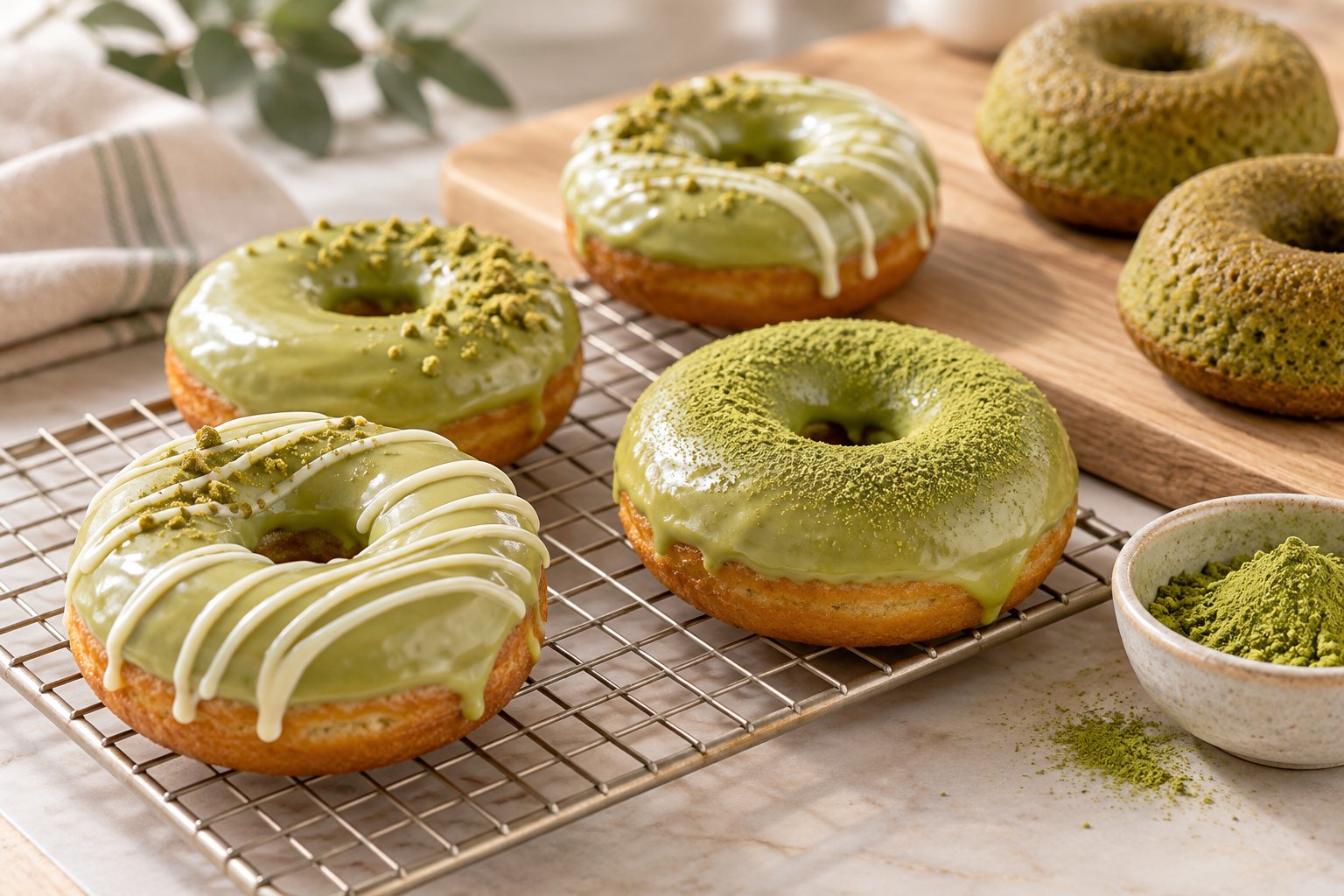
Matcha donuts are an easy item for cafés and bakeries that serve lattes to put in the display case. Some have matcha kneaded into the dough, some are baked, and some are finished with a matcha glaze or matcha chocolate. Where the matcha goes changes both the look and the cost. Frying browns the outside, and in hot countries glazes and chocolate need care too. We line up official recipes from a baking supplies company, an appliance maker and public bodies, and look in turn at matcha amounts, fermentation and making ahead, frying temperature and colour, glazes, oil management, shelf life and matcha per piece.
Types of matcha donuts, and where the matcha goes
How green a matcha donut looks depends on whether the matcha goes in the dough or in the glaze or chocolate added after frying. Doughs differ by whether they are fried or baked, and whether they use wheat flour or rice flour.
Types of dough
| Type | Dough | Examples in official recipes |
|---|---|---|
| Yeast-raised fried donut | Raised with yeast like bread, then fried | Tomizawa Shoten’s matcha donut puts matcha in both the dough and the chocolate finish |
| Fried cake donut | A dough raised with baking powder, cut out and fried (old-fashioned and similar) | Tomizawa Shoten’s old-fashioned style makes a plain dough and a matcha dough separately |
| Baked donut | Batter piped into a donut pan, or dough rolled out and cut, then baked in the oven | Tomizawa Shoten and Hitachi mix matcha into the dough and bake it |
| Rice flour donut | Made with rice flour, potato starch or tofu. Can be baked or fried | The Rice Stable Supply Support Organization (a public interest incorporated association that supports a stable rice supply) mixes matcha into one third of the dough and bakes it |
King Arthur Baking (a US flour company) writes that fried cake doughnuts get a crisp crust about 1/8 inch (about 3mm) thick, while baked doughnuts lack that crisp crust but are moist. Points to watch when using pancake mix are covered in Matcha pancakes.
In the dough, or in the finish
Tomizawa Shoten’s yeast-raised donut uses 4g of matcha in the dough, and mixes 4g of matcha into 150g of white chocolate to dip one side. Jade Leaf, a US matcha seller, puts matcha in both the dough and the glaze. Another approach is to pour only a matcha glaze over a plain dough. For cream-filled donuts, the cream recipe and refrigeration standards are covered in Matcha cream and matcha sauce.
Matcha amounts in official recipes
In official recipes that give matcha in grams, matcha in fried doughs was about 2–3% of the flour. Among baked donuts, Hitachi’s is about 2.9%, and Tomizawa Shoten’s recipe, which uses little flour and a lot of almond flour, has a higher share. We calculated each percentage by dividing the weight of matcha by the weight of flour.
Matcha as a share of the dough
| Source | Type | Matcha | Flour | Matcha to flour | Cooking | Pieces |
|---|---|---|---|---|---|---|
| Tomizawa Shoten, “彩り鮮やか ! 抹茶ドーナツ” (Colourful matcha donuts) | Yeast-raised, fried | 4g | 160g bread flour, 40g French bread flour | 2% | 180°C, about 2 min per side | 8 (about 50g each) |
| Hitachi, “焼き抹茶ドーナツ” (Baked matcha donuts) | Cake dough, baked | 5g | 170g cake flour | about 2.9% | Oven automatic menu | 4 (about 8cm across) |
| Tomizawa Shoten, “オールドファッション風ドーナツ” (Old-fashioned style donuts) | Cake dough, fried | 6g | 200g French bread flour (plus 10g almond flour) | 3% | 170°C, 1 min 30 s, then 1 min after turning | 7 plus mini donuts |
| Tomizawa Shoten, “簡単&ヘルシー♪抹茶の焼きドーナツ” (Easy baked matcha donuts) | Baked | 6g | 40g cake flour (plus 17g almond flour) | 15% (about 10.5% including almond flour) | 170°C, about 18 min | 6 |
| Rice Stable Supply Support Organization, “ベイクド豆腐ポンデ” (Baked tofu pon de rings) | Rice flour, baked | 1 tsp | One third of a dough of 150g rice flour and 90g potato starch | Not given in grams | 180°C, about 13 min | Matcha in one third of 6 |
| Jade Leaf, “Mochi Matcha Doughnuts” | Rice flour (mochiko), fried | 1 tbsp | 1.5 cups mochiko | By volume | Frying temperature not given | 12 |
Tomizawa Shoten’s yeast-raised matcha donut (8 pieces): dough of 160g bread flour, 40g French bread flour, 20g cane sugar, 4g salt, 2g instant dry yeast, 20g unsalted butter, 10g buttermilk powder, 40g whole egg, 40g milk, 65g water and 4g matcha. Topping of 200g white chocolate and 4g matcha. 500ml–1L of frying oil. To prepare, the matcha is mixed into the butter until even, and the matcha butter is added after the dough has been kneaded. Source: Tomizawa Shoten, “彩り鮮やか ! 抹茶ドーナツ” (Colourful matcha donuts, in Japanese) https://tomiz.com/recipe/pro/detail/20200220094855
Compared with other baked goods
Compared in the same way using official recipes, bread was about 1–3% of the flour (Matcha bread and croissants) and muffins about 4.2–10% (Matcha muffins and scones). The dough of a fried matcha donut uses about the same amount as bread. Tomizawa Shoten’s yeast dough uses 2% in the dough and the same amount again in the chocolate finish, adding matcha colour and flavour on the outside.
How the matcha is mixed in
Tomizawa Shoten’s yeast dough mixes the matcha into butter first, then adds it to the dough near the end of kneading. Its baked donut sifts the matcha together with the dry ingredients. Its old-fashioned style and Hitachi’s recipe whisk the dry ingredients and matcha together before combining them with the other ingredients. None of them add matcha straight into the liquid. Why lumps form is explained in Choosing matcha for baking.
Fermenting yeast dough and making ahead
Tomizawa Shoten’s yeast dough has a first rise of about 80 minutes at around 30°C, and about 60 minutes after shaping. Some recipes let you make cake dough the day before and refrigerate it.
Fermentation time and temperature
| Source | First rise | Rise after shaping | Frying |
|---|---|---|---|
| Tomizawa Shoten (matcha donut) | About 80 min at around 30°C | Rest 15 min, shape, then about 60 min at around 30°C | 180°C, about 2 min per side |
| King Arthur Baking (yeast-raised doughnuts) | 1 h 30 min to 2 h, until doubled | 30 min to 1 h, until doubled | 350°F (about 177°C), no more than 1 min per side |
How matcha affects fermentation and rise is summarised from research in Matcha bread and croissants. One report found that matcha at 3% of wheat flour had no effect on rise, and the 2–3% in fried doughs falls within that range.
Preparing the day before
King Arthur Baking says its yeast-raised mashed potato doughnut dough can be refrigerated overnight, and that frying the same day or the next day gives equally good doughnuts. Tomizawa Shoten’s old-fashioned style rests the dough in the refrigerator for at least 30 minutes, and suggests making it the night before. When you refrigerate yeast dough and fry it the next morning, keep the rise before chilling short, and set the rise after shaping by checking the dough’s temperature and how much it has risen in the morning (our suggestion). We did not find any official material showing how the colour of matcha dough changes overnight. Before you start making ahead, fry same-day dough and day-before dough side by side and compare colour and texture.
Frying temperature, and why the green turns brown
In official recipes for wheat flour doughs, frying temperatures were about 170–185°C, for 1–2 minutes per side. The outside touches hot oil and browns, so the green of the dough stays inside and less green shows from the outside.
Temperatures and times in official recipes
| Temperature | Recipe |
|---|---|
| 160–170°C | Hokuriku Regional Agricultural Administration Office, tofu donuts (rice flour, when fried) |
| 170°C | Tomizawa Shoten, old-fashioned style (1 min 30 s, then 1 min after turning) |
| 350°F (about 177°C) | King Arthur Baking, yeast-raised doughnuts (no more than 1 min per side) |
| 180°C | Tomizawa Shoten, matcha donut (about 2 min per side, until nicely coloured) |
| 365°F (about 185°C) | King Arthur Baking, mashed potato doughnuts (about 2 min per side) |
Among cooking oil makers, Nisshin OilliO gives medium temperature as 170–180°C, and J-Oil Mills gives the right temperature for most frying as about 160–180°C. Nisshin OilliO also writes that heating oil higher than needed makes it deteriorate faster.
Why frying dulls the green
Matcha green comes from chlorophyll. When heat removes the magnesium at its centre it turns olive, and with stronger heat the browning reactions add to this (Choosing matcha for baking). Yamamasa Koyamaen in Kyoto also explains that matcha can turn reddish when heated, and that in baked goods its aroma becomes harder to notice. We did not find a study that measured the colour of fried donuts, but as Tomizawa Shoten’s instruction to fry “until nicely coloured” shows, the outside browns.
Ways to show the green
The following are our suggestions.
- To show green on the outside, put matcha not only in the dough but also in the glaze or chocolate added after frying (the same idea as Tomizawa Shoten’s recipe)
- To keep the green of the dough, start from the lower end of the recipe temperature range, and cut one open to check colour and doneness
- Fry matcha donuts before other fried items, in clean, light-coloured oil
J-Oil Mills says frying items that soil the oil least first makes the oil last longer.
How thick to make matcha glaze and matcha chocolate, and how they set
In the two recipes where we could calculate a share in grams, matcha was about 2.7–3.1% of the chocolate or powdered sugar. Glaze thickness depends on the amount of liquid, and recipes differ on whether to glaze warm or cooled donuts.
Glaze and chocolate recipes
| Source | Finish | Matcha | Sweet base | Liquid | Matcha share |
|---|---|---|---|---|---|
| Tomizawa Shoten (matcha donut) | Matcha chocolate | 4g | 150g white chocolate | None | about 2.7% (of the chocolate) |
| Rishi Tea (a US tea company) | Matcha glaze | 7g | 2 cups powdered sugar | 2oz milk | about 3.1% (at 113g per cup of powdered sugar) |
| Jade Leaf (baked donuts) | Matcha glaze | 3 tsp | 1 cup powdered sugar | 1–2 tbsp milk | By volume |
| Jade Leaf (mochi donuts) | Matcha glaze | 1 tbsp | 1.5 cups powdered sugar | 2–3 tbsp milk | By volume |
| Hokuriku Regional Agricultural Administration Office (tofu donuts) | Icing | To taste | 4 tbsp powdered sugar | 1–2 tsp water | Amount not given |
We calculated Rishi Tea’s share using King Arthur Baking’s conversion (1 cup of powdered sugar = 113g). King Arthur Baking’s vanilla glaze uses 142g of powdered sugar with 14–28g of milk or water, adding liquid or sugar to adjust the consistency. Sift the matcha together with the powdered sugar before adding it to the liquid, then add liquid a little at a time at the end to reach the thickness you want (our suggestion).
When to glaze, and how it sets
| Source | Timing |
|---|---|
| King Arthur Baking (yeast doughnut blog) | While warm but not piping hot. Add toppings before the glaze sets |
| King Arthur Baking (air fryer blog) | Dip hot doughnuts on both sides and dry on a rack |
| Rishi Tea | Dip with the glaze bowl kept over the double boiler with the heat off, and let set for 5 minutes |
| Tomizawa Shoten, Jade Leaf, Rice Stable Supply Support Organization | Glaze or coat with chocolate after the donuts have cooled completely |
With chocolate coatings, pouring chocolate on warm donuts makes it run and set less easily (our view). White chocolate temperatures and tempering are covered in Matcha chocolate.
Stickiness in hot countries
Singapore’s monthly mean temperature is 26.8–28.6°C, and annual mean humidity is about 82%. Meiji says chocolate starts to melt at around 25°C (Matcha chocolate). King Arthur Baking says non-melting topping sugar does not melt and disappear on doughnuts as other sugars do, so it suits making them well ahead. A plain dusting of powdered sugar tends to melt and disappear over time, so dust just before selling or use non-melting sugar. Let glazed or chocolate-coated donuts set somewhere air-conditioned before putting them out (our suggestion).
Managing frying oil and when to change it
In Japan, the hygiene norm that gave a numerical guide for changing frying oil was abolished in June 2021, and no uniform replacement standard has been set. In Thailand, frying oil reused to make food for sale must have polar compounds (substances formed as oil deteriorates) at no more than 25% by weight.
Rules in Japan and Thailand
| Country | Content | Source |
|---|---|---|
| Japan | The “Hygiene Norm for Lunch Boxes and Prepared Dishes” (a 1979 Ministry of Health and Welfare notice) gave a guide for changing frying oil, such as “an acid value above 2.5”. It was abolished on 1 June 2021 by a Ministry of Health, Labour and Welfare notice issued as HACCP (a hygiene method that controls hazards at each step) became mandatory, and no uniform replacement standard has been set. As of 2022, many businesses still judged when to change oil by acid value | Ministry of Health, Labour and Welfare notice (1 June 2021), J-Oil Mills press release (July 2022), Iwate Prefecture document |
| Thailand | Ministry of Public Health Notification No. 347 (2012). When oil already used for frying is used to make food for sale, it must have polar compounds at no more than 25% by weight | Thai Ministry of Public Health |
Acid value is a number that shows the amount of free fatty acids in oil. J-Oil Mills says it is widely used in the food industry as an indicator for discarding oil. Shops that sell fried food in Thailand can check against the notification’s figure by keeping records with an oil tester that measures polar compounds (our suggestion).
Signs of tired oil
Nisshin OilliO gives five points for spotting tired oil: colour, foam, smoke, stickiness and smell.
| Sign | What Nisshin OilliO says |
|---|---|
| Colour | Oil used repeatedly gets darker |
| Foam | Foam disappears more slowly, and with further use “crab foam” forms that hides the food |
| Smoke | Tired oil smokes at around 180°C, the temperature for tempura. Fresh oil does not smoke until 230–240°C |
| Stickiness | The oil becomes sticky |
| Smell | The oil gives an unpleasant smell |
Nisshin OilliO also says tired oil cannot be restored, and that old tips for refreshing it, such as frying a pickled plum until burnt, are myths. Source: Nisshin OilliO, “疲れた油の見分け方” (How to spot tired oil, in Japanese) https://www.nisshin-oillio.com/kitchen/study-oil/distinguish.html
What a shop can do
- Do not raise the frying temperature more than needed. Turn the heat down or off when not frying (Nisshin OilliO says oil that is too hot deteriorates faster)
- Remove fried crumbs often (J-Oil Mills says crumbs also damage the oil)
- Record the date you change the oil, how much you fried, and the colour and foam, and set your shop’s own standard for changing it (our suggestion)
Storage and shelf life after frying, and handling in hot countries
A US flour company says yeast-raised doughnuts are best the day they are made, and should be frozen for longer storage. A Japanese hygiene guide for confectionery sets no number of days, and asks makers to check products against their own standards when storing them.
Guides from a maker and a hygiene guide
| Source | Applies to | Content |
|---|---|---|
| King Arthur Baking | Yeast dough (milk bread doughnuts) | Best the day they are made. Unfrosted and unfilled, airtight at room temperature for up to two days; freeze for longer |
| King Arthur Baking | Baked cake doughnuts | Cool completely and wrap airtight; several days at room temperature. Freeze for longer |
| Hygiene guide for confectionery makers (confirmed by Japan’s Ministry of Health, Labour and Welfare) | “Confections heated after the dough is made”, which include fried confections | Check the finish against your own standards, and store in lidded containers or similar at room temperature or refrigerated |
| Same | Heat-sterilised creams | Cool straight away, refrigerate, and use up as soon as possible |
The guide was produced by industry bodies such as the All Nippon Kashi Association and confirmed by the Ministry of Health, Labour and Welfare, for small confectionery makers. Figures for heating and cooling cream are in Matcha cream and matcha sauce.
What to decide for a shop in a hot country
Bangkok’s monthly mean temperature is 27.3–30.7°C (1991–2020 normals). King Arthur Baking’s day counts are for US home kitchens, so they cannot be applied as they are. Keep cream-filled donuts in a refrigerated case, put glazed or chocolate-coated ones somewhere air-conditioned, and set the selling period after storing and checking them in your shop (our suggestion). Matcha fades in light even after baking, so do not leave donuts under display lights for long. Labelling and allergens for bagged products are covered in Matcha cookies, and storing matcha powder itself in Matcha shelf life.
Matcha per donut and matcha cost
Calculated from official recipes, one matcha donut contains about 0.86–1.25g of matcha. The matcha cost of one donut is “price per kg ÷ 1,000 × grams of matcha in one donut”.
Matcha in one donut
| Recipe | Matcha per batch | Pieces | Matcha per donut |
|---|---|---|---|
| Tomizawa Shoten, old-fashioned style | 6g | 7 (plus mini donuts) | about 0.86g (actually less, since the minis share it) |
| Tomizawa Shoten, matcha donut (yeast dough) | 8g (4g dough, 4g chocolate) | 8 | 1.0g (0.5g dough, 0.5g chocolate) |
| Tomizawa Shoten, baked matcha donut | 6g | 6 | 1.0g |
| Hitachi, baked matcha donut | 5g | 4 | 1.25g |
The per-donut figures are our calculations, dividing by the number of pieces stated in each recipe. Some chocolate or glaze is left over after dipping, so the matcha that actually ends up on each donut is less than this. One matcha latte uses 3g of matcha in Ippodo Tea’s recipe (How to make a hot matcha latte). The 3g of matcha in one latte is about the amount in 2.4–3.5 donuts.
What goes into the cost
Besides matcha, include flour, butter, eggs, dairy, chocolate, frying oil, individual bags, and an allowance for failed and unsold donuts in the cost of one donut. For frying oil, divide by the number of donuts fried before you change it. How the price per kg of matcha is set is covered in How matcha prices are set.
Choosing matcha for donuts
Test the matcha for the dough and the matcha for the glaze or chocolate separately. Matcha in the dough goes through frying heat, while matcha in the finish is not heated, so its colour and aroma show as they are.
What to check
- Whether the ingredients are 100% matcha. A latte mix with sugar or milk powder gives too little matcha at the recipe amount (how to tell is in What is pure matcha?)
- For matcha in the glaze or chocolate, compare how vivid the green is side by side (grade names are covered in Matcha grades)
- Whether you can keep buying the same specification. A new lot can change the colour
How to test
- Fry each candidate matcha in your own recipe with the same matcha amount, frying temperature and time, and photograph the outside and the cross-section under the same light
- Make a glaze or chocolate with the same matcha, and compare the colour and stickiness just after coating and a few hours later, somewhere at the same temperature as your sales floor
- Taste for the balance of bitterness and sweetness, and decide together with the matcha cost per donut and the selling price
Omakase Matcha supplies matcha from Uji, Yame, Shizuoka, Kagoshima and Miyazaki. Orders start from 1kg, and you can request up to three samples. Request matcha for testing from Samples, and see how the regions differ in Origins.
Sources
- Tomizawa Shoten, “彩り鮮やか ! 抹茶ドーナツ” (Colourful matcha donuts, in Japanese) https://tomiz.com/recipe/pro/detail/20200220094855
- Tomizawa Shoten, “オールドファッション風ドーナツ(プレーンと抹茶)” (Old-fashioned style donuts, plain and matcha, in Japanese) https://tomiz.com/recipe/pro/detail/20220412194458
- Tomizawa Shoten, “簡単&ヘルシー♪抹茶の焼きドーナツ” (Easy baked matcha donuts, in Japanese) https://tomiz.com/recipe/pro/detail/20220404040349
- Hitachi, IH cooking heater recipes, “焼き抹茶ドーナツ” (Baked matcha donuts, in Japanese) https://kadenfan.hitachi.co.jp/ih/recipe/m/all/o066.html
- Rice Stable Supply Support Organization, “米粉でもちっと ベイクド豆腐ポンデ” (Chewy rice flour baked tofu pon de rings, in Japanese) https://komenet.jp/komekorecipe/komekowebkouza2023/pdf/komekorecipe_ponde.pdf
- MAFF Hokuriku Regional Agricultural Administration Office, “とーふドーナッツ(米粉)” (Tofu donuts with rice flour, in Japanese) https://www.maff.go.jp/hokuriku/seisan/komeko/recipe157.html
- Jade Leaf, “Mochi Matcha Doughnuts” https://www.jadeleafmatcha.com/blogs/matcha-recipes/mochi-matcha-doughnuts
- Jade Leaf, “Dunkin® Inspired: Baked Matcha Donuts (3 Ways)” https://www.jadeleafmatcha.com/blogs/matcha-recipes/dunkin-donuts-inspired-baked-matcha-donuts-three-ways
- Rishi Tea, “Donut Glaze” https://www.rishi-tea.com/blogs/journal/donut-glaze
- King Arthur Baking, “Yeast-Raised Doughnuts” https://www.kingarthurbaking.com/recipes/yeast-raised-doughnuts-recipe
- King Arthur Baking, “How to make yeast doughnuts” https://www.kingarthurbaking.com/blog/2016/08/04/make-yeast-doughnuts
- King Arthur Baking, “Milk Bread Doughnuts” https://www.kingarthurbaking.com/recipes/milk-bread-doughnuts-recipe
- King Arthur Baking, “Mashed Potato Doughnuts” https://www.kingarthurbaking.com/recipes/mashed-potato-doughnuts-recipe
- King Arthur Baking, “Dessert Doughnuts” https://www.kingarthurbaking.com/recipes/dessert-doughnuts-recipe
- King Arthur Baking, “Baked Doughnuts” https://www.kingarthurbaking.com/recipes/baked-doughnuts-recipe
- King Arthur Baking, “Three Easy Doughnut Glazes” https://www.kingarthurbaking.com/recipes/three-easy-doughnut-glazes-recipe
- King Arthur Baking, “Can you make doughnuts in an air fryer?” https://www.kingarthurbaking.com/blog/2021/08/12/can-you-make-doughnuts-in-an-air-fryer
- Nisshin OilliO, “揚げる油の温度” (Frying oil temperature, in Japanese) https://www.nisshin-oillio.com/kitchen/study-oil/temperature.html
- Nisshin OilliO, “疲れた油の見分け方” (How to spot tired oil, in Japanese) https://www.nisshin-oillio.com/kitchen/study-oil/distinguish.html
- J-Oil Mills, “よくあるご質問:つかいかた” (FAQ: how to use, in Japanese) https://www.j-oil.com/customer/faq/usage.html
- Ministry of Health, Labour and Welfare, “食品衛生法等の一部を改正する法律の施行に伴う営業等の取扱いについて” (Handling of businesses following the amended Food Sanitation Act, notice of 1 June 2021, in Japanese) https://www.mhlw.go.jp/content/12401000/000793435.pdf
- J-Oil Mills, press release (29 July 2022, in Japanese) https://www.j-oil.com/press/article/220729_003399.html
- Iwate Prefecture, “そうざい等の衛生確保に係る収去検査の取扱い方針” (Policy on sampling inspections for prepared dishes, in Japanese) https://www.pref.iwate.jp/_res/projects/default_project/_page_/001/082/178/toriatukaihoushin.pdf
- Thai Ministry of Public Health, Notification No. 347 (2012), Production method for food using reused frying oil (in Thai) https://exfood.fda.moph.go.th/law/data/announ_moph/P347.PDF
- All Nippon Kashi Association and others, “HACCPの考え方を取り入れた菓子製造業における衛生管理計画作成の手引書” (Guide to hygiene plans for confectionery makers based on HACCP principles, confirmed by the Ministry of Health, Labour and Welfare, in Japanese) https://www.mhlw.go.jp/content/11130500/000478404.pdf
- Yamamasa Koyamaen, “抹茶の取扱い” (Handling matcha, in Japanese) https://www.yamamasa-koyamaen.co.jp/matcha/basic/handling.html
- Meteorological Service Singapore, “Climate of Singapore” https://www.weather.gov.sg/climate-climate-of-singapore/
- Thai Meteorological Department, “Climatological Data for the Period 1991-2020” https://ubonmet.tmd.go.th/files/MetInfo/climate_normal.pdf
- Ippodo Tea, “抹茶ラテ” (Matcha latte, in Japanese) https://www.ippodo-tea.co.jp/blogs/tea-recipe/19%E6%8A%B9%E8%8C%B6%E3%83%A9%E3%83%86