
 Reviewed by: Takahiro Sugiyama (CEO, meguri Inc.)
Matcha cookies are an easy addition to the baked goods shelf for a café that already serves lattes. They keep for a few days after baking, so you can bag them for the counter or supply them to other shops. Those bags may count as “prepacked food” that needs a label under the rules of the country where you sell. This article compares official recipes from a tea company, flour millers and a chocolate maker by the amount of matcha, then looks at how to keep the green, shelf life, labels in Singapore, Thailand and Indonesia, and the matcha cost per cookie.
Types of matcha cookies a café can sell
Matcha cookies baked in a shop fall into four types by how the dough is shaped: drop, cut-out, icebox and piped. The shape changes how many you can bake and whether you can prepare the dough the day before.
The four methods
| Type | How it is made | In the shop |
|---|---|---|
| Drop | Soft dough dropped onto the tray with a spoon or ice cream scoop | Easy to sell as large single cookies |
| Cut-out (shortbread and similar) | Dough rolled out, chilled and cut with a cutter | Even shape and thickness. Scraps must be gathered and rerolled |
| Icebox (sablé and similar) | Dough shaped into a log, chilled and sliced with a knife | Keep the dough chilled and slice and bake as it sells |
| Piped | Soft dough piped from a piping bag | Small and light. Suits selling several in one bag |
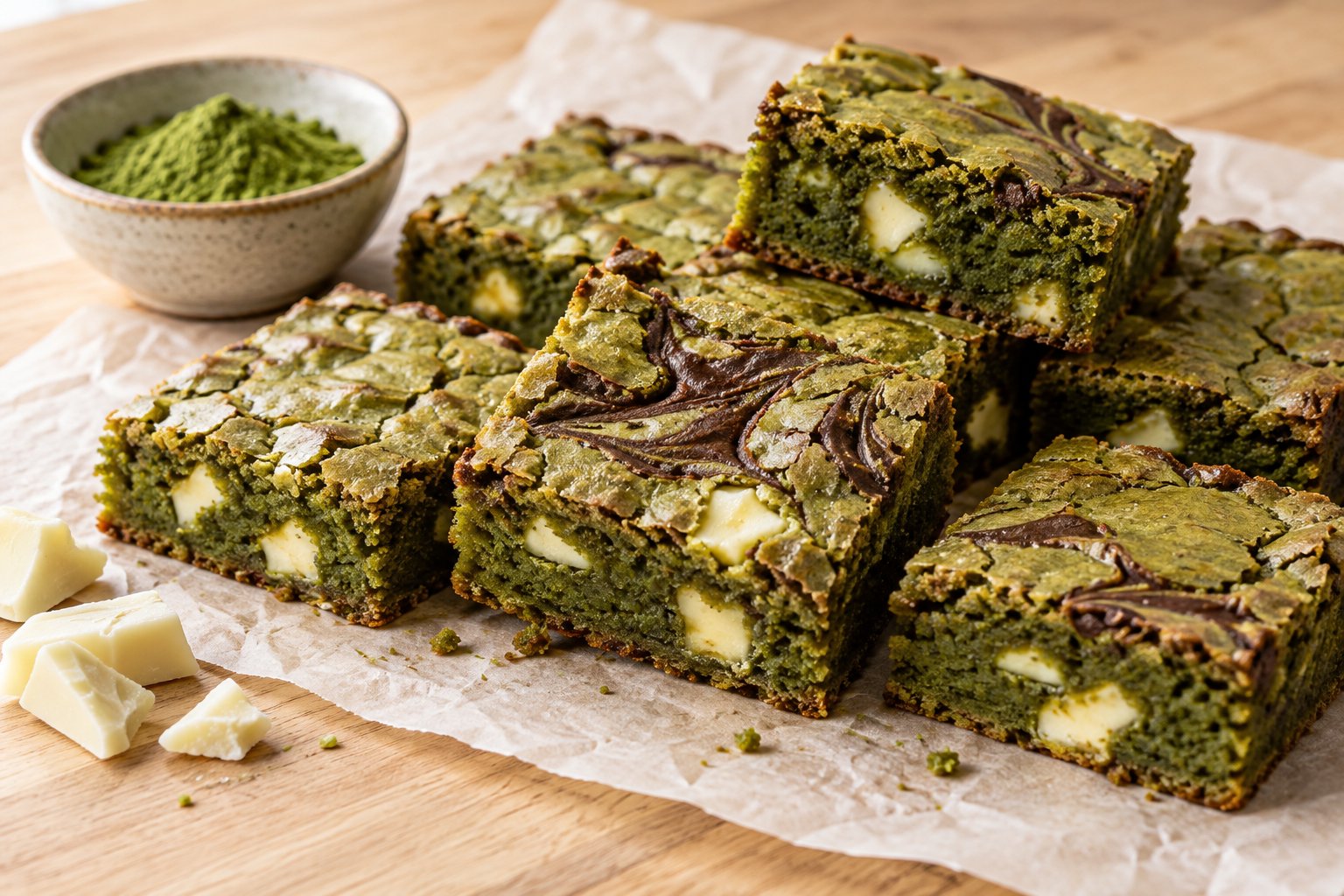
Drop cookies with white chocolate
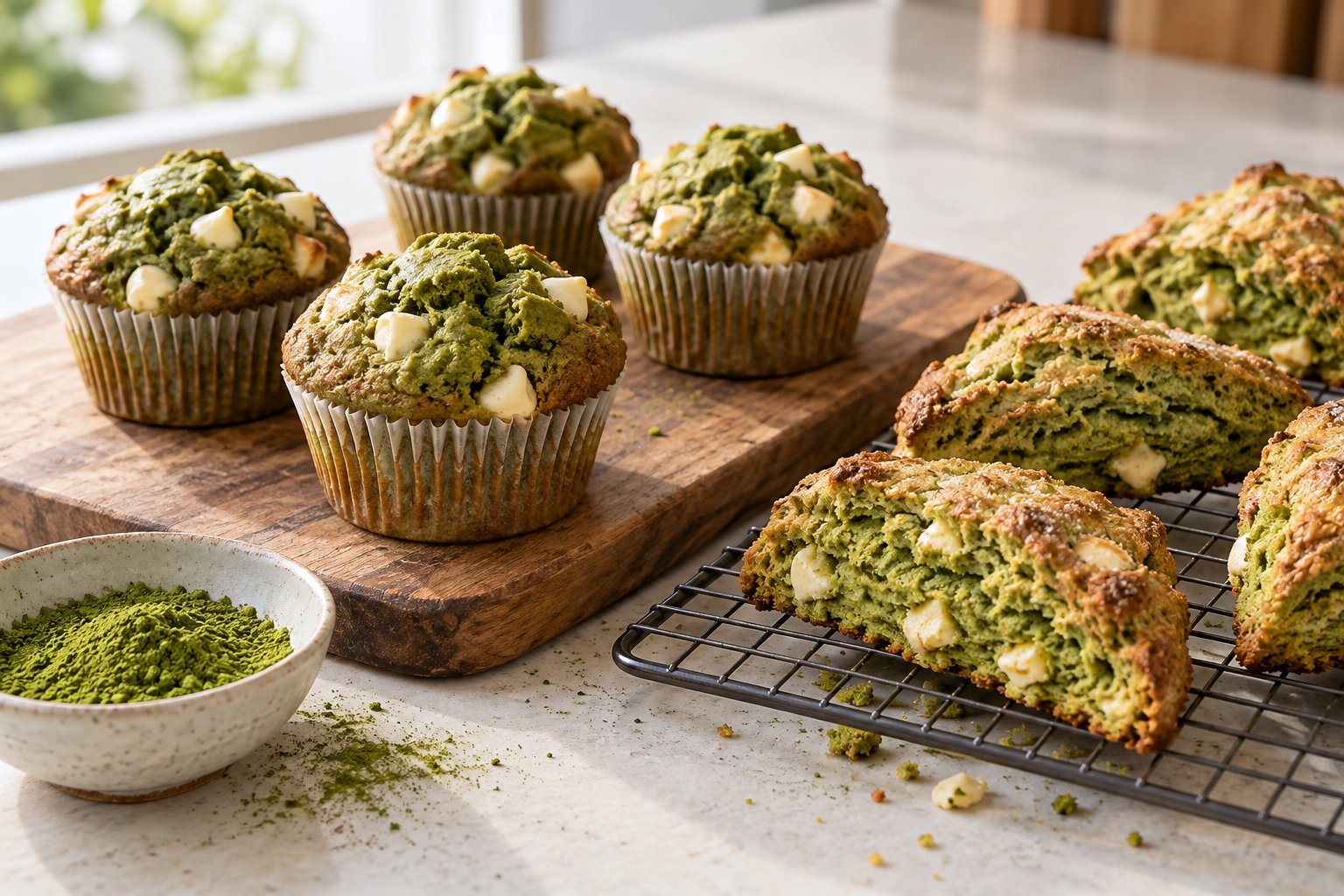
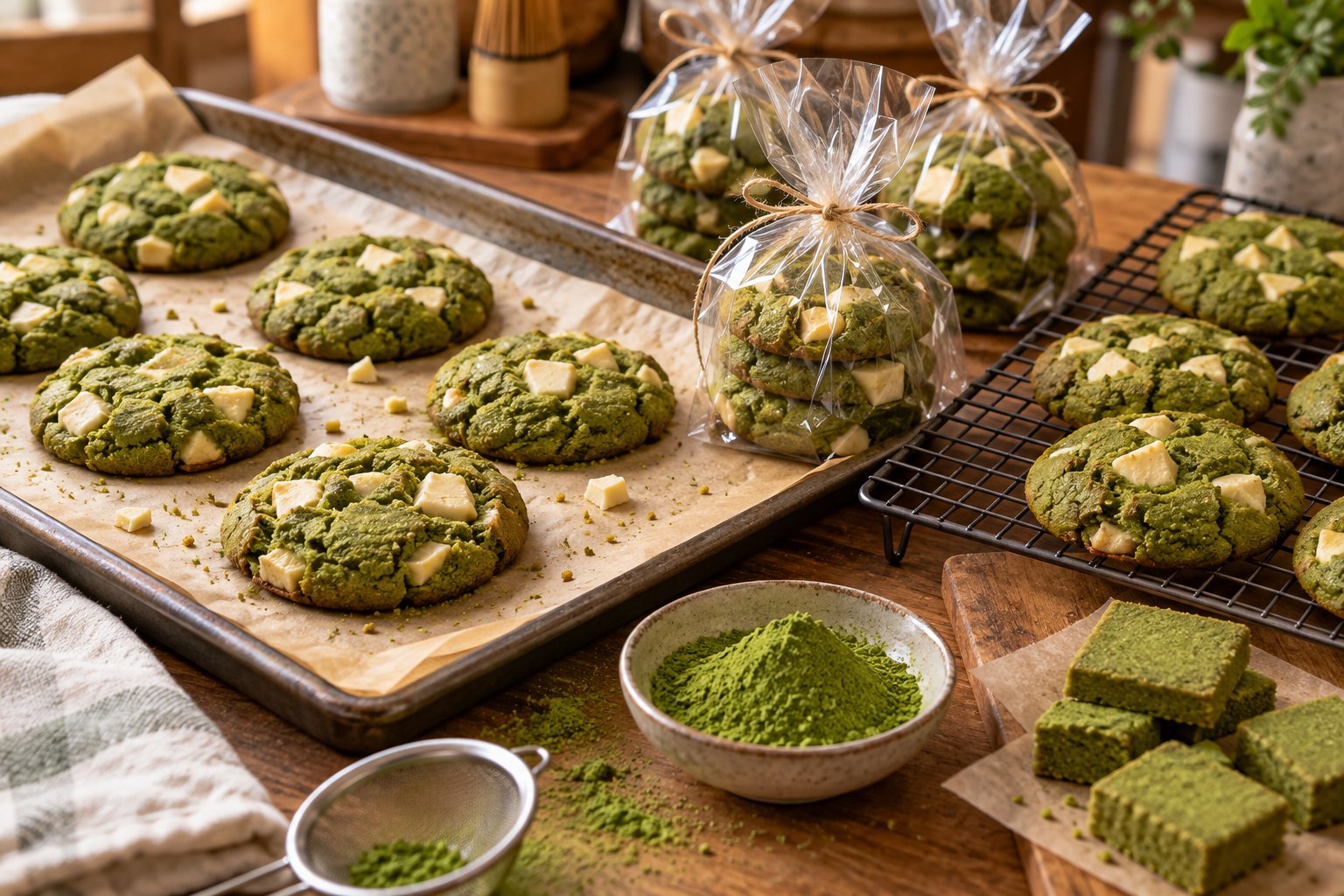
The recipe from Callebaut, the Belgian chocolate company compared below, is a drop cookie with white chocolate mixed into the dough and scooped onto the tray. White chocolate contains milk, so cookies sold in bags need a milk allergen declaration.
Comparing matcha amounts in official recipes
In official recipes that give matcha in grams, matcha was about 2.7–12.5% of the flour. We calculated the share by dividing the weight of matcha by the weight of cake flour (or all-purpose flour). Ratios for cakes and other baked goods are in Matcha for Baking. The table below lists cookie recipes that article does not cover.
Matcha as a share of flour
| Source | Type | Matcha | Flour | Matcha to flour | Baking | Yield |
|---|---|---|---|---|---|---|
| Nakamura Tokichi Honten (tea company in Uji, Kyoto) | Piped (egg white only) | 10g | Cake flour 80g | 12.5% | 160°C for 15 minutes | About 60, 2cm across |
| Meiji (Japanese confectionery and dairy company) | Icebox | 10g | Cake flour 200g | 5% | 180°C for 12–15 minutes | About 15 |
| AIYA America (US matcha seller) | Icebox (checkerboard; matcha only in the green dough) | 5g | All-purpose flour 95g | About 5.3% | 340°F (about 171°C) for 15–18 minutes | Not stated |
| King Arthur Baking (US flour miller) | Cut-out (glazed) | 9g | All-purpose flour 330g | About 2.7% | 325°F (about 163°C) for 12–14 minutes | About 24 |
| Callebaut (Belgian chocolate company) | Drop (with white chocolate) | 2 spoons | Plain flour 250g | By volume | 160°C (140°C fan) for 8–10 minutes | 8 |
| Bob’s Red Mill (US flour miller) | Icebox (pinwheel) | 2 teaspoons | Part of the dough | By volume | 350°F (about 177°C) for 8–10 minutes | 20 servings |
Nakamura Tokichi Honten’s recipe (for about 60 cookies 2cm across): butter 100g, powdered sugar 100g, egg white 50g, cake flour 80g, matcha 10g, salt 1g; preheat the oven to 160°C.
Source: Nakamura Tokichi Honten, “はじめての抹茶お菓子に|香り広がる抹茶クッキーのレシピ” (in Japanese) https://tokichi.jp/blogs/life-with-cha/recipe-matcha-cookie-starter
Why the share differs
Nakamura Tokichi Honten’s dough has little flour and a lot of egg white, butter and powdered sugar, so matcha is a high share of the flour. Divided by the whole dough (341g of ingredients in total), it is about 2.9%. King Arthur Baking’s recipe is a crisp dough with 254g butter for 330g all-purpose flour, and matcha is just under 3% of the flour. Do not set the amount of matcha from the share of flour alone; look at the share of the whole dough too.
A study on shortbread in which scores fell as matcha increased, with color and bitterness driving the results, is covered in Matcha for Baking. In your shop, bake two or three amounts from the range in the table and compare.
How the matcha goes in
Most recipes in the table combine matcha with the flour or sugar before adding it to the dough. Nakamura Tokichi Honten sifts matcha and cake flour together twice so lumps form less easily, and Meiji mixes cake flour and matcha in a zip bag before adding them. King Arthur Baking sifts the powdered sugar and matcha together first. Bob’s Red Mill sprinkles matcha over part of the dough and mixes it in to make two colors of dough.
Baking to keep the green
Many official recipes say to bake matcha cookies without letting them brown. Some recipes do bake for a golden color.
Recipes that say “do not brown”
King Arthur Baking takes the cookies out when they are slightly puffed, set on top and just beginning to take on slight color at the bottom edge, and says the cookies should not brown. Bob’s Red Mill also bakes until the bottom edges are barely light brown. Nakamura Tokichi Honten says its cookies, baked at 160°C for 15 minutes, come out with a faint, pale color and look elegant.
Source: King Arthur Baking, “Glazed Matcha Cookies” https://www.kingarthurbaking.com/recipes/glazed-matcha-cookies-recipe
Temperature and time
The recipes in the table bake at 160–180°C. Nakamura Tokichi Honten (160°C) and King Arthur Baking (about 163°C) bake at lower temperatures to keep the color pale. Callebaut’s drop cookies also bake at 160°C, but until golden. Decide whether you want to show the green or bring out the toasted color. Why heat changes matcha’s green is explained in Matcha for Baking. Ovens brown differently, so bake test batches in your own oven at different times and photograph the color.
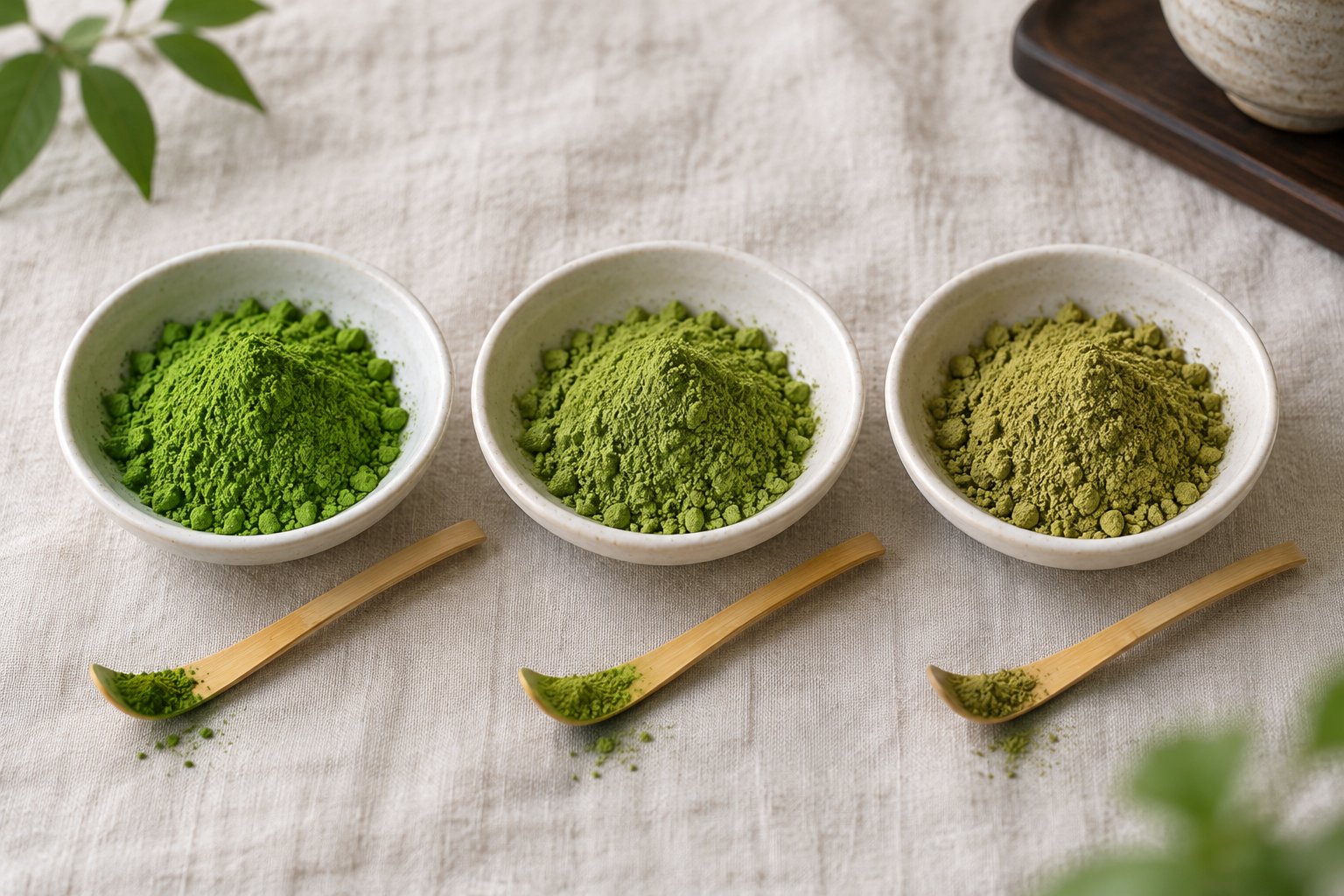
Matcha grade changes the green
King Arthur Baking says that, compared with culinary grade (sold for baking), the more expensive ceremonial grade (sold for drinking) gives the cookies a more vibrant green. There is no official standard for these grade names, so check what you are comparing in Matcha grades.
Shelf life and storage
The makers’ official recipes say to keep baked cookies airtight at room temperature for several days to a week, and to freeze them for longer. The date for cookies you sell is set by your shop for its own recipe and packaging.
Storage guidance from the makers
| Source | Storage |
|---|---|
| King Arthur Baking | Airtight at room temperature for several days. Freeze for longer storage, preferably before glazing |
| Bob’s Red Mill | Up to 1 week in an airtight container |
Both are home baking guides. For cookies you sell, the date depends on the dough’s moisture, the packaging, and the temperature and humidity where they are kept.
What to decide before selling
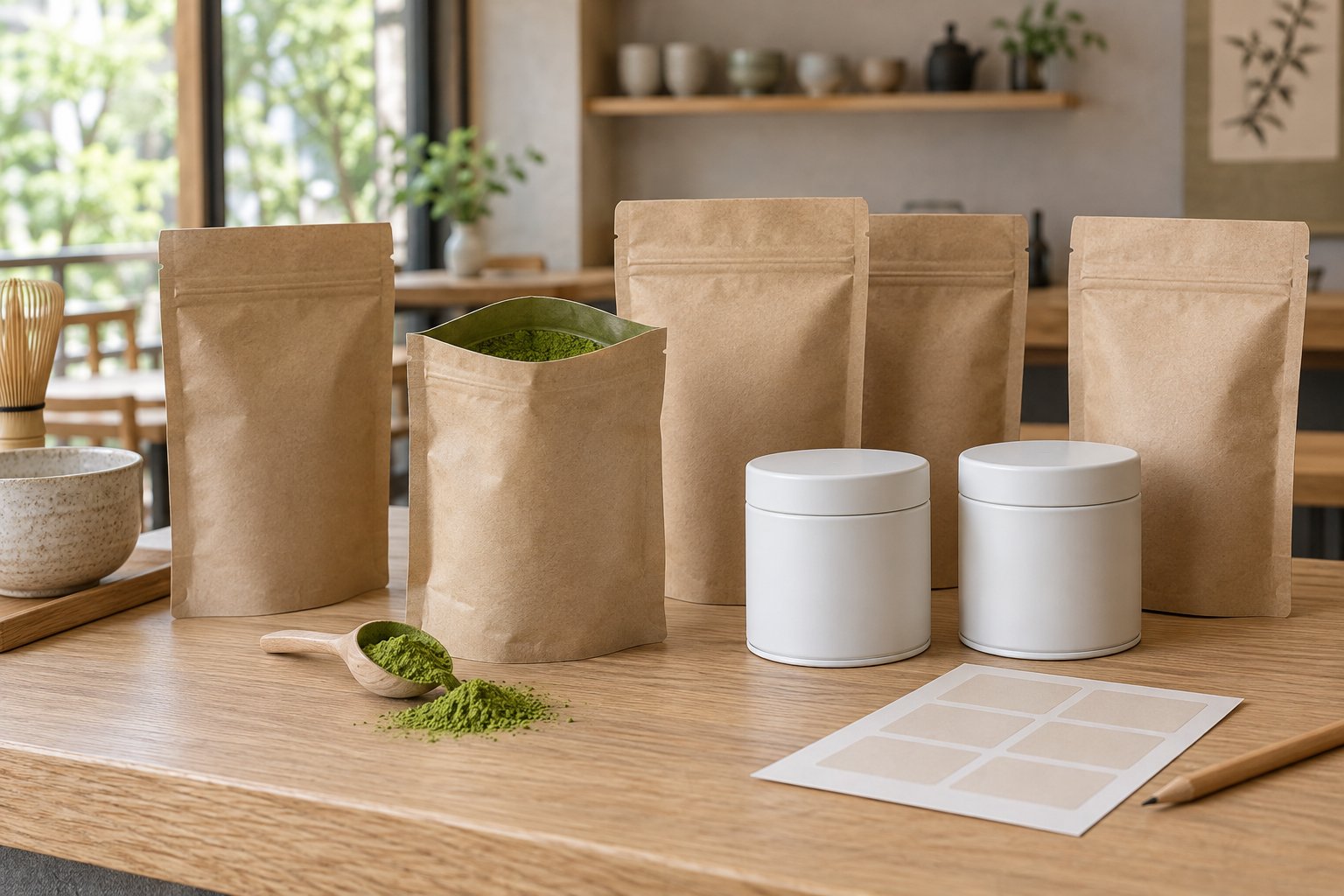
- Bag: use a bag that keeps out moisture, and decide whether to add a desiccant
- Display: matcha fades in light, so do not leave the cookies for long on shelves in direct sunlight or strong lighting
- Date: decide how many days after baking you will sell them, after storing them in your shop and checking texture and color
Storing matcha powder itself is covered in Matcha shelf life.
Labels for individually packed cookies
The same bagged cookies need different labels depending on whether you sell them only at your own counter or supply other shops.
Singapore
The Singapore Food Agency (SFA) labelling guide lists food prepared and packaged on the premises where it is sold as an example of food exempt from the general labelling requirements. If you supply other shops, the cookies are prepacked food and need the following in English.
| Label item | Points for cookies |
|---|---|
| Name of the food | A name that shows what is inside, such as “Matcha Cookies” |
| Ingredients | In descending order by weight. Include matcha, butter and chocolate |
| Net quantity | For example, “Net weight: 120g” |
| Local manufacturer, packer or vendor | Name and address. A phone number or website is not acceptable instead |
| Country of origin | For cookies baked in Singapore, “Product of Singapore” or similar |
| Lot identification | Required from 30 January 2026. An expiry or production date can serve as the lot mark |
The guide lists 19 categories of food that must be date-marked. Flour and chocolate confectionery are on the list, but cookies are not. If you do show an expiry date and it depends on storage conditions, the guide asks you to state how to store the food, such as “Store in a cool, dry place”.
The SFA treats businesses that supply food to their other outlets or to other food businesses as food processing establishments. A food retail licence covers sales to consumers only, and supplying other businesses needs a Licence to Operate a Food Processing Establishment.
Thailand
Thailand’s Ministry of Public Health Notification No. 450 exempts from labelling food for which the seller can give information to the consumer at the time of sale (such as food stalls), and food made and served in food shops and restaurants. Exempted food that has received a food serial number must still follow the notification.
Where a label is needed, such as when you supply other shops, it must be in Thai and show the food name, food serial number, name and address of the manufacturer, net quantity, percentage of main ingredients, allergens, expiry date, storage instructions (if any) and other items. If the shelf life is 90 days or less, the date is shown as day, month and year. Labels for imported products are covered in Private label matcha.
We could not confirm from the Thai FDA’s category list whether cookies fall into a category that requires a food serial number. Check with your local health authority or the Thai FDA before supplying other shops.
Indonesia
The labelling regulation of Indonesia’s Food and Drug Authority (BPOM) requires processed food sold in retail packaging to be labelled in Indonesian. This includes the product name, ingredients, net quantity, name and address of the manufacturer, production date and code, expiry information and the distribution permit number. Food made under a home industry registration (SPP-IRT) must show “P-IRT” with its number.
Explainers from BPOM’s Denpasar and Indramayu offices say that food with a shelf life of less than 7 days, and food served in restaurants and eateries, needs neither a distribution permit nor a home industry registration. Cookies kept for several days or more before sale may not fit this exception. The difference between the import number (ML) and domestic numbers (MD and P-IRT) is covered in How Indonesian cafés buy matcha powder.
Allergen labelling
Matcha cookies often contain wheat, milk and egg, and tree nuts are added if you use nuts or almond flavoring. All three countries require allergens to be declared on labels of packaged food.
Allergens in the three countries
| Country | Basis | Items |
|---|---|---|
| Singapore | SFA labelling guide | 8 groups: cereals containing gluten, crustaceans, eggs, fish, peanuts and soybeans, milk, tree nuts, sulphites (10mg/kg or more) |
| Thailand | Notification No. 450 | 10 items, close to the 8 groups above, with peanut and soybean listed separately and shellfish and squid added |
| Indonesia | Labelling regulation as amended by BPOM Regulation No. 20 of 2021 | Cereals containing gluten, egg, fish and seafood, peanut and soybean, milk, tree nuts, sulphites |
In Thailand, the label uses the wording “ข้อมูลสำหรับผู้แพ้อาหาร: มี…” (information for food allergy: contains…), and “อาจมี…” (may contain…) when there is a risk of cross-contact on shared equipment. Indonesia also requires a declaration when food made on the same production facilities may be cross-contaminated.
Ingredients in matcha cookies that count
| Ingredient | Allergen item |
|---|---|
| Cake flour, all-purpose flour | Cereals containing gluten (wheat) |
| Butter, white chocolate, milk | Milk |
| Egg, egg white, egg yolk | Egg |
| Almond flour, almond extract, nuts | Tree nuts |
Matcha itself is not on any of the three countries’ lists. A matcha mix with sugar or milk powder may add milk, though. If you bake peanut cookies in the same kitchen, consider a cross-contact statement as well.
Matcha cost per cookie
The matcha cost per cookie is “buying price per kg ÷ 1,000 × grams of matcha per cookie”. Grams per cookie is the matcha in one batch divided by the number of cookies.
Matcha per cookie
| Source | Matcha per batch | Yield | Matcha per cookie |
|---|---|---|---|
| Nakamura Tokichi Honten (piped) | 10g | About 60 | About 0.17g |
| King Arthur Baking (cut-out) | 9g | About 24 | About 0.38g |
| Meiji (icebox) | 10g | About 15 | About 0.67g |
The per-cookie figures are our own calculations. For small piped cookies, the matcha in one latte (3g in Ippodo Tea’s recipe) makes about 18 cookies.
What goes into the cost
Besides matcha, include the other ingredients, the bag, desiccant and label, and cookies lost to failed bakes in the cost per cookie. How the price per kg of matcha is set is covered in How matcha prices are set.
Choosing matcha for cookies
Decide by test baking whether to use the same matcha as your lattes or a separate one for baking.
What to check
- Whether the ingredient is 100% matcha. A latte mix with sugar or milk powder will not give enough matcha at the recipe amount
- Whether you can keep buying the same specification. A different lot changes the color after baking
- If you show a halal mark in the country where you sell the bags, the matcha’s certificate (What is halal matcha)
Test baking steps
- Bake each candidate matcha in your shop’s cookie recipe with the same amount of matcha
- Photograph the color under the same light right after baking, the next day, and on day 3 in the bag
- Taste for the balance of bitterness and sweetness, then decide with the matcha cost per cookie and the selling price
Omakase Matcha supplies matcha from Uji, Yame, Shizuoka, Kagoshima and Miyazaki, with orders from 1kg and up to 3 samples. Request matcha for test baking from Samples, and see how regions differ in Origins.
Sources
- Nakamura Tokichi Honten, “はじめての抹茶お菓子に|香り広がる抹茶クッキーのレシピ” (Fragrant matcha cookie recipe, in Japanese) https://tokichi.jp/blogs/life-with-cha/recipe-matcha-cookie-starter
- Meiji, “フランケンクッキー” (Franken cookies, in Japanese) https://www.meiji.co.jp/smartphone/sweets/okashi-land/oyatsu-kitchen/recipe/091.php
- AIYA America, “Matcha Checkered Cookies” https://aiya-america.com/matcha-checkered-cookies/
- King Arthur Baking, “Glazed Matcha Cookies” https://www.kingarthurbaking.com/recipes/glazed-matcha-cookies-recipe
- Callebaut, “White Chocolate Matcha Cookies” https://www.callebaut.com/en-GB/chocolate-recipe/3206/white-chocolate-matcha-cookies
- Bob’s Red Mill, “Matcha Pinwheel Cookies” https://www.bobsredmill.com/recipes/how-to-make/matcha-pinwheel-cookies
- Ippodo Tea, “Matcha Latte Recipe” https://ippodotea.com/blogs/recipes-to-brew-japanese-tea/matcha-latte-recipe
- Singapore Food Agency, “A Guide to Food Labelling and Advertisements” https://sfa.gov.sg/docs/default-source/food-information/labelling-and-packaging-information/a-guide-to-food-labelling-and-advertisements.pdf?sfvrsn=9659e1fa_2
- Singapore Food Agency, “Businesses that Need Licence / Registration for Food Manufacturing & Storage” https://www.sfa.gov.sg/food-manufacturing-storage/licence-registration/businesses-that-need-licence-registration-for-food-manufacturing-storage
- Ministry of Public Health Notification No. 450 (B.E. 2567), Labelling of prepacked food (in Thai) https://food.fda.moph.go.th/media.php?id=654869394207416320&name=P450.pdf
- Thai Food and Drug Administration, Notification No. 450, unofficial English translation https://food.fda.moph.go.th/media.php?id=657392349080592384&name=P450_EN.pdf
- Thai Food and Drug Administration, Explanation of Notification No. 450 (in Thai) https://food.fda.moph.go.th/media.php?id=653414653426278400&name=Detail-P450.pdf
- Indonesian Food and Drug Authority (BPOM), Regulation No. 31 of 2018 on Processed Food Labelling (in Indonesian) https://jdih.pom.go.id/download/rule/795/31/2018
- Indonesian Food and Drug Authority (BPOM), Regulation No. 20 of 2021 amending Regulation No. 31 of 2018 (in Indonesian) https://jdih.pom.go.id/download/rule/1287/20/2021
- BPOM Denpasar office, “Pelaku Usaha Wajib Tahu Ini: 9 Kriteria Pangan Olahan yang Dikecualikan dari Izin Edar BPOM” (in Indonesian) https://denpasar.pom.go.id/berita/pelaku-usaha-wajib-tahu-ini-9-kriteria-pangan-olahan-yang-dikecualikan-dari-izin-edar-bpom
- BPOM Indramayu office, “Jenis Pangan yang Wajib dan Tidak Wajib Mengurus SPP-IRT” (in Indonesian) https://indramayu.pom.go.id/berita/jenis-pangan-yang-wajib-dan-tidak-wajib-mengurus-spp-irt