
 Reviewed by: Takahiro Sugiyama (CEO, meguri Inc.)
To buy Japanese matcha and sell it in Singapore, the importing company needs a registration, and every shipment needs an import permit. Retail bags and tins also need English labels. This article is based on public information from the Singapore Food Agency, Singapore Customs, the Inland Revenue Authority of Singapore and Singapore Statutes Online, checked in October 2026. It uses matcha as the example, but the same steps apply to tea and other processed food.
Matcha is treated as “processed food” in Singapore
Matcha imports into Singapore are regulated by the Singapore Food Agency (SFA), and matcha falls into the processed food category. In the SFA’s classification, processed food is food that is not meat, fish or fresh fruits and vegetables (eggs and rice are separate categories).
You need a registration, not a licence
The SFA sets the required procedure by the category of food you import. A licence is required for meat and fish, fresh fruits and vegetables, and shell eggs. For processed food, a registration is enough.
Source: Singapore Food Agency, “What You Need to Know for Import of Food for Commercial Sale” https://www.sfa.gov.sg/food-import-export/commercial-imports/what-you-need-to-know-for-import-of-food
The SFA states that, regardless of the nature and mode of your business, only traders who are licensed or registered with the SFA can import food for commercial sale. This sentence also matters for samples, covered below.
Product codes for matcha
When you apply for an import permit, you declare an HS code (the international product number) and the SFA’s own product code. In the SFA’s product code list, green tea is divided into four codes, by whether it is leaves or dust (powder) and whether the packing is 3kg or less.
| Type | HS code | SFA product code |
|---|---|---|
| Leaves, packing not over 3kg | 09021010 | ZBP0NAC0000 |
| Dust, packing not over 3kg | 09021090 | ZBP0NAA0000 |
| Leaves, packing over 3kg | 09022010 | ZBP0NAD0000 |
| Dust, packing over 3kg | 09022090 | ZBP0NAB0000 |
This list is a PDF dated May 2025. You can check the latest codes with the SFA’s Product Code Search or the Singapore Customs HS/CA Product Code search tool. Agreeing in advance with the agent who files your declaration on which code to use for matcha avoids having to redo it.
The registration the importing company needs
The registration is free, and the SFA processes it in 1 working day. Before that, the company needs its entity number and must activate it with Singapore Customs.
| Step | Procedure | Where | Fees and time (as stated officially) |
|---|---|---|---|
| 1 | Register the company and get a Unique Entity Number (UEN) | Accounting and Corporate Regulatory Authority (ACRA) | As set out by ACRA |
| 2 | Activate the Customs Account | Singapore Customs | Free. Outcome within 4 working hours if no supporting documents are needed, or 3 working days after complete documents are received |
| 3 | Set up GIRO (direct debit) with the SFA | SFA | Used to pay licence, registration and permit fees |
| 4 | Register to import processed food | SFA (GoBusiness portal) | Free. 1 working day |
Logging in to GoBusiness requires Singpass (for individuals) or Corppass (for companies). Individuals and sole proprietors cannot apply if they have outstanding CPF Medisave (medical savings) payments.
Only key personnel registered with ACRA, such as an owner, partner or director, can activate the Customs Account. A newly registered company can activate it from the same ACRA portal. Opening a café is a separate matter from importing: it needs an SFA Food Shop Licence.
An import permit through TradeNet for every shipment
Even after registering, you need an import permit through TradeNet, the customs declaration system, for every shipment. Singapore Customs requires the permit to be obtained before the goods arrive in Singapore.
What goes into the application
According to Singapore Customs, an import permit for processed food includes:
- The SFA registration number for processed food
- The product code, quantity and unit of quantity
- The brand name (the product name or the manufacturer’s name is also acceptable)
The SFA states that you may also need to enter the establishment code of the exporting country. For Japan, prefectural codes are used: Kyoto is JPKYT, Shizuoka JPSZO, Kagoshima JPKGS, Fukuoka JPFKK and Miyazaki JPMYZ.
Fees and processing time
There is no SFA fee for an import permit for processed food. Compared with S$300 per shipment for chilled, frozen or processed meat, the fixed cost of importing matcha is small. If you file through TradeNet yourself, the customs cost is about S$3.19 per application (fees charged by an agent are separate).
The SFA takes at least 1 working day to review an application. Complete applications submitted by 5:30pm Monday to Thursday, or by 5:00pm on Friday, are approved by the next working day.
The CCP and inspections
When the permit is approved, a Cargo Clearance Permit (CCP) is issued. Print the CCP, present it for clearance and inspections, and follow any conditions attached to it. The SFA may inspect food on arrival, and some shipments are placed on “hold and test,” meaning they cannot be sold until the laboratory results are out. There is no fee for inspections.
Who files the application
There are two options: appoint a Declaring Agent such as a freight forwarder or customs broker, or register as a Declaring Agent yourself and get a TradeNet user ID. Even if you use an agent, your own Customs Account must be activated. Once it is, the agent can apply using your UEN.
Samples and small amounts still need registration and a permit
The SFA treats receiving and selling food or food samples by parcel post as importing food for commercial sale. Even samples ordered to compare suppliers need a registration and an import permit.
Singapore Customs has a “trade samples” category. It covers only goods that are shown, demonstrated or tested to win orders or prepare manufacturing, and that are not sold or consumed. In addition, the customs table shows that controlled items such as food need a permit even when the CIF value (cost of goods plus insurance and freight) is S$400 or less. Do not assume you can receive tasting samples without a permit.
A shop without a registration receives samples through a registered importer. How to compare samples is covered in Bulk Matcha: How to Buy Matcha Wholesale.
Customs duty and GST
In Singapore, customs duty applies to only four categories: intoxicating liquors, tobacco products, motor vehicles and petroleum products. There is no duty on matcha. Imported goods are, however, subject to Goods and Services Tax (GST).
The GST rate is 9%. It rose from 8% in 2023 to 9% on 1 January 2024. GST is collected by Singapore Customs, and the taxable amount is the total of:
- The CIF value
- Customs duty (zero for matcha)
- Incidental charges such as commission
For example, if the CIF value is S$1,000, GST is S$90. GST is charged whether or not the importer is GST-registered. A GST-registered company can claim the GST it paid as input tax if it holds an import permit that shows it as the importer.
Do not count on the S$400 relief
Goods with a CIF value of S$400 or less that arrive by post or air get GST relief. However, at Changi Airfreight Centre, the permit waiver applies only to goods that are neither controlled nor dutiable. Matcha is a controlled item, so if you import it for sale, you cannot skip the permit.
The quality standards matcha must meet: tea standard, pesticide residues and lead
Singapore’s Food Regulations set a standard for tea itself, and limits for pesticide residues and lead. Food that does not meet them cannot be imported or sold.
The tea standard (regulation 153)
Regulations 153 to 156 of the Food Regulations cover tea. Under regulation 153, tea is the leaves and leaf buds of Camellia sinensis prepared by the usual trade processes. Ash must be at least 4% and not more than 7%, water-soluble extract must be at least 30%, and adding any matter for colouring or other purposes is prohibited.
Pesticide residues
Limits for pesticide residues are listed pesticide by pesticide in the Ninth Schedule of the Food Regulations. Tea (“tea (dry manufactured),” “green tea” and so on) is listed for several pesticides. Under regulation 30 of the Food Regulations, unless otherwise prescribed, a pesticide residue must not exceed the limit adopted by the Codex Alimentarius Commission, the international food standards body. When two or more pesticides in the Ninth Schedule remain, the sum of each residue divided by its limit must not exceed 1.
Meeting Japan’s standards does not guarantee meeting Singapore’s. When you buy, ask your supplier for pesticide residue test results checked against Singapore’s limits. How standards differ by country is covered in Bulk Matcha: How to Buy Matcha Wholesale.
Lead and other heavy metals
The Tenth Schedule of the Food Regulations limits lead in tea to 2ppm (2mg per kg). How to read test results is covered in Matcha Lead: Does Matcha Have Lead?.
According to a survey by the Japan External Trade Organization (JETRO) as of October 2022, tea is not on the SFA’s list of items under strict import control, and no plant health certificate is needed. Even so, the SFA samples and tests imported food, so keeping test documents for each lot lets you answer questions quickly.
English labelling rules: retail packs and bulk packs differ
Labelling requirements apply only to food packed in advance for retail sale (prepacked food). The labels needed differ between the bulk bags a café uses for drinks and the tins or bags it sells to customers.
| No. | Mandatory information (in English) |
|---|---|
| 1 | Name or description of food |
| 2 | Statement of ingredients (including ingredients known to cause hypersensitivity) |
| 3 | Net quantity of food in the package |
| 4 | Name and address of the local entity responsible for the product |
| 5 | Country of origin |
| 6 | Lot identification |
| 7 | Directions for use |
Source: Singapore Food Agency, “A Guide to Food Labelling and Advertisements,” page 7 https://www.sfa.gov.sg/docs/default-source/food-information/labelling-and-packaging-information/a-guide-to-food-labelling-and-advertisements.pdf
What retail packs need
Amended regulations took effect on 30 January 2026 and added to the required items.
| Item | What to show |
|---|---|
| Name | A name that shows what the food is. A brand name alone is not enough |
| Ingredients | For food with two or more ingredients, listed in descending order by weight |
| Net quantity | For solid food, written as in “Net weight: 100g.” A range is not allowed |
| Singapore business | Name and address of the importer, distributor or agent. A phone number or website cannot replace them |
| Country of origin | With a phrase that makes clear it is the country of origin, such as “Product of Japan” (from 30 January 2026) |
| Lot identification | A mark that identifies the production lot, such as a lot number or production date (from 30 January 2026) |
| Directions for use | Needed only for food that becomes unsafe if used or handled incorrectly |
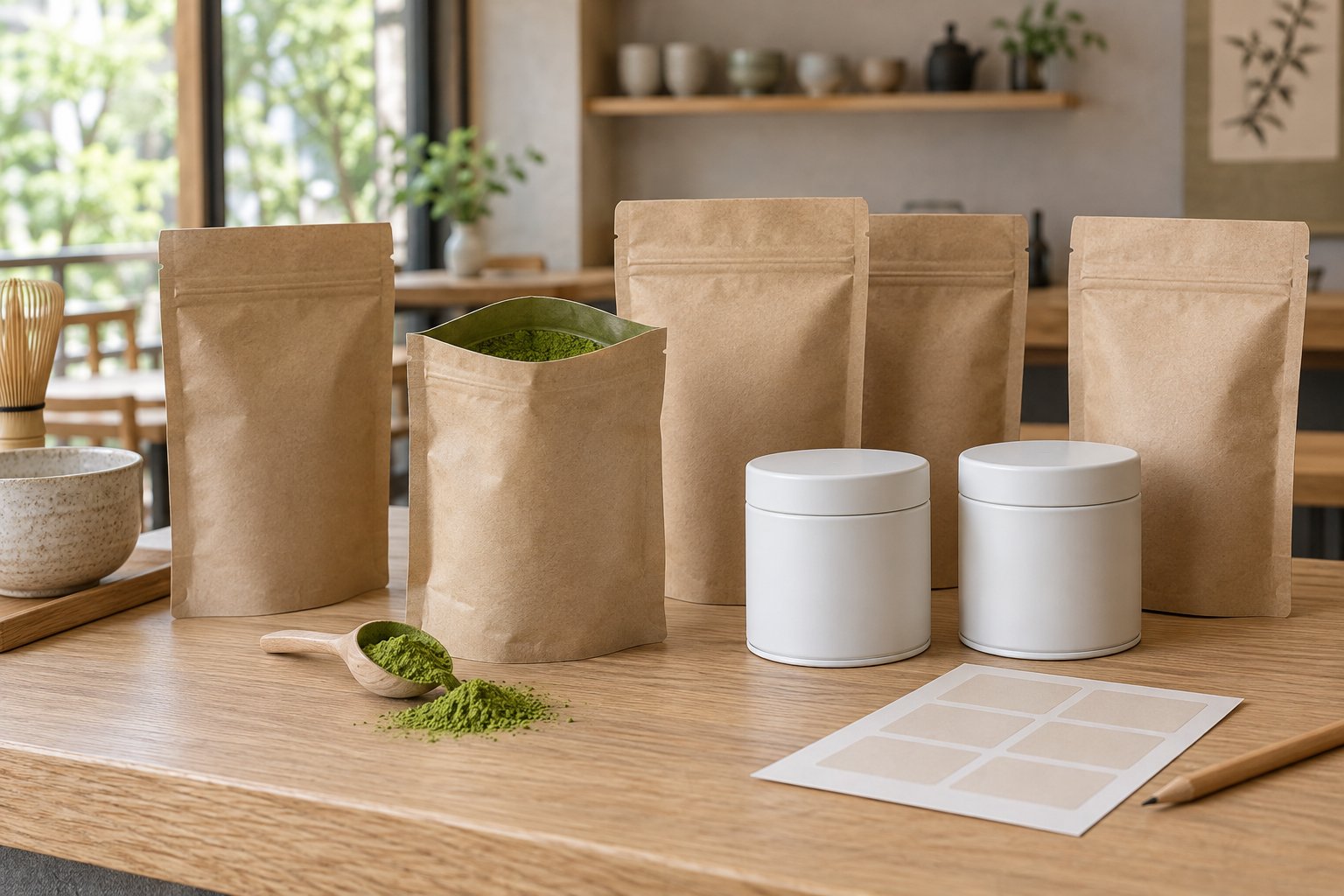
Japanese packaging alone is often not enough, and the SFA accepts English sticker labels added by the importer. The sticker must stay firmly attached and must not cover other required information. Altering or obscuring the date mark on the original package is prohibited. Date-marking is mandatory only for foods listed in the regulations, such as milk, flour and cooking oil, and tea is not on that list.
Bulk bags are outside the general labelling requirements
The SFA’s guide states that the general labelling requirements do not apply to food packed in non-retail containers for food manufacturers or food services to use further. Bulk bags a café uses for lattes fall into this category. If you sell tins or bags of matcha in your shop, they are retail packs and need the items in the table above in English. Breaching the Food Regulations carries a fine of up to S$1,000 for a first offence and up to S$2,000 for a second or later offence.
Documents, and changes to the rules
The basic documents for customs clearance are four: a commercial invoice, a packing list, an air waybill or bill of lading, and a copy of the import permit. For air and land imports, these are presented at the checkpoint.
- Commercial invoice
- Packing list
- Air waybill (AWB) or bill of lading (B/L)
- Copy of the import permit (CCP)
A health certificate is not required for all processed food. Only for items identified as high risk do you attach health certificates or laboratory reports when applying for the permit. A certificate of origin is not among the customs documents for tea listed by JETRO.
The radiation-related restrictions are gone
The Singapore government lifted its radiation-related import restrictions on Japanese food on 28 May 2021. Green tea had required certificates of origin from 2012, and tea from Shizuoka Prefecture also required radiation test reports. These documents are no longer needed.
A new food safety law is coming into force in stages
In 2025, Singapore passed the Food Safety and Security Act 2025, which will replace the Sale of Food Act in stages. JETRO says the transition is planned from the end of 2025 to 2028. On Singapore Statutes Online, as of October 2026, commencement dates are shown for only some provisions, and none is shown for Part 3, which covers imports. The registration and permit steps in this article are as of October 2026, so check the SFA’s latest guidance before you import.
The import process and common pitfalls
A first import has eight stages, from company registration to sale.
| Step | What to do | Who |
|---|---|---|
| 1 | Register with ACRA and get a UEN | The importing company |
| 2 | Activate the Customs Account | Key personnel of the importing company |
| 3 | Set up GIRO with the SFA and register to import processed food | The importing company |
| 4 | Get the product form (powder or leaves) and packing weight, origin, price and test documents from the supplier | The importing company and the supplier |
| 5 | Apply for the import permit through TradeNet before the goods arrive | Declaring Agent or the company itself |
| 6 | Receive the CCP and pay GST | Declaring Agent or the company itself |
| 7 | Clear customs, and undergo SFA inspection if required | The importing company |
| 8 | For retail packs, attach English labels before selling | The importing company |
Common pitfalls:
- Applying for the permit after the goods arrive, which delays collection
- Not knowing the prefectural code of the origin or the brand name, which stalls the application
- Mixing up powder and leaves, or 3kg or less and over 3kg, so the product code has to be corrected
- Assuming samples do not need a permit, and being stopped at customs
- Having pesticide residue results only against Japan’s standards, so they cannot be checked against Singapore’s
- Missing the Singapore importer’s address or the lot identification on retail English labels
How a shop without a registration can buy matcha
If you do not register yourself, buy through an importer or wholesaler registered with the SFA. The importer obtains the import permit in its own name and takes care of customs clearance and GST, so your shop can receive the goods without handling the import procedures itself. If you sell retail packs, agree with the importer whose name and address go on the label.
If you buy directly from Japan, also check the shipping terms (FOB, DAP, DDP and so on), which decide who pays duties and taxes. The differences between terms are covered in Bulk Matcha: How to Buy Matcha Wholesale, and grades suited to lattes in Matcha grades.
Buying from Omakase Matcha
Omakase Matcha supplies matcha bought directly from the Uji, Yame, Kagoshima, Shizuoka and Miyazaki regions, from 1kg. To Singapore, we deliver DDP (delivered duty paid), with duties and taxes paid by us. Payment is in advance by Wise or PayPal, and we also visit shops in Singapore.
If you want to taste before ordering, you can request up to 3 samples. Terms are on the Singapore wholesale and Wholesale pages.
Sources
Checked on 14 October 2026.
- SFA, “What You Need to Know for Import of Food for Commercial Sale” https://www.sfa.gov.sg/food-import-export/commercial-imports/what-you-need-to-know-for-import-of-food
- SFA, “Application Process & Fees for Licence / Permit / Registration for Import / Export” https://www.sfa.gov.sg/food-import-export/licence-permit-registration/application-process-fees-for-licence-permit-registration-for-import-export
- SFA, “Classification of General Food & Food Products” https://www.sfa.gov.sg/food-import-export/general-classification-of-food-food-products/classification-of-general-food-food-products
- SFA, “Product Codes for Processed Food Products” https://www.sfa.gov.sg/docs/default-source/tools-and-resources/product-codes/product-code-for-processed-food-and-food-appliances.pdf
- SFA, “List of Japan Prefectural Codes” https://www.sfa.gov.sg/docs/default-source/tools-and-resources/listofjapanprefecturalcodes.pdf
- SFA, “Labelling Requirements for Food” https://www.sfa.gov.sg/regulatory-standards-frameworks-guidelines/food-labelling-packaging-guidelines/labelling-requirements-for-food
- SFA, “A Guide to Food Labelling and Advertisements” https://www.sfa.gov.sg/docs/default-source/food-information/labelling-and-packaging-information/a-guide-to-food-labelling-and-advertisements.pdf
- Singapore Statutes Online, “Food Regulations” regulations 30, 31 and 153, Ninth and Tenth Schedules https://sso.agc.gov.sg/SL/SFA1973-RG1
- SFA, “Businesses that Need Licence / Permit for Food Retail” https://www.sfa.gov.sg/food-retail/licence-permit/businesses-that-need-licence-permit-for-food-retail
- Singapore Statutes Online, “Food Safety and Security Act 2025” https://sso.agc.gov.sg/Act/FSSA2025
- Singapore Customs, “Singapore Food Agency (SFA)” (requirements for controlled items) https://www.customs.gov.sg/doing-business/quick-links-for-traders/tradenet/competent-authorities-requirements-for-controlled-items/singapore-food-agency/
- Singapore Customs, “Activate / Update / Terminate Customs Account” https://www.customs.gov.sg/doing-business/getting-started/new-trader-registration/activate-update-terminate-customs-account/
- Singapore Customs, “Obtain a Customs Import Permit” https://www.customs.gov.sg/doing-business/import-operations/import-procedures/obtain-a-customs-import-permit/
- Singapore Customs, “Importing Trade Samples” https://www.customs.gov.sg/doing-business/import-operations/import-procedures/importing-trade-samples/
- Singapore Customs, “Importing by Postal or Courier Service” https://www.customs.gov.sg/doing-business/import-operations/import-procedures/importing-by-postal-or-courier-service/
- Singapore Customs, “Documents for Clearance of Goods” https://www.customs.gov.sg/doing-business/import-operations/import-procedures/documents-for-clearance-of-goods/
- Singapore Customs, “Duties and Dutiable Goods Overview” https://www.customs.gov.sg/doing-business/valuation-duties-and-fees/duties-and-dutiable-goods/duties-and-dutiable-goods-overview/
- Singapore Customs, “Goods and Services Tax” https://www.customs.gov.sg/doing-business/valuation-duties-and-fees/goods-and-services-tax-gst/
- Singapore Customs, “Permits, Documentation and Other Fees” https://www.customs.gov.sg/doing-business/valuation-duties-and-fees/permits-documentation-and-other-fees/
- IRAS, “Current GST Rates” https://www.iras.gov.sg/taxes/goods-services-tax-(gst)/basics-of-gst/current-gst-rates
- IRAS, “Importing of Goods” https://www.iras.gov.sg/taxes/goods-services-tax-(gst)/claiming-gst-(input-tax)/importing-of-goods
- JETRO, “茶の輸入規制、輸入手続き(シンガポール)” (Import regulations and procedures for tea, Singapore, in Japanese) https://www.jetro.go.jp/world/asia/sg/foods/exportguide/greentea.html
- JETRO, “菓子の輸入規制、輸入手続き(シンガポール)” (Import regulations and procedures for confectionery, Singapore, in Japanese) https://www.jetro.go.jp/world/asia/sg/foods/exportguide/pastry.html
- MAFF, “アジアにおける規制措置の変遷” (History of import restrictions in Asia, in Japanese) https://www.maff.go.jp/j/export/e_shoumei/oshirase/asia.html