
 Reviewed by: Takahiro Sugiyama (CEO, meguri Inc.)
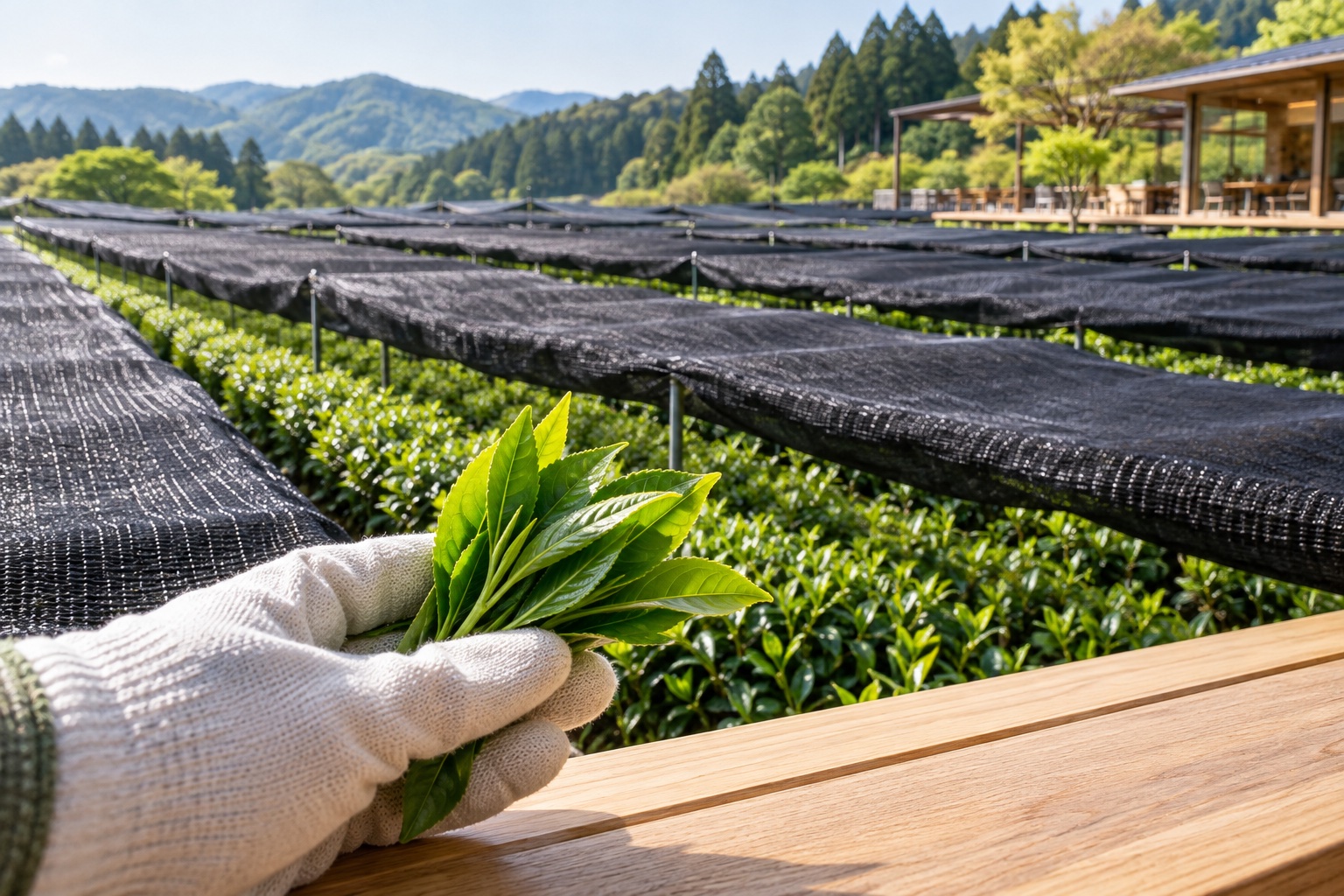
“Can our tencha (the shaded, unrolled leaf that is ground into matcha) be shipped to Europe or the US as it is?” When overseas enquiries for matcha increase, this is often the first question a Japanese grower faces. The answer depends on the pesticides used in the field that year and on the destination country. This article covers how the EU, US, Taiwan, Singapore, Thailand and Indonesia set their rules, compares the limits for common pesticides, explains what to watch with shaded tencha, and shows how export spray calendars are built and residue tests ordered. Everything was checked against each country’s law and documents from Japan’s Ministry of Agriculture, Forestry and Fisheries (MAFF) and NARO.
Whether tencha can be exported depends on the pesticides used and the market
Meeting Japan’s limits does not mean meeting the export market’s limits. Which countries a lot can go to only becomes clear once the spray records are checked, one pesticide at a time, against that market’s limits.
Why tea that meets Japan’s limits can fail
MAFF explains that tea meeting Japan’s maximum residue limits (MRLs) may still fail the export market’s limits and be unable to be exported. A guideline on export spray calendars compiled in September 2024 by NARO and others gives the reason: many of the countries that import Japanese tea do not grow tea, so pesticides used on tea in Japan are not registered for tea there. For pesticides with no limit, a low uniform value or the lowest level analysis can measure applies.
What to prepare for the check
The steps are as follows.
- List the pesticides sprayed that year (and the previous year for long-lasting ones) and the spray dates
- Decide on the target country and look up its tea limit for each pesticide
- For pesticides whose limit is lower than Japan’s, check the interval between spraying and plucking
- Test any pesticide that still raises doubt against the export market’s standard
On its page “Information on maximum residue limits in other countries” (in Japanese), MAFF publishes a table for 15 products including tea that sets the limits of Japan, Codex (the international food standards) and 20 countries and regions side by side, as PDF and Excel. The current table reflects a survey as of 1 September 2026 and is scheduled to be updated monthly until March 2027. The comparison table in the third section of this article uses its figures.
Source: MAFF, tea MRL table as of 1 September 2026 (in Japanese) https://www.maff.go.jp/j/shokusan/export/attach/pdf/zannou_kisei-955.pdf
The table notes that the figures are as of the survey date and may have changed since. Before export, confirm them in the market’s official sources listed in the next section.
How each market sets its rules: pesticides without a tea limit are treated differently
The biggest differences between countries are in how pesticides without a tea limit are treated. Japan applies a uniform 0.01 ppm (0.01 mg per kg) to pesticides without a limit, but export markets each use a different approach.
| Market | Pesticides with no tea limit | Where to check |
|---|---|---|
| EU | Uniform 0.01 mg/kg | EU Pesticides Database |
| US | Without a tolerance, food cannot be sold or imported once the residue is detected | Code of Federal Regulations, 40 CFR Part 180 |
| Taiwan | Pesticides not in the table must not be detected | Standards for Pesticide Residue Limits in Foods |
| Singapore | If not in the Ninth Schedule of the Food Regulations, the Codex value | Food Regulations, Regulation 30 and Ninth Schedule |
| Thailand | Annex limit, then Codex, then a uniform 0.01 mg/kg | Ministry of Public Health Notification No. 387 (as amended) |
| Indonesia | Set pesticides tested lot by lot | Quarantine Agency Head Decree No. 2314 of 2025 |
EU: uniform 0.01, and the March 2026 cut
The European Commission explains that a general default limit of 0.01 mg/kg applies where a pesticide is not specifically mentioned. The limits apply to imported products in the same way.
2026 brought a major change. Regulation (EU) 2023/334, stating that the neonicotinoid insecticides clothianidin and thiamethoxam play a role in the decline of bees and other pollinators worldwide, lowered their tea limits to 0.05 mg/kg, the lowest level analysis can measure. It applies from 7 March 2026, and products produced in or imported into the EU before that date are covered by the previous limits. The UK, which has left the EU, has its own limits: in MAFF’s table they remain 0.7 for clothianidin and 20 for thiamethoxam.
US: no tolerance means “not detected”
A notice from the US Environmental Protection Agency (EPA) states that food may not lawfully be sold in or imported into the US not only when residues exceed a tolerance, but also when a pesticide with no tolerance is detected at any level.
A tolerance can be set on application for a pesticide not registered in the US, so that treated food can be imported. This is called an import tolerance. For example, the Code of Federal Regulations sets a tolerance for “tea, dried” of 70 ppm for clothianidin and 20 ppm for thiamethoxam, both footnoted as having no US registration for tea. Imidacloprid, on the other hand, has no tea tolerance, and MAFF’s table lists it as “not detected”.
Taiwan, Singapore and Thailand
Article 3 of Taiwan’s Standards for Pesticide Residue Limits in Foods states that pesticides not listed in the table shall not be detected. Article 2 states that both the limits and the analysed residues are calculated on the weight of the product in the form in which it is sold.
Regulation 30 of Singapore’s Food Regulations prohibits importing or selling food containing residues of pesticides other than those in the Ninth Schedule, and, unless otherwise prescribed, residues must not exceed the Codex value. When two or more pesticides in the Ninth Schedule are present, the sum of each amount divided by its limit must not exceed 1.
According to JETRO (the Japan External Trade Organization), Thailand sets its upper limits in Ministry of Public Health Notification No. 387 and its amendments (up to No. 449 in 2024): the limit in the annex, otherwise the Codex value, and if neither exists, 0.01 mg per kg. Substances whose manufacture or possession is banned must not be detected, and Notification No. 419 added paraquat and chlorpyrifos to this group. The full import procedure is in How to Import Matcha into Thailand.
Indonesia: testing lot by lot
According to MAFF, exporting tea and other plant products to Indonesia requires either that Japan receives recognition of its food safety system from Indonesia, or that each lot is tested by a Japanese laboratory registered with Indonesia. The product MAFF’s page says has received this country recognition is apples; tea needs lot-by-lot testing, a certificate of analysis and advance notification.
Quarantine Agency Head Decree No. 2314 of 2025 lists 12 pesticides to test for green and black tea, including clothianidin 0.7 mg/kg, thiamethoxam 20 mg/kg and paraquat 0.2 mg/kg, plus limits for cadmium and lead. In MAFF’s comparison table the Indonesia column shows a uniform 0.01, which differs from the decree, so confirm with the importer too. The product list and testing process are covered in How to Import Matcha into Indonesia.
Comparing common pesticides: Japan versus export markets
Even pesticides routinely used on tea in Japan can have limits of one hundredth of Japan’s or less in some markets. Setting them side by side shows at once which pesticides are hard to use for which country.
From pesticides registered for tea in Japan, we picked those often detected in export testing and those whose limits vary widely between countries, and compared them using MAFF’s table (as of 1 September 2026). Units are mg/kg (ppm). Product names are Japanese brand names.
| Pesticide (main Japanese product) | Japan | EU | US | Taiwan | Singapore | Thailand |
|---|---|---|---|---|---|---|
| Clothianidin (Dantotsu) | 50 | 0.05* | 70 | 5.0 | 0.7 | 0.7 |
| Thiamethoxam (Actara) | 20 | 0.05* | 20 | 1.0 | 20 | 20 |
| Imidacloprid (Admire) | 10 | 0.05* | Not detected | 10.0 | 50 | 50 |
| Dinotefuran (Starkle) | 25 | 0.01 | 50 | 10.0 | Not detected | 0.01 |
| Flonicamid (Ulala) | 40 | 0.1* | 40 | 5.0 | Not detected | 0.01 |
| Tebuconazole (Onlyone) | 80 | 0.05* | Not detected | 10.0 | Not detected | 0.01 |
| Etoxazole (Baroque) | 15 | 0.05* | 15 | 5.0 | 15 | 15 |
| Bifenthrin (Telstar) | 30 | 30 | 30 | 2.0 | 30 | 30 |
* The limit is set at the lowest level analysis can measure. “Not detected” means below the detection limit.
The same pesticide can differ 1,000-fold
For clothianidin, Japan’s limit is 50 and the EU’s is 0.05, one thousandth. The US limit, 70, is higher than Japan’s. A pesticide that causes no problem in one country may be unusable in another, so there is no single list of “export-safe” pesticides.
Limits change almost every year
In NARO’s guideline (values as of January 2024), the EU tea limits were 1 for clothianidin, 20 for thiamethoxam and 15 for etoxazole. All three are now 0.05*. The Japan Tea Export Council’s fiscal 2025 report states that the EU limit for etoxazole was deleted after re-evaluation. Values in old spray calendars or documents from a few years ago cannot be reused as they are.
What to watch with shaded tencha
Tencha is grown under conditions in which pesticides remain longer than in sencha. Shading slows breakdown, and some pesticides remain into the following year.
Shading slows breakdown
The guideline explains that light is one of the main ways sprayed pesticides break down, and that covering the bushes with shade material slows the decline. Japan’s residue trials for pesticide registration are carried out under shaded conditions, so pesticides whose export limit is equal to or higher than Japan’s can be used as for the domestic market. For pesticides with a lower limit, it recommends a longer gap between spraying and plucking than for unshaded tea, and one step stricter judgement under heavy shading.
Pesticides that remain into the next first flush
According to the guideline, most pesticides used on tea fall below measurable levels within a few weeks, but some remain for several months to more than a year. The amounts are usually 0.1 mg/kg or less, but in countries where the limit is “not detected” or 0.05 mg/kg or lower, they can exceed the limit even the year after spraying. The guideline’s Table 7 lists these pesticides:
| Pesticide | Japan MRL | US MRL | US risk | Taiwan MRL | Taiwan risk | EU MRL | EU risk |
|---|---|---|---|---|---|---|---|
| Imidacloprid | 10 | Not detected | × | 10 | ○ | 0.05* | × |
| Clothianidin | 50 | 70 | ○ | 5 | ○ | 1 | □ |
| Chlorantraniliprole | 50 | 50 | ○ | 2 | □ | 0.05* | × |
| Chlorfenapyr | 40 | 70 | ○ | 2 | ○ | 50 | ○ |
| Cyantraniliprole | 30 | 30 | ○ | 2 | ○ | 0.05* | □ |
| Dinotefuran | 25 | 50 | ○ | 10 | ○ | 0.01 | × |
| Difenoconazole | 15 | 15 | ○ | 5 | ○ | 0.05* | □ |
| Thiacloprid | 25 | Not detected | × | 10 | ○ | 10 | ○ |
| Thiamethoxam | 20 | 20 | ○ | 1 | △ | 20 | ○ |
| Tebuconazole | 80 | Not detected | × | 10 | △ | 0.05* | × |
| Flubendiamide | 50 | 50 | ○ | 1 | △ | 50 | ○ |
Risk of exceeding the MRL: ○ low; △ risk in the flush sprayed (within 40 days of spraying); □ risk also in the year after spraying; × risk for one year or more after spraying. Units mg/kg, values as of 1 January 2024. * The lowest level analysis can measure is applied as the MRL.
Source: Tea Export Expansion IPM Consortium (NARO and others), “輸出相手国の残留農薬基準に対応した茶の輸出対応型防除暦の作成指針” (Guideline for export spray calendars for tea, September 2024, in Japanese), Table 7 https://www.naro.go.jp/PUBLICITY_REPORT/publication/files/yushutsu_boujoreki_sakusei_shishin_tea.pdf
The guideline advises that fields where a pesticide with a risk of one year or more has been sprayed should be avoided for exports to that country. Spray records from past years also help decide where a lot can be sold.
Which pesticides fail in real tests
In export testing, most exceedances come from pesticides that have no tea limit in the export market. The results of an industry body’s tests show where problems tend to arise.
Each year the Japan Tea Export Council tests 100 samples of tea intended for export for pesticide residues and publishes the results. In fiscal 2025, 35 of the 100 samples were tencha or matcha. The analysis was done by a laboratory in Germany for 774 substances, with a limit of quantification of 0.01 mg/kg.
Pass rates by market
| Market | Samples | Failed | Pass rate | Main causes |
|---|---|---|---|---|
| US | 54 | 14 | 74% | Tebuconazole, DEET (an insect repellent ingredient), flufenoxuron |
| EU | 47 | 3 | 94% | DEET, difenoconazole. Tencha and matcha: 1 of 11 |
| Taiwan | 11 | 0 | 100% | – |
All six pesticides that exceeded US limits had no US tea tolerance (import tolerance). The report considers that tebuconazole could be replaced with another fungicide that has a US tolerance.
Tencha tends to show high values
All four results above 1 mg/kg in fiscal 2025 were tencha (flonicamid, chlorfenapyr, fenbuconazole and difenoconazole). The average residue value by tea type was also 0.14 mg/kg for tencha and matcha, against 0.03 mg/kg for sencha. All four are major control products, and the report considers that the amount remaining varies widely with how they are used and with conditions.
Substances other than pesticides are also found
The same tests found DEET, an ingredient of insect repellent sprays, in 15 samples. The council judges non-pesticide substances against the uniform 0.01 mg/kg as well, and all failures against Japan’s standards were such substances. How insect repellent is used during field work is also part of managing tea for export.
How export spray calendars are built
An export spray calendar starts by deciding the country first and reselecting pesticides against that country’s limits. The steps in the guideline by NARO and others are as follows.
Sorting pesticides into four groups
Compare the export market’s limit with Japan’s and sort the pesticides. Pesticides whose decline is not known are not used for export, because the risk of exceeding cannot be judged.
| Group | Guideline description |
|---|---|
| ◎ | The export limit is equal to or higher than Japan’s; can be used as for the domestic market |
| ○ | The limit is lower than Japan’s, but the risk of exceeding is low judging from how it declines. The longer the gap before plucking, the lower the risk |
| △ | Low risk if used up to about 40 days before plucking, without directly reaching the new shoots |
| □ | Risk of exceeding in the year of use, low from the following year |
The guideline brings together research that mainly targeted the first flush, when pests are fewer, and research extending to the second to autumn flushes, and it includes an example calendar for US-bound tencha (Kinki region).
Building in non-chemical control
The guideline states that control methods other than pesticides carry no risk of exceeding limits and are highly effective as a countermeasure. It lists mating disruptors using sex pheromones, machine oil and BT products (microbial insecticides), protecting natural enemies, sprinkler irrigation timed to kill mulberry scale eggs, pruning such as light skiffing and medium pruning, and disease-resistant cultivars. With “Saeakari”, which resists the three diseases anthracnose, grey blight and bacterial shoot blight, it says tea can be grown without any fungicide (in areas with diseases the cultivar does not resist, control is still needed).
Preventing drift from neighbouring fields and mixing at the factory
A research summary from the Fukuoka Agriculture and Forestry Research Center says that export cultivation must prevent pesticide drift from nearby tea fields and mixing of leaves at the processing stage. It therefore states that export fields should ideally not border other tea fields or orchards, and dedicated machines and factories should be used. When crude tea is made at a shared factory, export lots need to be processed separately.
How to order a residue test
When ordering a test, ask for results that can be judged against the export market’s standard. A result marked “compliant” under Japan’s standards alone does not show whether the tea will pass abroad.
What to specify
- The export market and the standard used for judgement (EU, US Code of Federal Regulations and so on)
- The range of pesticides tested, and whether it includes every pesticide sprayed in the field
- The limit of quantification: for a market with a uniform 0.01 mg/kg, a method that measures down to 0.01 mg/kg or lower
- The sample: Taiwan calculates on the weight of the product as sold, so send the dried tea in its shipping form, such as tencha or matcha
- Whether the certificate of analysis can be issued in English
How to check a laboratory’s reliability and read its report is covered in Certificate of Analysis (COA) for Matcha.
Registered laboratories for Indonesia
For Indonesia, testing is done by Japanese laboratories registered with the Indonesian Quarantine Agency. Their registration is valid for three years from 1 July 2025, and the list is on MAFF’s page. Fees and methods are confirmed directly with each laboratory.
Free testing and subsidies
The Japan Tea Export Council’s testing covers 100 samples a year at the council’s cost. It accepts crude or finished tea whose raw material and sprayed pesticides are known, with a 100 g sample.
MAFF’s support programme for export market regulations covers up to half of the analysis cost when the export market’s law requires testing before export, as in Indonesia. Tests done only to check for yourself whether tea meets the export market’s limits are not covered.
Decide the market before changing the spray programme
Because usable pesticides depend on the destination, the quickest route for export tencha is to decide the buyer first and then rebuild the spray programme. The Fukuoka research summary notes that the destination for first-flush exports may be decided only a few months before plucking, which makes it hard to adapt when the destination changes from the previous year.
Choosing organic
Tea grown under Organic JAS (Japan’s organic standard) does not, in principle, use chemically synthesised pesticides. MAFF considers organic tea suited to export because overseas demand is high and it is also more likely to clear residue limits. In 2025, over 60% of tea exports by volume to the US and to the EU and UK were organic tea exported under organic equivalence arrangements. Buying organic matcha is covered in Organic Matcha: How to Buy It Wholesale.
Talk to buyers early
Knowing which shops in which country a buyer will sell to narrows the standard to check down to one. Meguri Inc., which runs Omakase Matcha, takes trade enquiries from growers of tencha and matcha in order to supply Japanese matcha to cafés in Singapore, Thailand and Indonesia.
Sources
- MAFF, “諸外国における残留農薬基準値に関する情報” (Information on maximum residue limits in other countries, in Japanese) https://www.maff.go.jp/j/shokusan/export/zannou_kisei.html
- MAFF, tea MRL table by country and region as of 1 September 2026 (PDF and Excel, in Japanese) https://www.maff.go.jp/j/shokusan/export/attach/pdf/zannou_kisei-955.pdf / https://www.maff.go.jp/j/shokusan/export/attach/xls/zannou_kisei-715.xlsx
- MAFF, “品目別、国・地域等別の残留農薬基準値表の見方について” (How to read the MRL tables, in Japanese) https://www.maff.go.jp/j/shokusan/export/attach/pdf/zannou_kisei-941.pdf
- Consumer Affairs Agency, uniform limit under Article 13(3) of the Food Sanitation Act (0.01 ppm, in Japanese) https://www.caa.go.jp/policies/policy/standards_evaluation/pesticide_residues/assets/standards_cms208_240918_02.pdf
- European Commission, “EU legislation on MRLs” https://food.ec.europa.eu/plants/pesticides/maximum-residue-levels/eu-legislation-mrls_en
- Commission Regulation (EU) 2023/334 (clothianidin and thiamethoxam) https://eur-lex.europa.eu/legal-content/EN/TXT/?uri=CELEX:32023R0334
- US Federal Register, EPA, “Pesticides; Guidance on Pesticide Import Tolerances and Residue Data for Imported Food” (1 June 2000) https://www.govinfo.gov/content/pkg/FR-2000-06-01/html/00-13708.htm
- US Code of Federal Regulations, 40 CFR 180.586 (clothianidin) https://www.ecfr.gov/current/title-40/chapter-I/subchapter-E/part-180/subpart-C/section-180.586
- US Code of Federal Regulations, 40 CFR 180.565 (thiamethoxam) https://www.ecfr.gov/current/title-40/chapter-I/subchapter-E/part-180/subpart-C/section-180.565
- US Code of Federal Regulations, 40 CFR 180.472 (imidacloprid) https://www.ecfr.gov/current/title-40/chapter-I/subchapter-E/part-180/subpart-C/section-180.472
- Laws & Regulations Database of Taiwan, “農藥殘留容許量標準” (Standards for Pesticide Residue Limits in Foods) https://law.moj.gov.tw/LawClass/LawAll.aspx?pcode=L0040083
- Singapore Statutes Online, “Food Regulations,” Regulation 30 https://sso.agc.gov.sg/SL/SFA1973-RG1?ProvIds=pr30-#pr30-
- JETRO, “茶の輸入規制、輸入手続き(タイ)” (Import rules and procedures for tea: Thailand, in Japanese) https://www.jetro.go.jp/world/asia/th/foods/exportguide/greentea.html
- MAFF, food safety measures for pesticide residues when exporting fresh plant-based food to Indonesia (in Japanese) https://www.maff.go.jp/j/shokusan/export/id_lab.html
- Indonesian Quarantine Agency Head Decree No. 2314 of 2025, Annex 2 (test items and limits by product, MAFF’s provisional translation, in Japanese) https://www.maff.go.jp/j/shokusan/export/attach/pdf/id_lab-30.pdf
- Tea Export Expansion IPM Consortium (NARO and others), “輸出相手国の残留農薬基準に対応した茶の輸出対応型防除暦の作成指針” (Guideline for export spray calendars for tea, September 2024, in Japanese) https://www.naro.go.jp/PUBLICITY_REPORT/publication/files/yushutsu_boujoreki_sakusei_shishin_tea.pdf
- Fukuoka Agriculture and Forestry Research Center, “米国、台湾、EUへ茶の輸出を可能とする病害虫防除体系” (Pest control system enabling tea exports to the US, Taiwan and the EU, in Japanese) https://farc.pref.fukuoka.jp/farc/seika/r06/06-16.pdf
- Japan Tea Export Council, “令和7年度 輸出用茶残留農薬検査事業 実施報告書” (Fiscal 2025 report on residue testing of tea for export, in Japanese) https://nihon-cha.or.jp/export/wordpress/wp-content/uploads/nouyaku-report-r07.pdf
- Japan Tea Export Council, “輸出用茶残留農薬検査実施要領” (Residue testing of tea for export: guidelines, in Japanese) https://nihon-cha.or.jp/export/pesticide_test/
- MAFF, “茶をめぐる情勢(令和8年10月)” (The tea situation, October 2026, in Japanese) https://www.maff.go.jp/j/seisan/tokusan/cha/attach/pdf/ocha-201.pdf
- MAFF, support programme for export market regulations (in Japanese) https://www.maff.go.jp/j/shokusan/export/e_support/koubo.html