
 Reviewed by: Takahiro Sugiyama (CEO, meguri Inc.)
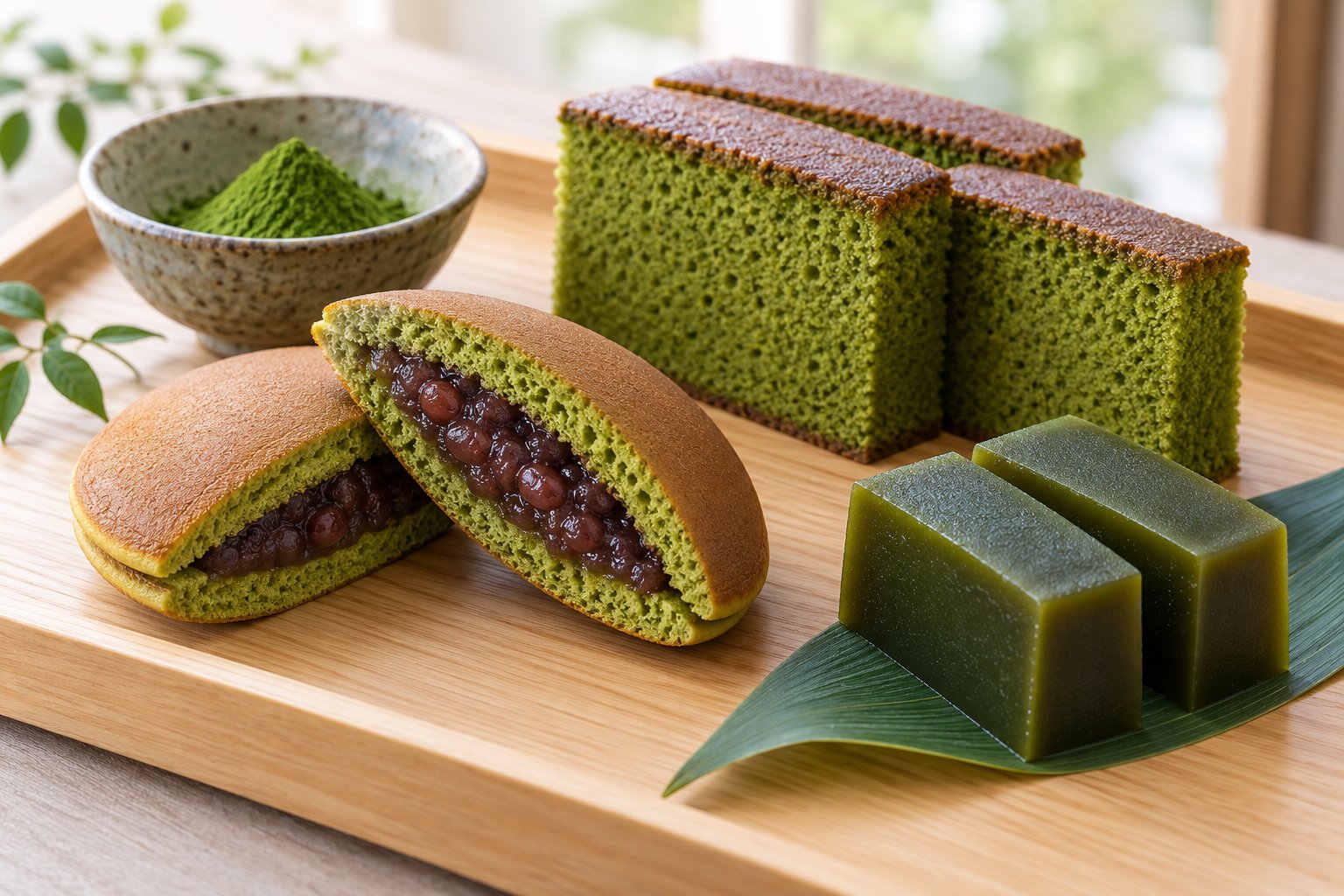
Matcha dorayaki, matcha castella and matcha yokan are Japanese sweets (wagashi) that cafés serving matcha lattes, and wagashi shops, can add using the same matcha. Dorayaki is two small pancakes sandwiching sweet bean paste (anko). Castella is a sponge cake from Nagasaki. Yokan is a block of bean paste set with agar (kanten, a seaweed gelling agent). The three are made differently: baked, baked and rested, or boiled and set. The amount of matcha and the shelf life differ a lot. We put official recipes from tea companies and a baking supply store, a Japanese confectionery hygiene guide and the official pages of long-established makers side by side, and look in turn at the amount of matcha, color, key steps, shelf life and grams of matcha per piece.
How the three matcha sweets differ: baked, rested, or boiled and set
Dorayaki is baked briefly, castella is baked for a long time and then rested, and yokan is bean paste and agar boiled and set. Because the heating differs, how well the matcha keeps its color and how long the sweet keeps also differ.
How each is made and heated
| Sweet | How it is made | Heating example in the hygiene guide |
|---|---|---|
| Dorayaki | Batter cooked on a griddle or frying pan, then sandwiched with anko | Pancakes at 190–200°C for just over 90 seconds |
| Castella | Batter of whipped eggs, sugar and flour baked in a mold in the oven | 200°C for 55–60 minutes |
| Neri yokan | Bean paste, sugar and agar boiled down, kneaded and set in a mold | Kneaded at about 105°C for 20–40 minutes |
| Canned mizu yokan | Filled into cans, seamed, then heated | 120°C for 4 minutes |
The heating examples come from a table in the “Guide to creating hygiene management plans for confectionery manufacturing based on HACCP principles,” written by Japanese confectionery industry bodies and checked by the Ministry of Health, Labour and Welfare (below, the confectionery hygiene guide). HACCP is a method of finding and controlling hazards such as food poisoning at each step of production.
Where the matcha goes
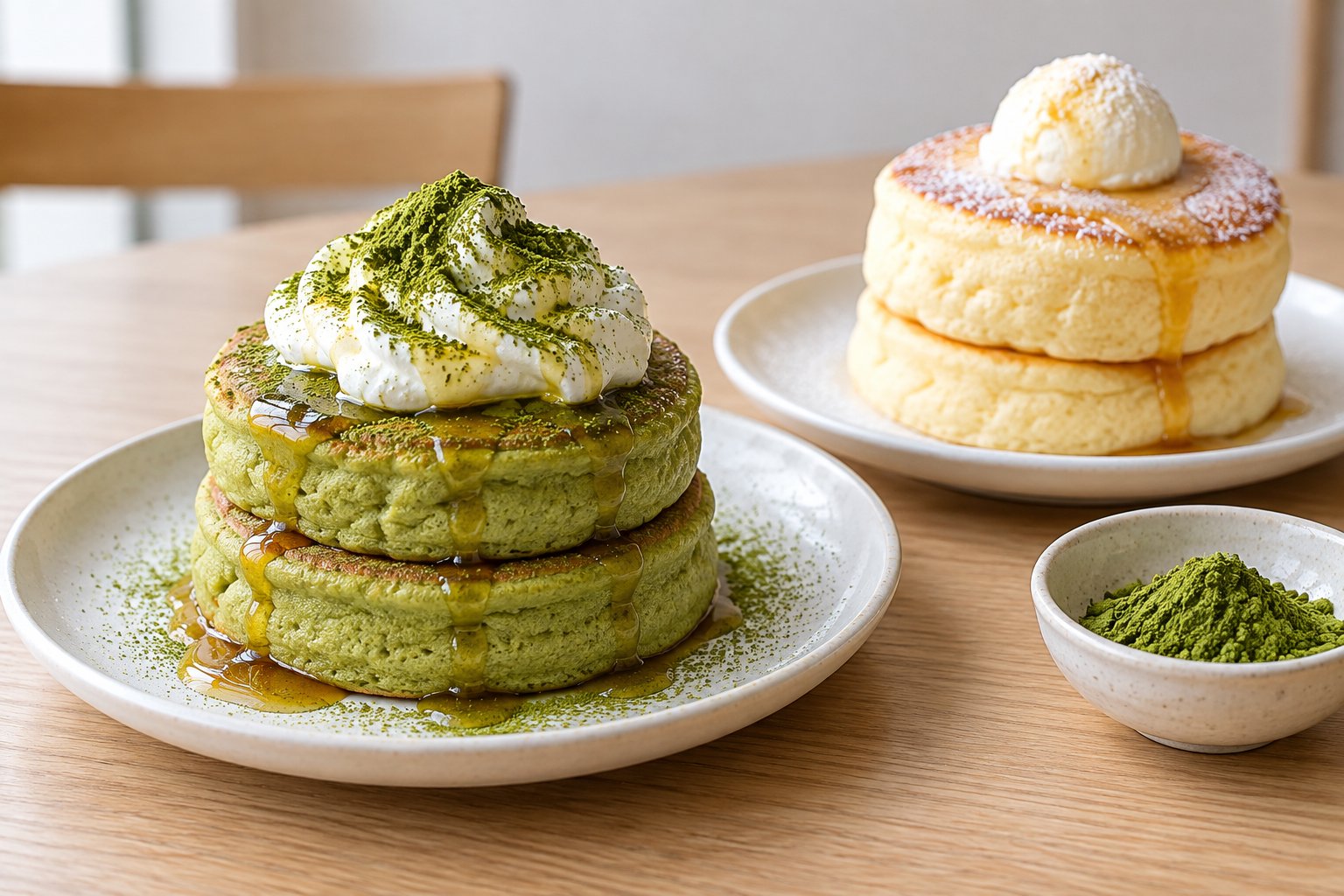
In dorayaki it goes into the pancakes and the bean paste, in castella into the batter, and in yokan into the bean paste. Dorayaki can have matcha in the pancakes and be filled with matcha bean paste, so count the matcha in both. Matcha mochi (daifuku and warabi mochi) is covered in Matcha Mochi for Cafés, and agar jelly in Matcha Jelly.
Comparing the amount of matcha in official recipes
In official recipes that give matcha in grams, dorayaki pancakes used 2–9% of the cake flour, castella about 6–17% of the flour, and yokan about 0.2–0.6% of all ingredients. Baked sweets are measured against the flour, while yokan is measured against the whole mix including water and bean paste, so the yokan figure looks small.
Dorayaki (matcha to flour)
| Source | Matcha | Flour | Matcha to flour | Number |
|---|---|---|---|---|
| Tomizawa Shoten, “Rich matcha dorayaki” | 3–5g (2 tsp) | 55g cake flour | about 5.5–9.1% | 4 (7–8cm) |
| Tomizawa Shoten, “Matcha torayaki” | 2g | 80g cake flour | 2.5% | about 10 |
| Tomizawa Shoten, “Matcha torayaki with white bean paste” | 2g | 100g cake flour | 2.0% | 5 |
Tomizawa Shoten is a Japanese baking supply store. Its rich matcha dorayaki recipe says that 5g gives a bitter result, and to adjust to taste from 3g. Torayaki is a dorayaki with a tiger-stripe pattern browned onto the surface.
Castella (matcha to flour)
| Source | Matcha | Flour | Matcha to flour | Mold |
|---|---|---|---|---|
| Tomizawa Shoten, “Matcha and dainagon bean castella” | 5g | 90g bread flour | about 5.6% | 15cm square |
| Ito En, “Matcha Taiwanese castella” | 10g | 60g cake flour | about 17% | 15cm square |
Taiwanese castella is a fluffy cake baked in a water bath (Ito En’s recipe bakes at 140°C for 60–70 minutes), and is baked differently from Nagasaki castella. It uses little flour, so the matcha ratio to flour is high. The steps of Ito En’s recipe are in How to Choose Matcha for Baking.
Yokan (matcha to all ingredients)
| Source | Matcha | Ingredients | Matcha to total | Yield |
|---|---|---|---|---|
| Tomizawa Shoten, “Matcha mizu yokan” | 2.5g | 150g white bean paste, 200g hot water, 120g water, 2g agar powder | about 0.53% (about 1.7% to the bean paste) | 6 cups of 115cc |
| Tomizawa Shoten, “Chestnut matcha yokan”, dark matcha layer | 2g | 2g agar powder, 80g granulated sugar, 80g water, 160g white bean paste | about 0.62% | part of one mold |
| Same, light matcha layer | 0.5g | Same | about 0.16% | Same |
The ratios are our calculation: the weight of matcha divided by the total of the ingredients in the table. The chestnut matcha yokan uses the same mix with 2g and 0.5g of matcha to make a dark green and a light green yokan, combined in one bar. It shows that the amount of matcha sets the depth of color.
What the tables show
Castella at about 6–17% and the stronger dorayaki at about 9% are higher than official recipes for matcha bread (about 1–3% of the flour). Yokan at about 0.2–0.6% comes out lower than official recipes for matcha jelly (about 0.8–2.4% of the liquid). Water, sugar and bean paste make up most of the weight of yokan, so the ratio to the whole is small.
Many recipes give matcha in teaspoons or tablespoons. A matcha dorayaki recipe from AIYA America, a US matcha company, also lists “cake flour 1 cup” and “Matcha powder 1 Tbsp” by volume. In a shop, weigh the matcha in grams too, and fix a step where it is sifted in together with the flour (our suggestion).
Matcha dorayaki: rest the batter and set the browning with the heat
Cook dorayaki pancakes over heat that is not too strong until bubbles appear on top, then flip and cook the other side briefly. Too much heat browns the whole surface and hides the matcha green.
Making the batter
Tomizawa Shoten’s rich matcha dorayaki combines cake flour, matcha and baking powder, and sifts the matcha on its own first if it has lumps. Eggs and granulated sugar are mixed until thick, honey dissolved in lukewarm water is added, and then the dry ingredients are sifted in. The water is adjusted so that a trail of batter dropped from a spoon disappears smoothly.
The matcha torayaki sifts in the flour and matcha, mixes quickly, covers the bowl with plastic wrap and rests it in the fridge for 15 minutes or more. The torayaki with white bean paste rests for 30 minutes at room temperature.
Heat and browning
The torayaki recipe heats the frying pan, turns it to a strong low heat, pours about 1 tablespoon of batter, flips it when bubbles appear, and takes it out after 15–20 seconds when it puffs up. It says that with too little heat the pattern is faint, and with too much the whole surface turns brown. It also warns that overcooking loses the moist texture. The rich matcha dorayaki also cooks the second side for about 10 seconds.
Browning comes from a reaction between sugars and amino acids in the batter. Matcha green turns olive with heat, so the darker the browning, the more the green is hidden. Pan temperature and color are also compared in Matcha Pancakes.
Pancakes made ahead
The torayaki recipe says to cool them and put them in bags so they do not dry out before handing them over. It says they keep for about 2–3 days at a cool room temperature, but the matcha color looks best on the day they are made. In a shop, cook only the pancakes you will fill that day, and bag or box them as soon as they cool so they do not dry out (our suggestion).
Matcha castella: wrap and rest it after baking
Castella becomes moist when it is wrapped and rested after baking. A long-established Nagasaki maker also rests its castella for a full day and night after baking before packing it.
Baking
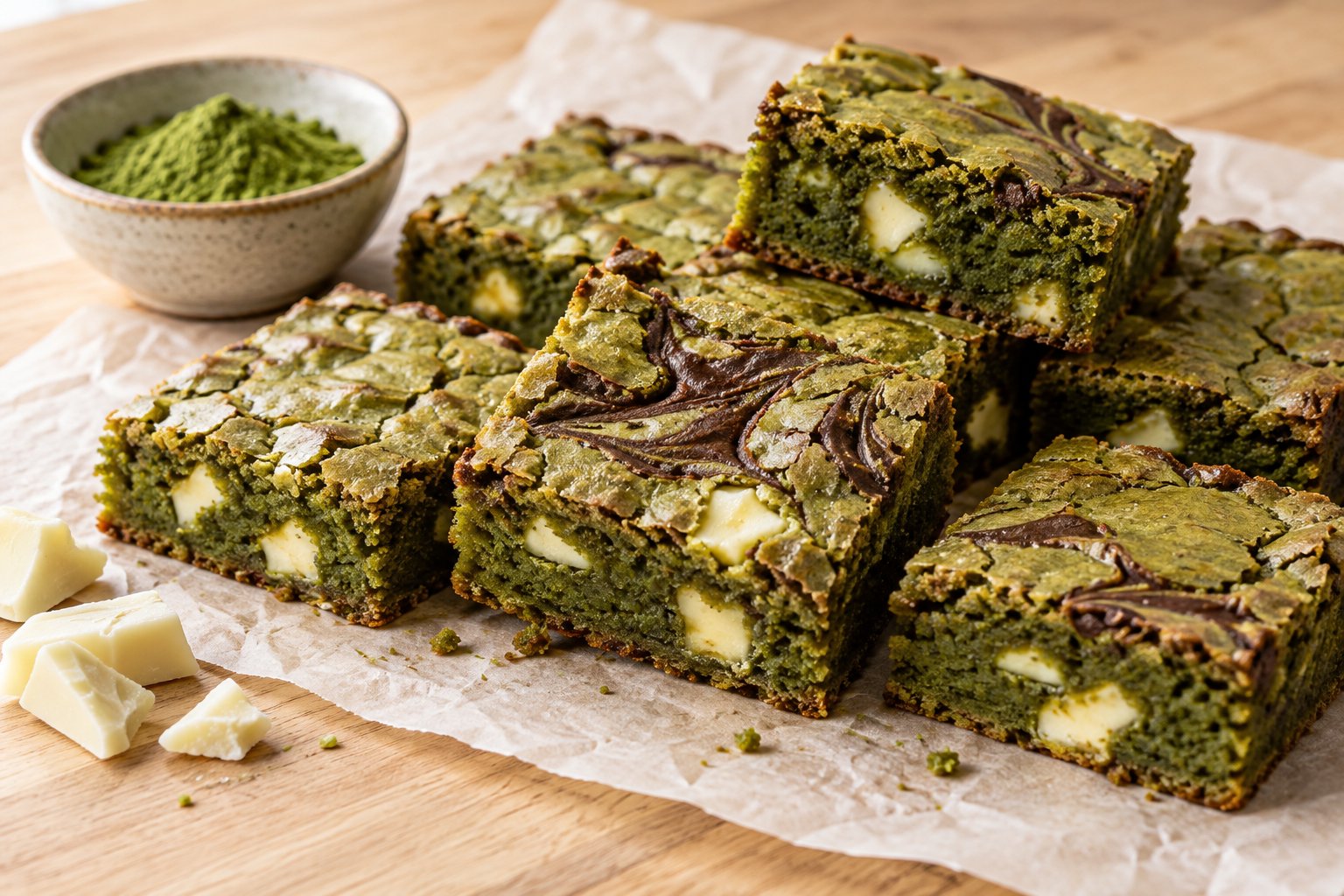
Tomizawa Shoten’s matcha and dainagon bean castella sifts bread flour and matcha together, whips eggs and sugar while warming them over hot water to about 40°C, and adds honey, oil and mirin warmed to 30°C. It bakes in a 15cm square mold at 180°C for 15 minutes, then at 160°C for 35 minutes. The same store’s hojicha castella bakes at 180°C for 1 minute, mists the surface with water and runs a bamboo skewer through to remove bubbles before baking on, and covers the top with foil once it has browned.
Castella bakes for a long time, so the matcha in the batter is heated for tens of minutes (dorayaki pancakes take just over 90 seconds in the guide’s example). Why matcha green changes with heat is covered in How to Choose Matcha for Baking.
Resting time
| Source | After baking |
|---|---|
| Tomizawa Shoten, “Matcha and dainagon bean castella” | Cover with plastic wrap while warm, turn out of the mold and wrap the whole cake. Rest overnight in the fridge once cool |
| Tomizawa Shoten, “Hojicha castella” | Cover the top with plastic wrap, turn upside down, put in a bag and leave for 2 days |
| Fukusaya (an old Nagasaki maker) | Place on boards and mature for a full day and night in a storeroom with controlled temperature and humidity, then pack |
Fukusaya explains that this resting brings out sweetness and richness, and goes as far as saying that freshly baked castella is not good to eat. In a shop, bake and wrap the castella by the day before you sell it, and slice and serve it from the day after resting (our suggestion).
Slicing changes the hygiene category
The confectionery hygiene guide points out that the same castella falls into category 2 if it is cut by machine after baking, but category 3 (sweets with hand work after heating) if a person cuts it with a knife. Castella sliced piece by piece in a café should be treated as a sweet with hand work. Keep knives and boards clean and do not touch the cake with bare hands when slicing.
Matcha yokan: dissolve the agar, cool before pouring
For yokan, dissolve the agar fully in water before adding sugar and bean paste, and work a small amount of matcha into a paste before mixing it in. Mizu yokan is less likely to split into two layers if it is cooled a little before pouring.
Neri yokan and mizu yokan
Neri yokan is yokan made by boiling bean paste, sugar and agar for a long time to drive off water. Toraya explains that it kneads its yokan for 1 hour, including time cooked above 100°C. Mizu yokan is a soft yokan with more water. The “Our Regional Cuisines” site of the Ministry of Agriculture, Forestry and Fisheries (MAFF) introduces “decchi yokan,” a mizu yokan from Fukui Prefecture, made with 8g of kaku kanten (agar stick), 5 to 5½ cups of water and 150g of koshi-an (smooth bean paste).
Setting with agar
Tomizawa Shoten’s matcha mizu yokan is made in this order:
- Work sifted matcha into the white bean paste (doing it here stops the matcha forming lumps)
- Add the hot water little by little and mix
- Sprinkle agar powder into the water and heat over medium heat for 1–2 minutes while stirring. Once it boils, lower the heat to a gentle boil
- Turn off the heat and add the mixture from steps 1 and 2 little by little
- Stir with the bowl set in water to cool it a little, pour into cups and set in the fridge
The chestnut matcha yokan mixes the matcha with sugar, makes a paste with boiling water, and adds it to the agar mix after the bean paste has dissolved and the heat is off. In both, the matcha goes in after the agar is fully dissolved, and is not boiled for long.
Preventing two layers and weeping
Tomizawa Shoten’s recipe says that pouring while hot tends to form layers as it sets, and that agar sets at room temperature, so take care not to cool it too far. Imuraya’s mizu yokan recipe also strains the mix while warm, stirs it slowly to cool, pours it into a container, cools it for about 20 minutes at room temperature, and chills it in the fridge for about 2 hours once it has set a little.
Water that seeps out of set agar over time is called weeping (syneresis). Studies on how sugar and cooling affect weeping are covered in Matcha Jelly. Toraya also explains that once yokan is past its best-before date, the agar’s ability to hold water weakens over time and syrup spreads over the surface.
Keeping the matcha color
Matcha green fades with heat, light and time. The main points where color is lost are browning for dorayaki, long baking for castella, and showcase lighting and days on display for yokan.
Where each sweet loses color
| Sweet | When color fades | What official sources say |
|---|---|---|
| Dorayaki | Strong heat, time after making | Too much heat browns the whole surface; the matcha color looks best on the day (Tomizawa Shoten) |
| Castella | Long baking, browning on top and bottom | Cover with foil once browned (Tomizawa Shoten) |
| Yokan | Long display in a lit showcase | Matcha fades in light, and the same applies when used in sweets (Yamamasa Koyamaen) |
Yamamasa Koyamaen, a tea company in Kyoto, explains that matcha can turn reddish when heated and fades in light. How matcha powder changes color in storage is covered in Matcha Color.
What a shop can do (our suggestions)
- Keep dorayaki browning light, and show matcha green through the bean paste too
- For castella, compare the cut face with a reference photo, and keep the baking time and temperature fixed once set
- For yokan, avoid direct sun and strong lights in the showcase, and display only what was made that day
- Make one test batch with each new lot of matcha using the same recipe, and check the color before use
Shelf life and the hygiene guide’s categories
Water and sugar content have a large effect on how long the three sweets keep. In the confectionery hygiene guide’s table, mizu yokan is in the water range where bacteria can be active, and neri yokan and castella are below it.
Water activity of the three sweets
Water activity is a number from 0 to 1 showing the share of water in a food that microbes can use. The guide says that below 0.86 bacteria generally cannot be active, and below 0.80 ordinary molds cannot either.
| Sweet (guide’s table) | Water (%) | Water activity |
|---|---|---|
| Mizu yokan (4 samples, incl. canned) | 48.76–52.73 | 0.945–0.962 |
| Castella | 28.60 | 0.840 |
| Neri yokan (2 samples) | 26.02–28.66 | 0.799–0.822 |
Source: All Nippon Kashi Association and others, “HACCPの考え方を取り入れた菓子製造業における衛生管理計画作成の手引書” (Guide to hygiene management plans for confectionery manufacturing based on HACCP principles, checked by the Ministry of Health, Labour and Welfare, revised 4 June 2024, in Japanese), reference material 6, p. 25 https://www.mhlw.go.jp/content/11130500/000478404.pdf
The guide says that neri yokan has about 26–30% water, but sugar and starch syrup make up about 60% of its weight, so its water activity is about 0.80–0.85. Food poisoning bacteria do not multiply easily, but mold may grow. In the table, castella is 0.840 and mizu yokan 0.945–0.962.
Best-before dates of neri yokan
Neri yokan packed in a factory keeps for a long time. Toraya’s yokan (including “Shinmidori,” which contains matcha) has a best-before date of 1 year from manufacture. Nakamura Tokichi Honten’s small matcha yokan has 18 months.
Source: Toraya, “羊羹の賞味期限” (Best-before dates of yokan, in Japanese) https://www.toraya-group.co.jp/products/best_before_date
Toraya also says that once opened and exposed to air, sugar may recrystallize or mold may appear within a week. At the same company, matcha mizu yokan is set at 120 days from manufacture, shorter than neri yokan. Both are figures for products made and packed in a factory, and do not apply to yokan sliced in a shop or mizu yokan poured into cups.
Dorayaki involves a lot of hand work
The guide places sweets that are not heated or heated at a low level in category 5, and gives dorayaki pancakes as an example. It says that of 81 confectionery food poisoning cases from 2000 to 2017, the 6 in category 5 were sakura mochi, dorayaki and crepes, all involving hand work after low heat cooking. Its table of cases includes dorayaki in Kagoshima city in 2000 (Staphylococcus, 61 patients) and dorayaki in Osaka city in 2009 (same, 3 patients). Touching the pancakes by hand to fill them calls for thorough handwashing, gloves and sanitized tools. How the guide treats crepes is covered in Matcha Crepes.
Storage in cafés in hot countries
Where it is hot all year, as in Singapore or Bangkok, keep mizu yokan and dorayaki made in the shop chilled, set a number of days and label them with a date. Use neri yokan up quickly once it is cut or opened.
Fukui’s mizu yokan is eaten in winter
MAFF introduces decchi yokan from Fukui as a mizu yokan eaten in winter. It says it has less adzuki and sugar than ordinary yokan, and is also said to have come to be eaten in winter, when a low sugar content is not a problem. In Singapore and Bangkok, the monthly average temperature is above 25°C all year (the weather service figures are in Matcha Shelf Life).
Official rules and shop guidelines
| Source | What it says |
|---|---|
| Confectionery hygiene guide | Bacillus cereus multiplies readily in grain-based foods at around 30°C, so after heating do not leave food at room temperature for long; chill it promptly. Set dates based on tests and similar evidence |
| US FDA, “Food Code 2026” | Refrigerated ready-to-eat food made on site and held for more than 24 hours: 5°C or below for up to 7 days. Count the day of preparation as Day 1 and date-mark it |
| Tomizawa Shoten, “Chestnut matcha yokan” | About 1 week in the fridge (depends on storage, so eat early) |
| Tomizawa Shoten, “Matcha torayaki” | About 2–3 days at a cool room temperature; the matcha color is best on the day |
| Sweet | Shop guideline (our suggestion) |
|---|---|
| Mizu yokan (cups) | Keep chilled, set a number of days shorter than the FDA limit and date-mark |
| Neri yokan (sliced in the shop) | Wrap the cut face in plastic wrap, chill and use within a few days |
| Castella | After resting, keep wrapped in a cool place or the fridge. Wrap slices so they do not dry out |
| Dorayaki | Wrap as soon as cool, and fill only what you will sell that day. Chill in a hot shop |
Matcha powder itself is also sensitive to heat and humidity, so decide where to keep opened bags using Matcha Shelf Life.
Matcha per piece and per slice, and the matcha cost
Work out the matcha cost per piece as buying price per kg ÷ 1,000 × grams of matcha per piece. Calculated from official recipes, the pancakes of one dorayaki held about 0.2–1.25g, one slice of castella about 0.6–1.1g, and one cup of mizu yokan about 0.4g.
Matcha in one piece or slice
| Item | Matcha per batch | Number | Per piece or slice (our calculation) |
|---|---|---|---|
| Rich matcha dorayaki (Tomizawa Shoten) | 3–5g | 4 | about 0.75–1.25g |
| Matcha torayaki with white bean paste (Tomizawa Shoten) | 2g | 5 | about 0.4g |
| Matcha torayaki (Tomizawa Shoten) | 2g | about 10 | about 0.2g (matcha bean paste not included) |
| Matcha and dainagon bean castella (Tomizawa Shoten) | 5g | 9 slices (assumed) | about 0.56g |
| Matcha Taiwanese castella (Ito En) | 10g | 9 slices (assumed) | about 1.1g |
| Matcha mizu yokan (Tomizawa Shoten) | 2.5g | 6 cups | about 0.42g |
Cutting castella into 9 is our assumption. The torayaki uses about 20g of matcha bean paste per piece, but the recipe does not say how much matcha is in the store-bought matcha bean paste, so only the pancakes are counted. If you make matcha bean paste in the shop, add the matcha in the paste to each piece too.
How to calculate
For example, rich matcha dorayaki made with 5g of matcha costs “buying price per kg ÷ 1,000 × 1.25” in matcha per piece. Compared with the matcha in one matcha latte (3g in Ippodo Tea’s recipe), one piece of dorayaki, castella or mizu yokan used half or less. Include flour, eggs, bean paste, sugar, agar, packaging and anything thrown away unsold in the cost. How the buying price per kg is set is covered in Matcha Price.
Grades to match and test batches
The batters of dorayaki and castella change color and aroma with heat, while yokan is heated briefly and its color is easy to see. Grade names and differences are on Matcha grades. Make the candidate matcha in your own recipe, and photograph the color just after making and the next day under the same light. Comparing these makes the choice easier (our suggestion).
Omakase Matcha supplies matcha from Uji, Yame, Shizuoka, Kagoshima and Miyazaki, with orders from 1kg and up to 3 samples. Request matcha for test batches from Samples, and see the differences between regions on Origins.
Sources
- Tomizawa Shoten, “濃い抹茶どら焼き” (Rich matcha dorayaki, in Japanese) https://tomiz.com/recipe/pro/detail/20220323123728
- Tomizawa Shoten, “抹茶のとら焼き” (Matcha torayaki, in Japanese) https://tomiz.com/recipe/pro/detail/20240423123933
- Tomizawa Shoten, “抹茶のトラ焼き~白粒あん~” (Matcha torayaki with white bean paste, in Japanese) https://tomiz.com/recipe/pro/detail/20250203142651
- Tomizawa Shoten, “抹茶と大納言のカステラ” (Matcha and dainagon bean castella, in Japanese) https://tomiz.com/recipe/pro/detail/20201222011642
- Tomizawa Shoten, “ほうじ茶カステラ 抹茶カステラ” (Hojicha castella, matcha castella, in Japanese) https://tomiz.com/recipe/pro/detail/20180419110307
- Tomizawa Shoten, “抹茶水羊羹” (Matcha mizu yokan, in Japanese) https://tomiz.com/recipe/pro/detail/20250625090903
- Tomizawa Shoten, “栗入り抹茶羊羹『木漏れ日』” (Chestnut matcha yokan “Komorebi”, in Japanese) https://tomiz.com/recipe/pro/detail/20220503153401
- Ito En, “お菓子研究家 福田淳子氏監修!抹茶台湾カステラ” (Matcha Taiwanese castella, in Japanese) https://www.itoen.jp/recipe/45856/
- Imuraya, “水ようかん” (Mizu yokan, in Japanese) https://www.imuraya.co.jp/recipe/azuki/vol14/
- AIYA America, “Matcha Dorayaki” https://aiya-america.com/matcha-dorayaki/
- Fukusaya, “福砂屋のカステラづくり” (How Fukusaya makes castella, in Japanese) https://www.fukusaya.co.jp/castella/make.html
- Toraya, “羊羹の賞味期限” (Best-before dates of yokan, in Japanese) https://www.toraya-group.co.jp/products/best_before_date
- Toraya, “小形羊羹 新緑” (Small yokan Shinmidori, in Japanese) https://www.toraya-group.co.jp/products/petite-shimmidori
- Toraya, “水羊羹 抹茶” (Mizu yokan, matcha, in Japanese) https://www.toraya-group.co.jp/products/mizuyokan-matcha
- Nakamura Tokichi Honten, “小柄ようかん[抹茶]” (Small yokan, matcha, in Japanese) https://tokichi.jp/products/yo3-m
- MAFF, “うちの郷土料理 でっち羊かん 福井県” (Our Regional Cuisines: decchi yokan, Fukui, in Japanese) https://www.maff.go.jp/j/keikaku/syokubunka/k_ryouri/search_menu/menu/decchi_youkan_fukui.html
- All Nippon Kashi Association and others, “HACCPの考え方を取り入れた菓子製造業における衛生管理計画作成の手引書” (Guide to hygiene management plans for confectionery manufacturing based on HACCP principles, checked by the Ministry of Health, Labour and Welfare, revised 4 June 2024, in Japanese) https://www.mhlw.go.jp/content/11130500/000478404.pdf
- US Food and Drug Administration, “FDA Food Code 2026” §3-501.17 https://www.fda.gov/food/fda-food-code/food-code-2026
- Yamamasa Koyamaen, “抹茶の取扱い” (Handling matcha, in Japanese) https://www.yamamasa-koyamaen.co.jp/matcha/basic/handling.html
- Ippodo Tea, “抹茶ラテ” (Matcha latte, in Japanese) https://www.ippodo-tea.co.jp/blogs/tea-recipe/19%E6%8A%B9%E8%8C%B6%E3%83%A9%E3%83%86