
 Reviewed by: Takahiro Sugiyama (CEO, meguri Inc.)
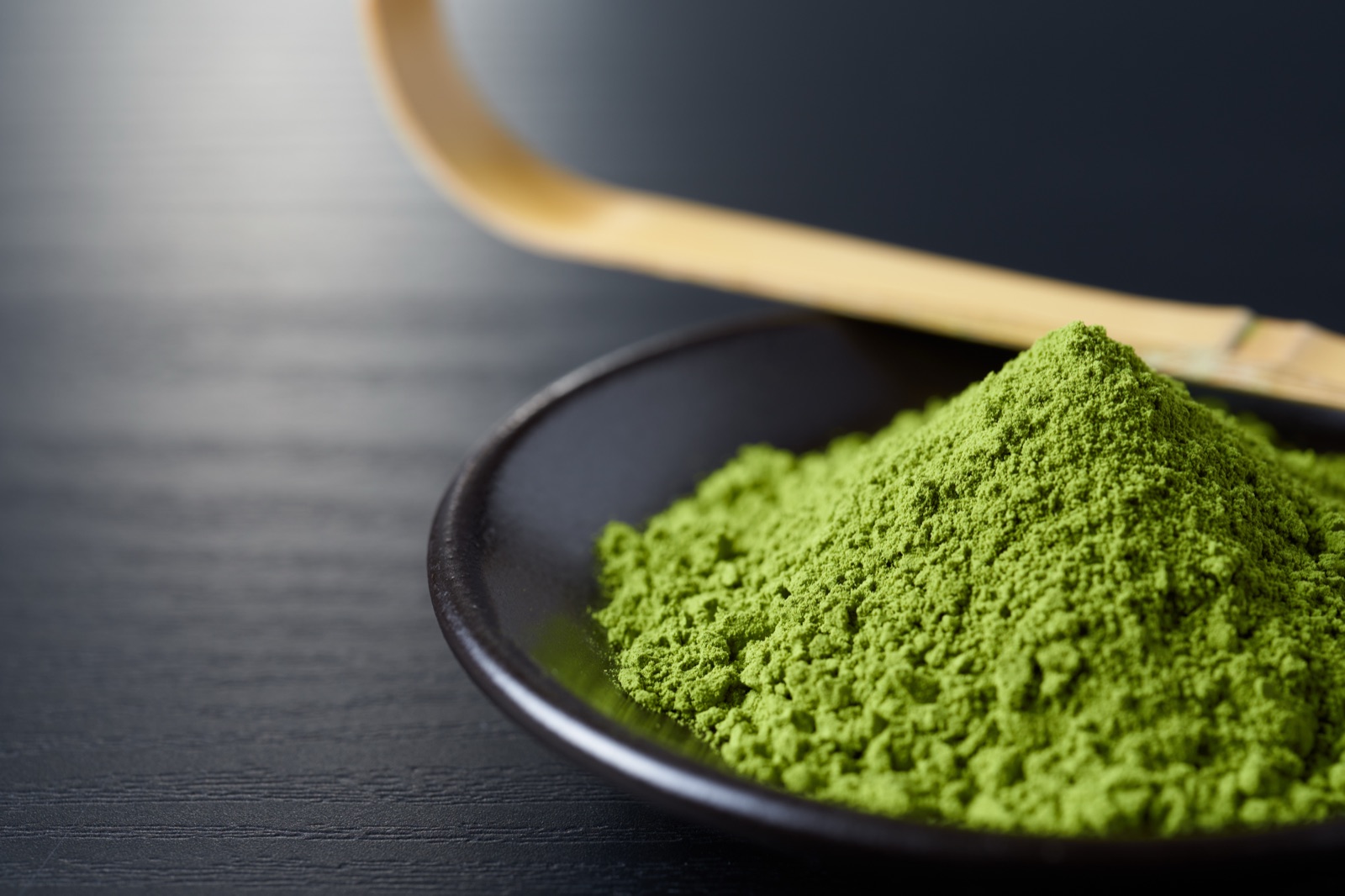
When you collect quotes for matcha from several suppliers, the price per kg can differ a lot. The differences come from what is inside the bag, such as the price of the raw material tencha (the tea leaves that matcha is made from), the harvest and the milling method, and from the costs of getting it from Japan to you. Using Japanese statistics and documents from public bodies, we checked how much each of these moves the price, and how to compare quotes.
What sets the price of matcha?
The price of matcha is made up of two things: what is inside the bag, and the cost of getting it to you. The contents are the tencha, the harvest, the milling method, the origin and so on. Getting it to you covers export, shipping and import taxes.
The cost of the contents
Of the contents, tencha is the part whose price is shown in public statistics. MAFF (Japan’s Ministry of Agriculture, Forestry and Fisheries) explains that tea prices differ greatly by type of tea and by harvest (which picking of the year the tea comes from), with differences in quality added on top.
The things that move the price of the contents are:
| Item | Effect on price |
|---|---|
| Whether the raw material is tencha | Tencha is shaded while it grows, so it costs more than sencha |
| Harvest | First flush is about twice the price of second flush (tencha, 2025 crop) |
| Milling | A stone mill at the tea merchant interviewed grinds about 40g an hour; the machine line at JA Kyoto Yamashiro makes about 150kg a day |
| Origin and cultivar | Specifying an origin or cultivar narrows the raw material you can choose from |
| Organic | Limited to raw material grown in organic JAS (Japan’s organic standard) tea fields |
We did not find public statistics showing price differences by origin, cultivar or organic status. This article focuses on tencha, harvest and milling, where numbers exist.
The cost of getting it to you
After the tea leaves a factory in Japan, export procedures, shipping, import duties and taxes in the destination country, and the margins of importers and wholesalers are added before it becomes a café’s buying price. Which of these costs the seller covers depends on the delivery terms in the quote.
Why tencha, the raw material, is expensive
For the 2025 crop, tencha traded at a national average of 8,562 yen per kg, about 4.9 times the price of sencha. It is a tea that takes extra work: it is shaded while it grows and dried in a dedicated oven.
Shaded while growing, dried without rolling
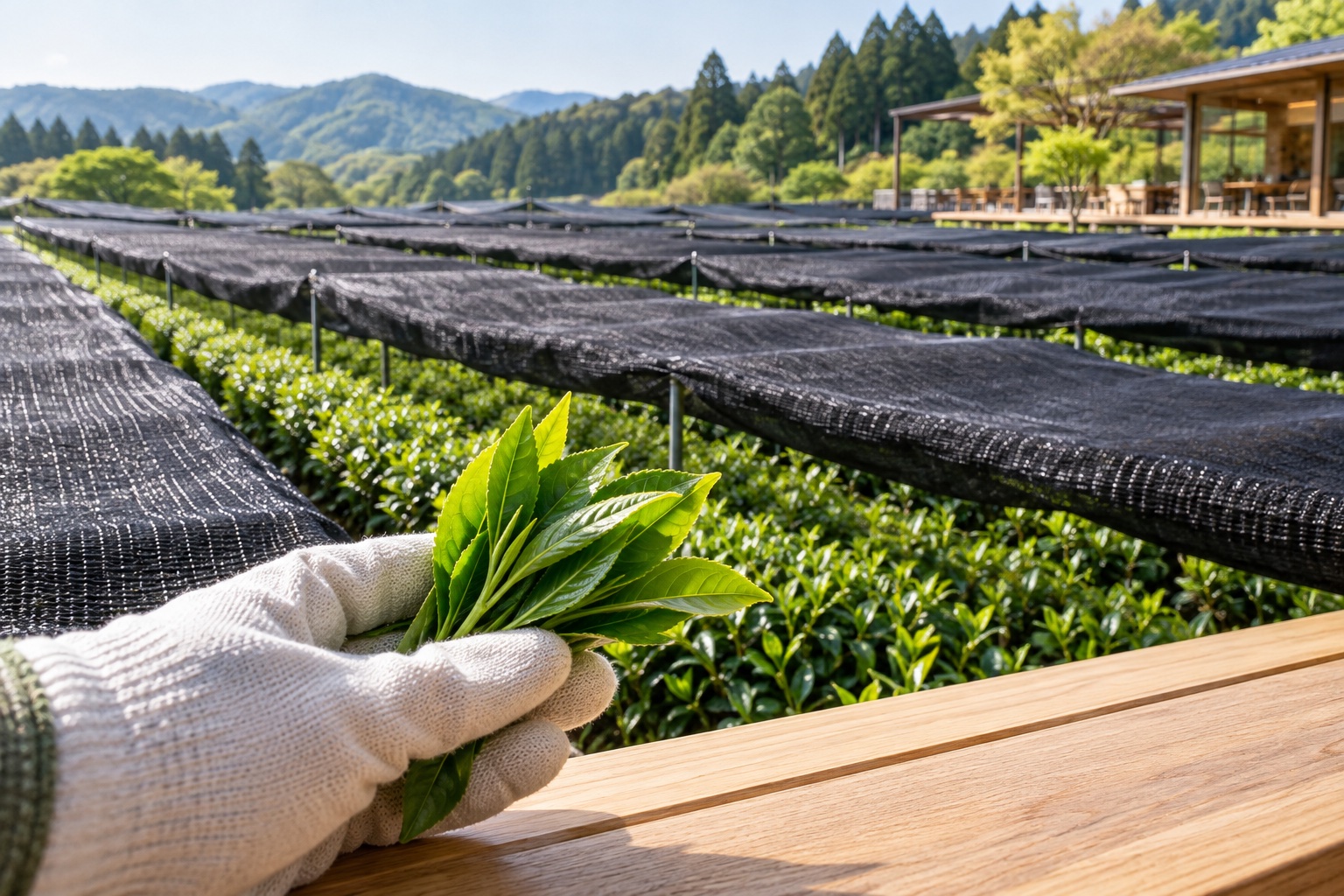
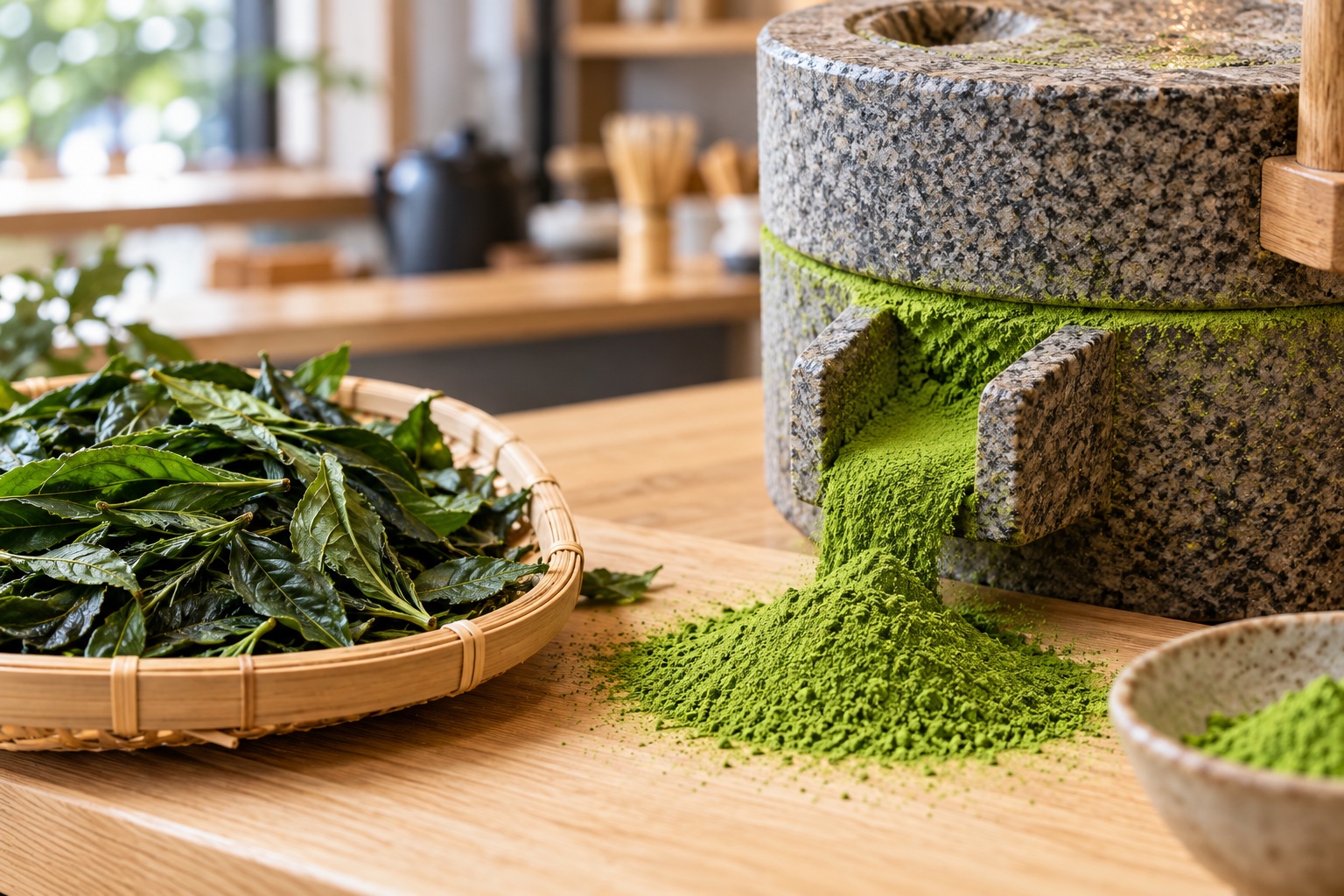
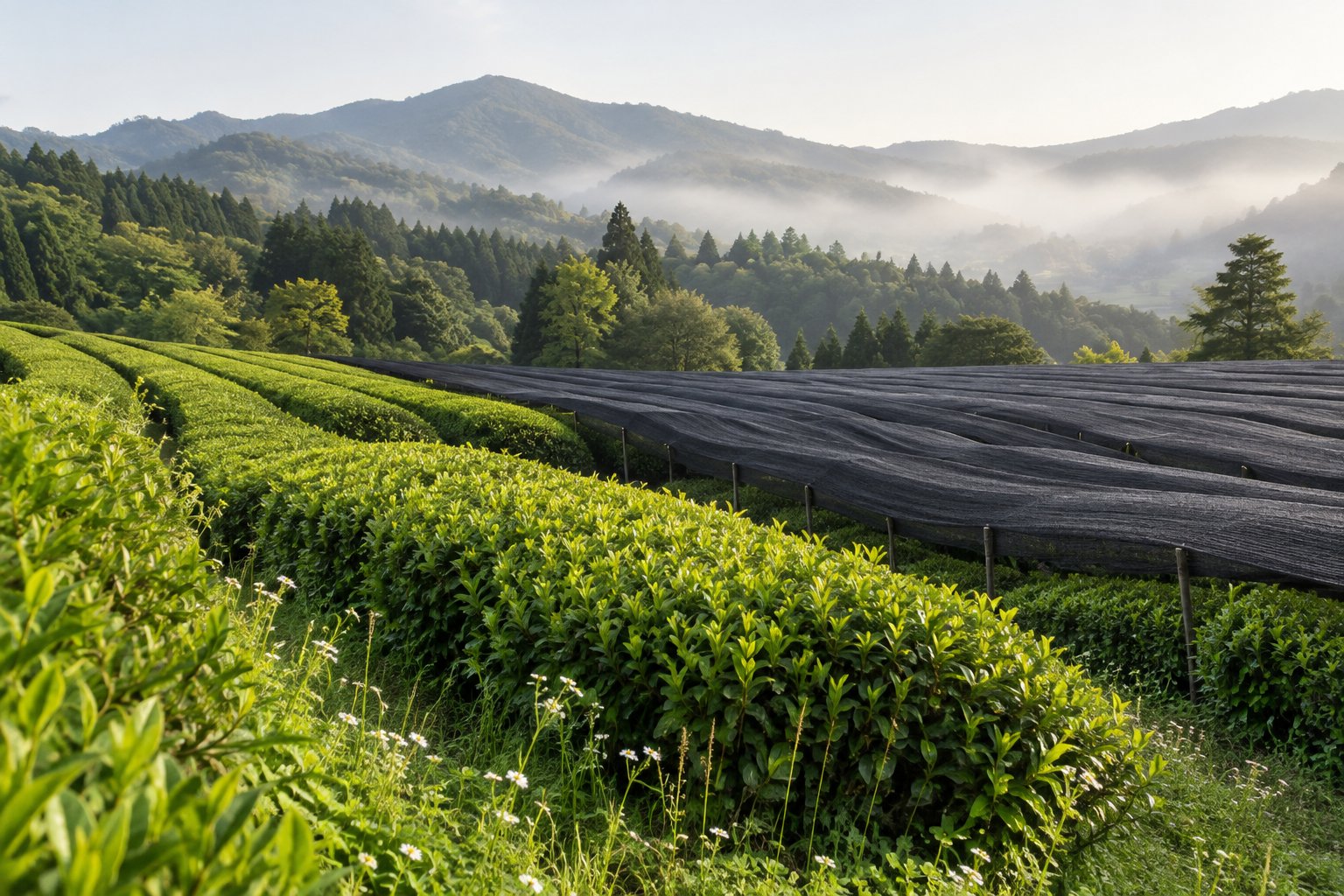
According to MAFF, tencha is made from leaves picked in tea fields shaded for about 2 to 3 weeks with reed screens or cheesecloth (kanreisha, a cloth that blocks sunlight). The leaves are steamed and then dried without rolling in a tencha oven (tencharo, an oven used only for drying tencha) or similar. Switching to tencha requires shading materials and a factory with a tencha oven.
Tencha production is rising. The 2025 crop was 6,278 tonnes, about 3.2 times the 2014 level, and made up 8.6% of crude tea production (aracha, tea that has been steamed and dried after picking, before finishing).
The harvest changes the price about twofold
The prices of crude tea for the 2025 crop, from MAFF’s document (survey by the National Federation of Tea Producers’ Associations), were:
| 2025 crop (Japan) | First flush | Second flush | Average of all harvests |
|---|---|---|---|
| Tencha | 10,030 yen | 4,950 yen | 8,562 yen |
| Sencha | 2,278 yen | 1,321 yen | 1,746 yen |
Prices are per kg.
Even for the same tencha, first flush costs about twice as much as second flush. The more first flush a matcha uses, the higher its cost at the raw material stage. How harvest affects taste is covered in Matcha grades.
From 2025, the price of the raw material itself rose. In the average trading prices at the JA Zen-Noh Kyoto tea market that Ippodo Tea published from Kyoto Prefecture Tea Industry Council data, first flush tencha used as matcha raw material went from 5,402 yen per kg in 2024 to 17,797 yen in 2026 (as of 19 June). The background is in Is There a Matcha Shortage?.
A stone mill grinds about 40g an hour
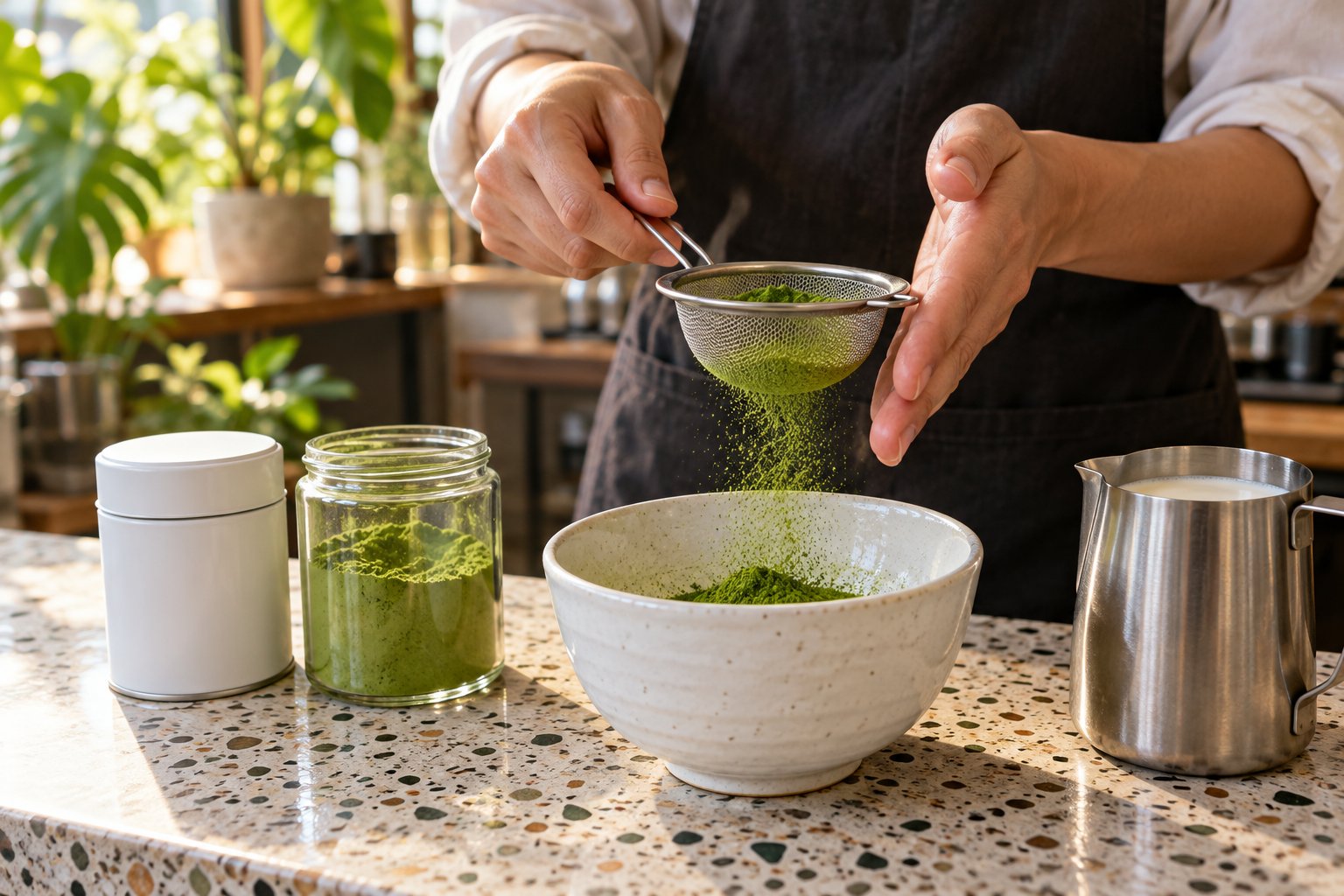
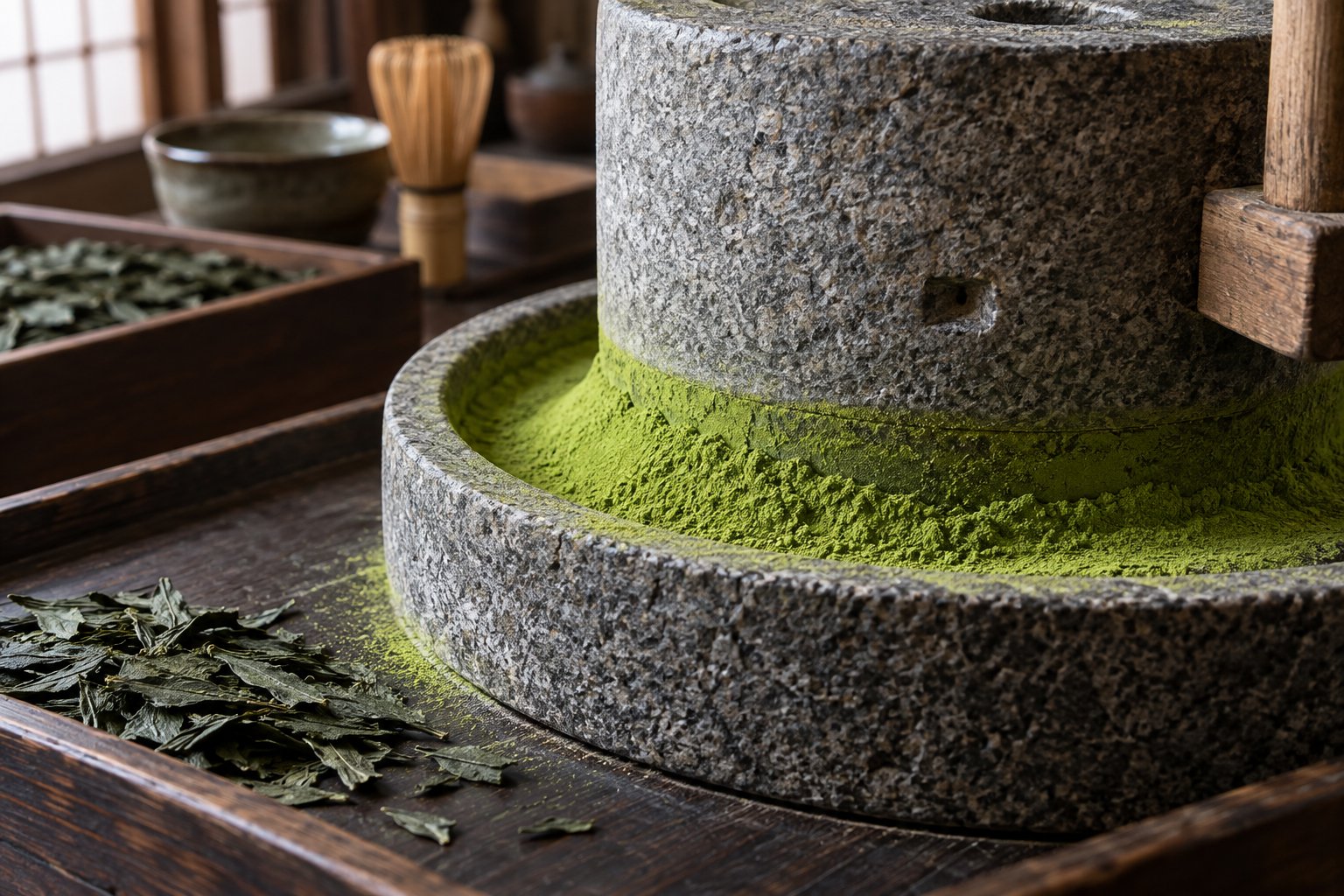
Stone-milled matcha can be made at only about 40g an hour per mill. The amount is very different from a machine line.
A tea merchant in Uji city, interviewed by MAFF’s Kinki Regional Agricultural Administration Office in March 2025, uses traditional tea mills (chausu, stone mills for grinding tencha) turning at 53 to 54 rotations a minute, and each mill grinds about 40g an hour. Eighty mills are now running day and night, but the company’s president said production cannot keep up and they are turning down orders.
In the same report, a processing facility of JA Kyoto Yamashiro in Ujitawara town makes about 150kg of matcha a day on an automated line using bead mill and air-flow grinding machines.
Source: Kinki Regional Agricultural Administration Office, “世界的な抹茶需要に応えるため!宇治茶の産地での取り組み” (Meeting world demand for matcha: efforts in the Uji tea growing area, in Japanese) https://www.maff.go.jp/kinki/tiiki/kyoto/250304_ujichaseichakoujou.html
Even if one mill ran for 24 hours straight, it would make about 960g (40g × 24 hours). Making 1kg of stone-milled matcha takes one mill more than a full day.
Under Japan’s labelling standard, tea ground by a machine with a function equivalent to a stone mill is also matcha, as long as the raw material is tencha. Machine-milled matcha is still matcha. Stone-milled matcha can only be made in limited amounts. The tea merchant interviewed also said its stone-milled matcha is recognised as a high-end product. If the matcha is for lattes, you can decide whether to specify the milling method after tasting samples with your own milk.
How much does Japan export matcha for?
The export unit price of powdered green tea, which includes matcha, rose from 4,629 yen per kg in 2022 to 9,971 yen in January to August 2026. It more than doubled in less than four years.
Export unit prices by year
Japan’s trade statistics have no category for matcha alone. In 2019, a category for green tea “in powder form” was created, and both matcha and powdered tea (tea ground into powder with a crusher or similar) fall into it. From the Japan Tea Export Council’s figures, the export unit prices per kg of powdered green tea are:
| Year | World | To the US | To Thailand | To Singapore |
|---|---|---|---|---|
| 2023 | 5,036 yen | 5,469 yen | 3,031 yen | 4,728 yen |
| 2024 | 5,341 yen | 5,823 yen | 3,642 yen | 6,248 yen |
| 2025 | 6,927 yen | 6,778 yen | 4,804 yen | 8,148 yen |
| January to August 2026 | 9,971 yen | 9,804 yen | 8,840 yen | 9,531 yen |
Prices are per kg. The world figure for 2022 was 4,629 yen (calculated as exports of 14.73 billion yen ÷ 3,183 tonnes).
Source: Japan Tea Export Council, “緑茶の国別・形状別輸出実績 2025年1〜12月” (Green tea exports by country and form, January to December 2025, in Japanese) https://nihon-cha.or.jp/export/wordpress/wp-content/uploads/2025-12_cha_export.pdf
The unit price of powdered green tea exported to Thailand rose about 2.9 times from 2023 to January to August 2026. Until 2025 it was lower than the world figure, but in January to August 2026 the gap with the world figure narrowed.
Do not use the export unit price as a market price
The export unit price is an average: export value divided by export volume. In MAFF’s document, the 2025 export unit price of powdered green tea, 6,927 yen, was about 2.3 times that of green tea in other forms (3,007 yen).
On the other hand, 6,927 yen is lower than the 2025 crop price of first flush tencha as crude tea (10,030 yen). The powder category also includes powdered tea, and it does not separate matcha by the harvest of its tencha. The year of export and the year the tencha was made are not necessarily the same either. The export unit price is a guide to how prices are moving, not a yardstick for deciding whether a particular matcha quote is high or low.
Taxes when importing
In Singapore, matcha has no import duty. In Thailand, the duty ranges from 0% to 90% depending on whether the shipment falls within the tariff quota. Who pays import taxes is set by the delivery terms in the quote.
| Singapore | Thailand | |
|---|---|---|
| Import duty | None (duty applies only to four categories: liquor, tobacco, motor vehicles and petroleum products) | 30% within the quota, 90% outside it. Exempt within the quota under the Japan-Thailand Economic Partnership Agreement (JTEPA) (JETRO, as of October 2024) |
| Tax on import | GST (Goods and Services Tax) 9% | VAT (Value Added Tax) 7% (rate until 30 September 2027) |
In Singapore, GST is charged on the total of the CIF value (cost of goods, freight and insurance), duties, and commission and other incidental charges. A GST-registered business listed as the importer on the import permit can claim back the GST it paid. The procedures are in How to Import Matcha into Singapore, and Thailand’s tariff quota and VAT in How to Import Matcha into Thailand.
When comparing quotes, use the same delivery terms. Under FOB (handed over at a Japanese port), DAP (delivered to your location) and DDP (the seller also pays duties and taxes), the same matcha will be quoted at different amounts. The differences between terms are in How to Buy Matcha Wholesale.
Turning the price per kg into a cost per cup
The matcha cost of one cup is the price per kg ÷ 1,000 × the grams used per cup. A difference that looks large per kg is easier to judge once it is turned into a cost per cup.
Using export unit prices
For reference, here are the export unit prices of powdered green tea, which includes matcha, converted into the matcha cost of a 3g cup. These are average prices at the point of export, so freight, taxes and wholesale margins are not included.
| Export unit price | Per kg | Per 3g |
|---|---|---|
| To Singapore (2025) | 8,148 yen | About 24 yen |
| To Thailand (January to August 2026) | 8,840 yen | About 27 yen |
| World (January to August 2026) | 9,971 yen | About 30 yen |
Before the matcha reaches a café, shipping, import taxes and wholesale margins are added. You can use this as a starting point when thinking about the share of matcha in the price of a cup.
Calculating with your own quotes
For each quote, work out the price per kg including the costs of getting it to you, then calculate the matcha cost per cup. An example for Singapore is in Where to Buy Matcha Powder in Singapore, and how to work back from latte recipes and menu prices is in How to Choose Matcha for Café Lattes.
The grams used per cup affect your cost as much as the price. For example, raising the same matcha from 3g to 4g per cup makes the matcha cost about 1.3 times higher.
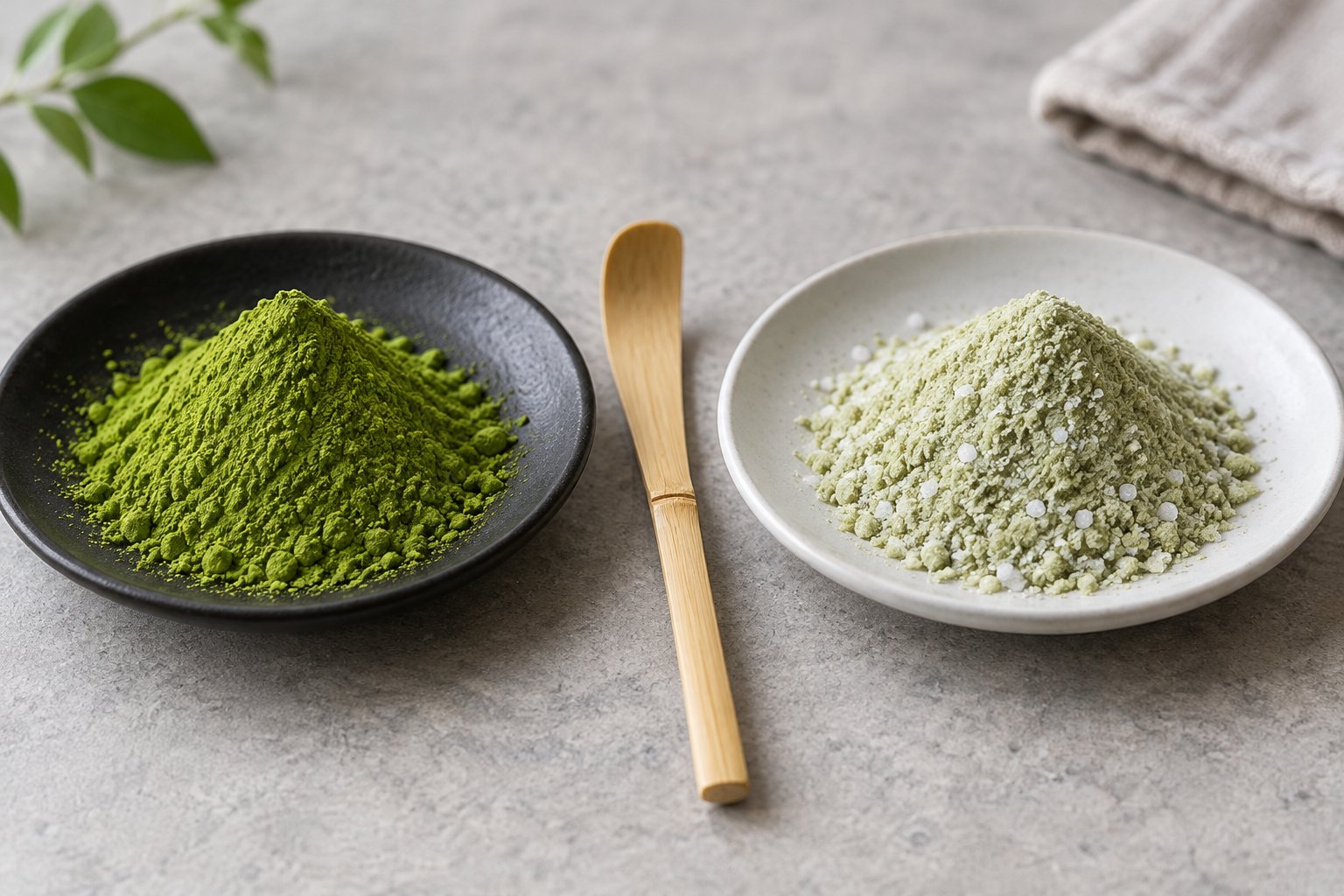
Why very cheap “matcha” may not be matcha
Under Japan’s labelling standard, only tencha ground with a tea mill or similar is matcha. A powder far cheaper than the market may differ in raw material or method.
The Green Tea Labelling Standard of the Japan Tea Central Public Interest Incorporated Association defines matcha as “tencha made into a fine powder with a tea mill or similar.” Powdered tea, made by grinding tea with a crusher or similar machine, is a different type of tea from matcha. Tencha made in autumn and similar tea is called “tencha for food processing,” and is used mainly as a raw material for processed foods.
Powders sold overseas under the same name “matcha” can include:
- Matcha ground from tencha (first flush, second flush or later, or blends)
- Powdered tea made by grinding sencha or other tea
- Latte mixes in which matcha or powdered tea is mixed with sugar, milk powder and so on
Just as the “powder form” category in export statistics contains both matcha and powdered tea, the name alone does not tell them apart. The difference between matcha and powdered tea, and how to read labels, are in Pure Matcha: What 100% Pure Matcha Powder Means. A NARO (National Agriculture and Food Research Organization) study found that more expensive Japanese matcha tended to contain more theanine, a type of amino acid. How to tell grades apart by their components is in Matcha grades.
What to check when comparing quotes
Compare quotes on cost per cup after lining up the conditions for the contents and for delivery. Putting prices per kg side by side does not show where the difference comes from.
Conditions for the contents
| Item | What to check |
|---|---|
| Raw material | Is it tencha? The ingredient list |
| Harvest | First flush only, or including second flush and later, and in what proportion |
| Origin and cultivar | The prefecture, and the breakdown if it is a blend |
| Milling | Stone mill or machine |
| Organic | Whether it is certified, such as organic JAS, and the certificate |
| Lot and documents | Lot number, certificate of analysis (COA), pesticide residue test results |
Delivery conditions and price reviews
| Item | What to check |
|---|---|
| Delivery terms | FOB, DAP or DDP. Who pays duties and import taxes |
| Minimum order and packaging | The smallest amount you can buy at a time, and the size of each bag |
| Price review | How long the price is valid. Whether it is reviewed after the next new tea season |
The price of matcha moves with that year’s trading price of tencha. Ippodo Tea has also announced price revisions for some products in October and November 2026 in response to 2026 crop trading prices. Agreeing your annual volume and when prices will be reviewed with your supplier before signing helps you prepare for sudden increases.
How Omakase Matcha works
Omakase Matcha sells matcha bought directly from the growing regions of Uji, Yame, Kagoshima, Shizuoka and Miyazaki, from 1kg. We deliver to Singapore on DDP terms and to Thailand and Indonesia on DAP terms, with payment in advance by Wise or PayPal. The character of each region is on Origins. If you want to taste before getting a quote, you can request samples of up to 3 types.
Sources
- MAFF, “茶をめぐる情勢(令和8年10月)” (The situation of tea, October 2026, in Japanese) https://www.maff.go.jp/j/seisan/tokusan/cha/attach/pdf/ocha-201.pdf
- Kinki Regional Agricultural Administration Office, “世界的な抹茶需要に応えるため!宇治茶の産地での取り組み” (Meeting world demand for matcha: efforts in the Uji tea growing area, interviewed March 2025, in Japanese) https://www.maff.go.jp/kinki/tiiki/kyoto/250304_ujichaseichakoujou.html
- Japan Tea Export Council, “緑茶の国別・形状別輸出実績 2023年1〜12月” (Green tea exports by country and form, January to December 2023, in Japanese) https://nihon-cha.or.jp/export/wordpress/wp-content/uploads/2023-12_cha_export.pdf
- Japan Tea Export Council, “緑茶の国別・形状別輸出実績 2024年1〜12月” (Green tea exports by country and form, January to December 2024, in Japanese) https://nihon-cha.or.jp/export/wordpress/wp-content/uploads/2024-12_cha_export.pdf
- Japan Tea Export Council, “緑茶の国別・形状別輸出実績 2025年1〜12月” (Green tea exports by country and form, January to December 2025, in Japanese) https://nihon-cha.or.jp/export/wordpress/wp-content/uploads/2025-12_cha_export.pdf
- Japan Tea Export Council, “緑茶の国別・形状別輸出実績 2026年1〜8月” (Green tea exports by country and form, January to August 2026, in Japanese) https://nihon-cha.or.jp/export/wordpress/wp-content/uploads/2026-08_cha_export.pdf
- Ippodo Tea, “2026年10月・11月 商品仕様の見直しと価格改定について” (Product specification changes and price revisions for October and November 2026, in Japanese) https://www.ippodo-tea.co.jp/blogs/news/20260901
- Japan Tea Central Public Interest Incorporated Association, “緑茶の表示基準” (Green Tea Labelling Standard, in Japanese) https://www.nihon-cha.or.jp/pdf/hyoujikijyun.pdf
- NARO, “国産抹茶の価格と化学成分含有量の関係” (Relationship between the price and chemical components of Japanese matcha, in Japanese) https://www.naro.go.jp/project/results/4th_laboratory/nifts/2018/nifts18_s16.html
- Singapore Customs, “Duties and Dutiable Goods Overview” https://www.customs.gov.sg/doing-business/valuation-duties-and-fees/duties-and-dutiable-goods/duties-and-dutiable-goods-overview/
- IRAS, “Current GST Rates” https://www.iras.gov.sg/taxes/goods-services-tax-(gst)/basics-of-gst/current-gst-rates
- IRAS, “Importing of Goods” https://www.iras.gov.sg/taxes/goods-services-tax-(gst)/claiming-gst-(input-tax)/importing-of-goods
- JETRO, “茶の輸入規制、輸入手続き(タイ)” (Import regulations and procedures for tea, Thailand, in Japanese) https://www.jetro.go.jp/world/asia/th/foods/exportguide/greentea.html
- The Revenue Department of Thailand, Press release 18/2569 (in Thai) https://www.rd.go.th/fileadmin/user_upload/news/2569thai/news18_2569.pdf