
 Reviewed by: Takahiro Sugiyama (CEO, meguri Inc.)
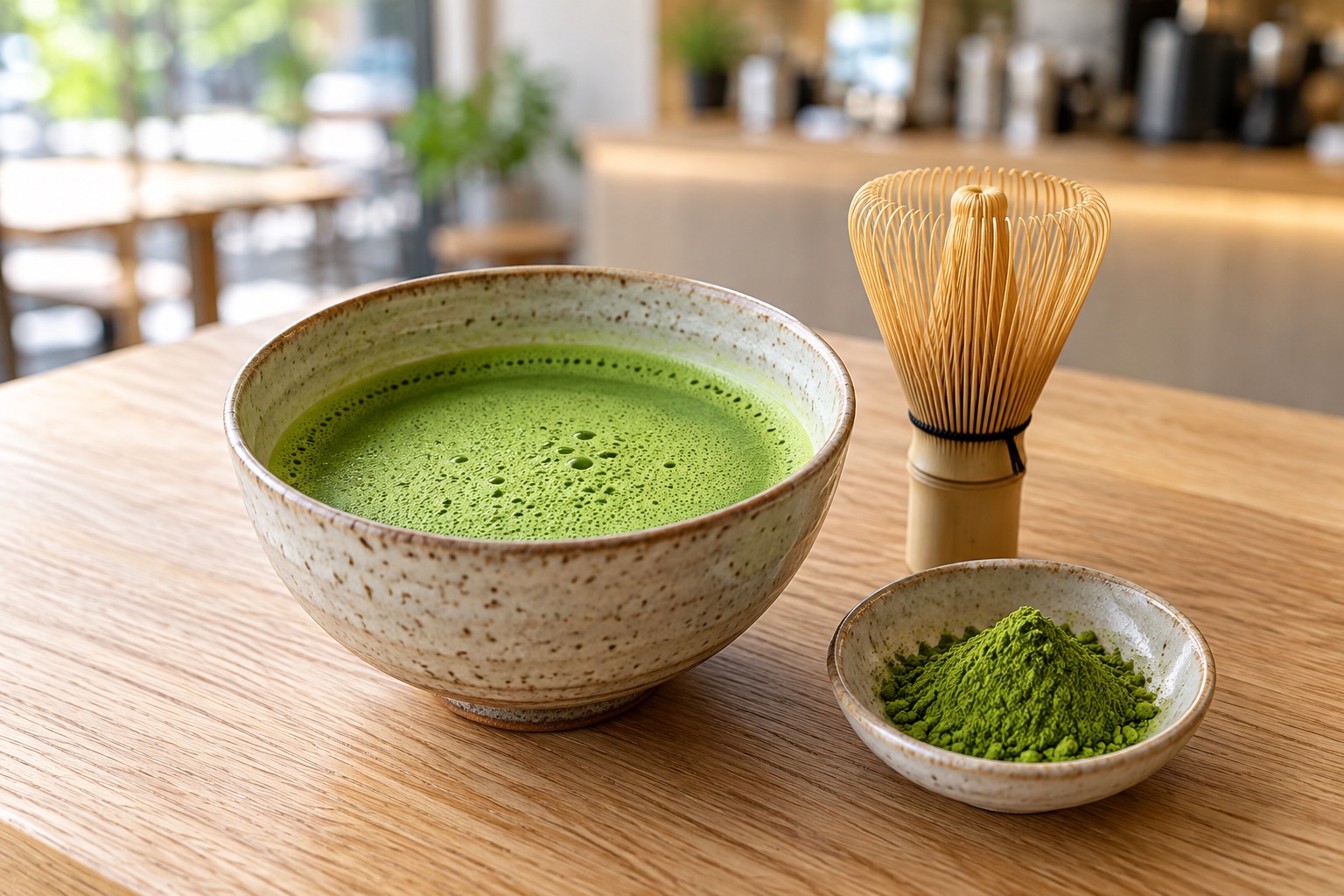
Cafés that serve matcha lattes are often asked, “Is matcha good for you?” In Indonesia many people search “manfaat matcha” (benefits of matcha), and in Thailand “มัทฉะ ประโยชน์” (matcha benefits). Yet most of the benefits you find online do not say what the research was or how strong it is. Below we check what official bodies and research actually say, then go country by country through what a shop can write on its menu and social media.
What is known about matcha’s health benefits
Even for green tea as a whole, most human health effects have no definite conclusion yet. Human trials of matcha alone are even fewer, and there is no basis for a shop to state that matcha “works”.
What official bodies say
The U.S. National Institutes of Health’s National Center for Complementary and Integrative Health (NCCIH) says that although many studies have been done on green tea and its extracts, definite conclusions cannot yet be reached on whether green tea is helpful for most of the purposes for which it is used. NCCIH describes the state of research as follows.
| Topic | What NCCIH says |
|---|---|
| Cancer | Overall results of studies on green tea consumption and cancer risk have been inconsistent |
| Heart | Linked to a lower risk of coronary heart disease in Asian populations but not in Western populations |
| Body weight | Catechins and caffeine may have a modest effect on body weight. Effects vary with product composition and physical activity |
| Cholesterol | Most studies used green tea extract supplements rather than the beverage. Total and LDL cholesterol fell to a small extent; HDL and triglycerides did not change |
Few studies on matcha itself
Matcha is drunk as whole ground leaves, so results for brewed green tea do not necessarily apply to it. A systematic review (a review that collects and evaluates studies by a set procedure) published in 2026 on matcha and green tea compounds and stress-related hormones points out that chemically different preparations, namely whole-leaf matcha, brewed green tea, isolated theanine and concentrated EGCG, are routinely treated as interchangeable. In this review, the certainty of evidence was “low” to “very low”.
Studies on focus and theanine are covered in matcha and caffeine.
What is in matcha
Because matcha is drunk as a whole powder, you take in everything in the grams you use. Calculating one cup from food composition tables gives a sense of the amounts.
Food table values and a 2g calculation
From the matcha values in Japan’s Standard Tables of Food Composition (MEXT), we calculated the amounts in 2g, one cup of usucha (thin matcha).
| Component | Per 100g of matcha | Per 2g (calculated) |
|---|---|---|
| Energy | 237kcal | about 4.7kcal |
| Dietary fibre | 38.5g | about 0.77g |
| β-carotene equivalents | 29,000µg | 580µg |
| Vitamin K | 2,900µg | 58µg |
| Vitamin C | 60mg | 1.2mg |
The tables list caffeine at 3.2g per 100g, which gives 64mg in 2g by calculation. Catechins and theanine are not items in the tables. The differences between matcha and sencha are compared in matcha vs green tea (sencha).
Where “137 times more catechins” comes from
The figure often seen in benefit articles, “matcha has 137 times the EGCG (a type of catechin) of green tea”, comes from an analytical chemistry paper published by a U.S. university in 2003. The paper states that the EGCG available from matcha was 137 times that of one brand of green tea, “China Green Tips”, and at least three times the largest literature value for other green teas. It did not study health effects, and it did not compare matcha with all green teas.
How strong the evidence is: heart, cancer and body weight
Cochrane reviews (systematic reviews that collect and assess medical research by a set procedure) also find only “limited evidence” for green tea. Even where studies give numbers, the number of trials and their length are limited.
Heart and cholesterol (Cochrane 2013)
The review combined 11 trials (821 participants) lasting at least three months, seven of them on green tea. With green tea, total cholesterol fell by 0.62mmol/L, LDL cholesterol by 0.64mmol/L and systolic blood pressure by 3.18mmHg.
On the other hand, few trials contributed, and the results were not stable when the analysis conditions were changed. No trial reported events such as heart attacks, and the authors say the results should be treated with some caution. Some trials used tea extracts.
Cancer (Cochrane 2020)
A review of 142 studies concluded that there is limited evidence that green tea lowers the risk of cancer overall or at specific sites. Results were inconsistent, and most studies were done in Asian populations who drink a lot of green tea, which limits how far the findings apply to other populations. Trials with high intakes of extracts also reported side effects such as gastrointestinal disorders and raised liver enzymes.
Body weight
NCCIH says catechins and caffeine may have a modest effect on body weight. It adds that the effect varies with product composition and physical activity, so this is not a basis for saying a matcha latte makes you lose weight.
Cautions: caffeine, extracts and the liver, medicines
The three things official bodies warn about are the amount of caffeine, green tea extract supplements and interactions with medicines. Green tea drunk as a beverage and concentrated extracts are treated separately.
Caffeine
EFSA says caffeine intakes up to 400mg a day for healthy adults, and up to 200mg a day for pregnant and breastfeeding women, do not raise safety concerns. Health Canada also gives up to 400mg a day for adults, and the U.S. Food and Drug Administration (FDA) cites 400mg a day for most adults. The caffeine in a cup of matcha and a comparison with coffee are in matcha and caffeine.
Green tea extracts and the liver (EFSA 2018)
In April 2018, following reports of liver damage, EFSA assessed the safety of green tea catechins. Its conclusions:
- Catechins from green tea brewed with hot water, and from instant and ready-to-drink green tea beverages with similar catechin content, are generally considered safe
- In food supplements, EGCG doses at or above 800mg a day may be associated with initial signs of liver damage
- Below 800mg a day, the experts could not identify a safe dose based on available data
The concern is about extracts in supplements, not brewed green tea. Matcha itself is not named in this assessment. Following this, the EU changed its rules in 2022: foods with added green tea extracts must contain less than 800mg of EGCG per daily portion, and the label must state the EGCG per portion and a warning. Aqueous green tea extracts whose composition, once made into a drink, is comparable to traditional green tea infusions are excluded.
Interactions with medicines
NCCIH explains that green tea at high doses reduces blood levels of nadolol, a beta-blocker used for high blood pressure and heart problems, and that green tea extract reduces blood levels of the cholesterol-lowering drug atorvastatin. An interaction with raloxifene, used to treat osteoporosis, has also been reported. If a customer who takes medicine asks, suggest they talk to their doctor or pharmacist.
Lead and other heavy metals in matcha, and the test documents to ask for, are covered in matcha and lead.
Singapore: claims of preventing disease or improving health are prohibited
Singapore’s Food Regulations prohibit labels and advertisements that suggest a food prevents or cures disease, or that health or an improved physical condition may be achieved by consuming it. Health claims can be used when a food meets the conditions of claims approved by the Health Promotion Board (HPB).
Source: Singapore Food Agency (SFA), “A Guide to Food Labelling and Advertisements”, p.54: “The use of claims for therapeutic or prophylactic action; claims which could be interpreted as advice of a medical nature from any person; claims that a food will prevent, alleviate or cure any disease or condition affecting the human body; and claims that health or an improved physical condition may be achieved by consuming any food, is prohibited.” https://www.sfa.gov.sg/docs/default-source/food-information/labelling-and-packaging-information/a-guide-to-food-labelling-and-advertisements.pdf
What the regulations say
Regulation 9 of the Food Regulations prohibits claims about a food’s nature, effects and so on that are false, misleading or deceptive, or likely to create an erroneous impression regarding its value or safety. Regulation 12 applies the same prohibitions to advertisements other than labels. The Sale of Food Act defines an “advertisement” as words, sound, pictures, signs and similar used to promote the sale of food.
Health claims that are allowed
According to the SFA guide, health claims come in three types: nutrient function claims, other function claims and reduction of disease risk claims, and they are under the purview of HPB. HPB says that if a product meets the criteria in its list of approved claims, no registration is required before using the claim.
When we checked the approved list in HPB’s guide (August 2024 edition), we found no claims with tea, catechins or polyphenols as the subject. The only antioxidant claims are for vitamin E. To use a claim not on the list, you apply to HPB for a new claim. New reduction of disease risk claims can only be used after they are gazetted in the Food Regulations.
Thailand: the 2026 advertising notification lists wording that is not allowed
On 27 July 2026, the Thai Food and Drug Administration (Thai FDA) published a new notification on food advertising in the Royal Gazette, listing wording that suggests treating or preventing disease, as well as detox, immunity and anti-ageing, as examples that are not allowed. Advertising that claims health effects or benefits needs approval in advance.
Structure of the notification
The notification “หลักเกณฑ์การโฆษณาอาหาร พ.ศ. 2569” (Criteria for food advertising, 2026) applies from the day after its publication in the Royal Gazette and replaces the 2021 notification. Section 40 of the Food Act prohibits false or deceptive advertising about a food’s benefits, quality or properties, and Section 41 requires approval before advertising for commercial purposes by broadcast, print and other means. The notification defines “food advertising” as any act that makes the public see or know a message about food for commercial benefit.
Examples of wording not allowed (Annex 1)
The examples in Article 5 and Annex 1 of the notification include words often seen in matcha benefit articles.
| Category | Examples in Annex 1 |
|---|---|
| Treating or preventing disease | lowers cholesterol, lowers blood pressure, lowers blood sugar, prevents heart disease or cancer, improves memory |
| Changing body functions | strengthens immunity, detox, nourishes the brain or liver |
| Beauty | slows ageing, whitens skin, reduces wrinkles |
| Raising expectations beyond reality | no side effects, approved by อย. (Thai FDA), safe |
Wording that claims weight loss is also covered by Article 5, except for designated weight-control foods.
Advertising that needs approval, and advertising that does not
Article 7 says health claims must follow the Ministry of Public Health notification on health claims on labels, and Annex 3 requires a nutrition analysis report per 100g for advertising that uses words such as “เพื่อสุขภาพ” (for health) or “healthy”. Article 6, on the other hand, says academic information with no commercial purpose and advertising that only states facts in line with Annex 2 do not need approval. However, if text claiming benefits, quality or properties is included with it, an application for approval is required.
Indonesia: BPOM’s regulation prohibits claims of preventing or treating disease
Regulation No. 1 of 2022 of Indonesia’s National Agency of Drug and Food Control (BPOM) prohibits labels and advertisements of processed food from showing that the food can prevent, treat or cure disease. Health claims are limited to those listed in the regulation or those with BPOM’s written approval.
What the regulation says
The regulation defines a health claim as any statement that a relationship exists between a food or its ingredients and health. The main articles are:
| Article | Content |
|---|---|
| Article 4 | Claims in advertisements must match the label approved when the distribution permit was obtained |
| Article 17 | Nutrient and non-nutrient function claims listed in Annex VII are allowed |
| Article 18 | Reduction of disease risk claims can be used only after written approval from the Head of BPOM |
| Article 23 | Claims not in the regulation can be used only after written approval |
| Article 27 | Claims must be backed by analysis results from an accredited or government laboratory |
| Article 28 | Claims showing that a food can prevent, treat or cure disease, claims that exploit consumers’ worries and others are prohibited |
Drinks made in store and packaged products
The regulation covers the labels and advertisements of “processed food” (Pangan Olahan). How far it reaches matcha drinks made to order in a shop cannot be settled from the text of the regulation alone. If you sell packaged matcha powder or bottled matcha drinks, their labels and advertisements are covered by this regulation, and claims in advertisements must match the label. Indonesia’s rules on sweetness and sugar are in sweetness levels for matcha drinks.
Japan: the Health Promotion Act, the misleading representations law and Foods with Function Claims
In Japan, anyone who advertises or labels food must not make claims about health effects that are significantly contrary to fact or significantly misleading. Posters, signboards, flyers and spoken explanations also count as representations.
The Health Promotion Act and the misleading representations law
The Consumer Affairs Agency’s “Points to note on health foods under the Act against Unjustifiable Premiums and Misleading Representations and the Health Promotion Act” says that because Article 65 of the Health Promotion Act applies to “any person”, anyone who advertises or labels food is covered, not only manufacturers and sellers. Its examples of health-maintenance effect claims include disease prevention such as “prevents lifestyle diseases” and “prevents dementia”, as well as “relieves fatigue”, “boosts immunity”, “promotes fat burning!” and “anti-ageing”.
Claiming drug-like effects such as treating or preventing disease for a food cannot be advertised without approval under the Pharmaceuticals and Medical Devices Act. Items such as prepared dishes that are clearly food from their appearance are outside this treatment, but false or exaggerated claims about them are covered by the Act against Unjustifiable Premiums and Misleading Representations and the Health Promotion Act. Under the former, the Consumer Affairs Agency can ask for materials showing reasonable grounds for a claim, and if none are submitted or they are not accepted as grounds, the claim is deemed misleading.
A case comparing 100g of powder
The guidance includes an enforcement case about powdered tea drinks.
| Case 43 (10 December 2013) | Content |
|---|---|
| What was shown | Pamphlets and the website showed polyphenol content per 100g: “○○ tea 5,420mg”, “○○ tea 5,410mg”, “red wine 250mg”, “coffee 168mg” |
| Why it was a problem | Red wine and coffee were given per 100g as drunk, while the two products were given per 100g of powder, which cannot be drunk as is. Per 100g as drunk, the products had much less polyphenol than the red wine and others |
Source: Consumer Affairs Agency, “健康食品に関する景品表示法及び健康増進法上の留意事項について” (Points to note on health foods, p.46, in Japanese) https://www.caa.go.jp/policies/policy/representation/extravagant_advertisement/assets/representation_cms213_241001_01.pdf
Setting a per-100g value for the powder next to a per-100g value for a ready-to-drink beverage makes the powder look richer than it is. When comparing matcha’s components with other drinks, compare values calculated for the grams used in one cup.
Foods with Function Claims and Foods for Specified Health Uses
According to the Consumer Affairs Agency, Foods with Function Claims is a system in which a business notifies the Commissioner of the Consumer Affairs Agency, before sale, of the scientific evidence on safety and function, and can then display the function. Unlike Foods for Specified Health Uses (FOSHU), the government does not review these. FOSHU claims require the Commissioner’s permission. According to the guidance, Japan’s Food Labelling Standards prohibit foods other than the three types of Foods with Health Claims (FOSHU, Foods with Function Claims and Foods with Nutrient Function Claims) from showing the function of a nutrient or that a specific health purpose can be expected, on packaging, displays near the product and similar.
Wording you can use on menus and social media (our view)
Keeping to facts you can verify and not writing about effects is the safe line common to all four countries. The table below is our own summary based on the examples in each country’s rules; check with the authorities or professionals in each country whether a specific claim is lawful.
Facts you can write, and wording to avoid
| Examples of facts you can write | Examples of wording to avoid |
|---|---|
| Origin, harvest and grade (for example, first flush from Kagoshima) | “Boosts immunity”, “detox” |
| Grams of matcha per cup | “Burns fat”, “helps you slim” |
| Calculated caffeine (for example, 96mg from 3g of matcha, calculated) | “Lowers cholesterol”, “prevents cancer” |
| Sweetness levels and grams of sugar | “Anti-ageing”, “beautiful skin” |
| That matcha is tea drunk with the whole leaf | “137 times the catechins of green tea” (a comparison without its source) |
| Your own analysis values (with laboratory results) | “No side effects”, “approved by the authorities” |
What to check with your supplier
If you plan to put health or nutrition claims on packaging, ask your supplier for component analysis results. Indonesia requires analysis from an accredited or government laboratory, and Thailand requires a nutrition analysis report per 100g for the word “healthy”. Wording to avoid on your own brand’s label is covered in private label matcha, and the differences between grades in matcha grades.
Sources
- NIH National Center for Complementary and Integrative Health, “Green Tea” https://www.nccih.nih.gov/health/green-tea
- Hartley L et al., “Green and black tea for the primary prevention of cardiovascular disease”, Cochrane Database of Systematic Reviews 2013, CD009934 https://pubmed.ncbi.nlm.nih.gov/23780706/
- Filippini T et al., “Green tea (Camellia sinensis) for the prevention of cancer”, Cochrane Database of Systematic Reviews 2020, CD005004 https://pubmed.ncbi.nlm.nih.gov/32118296/
- Alanazi A et al., “A CE/TA-stratified systematic review and evidence map of matcha and green tea bioactives in endocrine stress regulation”, Frontiers in Nutrition 2026 https://pubmed.ncbi.nlm.nih.gov/42775228/
- Weiss DJ, Anderton CR, “Determination of catechins in matcha green tea by micellar electrokinetic chromatography”, Journal of Chromatography A 2003 https://pubmed.ncbi.nlm.nih.gov/14518774/
- MEXT Food Composition Database, “抹茶 茶” (Matcha, tea, food number 16035, in Japanese) https://fooddb.mext.go.jp/details/details.pl?ITEM_NO=16_16035_7
- European Food Safety Authority, “EFSA assesses safety of green tea catechins” (18 April 2018) https://www.efsa.europa.eu/en/press/news/180418
- Commission Regulation (EU) 2022/2340 (EGCG from green tea extracts) https://eur-lex.europa.eu/eli/reg/2022/2340/oj/eng
- European Food Safety Authority, “Caffeine” https://www.efsa.europa.eu/en/topics/topic/caffeine
- Health Canada, “Caffeine in foods” https://www.canada.ca/en/health-canada/services/food-nutrition/food-safety/food-additives/caffeine-foods.html
- U.S. Food and Drug Administration, “Spilling the Beans: How Much Caffeine is Too Much?” https://www.fda.gov/consumers/consumer-updates/spilling-beans-how-much-caffeine-too-much
- Singapore Food Agency (SFA), “A Guide to Food Labelling and Advertisements” https://www.sfa.gov.sg/docs/default-source/food-information/labelling-and-packaging-information/a-guide-to-food-labelling-and-advertisements.pdf
- Singapore Food Regulations, regulation 9 https://sso.agc.gov.sg/SL/SFA1973-RG1?ProvIds=pr9-#pr9-
- Singapore Food Regulations, regulation 12 https://sso.agc.gov.sg/SL/SFA1973-RG1?ProvIds=pr12-#pr12-
- Singapore Sale of Food Act 1973 https://sso.agc.gov.sg/Act/SFA1973
- Health Promotion Board (HPB), “Nutrition labelling and claims” https://www.hpb.gov.sg/healthy-living/food-and-beverage/nutrition-labelling-and-claims/
- Health Promotion Board (HPB), “A Guide to Nutrition Labelling for Food Products” (August 2024) https://isomer-user-content.by.gov.sg/484/52300722-8fa4-41aa-a3b3-4bed2258b59c/a-guide-to-nutrition-labelling-for-food-products-(aug24)-(3).pdf
- Thai FDA notification “หลักเกณฑ์การโฆษณาอาหาร พ.ศ. 2569” (Criteria for food advertising, Royal Gazette, 27 July 2026, in Thai) https://ratchakitcha.soc.go.th/documents/123102.pdf
- BPOM Regulation No. 1 of 2022, “Pengawasan Klaim pada Label dan Iklan Pangan Olahan” (Supervision of claims on labels and advertisements of processed food, in Indonesian) https://peraturan.bpk.go.id/Download/218530/Peraturan%20BPOM%20Nomor%201%20Tahun%202022.pdf
- Consumer Affairs Agency, “健康食品に関する景品表示法及び健康増進法上の留意事項について” (Points to note on health foods, partially revised 5 December 2022, in Japanese) https://www.caa.go.jp/policies/policy/representation/extravagant_advertisement/assets/representation_cms213_241001_01.pdf
- Consumer Affairs Agency, “機能性表示食品について” (Foods with Function Claims, in Japanese) https://www.caa.go.jp/policies/policy/food_labeling/foods_with_function_claims/