
 Reviewed by: Takahiro Sugiyama (CEO, meguri Inc.)
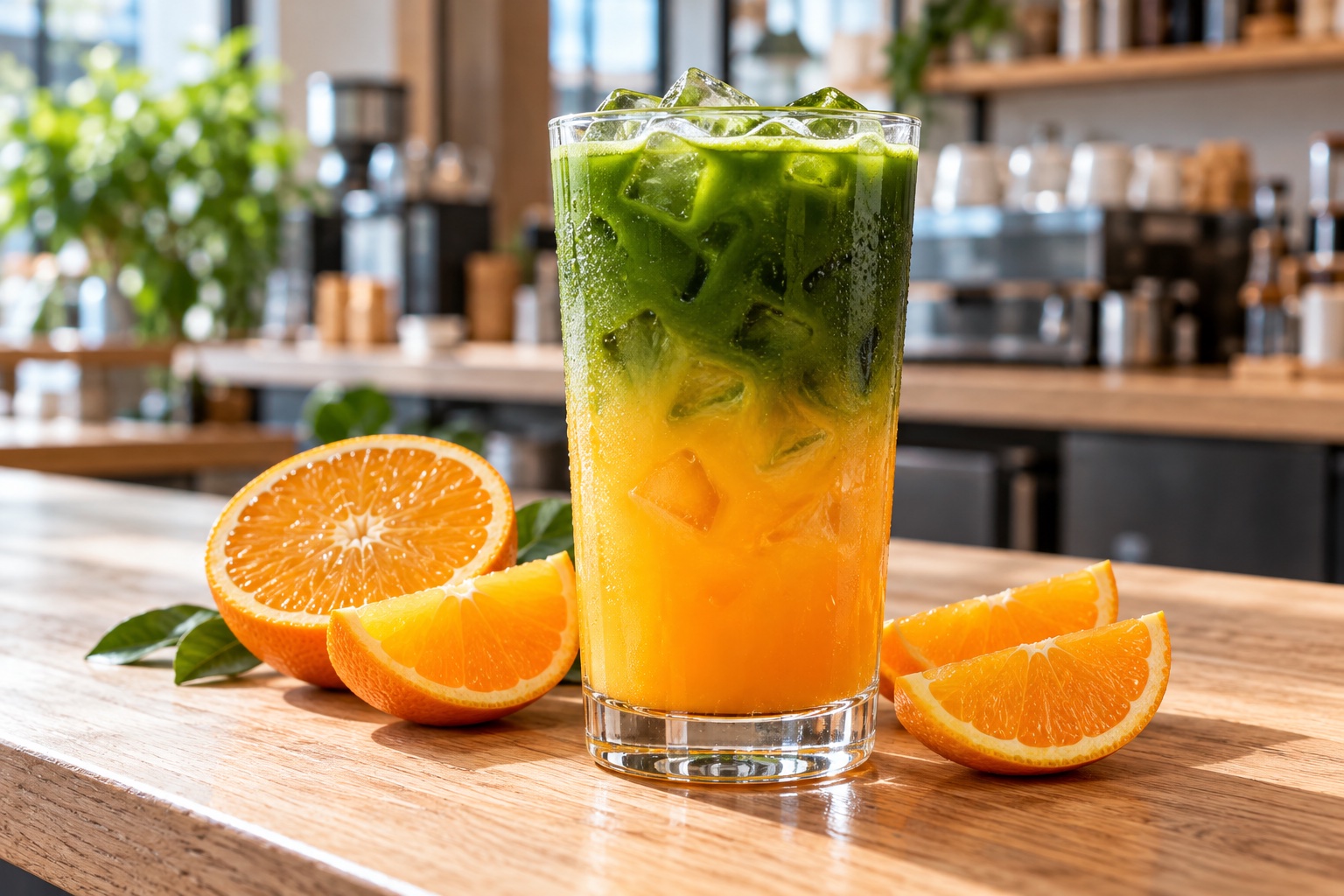
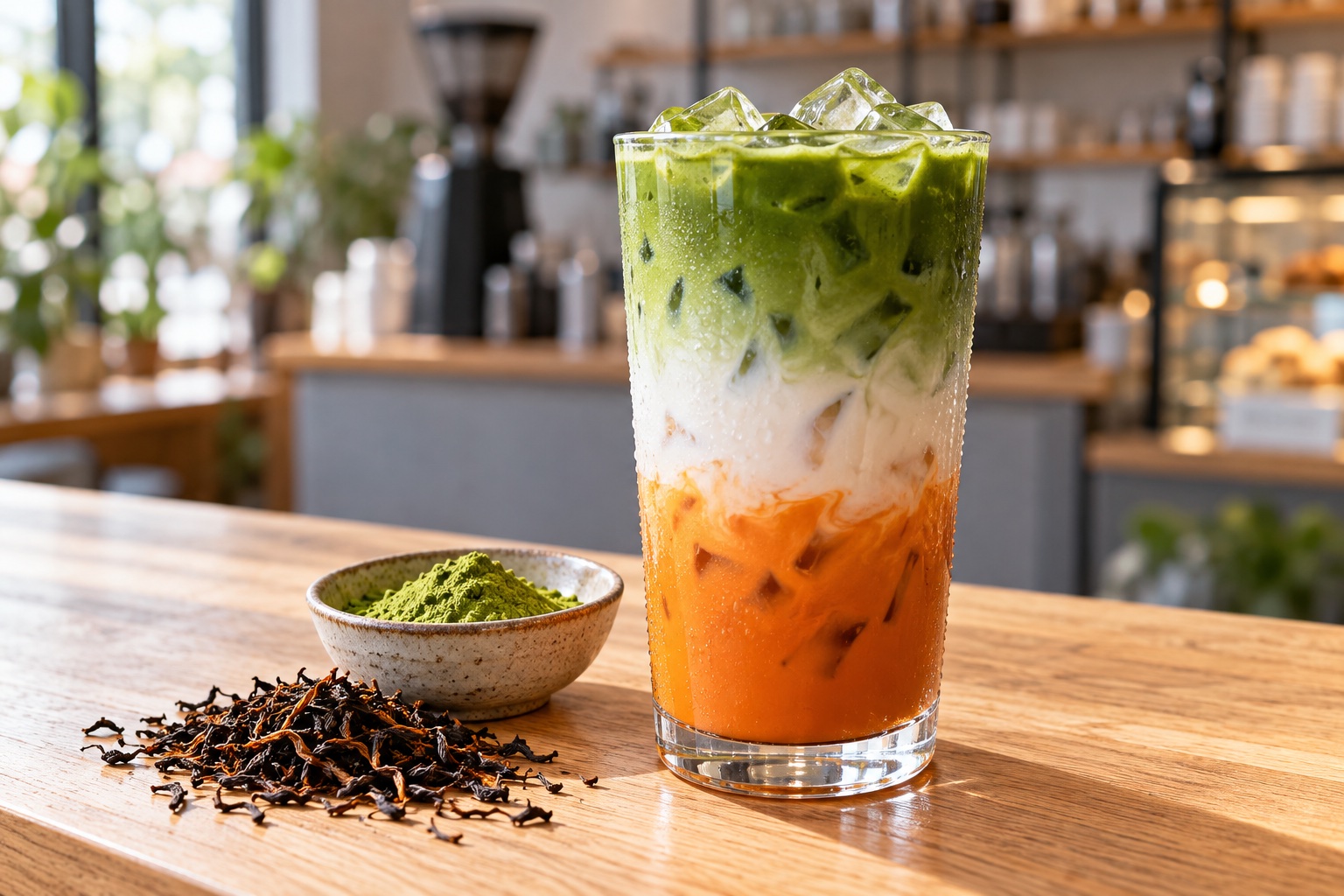
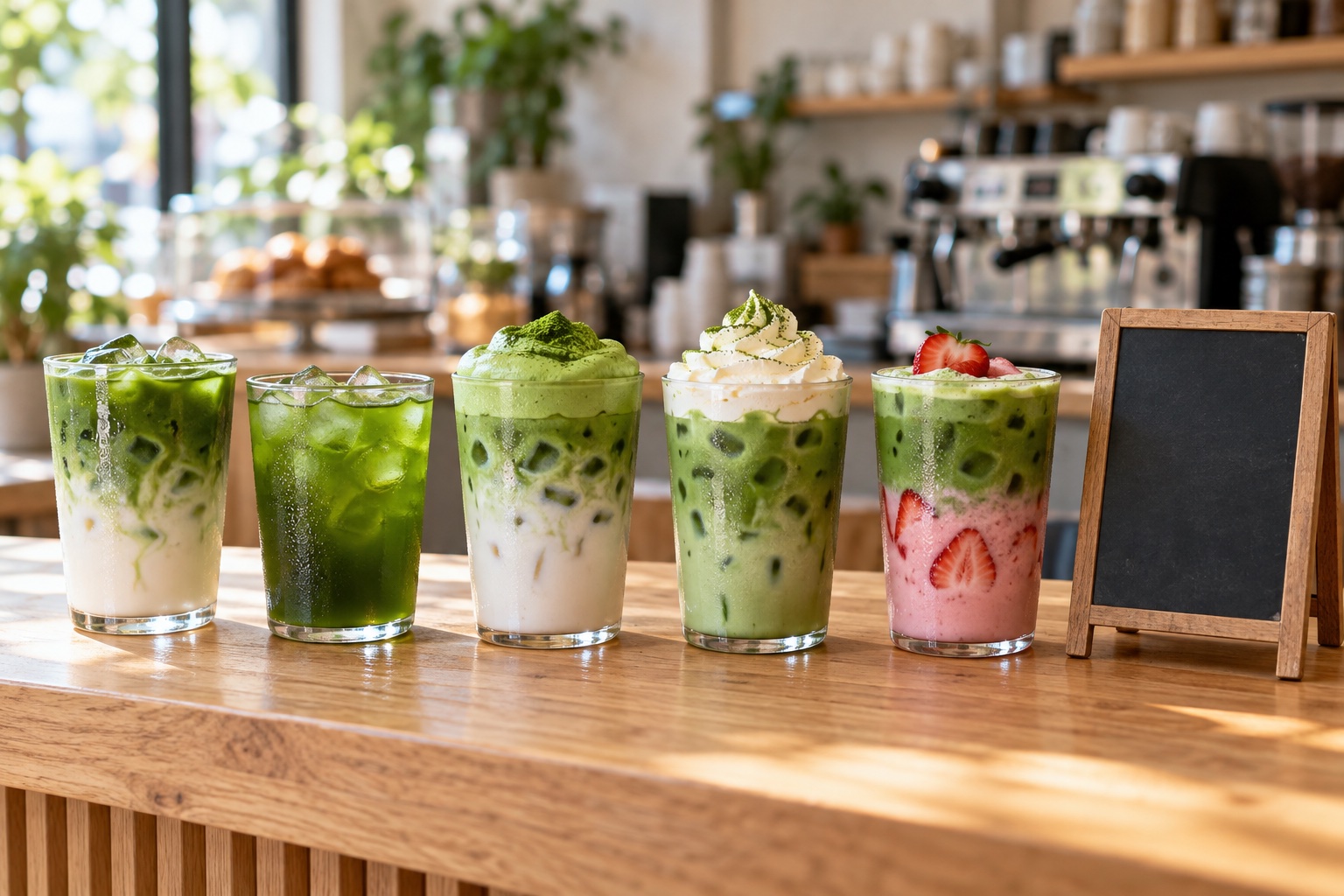
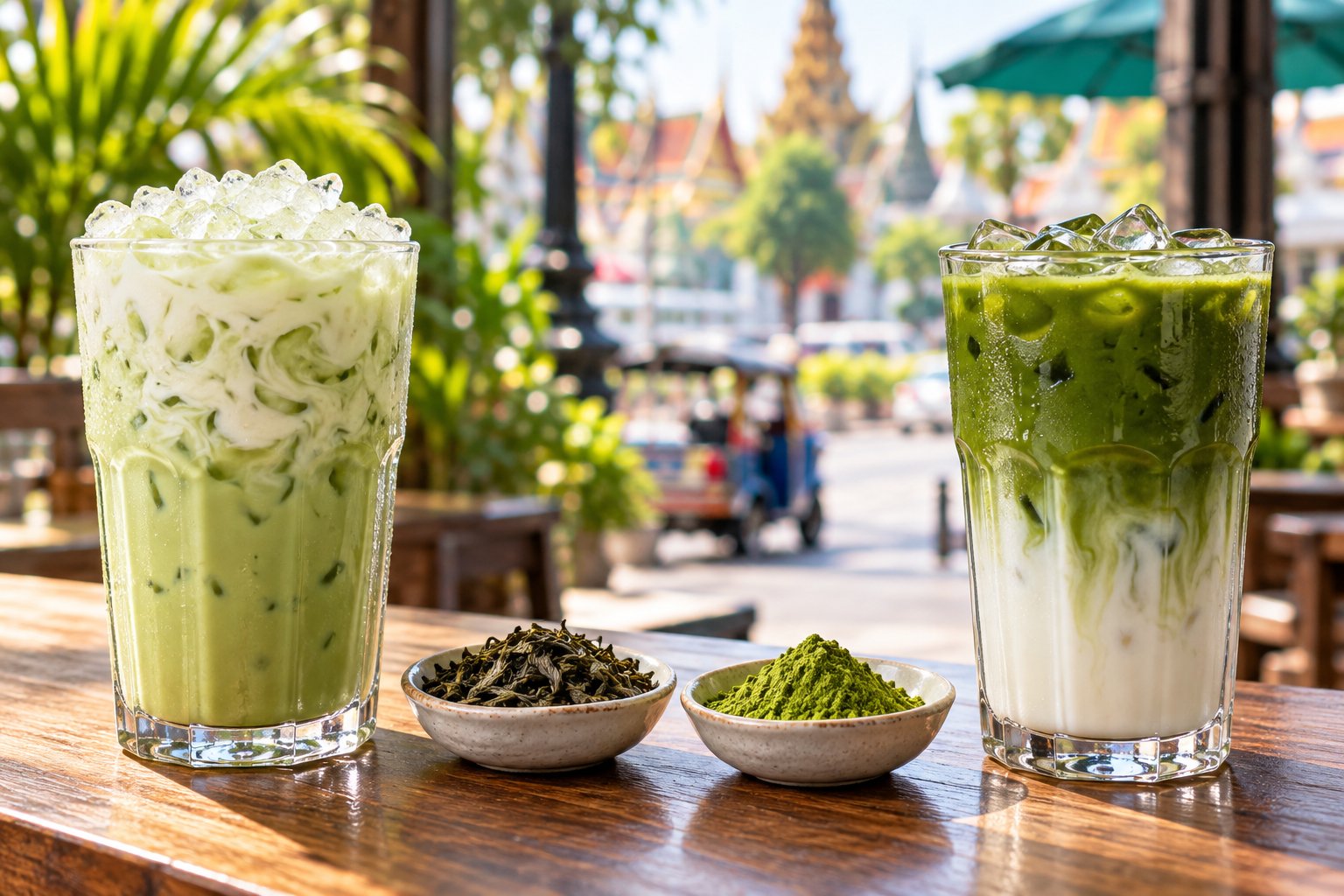
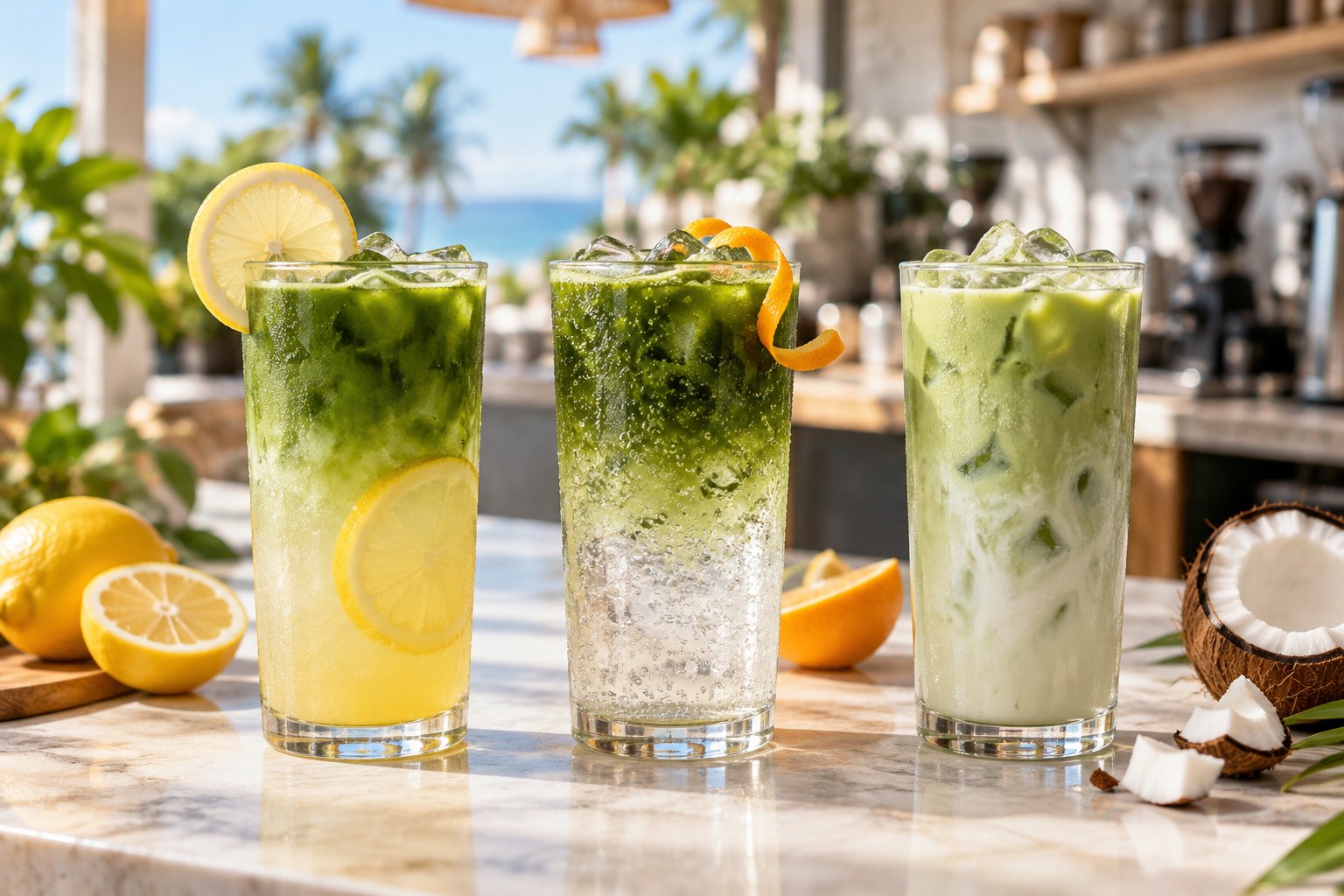
At café chains and convenience store cafés in Thailand, a cold drink of matcha and orange juice sits next to the matcha latte. Its Thai name is “มัทฉะส้ม” (matcha orange). In Singapore and Thailand you also see sodas and lemonades that combine yuzu and matcha. The drink is simple to make, but the look and the cost change with the juice you use, how yuzu’s acid changes the color, and the order you pour in. This guide checks shop menus, official recipes and public data in turn, and sets out the steps for serving it in a café.
What are matcha orange and yuzu matcha?
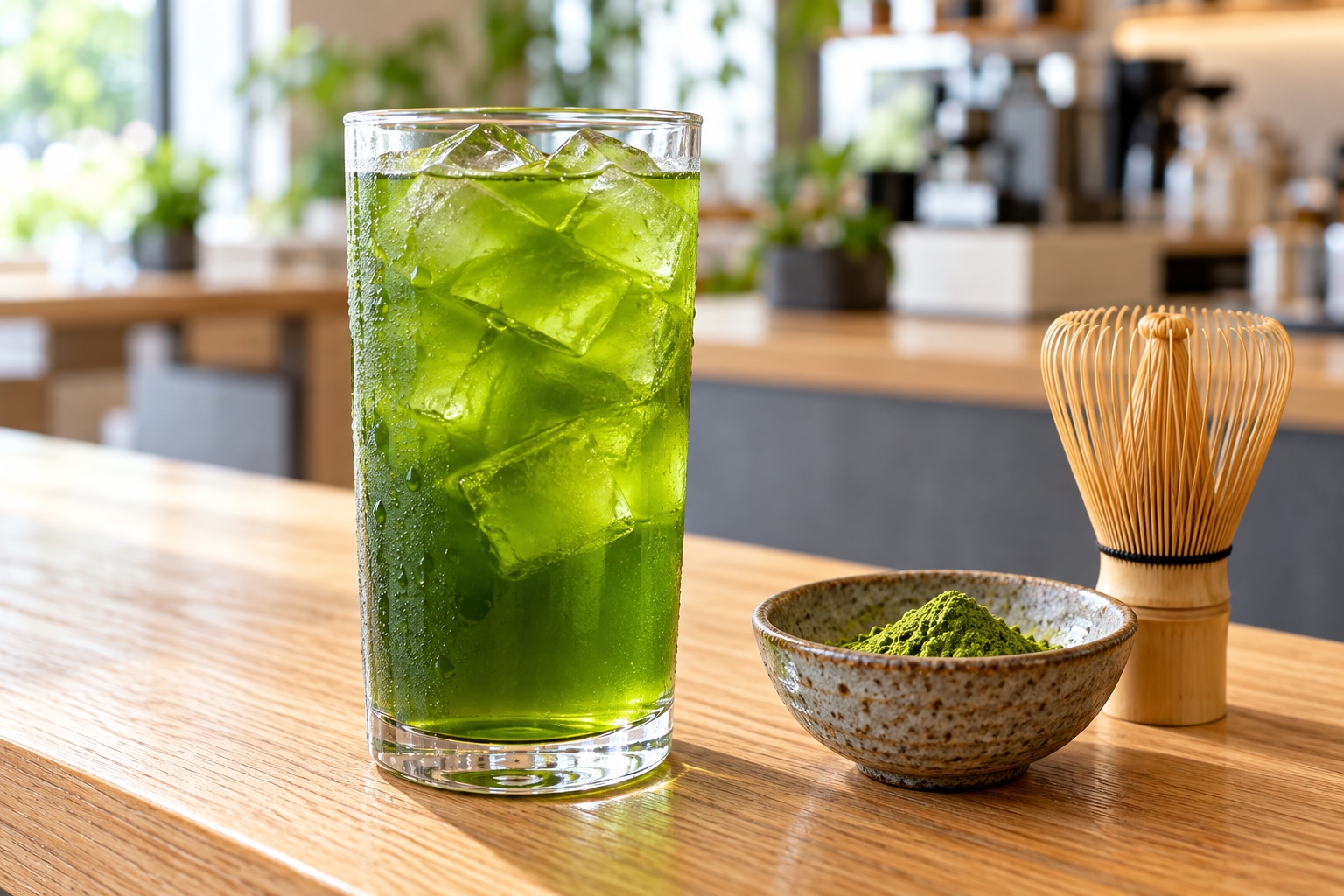
Matcha orange is a cold drink without milk, made by combining matcha dissolved in hot water with orange juice and ice. In Thailand, major café chains and a convenience store chain sell it as a regular menu item. Yuzu matcha is most often made by combining yuzu juice or yuzu purée with sparkling water or lemonade.
Menus in Thailand and Singapore
These are examples checked on delivery-site menus and in company announcements (prices as listed in October 2026).
| Country | Shop | Menu name | Price / period |
|---|---|---|---|
| Thailand | Café Amazon | มัทฉะส้ม เย็น (iced matcha orange) | 65 baht |
| Thailand | Inthanin | มัทฉะน้ำส้มสดเย็น (iced matcha with fresh orange juice) | 80 baht |
| Thailand | Inthanin | มัทฉะยูซุโซดาเย็น (iced matcha yuzu soda) | 70 baht |
| Thailand | All Café (in-store café at 7-Eleven) | มัทฉะน้ำส้ม (matcha orange) | from 29 January 2026 |
| Thailand | All Café | มัทฉะยูสุโซดาเย็น (iced matcha yuzu soda) | 3 September to 4 November 2026 |
| Singapore | Matchaya | Yuzu Matcha Fizz | Not listed |
| Singapore | Tea Pulse | Matcha Yuzu Lemonade | Not listed |
At both shops, the cold matcha made only with water and ice, “เพียวมัทฉะเย็น”, is 60 baht. Café Amazon prices matcha orange 5 baht higher, and Inthanin prices its matcha with fresh orange juice 20 baht higher. Inthanin’s description reads “natural sweetness from 100% real fruit juice”.
The juice the chains use
According to an announcement by TACC, which runs All Café, its matcha orange uses juice of the “ส้มสายน้ำผึ้ง” (Sai Nam Phueng) orange variety for a sweet and sour taste. The yuzu soda uses yuzu imported from Japan (written as SHIBORI in the announcement). Café Amazon’s menu also lists “100% Tangerine Orange Juice with Orange Sacs” next to the matcha orange. The international standard covered below sets separate values for tangerine (mandarin) and orange, so check on the label whether the juice you buy is orange or tangerine.
How this guide relates to other articles
How to combine matcha with lemonade, tonic, soda and coconut water, how acid dulls the green, and why the powder sinks are covered in Matcha lemonade, tonic and soda. The matcha orange recipes from the Florida Department of Citrus in the US and ArtfulTea, a US tea specialist, are also covered there. This guide focuses on orange and yuzu and goes deeper into choosing the juice, building layers, hygiene and cost. Menu names in English and Thai are matched in Matcha drink names.
Comparing ratios in official recipes
The official recipes compared here use 1–2 teaspoons of matcha, and most put the juice and ice in first and pour the matcha dissolved in hot water in last. Yuzu is used in three ways: as juice, as purée, or as yuzu-flavored matcha.
5 recipes compared
These recipes are published by tea companies, a fruit company and a syrup company on their own sites. Conversions used: 1fl oz = about 30ml, 1 cup = about 237ml, 180°F = about 82°C, 1 tablespoon = about 15ml.
| Drink | Source (country, business) | Matcha | Water to dissolve the matcha | Combined with |
|---|---|---|---|---|
| Matcha orange | Sunkist (Hong Kong site, fruit company) | 2 tsp | 60ml hot water (80°C or below) | Juice of 3.5 navel oranges, 1 tsp sugar, orange tapioca pearls |
| Orange matcha latte | ITO EN (North America, tea company) | 1 tsp | About 118ml hot water | A splash each of orange juice, maple syrup and vanilla, cream foam with orange |
| Yuzu matcha lemonade | Matchaful (US, matcha company) | 1 tsp | About 59ml water at about 82°C | 1 tbsp yuzu juice, 3 tbsp lemon juice, 1 tbsp agave, sparkling water (about 473ml cup) |
| Yuzu matcha spritz | T2 (Australia, tea company) | 1 tsp yuzu-flavored matcha | 150ml water at 80°C | Honey (optional), ice, sparkling water |
| Frozen matcha yuzu lemonade | Monin (US, syrup company) | 30mL matcha concentrate | None | 30mL yuzu purée, 120mL frozen lemonade concentrate, ice (480mL glass) |
Pouring order
Matchaful shakes ice, yuzu juice, lemon juice and agave, pours it into the cup, then tops it with whisked matcha and sparkling water. ITO EN also puts orange juice and the other flavorings in the glass first and pours the matcha over the top, finishing with cream foam. T2 pours the matcha over ice, adds sparkling water and stirs gently once. Sunkist and Monin combine everything, or blend it with ice.
Setting your shop’s standard (our view)
From here on, this is our view. A teaspoon can weigh different amounts depending on whether the powder was sifted and how fine it is, so weigh it in grams in your shop. Start with 3g of matcha, the amount common in official matcha tonic and matcha soda recipes, and add 0.5g at a time if the matcha taste gets lost behind the sweetness of orange or the sourness of yuzu. For orange, deciding the amount of juice first with a line on the glass keeps the taste and cost of each drink the same.
Choosing orange juice: fresh, 100% or nectar
Even under the name “orange juice”, directly expressed juice, concentrate diluted back with water, and nectar made by adding water and sugar to juice differ in definition and sugar content. They change the matcha taste and how easily you can adjust sweetness, so tell them apart on the label before you buy.
Definitions in the international standard
The Codex Alimentarius Commission, which sets international food standards, separates juice and nectar as follows in its “General Standard for Fruit Juices and Nectars” (CXS 247-2005).
- Directly expressed juice: juice pressed from fruit by mechanical means. Its Brix (a measure of the sugar and other solids dissolved in a liquid) stays as pressed and is not changed except by blending with juice of the same kind of fruit
- Juice from concentrate: concentrated juice diluted back with water. “From concentrate” or “reconstituted” is written near the name
- Nectar: juice with water added, which may also have sugar, honey or sweeteners added. The share of juice is written clearly as “juice content __%”
- If sugar is added to juice, “sugar(s) added” is written after the name
Values for orange and tangerine
The annex of the same standard sets orange nectar at a minimum of 50% juice, and orange juice from concentrate at a Brix of at least 11.2 (11.8–11.2 depending on the country). Tangerine (mandarin) nectar is also at least 50% juice. Nectar is about half juice and may contain added sugar, which makes sweetness harder to adjust in the shop when you combine it with matcha.
Source: Codex Alimentarius, “General Standard for Fruit Juices and Nectars (CXS 247-2005)”, Annex p.16 https://www.fao.org/input/download/standards/10154/CXS_247e.pdf
| Fruit | Minimum Brix for reconstituted juice | Minimum juice content in nectar |
|---|---|---|
| Lemon | 8.0 | According to the legislation of the importing country |
| Mandarin / tangerine | 11.8 | 50.0% |
| Orange | 11.8–11.2 (not lower than 11.2) | 50.0% |
Sugar and acid in numbers
In Japan’s official food composition table (Standard Tables of Food Composition in Japan, 8th revised edition, 2023 supplement), sugars and citric acid per 100g are as follows.
| Juice | Sugars (total of glucose, fructose and sucrose) | Citric acid |
|---|---|---|
| Valencia orange, straight juice | 8.8g | 0.9g |
| Valencia orange, juice from concentrate | 7.7g | Not listed |
| Satsuma mandarin, straight juice | 9.1g | Not listed |
| Lemon juice | 1.5g | 6.5g |
The same table lists straight Valencia orange juice as “100mL = 103g”. Because orange juice contains sugar, it is slightly heavier than the same volume of water. This difference matters for how layers form, covered below.
Choosing yuzu: juice, purée or yuzu-flavored matcha
Yuzu juice is far more acidic than orange, and in Japan some of it is distributed frozen without heating. The official recipes use yuzu as juice (Matchaful), purée (Monin) or yuzu-flavored matcha (T2).
Acid and sugar in yuzu juice
In a report by the Kochi Prefectural Industrial Technology Center, which surveyed a yuzu juice plant run by an agricultural cooperative in the prefecture, the Brix of yuzu juice was 7.9% in 2004 and 9.0% in 2005, and the acidity (as citric acid) was 5.4% and 5.0%. It is measured differently from the 0.9g of citric acid per 100g in straight orange juice in the food composition table, so treat it as a guide, but handle yuzu juice as having more than 5 times the acid of orange, close to lemon.
The same report found differences between the two years of 1.1% in Brix and 0.4% in acidity, and recommends that each pressing plant check the juice composition every day.
Source: Kochi Prefectural Industrial Technology Center, “Development of the modernistic quality control system in manufacture of yuzu juice”, Report No.37 (in Japanese) https://www.pref.kochi.lg.jp/_files/00014298/No37-1.pdf
| Year | Brix | Acidity (as citric acid) |
|---|---|---|
| 2004 | 7.9% | 5.4% |
| 2005 | 9.0% | 5.0% |
Frozen juice that has not been heated
According to the same report, yuzu juice plants in Kochi generally do not concentrate the juice, add sugar or heat-sterilize it; they press and filter it and freeze it as it is. This is thought to be because they value yuzu’s distinctive aroma and avoid processing that changes it. The report also says yeast and mold were found in the juice before freezing, that thawed juice should be kept strictly cold, and that products made with the juice basically need heat sterilization. Check on the label and with the supplier whether the yuzu juice you buy is heat-sterilized or frozen without heating.
Purée and yuzu-flavored matcha
Monin’s recipe uses yuzu purée with Monin’s matcha concentrate (a concentrated syrup), and T2’s uses matcha flavored with yuzu, so neither presses fruit. Purematcha’s matcha yuzu soda, with yuzu jam at the bottom, is covered in Matcha lemonade, tonic and soda. From here on, this is our view. Purée and jam often contain sweetness, so shops that want to keep the matcha bitterness can choose juice, and shops that want a sweet, easy drink can choose purée or jam.
Color and layers: how orange and yuzu differ
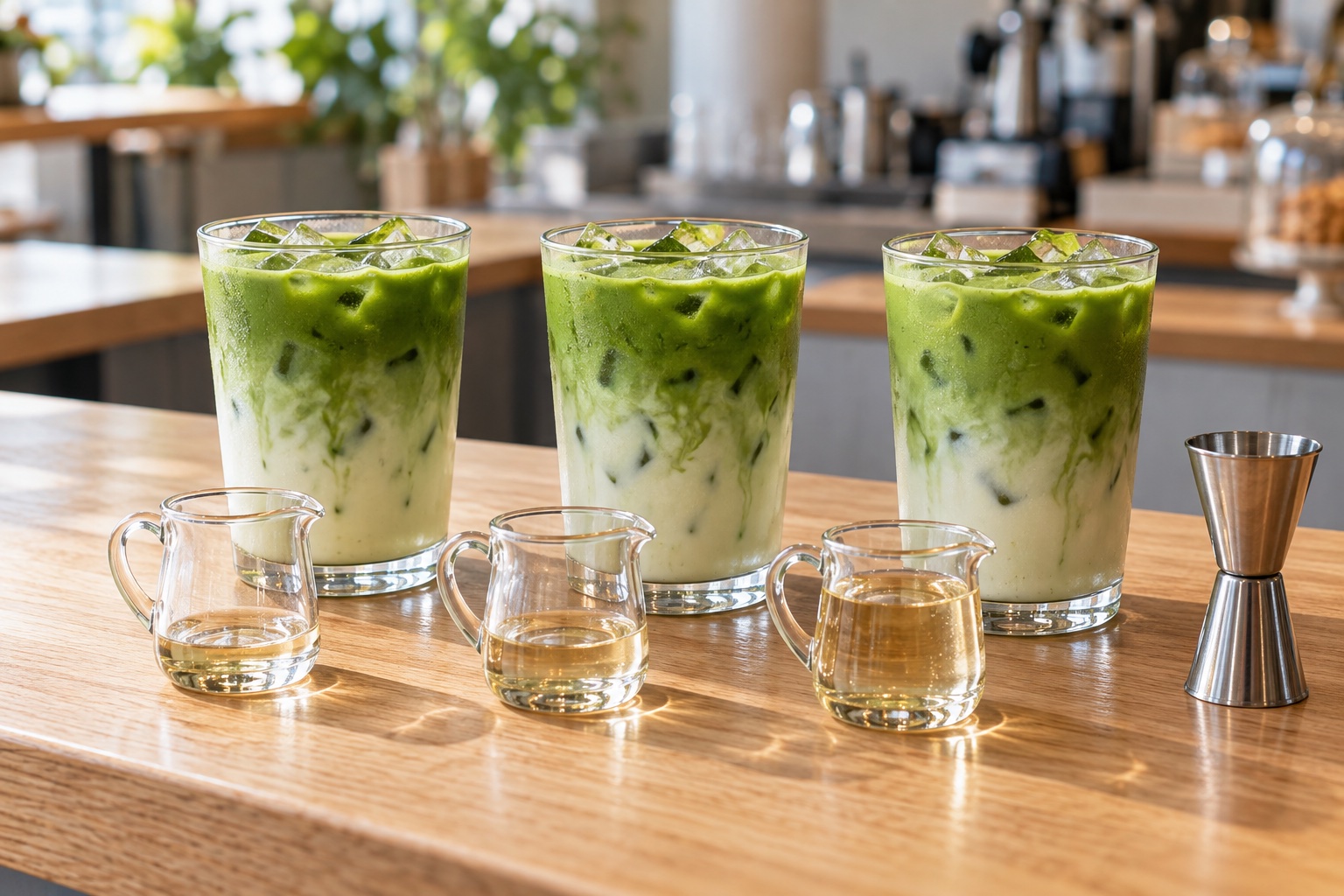
The green of matcha fades easily with acid; orange is less acidic than lemon, and yuzu is close to lemon. Layers form when the heavier, sugar-containing juice goes at the bottom and the matcha dissolved in hot water goes on top.
Acidity and how long the green lasts
The green of matcha is the color of chlorophyll, and under acidic conditions magnesium leaves the chlorophyll and the color becomes duller. The mechanism, and juice pH values from Clemson University in the US (orange juice 3.30–4.19, lemon juice 2.00–2.60), are covered in “Why the green fades with acid” in Matcha lemonade, tonic and soda. We could not find an official pH value for yuzu juice, but as shown above, its citric acid is close to lemon. From here on, this is our view. Matcha orange tends to keep its color from making to the last sip, while yuzu matcha, like lemonade, should have the matcha added just before serving.
Why layers form and the pouring order
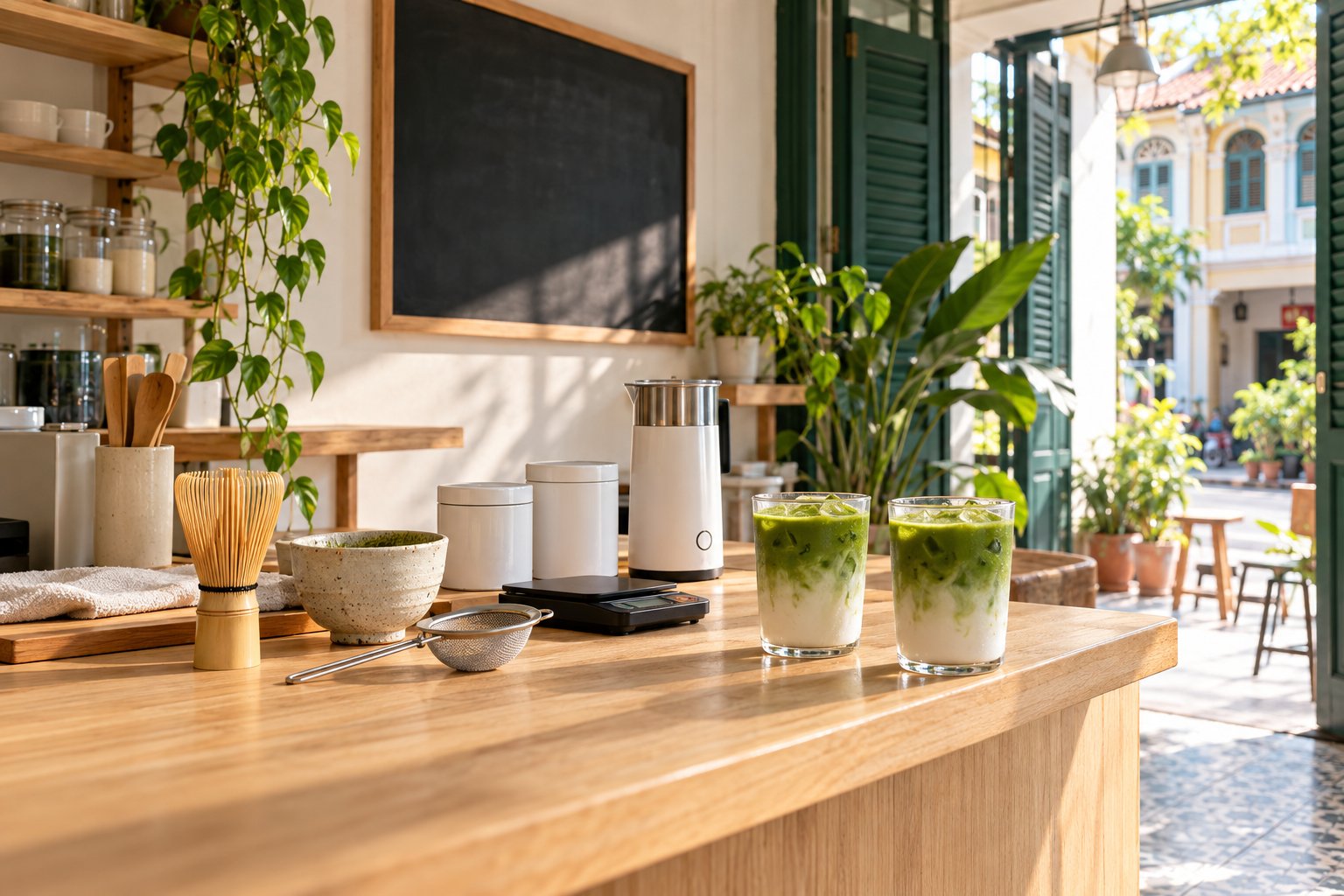
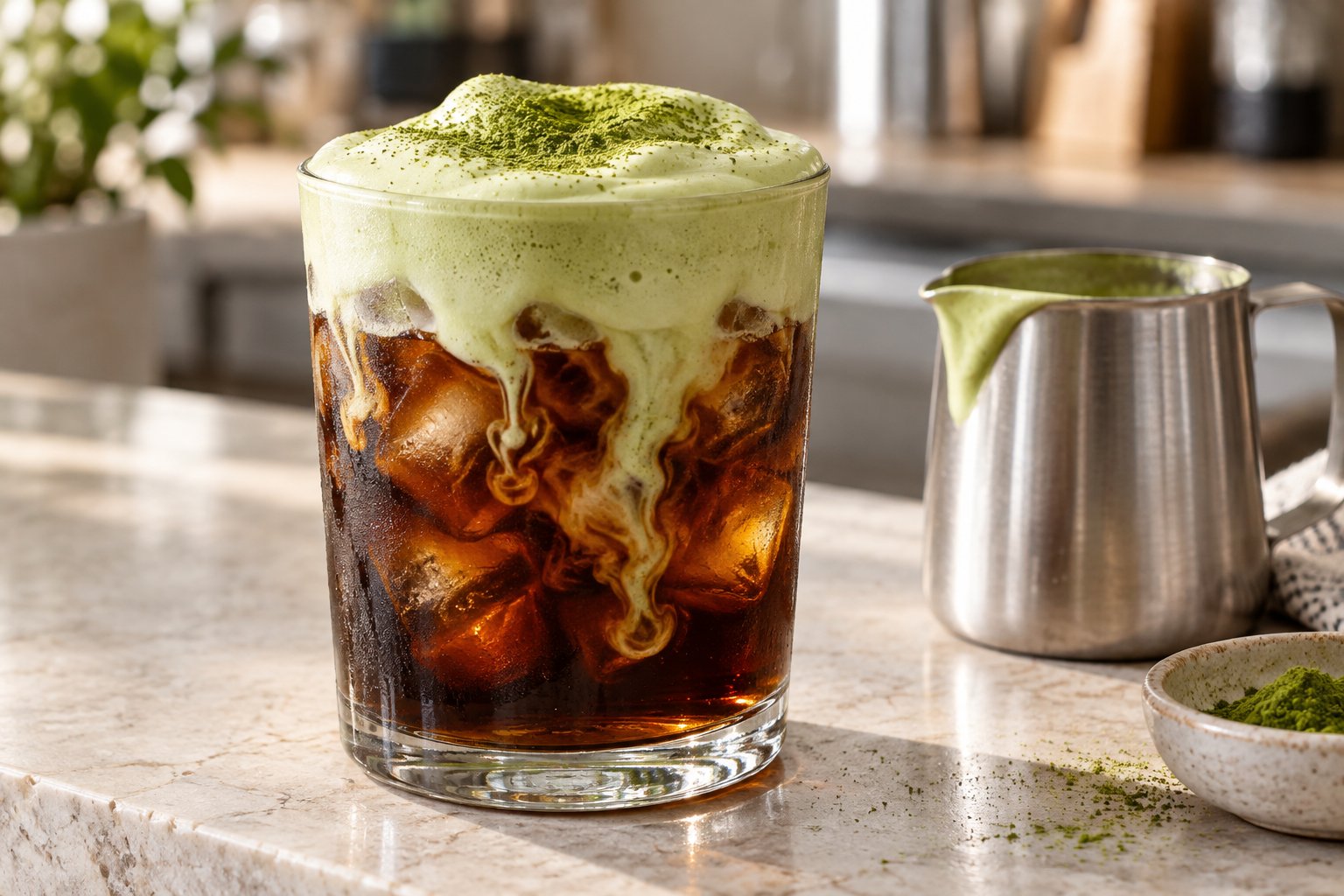
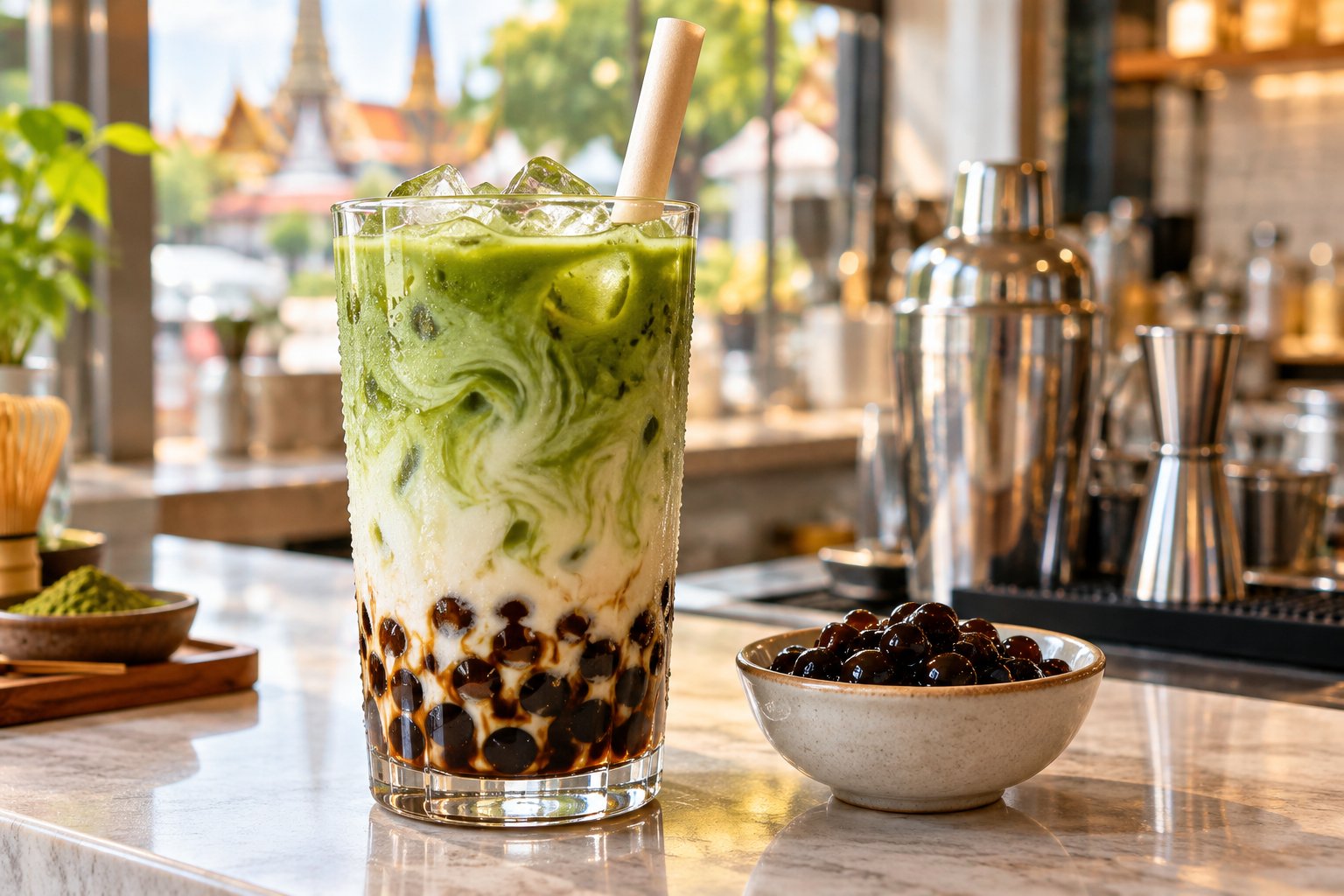
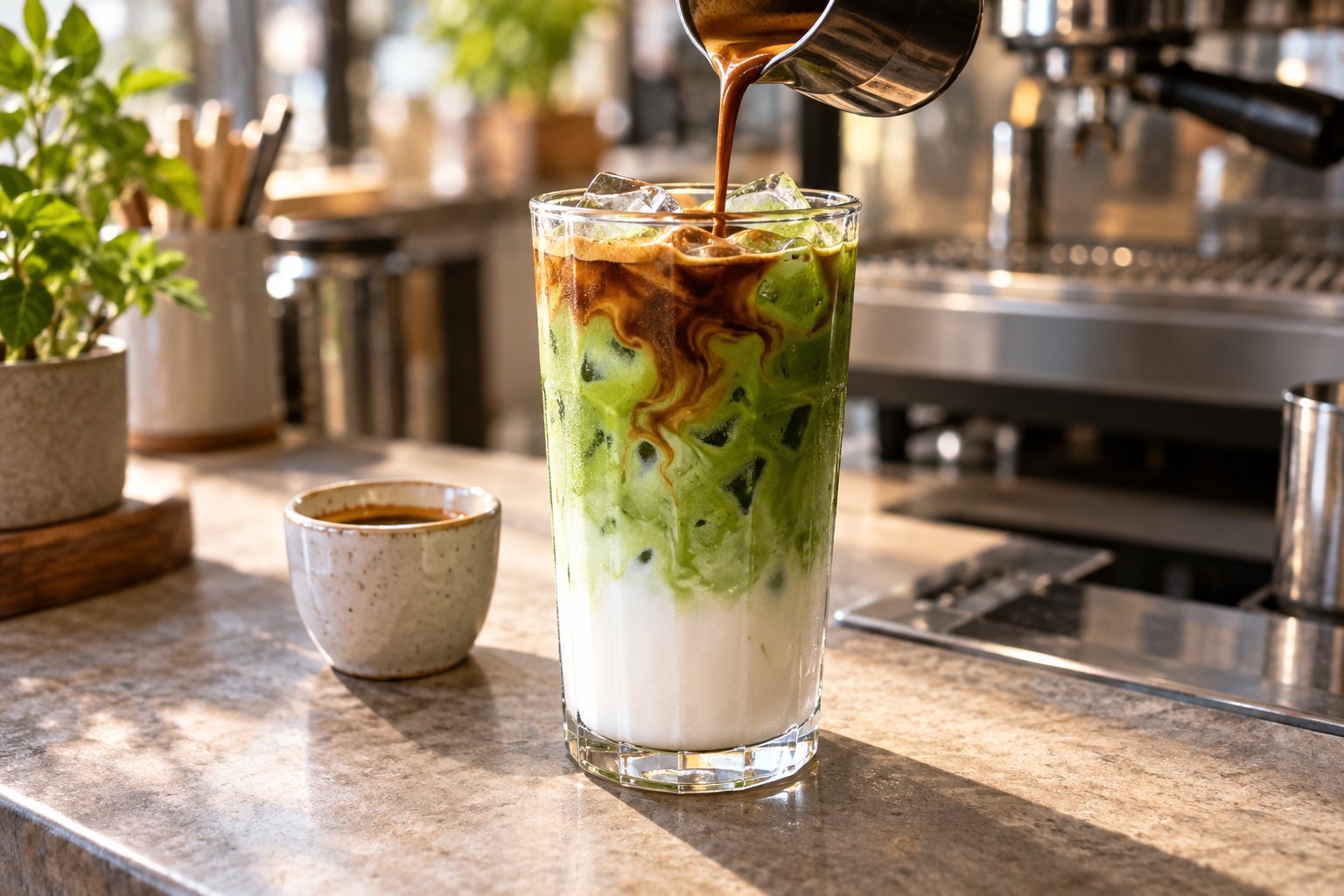
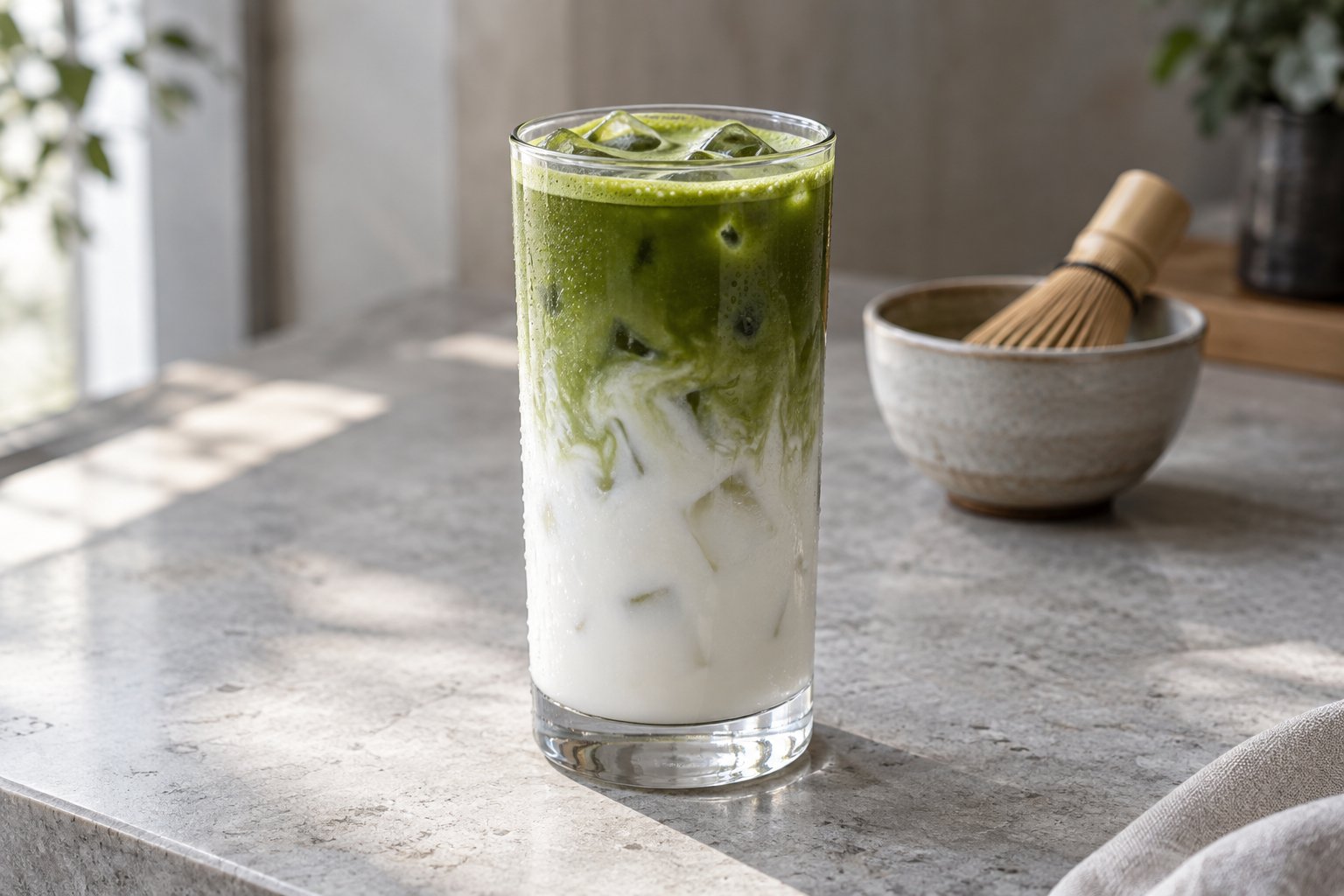
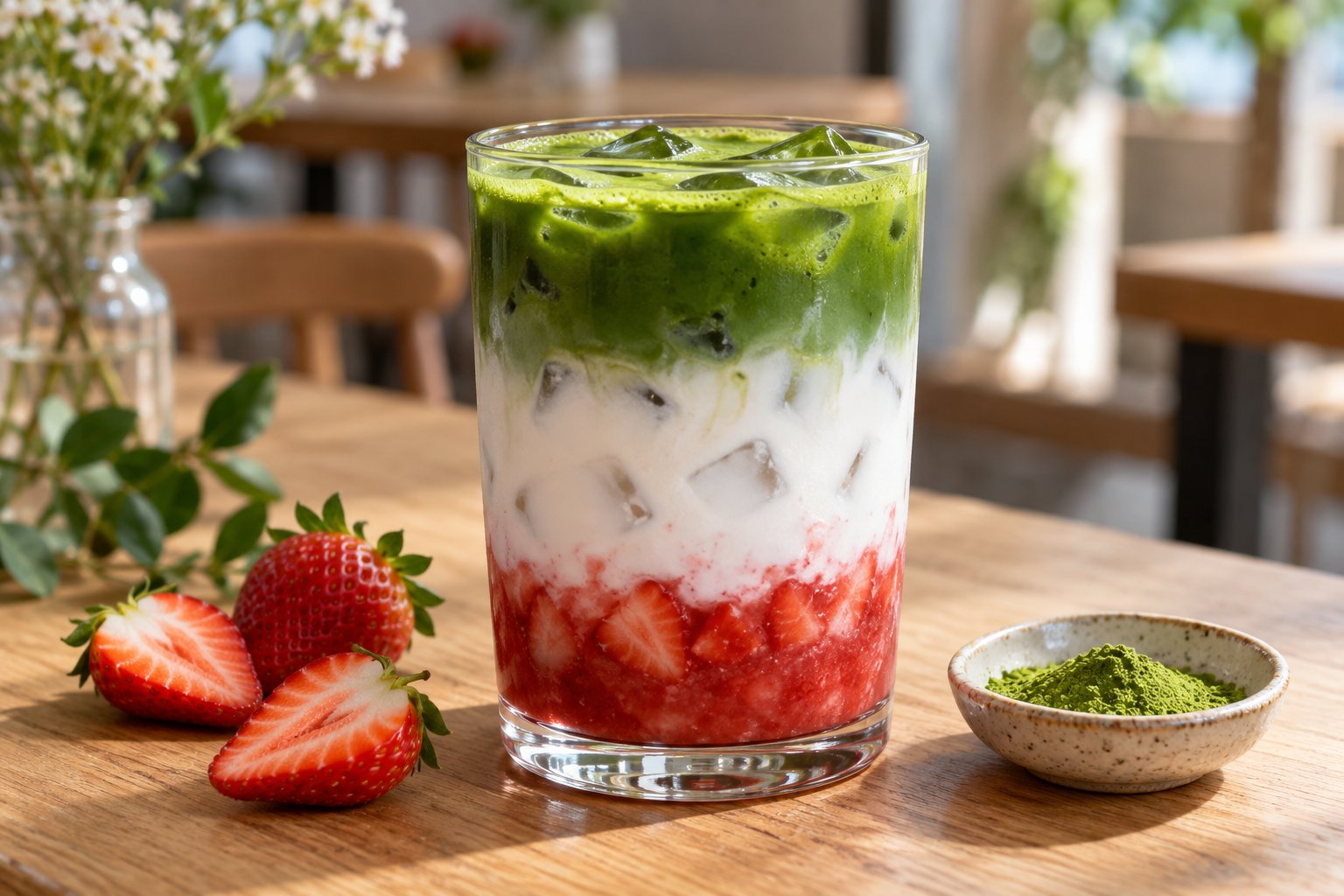
As the food composition table values above show, orange juice is slightly heavier than the same volume of water. From here on, this is our explanation. Matcha dissolved in a little hot water weighs almost the same as water, so when it is poured last into a glass that already holds juice and ice, it sits on top and makes two layers of green and orange. If you put the matcha in first and pour the juice on top, the force of the pour mixes them. Detailed pouring steps are in “How to pour two layers” in Iced matcha latte.
Layers break up in delivery
Café Amazon’s description of its matcha orange says the layers may look different from the photo because of delivery. In takeaway and delivery, the layers break up sooner or later. Mixing green and orange produces a muddy color that is neither, so photograph the drink in layers and write “please stir before drinking” on the menu.
Which matcha to use
The sweetness of orange and the acid of yuzu tend to hide matcha’s bitterness, but in a layered drink the green of the matcha is in full view, so choose the grade by color. Of the recipes compared, Matchaful specifies its own matcha and T2 specifies yuzu-flavored matcha.
How to think about grade
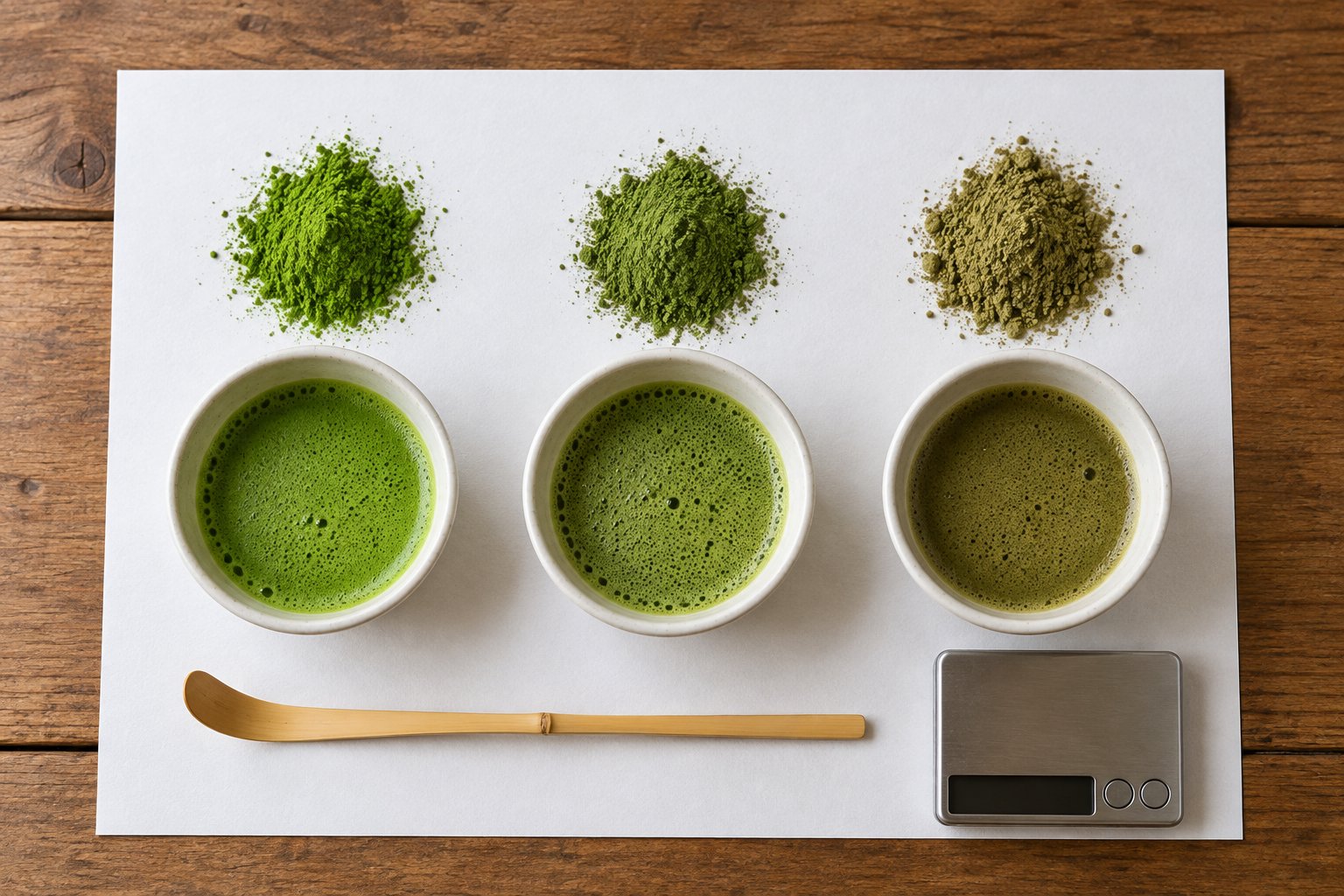
Culinary (a grade sold for cooking) and ceremonial are names used by sellers, with no official standard. Differences in harvest and raw leaf are covered in Matcha grades, and how to judge color and particles in Matcha quality. Whether you can use your latte matcha as it is should be checked in a drink made with the juice.
Compare using your shop’s recipe (our suggestion)
From here on, this is our suggestion.
- Dissolve each candidate matcha at the same grams and make one drink each with your orange juice and your yuzu soda
- Photograph the color of the top layer fresh, after 5 minutes and after 15 minutes
- Check the color after stirring and whether the bitterness gets lost behind the juice
- Work out the matcha cost per drink and decide whether to use the same matcha as your latte or a separate one
Prep, hygiene and sugar labeling
Keep juice chilled and take out only what you use, and dissolve the matcha for each order. Freshly squeezed juice is not heat-treated, so set your quantities on the basis of keeping it cold and using it up quickly. Below is an example of our steps, based on public sources and official recipes.
Before opening
- Keep packaged juice in the refrigerator and take out only what you use. Write the date it was opened
- If you squeeze juice, squeeze only what you will use that day and refrigerate it
- Thaw the frozen yuzu juice you need in the refrigerator and keep it refrigerated after thawing
- Prepare a scale and tea strainer for one serving of matcha (for example 3g) and the water temperature (around 80°C in the official recipes)
For each order
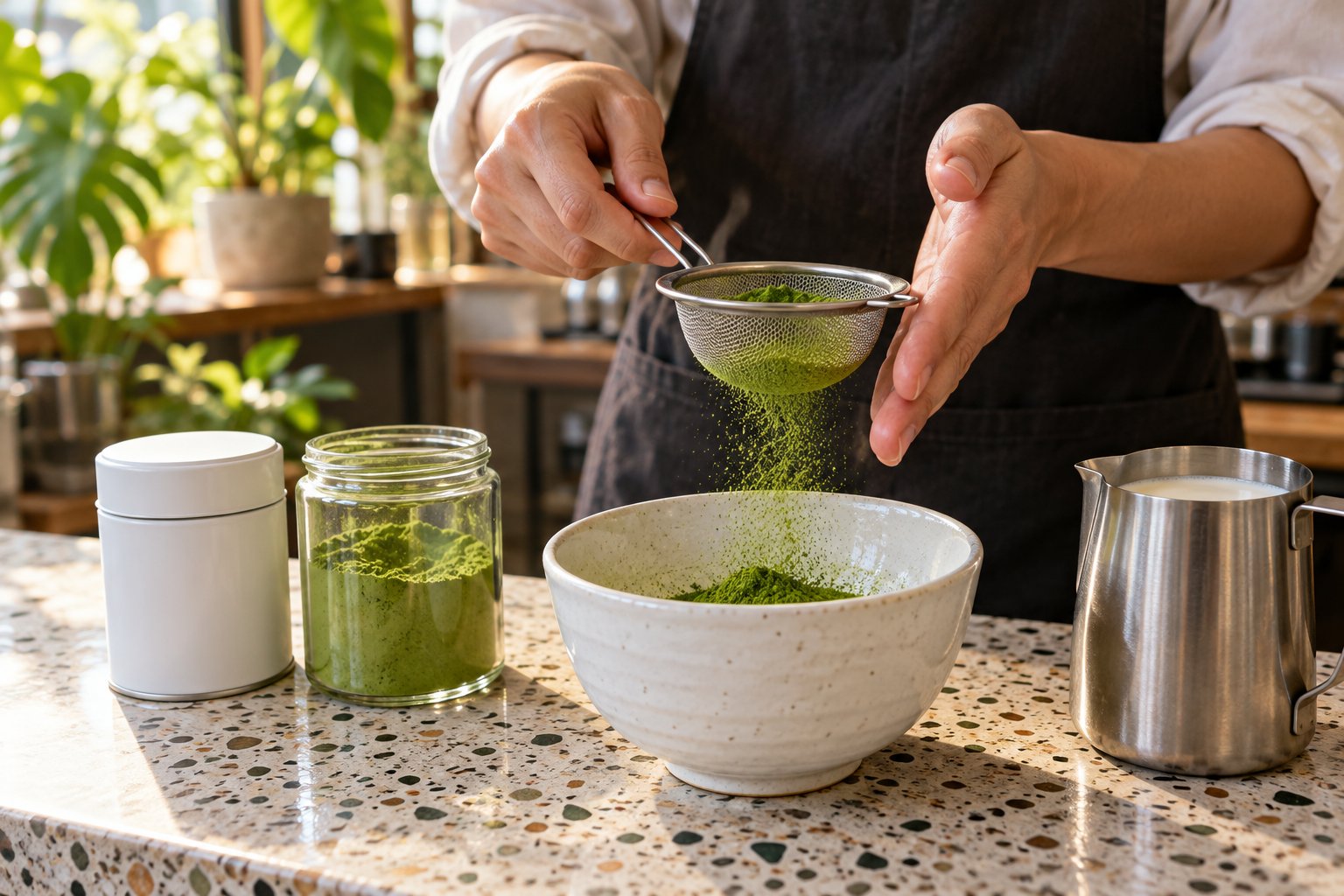
- Weigh and sift the matcha, then dissolve it in a little hot water
- Put ice in the glass and pour juice up to the set line (add sweetener here)
- For yuzu soda, pour the sparkling water gently after the yuzu juice or purée
- Pour the dissolved matcha last over the ice and serve with a straw
Hygiene of freshly squeezed juice
The US Food and Drug Administration (FDA) says juice that has not been treated, for example by pasteurization, can contain bacteria from the fruit, and can cause serious illness in children, older adults, pregnant women and people with weakened immune systems. Untreated juice sold in bottles or cartons must carry a warning, but the FDA does not require a warning for juice sold by the glass. Juice squeezed in the shop carries no label, so keeping it cold and using it up quickly in the shop is what keeps it safe. Official guidance on how long cold food can be held is covered in “Can you make it ahead?” in Iced matcha latte.
Singapore’s Nutri-Grade
According to Singapore’s Ministry of Health, from the end of 2023 drinks made in shops are also covered by “Nutri-Grade”, the label for sugar and saturated fat, and freshly squeezed juices are included. HealthHub, the ministry’s health information site, says some fruit juices are high in natural sugars and can be graded C or D. The sugar bands per 100ml are B for more than 1g up to 5g, C for more than 5g up to 10g, and D for more than 10g. Using the food composition table value for straight orange juice (8.8g of sugars per 100g, 100mL = 103g), a drink of 150ml of orange juice plus 60ml of hot water with matcha comes to about 6.5g per 100ml excluding ice, which falls in the C band (our calculation). The grade is set by the amount of juice even without added sugar, so fix the juice amount in ml. The system is explained in Strawberry matcha latte, and sweetness levels in Thailand in Matcha drink sweetness levels.
Cost per drink
Matcha cost per drink is “buying price per kg ÷ 1,000 × grams used per drink”, plus the cost of juice. How you calculate juice cost depends on whether you buy it packaged or buy fruit and squeeze it.
Matcha cost
Use the grams of matcha you set in your shop. How the price per kg is set is covered in Why matcha costs what it does, and how to choose a grade to fit your selling price in Choosing matcha for café lattes.
Juice cost
- Packaged juice: price per pack ÷ volume × amount per drink. Include any opened juice you could not use up
- Freshly squeezed orange: price of one fruit × number of fruits per drink. Sunkist’s recipe uses the juice of 3.5 navel oranges per drink. First measure how many of your fruits one drink needs
- Yuzu juice (bottled or frozen): price per bottle ÷ volume × amount per drink
- Whole yuzu: in the food composition table, yuzu juice is 25% of the weight of the whole fruit. About 250g of juice can be pressed from 1kg of fruit (our calculation), so divide the fruit price by the amount you can press to get the juice price
Add sugar or syrup, sparkling water, ice, cup, lid and straw to get the ingredient cost per drink. Fruit prices change with the season, so recalculate the juice cost per drink each time you buy fresh fruit.
What to check when buying and adding it to the menu
Check the type of juice and whether sugar is added on the label, and choose the matcha by its color in a drink made with your juice. On the menu, say that the drink is served in layers and should be stirred.
What to check on the juice label
- Whether it says “juice” or “nectar”. For nectar, the “juice content __%” figure
- Whether it says “from concentrate” or “reconstituted”
- Whether it says “sugar(s) added”, or lists sugar or sweeteners in the ingredients
- For yuzu juice, whether it is heat-sterilized or frozen without heating, the storage temperature and how to handle it after thawing
When adding it to the menu (our suggestion)
- If you start with one drink, choose matcha orange, which keeps its color better and is a known name in Thailand
- For yuzu matcha, set the step of adding the matcha just before serving before putting it on the menu
- Photograph it in layers and write “please stir before drinking”
- If you squeeze juice, decide how much to squeeze and by what time to use it up
Omakase Matcha supplies matcha sourced from the growing regions of Uji, Yame, Shizuoka, Kagoshima and Miyazaki. Orders start at 1kg, you can choose up to 3 samples, and we can help adjust the recipe to your menu. To compare the color when combined with orange or yuzu, request samples from Samples.
Sources
- Wongnai, “Café Amazon” menu https://www.wongnai.com/delivery/businesses/577439iz/order
- Wongnai, “Inthanin Coffee (Chaeng Watthana 22)” menu https://www.wongnai.com/delivery/businesses/321918zp/order
- Wongnai, “Inthanin Coffee (Rat Burana 1)” menu https://www.wongnai.com/delivery/businesses/321927gX/order
- ThaiPR.net, “TACC เดินหน้าเสิร์ฟเมนูใหม่ “มัทฉะน้ำส้ม” บุก All Café ใน 7-Eleven ทั่วประเทศ” (29 January 2026, in Thai) https://www.thaipr.net/?p=3688158
- InfoQuest, “TACC เสิร์ฟเมนู Yuzu ใหม่ใน All Café” (3 September 2026, in Thai) https://www.infoquest.co.th/?p=642588
- Grab Singapore, “Matcha Orchard: Find and Order Matcha Cafes in Singapore” https://www.grab.com/sg/articles/food/matcha-orchard/
- Sunkist Hong Kong, “Orange Matcha Boba” https://hk-en.sunkist.com/recipes/orange-matcha-boba/
- ITO EN, “Orange Maple Matcha Latte” https://itoen.com/blogs/recipes/orange-maple-matcha-latte
- Matchaful, “Recipe: Iced Yuzu Matcha Lemonade” https://www.matchaful.com/blogs/the-matchaful-blog/iced-yuzu-matcha-lemonade
- T2, “Yuzu matcha spritz” https://www.t2tea.com/blogs/recipes/yuzu-matcha-spritz
- Monin US, “Frozen Matcha Yuzu Lemonade” https://monin.us/products/frozen-matcha-yuzu-lemonade
- Codex Alimentarius, “General Standard for Fruit Juices and Nectars (CXS 247-2005)” https://www.fao.org/input/download/standards/10154/CXS_247e.pdf
- Ministry of Education, Culture, Sports, Science and Technology (MEXT), Japan, “Standard Tables of Food Composition in Japan, 8th revised edition, 2023 supplement” (main table, carbohydrate tables main table and appendix 2, in Japanese) https://www.mext.go.jp/a_menu/syokuhinseibun/mext_00001.html
- Sugimoto, “Development of the modernistic quality control system in manufacture of yuzu juice”, Reports of Kochi Prefectural Industrial Technology Center No.37 (2006, in Japanese) https://www.pref.kochi.lg.jp/_files/00014298/No37-1.pdf
- U.S. Food and Drug Administration, “What You Need to Know About Juice Safety” https://www.fda.gov/food/buy-store-serve-safe-food/what-you-need-know-about-juice-safety
- Ministry of Health Singapore, “Extension of Nutri-Grade requirements to freshly prepared beverages from end 2023” https://www.moh.gov.sg/newsroom/extension-of-nutri-grade-requirements-to-freshly-prepared-beverages-from-end-2023
- HealthHub, “Make Better Drink Choices With Nutri-Grade” https://www.healthhub.sg/programmes/nutrition-hub/nutri-grade-mark
- Clemson University Cooperative Extension, “pH Values of Common Foods and Ingredients” https://www.clemson.edu/extension/food/_files/ph-of-common-foods-table.pdf