
 Reviewed by: Takahiro Sugiyama (CEO, meguri Inc.)
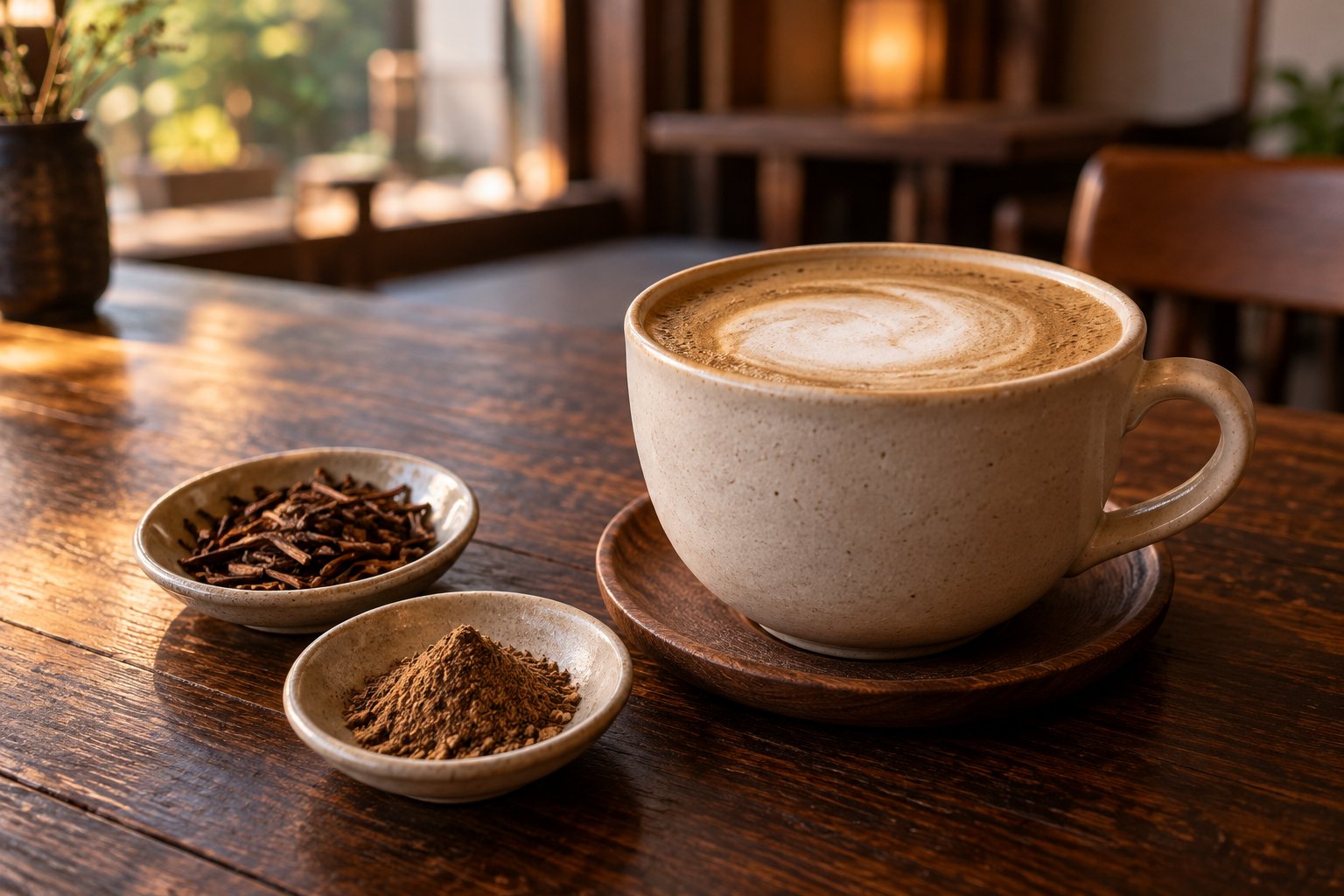
Cafés that serve matcha lattes often consider a hojicha latte as the next item on the menu. Hojicha and matcha are both Japanese green teas, but they are made from different raw material in different ways, and the caffeine and the points to check when buying differ too. Using a Japanese industry body’s labelling standard, Japan’s official food composition tables and tea companies’ own explanations, this article looks at what hojicha is, then at latte ratios and buying.
What is hojicha?
Hojicha is green tea made by roasting sencha, bancha or similar tea over strong heat. Roasting turns the leaves brown and gives them a toasty aroma. Although it is brown, it is not a fermented tea like black tea.
The definition in the labelling standard
The Green Tea Labelling Standard of the Japan Tea Central Public Interest Incorporated Association (a common standard for green tea set by the industry body, last revised on 10 July 2026) defines each name used for green tea. The names related to hojicha are:
| Name | Definition |
|---|---|
| Hojicha | Tea made by roasting sencha, bancha or similar tea over strong heat |
| Bancha | Tea made from leaves that have grown large and hard after the new shoots, older leaves, stems and similar material, and tea made from leaves picked between harvest seasons (first flush, second flush and so on) |
| Kukicha (bocha, stem tea) | Tea containing a large share of stems and leaf stalks separated during the refining of aracha (unrefined tea) |
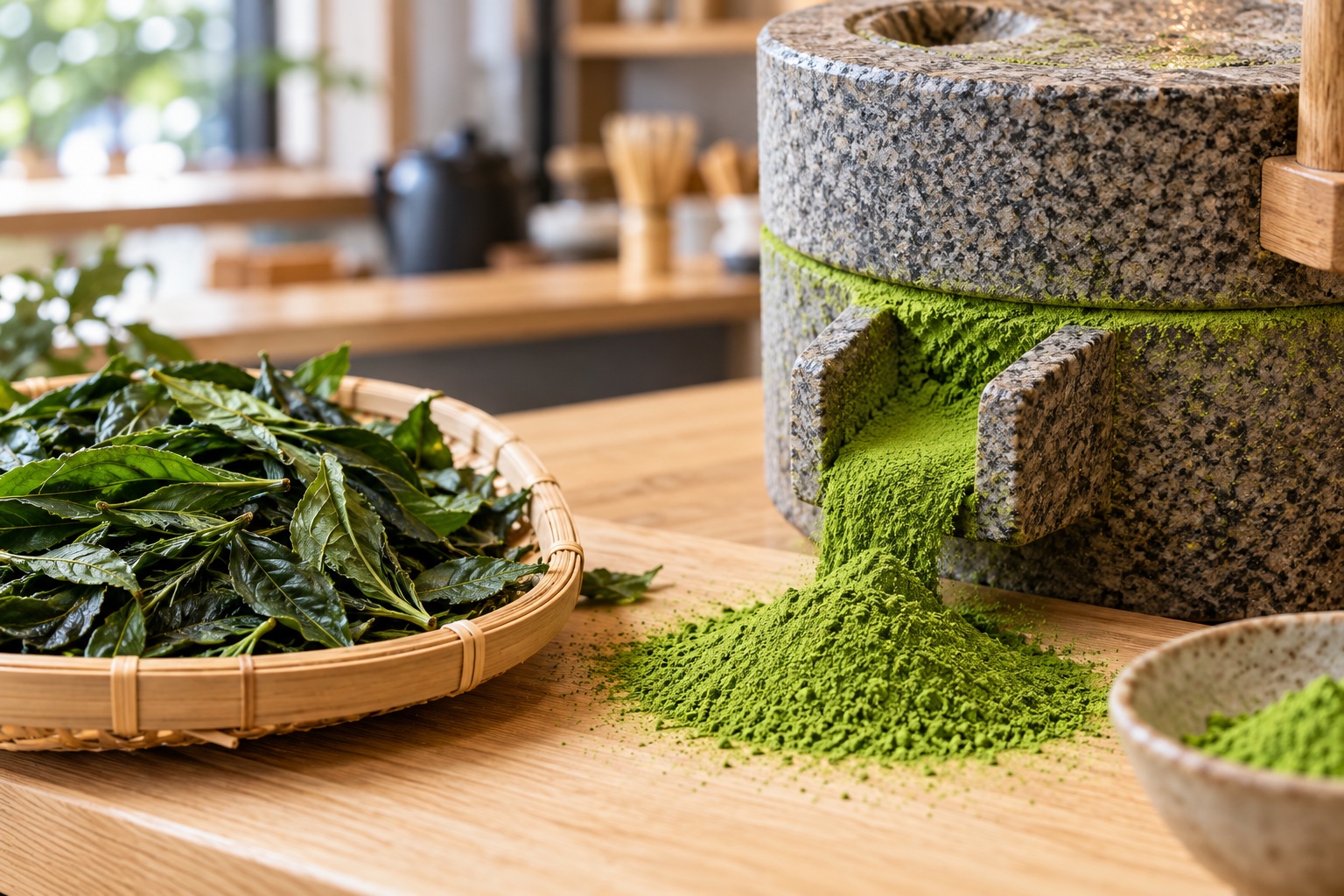
| Matcha | Tencha (tea grown under shade and dried in a tencha furnace or similar without rolling) made into a fine powder with a tea mill or similar |
The Standard Tables of Food Composition in Japan (8th revised edition, 2023 supplement), published by MEXT (Japan’s Ministry of Education, Culture, Sports, Science and Technology), also place hojicha in the same “green tea” group as sencha and matcha. Its English name there is “Hoji-cha (roasted tea).”
Color and aroma
Ippodo Tea, a long-established tea company in Kyoto, describes hojicha as “roasted bancha” with an amber color, little astringency and an aroma that fills the room. It is pronounced “hoh-jee-chah.” Ippodo Tea’s English site writes it as Hojicha, and the food tables give the English name Hoji-cha.
What hojicha is made from, and how it is roasted
Hojicha is made from bancha, sencha, stems and similar tea, and its aroma and color change with the material used and how strongly it is roasted. The labelling standard has no common scale for the degree of roasting.
Raw material: bancha, sencha and stems
The Standard Tables of Food Composition describe hojicha as tea made by roasting the large leaves called “atama” that come out of refining bancha and sencha, and say that it is now treated as a tea type of its own, with sencha and green stems mixed in. It was originally tea made by roasting large leaves left over from refining sencha and similar teas.
Some products combine leaves and stems, and some use stems only. Ippodo Tea sells a stems-only hojicha alongside one made from leaves and stems, and says the stems-only version has a deeper roasted flavor.
Roasting and aroma
According to NARO (Japan’s National Agriculture and Food Research Organization), tea is roasted in machines such as rotating drum roasters and vibrating roasters. Among the aroma compounds that increase with roasting, one pyrazine (2-ethyl-3,5-dimethylpyrazine) increases with the strength of roasting, so NARO says it can be used as an indicator of the degree of roasting. In a paper by a NARO researcher, the compounds with the strongest influence on the aroma of hojicha leaves were also this pyrazine and furaneol.
Stronger roasting increases some aromas but reduces others. NARO states that one aroma compound (4-MMP) decreases with strong roasting. On roasting temperature, the only reference we found in public material is an example in the labelling standard: a business that buys finished tea and roasts it at 140°C or higher is listed as the “manufacturer” on the label. We did not find any official categories by temperature.
Hojicha vs matcha and sencha
Hojicha and matcha differ in the raw leaf, the processing and the way they are drunk. Matcha is shaded tencha ground into powder, and hojicha is roasted bancha, sencha or similar tea.
Side by side
| Hojicha | Matcha | Sencha | |
|---|---|---|---|
| Raw material | Bancha, sencha, stems and similar | Tencha (leaves grown under shade and dried without rolling) | Leaves grown without shading |
| Processing | Roasted over strong heat | Tencha ground into a fine powder with a tea mill or similar | Steamed, rolled and dried |
| Color | Brown (amber when brewed) | Bright green | Green |
| How it is drunk | Brew the leaves; powder is dissolved and drunk | Powder is dissolved and the whole leaf is drunk | Brew the leaves |
Matcha and sencha are compared in more detail in Matcha vs Green Tea.
Price of the raw tea
For aracha produced in 2025, the average price across all harvest seasons was 8,562 yen per kg for tencha, 1,812 yen for bancha and 1,746 yen for sencha. Tencha was about 4.7 times the price of bancha (calculated). These are prices of aracha (unrefined tea, before finishing), from MAFF (Japan’s Ministry of Agriculture, Forestry and Fisheries) materials based on a survey by the National Federation of Tea Producers’ Associations.
The prices by tea type in the MAFF material have no category for hojicha, so the price of hojicha itself is not known. MAFF states that production of cheaper fourth-flush and autumn-winter bancha, used for bottled drinks and similar products, is increasing. Why matcha prices have risen is covered in Is There a Matcha Shortage?
Caffeine: hojicha vs matcha in the food tables
In the Standard Tables of Food Composition, hojicha infusion contains 20mg of caffeine per 100g, the same value as sencha infusion. It cannot be said that hojicha has almost no caffeine. Note also that the brewing conditions differ, so these values do not compare the same amount of leaves.
Values per 100g of infusion
| Drink | Caffeine (per 100g of infusion) | Brewing method in the tables |
|---|---|---|
| Gyokuro | 160mg | 10g of tea, 60mL of water at 60°C, 2.5 minutes |
| Sencha | 20mg | 10g of tea, 430mL of water at 90°C, 1 minute |
| Hojicha | 20mg | 15g of tea, 650mL of water at 90°C, 0.5 minutes |
| Bancha | 10mg | 15g of tea, 650mL of water at 90°C, 0.5 minutes |
Source: MEXT Food Composition Database, “ほうじ茶 浸出液” (Hojicha, infusion; Standard Tables of Food Composition in Japan, 8th revised edition, 2023 supplement) https://fooddb.mext.go.jp/details/details.pl?ITEM_NO=16_16040_7
Compared with matcha
Matcha is drunk as a whole powder, so the caffeine depends on how much goes into a cup. The tables list 3.2g of caffeine per 100g of matcha, so the roughly 2g used in the Kyoto Prefectural Tea Research Institute’s method works out at 64mg (calculated). Values for lattes, koicha and other amounts are in Does Matcha Have Caffeine?
The tables have no value for drinking the powder
For hojicha, the tables list only the infusion, with no value for the leaves or powder. A latte made with hojicha powder means drinking the whole powder, unlike brewed leaves, but the amount of caffeine cannot be calculated from the tables. We also did not find any official material that measured how much caffeine roasting removes.
If you want to answer customers’ caffeine questions with a number, ask your supplier for analysis results or send a sample to a testing laboratory.
What is hojicha powder?
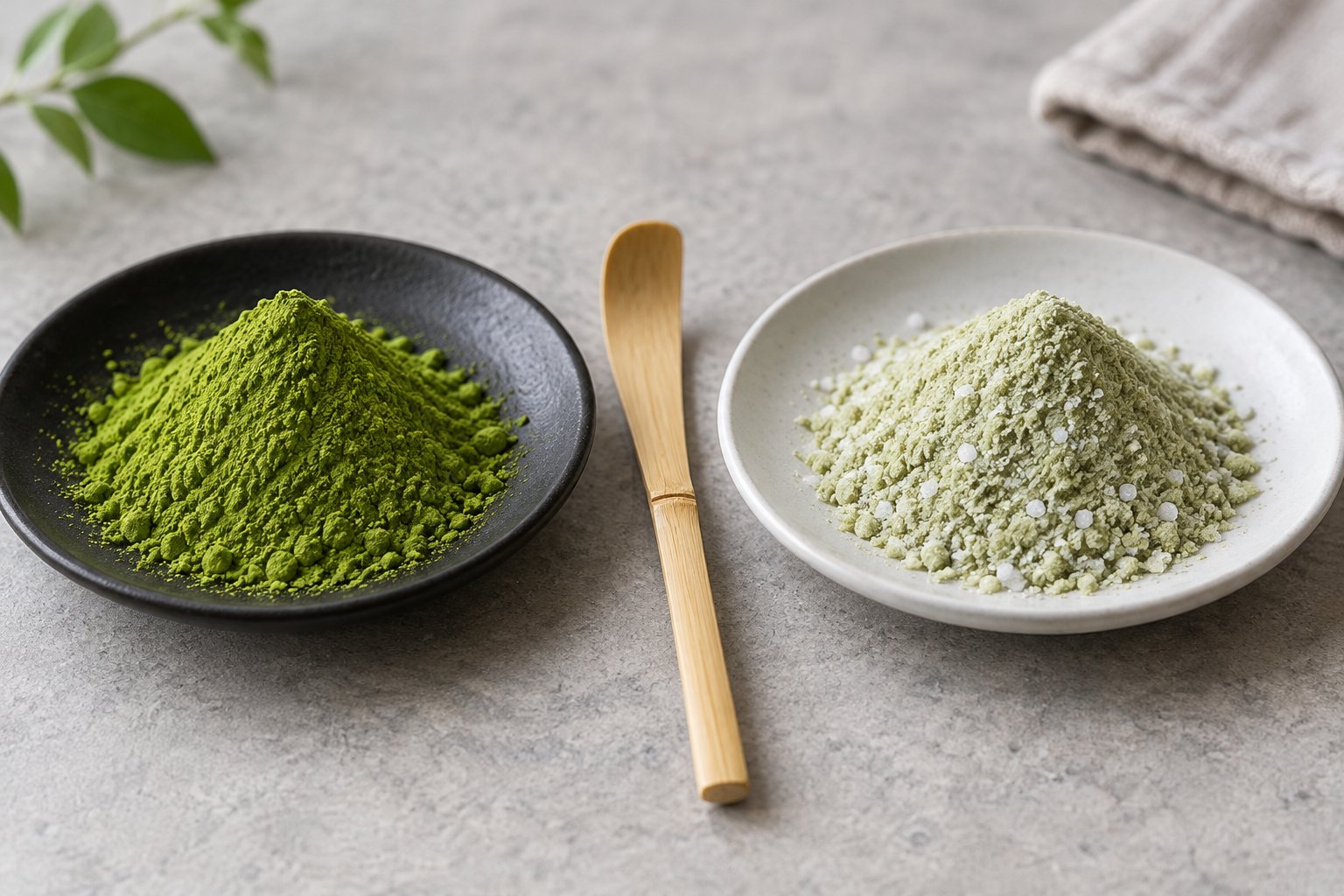
Hojicha powder is hojicha ground into a fine powder, and under the names in the labelling standard it is not matcha. In the labelling standard, tea ground into powder with a grinder or similar is “powdered tea,” a different name from matcha, which is tencha ground with a tea mill or similar.
Powder made from roasted tencha is not matcha either
Yamamasa Koyamaen in Uji, Kyoto, makes a hojicha powder called “Rich” by lightly roasting and grinding the “vein parts with leaf flesh attached” of tencha, the raw material for matcha, which can withstand roasting. The company states that it is not roasted matcha. The same company’s “Kogashi” is Uji tea from Kyoto Prefecture roasted twice, a powder with a deep color and a strong roasted flavor. Both list “green tea” as the ingredient.
| Item | Product page for hojicha powder “Rich” (translated) |
|---|---|
| Note | Made by roasting and grinding the “vein parts with leaf flesh attached” of the raw leaf for matcha, which can withstand roasting. It is not roasted matcha |
| Ingredient | Green tea (Kyoto Prefecture, using hand-picked first-flush tencha) |
| Best before | 8 months |
| Storage | Avoid high temperature and humidity, and store in a dark place |
Source: Yamamasa Koyamaen official online shop, “【焙じ茶パウダー】Rich” (Hojicha powder Rich, in Japanese) https://yamamasa-koyamaen.com/products/hojicha-powder-rich
According to Marukyu Koyamaen, tencha is put through a winnower during finishing, which uses air to remove stems and leaf veins. Some products, such as Yamamasa Koyamaen’s “Rich,” are made by roasting and grinding the vein parts of tencha. For products sold overseas as “roasted matcha,” ask your supplier whether the raw material is tencha and which part of the leaf is used.
Pure powder vs sweetened mixes
Hojicha powder comes as tea-only powder and as latte mixes with sugar or other ingredients added. If the ingredient list says only “green tea,” it is tea-only powder; if it lists sugar or milk ingredients, it is a mix. A mix fixes the sweetness of each cup, so tea-only powder suits shops that want to adjust sweetness themselves. How to tell the difference for matcha is covered in What Is Pure Matcha?
How to make a hojicha latte: published recipes compared
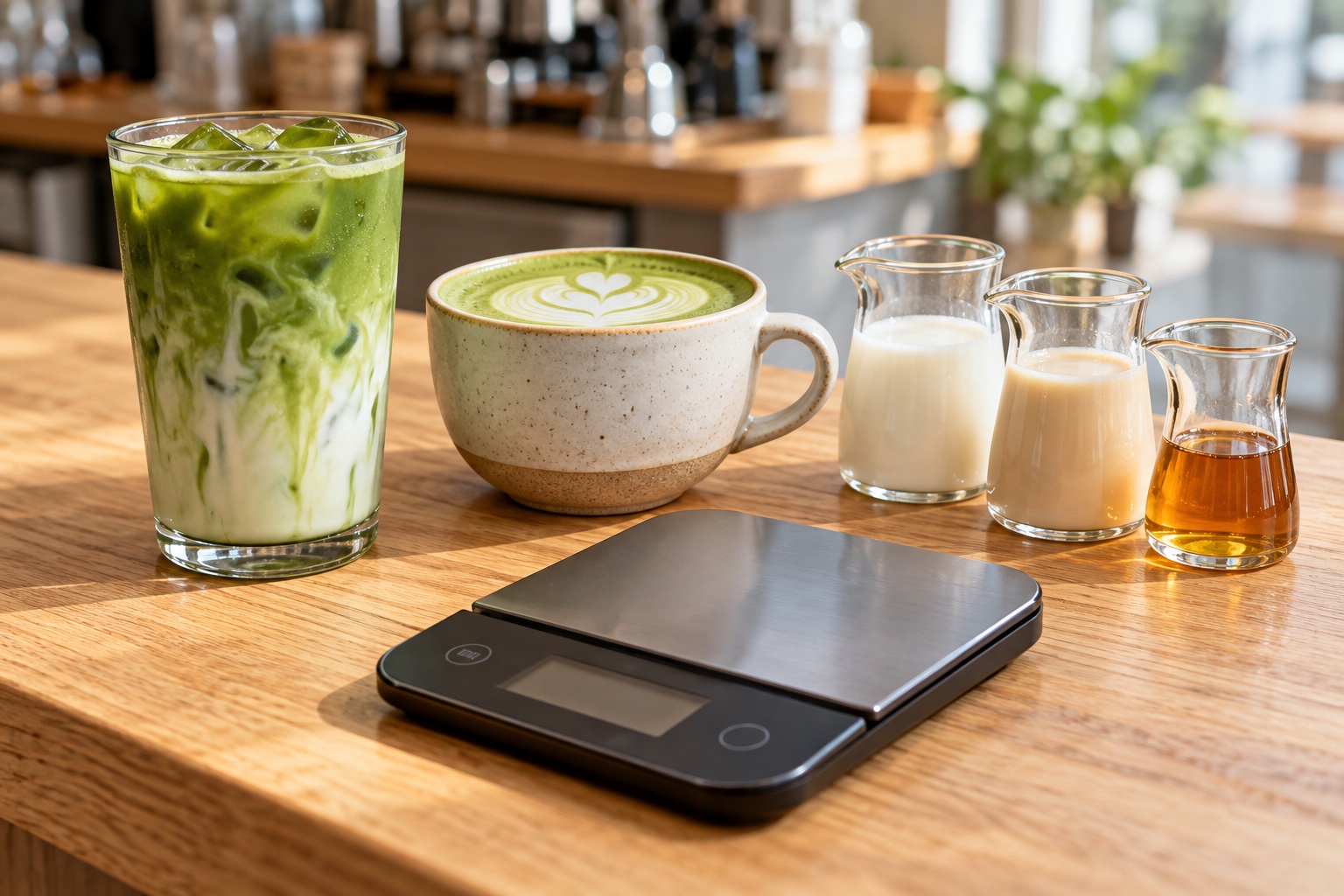
A hojicha latte is made either by dissolving powder in a little hot water and adding it to milk, or by brewing the leaves strong and adding milk. Among recipes published by a tea company and a coffee company, Yamamasa Koyamaen and Kurasu both use 4g of powder per cup.
Recipes side by side
| Yamamasa Koyamaen (hot) | Yamamasa Koyamaen (iced) | Kurasu | Ippodo Tea | |
|---|---|---|---|---|
| Hojicha | 4g of powder | 4g of powder | 4g of powder | 15g of leaves |
| Liquid to dissolve or brew | 50ml of boiling water | 50ml of cold water | 20g of hot water | 200mL of water at 100°C, 1 minute or more |
| Milk | 150ml | 150ml | About 150g (iced: 150g with 100g of ice) | To taste |
| Sweetener | 10g of sugar | 10g of syrup | 4g of sugar | None |
Kurasu is a Kyoto-based coffee company that also sells its own hojicha powder in its shops and online store. Its recipe mixes powder, sugar and hot water at 1:1:5 to make a syrup, then combines the syrup and milk at 1:5. Compared with Ippodo Tea’s matcha latte recipe (3g of matcha, 100ml of water at 80°C, 100ml of milk), the hojicha powder recipes use slightly more powder and less liquid to dissolve it.
Cold water works too
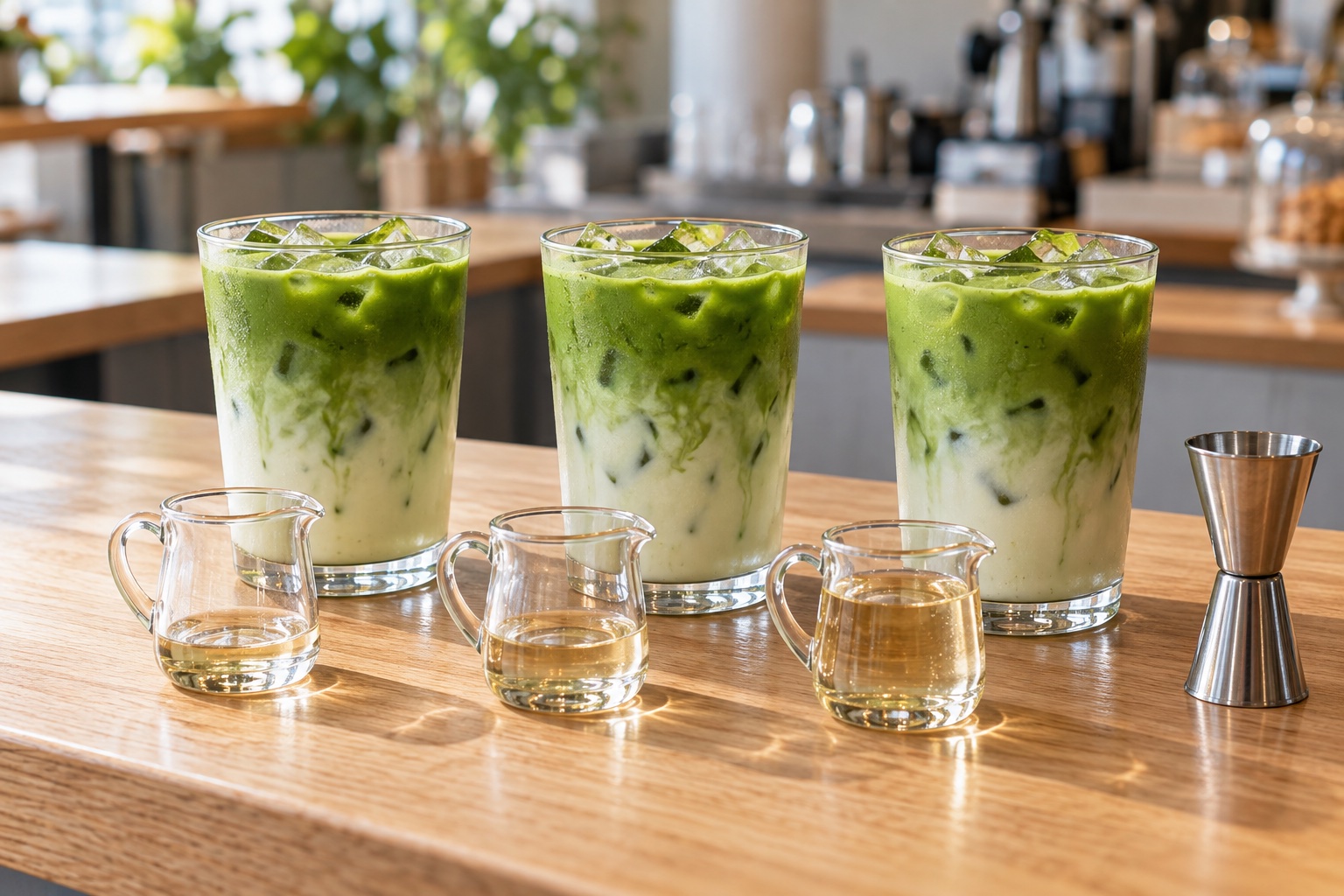
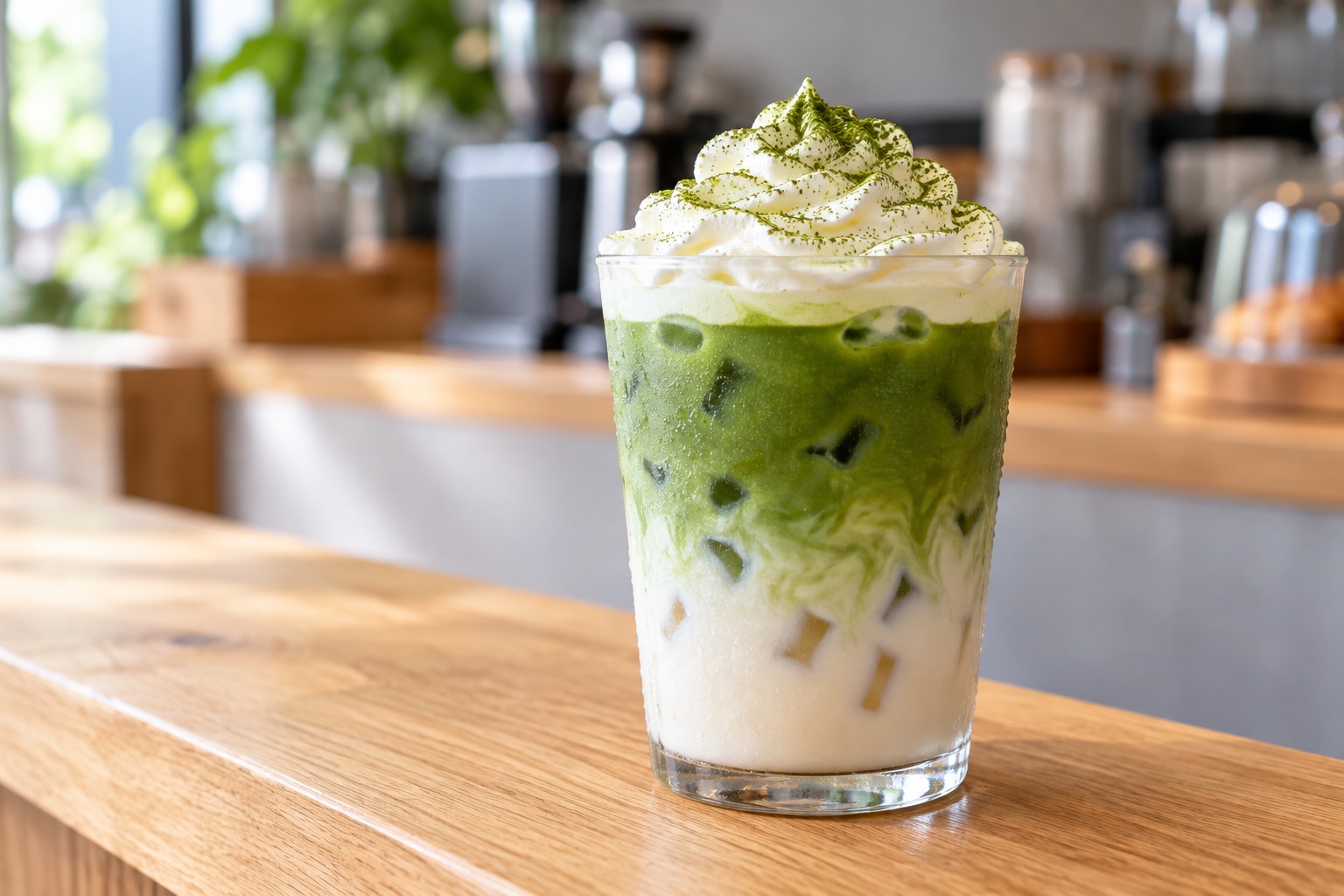
Yamamasa Koyamaen’s iced recipe dissolves the powder in 50ml of cold water instead of boiling water and pours it slowly into a glass of milk, syrup and ice. The company says that mixing with a chasen (bamboo whisk) or a milk frother makes the foam fluffier, and that pouring onto the ice makes two layers form more easily. Kurasu notes that the syrup tends to form lumps, so it should be mixed well with a spoon or spatula.
Setting your shop’s standard (our view)
- Start with a published ratio, such as 4g of powder, 50ml of liquid and 150ml of milk
- Scale the powder and milk in the same proportion to fit your cup size
- Taste side by side with each milk you use, such as dairy and oat milk, and check how much aroma comes through
- Write down the amounts in grams so every staff member makes it the same way
How to pour and prepare iced drinks ahead is covered for matcha in Iced Matcha Latte Recipe. Cost per cup can be worked out with the same formula as in How to Choose Matcha for Café Lattes.
What to check when buying hojicha for a café
When buying hojicha powder, check five things: raw material, roast level, particle fineness, lot and documents. Products with the same name, “hojicha powder,” can differ greatly in taste and color depending on the part of the leaf used and how it was roasted.
Five things to check
| Item | What to check | Why |
|---|---|---|
| Raw material | Product name and ingredients (green tea only, or sugar and other additions), origin, and whether it is leaf, stem or tencha veins | The material and the part used change the aroma. A mix has fixed sweetness |
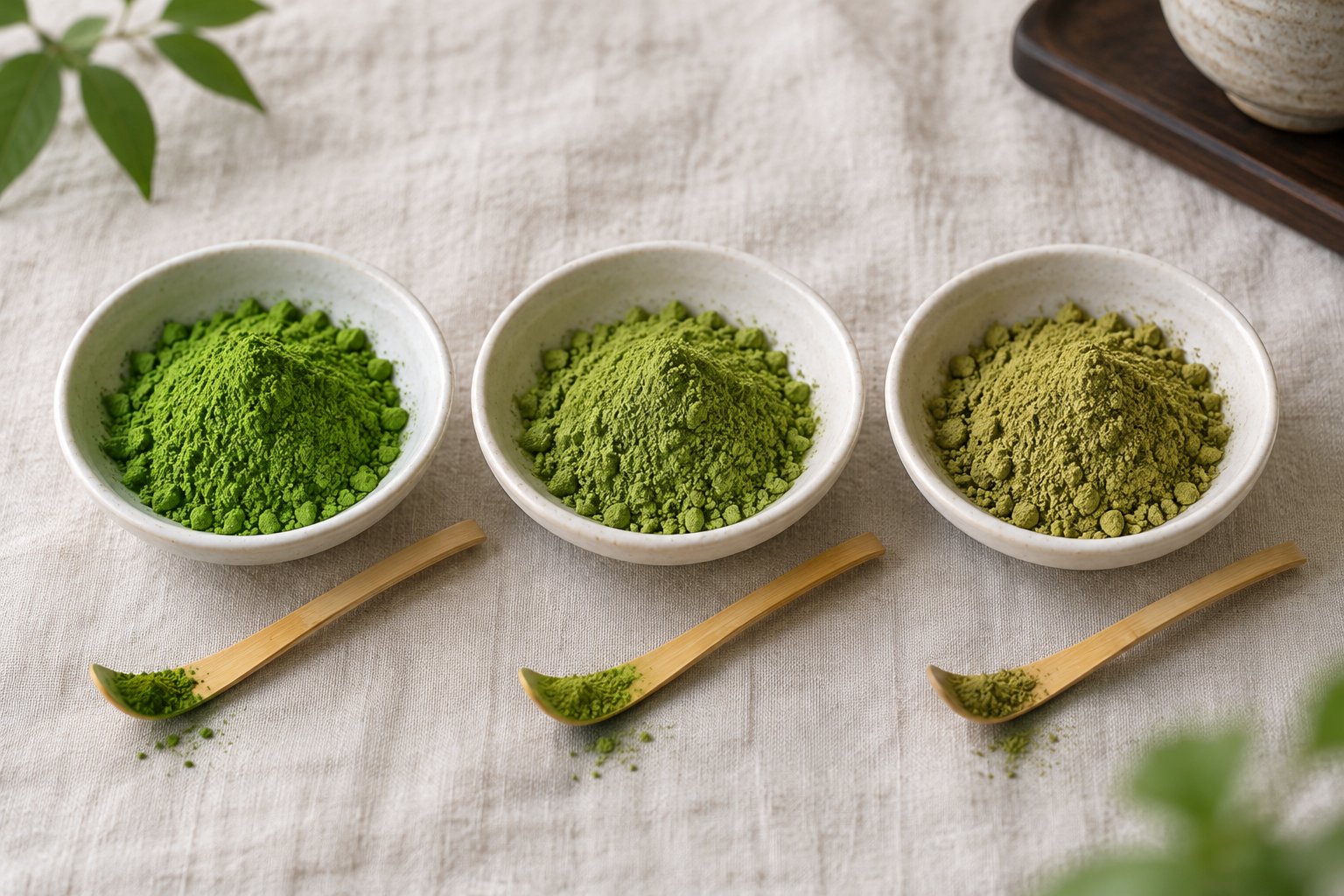
| Roast level | The supplier’s description of a light or deep roast, and a tasting of lattes made with the same amount | There is no common scale for roast level, so compare by taste rather than words |
| Particle fineness | Whether lumps or sediment remain when dissolved in hot and cold water | To check whether it leaves undissolved powder in cold drinks |
| Lot | Lot numbers, and how the supplier checks color and aroma between lots | Tea leaves change slightly by year and by picking season |
| Documents | Specification sheet, certificate of analysis (COA), pesticide residue test results, best-before date and storage method | For import procedures and for explaining the product to customers |
How to compare
A description of the roast level does not tell you whether it suits your menu. Ask for two or three samples, make them with the same amount of powder, the same water and the same milk, and taste them side by side. If you will serve it next to a matcha latte, also check how the depth of color and the strength of aroma look different on the menu.
Import procedures differ by country. For Singapore, see How to Import Matcha into Singapore; for Thailand, see How to Choose Matcha for Café Lattes. For choosing a matcha supplier, see Bulk Matcha: How to Buy Matcha Wholesale.
How to store hojicha
Store hojicha away from heat, humidity, light and odors from other foods. Marukyu Koyamaen says green tea is sensitive to these four, and that handling green teas other than matcha with the same care as matcha is the safe approach.
What tea companies say
- Marukyu Koyamaen: after opening a bag of tea, move it into a can or other airtight container
- Yamamasa Koyamaen: hojicha powder has a best-before period of 8 months, with the storage method “avoid high temperature and humidity, and store in a dark place”
- Ippodo Tea: gives the shelf life of its hojicha product as “Consume quickly”
The label examples in the Japan Tea Central Public Interest Incorporated Association’s labelling standard also give the storage method for green tea as “avoid high temperature and humidity, and take care with odors from other foods.”
In shops in hot climates
In Singapore and Bangkok, the monthly mean temperature is above 25°C all year, and humidity is high (in the 1991 to 2020 normals of the Meteorological Service Singapore and the Thai Meteorological Department, monthly means are 26.8 to 28.6°C in Singapore and 27.3 to 30.7°C in Bangkok). Move opened bags into an airtight container and keep it away from heat sources such as espresso machines. Marukyu Koyamaen says that frozen matcha will collect condensation and become damp unless it is brought close to room temperature before opening, and recommends bringing refrigerated matcha as close to room temperature as possible before use. If you keep hojicha powder chilled, let it come to room temperature with the bag still closed before opening it (our view). Storage tests at different temperatures and how to decide order quantities are covered for matcha in Does Matcha Go Bad?
Omakase Matcha plans to add hojicha and genmaicha powders; they are coming soon. The matcha we currently carry is on the Catalog, and how we think about grades is on Matcha grades.
Sources
- Japan Tea Central Public Interest Incorporated Association, “緑茶の表示基準” (Green Tea Labelling Standard, last revised 10 July 2026, in Japanese) https://www.nihon-cha.or.jp/pdf/hyoujikijyun.pdf
- MEXT Food Composition Database, “ほうじ茶 浸出液” (Hojicha, infusion, food number 16040, in Japanese) https://fooddb.mext.go.jp/details/details.pl?ITEM_NO=16_16040_7
- MEXT Food Composition Database, “番茶 浸出液” (Bancha, infusion, food number 16039, in Japanese) https://fooddb.mext.go.jp/details/details.pl?ITEM_NO=16_16039_7
- MEXT Food Composition Database, “せん茶 浸出液” (Sencha, infusion, food number 16037, in Japanese) https://fooddb.mext.go.jp/details/details.pl?ITEM_NO=16_16037_7
- MEXT Food Composition Database, “玉露 浸出液” (Gyokuro, infusion, food number 16034, in Japanese) https://fooddb.mext.go.jp/details/details.pl?ITEM_NO=16_16034_7
- MEXT Food Composition Database, “抹茶 茶” (Matcha, tea, food number 16035, in Japanese) https://fooddb.mext.go.jp/details/details.pl?ITEM_NO=16_16035_7
- MAFF, “茶をめぐる情勢(令和8年10月)” (The situation of tea, October 2026, in Japanese) https://www.maff.go.jp/j/seisan/tokusan/cha/attach/pdf/ocha-201.pdf
- NARO Institute of Vegetable and Tea Science, “茶の焙煎程度の簡易評価方法” (A simple method for evaluating the degree of tea roasting, in Japanese) https://www.naro.go.jp/laboratory/nfri/seikatenji/files/poster020.pdf
- Yuzo Mizukami, “Solvent-assisted flavor evaporation装置を用いた高真空蒸留と香気エキス希釈分析法によるほうじ茶葉香気寄与成分の特定” (Identification of aroma-active compounds in hojicha leaves, Tea Research Journal No. 113, 2012, in Japanese) https://www.jstage.jst.go.jp/article/cha/2012/113/2012_113_55/_article/-char/ja
- Kyoto Prefectural Tea Research Institute, “お茶のおいしい入れ方 抹茶” (How to make delicious tea: matcha, in Japanese) https://www.pref.kyoto.jp/chaken/irekata_maccha.html
- Ippodo Tea, “Stems Hojicha” https://ippodotea.com/products/kuki-hojicha
- Ippodo Tea, “Hojicha with Milk” https://ippodotea.com/blogs/recipes-to-brew-japanese-tea/hojicha-with-milk
- Ippodo Tea, “Matcha Latte Recipe” https://ippodotea.com/blogs/recipes-to-brew-japanese-tea/matcha-latte-recipe
- Yamamasa Koyamaen, “【レシピ】焙じ茶パウダーの楽しみ方” (Recipes with hojicha powder, 4 August 2022, in Japanese) https://www.yamamasa-koyamaen.co.jp/enjoy/2022/post-20/
- Yamamasa Koyamaen, “【焙じ茶パウダー】Rich” (Hojicha powder Rich, in Japanese) https://yamamasa-koyamaen.com/products/hojicha-powder-rich
- Yamamasa Koyamaen, “【焙じ茶パウダー】焦がし” (Hojicha powder Kogashi, in Japanese) https://yamamasa-koyamaen.com/products/hojicha-powder-kogashi
- Kurasu, “「ほうじ茶ラテ」の美味しいレシピ” (A hojicha latte recipe, 17 July 2024, in Japanese) https://jp.kurasu.kyoto/blogs/kurasu-journal/hojicha-recipe
- Kurasu, “Kurasuについて” (About Kurasu, in Japanese) https://jp.kurasu.kyoto/pages/kurasu-story
- Kurasu, “ほうじ茶粉・HOJICHA” (Hojicha powder, in Japanese) https://jp.kurasu.kyoto/products/hojicha
- Marukyu Koyamaen, “抹茶について・お茶の保存方法・抹茶ができるまで” (About matcha, how to store tea, how matcha is made, in Japanese) https://www.marukyu-koyamaen.co.jp/about-tea/know-matcha.html
- Meteorological Service Singapore, “Climate of Singapore” https://www.weather.gov.sg/climate-climate-of-singapore/
- Thai Meteorological Department, “Climatological Data for the Period 1991-2020” https://ubonmet.tmd.go.th/files/MetInfo/climate_normal.pdf