
 Reviewed by: Takahiro Sugiyama (CEO, meguri Inc.)
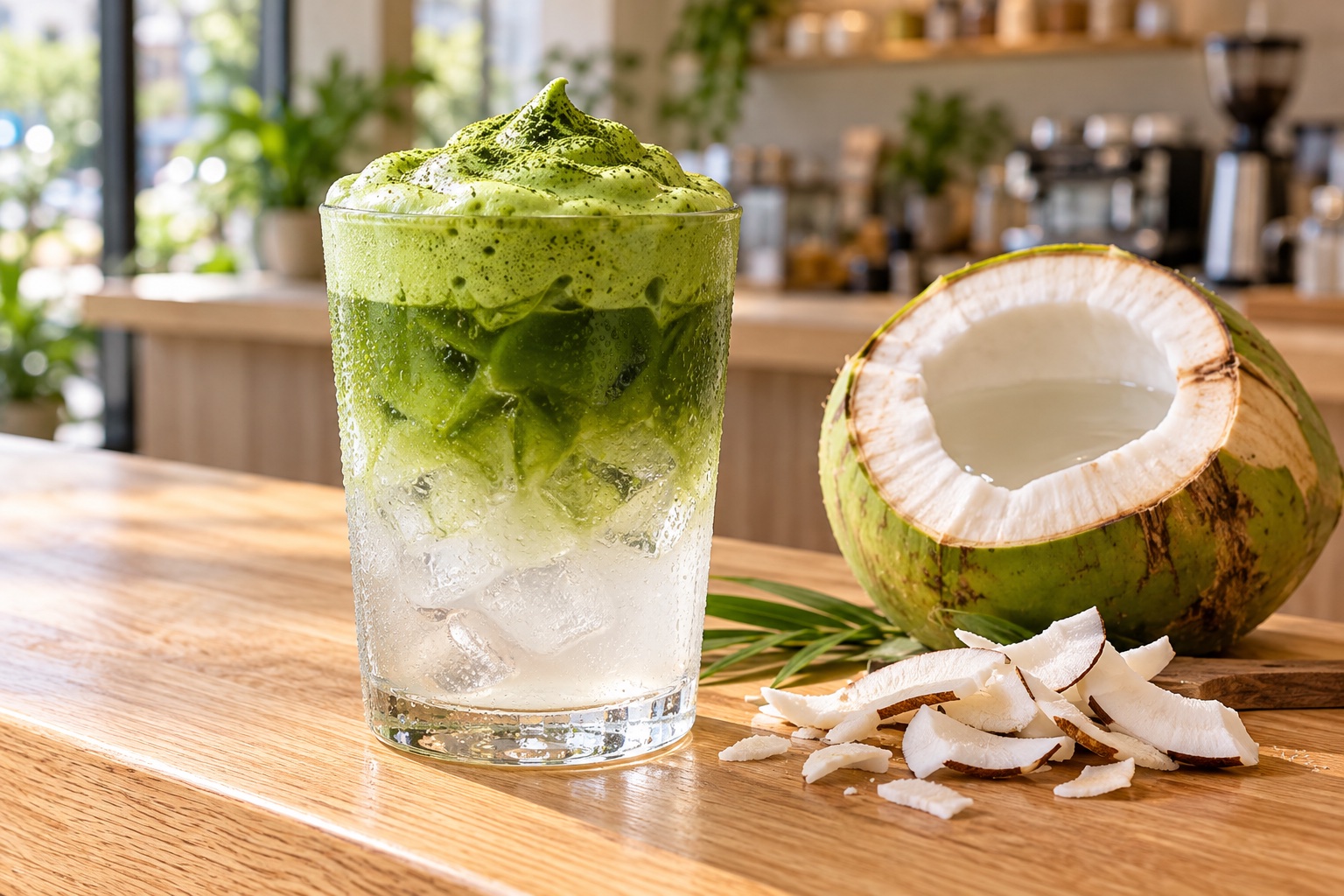
Matcha shops in Singapore and Thailand now list a matcha latte made with coconut milk instead of dairy milk, and “cloud matcha”, a matcha foam floated on coconut water. Both carry the word “coconut”, but the fat in the ingredients is very different, and so are how they separate, how they foam and how they are labeled. This guide compares official recipes from tea companies and others, checks the reasons against food composition data and research, then covers prep, labeling and cost.
What are coconut matcha lattes and cloud matcha?
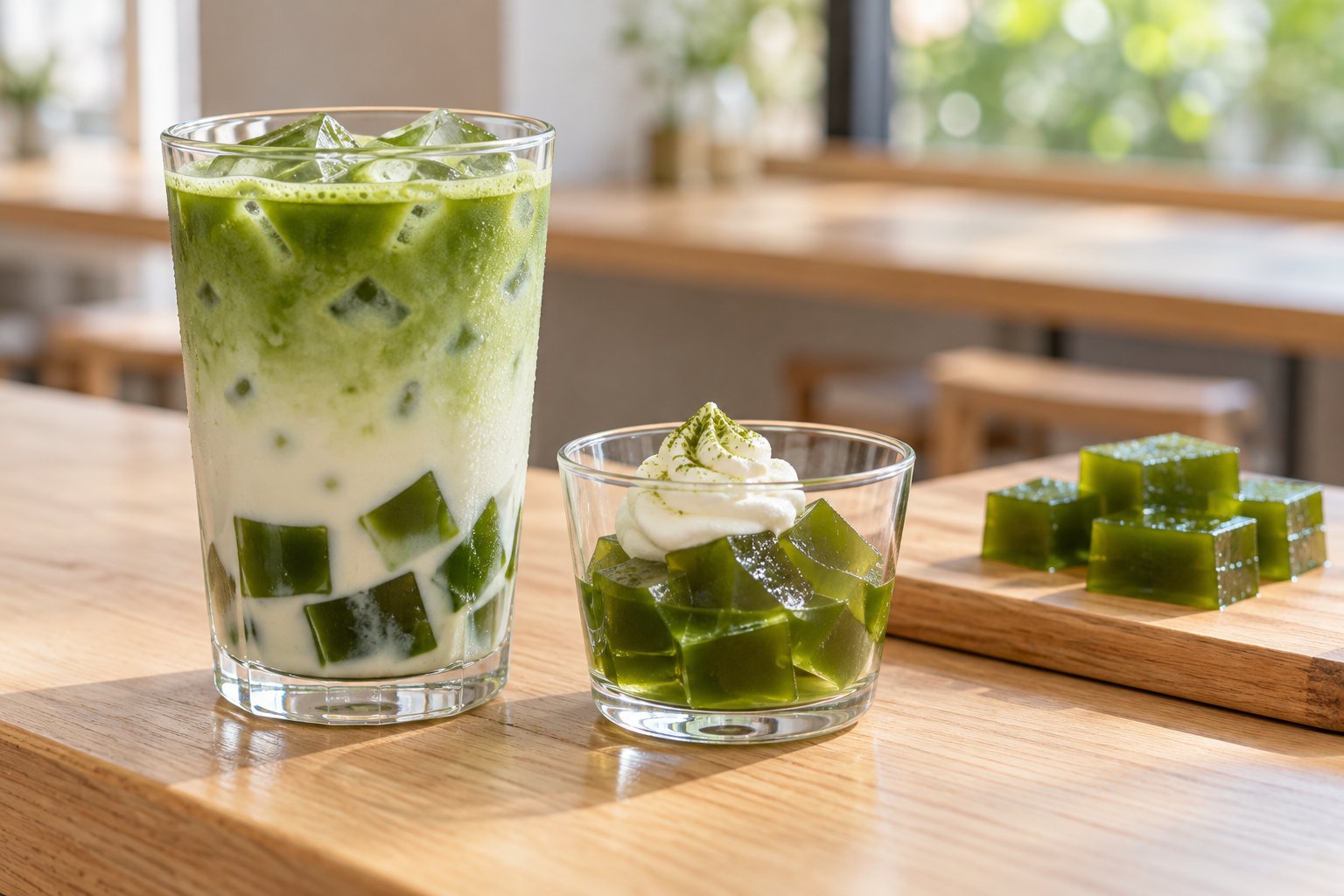
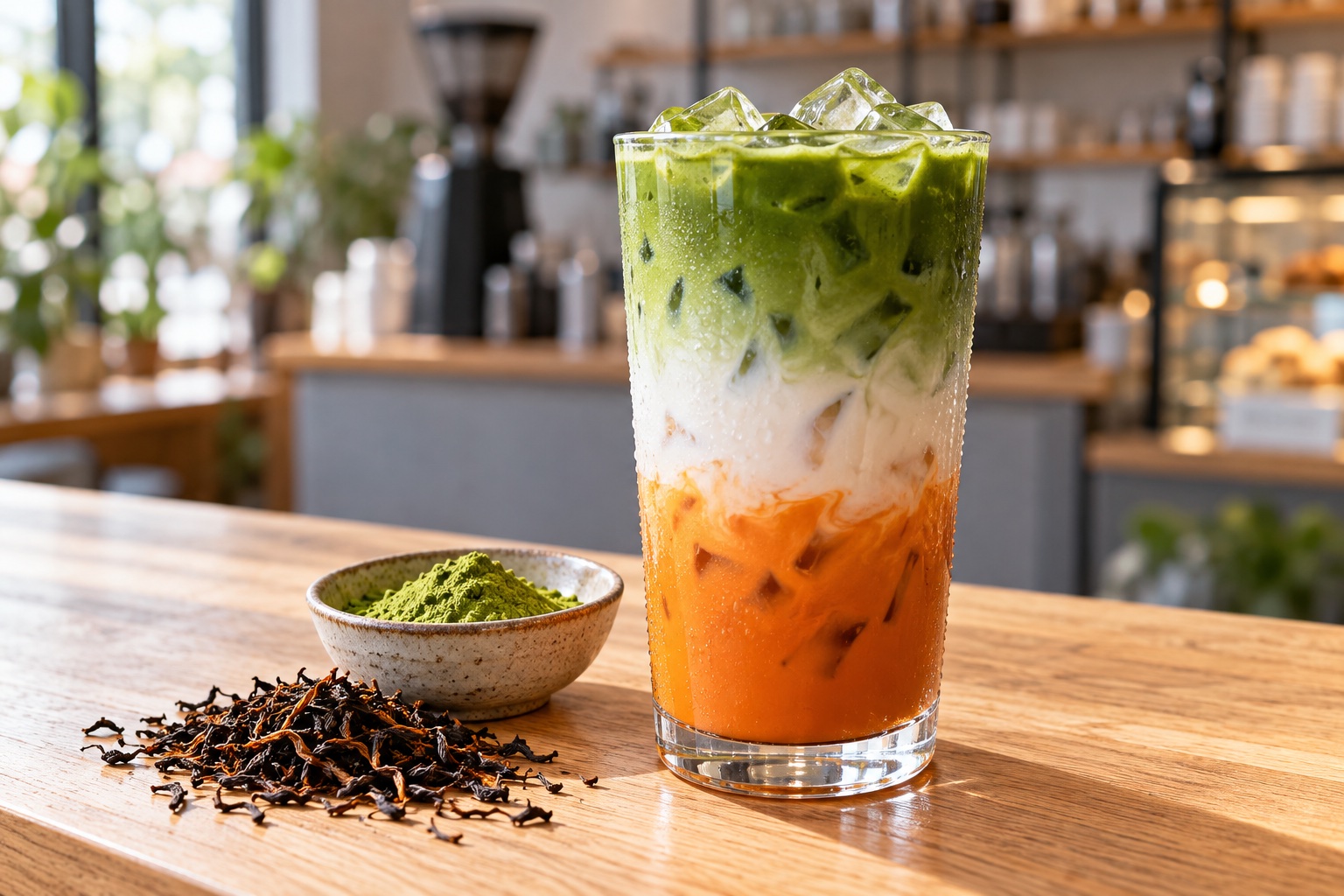
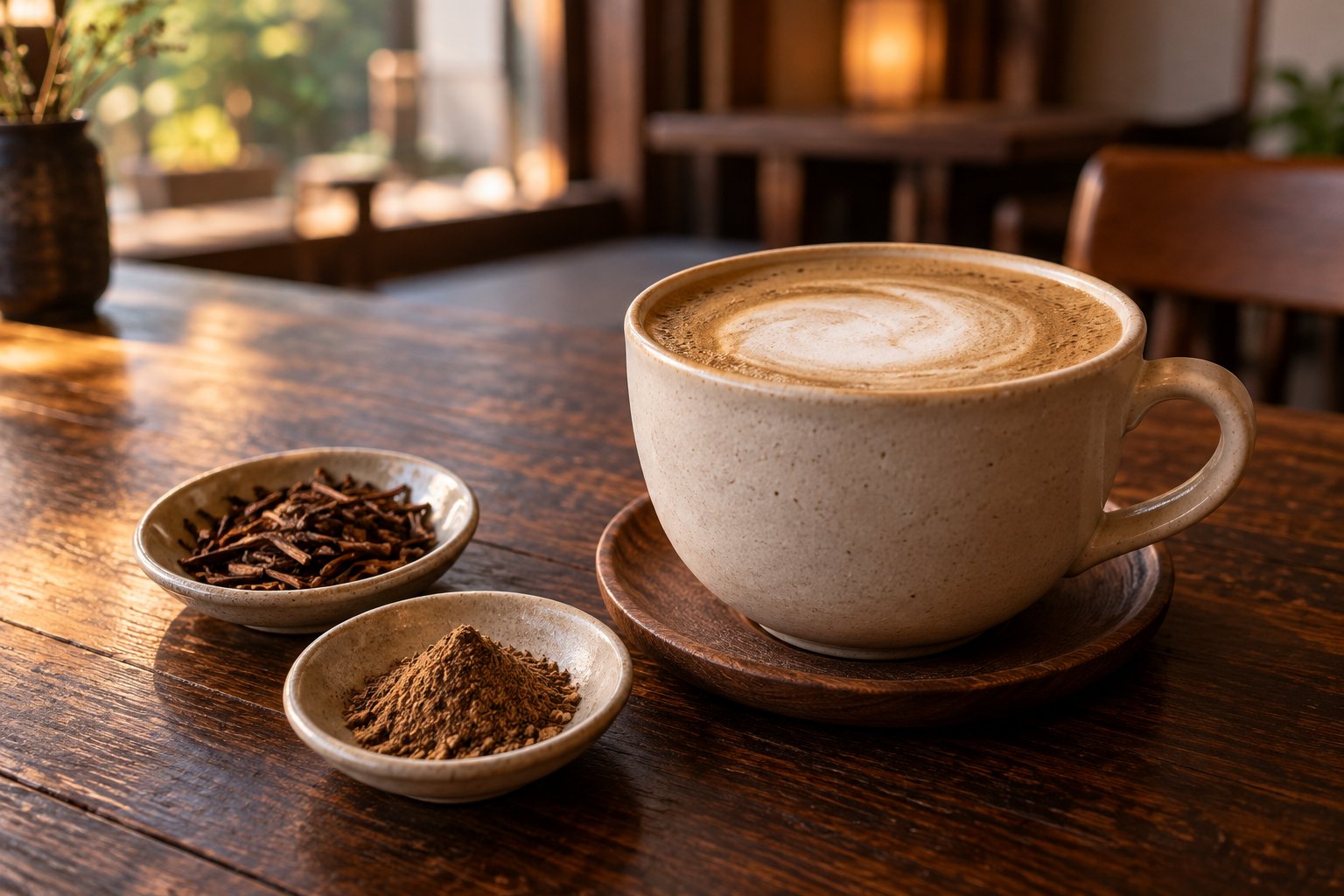
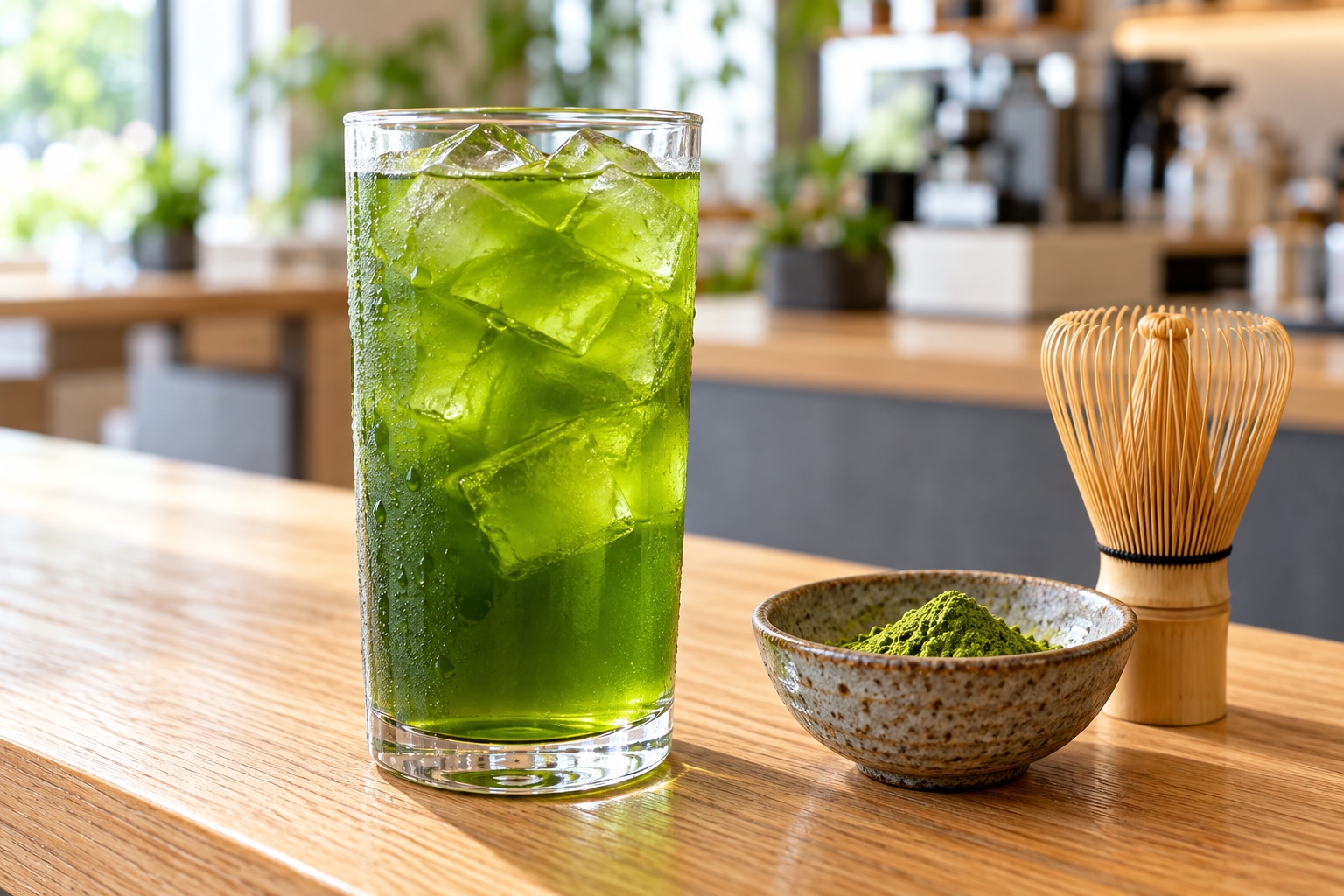
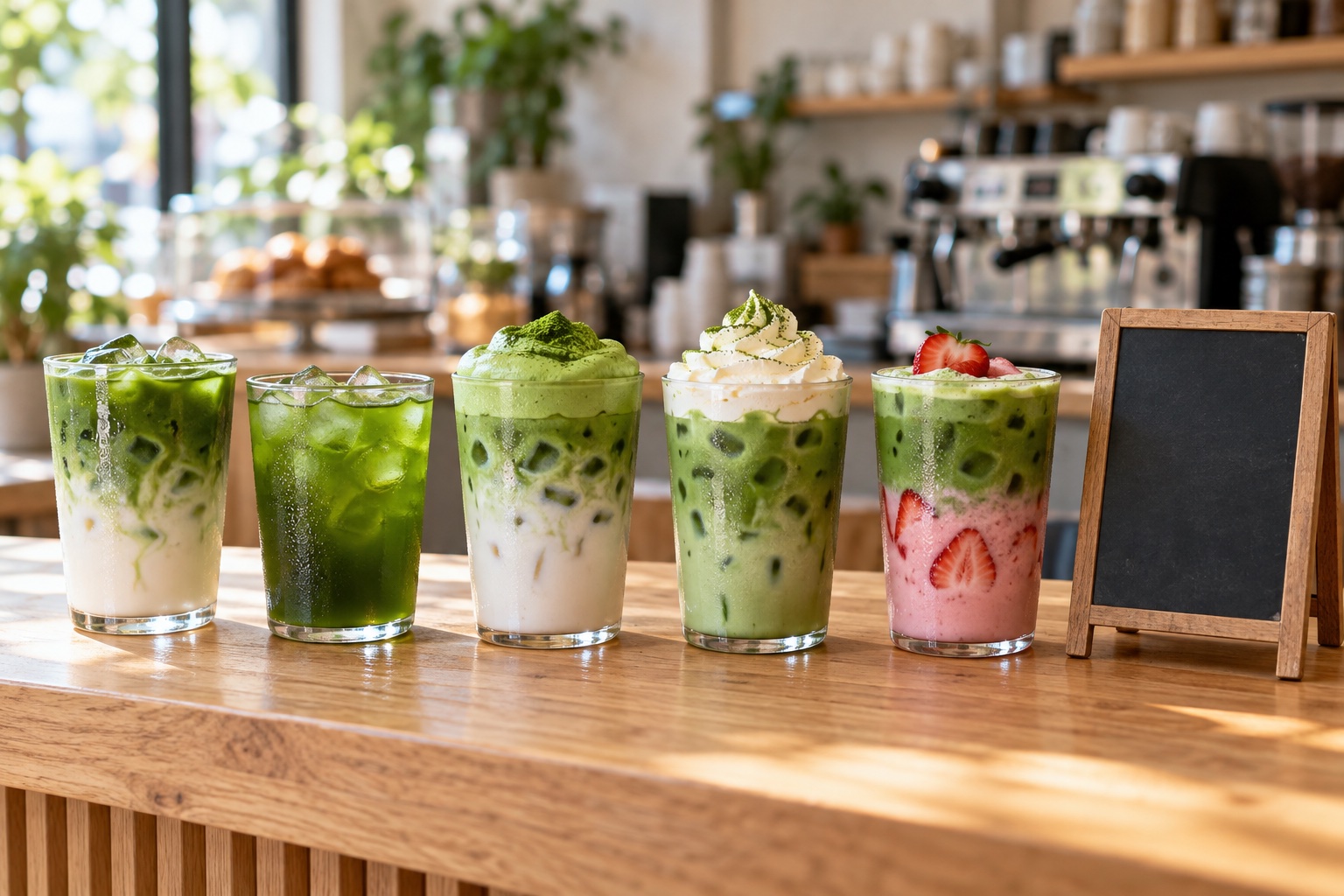
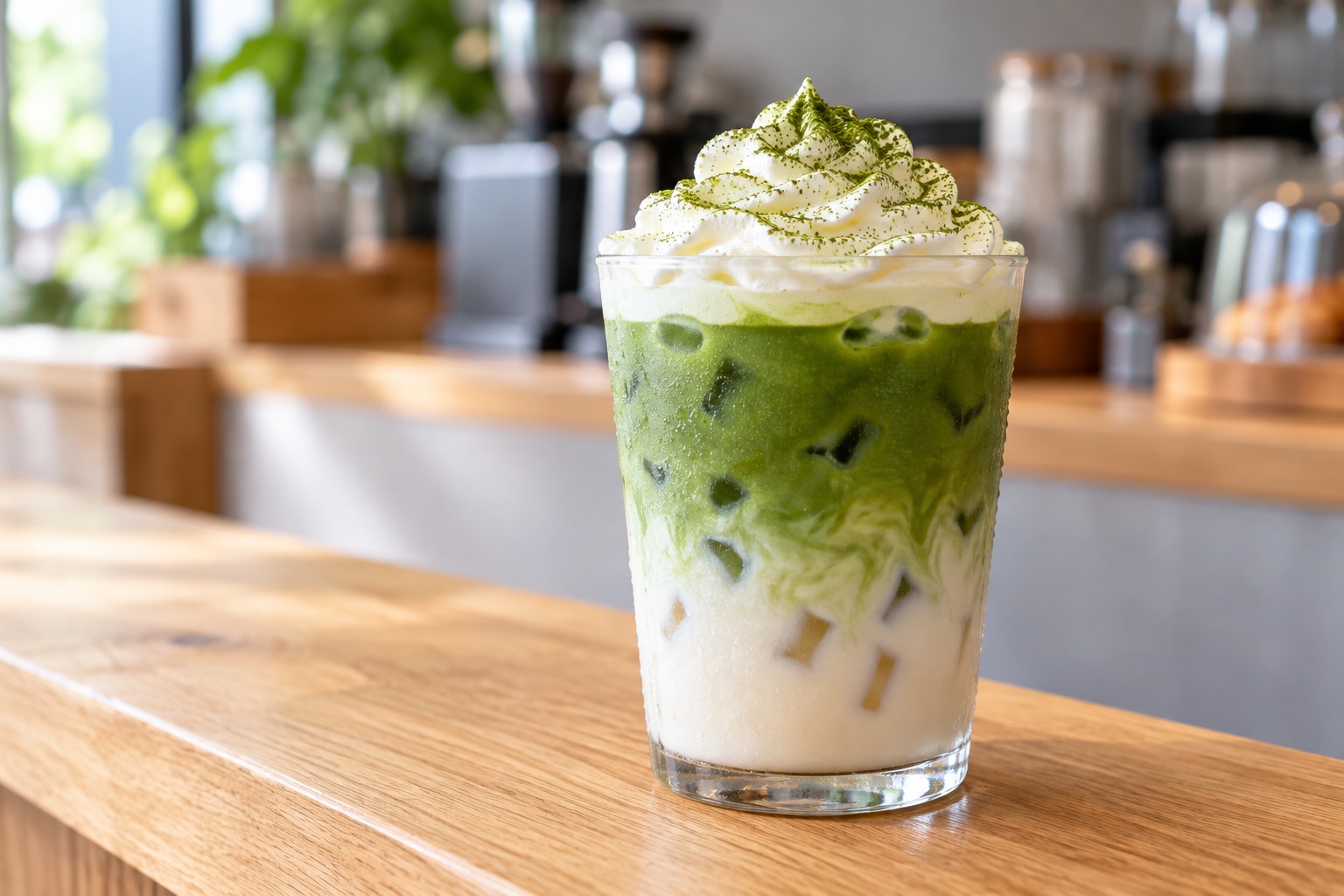
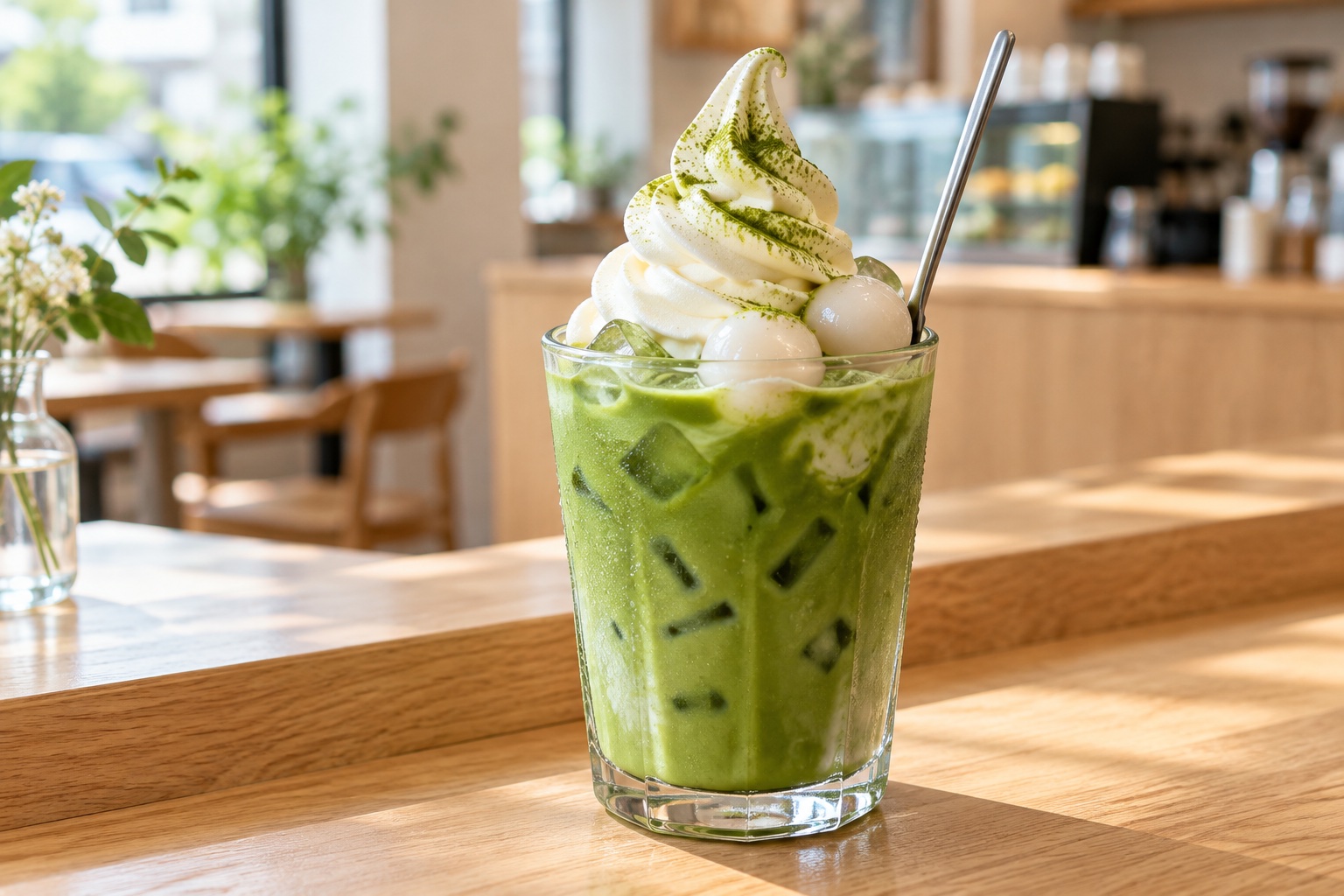
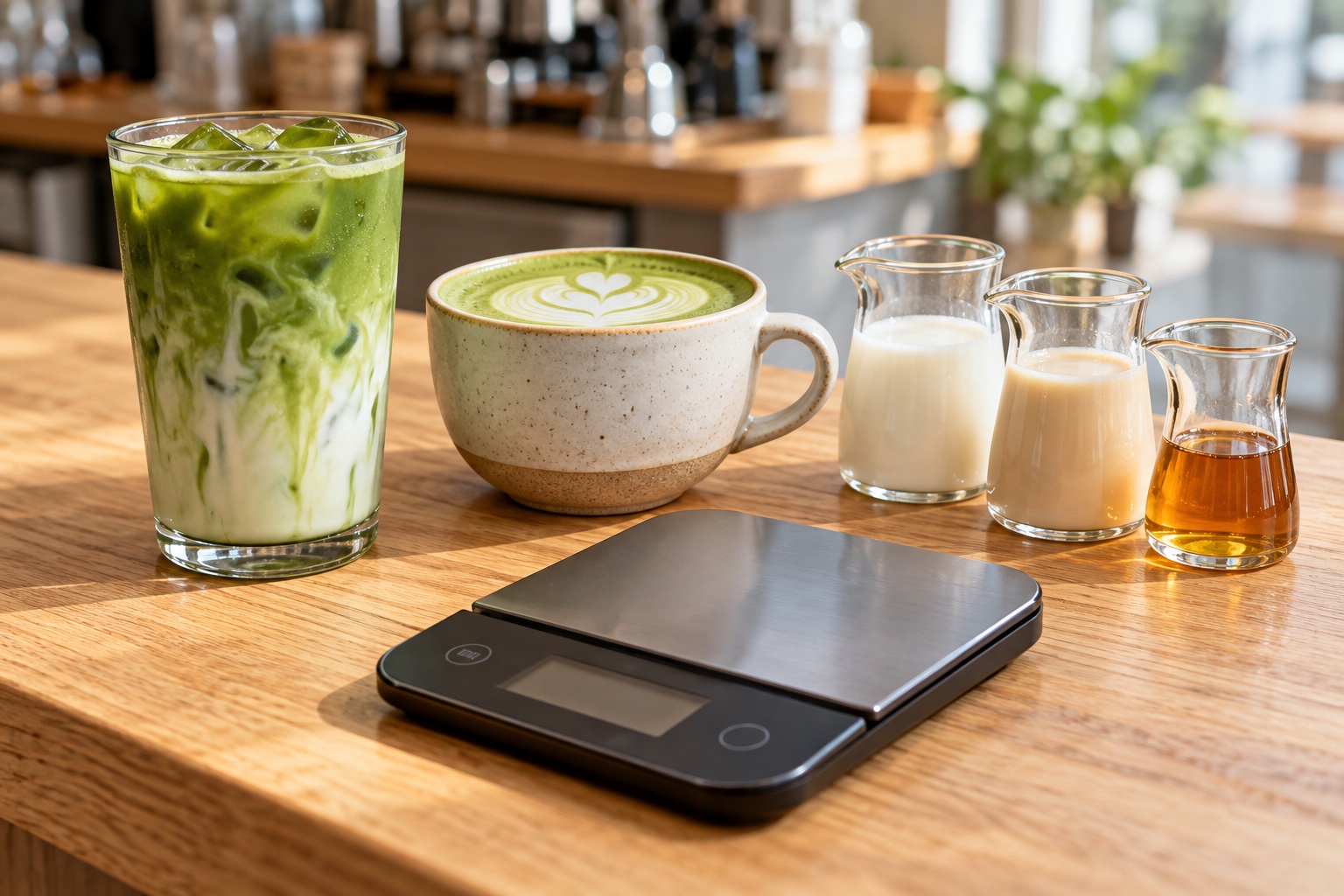
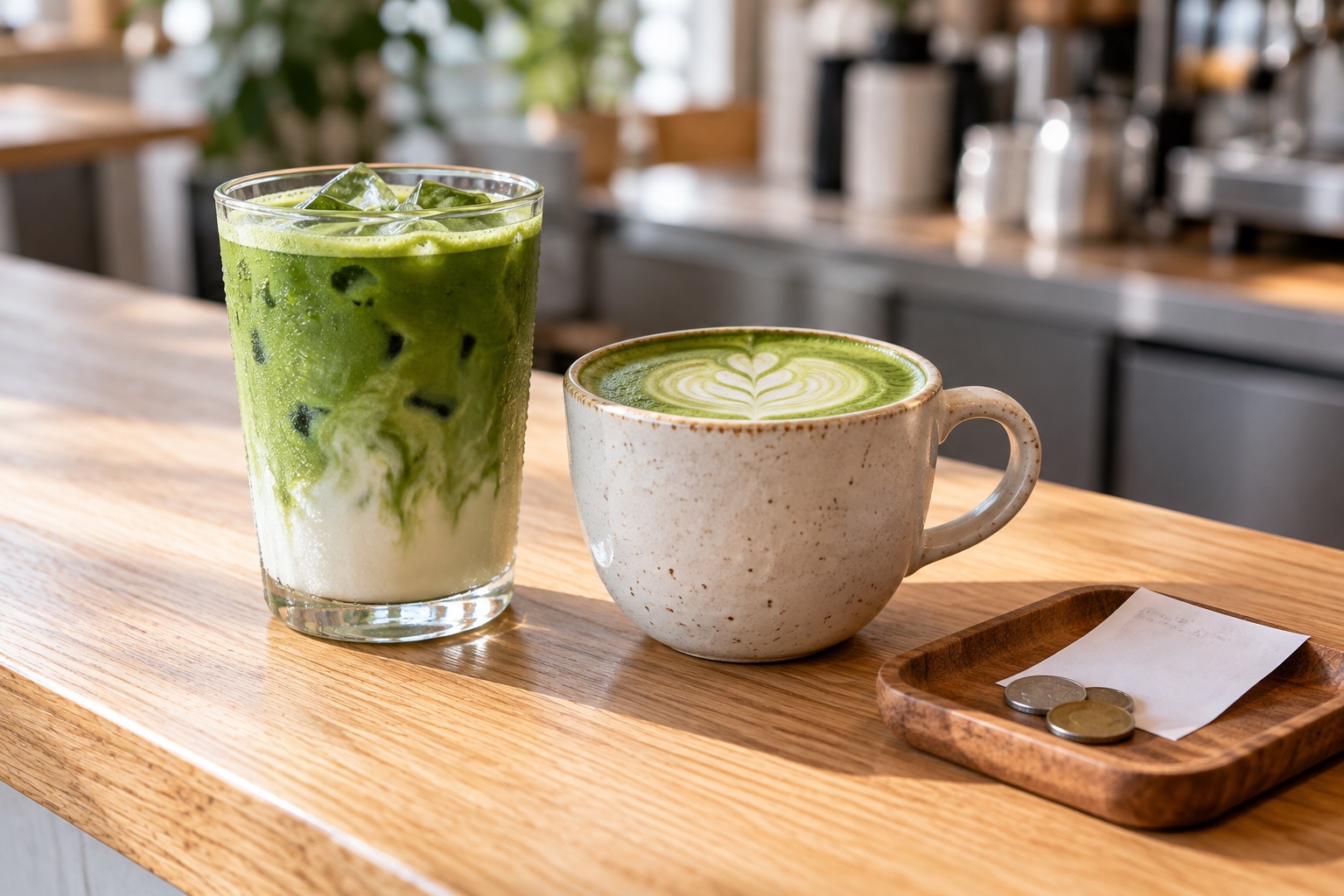
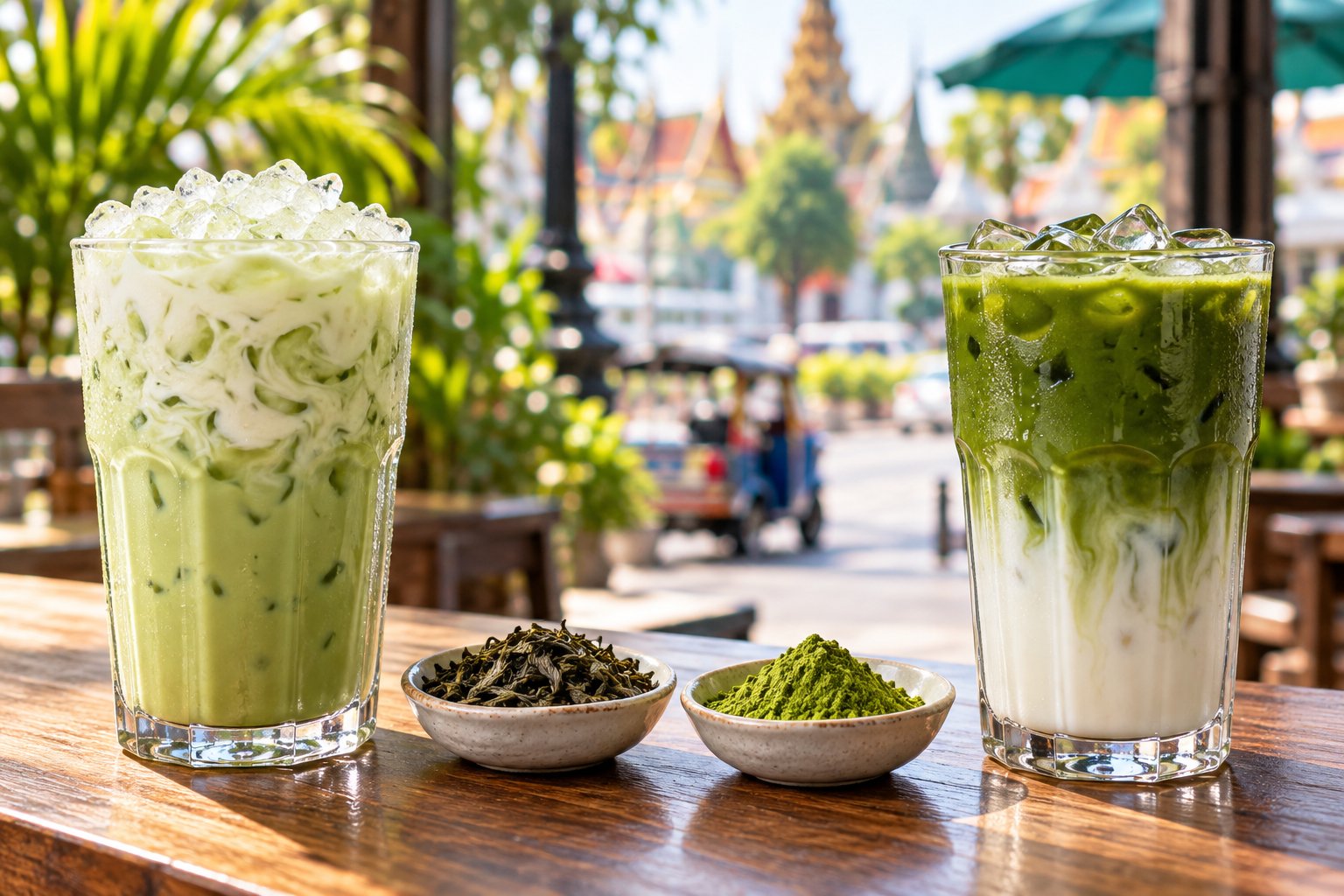
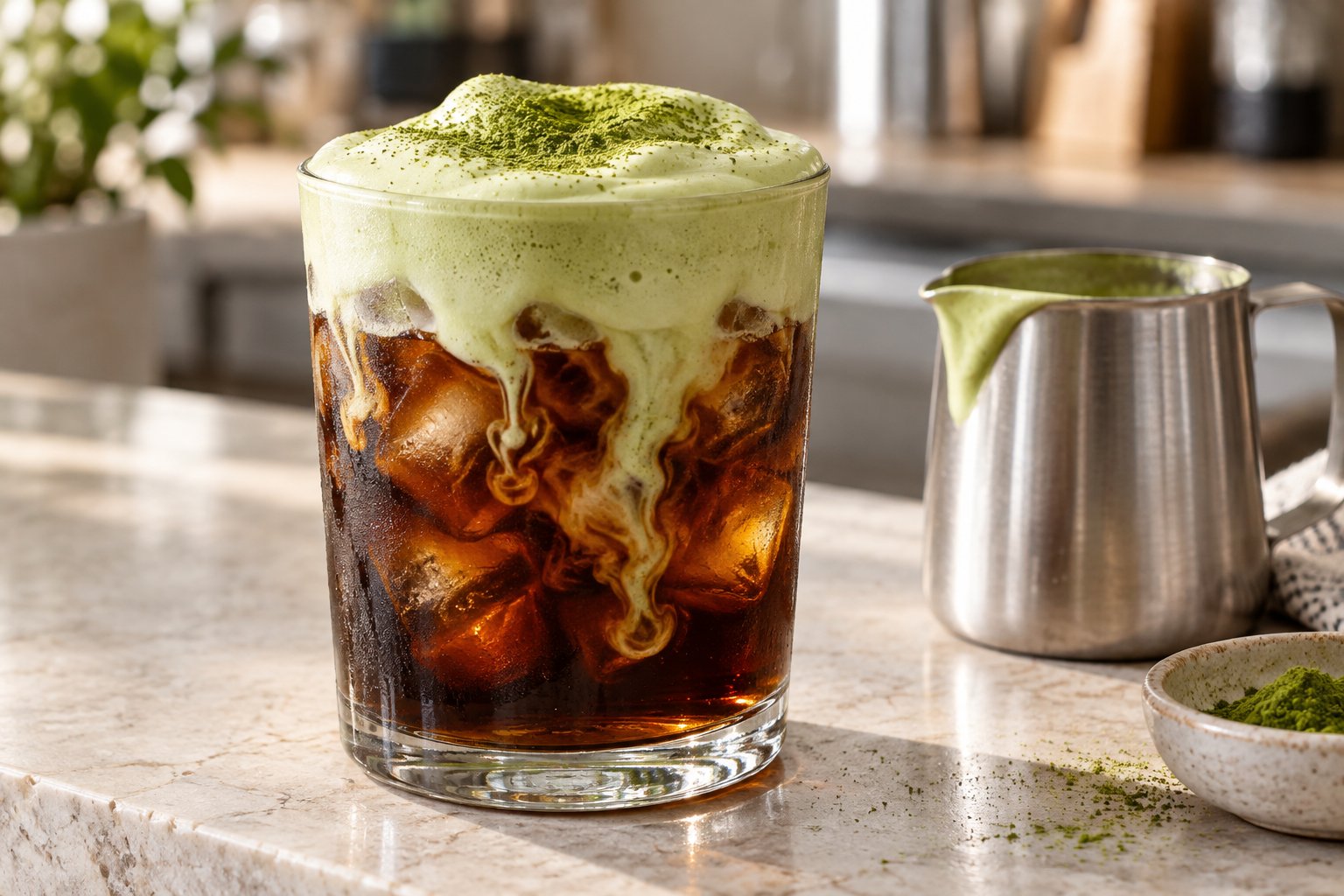
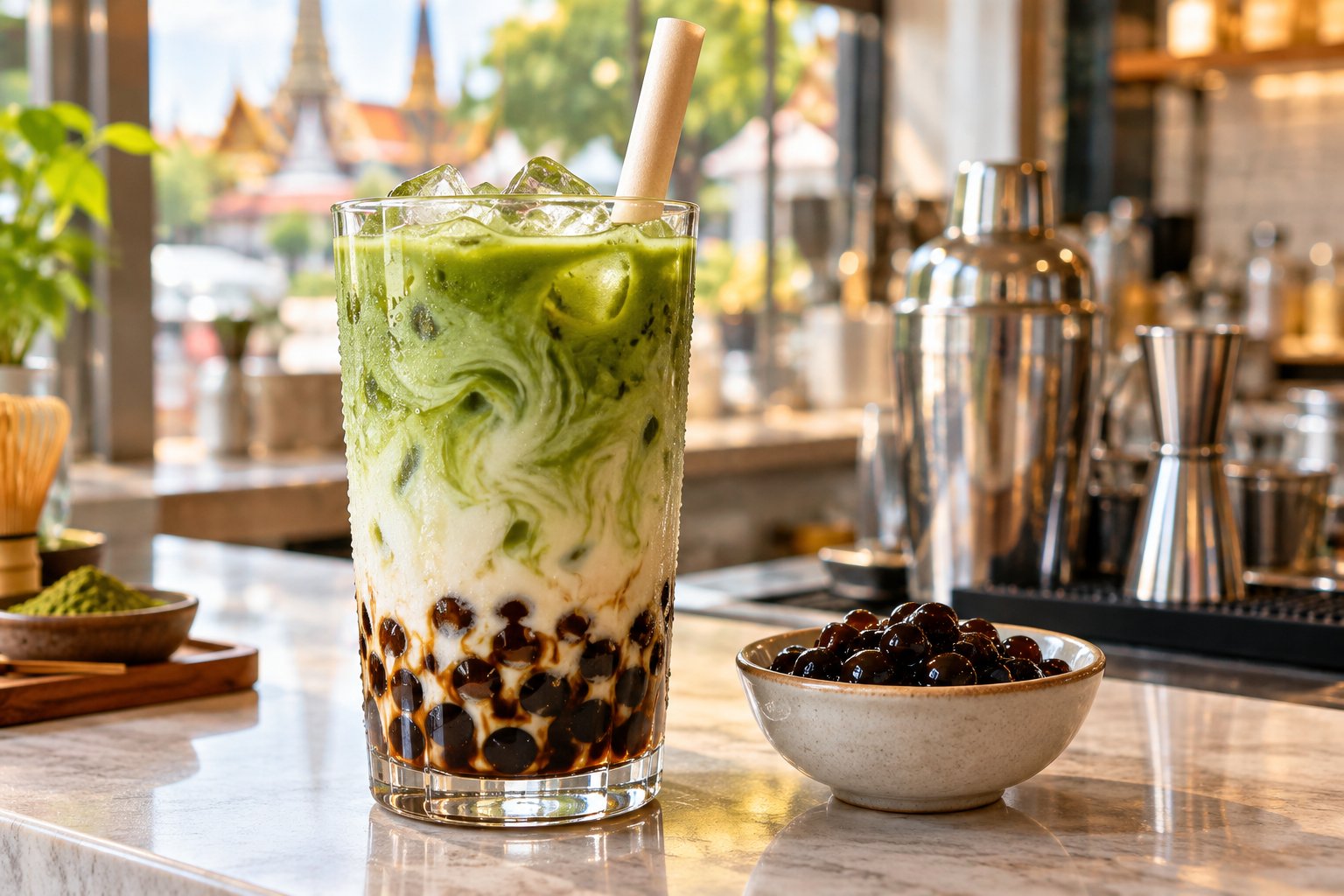
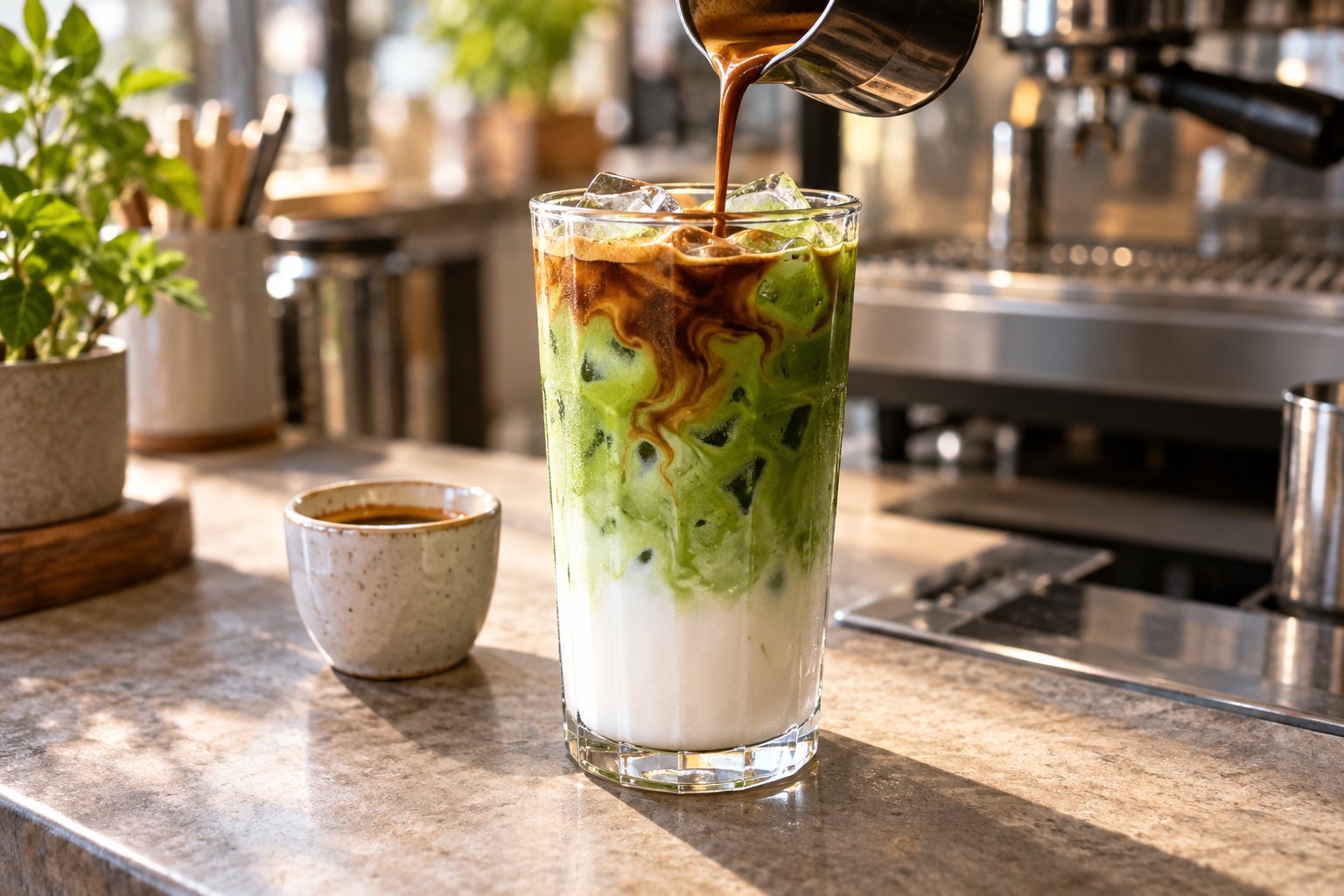
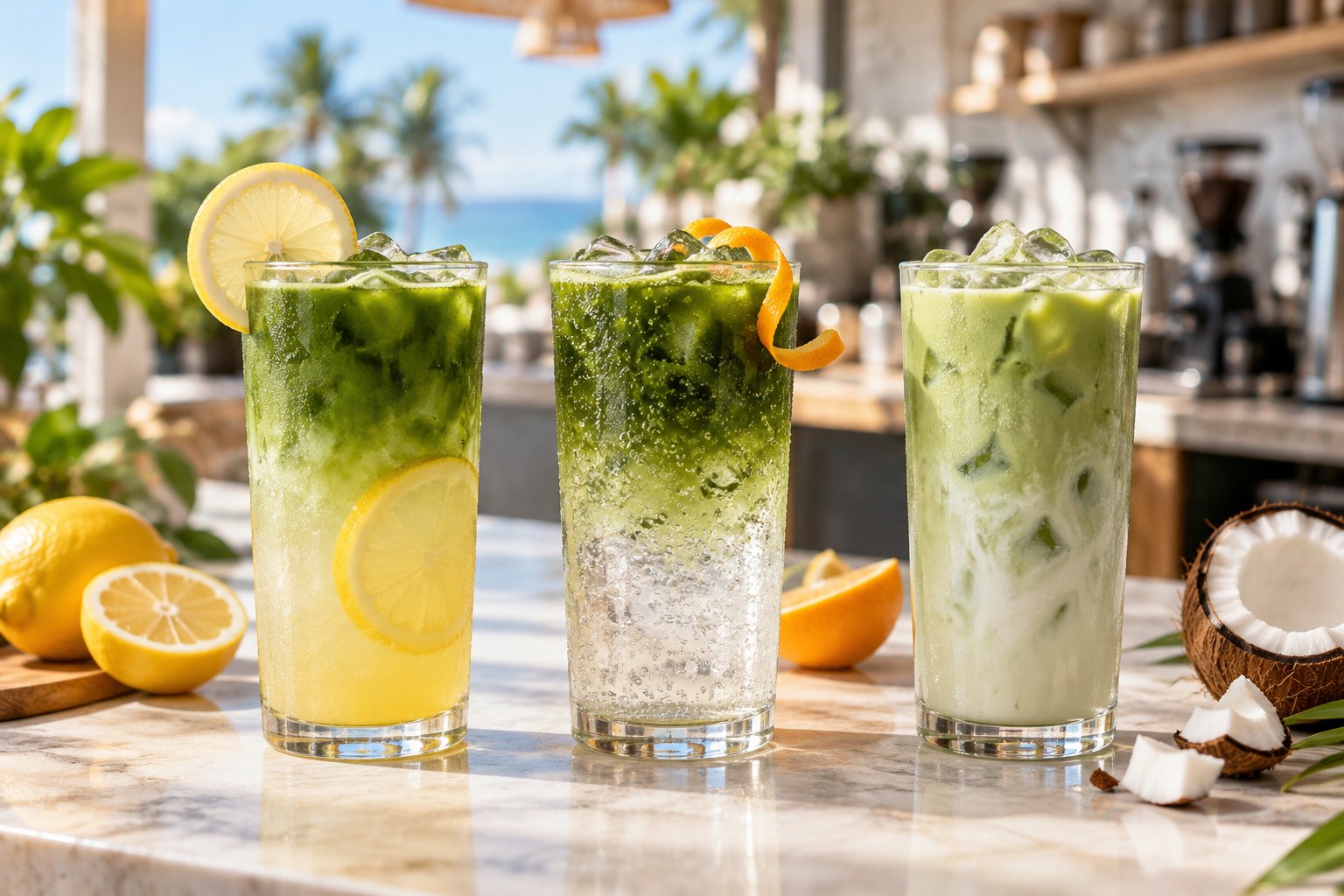
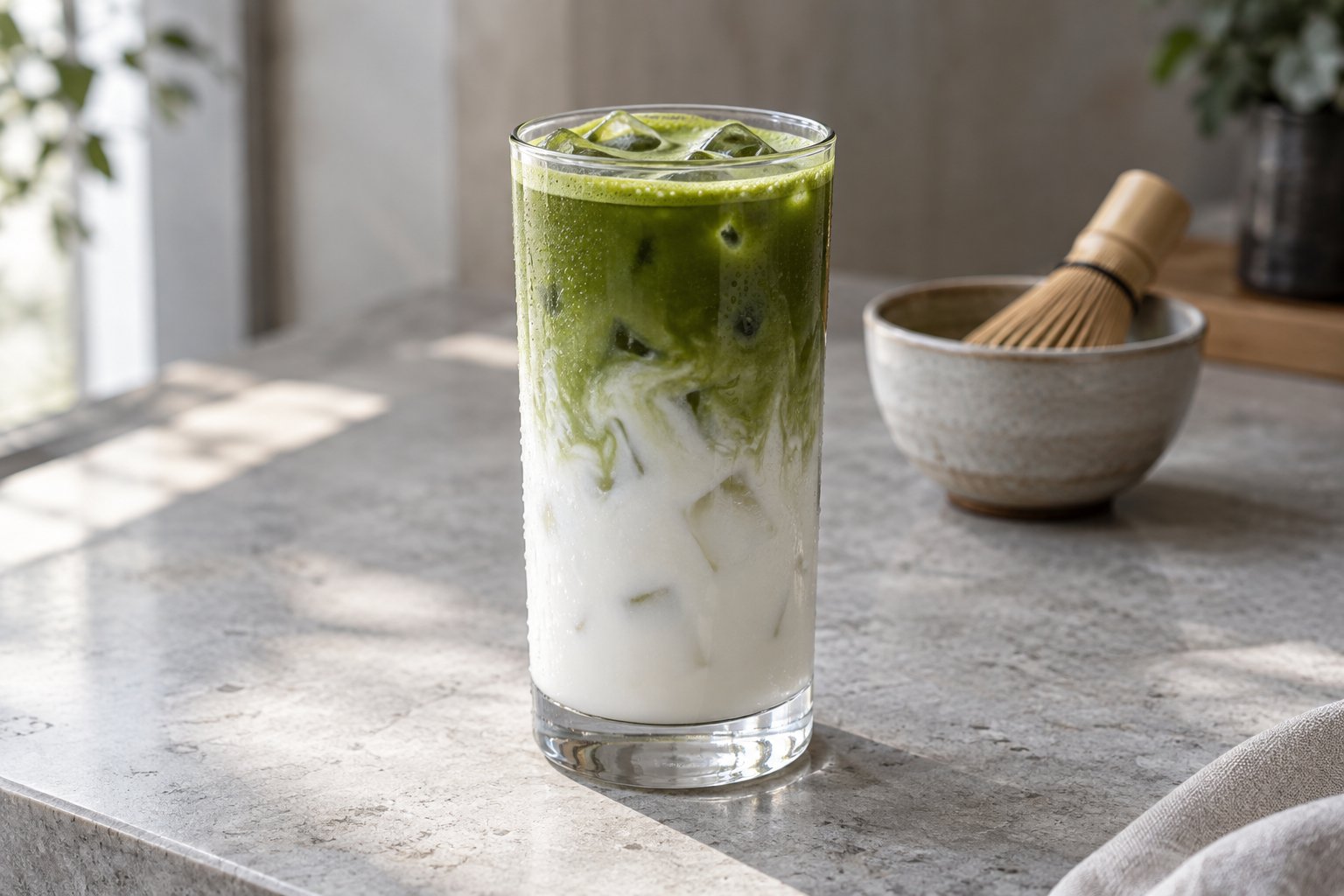
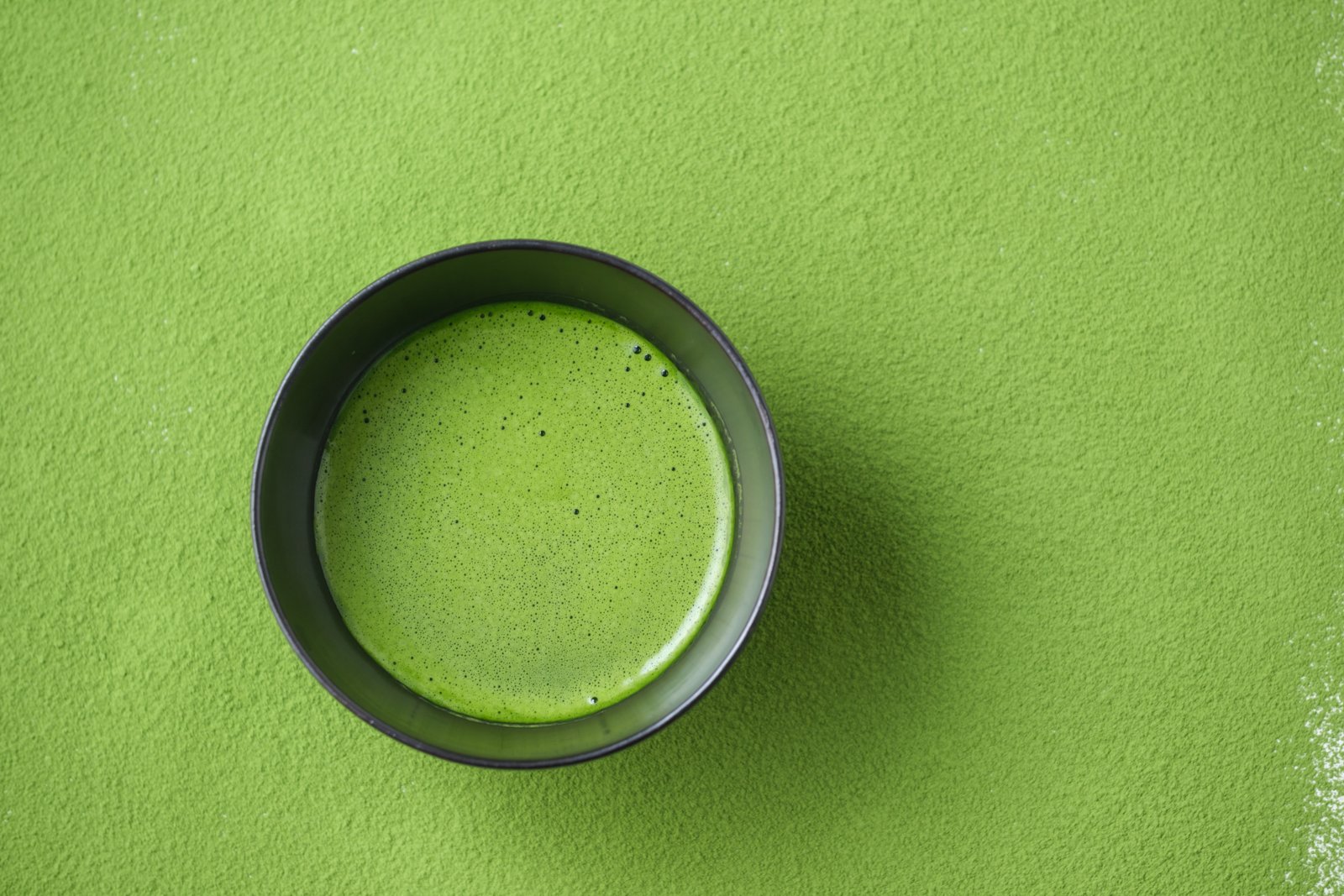
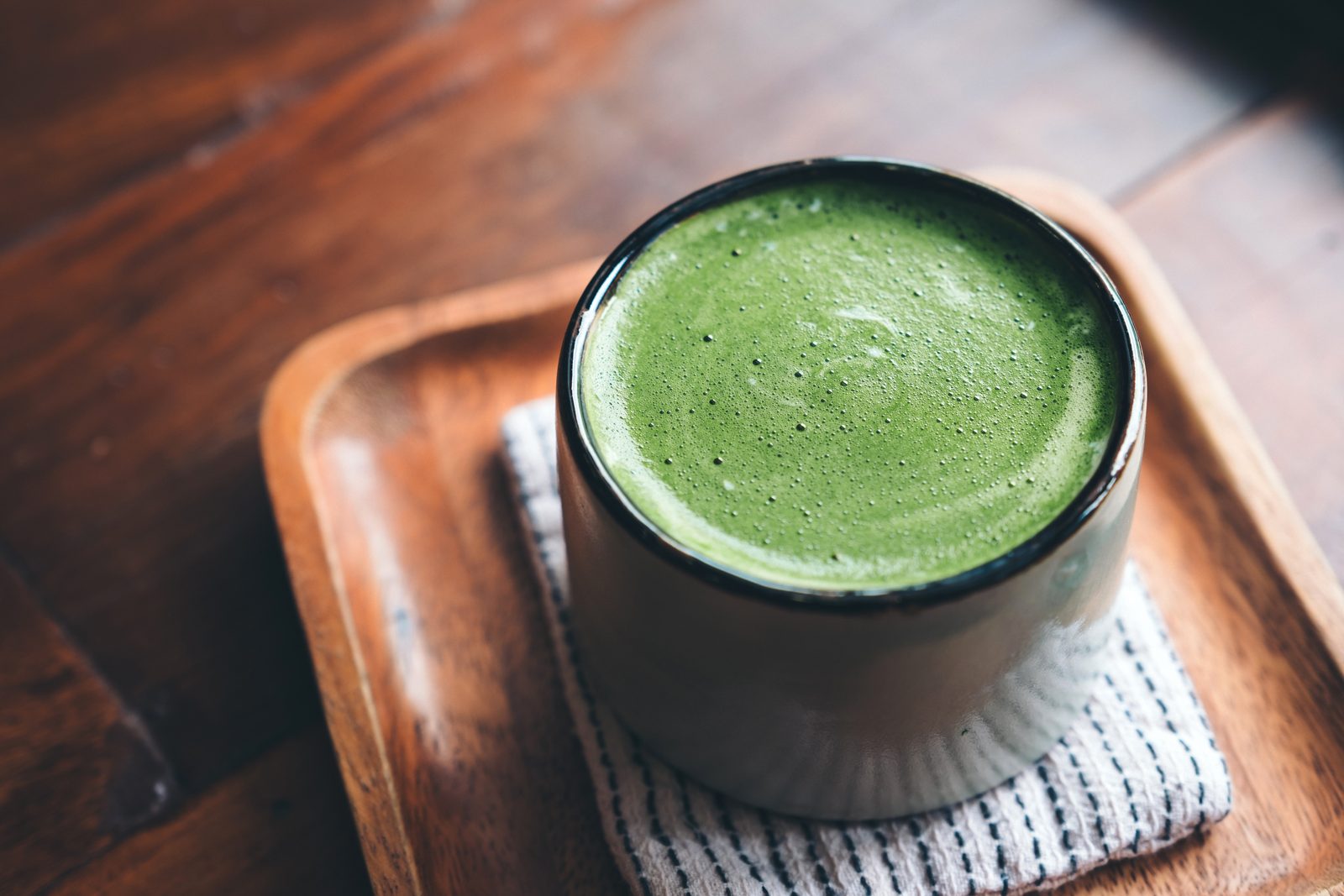
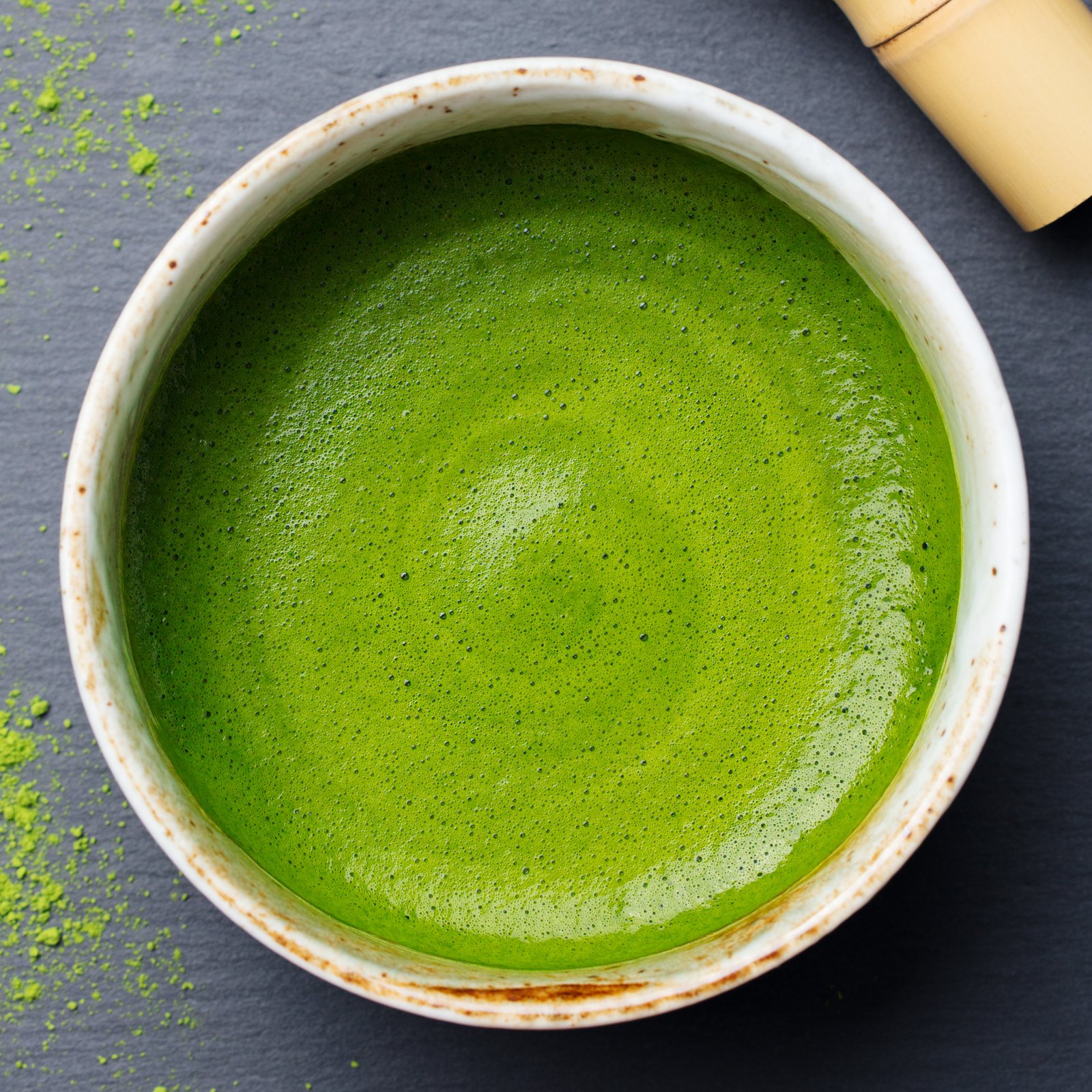
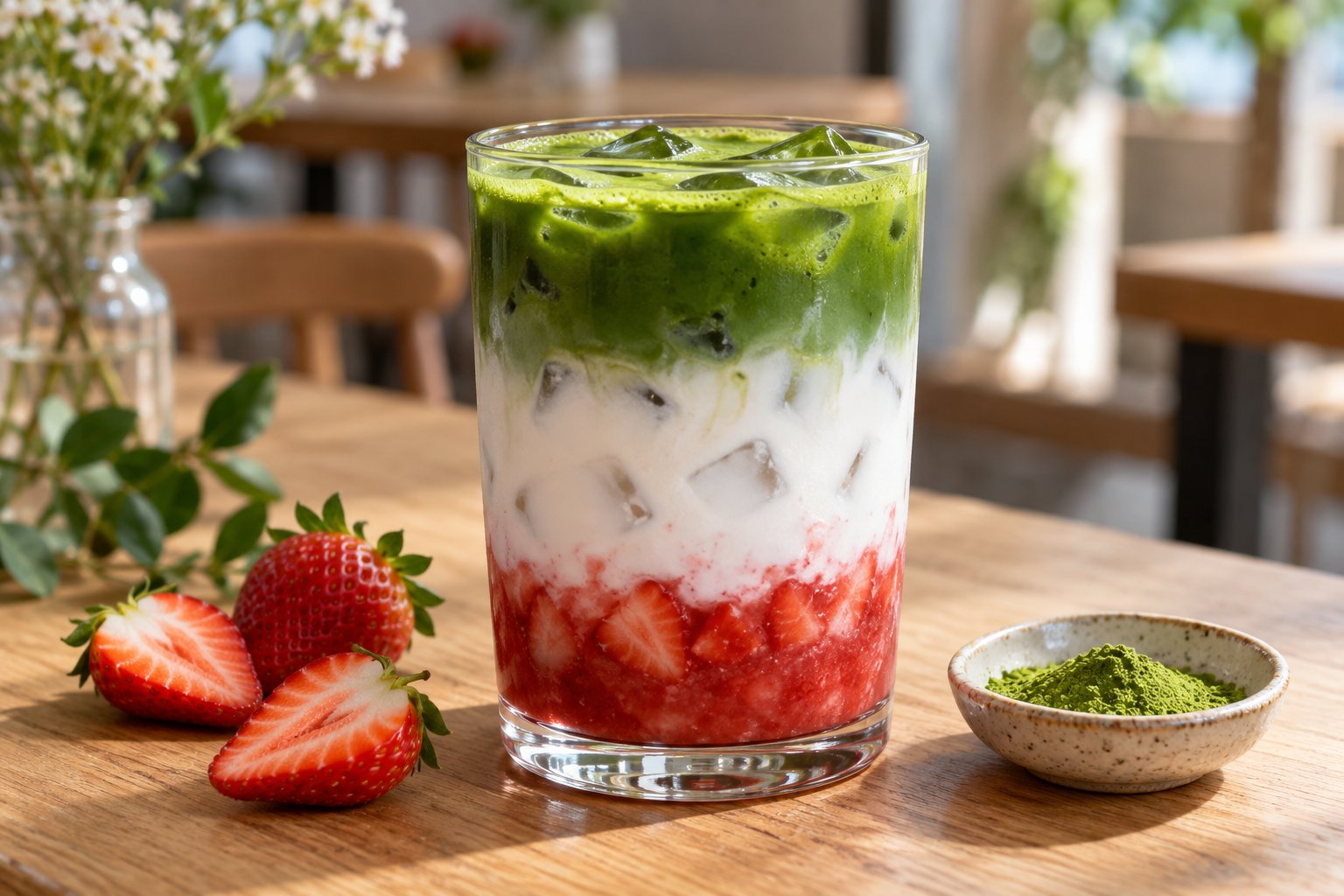
Coconut matcha drinks fall into two types: a latte that combines matcha with coconut milk, and cloud matcha, which floats a matcha foam on coconut water. In Southeast Asia, both chains and specialist matcha shops sell them.
What cafés are selling
luckin coffee Singapore lists a Coconut Matcha Latte in the matcha category of its official menu. An article on the Singapore site of the delivery app Grab features the Coconut Matcha Cloud at Hey Matcha, the Coconut Matcha Latte at Whisking Matcha SG, and the Iced Coconut Matcha Cold Foam at Bon Bon Matcha.
In August 2026, the Thai coffee chain Inthanin (อินทนิล) launched Cloud Matcha (มัทฉะคลาวด์), a layer of whipped matcha on fresh coconut water, from 85 baht at its stores nationwide. In Indonesia, a local guide reports that Kynd Community, a café in Bali with a plant-based menu, serves Coconut Cloud Matcha.
Four ingredients called “coconut”
Ingredients that carry the coconut name include canned coconut milk (liquid pressed from grated coconut meat with water), coconut cream (a richer liquid pressed from the meat), coconut milk beverages (products sold in cartons to drink as they are), and coconut water (the clear liquid inside the nut). The usual pattern is canned or carton coconut milk for a latte, and coconut water for the bottom layer of cloud matcha.
How this guide relates to other articles
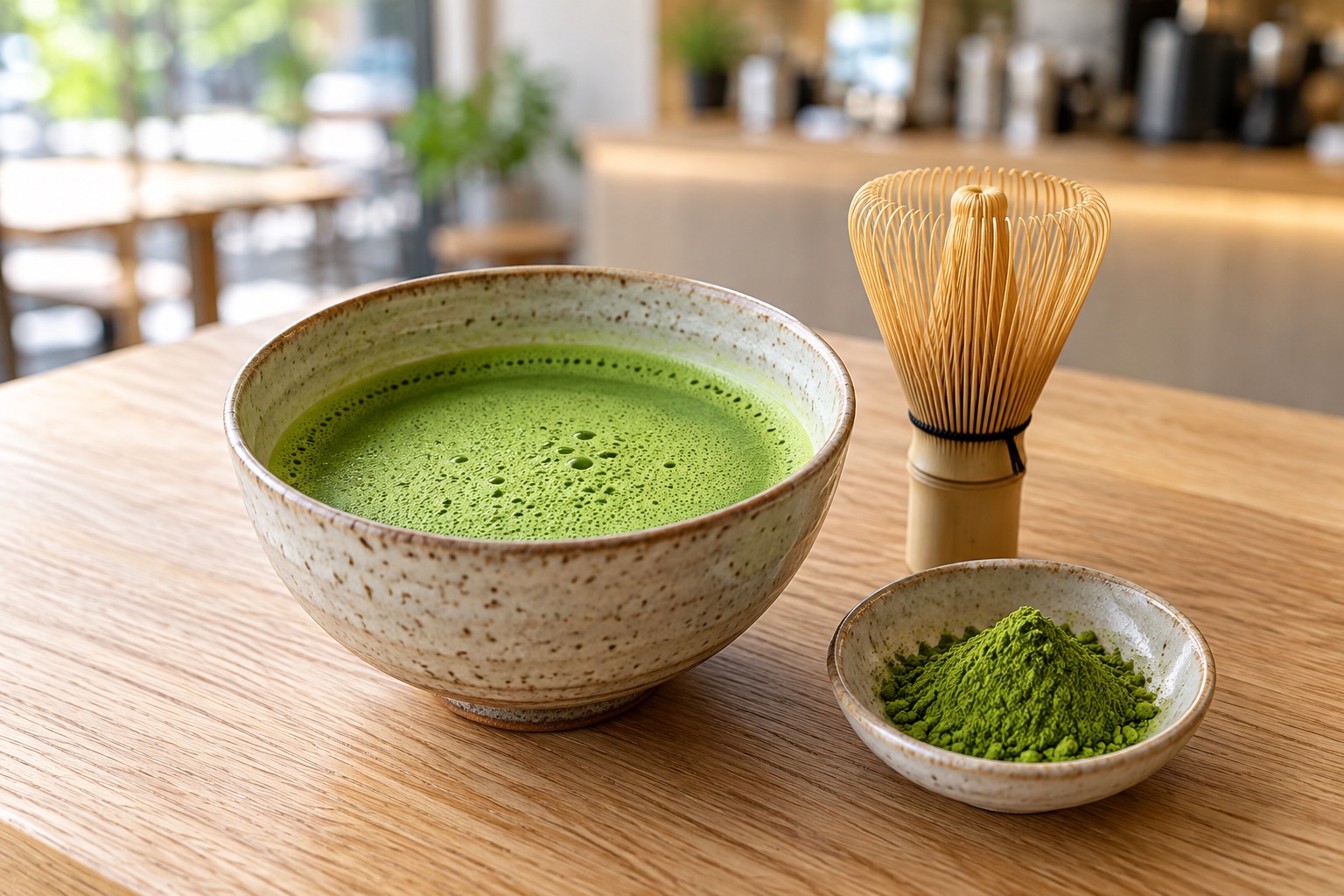
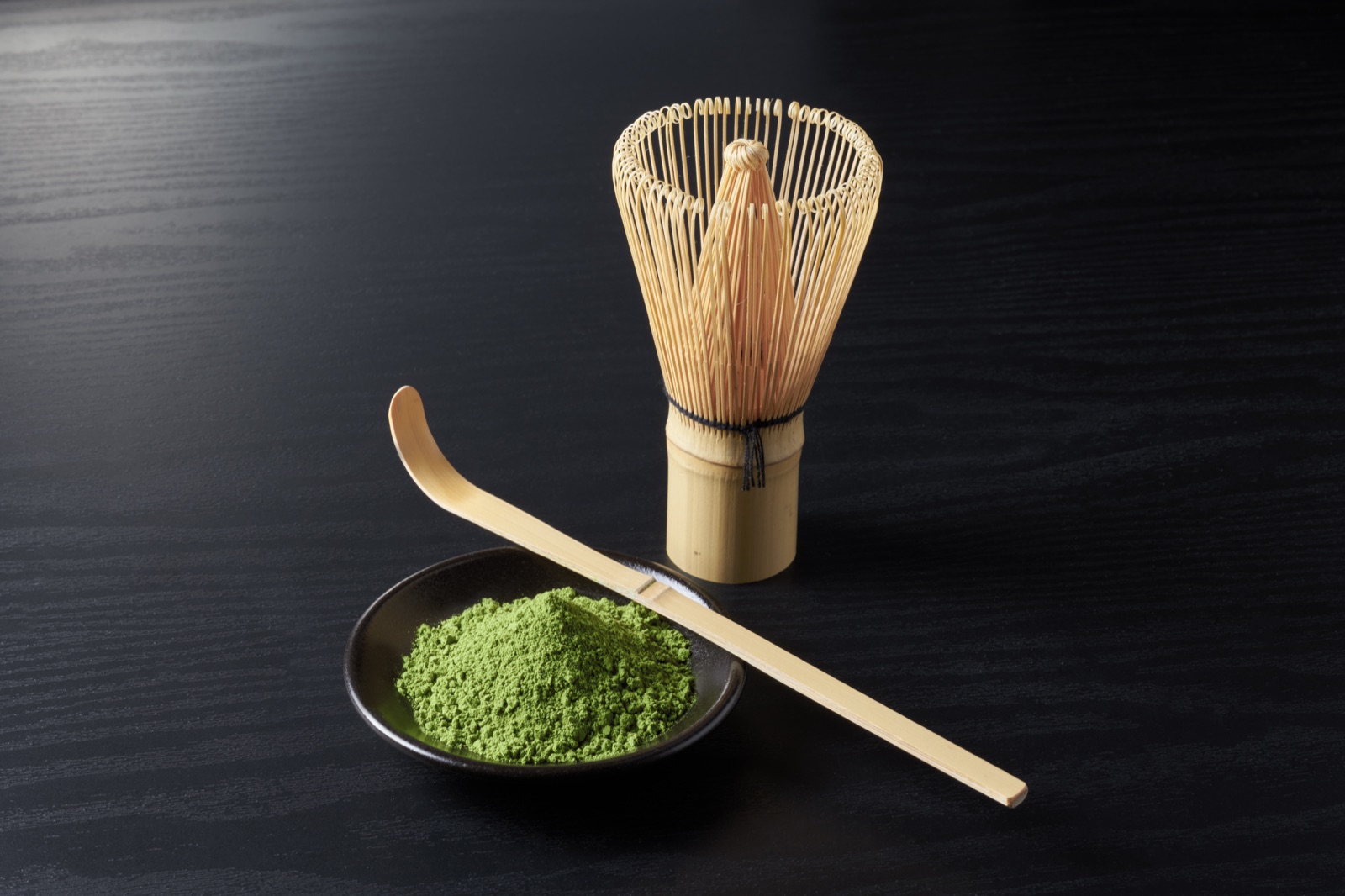
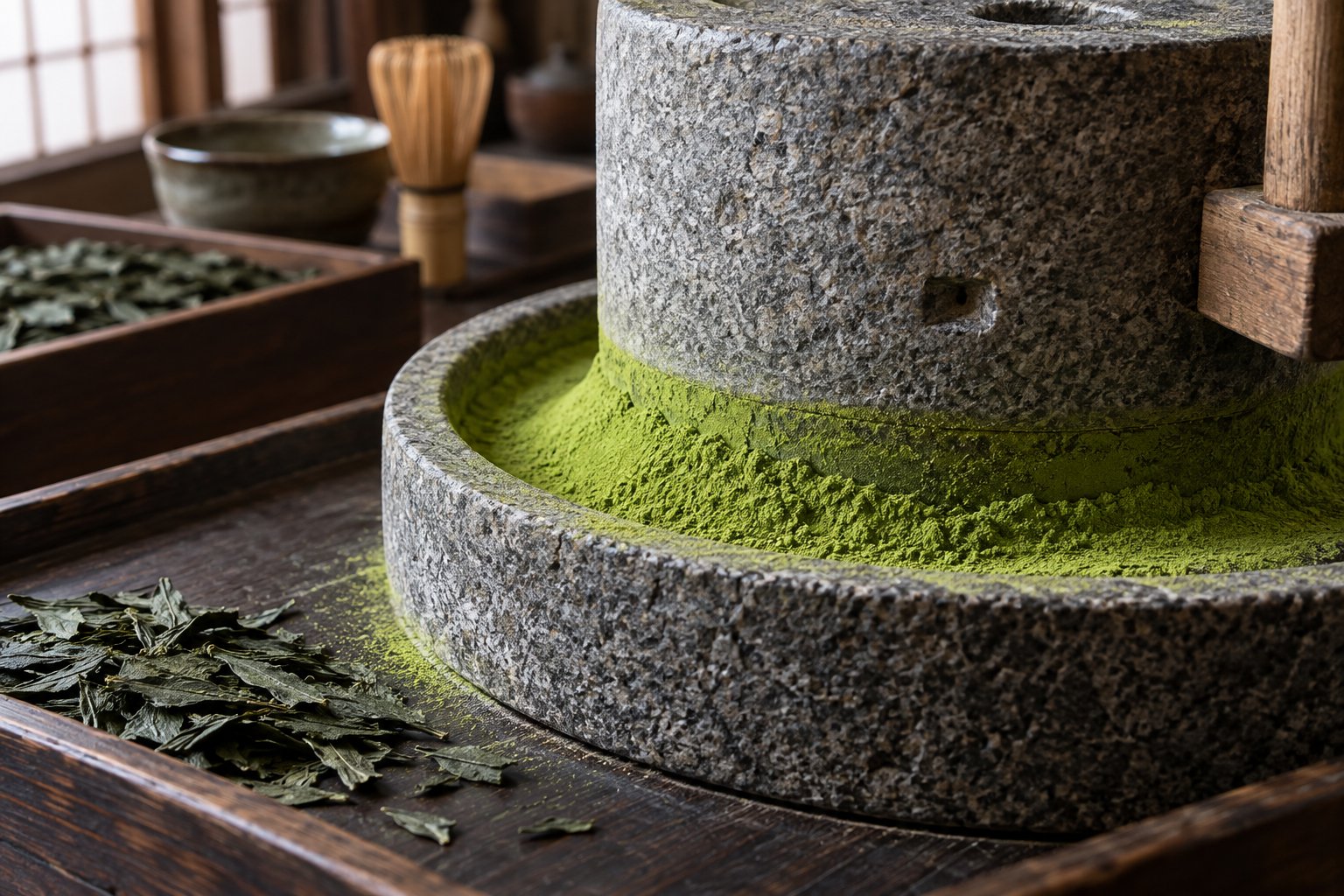
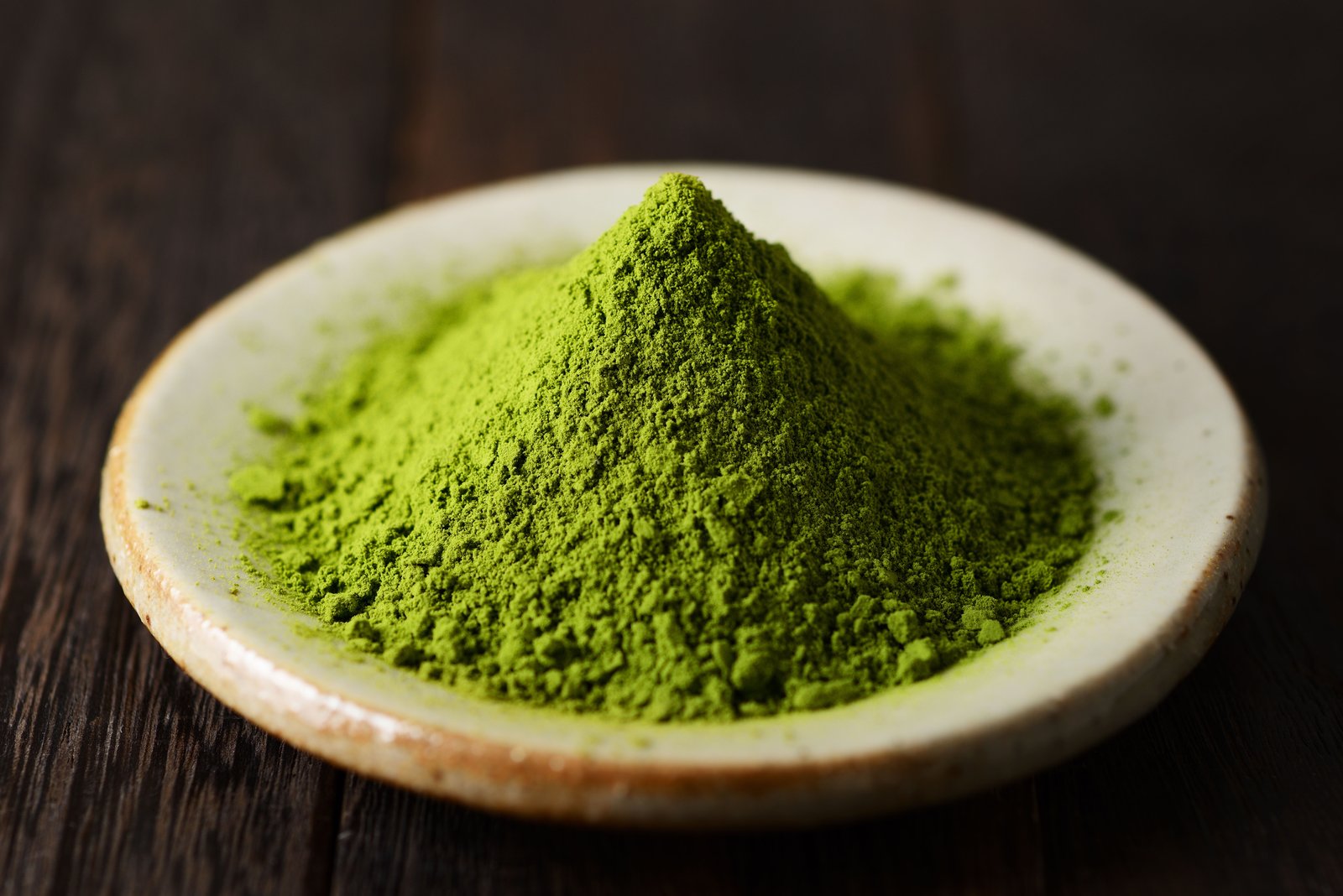
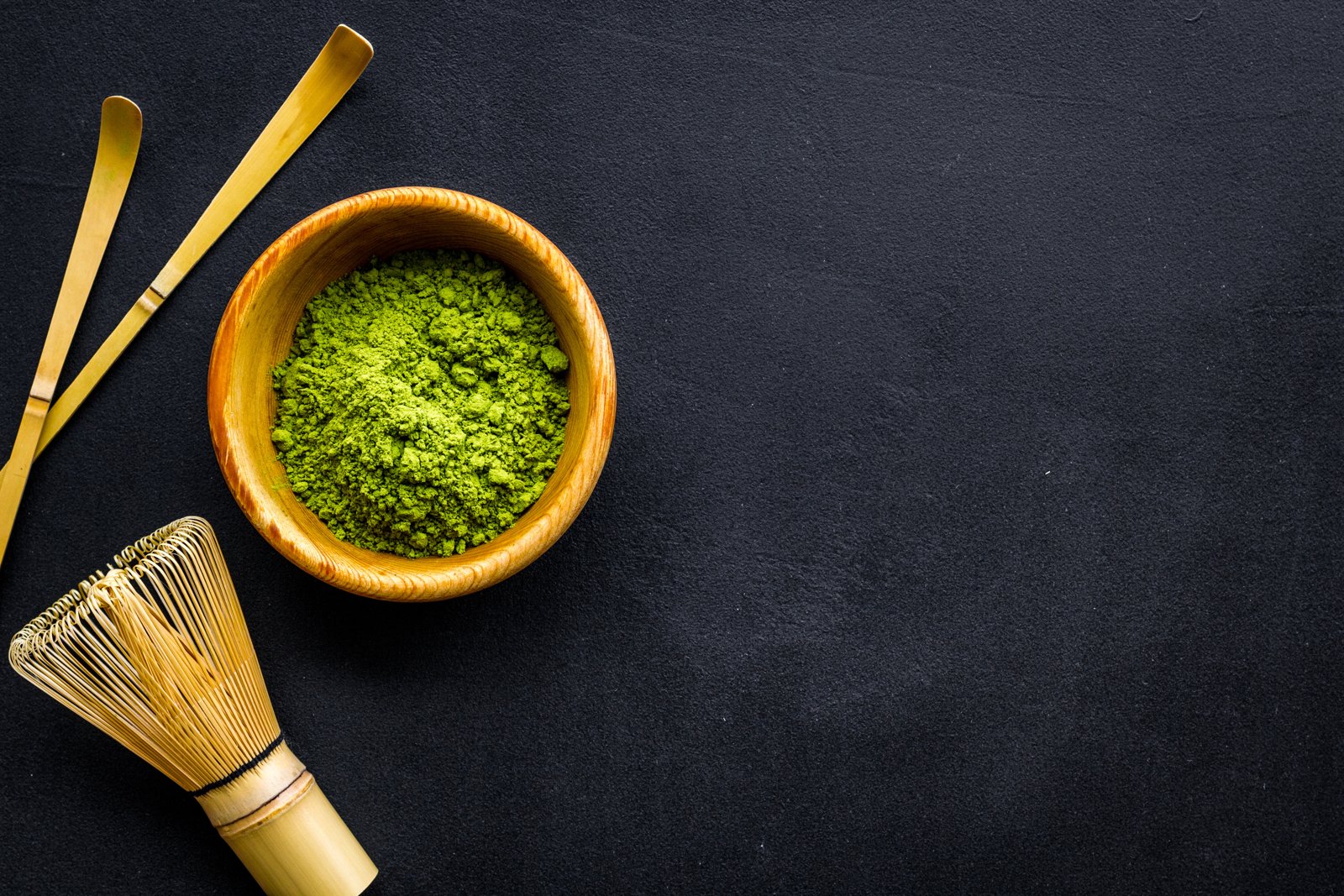
Matcha is tencha (tea leaves grown under shade and dried without rolling) ground into a fine powder. Drinks that combine matcha with coconut water without a foam are covered in matcha lemonade, tonic and soda, and how to approach a latte made with plant milks such as oat milk is in the oat milk matcha latte. This guide focuses on what changes because of coconut fat.
Comparing the fat in coconut milk, cream and water
In the US Department of Agriculture’s database, canned coconut milk has 21.3g of fat per 100g and coconut water 0.2g, a difference of about 100 times within the same fruit. Most of the fat is saturated.
Composition compared
These figures come from FoodData Central, the food composition database of the US Department of Agriculture (USDA). Whole milk and heavy cream (high-fat dairy cream) are included for comparison.
| Ingredient (USDA item) | Fat | Saturated fat | Protein | Energy |
|---|---|---|---|---|
| Coconut cream (raw, liquid pressed from the meat) | 34.7g | 30.8g | 3.63g | 330kcal |
| Coconut milk (canned) | 21.3g | 18.9g | 2.02g | 197kcal |
| Coconut milk beverage (sweetened, fortified) | 2.08g | 2.08g | 0.21g | 131kJ |
| Coconut water | 0.2g | 0.176g | 0.72g | 19kcal |
| Whole milk (3.25% milkfat) | 3.25g | 1.86g | 3.15g | 254kJ |
| Heavy cream | 36.1g | 23.0g | 2.84g | 1,420kJ |
All values per 100g. Energy units are as shown in the database.
What the table shows
Canned coconut milk has more than 6 times the fat of whole milk, while the coconut milk beverage has less fat than whole milk. Even when a recipe just says “coconut milk”, canned and carton versions differ in fat by about 10 times, so check which one is meant before moving a recipe into your shop.
Coconut fat is high in saturated fatty acids. A 2016 review says 92% of the fatty acids in coconut oil are saturated. Protein, on the other hand, is about 2g per 100g even in canned coconut milk, less than whole milk. Both of these points matter for separation, foam and labeling below.
Comparing ratios in official recipes
Of 8 official recipes, the 3 cloud matcha recipes and 1 shaken latte give the matcha in grams, and the cloud matcha recipes use 2 to 4g. The 4 lattes made with coconut milk use about 118 to 237ml per drink.
The 8 recipes
These recipes are published by tea companies and food companies on their own websites. Conversions use 1 cup = about 237ml and 1 fl oz = about 30ml.
| Type | Source (business) | Matcha | Liquid to dissolve it | Coconut ingredient | Other ingredients and method |
|---|---|---|---|---|---|
| Latte (hot) | Navitas Organics (US, food company) | 1 tsp | About 59ml hot water | About 118ml unsweetened coconut milk | Warm the milk slightly, froth it and pour it over the matcha |
| Latte (iced) | ITO EN (US, tea company) | 1.5 tsp | About 59ml water | About 237ml coconut or almond milk | Honey, vanilla and 3 ice cubes, blended for about 30 seconds |
| Latte (hot) | ITO EN (same) | 3/4 tsp | About 237ml hot water | 2 tbsp coconut butter | Blended with maple syrup until frothy |
| Latte (iced) | Forager Project (US, plant-based food company) | 1.5 tsp | 1 tbsp water | About 237ml of its own coconut milk | 1/2 cup ice, stirred well after pouring |
| Latte (iced) | Happy Earth Tea (tea retailer) | 1 to 1.5g if unsweetened (9g if sweetened matcha) | None | About 177ml coconut milk | 6 oz ice and a splash of coconut water, shaken for 10 seconds |
| Cloud | Paper & Tea (Germany, tea specialist) | 2g | 50ml water at about 70°C | 80ml coconut water | Whipped with 60ml chilled oat cream and poured on top |
| Cloud | Purematcha (Australia, matcha retailer) | 4g | None | 150ml coconut water | Whipped with 60ml cream and 20ml whole milk; 15ml maple syrup |
| Cloud | Nio Teas (tea retailer) | 4g | None | 100ml full-fat coconut milk for the foam, 200ml coconut water below | Whipped with a frother, spooned on over the back of a spoon |
ITO EN explains that coconut butter is finely ground dried coconut meat and is different from coconut oil.
What the table shows
The 3 cloud matcha recipes each use a different foam base: oat cream, dairy cream, or full-fat coconut milk. Dividing the matcha by the total liquid (1ml = 1g, excluding ice and syrup) gives about 1.1% for Paper & Tea, about 1.7% for Purematcha and about 1.3% for Nio Teas (our calculation). The iced matcha latte from Ippodo Tea, a long-established Kyoto tea shop (3g matcha, 100ml hot water, 100ml milk), is about 1.5%, so they sit in almost the same range.
The 4 lattes give the matcha in teaspoons, so convert it to grams in your shop. Only Forager Project, which specifies its own product, makes clear whether the coconut milk is canned or in a carton.
Setting your shop’s standard (our approach)
This is our approach. For a latte, start with 3g of matcha, the same as a dairy matcha latte, and if you use canned coconut milk, first decide how much water or ice to dilute it with. For cloud matcha, try 2 to 4g of matcha in the foam and 80 to 200ml of coconut water below, adjusted to your glass. The coconut aroma tends to come through ahead of the matcha aroma, so if the matcha tastes weak, increase it 0.5g at a time. The basic ratio for a dairy matcha latte is in choosing matcha for café lattes.
How to make a coconut matcha latte and cloud matcha
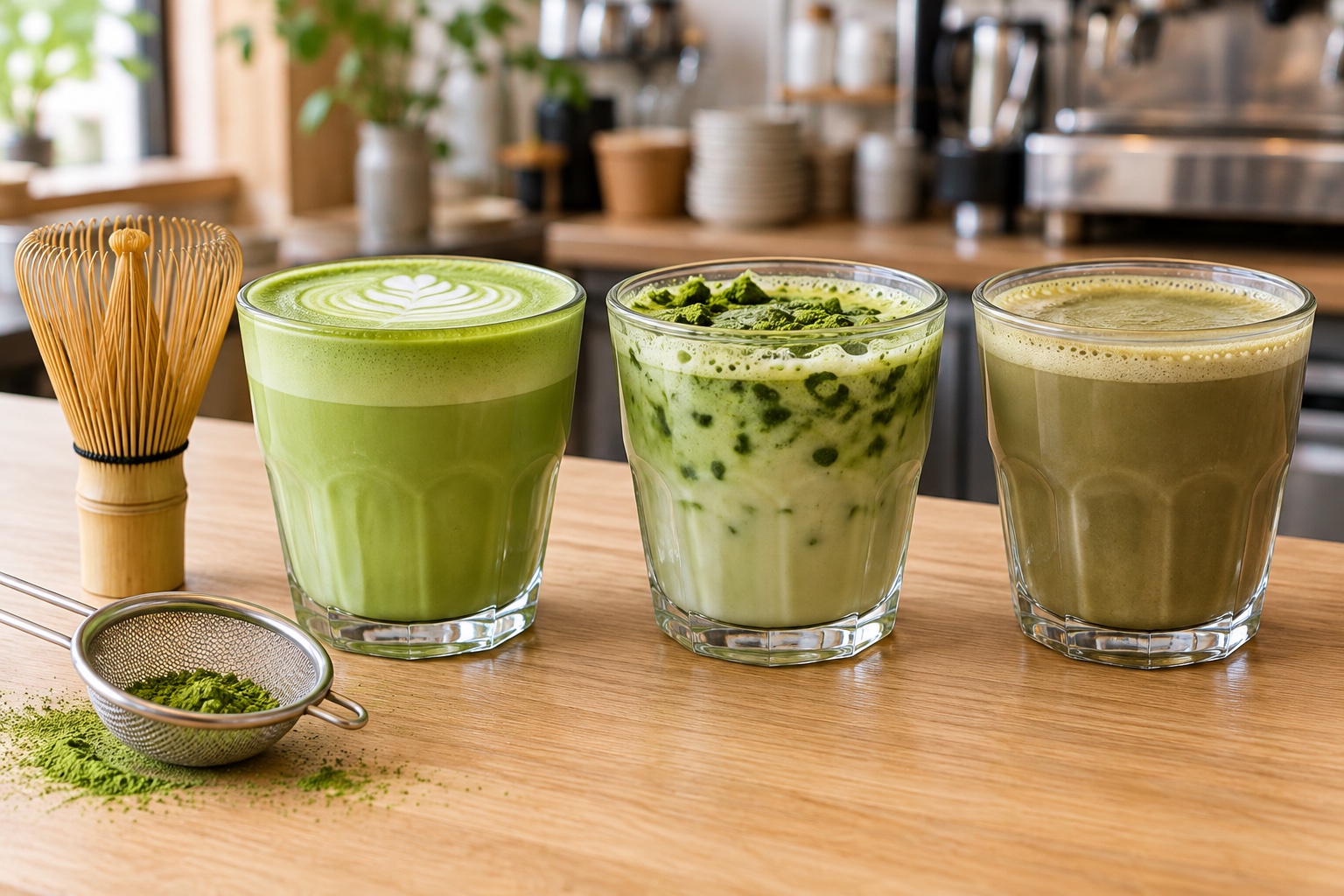
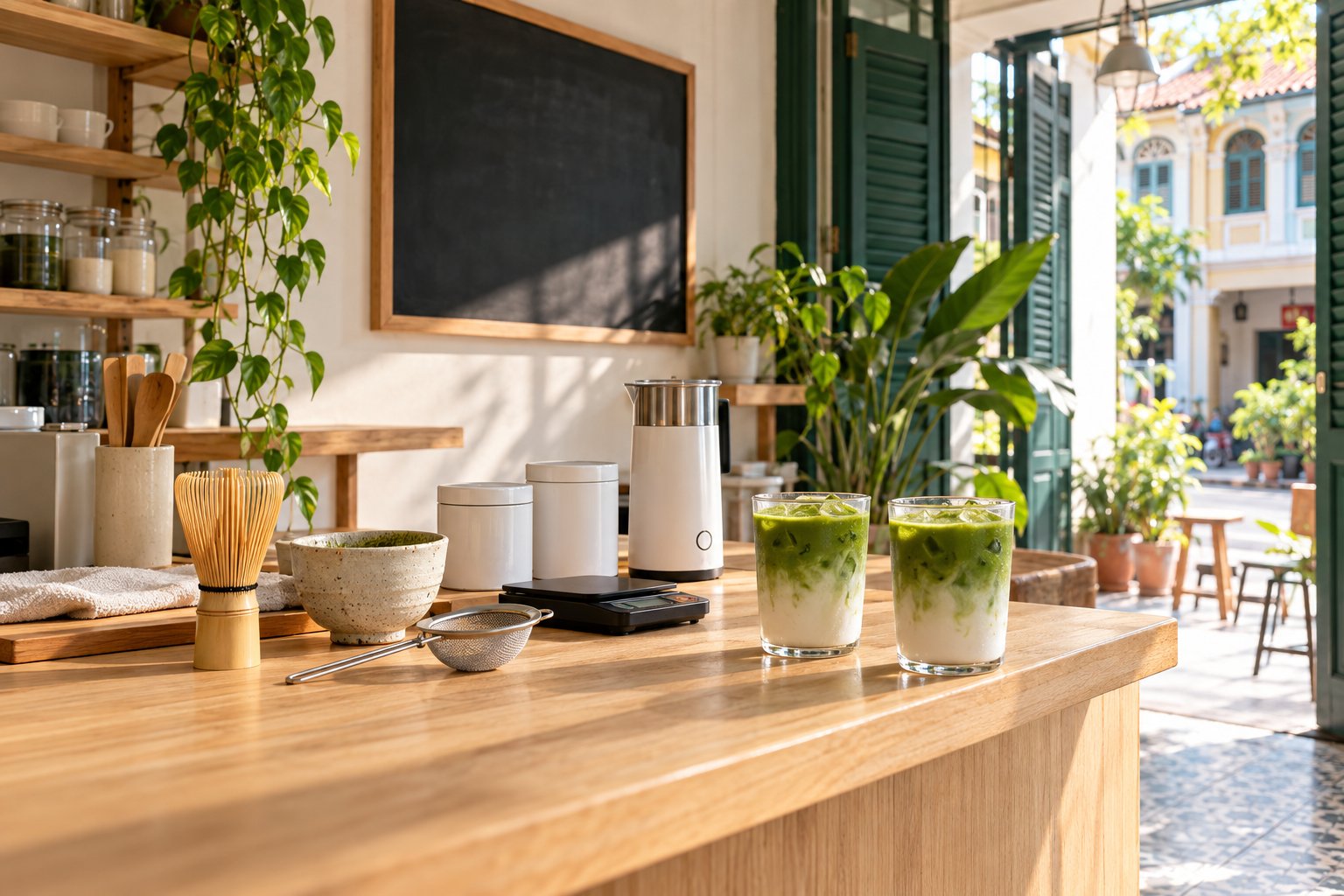
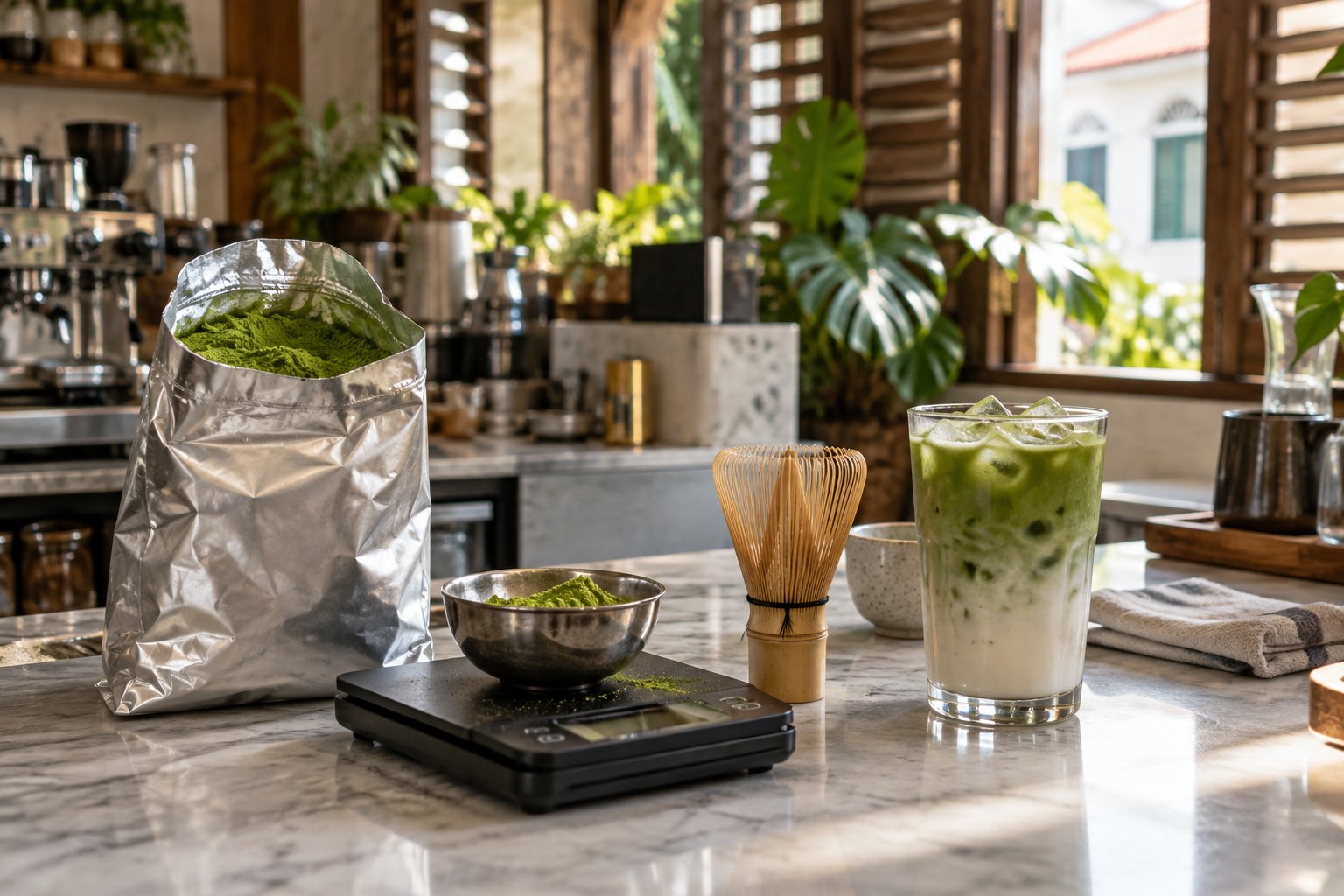
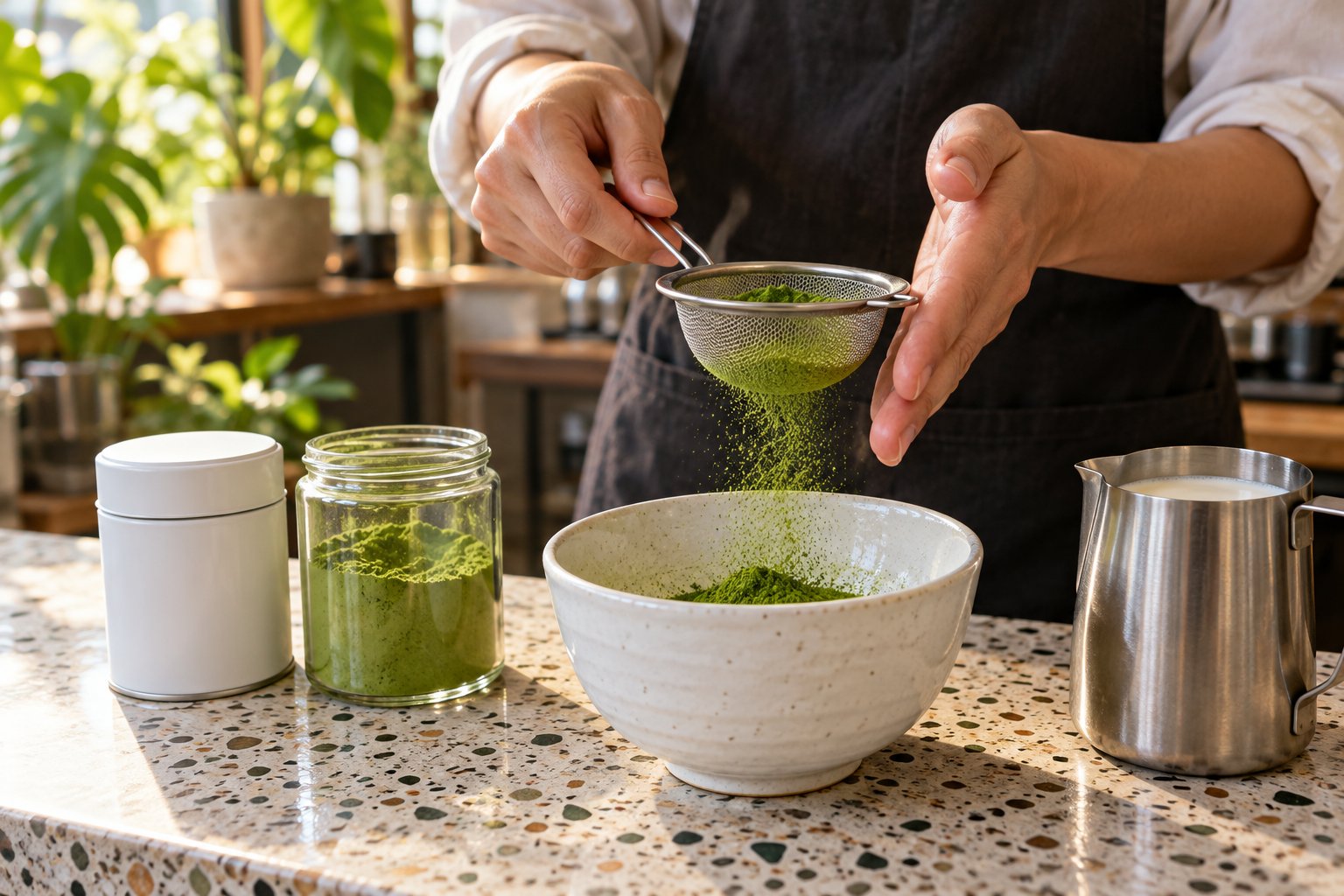
For a latte, combine dissolved matcha with coconut milk. For cloud matcha, put ice and coconut water in the glass first and add the matcha foam last. In both cases, sift the matcha first.
Coconut matcha latte (hot)
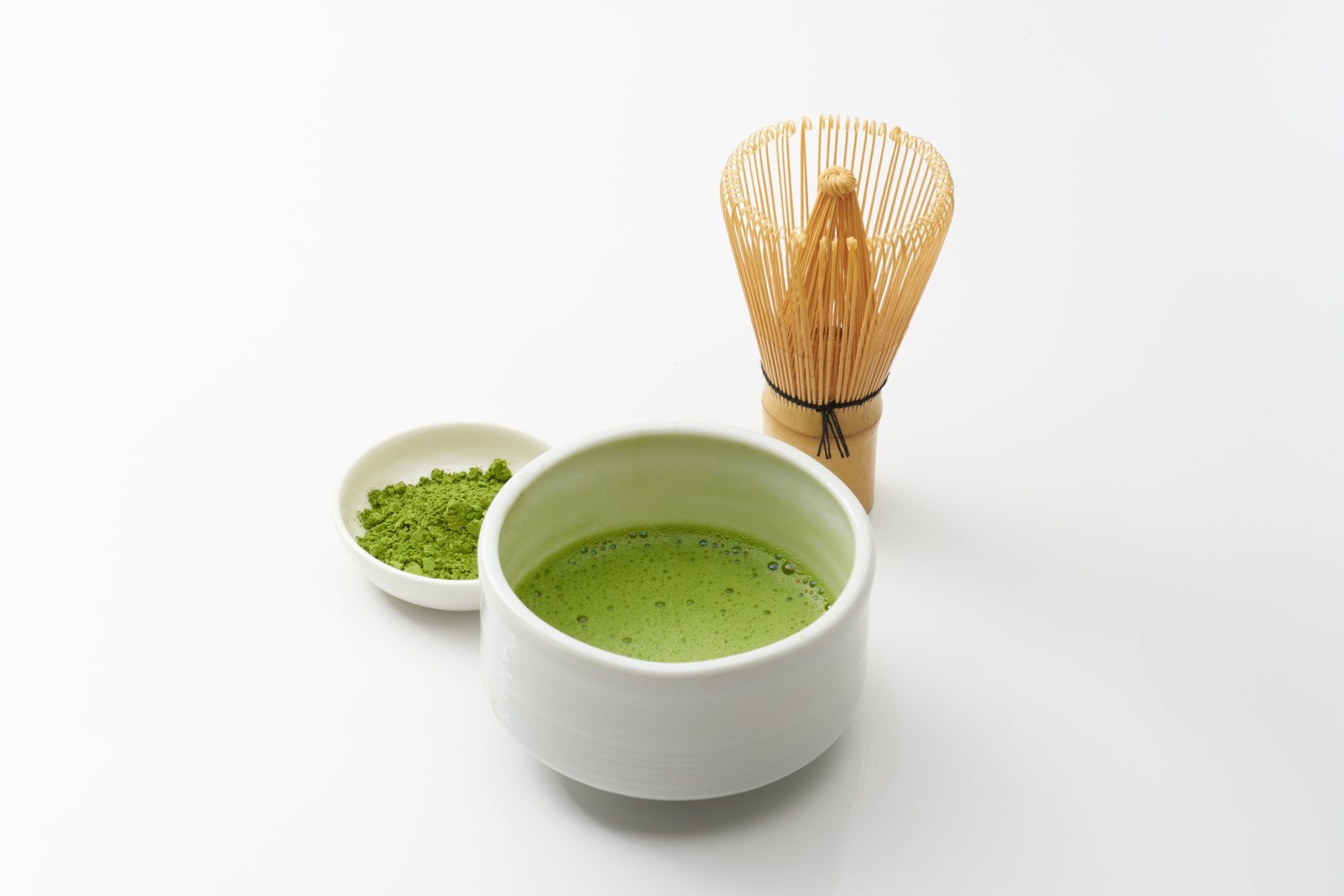
Navitas Organics sifts the matcha, whisks it with hot water until bubbles form, then pours unsweetened coconut milk that has been warmed slightly and frothed over the top. For ITO EN’s coconut butter latte, the coconut butter is melted in hot water, then matcha and maple syrup are added and blended until frothy. Water temperature for dissolving matcha and how to prevent lumps are covered in how to make matcha.
Coconut matcha latte (iced)
Forager Project dissolves the matcha in a little water, pours it into a glass of ice and coconut milk, and says to stir well before drinking. Happy Earth Tea puts matcha, ice, coconut milk and a splash of coconut water in a shaker and shakes hard for 10 seconds. ITO EN blends all the ingredients until slightly frothy and pours the drink over ice. Coconut milk is hard to mix, and all 3 official recipes include a step of stirring well, shaking or blending. How to pour in layers is in the iced matcha latte guide.
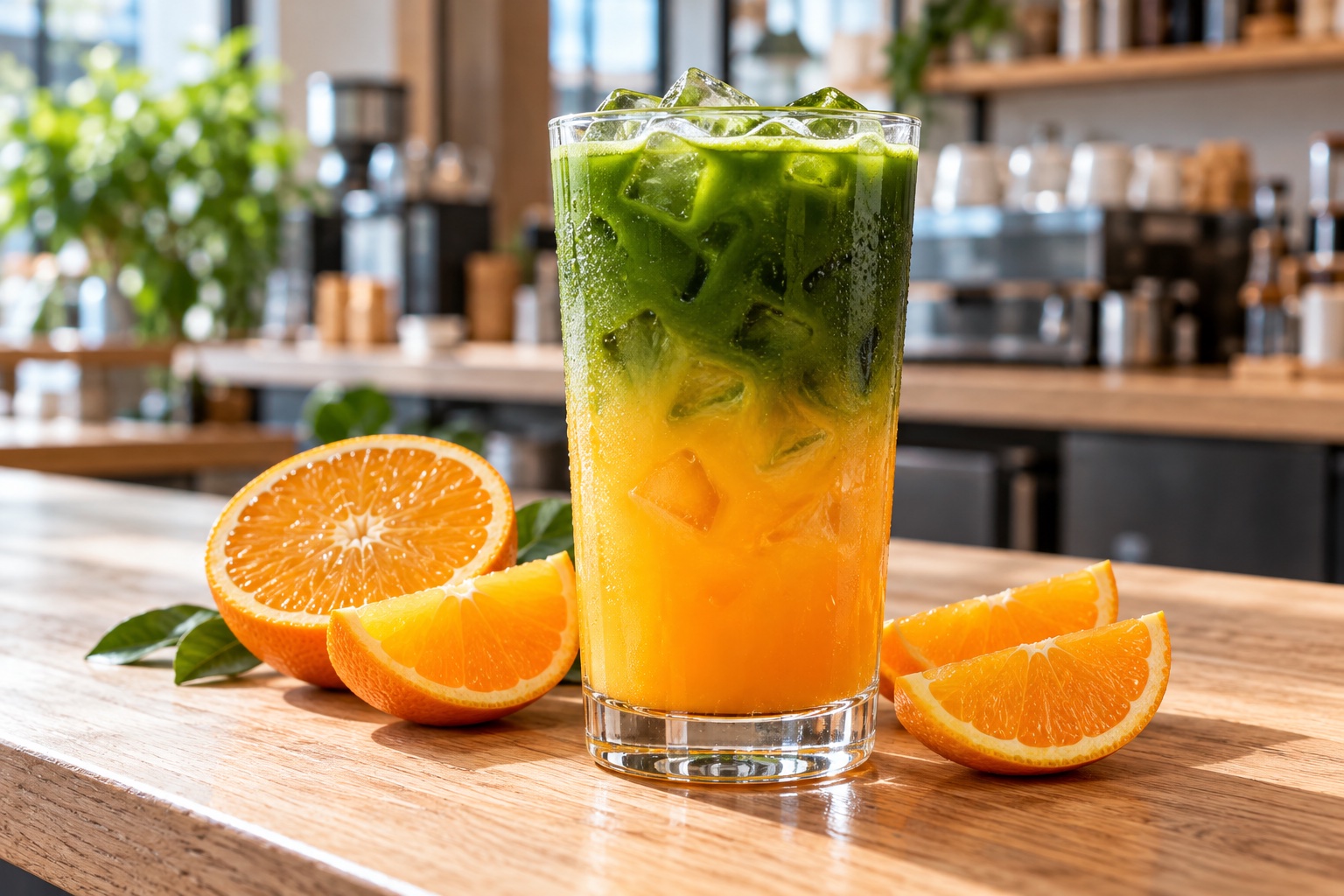
Cloud matcha
Paper & Tea’s steps are as follows.
- Fill a glass with ice (crushed ice if possible) and pour in 80ml of coconut water
- Whisk 2g of matcha with 50ml of water at about 70°C until there are no lumps
- Add 60ml of well-chilled oat cream and froth until smooth with a frother (a tool for foaming milk)
- Transfer to another container and pour slowly over the coconut water in a circle to make a layer
- Dust a little matcha on top
Nio Teas fills the glass about halfway with ice and about two-thirds with coconut water, then spoons the foam on over the back of a spoon so it does not sink into the liquid below. To keep the foam layer, the recipes leave space at the top of the glass for the foam.
Why it separates, sets and foams
Coconut milk separates easily because it has little protein, and coconut fat melts at around 25°C, so it tends to set when chilled. That same fat is what a foam needs.
Low protein means easy separation
A 2019 study on the stability of coconut milk says coconut milk is unstable and prone to separation because its protein is not enough to stabilize the product. The same study says commercial products are adjusted to 15 to 40% fat. Nio Teas also says chilling the can helps the cream separate. Stir canned coconut milk thoroughly before measuring it.
Coconut fat sets when chilled
In a 2017 study that measured virgin coconut oil (oil taken from the meat without heating) by heat flow, melting peaked at about 24.7°C and ended at about 26.8°C. On cooling, it began to set at about 6.4°C. A 2016 review also describes coconut oil as solid at ambient temperature.
This is our approach based on these studies. Iced drinks and canned coconut milk kept in the fridge are in the temperature range where the fat starts to set. White specks floating in a cold latte, or the top of a chilled can setting, may be due to this property. If specks are a problem, try opening a can at room temperature and stirring it well, or thinning the coconut milk with a little hot water before adding it to ice.
A foam needs fat
Nio Teas uses full-fat canned coconut milk because reduced-fat coconut milk does not have enough fat to whip into a stable foam. Purematcha says the foam can be made with whippable plant-based cream but is slightly less stable than dairy cream. Paper & Tea says well-chilled oat cream gives a creamy, stable foam, and switching to whipping cream makes the foam denser. Carton coconut milk beverages have only about 2g of fat per 100g, so they are not suited to a cloud matcha foam. How foam forms and how to froth with each tool are covered in matcha cold foam.
Prep and holding times
The layers of cloud matcha start to merge within a few minutes, so froth the foam for each order, or re-whip foam kept in the fridge. Follow the label of the brand you use for storing coconut milk after opening.
What the official recipes say
Nio Teas says the layers begin to merge a few minutes after the foam goes on, so serve right after assembling; stirring is fine. It says the foam can be made ahead and kept in a sealed container in the fridge for up to 4 hours, then re-whipped for 10 to 15 seconds and poured over fresh ice and coconut water. This is one company’s recipe guide, not an official standard.
Official guides on cold food temperatures and how long food can be held are summarized in the “Prep and holding times” section of matcha cold foam and the “Can you make it ahead?” section of the iced matcha latte guide. Check the rules of your own country or local authority for the standard you must follow.
Before opening (our approach)
This is an example of our steps.
- Once a can of coconut milk is opened, stir it well, write the opening time on it and refrigerate it. Follow the label for how many days it keeps after opening
- For the latte, bring the portion to room temperature or thin it with a little hot water before measuring (adding it to ice while cold can cause specks)
- Keep coconut water in the fridge and take out only what you need
- Weigh the matcha one drink at a time and keep it separate from the foam ingredients
For each order
- Put ice and coconut water (coconut milk for a latte) in the glass
- Sift the matcha and whip it with hot water or the foam ingredients
- Spoon the foam on over the back of a spoon and serve with a straw or stirrer
- Tell customers on the menu or at the counter to stir before drinking
Coconut allergen labeling
In the US, coconut has not counted as a tree nut major food allergen since 2025, but it must still appear in the ingredient list. Other countries may treat it differently, so check the rules where your café operates.
US: coconut is off the tree nut list
On January 6, 2025, the US FDA published the 5th edition of its food allergen Q&A guidance. According to the FDA’s FAQ, coconut is not in the tree nut list (Table 1) of the 5th edition and is no longer a tree nut that is a major food allergen. However, when coconut is used in a food, it must be listed in the ingredient list unless an exemption applies. The FDA says there will be a transition period before firms remove coconut from the “Contains” statement on packages.
Source: US FDA, “Frequently Asked Questions: Food Allergen Labeling Guidance for Industry” https://www.fda.gov/food/food-allergensgluten-free-guidance-documents-regulatory-information/frequently-asked-questions-food-allergen-labeling-guidance-industry
How to tell customers (our approach)
This is our approach. Some customers are allergic to coconut, so even though it is no longer a major allergen, say on the menu that the drink contains coconut. If you use dairy cream for the cloud matcha foam, milk must be labeled too. How to communicate milk as an allergen is in matcha cold foam. Other countries may treat coconut differently, so check the labeling rules where your café operates.
Singapore’s Nutri-Grade and saturated fat
Singapore’s Nutri-Grade gives a drink the poorer of its grades for sugar and saturated fat, so drinks made with canned coconut milk tend to land in C or D even when they have little sugar. Coconut water has little fat, so its grade is set by sugar.
Saturated fat can set the grade
According to HealthHub, run by Singapore’s Ministry of Health, Nutri-Grade grades drinks by sugar and saturated fat per 100ml and gives the poorer of the two grades. For saturated fat, 0.7g or less is A, more than 0.7g up to 1.2g is B, more than 1.2g up to 2.8g is C, and more than 2.8g is D. Freshly prepared drinks have been covered since December 30, 2023, and grades C and D must be shown on the menu. More detail on the scheme is in the “Serving in Singapore” section of the strawberry matcha latte guide.
HealthHub’s page explains that a low-sugar or sugar-free drink can still be graded C or D if it is high in saturated fat. Its example is full-fat milk: grade A for sugar (0g per 100ml) and grade C for saturated fat (2.8g per 100ml), so the final grade is C. The bands on the page are as follows.
| Grade | Sugar (g per 100ml) | Saturated fat (g per 100ml) |
|---|---|---|
| A | 1 or less, and no sweetener | 0.7 or less |
| B | More than 1 to 5 | More than 0.7 to 1.2 |
| C | More than 5 to 10 | More than 1.2 to 2.8 |
| D | More than 10 | More than 2.8 |
Source: Singapore Ministry of Health, HealthHub, “Nutri-Grade Mark” https://www.healthhub.sg/programmes/nutrition-hub/nutri-grade-mark
Estimating coconut drinks (our calculation)
These are our estimates using the USDA values above, with 1ml = 1g and liquid only, excluding ice.
| Example | Saturated fat per drink | Per 100ml | Saturated fat band |
|---|---|---|---|
| Nio Teas cloud matcha (100ml canned coconut milk + 200ml coconut water) | About 19.3g | About 6.4g | D |
| 200ml coconut milk beverage + 50ml hot water for the matcha | About 4.2g | About 1.7g | C |
| Coconut water alone (reference) | - | About 0.18g | A |
To keep a 250ml drink within the C limit for saturated fat (2.8g per 100ml), canned coconut milk can go up to about 37g; within the B limit (1.2g), up to about 16g. Putting 50ml of canned coconut milk into a 250ml drink takes it into the D range by this calculation. Coconut water is in a low band for fat, but with 2.61g of sugar per 100g it exceeds the A limit (1g) for sugar. Calculate the actual grade from the nutrition label of the products you use and the size of the drink.
Cost per drink, and what to check when buying
Matcha cost per drink is “buying price per kg ÷ 1,000 × grams used per drink”; add the cost of the coconut ingredients to that. When buying, check the fat and labeling of the coconut products.
Calculating cost
The official recipes use 2 to 4g of matcha for cloud matcha, and a basic dairy matcha latte uses 3g. Matcha cost per drink is these grams multiplied by “buying price per kg ÷ 1,000”. How the price per kg is set is explained in how matcha prices are set.
The cost of coconut ingredients is the buying price of one carton or can ÷ its volume × the amount used per drink. Canned coconut milk has to be used up within a set number of days after opening, so include any you throw away in the cost. Add the foam ingredients (cream or oat cream), sweetener, ice, cup, lid and straw to get the ingredient cost per drink. Foam increases in volume when whipped, so calculate using the volume of liquid before whipping.
What to check on coconut products
- Canned or carton: the same “coconut milk” can differ in fat by about 10 times
- Fat, saturated fat and sugars on the nutrition label: used for the Nutri-Grade calculation
- Ingredients: whether it contains emulsifiers, stabilizers or sugar
- How to store it after opening, and for how many days
Choosing matcha (our suggestion)
This is our suggestion. Coconut aroma and fat can hide the aroma and color of matcha, so compare candidate matcha using your shop’s coconut milk and coconut water in the same recipe.
- Make both a latte and a cloud matcha with each candidate matcha
- Compare the green of the foam layer and the color of the latte when freshly made and after 5 minutes
- Taste to check whether you can pick out the matcha aroma through the coconut
- Work out the matcha cost per drink and decide together with the selling price
Differences between grades are explained in matcha grades, and differences between regions in matcha origins. Omakase Matcha sources matcha from the growing regions of Uji, Yame, Shizuoka, Kagoshima and Miyazaki. Orders start from 1kg, you can choose up to 3 samples, and we can help adjust a blend to suit your menu. Request samples for testing from sample request.
Sources
- luckin coffee Singapore, “Menu” https://www.luckincoffee.com.sg/menu
- Grab Singapore, “Matcha in Singapore” https://www.grab.com/sg/articles/food/matcha-singapore/
- Brand Buffet, “อินทนิล เปิดตัว Airicano™ และ Cloud Matcha” (August 10, 2026, in Thai) https://www.brandbuffet.in.th/2026/08/inthanin-open-airicanotm-cloud-matcha/
- What’s New Indonesia, “Best Matcha in Bali” (May 22, 2025) https://www.whatsnewindonesia.com/bali/ultimate-guide/food-and-drink/best-matcha-bali
- USDA FoodData Central, “Nuts, coconut milk, canned (liquid expressed from grated meat and water)” https://fdc.nal.usda.gov/food-details/170173/nutrients
- USDA FoodData Central, “Nuts, coconut cream, raw (liquid expressed from grated meat)” https://fdc.nal.usda.gov/food-details/170580/nutrients
- USDA FoodData Central, “Beverages, coconut milk, sweetened, fortified with calcium, vitamins A, B12, D2” https://fdc.nal.usda.gov/food-details/174116/nutrients
- USDA FoodData Central, “Nuts, coconut water (liquid from coconuts)” https://fdc.nal.usda.gov/food-details/170174/nutrients
- USDA FoodData Central, “Milk, whole, 3.25% milkfat, with added vitamin D” https://fdc.nal.usda.gov/food-details/171265/nutrients
- USDA FoodData Central, “Cream, fluid, heavy whipping” https://fdc.nal.usda.gov/food-details/170859/nutrients
- Navitas Organics, “Coconut Matcha Latte Recipe” https://navitasorganics.com/blogs/recipes/coconut-matcha-latte-recipe
- ITO EN, “Iced Matcha Latte” https://itoen.com/blogs/recipes/iced-matcha-latte
- ITO EN, “Coconut Matcha Latte” https://itoen.com/blogs/recipes/coconut-matcha-latte
- Forager Project, “Iced Coconutmilk Matcha Latte” https://www.foragerproject.com/recipes/iced-oatmilk-matcha-latte/
- Happy Earth Tea, “Recipe: Iced Coconut Matcha Latte” https://happyearthtea.com/blogs/tea-101/recipe-iced-coconut-matcha-latte
- Paper & Tea, “Coconut Matcha Cloud” https://www.paperandtea.com/blogs/journal/coconut-matcha-cloud
- Purematcha, “The Perfect Matcha Coconut Cloud Recipe” https://purematcha.com.au/blogs/matcha-recipes/matcha-coconut-cloud-recipe
- Nio Teas, “Coconut Matcha Cloud” https://nioteas.com/blogs/ricette/cloud-matcha-cocco
- Ippodo Tea, “Iced Matcha Latte” https://ippodotea.com/blogs/recipes-to-brew-japanese-tea/iced-matcha-latte
- Thanatrungrueang, Harnsilawat, “Effect of sucrose ester and carboxymethyl cellulose on physical properties of coconut milk,” Journal of Food Science and Technology 56(2) (2019) https://pmc.ncbi.nlm.nih.gov/articles/PMC6400784/
- Srivastava et al., “Melting, crystallization and storage stability of virgin coconut oil and its blends by differential scanning calorimetry (DSC) and Fourier transform infrared spectroscopy (FTIR),” Journal of Food Science and Technology 54(1) (2017) https://pmc.ncbi.nlm.nih.gov/articles/PMC5305700/
- Eyres et al., “Coconut oil consumption and cardiovascular risk factors in humans,” Nutrition Reviews (2016) https://pmc.ncbi.nlm.nih.gov/articles/PMC4892314/
- US FDA, “Frequently Asked Questions: Food Allergen Labeling Guidance for Industry” https://www.fda.gov/food/food-allergensgluten-free-guidance-documents-regulatory-information/frequently-asked-questions-food-allergen-labeling-guidance-industry
- Singapore Ministry of Health, HealthHub, “Nutri-Grade Mark” https://www.healthhub.sg/programmes/nutrition-hub/nutri-grade-mark
- Health Promotion Board Singapore, “Measures for Nutri-Grade” https://hpb.gov.sg/healthy-living/food-beverage/nutri-grade