
 Reviewed by: Takahiro Sugiyama (CEO, meguri Inc.)
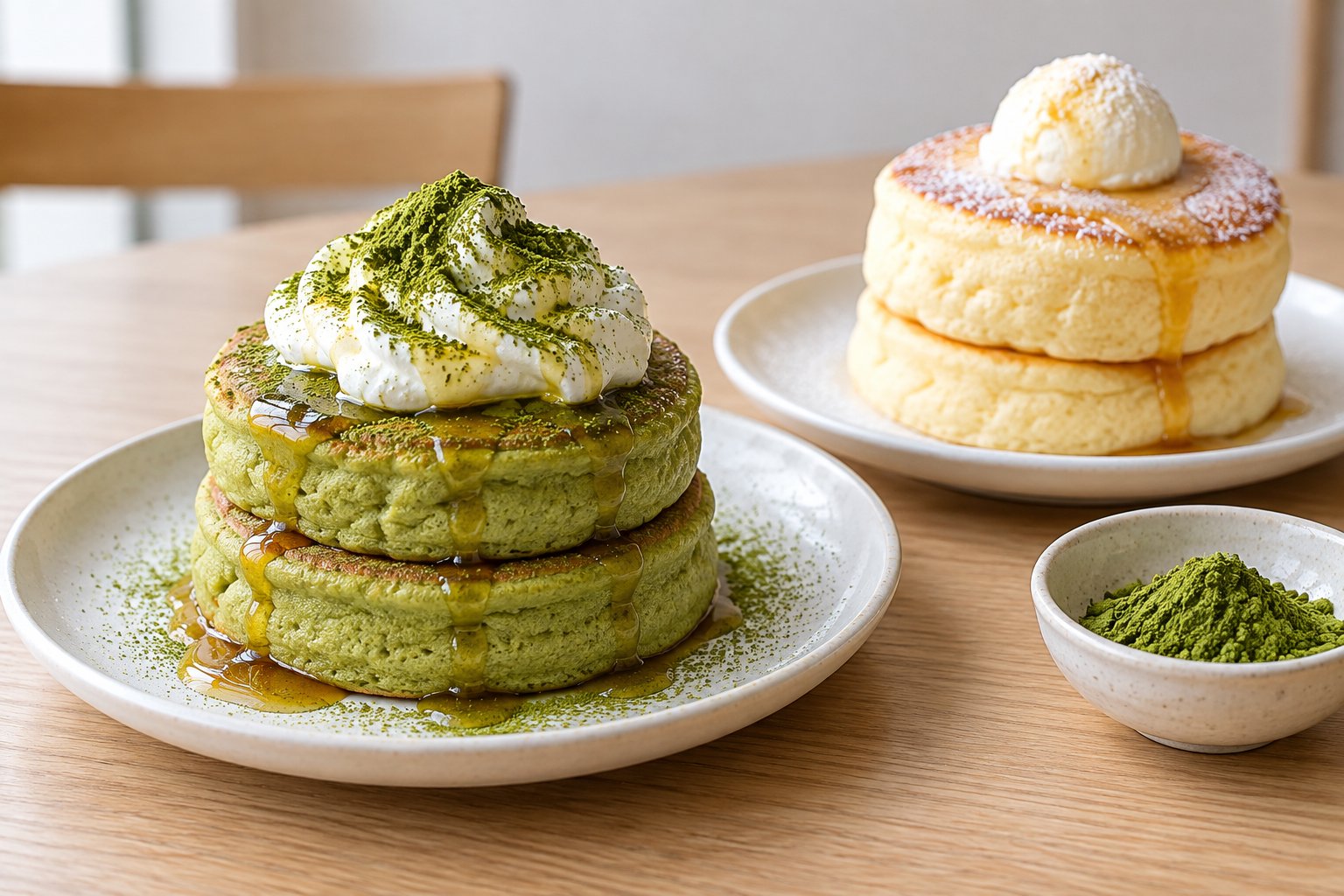
Matcha pancakes are an easy brunch or dessert item for a café that already serves matcha lattes. The amount of matcha varies widely between recipes, though, and the surface browns in the pan, which hides the green. We lined up the official recipes of Japanese pancake mix makers and tea companies and checked, in order, the amount of matcha, mixing, heat, soufflé pancakes, making ahead, toppings and matcha per pancake.
Three ways to make matcha pancakes
Matcha pancakes are made from flour, from pancake mix, or as soufflé pancakes raised with meringue. All three mix matcha into the batter. What differs is how they rise and how they are cooked.
How the three methods differ
| Method | What makes it rise | Official recipe examples |
|---|---|---|
| From flour | Baking powder added to flour | AIYA America (US matcha seller), Nio Teas (matcha seller) |
| From pancake mix | Baking powder already in the mix | Showa Sangyo, Morinaga, Nisshin Seifun Welna, Ito En |
| Soufflé | Meringue (whipped egg whites) | Morinaga (no matcha), Jade Leaf (US matcha seller) |
According to Showa Sangyo, a Japanese flour and pancake mix maker, pancake mix is cake flour combined with sugars, baking powder, starch, salt, fat, dairy, flavoring and so on. You do not have to weigh sugar or salt in the shop, so prep takes less work.
Choosing for a café
If you serve a set number every day, pancake mix (fewer ingredients to weigh in the shop) or a from-flour recipe with the dry ingredients weighed out in advance suits you. Tall soufflé pancakes are cooked to order and take time per pancake. How to cook them is covered in a later section.
Comparing the amount of matcha in official recipes
In official recipes, matcha ranged from about 0.8% to 15% of the pancake mix, and most were 4–5%. We calculated the ratio by dividing the weight of matcha by the weight of the mix.
Matcha as a share of mix or flour
| Source | Pancake | Matcha | Mix or flour | Matcha ratio | Cooking | Number |
|---|---|---|---|---|---|---|
| Ito En | Matcha pancakes (the matcha batter of three colored batters) | 1/4 teaspoon (about 0.6g) | 75g mix | about 0.8% | Both sides over low heat | Not stated (2 tablespoons each) |
| Morinaga | Kyoto matcha hotcakes | 3g | 75g mix (one 150g bag is split between matcha and hojicha batters, so we counted half) | 4% | Hot plate about 120°C, or low heat in a pan | 4 |
| Nisshin Seifun Welna | Matcha hotcakes | 1 tablespoon (about 7.5g) | 160g mix | about 4.7% | Low heat 2–3 minutes, flip, about 1 minute | 4 |
| Morinaga | Tamba black bean matcha hotcakes | 1 tablespoon (about 7.5g) | 150g mix | about 5% | Hot plate about 160°C, covered, low heat about 5 minutes | 10 (about 8cm wide) |
| Showa Sangyo | Matcha hotcakes | 20–30g | 200g mix | 10–15% | Low heat 3 to 3.5 minutes per side, hot plate 160–180°C | 4 |
| AIYA America | Matcha Pancakes | 1 tablespoon | 1 cup flour | By volume | Medium heat about 2 minutes, flip, about 1 minute | 10–12 |
| Nio Teas | Matcha Pancakes | 1 tablespoon | 1.5 cups all-purpose flour | By volume | Medium heat | Not stated |
| Jade Leaf | Fluffy Matcha Soufflé Pancakes | 2 tablespoons | 6 tablespoons cake flour | By volume | Covered, low heat 3–4 minutes | Not stated |
For grams per spoon, we followed Ito En, a Japanese tea company that writes 10g of matcha as “4 teaspoons” and 5g as “2 teaspoons” in its own recipes, and converted at 2.5g per teaspoon and 7.5g per tablespoon. The weight changes with a level or heaped spoon, so weigh it once in your shop. The English recipes give both flour and matcha by volume only, so we did not convert them to grams.
Source: Showa Sangyo, “抹茶のホットケーキ” (Matcha hotcakes, in Japanese) https://www.showa-sangyo.co.jp/recipe/list/article.html?pdid2=599
The range is about how strong you want the matcha
Showa Sangyo describes its recipe as having a rich matcha aroma, and uses about 2 to 4 times as much matcha as the 4–5% recipes. Ito En’s recipe bakes white, matcha and pink batters, and uses only 1/4 teaspoon of matcha. If you want the matcha flavor up front, start near Showa Sangyo; if you pair it with other toppings, start near 4–5%.
Comparing with other bakes
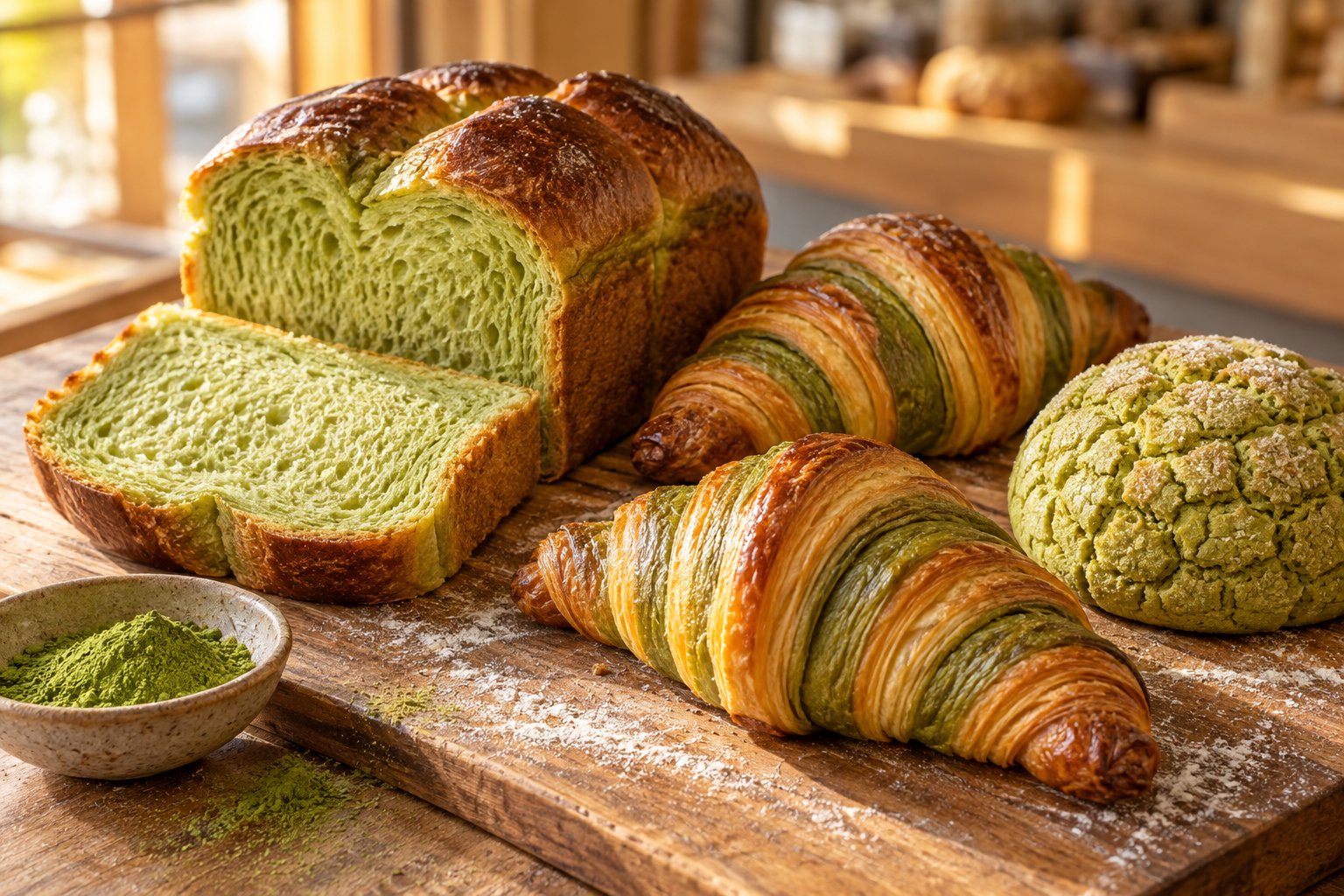
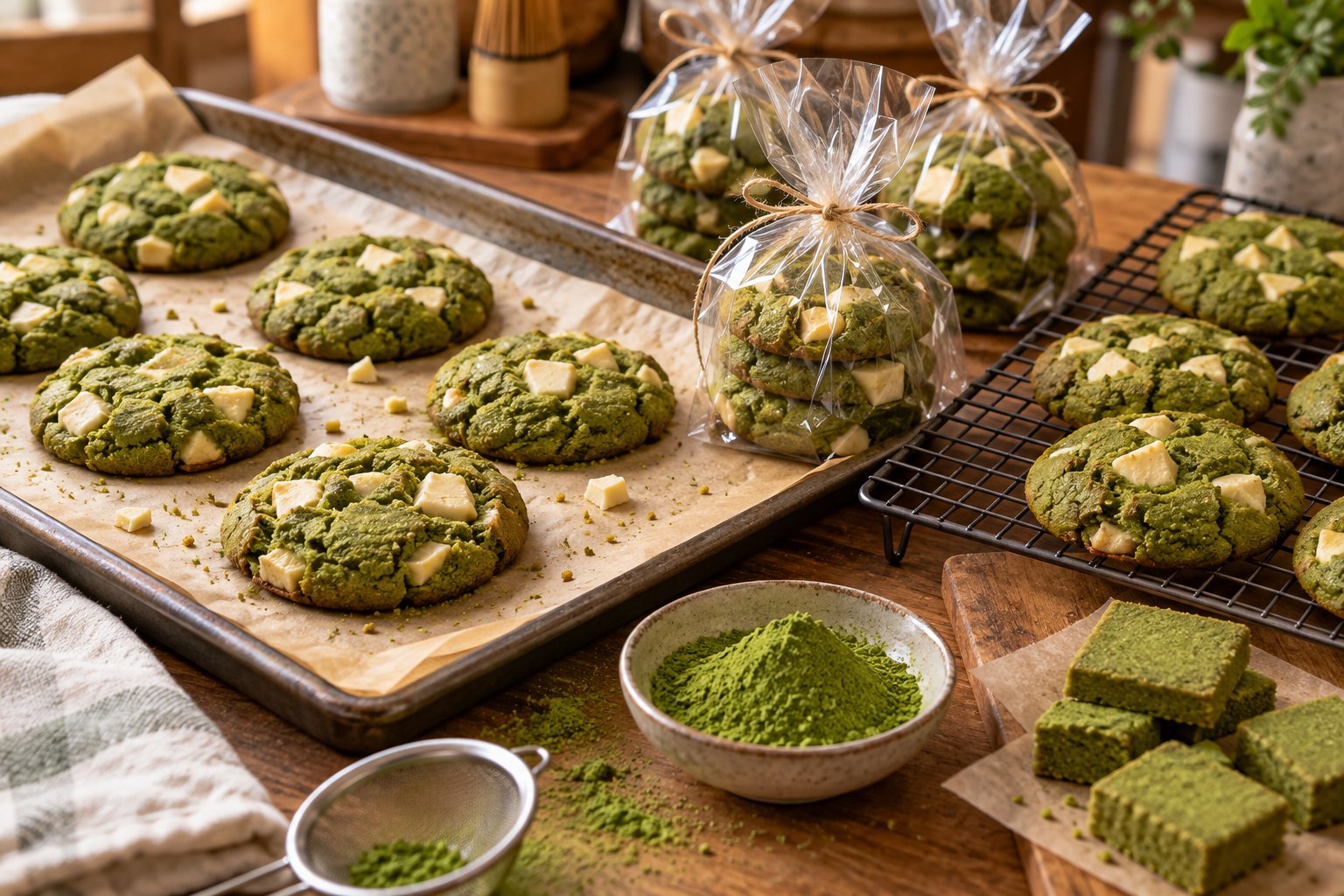
Compared the same way with official recipes, bread uses about 1–3% of the flour (Matcha bread and croissants), cookies about 2.7–12.5% (Matcha cookies for cafés), and Taiwanese castella and roll cakes about 7–17% (Matcha for baking). Most pancakes use more than bread and overlap with the low end of cookies.
Adding matcha and avoiding lumps
Official recipes add matcha in three ways: with the dry mix, dissolved in milk, or made into a paste with a little water. In every case, they avoid overmixing once the mix goes in.
Three ways to add matcha
| Method | Steps in official recipes |
|---|---|
| With the dry mix | Nisshin Seifun Welna adds the mix and matcha together to the beaten egg and milk. AIYA America and Nio Teas combine flour, baking powder and matcha first, and Nio Teas sifts them |
| Dissolved in milk | Showa Sangyo mixes matcha into the milk until dissolved, adds the egg, then the mix |
| Paste with water | Ito En makes a paste of matcha and 1 teaspoon of water, adds it to the egg and milk, and adds the mix last |
Making a paste with a little liquid first when adding to liquids, or sifting with the dry ingredients when adding to flour, is the same order covered in Matcha for baking.
Do not overmix once the mix is in
Showa Sangyo says to stir 25–30 times each way after adding the mix, 50–60 times in total. It explains that overmixing develops gluten (the stretch formed by wheat protein), so the pancakes rise less and are less soft. Nio Teas also says overmixing makes the pancakes dense, and that the batter should be slightly lumpy. Get rid of matcha lumps before the mix goes in, and once it is in, stir a set number of times and stop.
Why pancakes brown, and the heat to use
The side that touches the pan browns because of the sugars and dairy in the mix. To show the green, do not let the heat get too high, and show the color on the sides, the cut surface and matcha on top, which brown less.
Why the surface browns
Showa Sangyo explains that the sugars in pancake mix bake the pancake to a toasty golden brown. It also says dairy adds richness and flavor and gives an even color. With matcha in the batter, the side touching the pan still browns like a plain pancake. In the photo on Showa Sangyo’s recipe, the surface is golden brown and the green shows on the sides.
The green of matcha itself also changes with heat. When heat removes magnesium from chlorophyll, the green pigment, it turns olive. The mechanism and the research are in Matcha for baking.
Heat in official recipes
| Source | Heat or temperature | Time |
|---|---|---|
| Showa Sangyo (pancake guide) | Heat the pan over medium, cool it briefly on a damp cloth, then low heat. The right temperature is 160–180°C | Low heat about 3 minutes, flip, about 3 minutes |
| Nisshin Seifun Welna | Wait over low heat until fully hot | 2–3 minutes, flip, about 1 minute |
| Morinaga (black bean) | Hot plate about 160°C, covered, low heat | About 5 minutes |
| Morinaga (Kyoto matcha) | Hot plate about 120°C, or low heat in a pan | Not stated |
| AIYA America | Medium heat | About 2 minutes, flip, about 1 minute |
Showa Sangyo describes 160–180°C as the point where drops of water sizzle and evaporate somewhat slowly. It also says too much oil keeps the batter from touching the pan evenly, leaving a blotchy surface. Morinaga’s Kyoto matcha hotcakes, which bake a matcha batter and a hojicha (roasted green tea) batter separately, use a hot plate at about 120°C, lower than the other recipes. The recipe does not say why.
Ways to show the green (our suggestions)
- If you use a hot plate, cook one pancake at 120°C and one at 160°C and compare the surface color and how done the inside is before deciding
- Plate with the paler side up. When stacking, offset the pancakes so the green sides show
- Dust with matcha to finish. Morinaga’s recipe also dusts matcha after plating
How to cook soufflé pancakes
Soufflé pancakes fold stiffly whipped meringue into the batter and cook slowly, covered, over low heat. Cooking before the meringue bubbles collapse is what gives them height.
Morinaga’s method (with pancake mix)
Morinaga’s “Shunwari hotcakes (meringue)” makes 3 pancakes from 150g of mix, 3 eggs and 4 tablespoons of milk. It uses only 1 yolk and whips all 3 whites.
- Mix the yolk and milk, add the mix and stir lightly
- Whip the whites with a hand mixer into a stiff meringue
- Blend in 1/3 of the meringue with a whisk, then fold in the rest with a rubber spatula
- Heat the pan over medium, cool it on a damp cloth, then over low heat pour 1/3 of the batter all at once from a little height
- Cook over low heat about 3 minutes, flip when small bubbles appear, and cook about 2 minutes
Morinaga says not to overmix and to cook right after mixing, because the meringue collapses. It says cooking with a lid makes them even fluffier. This recipe has no matcha, so to add it, combine it with the mix in step 1.
Jade Leaf’s method (from flour)
Jade Leaf mixes the yolks with sugar, vanilla and baking powder, then adds sifted matcha, cake flour and milk. The whites are whipped with lemon juice and salt, the rest of the sugar is added gradually, and they are whipped to glossy, stiff peaks. The batter goes into greased pastry rings (bottomless round molds) at least 3 inches (about 7.6cm) wide and 1.5 inches (about 3.8cm) tall, is cooked covered over low heat for 3–4 minutes, and is flipped between two spatulas.
Jade Leaf uses 2 tablespoons of matcha to 6 tablespoons of cake flour, so by tablespoon the matcha is one third of the flour. That is more matcha than any other recipe in the earlier table, so in your shop, reset the amount as a share of the mix or flour and test bake.
Making batter ahead, and storing baked pancakes
Do not keep pancake mix batter. Cook it soon after making it. If you want a stock, the makers recommend cooking and then freezing.
Batter that sits rises less
According to Showa Sangyo, baking powder combines baking soda (alkaline) with acidic ingredients that react in the batter’s moisture and release carbon dioxide. Batter made with baking powder may rise poorly if left for a long time, so it says to use batter as soon as possible.
Source: Morinaga customer service, “ホットケーキを焼く前の生地(卵・牛乳を混ぜた状態)で冷蔵・冷凍保存できますか?” (Can hotcake batter, with egg and milk mixed in, be refrigerated or frozen before cooking?, in Japanese) https://www.morinaga.co.jp/faq/faq_detail.html?id=49
Morinaga’s Q&A says storing batter before cooking weakens the baking powder in the mix, so the pancakes may not rise well, and recommends freezing after cooking. Meringue bubbles also fade over time, so fold soufflé batter together just before cooking.
Freezing and reheating cooked pancakes
Morinaga says to cool cooked pancakes, wrap them in plastic wrap and freeze. At 20°C in an airtight container they thaw in about 2–3 hours. In a microwave, for pancakes the size of 3 made from 150g of mix, allow about 1 minute per pancake at 500W, or about 50 seconds at 600W. Heating too long at high wattage dries them out and makes them hard, and Morinaga says that reheating afterwards in a toaster oven or a pan over low heat gives a crisp outside.
What you can prep in the shop (our suggestions)
- Weigh the mix (or dry ingredients) and matcha for each batch into separate bags
- Keep the egg and milk separate, and combine them for each order or batch
- Matcha powder loses color with light and humidity, so keep the weighed bags out of the sun too (storage guide: Matcha shelf life)
Matcha cream, sauces and other toppings
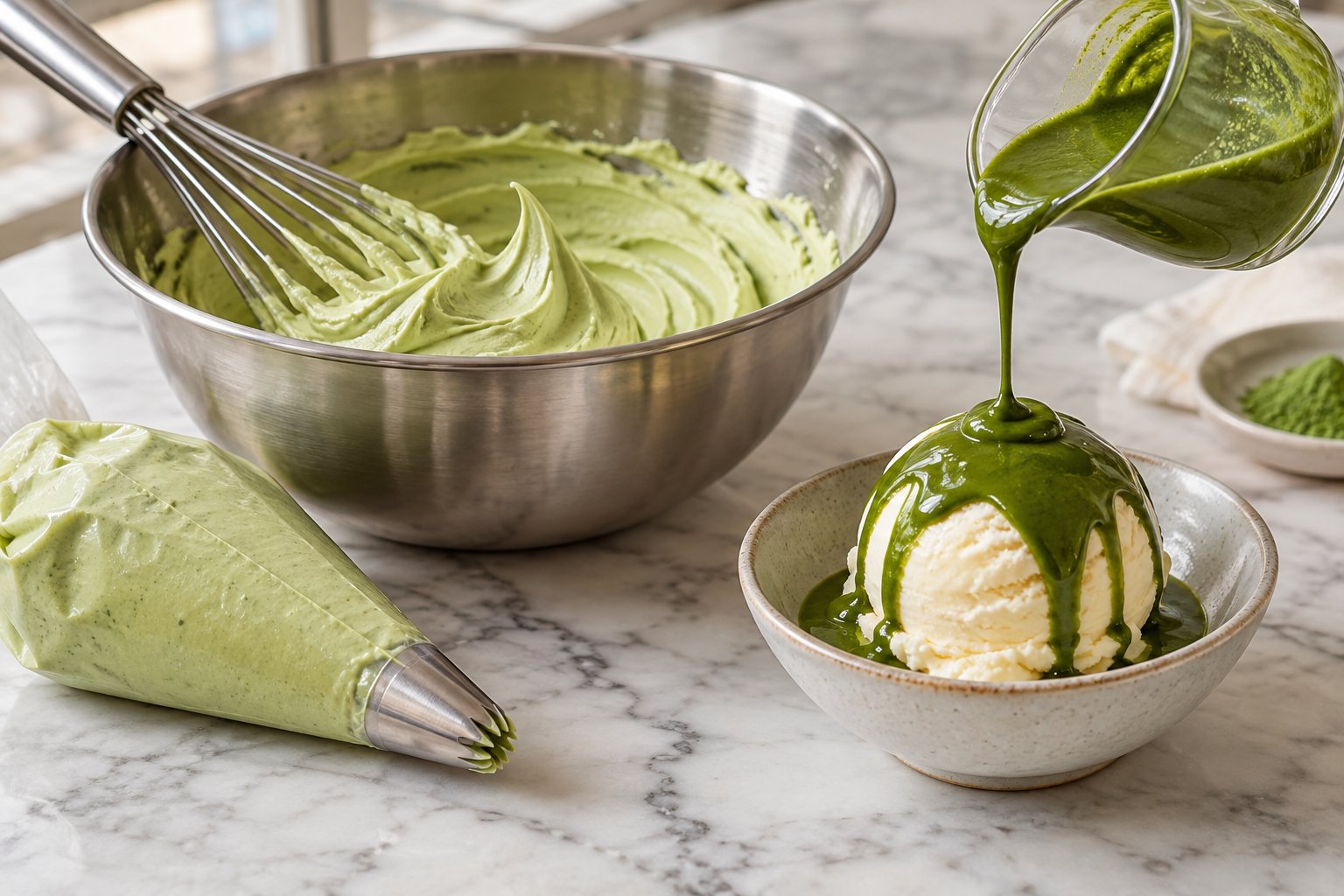
Matcha cream in official recipes was about 2.5–5% matcha to cream. Ito En first makes a paste of matcha, sugar and hot water, while Morinaga adds a small amount of matcha to the cream and sugar and whips it as is.
Matcha cream ratios
| Source | Matcha | Cream | Sugar | Matcha ratio (our calculation) |
|---|---|---|---|---|
| Morinaga (Kyoto matcha hotcakes) | 0.5g | 20g | 3g | 2.5% |
| Ito En (matcha whipped cream, supervised by pastry researcher Junko Fukuda) | 5g | 100ml (40% milk fat or more) | 20g granulated sugar | about 5% (counting 100ml as 100g) |
Ito En sifts the matcha, mixes it with the granulated sugar, makes a paste with 2 teaspoons of hot water, adds the cream gradually and whips it to 80% (soft but holding shape) with the bowl over ice water. Morinaga whips until peaks form and sandwiches it between pancakes. Steps to avoid overwhipping and splitting, and ratios for parfaits, are compared in Matcha parfait for cafés.
What the official recipes serve with them
| Source | Toppings |
|---|---|
| Showa Sangyo | Cream whipped to 80%, sweet azuki beans, seasonal fruit, chestnuts in syrup |
| Morinaga (Kyoto matcha) | Sweet bean paste and matcha or hojicha cream sandwiched between pancakes, dusted with powder |
| Morinaga (black bean) | Tamba black beans scattered on the poured batter and cooked |
| Nisshin Seifun Welna | Cream, kuromitsu (brown sugar syrup) |
| Jade Leaf | Butter, maple syrup, fruit |
| Nio Teas | Maple syrup, berries, whipped cream, sweet red bean paste, honey, a dusting of matcha |
For a matcha sauce, you can use matcha syrup made with sugar and matcha (Matcha syrup) or a sauce of matcha melted into white chocolate (Matcha chocolate).
Showing allergens
Matcha pancakes usually contain wheat, egg and milk (milk, butter, cream), and toppings may add nuts and more. The allergen lists for Singapore, Thailand and Indonesia are in Matcha cookies for cafés.
Matcha per pancake and matcha cost
The matcha cost of one pancake is “buying price per kg ÷ 1,000 × grams of matcha per pancake”. Grams per pancake is the matcha in one batch divided by the number of pancakes.
Matcha per pancake
Calculated from the official recipes (our calculation, at 7.5g per tablespoon):
| Source | Matcha per batch | Number | Matcha per pancake |
|---|---|---|---|
| Morinaga Kyoto matcha hotcakes (batter only) | 3g | 4 | 0.75g |
| Morinaga Tamba black bean matcha hotcakes | 1 tablespoon (about 7.5g) | 10 (about 8cm wide) | about 0.75g |
| Nisshin Seifun Welna matcha hotcakes | 1 tablespoon (about 7.5g) | 4 | about 1.9g |
| Showa Sangyo matcha hotcakes | 20–30g | 4 | 5–7.5g |
Showa Sangyo’s 5–7.5g per pancake is more than the 3g of matcha in one matcha latte from Ippodo Tea, a long-established Kyoto tea shop. If you use the same matcha as your lattes, one pancake may hold more matcha than one latte.
What to include in the cost
Add the matcha in the cream and the dusting to the matcha in the batter. Also include the mix or flour, eggs, dairy, toppings and failed pancakes. How matcha prices are set is covered in How matcha prices are set.
Choosing matcha for pancakes
Decide whether to use the same matcha as your lattes or a separate one by test baking your own recipe. The surface browns, so color differences show on the sides, the cut surface, and the cream or matcha on top.
What to check
- Whether it is 100% matcha. A matcha mix with sugar or milk powder will not give enough matcha at the recipe amount (how to tell: What is pure matcha?)
- How much goes into one pancake. In a high-matcha recipe like Showa Sangyo’s, the grade changes the cost per plate a lot (grade names: Matcha grades)
- Whether you can keep buying the same spec. A new lot can change the batter color
Test baking steps
- Bake the candidate matchas in your recipe with the same amount of matcha, at the same temperature for the same time
- Photograph the surface, sides and cut surface right after cooking and 10 minutes later, under the same light
- Taste for the balance of bitterness against the sweet toppings, and decide together with the matcha cost per pancake and the menu price
Omakase Matcha supplies matcha from Uji, Yame, Shizuoka, Kagoshima and Miyazaki, with orders from 1kg and up to 3 samples. Request matcha for test baking on Samples, and see the differences between regions on Origins.
Sources
- Showa Sangyo, “抹茶のホットケーキ” (Matcha hotcakes, in Japanese) https://www.showa-sangyo.co.jp/recipe/list/article.html?pdid2=599
- Showa Sangyo, “ホットケーキミックスとは?” (What is pancake mix?, in Japanese) https://www.showa-sangyo.co.jp/knowlege/hotcake/learn/
- Showa Sangyo, “みんな大好き おうちで、とびきりおいしいホットケーキを作りましょう!” (Make great hotcakes at home, in Japanese) https://www.showa-sangyo.co.jp/knowlege/hotcake/master/
- Morinaga, “京のお抹茶ホットケーキ・京のほうじ茶ホットケーキ” (Kyoto matcha and hojicha hotcakes, in Japanese) https://www.morinaga.co.jp/recipe/detail/1075
- Morinaga, “丹波の黒豆抹茶ホットケーキ” (Tamba black bean matcha hotcakes, in Japanese) https://www.morinaga.co.jp/recipe/detail/786
- Morinaga, “しゅんわりホットケーキ(メレンゲ)” (Fluffy meringue hotcakes, in Japanese) https://www.morinaga.co.jp/recipe/detail/934
- Morinaga customer service, “ホットケーキを焼く前の生地(卵・牛乳を混ぜた状態)で冷蔵・冷凍保存できますか?” (Can hotcake batter be refrigerated or frozen before cooking?, in Japanese) https://www.morinaga.co.jp/faq/faq_detail.html?id=49
- Nisshin Seifun Welna, “抹茶ホットケーキ” (Matcha hotcakes, in Japanese) https://www.nisshin-seifun-welna.com/index/recipe/detail/n-332.html
- Ito En, “抹茶パンケーキ” (Matcha pancakes, in Japanese) https://www.itoen.jp/recipe/39882/
- Ito En, “お菓子研究家 福田淳子氏監修!抹茶台湾カステラ” (Matcha Taiwanese castella, in Japanese) https://www.itoen.jp/recipe/45856/
- Ito En, “お菓子研究家 福田淳子氏監修!抹茶ホイップと小倉みかんのサンド” (Matcha whipped cream sandwich, in Japanese) https://www.itoen.jp/recipe/45852/
- AIYA America, “Pure Matcha. Naturally Delicious Recipes” https://aiya-america.com/content/Aiya%20America_Holiday%20Recipe%20Brochures.pdf
- Jade Leaf Matcha, “Fluffy Matcha Soufflé Pancakes” https://www.jadeleafmatcha.com/blogs/matcha-recipes/fluffy-matcha-souffle-pancakes
- Nio Teas, “Matcha Pancakes Recipe” https://nioteas.com/blogs/recette/crepes-au-matcha
- Ippodo Tea, “抹茶ラテ” (Matcha latte, in Japanese) https://www.ippodo-tea.co.jp/blogs/tea-recipe/19%E6%8A%B9%E8%8C%B6%E3%83%A9%E3%83%86