Reviewed by: Takahiro Sugiyama (CEO, meguri Inc.)
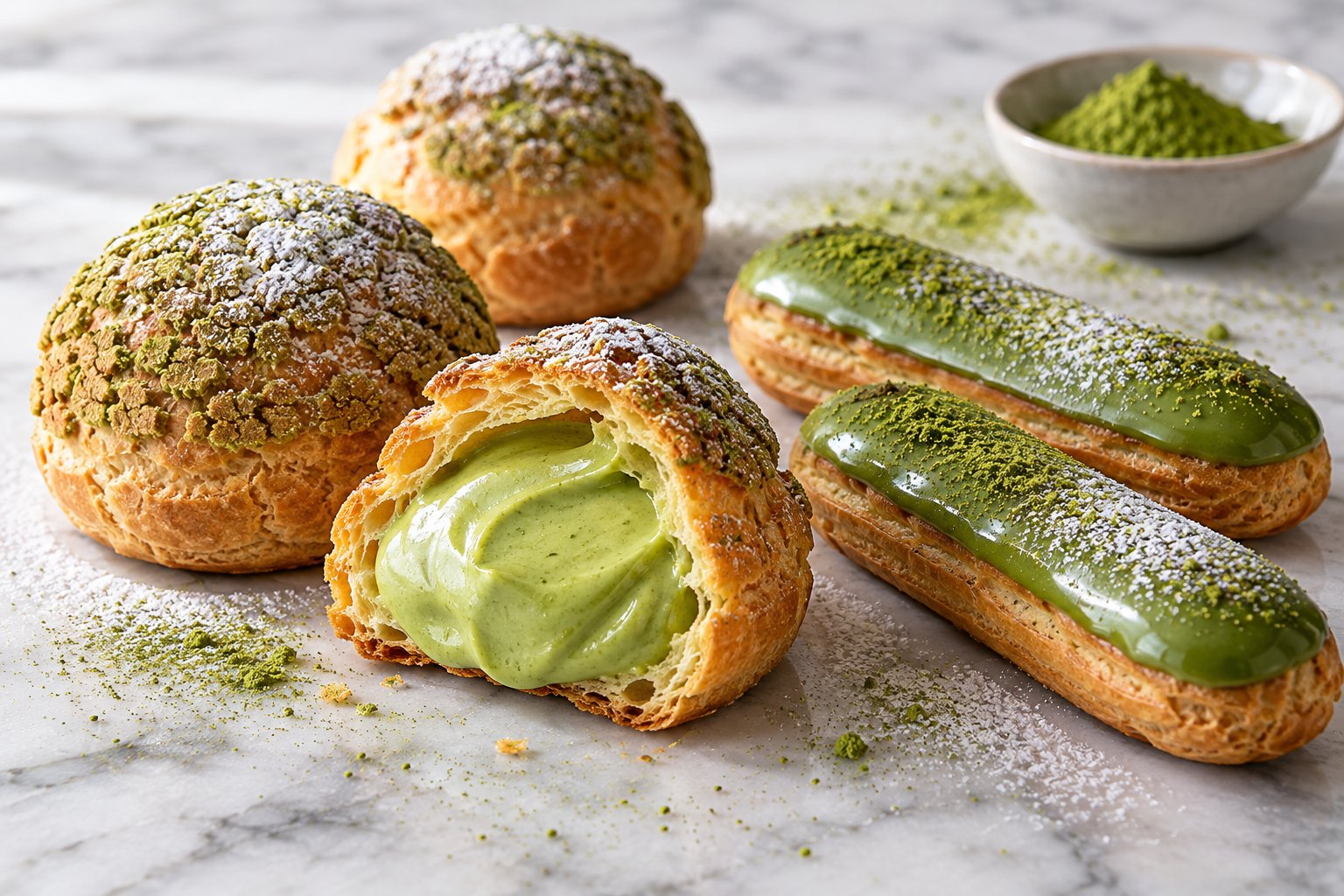
A matcha cream puff is a baked choux shell (a pastry baked so it is hollow inside) filled with matcha custard or matcha whipped cream. Some versions put matcha into the shell itself, some into a cookie layer baked on top (craquelin), and some are long éclairs with a matcha glaze. We put official recipes from tea companies, baking supply stores and a flour miller side by side, and look in turn at matcha amounts, why shells collapse, when to fill, storage standards and matcha per piece.
What is a matcha cream puff: four places to put matcha
A matcha cream puff changes in aroma and look depending on which of four places the matcha goes: the choux shell, the craquelin, the cream or the topping. Matcha in the baked parts is exposed to heat, while matcha in the unbaked parts keeps more of its aroma and colour.
How the four places differ
| Where the matcha goes | Result | Heat | Official recipe example |
|---|---|---|---|
| Choux shell | Green shell | Baked in the oven | Tomizawa Shoten “Bite-size matcha cream puffs” |
| Craquelin (a thin cookie dough placed on the choux and baked with it) | Matcha craquelin puff | Baked in the oven | AIYA America “Matcha Choux Au Craquelin” |
| Cream (custard, whipped cream) | Green filling | Custard is cooked. Whipped cream is not heated | Ito En “抹茶シュークリーム” |
| Topping (chocolate, glaze, dusting) | Matcha éclair, green-topped puff | Not heated | Tomizawa Shoten’s matcha coating, AIYA America’s matcha glaze |
According to Yamamasa Koyamaen, a Kyoto tea company, heating can dull matcha’s flavour or turn its colour reddish, and in baked goods the matcha aroma becomes harder to notice. One way to split it: cream for matcha aroma, topping for a visible green (our view).
Serving it in a shop
Yamamasa Koyamaen describes how the deli at The Westin Tokyo offered a matcha cream puff for a limited time: the chef gathered many types of matcha and chose the company’s “Ogurayama” because it went well with the flavour of the cream. In a cream puff, the matcha is chosen together with the cream it goes into.
Matcha amounts in official recipes
In official recipes, matcha was 8% of the flour in the choux shell, about 12.8% of the flour in the craquelin, and about 2.5% of the liquid in the cream. The ratios are our calculation, dividing the matcha weight by the weight of the ingredient in the table (1ml = 1g).
Comparison by place
| Source | Where | Matcha | Against | Matcha ratio |
|---|---|---|---|---|
| Tomizawa Shoten (Bite-size matcha cream puffs, about 25) | Choux shell | 4g | Cake flour 50g (water 80ml, butter 45g, whole egg about 125g) | 8% of flour |
| AIYA America (a US matcha seller; Matcha Choux Au Craquelin) | Craquelin | 6g | All-purpose flour 47g (butter 42g, brown sugar 50g) | About 12.8% of flour, about 4.1% of the whole craquelin |
| Ito En (matcha cream puffs, 10) | Cream (milk and cream cooked) | 2 tsp (about 5g) | Milk 100cc, cream 100cc | About 2.5% of the liquid (converted) |
| Tomizawa Shoten (Bite-size matcha cream puffs) | Topping (white coating chocolate) | 1.3g | Chocolate 60g | About 2.2% of the chocolate |
For Ito En’s teaspoons, we used 2.5g per teaspoon, since the company writes 5g of matcha as 2 teaspoons in another recipe.
Why the range is wide
Craquelin has a lot of butter and sugar and little flour, so the ratio to flour comes out high. Against the whole craquelin it is about 4.1%, lower than the 8% of flour in the choux shell. A recipe-by-recipe comparison of matcha whipped cream and matcha custard, including Ito En’s 2.5%, is in Matcha cream and sauces. Ratios for other doughs are in Matcha crepes, Matcha cake and Matcha cookies.
Matcha in the choux shell: rise and colour
When you put matcha in the shell, replace part of the flour so the total powder stays the same, and plan on the browning hiding much of the green. Aroma can be added in the unbaked parts.
Replacing part of the flour
We found no official matcha recipe tested side by side with the same shell without matcha. A useful reference is cocoa choux from the same baking supply store. Tomizawa Shoten’s “Basic cream puffs” use milk 50ml, water 50ml, butter 45g, cake flour 60g and about 100g of egg. The shell for its “Grown-up chocolate craquelin puffs” uses the same milk, water, butter and egg, with the flour split into 50g of cake flour and 10g of cocoa. When adding a powder, reduce the cake flour so the total stays the same (our comparison).
Neither matcha nor cocoa contains gluten (the wheat protein that forms the dough’s framework). The more matcha you add, the less wheat flour there is, so the rise may change (our view). A study on green tea powder and rise is covered in Matcha cake. In a shop, bake shells with 0%, 4% and 8% matcha under the same conditions and compare height and cross-section (our suggestion).
Browning and green
Tomizawa Shoten’s “Bite-size matcha cream puffs” bake at 180°C for 20 minutes, then once puffed and browned, at 150°C for about 10 minutes. Shells with matcha also brown, so they come out a brownish green. Cutting the baking time to keep the shell paler and greener leaves it undried, which makes it collapse as it cools (our view). If you want to show the colour, a matcha coating or glaze after baking is more reliable. Why heat changes matcha’s colour is explained in Matcha colour.
Matcha in craquelin
Tomizawa Shoten’s “Basic craquelin puffs” say that baking with a cookie layer on top makes the puffs rise evenly, so they look neat. AIYA America puts 6g of matcha into this cookie layer. Keeping the shell to its basic recipe and making only the craquelin matcha gives a green look without changing the shell’s rise (our view).
Why choux collapses or does not puff, and how to bake it
Choux puffs because the water in the dough turns to steam, and its shape sets as the egg and flour proteins firm up. Collapse and poor rise come from how long the dough is cooked in the pan, dough temperature, the amount of egg, and handling during and after baking.
How it puffs
According to King Arthur Baking (a US flour miller), the water in the dough turns to steam, which expands so the pastry doubles in size and becomes hollow. The egg and flour proteins then set the shape. Often the oven is turned down and the shells are pierced so the remaining steam can escape.
Causes and fixes by step
| Step | What happens | Fix in official recipes |
|---|---|---|
| Cooking the dough in the pan | Cooked too long, butter seeps out and too much water evaporates, giving a dough that rises poorly | Stop when a thin film forms on the pan bottom and the dough comes together (Tomizawa Shoten) |
| Adding egg | Dough that is too hot cooks the egg. Cold dough does not rise | Cool the dough to about 52°C (125°F) before adding egg (King Arthur Baking). Cold dough does not rise enough in the oven (Tomizawa Shoten) |
| Amount of egg | Too little and the dough breaks off | Dough that falls from the spatula in a smooth inverted triangle. How much egg it takes depends on how much water evaporated in the pan (Tomizawa Shoten) |
| Egg wash | Too much drips onto the tray and stops the rise | Do not overdo it (Tomizawa Shoten) |
| During baking | Opening the oven makes it collapse | Do not open it (Tomizawa Shoten, King Arthur Baking) |
| After baking | Steam stays inside | Cut a slit and return to the oven for 5 minutes (King Arthur Baking). Leave in the turned-off oven with the door slightly open for about 15 minutes (AIYA America) |
Source: Tomizawa Shoten, “抹茶のひとくちシュークリーム” (Bite-size matcha cream puffs, in Japanese) https://tomiz.com/recipe/pro/detail/20171004175505
A baking routine (our suggestion)
Most official recipes bake in two stages: high heat first, then lower. Tomizawa Shoten’s bite-size matcha puffs (3cm across) bake at 180°C for 20 minutes and 150°C for about 10 minutes, and King Arthur Baking at 425°F (about 218°C) for 15 minutes and 350°F (about 177°C) for 25 minutes. Ito En (about 3cm across) bakes in one stage at 200°C for 20–25 minutes.
- Pipe matcha and plain dough to the same size and bake them on the same tray in your shop’s oven
- As in Tomizawa Shoten’s “Basic cream puffs”, lower the temperature only after the cracks have browned too
- Break one open after baking. If the inside is damp, lengthen the time at the lower temperature next time
The filling: matcha custard, matcha whipped cream, diplomat cream
Cream puff fillings fall into three types: matcha custard, matcha whipped cream, and diplomat cream (custard folded with whipped cream). The amount of matcha can stay as in matcha cream recipes. What needs thought for choux is the texture and which part the matcha goes into.
How the three differ
| Cream | How it is made | Official recipe example |
|---|---|---|
| Matcha custard | Milk, sugar, flour and so on, cooked | Ito En uses no egg, cooks milk and cream with matcha, sugar and cake flour, and chills it in the refrigerator before filling |
| Matcha whipped cream | Cream whipped | See the comparison in the matcha cream article |
| Diplomat cream | Whipped cream folded into cold custard | AIYA America puts the matcha in the whipped cream (½ tbsp to 240mL of cream) and folds it into cooled custard |
Putting matcha in the whipped side rather than cooking it avoids losing aroma to heat (our view). How to mix matcha without lumps, how to cool custard and how plant-based whipping cream differs are in Matcha cream and sauces.
Texture for choux
Nakazawa Nyugyo (a Japanese cream maker) explains that cold custard for sandwiching or piping is mixed with a rubber spatula to keep its body, while for cream puffs it is mixed with a whisk to cut the body until it drips from the whisk. Tomizawa Shoten’s “Bite-size matcha cream puffs” use a skewer to make a hole in the bottom big enough for a piping tip and fill through it. If you fill from the bottom, make the cream soft enough to pass through the tip.
When to fill, and soggy shells
Bake shells ahead and fill just before serving: this is the common step in official recipes. The longer the cream sits in the shell, the more its moisture softens the shell.
Filling times in official recipes
| Source | Empty shells | After filling |
|---|---|---|
| King Arthur Baking (Cream Puffs and Éclairs) | Store lightly covered at room temperature. Splitting them and exposing the centres to air helps keep them from going soggy | Fill just before serving |
| King Arthur Baking (Easy Mini Puffs) | Freeze unbaked dough and use within one month | Fill within an hour of serving, otherwise they get soggy |
| AIYA America (Matcha Cream Puffs) | Airtight at room temperature for up to 3 days | Serve immediately |
| AIYA America (Matcha Rose Eclairs) | Best used within 24 hours. Empty shells keep up to 3 months frozen | Store airtight and eat within 24 hours |
AIYA America’s “Matcha Choux Au Craquelin” says filled puffs keep 2–3 days in the refrigerator, but this is a home recipe guideline. Set your shop’s number of days using the standards in the next section.
Keeping shells crisp
- Cut a slit or hole after baking to let the steam out (King Arthur Baking, AIYA America)
- Seal the shell with chocolate. AIYA America dips the shell bottoms in melted chocolate and lets it set before filling
- Time the filling to the order or the serving time
“Naki” on dusted matcha
AIYA America’s cream puffs are finished with a dusting of matcha. According to Yamamasa Koyamaen, matcha easily absorbs moisture and water, so matcha dusted on sweets can turn wet and lower the product’s value; this is called “naki” (literally “crying”). In a humid shop, dust matcha just before serving (our suggestion). Yamamasa Koyamaen also gives the example of a matcha cake fading after a long time under showcase lighting, so do not leave dusted or coated puffs on display for long.
Storage: a Japanese hygiene guide, and hot countries
Treat cream puffs as a sweet filled by hand after baking, and set and record the chilling temperature and time limit. A Japanese confectionery hygiene guide classifies choux as a “sweet with hand finishing after heating”, and cream puffs appear in its list of past food poisoning cases.
How the hygiene guide treats cream puffs
The “Guide to hygiene management plans for confectionery manufacturing incorporating the HACCP approach”, made by industry bodies including the All Nippon Kashi Association and checked by Japan’s Ministry of Health, Labour and Welfare, sorts sweets into five categories by how they are made (HACCP is a hygiene method that finds and controls hazards at each step). Choux is in Category 3: handwork comes after heating and cooling, and unheated ingredients are added at that point. As an example of heating for Western sweets in Category 3, the guide lists cream puffs at 200°C for 30–35 minutes.
| Category | Example | Heating example |
|---|---|---|
| Category 3 (hand finishing after heating), Western | Shortcake | 180°C, 16–20 minutes |
| Same | Cream puff | 200°C, 30–35 minutes |
| Hazard (core temperature) | Salmonella | Killed at 75°C for 1 minute or more |
Source: All Nippon Kashi Association and others, “HACCPの考え方を取り入れた菓子製造業における衛生管理計画作成の手引書” (Guide to hygiene management plans for confectionery manufacturing, checked by the Ministry of Health, Labour and Welfare, revised 4 June 2024, in Japanese), page 18 https://www.mhlw.go.jp/content/11130500/000478404.pdf
In the guide’s table of food poisoning cases (2000–2017), 8 cases had cream puffs as the cause: 7 Salmonella and 1 norovirus. The largest was in Kitakyushu, with 644 patients. The guide requires heating at 75°C for 1 minute or more when using shell eggs or unpasteurised yolks, and asks for particular care when using yolks in custard and other creams. It says heat-treated cream should be cooled immediately and kept in the refrigerator, and that refrigerator and chilled display case temperatures should be checked every day at the start and end of work. The cooked cream and the filling step matter more than the baked shell itself (our view).
Official standards
| Source | What it says |
|---|---|
| US FDA “Food Code 2026” | Food that needs temperature control is held at 5°C or below |
| Same | Refrigerated food made in the shop and held more than 24 hours: up to 7 days at 5°C or below, counting the day of preparation as Day 1, with a date mark |
| Same (when using time as the control) | Prepare written procedures; the food must be 5°C or below when taken out. Mark the time 4 hours later, and serve or discard it by then |
| Singapore Food Agency (SFA) “Guidelines for Ordering Catered Meals for Functions and Events” | Keep cold food below 5°C. Food should not be kept at room temperature for more than 4 hours from cooking (guidance for people ordering catering) |
The Food Code is a model that US states and local governments use when writing food hygiene rules. Check the rules of the country or city where your shop is. Storing matcha powder itself is covered in Matcha shelf life and storage.
Hot countries (our suggestion)
In hot, humid places such as Singapore and Thailand, cream temperature and soggy shells become problems at the same time. Some tea companies’ products are delivered frozen. Chayudo’s “抹茶しゅーくりーむ” (matcha cream puff) is frozen right after production, with a best-before of 1 month frozen from the production date and 3 days at 10°C or below after thawing. Kyoto Uji Yamasan’s “Uji matcha cream puffs” must be kept frozen, and should be eaten within 2 days in the refrigerator after thawing.
- Keep filled cream puffs in a showcase or refrigerator at 5°C or below
- If you display them out of refrigeration, follow the Food Code’s 4-hour rule: write the time out and the end time, and discard after that
- Keep empty shells airtight, and fill to the serving time
- For large batches, freeze unbaked dough or empty shells, and bake or fill only what you need that day
Matcha per piece and matcha cost
Across official recipes and tea companies’ products, one cream puff held about 0.2–2g of matcha. It varies widely with where the matcha goes and the size of the piece.
Matcha in one piece
| Source | Size | Where the matcha goes | Matcha per piece (our calculation) |
|---|---|---|---|
| Tomizawa Shoten (Bite-size matcha cream puffs) | Piped 3cm across, about 25 | Shell 4g + coating 1.3g | Shell about 0.16g + coating about 0.08g (matcha coating on two-thirds, about 17 of the 25) = about 0.24g |
| Ito En (matcha cream puffs) | Piped about 3cm across, 10 | Cream, 2 tsp (about 5g) | About 0.5g |
| Chayudo (matcha cream puff, product) | About 7cm across, about 4cm thick | Cream | 2g or more (Chayudo’s label) |
Chayudo describes 2g or more per piece as comparable to drinking one cup of matcha. The matcha in one latte is in How to make a hot matcha latte.
Working out matcha cost per piece
Matcha cost per piece = buying price per kg ÷ 1,000 × grams of matcha per piece. Add the matcha in the shell, cream and topping, plus leftover cream and the final dusting. How the price per kg is set is covered in How matcha prices are set.
Grade and test baking
Yamamasa Koyamaen recommends drinking grades for dusting and for cream, where matcha’s flavour shows. Its guide by use is covered in Choosing matcha for baking. Try a culinary grade for the baked shell and craquelin, and one grade higher for the unbaked cream and topping, then compare aroma and colour to decide whether to use two matchas (our suggestion). Grade differences are in Matcha grades, and white chocolate coatings in Matcha chocolate.
Omakase Matcha supplies matcha from Uji, Yame, Shizuoka, Kagoshima and Miyazaki, with orders from 1kg and up to 3 samples. To compare aroma and colour in your shell and cream, request matcha on Samples.
Sources
- Tomizawa Shoten, “抹茶のひとくちシュークリーム” (Bite-size matcha cream puffs, in Japanese) https://tomiz.com/recipe/pro/detail/20171004175505
- Tomizawa Shoten, “基本のシュークリーム” (Basic cream puffs, in Japanese) https://tomiz.com/recipe/pro/detail/20171002144616
- Tomizawa Shoten, “大人のショコラクッキーシュー” (Grown-up chocolate craquelin puffs, in Japanese) https://tomiz.com/recipe/pro/detail/20171006181329
- Tomizawa Shoten, “基本のクッキーシュー” (Basic craquelin puffs, in Japanese) https://tomiz.com/recipe/pro/detail/20220815171940
- Ito En, “抹茶シュークリーム” (Matcha cream puffs, in Japanese) https://www.itoen.jp/recipe/40001/
- Ito En, “お菓子研究家 福田淳子氏監修!抹茶ホイップと小倉みかんのサンド” (Matcha whipped cream and ogura mandarin sandwich, in Japanese) https://www.itoen.jp/recipe/45852/
- AIYA America, “Matcha Cream Puffs” https://aiya-america.com/matcha-cream-puffs/
- AIYA America, “Matcha Choux Au Craquelin” https://aiya-america.com/matcha-choux-au-craquelin/
- AIYA America, “Matcha Rose Eclairs” https://aiya-america.com/matcha-rose-eclairs/
- King Arthur Baking, “Pâte à choux perfected” (12 June 2018) https://www.kingarthurbaking.com/blog/2018/06/12/pate-a-choux-perfected
- King Arthur Baking, “Cream Puffs and Éclairs” https://www.kingarthurbaking.com/recipes/cream-puffs-and-eclairs-recipe
- King Arthur Baking, “Easy Mini Puffs” https://www.kingarthurbaking.com/recipes/easy-mini-puffs-recipe
- Nakazawa Nyugyo, “カスタード” (Custard, in Japanese) https://www.nakazawa.co.jp/chiebukuro/?mode=chiebukuro09
- Yamamasa Koyamaen, “抹茶の取扱い” (Handling matcha, in Japanese) https://www.yamamasa-koyamaen.co.jp/matcha/basic/handling.html
- Yamamasa Koyamaen, “加工用抹茶・他パウダー(業務用・製菓用)” (Matcha and powders for food processing, in Japanese) https://www.yamamasa-koyamaen.co.jp/product/for-processing.html
- Yamamasa Koyamaen, “Using Ogurayama in a popular cream puff of Westin Hotel Tokyo” (8 July 2019) https://www.yamamasa-koyamaen.co.jp/en/enjoy/2019/using-ogurayama-in-a-popular-cream-puff-of-westin-hotel-tokyo/
- Chayudo, “抹茶しゅーくりーむ” (Matcha cream puff, in Japanese) https://chayudo.co.jp/products/matcha-cream-puff
- Kyoto Uji Yamasan, “宇治抹茶 たっぷりシュークリーム(6個入)” (Uji matcha cream puffs, 6 pieces, in Japanese) https://www.kyotoyamasan.jp/products/11955
- All Nippon Kashi Association and others, “HACCPの考え方を取り入れた菓子製造業における衛生管理計画作成の手引書” (Guide to hygiene management plans for confectionery manufacturing, checked by the Ministry of Health, Labour and Welfare, revised 4 June 2024, in Japanese) https://www.mhlw.go.jp/content/11130500/000478404.pdf
- US Food and Drug Administration, “FDA Food Code 2026” §3-501.16, §3-501.17, §3-501.19 https://www.fda.gov/food/fda-food-code/food-code-2026
- Singapore Food Agency, “Guidelines for Ordering Catered Meals for Functions and Events” (updated 31 May 2019) https://sfa.gov.sg/docs/default-source/food-retail/guidelines-for-ordering-catered-meals-for-functions-and-events.pdf